

Introduction
The current fast development of air transport and its infrastructure is conducive to the systematic transformation of spatial development. Technical progress and the accessibility of airports has led to extending their development, gradually surrounding them with additional functions. Large airports have become key hubs in the global production and operation of economic systems, offering fast communication and connectivity. They have also become elements of regional economic development, attracting various types of economic activities and creating tourism. Ports and airport-related zones strengthen the competitive and marketing potential of cities and regions, stimulate their development and the efficient use of common resources. Following global experiences, a tendency to create airport-related areas around Polish airports can be observed. One example is Gdańsk Lech Wałęsa Airport.
The issue raised in this study concerns the interrelationships in the development of airports and the space in the immediate vicinity of these transportation hubs. The fast pace of change in the development of air transport, including aviation infrastructure and transformations of the spatial structure, make scientific research in this area insufficient. In addition, most airport-related areas, the so-called airport cities, have developed spontaneously and intuitively; only recently an awareness of this trend has been established and a theoretical background for it is starting to be developed. This paper presents the most important issues and premises for the targeted development of airport-related areas, with particular emphasis on the planned implementation of an airport city in the immediate vicinity of an airport.
Problems in the development of airport-related zones have appeared in the scientific literature for two decades (in countries where the airport city concept has found practical application), in addition to the interdependencies occurring in the development of airports and agglomerations and regions, primarily around various development and functioning models of these zones (airport city, aetropolis, airport corridor, airport region, aeria). The analyses relate to additional functions that are implemented around airports that are not only directly related to aviation services but also to industrial, logistics, distribution and special economic zone functions. As a consequence, as airport-related zones develop, they attract functions traditionally reserved for city centers. Therefore, comprehensive plans for the development of airport-related zones as multifunctional urban areas are emerging. Although airport cities have developed organically and spontaneously so far, they should now be carefully planned and designed (Kasarda, 2000). Intensive development of airport-related zones is also envisaged in Poland, although the amount of analysis in this regard is negligible so far. The reason for this is probably the lack of practical references and the modest scope of current theoretical research. There are some theoretical studies from experts in the field of air transport and more often architectural studies and airport city concepts that have been prepared for airports. Gdańsk Airport is an excellent example of the design and construction of an airport city, where a business district with residential functions is being built from scratch. As demonstrated on the basis of analysis of previously created airport districts, they are often considered a misconception of a city's spatial development. Therefore, there is a need for research on the coherent development of airport city districts in order to use the full potential of such areas. As shown by the examples of other similar projects in the world, good planning of the airport city district is a prerequisite for the success of the entire project.
The adopted structure of this study and the research methodology use were based mainly on literature studies and a critical review of the literature as well as on face-to-face interviews, onsite observation and analysis of feedback between an airport and the spatial development of an airport zone. This allowed for the formulation of the following research thesis: Dynamic growth in handling passenger air transport at airports and their impact on the development of cities and agglomerations forces detailed planning, preparation and construction of airport-related zones, a so-called airport city, also around regional airports (based on the experience of European and world airports and their airport-related zones). Detailed considerations about Gdańsk Airport provide an example of the application of a qualitative method in an individual case, confirmed by observation and in-depth interviews.
The City- and Region-forming Functions of an Airport
The core function of an airport is its transport function, fulfilled by providing air services to passengers (and their luggage), cargo and post. However, an airport is often also a transportation hub with a city- and region-forming nature, influencing the directions of spatial development as part of its structure. It affects the creation of a diverse space in both territorial and procedural terms. Separate urban areas of cities, agglomerations and metropolises, i.e. areas with compact, intensive buildings and high population density as well as spatial coherence due to transport and communication connections, are transformed (Rucińska et al., 2012). The region-forming function, on the other hand, is expressed by the supra-local range of connections between the airport and the non-urban area diversified in terms of a settlement network structure, population density or the development of centers. The range of regional markets for airports is determined by the offer of services, the network of connections, the time required to reach the airport and competitive airports, and above all, the transport accessibility of the airport, which determines the attractiveness of the hub, the immediate surroundings and the entire region. Therefore, the systems of linear and point facilities of the transport infrastructure are an important stimulus for the development of regional spatial structures (Rucińska and Ruciński, 2017).
It should be noted that both airports and spatial development structures are characterized by interdependent development goals resulting from the effectiveness of the use of urban, regional, social and economic potential. Airports attract investments, labor, modern transport solutions, increased mobility, etc. The attractiveness of cities where airports are located contributes to increased air transport and improved quality of their service. Thus, local and regional authorities who support initiatives of the development of an aviation infrastructure are interested in the further development of the airport.
The strength and scale of the impact that airports have on the development of cities and regions depends on the degree of activity and functioning of the air transport. Research results prove that airports have become 'centers' of local and regional growth, and their impact on the development and functioning of spatial structures has been variable in time and space. Over centuries, newly emerging branches of transport have caused an increased size of settlement regions and the range of influence of their central centers. In the post-war years, air transport was limited to strengthening the specialized function of cities as central hubs, mainly in areas of its most intensive development, which resulted from a relatively small amount of passenger air transport in the world, with a clear upward trend. The 1970s and 1980s were a period when interdependencies in air transport and the development of agglomerations intensified, however, the small amount of air transport was only conducive to the development of the world's largest cities (ICAO Digest of Statistics, 2017; data.worldbank.org). The graph below presents the development of passenger transport in air transport in the years from 1945 to 2018 (Figure 1).
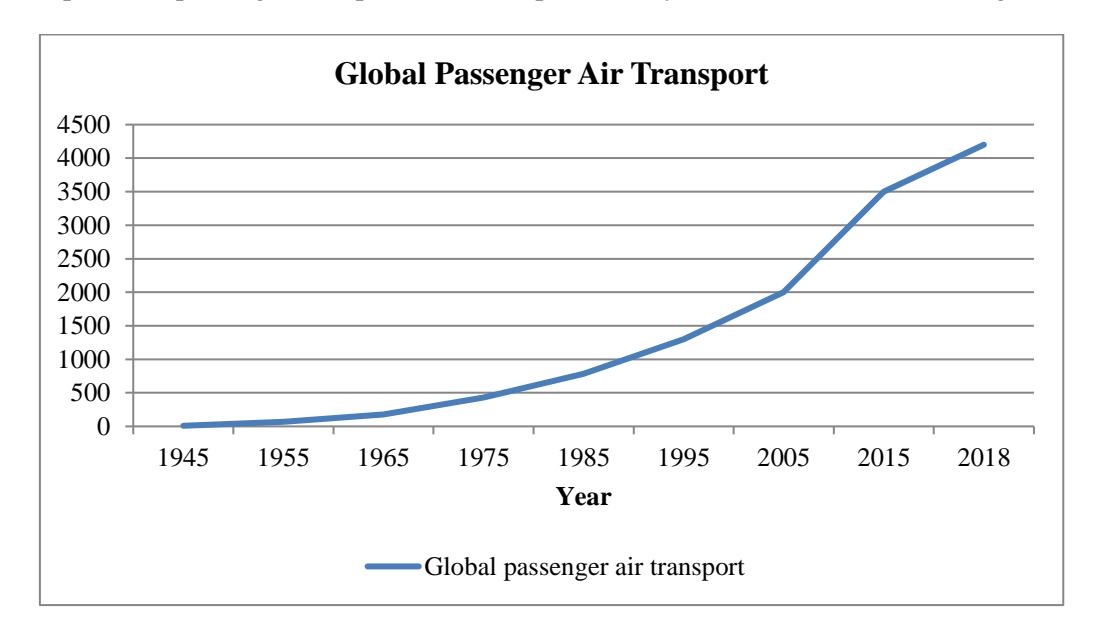
Figure 1. Global passenger air transport from 1945 to 2018 in millions of passengers. Source: ICAO Digest of Statistics 2017, International Civil Aviation Organization, Civil Aviation Statistics of the World and ICAO staff estimates, data.worldbank.org, accessed on 10.11.2019.
After 1970 there was a huge development of air transport, both quantitative and qualitative, measured by the number of passengers, cargo, new connections, services and airports. In 2015, global air passenger transport amounted to 3.5 billion passengers, while in 2018 the number of passengers had increased to 4.3 billion (www.icao.int). It should be added that IATA forecasts that in 2036 the number of passengers in air transport will increase to over 8 billion (www.iata.org, 2019).
The increased number of inhabitants, prosperity and impact of specialized functions of metropolitan areas, e.g. political, administrative, industrial, transport, commercial, and cultural agglomerations, has resulted in a quantitative and qualitative increase in demand and supply, which is expressed in transport demands regarding speed, capacity and transport capacity, range and appropriate transport conditions. In recent decades, air transport has satisfied all these demands to the highest degree. In the 1960s, 1970s and 1980s, the region-forming role of air transport was already noticeable with relatively low passenger service in air transport, around 100 to 200 million passengers per year. Subsequently, in order for airports to significantly
contribute to the development of urban agglomerations, it was necessary to multiply air transport and the number of passengers served. It should also be noted that labor and capitalintensive branches of the economy are associated with large cities and they also require a highly qualified workforce and a significant contribution of know-how. Usually, the final products of these activities are characterized by high susceptibility to air transport due to their high value, which has resulted in increased demand for cargo air transport, the construction of specialized fleets, terminals and logistics activities at airports. Around airports in the world, not only the largest ones, production complexes are set up, focused on handling and exporting final products by air, among others IT and electronics companies, production of parts and components for the automotive industry, logistics and forwarding companies providing services for their operation (Rucińska and Ruciński, 2017).
The development of the city-forming function of 21st century airports leads to increased numbers of workers at airports and in their production surroundings. According to the conducted research, for every million passengers served at European airports there are 2950 jobs on a national scale, 2000 jobs on a regional scale and 1425 jobs on a sub-regional scale (www.aci.areo, 2019). Tens of thousands of people who settle around ports find employment in the surroundings of the largest airports in the world, in America and Asia, creating new clusters of settlements (cities, districts, and housing estates) equipped with efficient transport, communication, and commercial networks, administrative, cultural, medical, and educational institutions, etc.
It is worth noting that the region- and city-forming functions of airports are often taken into account when creating the development strategies and promotional policies of cities and regions, which are jointly implemented by airlines and municipal and regional authorities. It should also be noted that airport catchment areas are increasingly becoming business, tourist and local goals. Airports are interested in the development and service of business needs and the vicinity of tourist reception places is conducive to improving the accessibility of destinations for air service customers, generating benefits for all participants (Rucińska and Ruciński, 2017).
The Airport City Concept in the Literature
The issue of spatial development, also around airports, is interdisciplinary. This topic is interesting for urban planners, architects, geographers, economists, sociologists and representatives of several technical sciences, and the number of publications in this area is significant. These issues also apply to representatives of central, local government and public administration centers.
Processes regarding the development of settlement, production and transport systems have been the subject of research by scientists in the 19th and 20th centuries. Researchers paid attention to market relationships between production and distance as well as issues related to the location of industrial cities and the cost of transport, labor or the development trends of cities based on the communication principle and issues of regional balance. The authors of current publications are representatives of various academic environments, research institutes, urban and architectural studios, and planning design companies. Noteworthy is a study on regional monitoring, an instrument supporting regional development policy (Czochański, 2013). A pioneer of research and publication on the interdependent development of air transport, cities and regions was an American sociologist W.F. Ogburn. He pointed to the potential importance of air transport for the development of the great and important interdependencies between these two elements of civilization (Ogburn, 1959). The issues of interrelationships between the development of air
transport and space management structures, including the impact of branch infrastructure on the development of metropolitan agglomerations and world cities, have been described in more detail by J.H. Schulze (Schulze, 1959).
The issue of the development of airport-related zones first appeared in the English literature at the beginning of the 21st century. The concept of the airport city was initiated in the USA (Kasarda, Lindsay, 2011) and the publications by American authors have since dominated the knowledge market in this area. In the last decade, however, more studies have appeared from authors and practitioners representing countries where the idea of developing airport cities has found practical implementation (China, Korea, Great Britain, Germany, the Netherlands). In Poland, the issue of the development of airport-related zones is new and relatively little attention has been paid to it in the literature. This is due to the lack of practical experience and the limited scope of theoretical research. Publications of academics at individual research centers in Warsaw, Gdańsk, Poznań (Stangel, 2014; Marciszewska, 2010; Wróbel, 2012, Ruciński, 2008) are available. Reports and projects of airport cities are also available that have been prepared for Polish airports by architects, engineers and urban planners for commercial purposes. However, it should be emphasized that this subject is becoming increasingly attractive in terms of research, as evidenced by scientific studies and recommendations for the effective development of airport-related zones.
The term airport city is currently very popular, but it can be understood in several different ways. It may mean commercial complex building development at an airport. The name airport city is used in this way in many places as a marketing term for airport-related investments, e.g. the Airport City Business Park in Belgrade. An airport city is also a business model in which the airport takes on the role of land developer or land and building developer, building a complex development on areas owned by the airport. It is an extension of the commercial activities of the airport as an enterprise through real estate development, often conducted by separate entities. In another meaning, an airport city implies urban space or certain features of the built-up area near an airport (Gierczak-Korzeniowska, 2017).
The airport city is a relatively young, emerging concept – an urban form. It is usually an international center for air passenger and freight transport with an urban character, built around an airport. The airport city consists of several cooperating parts: airport airside zones (runways, taxiways, aprons, passenger terminals, cargo hangars, etc.) and airport landside zones (partly terminals, garages, transport stops) as well as business complexes – conference rooms, hotels, and shops. Theme parks, entertainment centers, exhibition grounds, etc. are built in the immediate vicinity. Their functional structure consists of a set of logically connected and mutually strengthening elements. These are both functions and amenities typically aimed at travelers as well as functions aimed at satisfying the personal needs of guests (tourists and businessmen). It should be clearly emphasized that a city in general is multifunctional in its concept, but the main difference is that an airport city often has no residents and focuses primarily on business functions (www.zjakconsult.com). The best known airport cities in Europe, conceptually defined and consciously using this name, are Dusseldorf Airport City, Vienna Airport City, Zurich Airport City, and Frankfurt Airport City (Wróbel, 2012).
Among the many authors of scientific studies in the field of the airport city, John Kasarda and Greg Lindsay deserve special attention. They believe that the so-called aerotropolis is a new type of settlement that represents the logic of globalization, where the level of transport technology defines the city in an absolute way; transport always determines city shape and appearance. They believe that like in the 18th century cities were built around sea and river
ports, in the 19th century around railway stations and in the 20th century near highways, in the twenty-first century cities will be built around airports (www. bldgblog.com, 2019). Kasarda's main credit is that he noticed and paid attention to the phenomenon as a trend relatively early, which, if not noticed quickly, can cause many problems. Attempts at developing the area around an airport are still encountering one main obstacle, which is the lack of awareness that space for development is a limited good. Extensive use of land without plans that take into account the necessary infrastructure investments may result from a belief that an airport is a suburban area of a lower category and that the problems of city centers will never reach them. Airports have been incorrectly planned in many places around the world (Kasarda, 2010). In Poland, this was initially mainly due to systemic reasons and later to the underdevelopment of the technical and legal infrastructures. The airport was not considered a city-forming element.
The phenomenon discussed is related to the historical development of airports and their surroundings. Initially, airport-related zones developed organically when airports increased the number of functions performed and investments were made on the basis of a 'snowball effect'. Comprehensive plans for the development of airport-related zones as multifunctional urban areas are currently under development (Stangel, 2014). Such a model is widely used in airport planning in undeveloped areas, e.g. in Hong Kong or Dubai (Kasarda, 2010). The result of this process is a new urban-industrial structure, including industrial parks, logistics bases, and business centers, where the flow of people, goods and capital is concentrated and where contemporary urbanization processes in the global economy are focused (Stangel, 2014). It shows that airport-related zones are places where a synergy effect occurs that consists of multiplying benefits by combining different functions, directly or indirectly related to the airport. As Kasarda notes, with their development, airport-related zones attract new functions that are not directly related to aviation, but are associated with enterprises that are related to them. Therefore, airport-related zones also attract functions traditionally reserved for city centers, such as leisure, recreation, cultural or entertainment functions. M. and M. Guller make a division into three categories of economic activities in airport-related zones (Guller and Guller, 2001):
- 1. Main aviation activity the technical airport activity directly related to air transport service
- 2. Airport-related activity directly related to passenger and freight transport
- 3. Airport-focused activity
A reason for developing a modern airport city concept is maximizing revenues and diversification of strategies by airport managers as well as increased dependence on nonaviation revenues (Peneda, et al., 2010). According to Kasarda, four main elements influence the development of airport-related zones (Kasarda, 2010):
- 1. Companies dealing with air passenger and cargo transport services
- 2. Companies that often use air transport
- 3. Companies that satisfy additional needs of air passengers and employees of the two previous types of organizations
- 4. Companies that need well-connected investment areas and choose areas available in the vicinity of an airport although proximity to an airport is not essential.
The establishment of companies around an airport also has a direct impact on the number of jobs. Research shows that employment near airports grows faster than in suburban areas of the agglomeration where an airport is located (Kasarda, 2010). The airport city is a capital investment and is treated as a 'public good', therefore, careful planning, taking into account the previous experience of other airports to ensure the maximum value of their users, investors and the local population are increasingly important. When planning an airport city (or aerotropolis) it is also important to be aware of the direction of urban development and possible 'friendly' investments in the region (Kasarda and Appold, 2014).
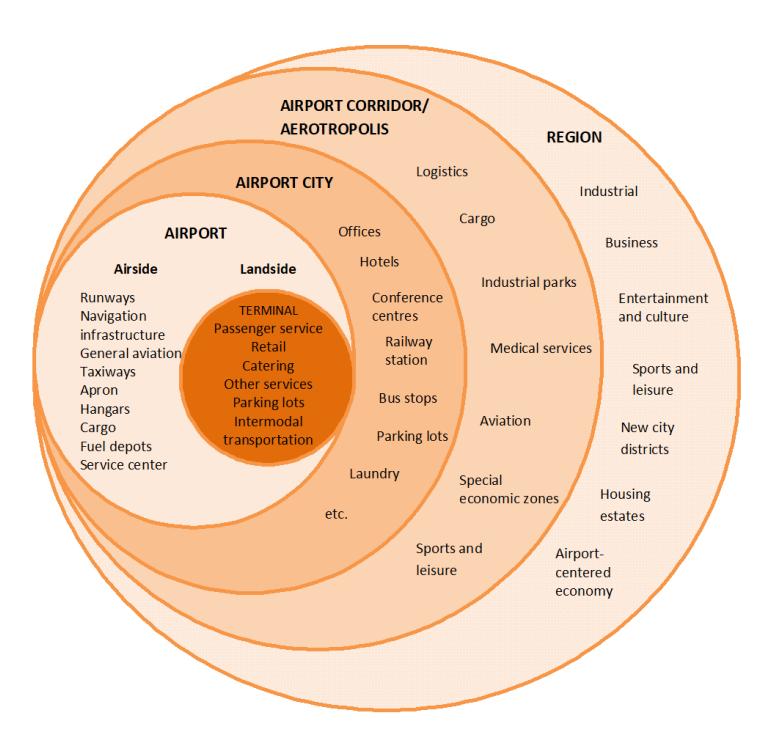
Figure 2. Diagram of the functional development of an airport and its surroundings. Source: M. Stangel, Airport City. Strefa okołolotniskowa jako zagadnienie urbanistyczne, Helion, Gliwice, 2014, pp. 38.
Thus, referring to the above discussion, an airport city covers the area around the airport, including the airport itself (runways, terminals), the elements of additional transport infrastructure (railway stations, tram and bus stops, and taxi stops) as well as business activities in its immediate vicinity. The airport city may be the center of a larger area around the airport, sometimes defined as an aerotropolis, especially in the USA, which means a vast urban form that is in some respects similar to a metropolis formed around an airport, which is the main driver of development for both the airport city and the aerotropolis. Business parks, technology parks and modern industrial and logistics centers are established within the aerotropolis, where companies related to air transport service are located first, then companies for which quick and efficient access to suppliers, customers or business partners possible only with the use of air transport is of key importance. Shopping centers, hotels and theme parks are also often built near airports. Thus, an aerotropolis is understood as a model for the further development of airport-related zones when new investments directly or indirectly related to the airport around the airport city appear. An aerotropolis consists of an airport complex, an airport city, transport corridors connecting them with the surroundings, and groups of buildings performing various functions located within a 30-km radius, such as companies related to the aviation industry, services for passengers and office complexes and even housing estates for airport employees or people who often fly planes (Stangel, 2014). Figure 2 shows a diagram of the functional
development of an airport and its surroundings. As can be seen, it is a new business model for the development of airport-related zones, which also includes the airport region in addition to the areas of commercial development in the immediate vicinity of the airport, airport cities, the aerotropolis, and the airport corridor.
The strength and importance of the airport city and aerotropolis can be demonstrated by the number of investments and their financial volume made by Asian countries (China, India), recognizing them as the most competitive tool in world trade in the 21st century. Currently, many airports in Asia and the Middle East are more modern, more attractive and more efficient than airports in Europe or the United States because these airports are treated as infrastructure assets that enable economic competition, rather than as a nuisance and environmental threat that must be controlled and reduced (Kasarda, 2011).
Among the scholarly literature, the work by Michał Stangel (Stangel, 2014) deserves attention. It is a pioneer among scientific publications on the Polish context, discussing the development of urban zones around airports. According to the author, airport areas are usually huge and often resemble anonymous, industrial buildings isolated from their metropolises. High investment outlays for the development of airport infrastructure in Poland prompted the author to look at the possibilities of targeted transformation of airport-related zones into a new type of intensively urbanized space. In his book, the author refers to the reflections of Kasarda and Appold and their classification. He also refers to the analysis of the Berlin urban planner Johanna Schlaak, who attempted to categorize the various models of airport-related zones in her doctoral dissertation in 2009, bringing to the fore the concept of airea, a kind of polycentric airportconurbation of industrial centers, office parks and service areas (Schlaack, 2010). The author looked at such zones in Europe and on this basis he tried to determine their development in Poland. He cites implementations and describes plans for areas accompanying the largest domestic airports of Warsaw, Krakow, Wrocław and Gdańsk. These considerations were based on investment plans, which, however, have not been implemented at any airport yet. The author proposed the urban planning of airport-related zones following the model of equal urban districts with their street layout, building quarters and green areas. He calls for 'the production of urban space' in place of the economic gain of advantage by easy access to an interchange point of global transport (Stangel, 2014).
Principles of Good Planning for Airport Cities
In the last decade, the concept of the airport city or the aerotropolis as a business model has been widely accepted around the world. It should be noted that there has been very little discussion on unsuccessful examples or how to obtain reliable results regarding the above investments. This means that they are usually successful and profitable projects in the long term. On the basis of the already constructed and implemented examples of the airport city concept, general principles conducive to the success of such an undertaking can be determined (Table 1).
A typical reason for implementing an airport city project for an airport is usually to increase non-aviation revenues. For municipalities, however, the fundamental reason is regional economic development. In-depth feasibility studies should show what is best suited to the airport and region in a given case, taking into account local conditions. Target markets, size, brand, function and design should differ from other airport cities if a unique, individualized and tailored strategy is developed.
Table 1. Principles of Good Planning for Airport Cities
| Principle | Description | |
|---|---|---|
| 1. | Strategic planning | Just like airports, which regularly implement plans and make updates, airport cities require a long-term strategic vision and planning; depending on the size and scale, a huge number of stakeholders from very different backgrounds and with different priorities should be involved; the goal is to develop a long-term master plan that will be supported by all stakeholders in favor of future lessees and will be attractive to investors; an accurate strategic plan also helps to gain the trust of financial institutions and support from within the organization. |
| 2. | Stakeholder management | Early and consistent stakeholder management is crucial, especially for spatially extensive projects; it is vitally important to gather all the groups involved at an early stage so that all problematic aspects can be identified in advance. |
| 3. | Detailed market research into demand | Acquiring specialized knowledge of regional economic development and urban planning is crucial to examine the preferences of potential lessees as well as to ensure and adapt the infrastructure being built to the needs of future lessees; research clearly shows that companies of different size and sectors have different needs in terms of location selection; a company's decision about location is a complex process and has changed in the globalized world; most often the idea of 'if you build it, they will come' does not pay. |
| 4. | Adaptation to air transport planning | An airport city must be strategically adapted to the airport itself; it is important to have a thorough understanding of future possibilities and limitations related to the development of routes to adapt them to the needs of companies to be located in the airport city; before allocating land for commercial development, one should also carefully examine whether the land will be needed for future air transport or other business functions that must be located near the airport. |
| 5. | Changing the local plan | It is a long-term process for many airports; sometimes convincing a local planning authority that commercial investment increases revenues from non-aviation activities can be a difficult or impossible process. |
| 6. | Integrated spatial development plan | It describes the future vision and use of space and ensures that the overall urban plan supports economic growth and regional well-being; a unanimous approach by stakeholders, such as the airport, spatial planning departments of all municipalities involved and the main transport providers in the region, is necessary to define the future vision. |
| 7. | Financial planning | The early start of a dialogue with financial institutions, investors, potential lessees helps to develop banking projects; a clear definition of the target market, return on investments and general strategic goals help to attract investors and companies. |
| 8. | Professional consultants | Qualified specialists have knowledge and experience in urban, economic, transport, infrastructure and real estate planning, and ensure systematic project management and project coordination. |
Source: own study based on M. Wiedemann, How to plan successful airport cities and aerotropolises, https://www.internationalairportreview.com/article/64259/wiedemann-airport-cities-aerotropolises/, accessed on 23.11.2019.
Reasons for the Development of an Airport City And Benefits for Users
The aviation market in Poland has very high development potential. According to forecasts of the Civil Aviation Authority (ULC), the number of passengers using Polish airports will increase from over 30 million in 2015 to about 50 million in 2020 and over 94 million in 2035, which would mean an increase of over 200% (www.ulc.gov.pl, 2019).
The increased number of passengers and the volume of goods transported by air are among the reasons why an increased number of companies that offer air transport-related services as well as companies that often use this type of transport decide to locate their activities near airports. This location is also beneficial for businesses engaged in commercial activities and companies providing services for travelers. Expanding their commercial and service offer, airports generate a very important alternative source of revenue, which allows them to further develop and increase their competitiveness in competition with other airports. Real estate is an increasingly important source of airport revenues and its importance for airports may soon be greater than revenues from aviation activities. The spectacular increase in the supply of retail space within airport terminals is the most visible part of this trend. Research shows that for every 1000 passengers there is an average of 0.7 m2of commercial space at airports, which generates 3 to 4 times higher revenue per m2 compared to local shopping centers. Real estate revenues account for around 40% of global airport revenues. In Europe, this share is slightly lower and amounts to approximately 30% (Kasarda, 2010).
Significant investments in communication infrastructure, in the form of building new road or rail connections, which allow convenient access to airports and surrounding areas, are aimed at providing airports with conditions for appropriate development. They thus enable airport-related locations to increase their attractiveness as business or commercial clusters for business. The intensification of these processes affects the development of urban forms that emerge around airports, such as an airport city or an aerotropolis (www.egospodarka.pl, 2019).
In addition to the benefits for airports, the implementation of commercial development projects in the form of individual facilities, parks or entire business districts near airports brings measurable benefits to developers involved in these projects. Lessees also benefit from locating their activities near airports. The most important benefits include (www.dtz.com, 2019):
- 1. A developed transport infrastructure (road, rail, air transport) creating convenient travel options to the workplace from various parts of the city.
- 2. Proximity to the airport saving time, especially for entities who often use air transport or aviation-related entities.
- 3. Access to a developed hotel base competition between numerous hotel facilities located in the vicinity of airports influences the attractiveness of their offers to customers.
- 4. Availability of parking spaces a much higher ratio of number of parking spaces to leased space compared to locations in city centers/metropolises.
- 5. A friendly business environment lower buildings (due to top-down height restrictions associated with flying zones) located in a surrounding of green areas, which have a positive impact on employees.
- 6. Lower business costs compared to central locations (e.g. rent, service charges, hotels, restaurants, etc.).
- 7. A large number of potential customers (passengers and people working at the airport and its surroundings) – a large market for commercial and service companies.
- 8. Availability of commercial and service outlets of different specificity.
- 9. A synergy effect benefits resulting from the mutual support of various commercial functions located within the airport city.
Significant benefits resulting from the location of economic activity in the vicinity of airports make any difficulties associated with these locations (e.g. aircraft noise, difficulties in getting to the city center) not so much noticeable by lessees. It can therefore be concluded that areas around important and dynamically developing airports can be a good place for business development.
In Warsaw, due to restrictions on the development of Chopin Airport related to the location of the airport within the city, the chances of an aerotropolis are very small. It is more realistic to build an airport city in the immediate vicinity of the passenger terminal at Chopin Airport, on an area of 22.5 ha belonging to the 'Polish Airports' state enterprise. A large commercial project can also be implemented along 17 Stycznia Street on an area of 10.6 ha of land. The presence of an airport is a factor conducive to commercial investments also farther away from the airport. The convenient access to the airport in Warsaw is an undoubted advantage of the location in Służewiec Przemysłowy, which in recent years has transformed into the capital's main business center. Office buildings emerging in this part of the city offer a high standard, with average rent rates 1/3 lower than the current rent rates in the central part of the city (www.egospodarka.pl, 2019).
Commercial real estate is also located around regional airports. An example of such a project is BCB Business Park, a modern business park being built at the new terminal of Lech Wałęsa Airport in Gdańsk. The building complex, constructed on 11 ha, will eventually include seven office buildings with an area of over 45,000 m2 , a conference and exhibition center, a service and shopping center, and a four-star hotel. The comprehensiveness and location in the immediate vicinity of the international airport are undoubted advantages of this project (www.dtz.pl, 2019).
Further commercial investments should be expected in the vicinity of airports together with the further growth of the aviation market in Poland and the development of the infrastructure necessary to operate them. The advantages of locations near airports should contribute to the fact that in Warsaw, Tri-City and other regional cities business districts or the beginnings of an airport city will develop, similar to those operating abroad (e.g. Amsterdam Schiphol, Frankfurt International Airport).
The Example of the Airport City at Gdańsk Airport as a Modern Urban Project
The Airport City project at the Gdańsk Airport is unique. This is the first undertaking of its kind in the country. Until now, plans to build a similar complex of office buildings, hotels or multistorey car parks and service areas have been discussed only in the context of Fryderyk Chopin Airport in Warsaw, but they have never been implemented. There is no comparable regional airport in Europe that services 5 million passengers a year, which has decided to implement such a huge undertaking, which is to last several years and costs PLN 1 billion (Gdańsk Airport, 2019). Similar 'airport districts' have been built only in Western Europe, for example facilities at the airports in Düsseldorf, Munich, Frankfurt, Paris and Manchester. However, it should be noted that all these ports are several times larger than the Gdańsk Airport and serve 20 to 50 million passengers annually (Korolczuk, 2019). Airport authorities in Gdańsk want to create another office area within the airport, supported by the investments previously created there (e.g. Intel office park or BCB Business Park). It is designed to be a new business and service center in Tri-City, environmentally friendly and with unique architecture.
The Gdańsk Airport serves one of the strongest metropolitan regions in Poland and Europe. The rich network of flight connections and multimodality of this place offer excellent transport possibilities, not only for Tri-City but for the whole of Pomerania.
In its assumption, Airport City Gdańsk (ACG) is designed to be a modern airport city located next to Lech Wałęsa Gdańsk Airport, from which 81 connections to 21 countries were offered in 2019, in the immediate vicinity of the Pomeranian Metropolitan Railway stop (which will allow access to the building complex from various corners of Tri-City and Kashubia) and the Tri-City Beltway and the nearby entry to the A1 highway, with close access to public transport, bicycle routes and services. The project envisages the construction of a complex of office and service buildings with related facilities in the area, adjacent directly to Gdańsk Lech Wałęsa Airport. The names of the office buildings will refer to the aviation alphabet: Alpha, Bravo, Charlie, Delta, Echo, Foxtrot, Golf and Hotel. The Airport City will offer approximately 120,000 m2 of usable floor space and approximately 100,000 m2 of rentable space. In the first stage of the project, the six-storey Alpha office building with a leasable area of 8,500 m2 and a car park for about 200 cars will be built. Construction began in 2019 and the facility is to be ready at the turn of the second and third quarters of 2021. In the subsequent, second stage, the Bravo facility will be twice as large (with a usable area of 16,500 m2with 381 parking spaces). The Bravo construction schedule and commissioning date will depend on the market success of the Alpha
facility. Ultimately, seven buildings are going to be built, depending on the demand reported by the market and potential lessees (Gdańsk Airport, 2019). A visualization of the development of the space around Gdańsk Airport is presented below (Figure 3).
Figure 3. Visualization of the airport city at Gdańsk Lech Wałęsa Airport. Source: http://business-park.bcb.com.pl/, 20.11.2019.
The investment will provide space for offices, services, catering and a hotel. As part of the ACG project, cubature facilities, external roads with the necessary engineering facilities will be built, serving the area of ACG and Gdańsk Airport, a system of internal roads, squares, pavements and bike lanes, utilities supply networks and drainage of sewage and rainwater, land development facilities and street furniture (Airport City Gdańsk, 2019). The airport city buildings will have an intelligent management system and 24-hour security. They will also be energy-saving and fully adapted for use by people with disabilities. The building complex will include parking lots for bicycles, charging stations for electric vehicles and bicycles, there will also be a sports and leisure area. The airport intends to design thematic culture, recreation, gastronomy and shopping paths in cooperation with Pomeranian universities and NGOs (Dzwonnik, 2019).
Moreover, urban greenery development is included in the investment. The land development project is based on the idea of creating a unique space for users, both at work and in leisure time. An important element is also the aspect of ecological use of the environment. A large part of the external area will cover diverse flora, which will strengthen the existing biodiversity of the area and ensure its ecological balance. The roofs of the buildings will have green terraces available to the building complex lessees, with a view of the airport. An interesting and innovative solution will be a garden that creates the possibility of growing plants by office employees and local restaurants.
The ACG investment was planned in accordance with prevailing trends, taking into account the needs of building users and respecting the natural environment. The focal point of the investment area is going to be a multifunctional square, giving the opportunity to spend free
time. A recreational alley will be built with a sports section along the whole building complex, which will become an element joining subsequent stages of the investment. The project will also include street furniture to promote the relaxation of building users and outdoor lighting will be designed with respect for users of adjacent plots (Materiały, 2019). The energy efficiency of the investment will be supported by a Leed Gold Certificate, which can be achieved by using practical solutions in the field of design, construction and operation in a manner consistent with sustainable development (www.airportcitygdansk.pl, 2019).
Thus, the green solutions of this project will include (Airport City Gdańsk, 2019):
- 1. Energy-saving architectural and installation solutions
- 2. Facilities for cyclists
- 3. An electric vehicle charging station
- 4. Green roofs
- 5. Functional and biodiverse development of outdoor areas
- 6. Rainwater recovery for maintaining green areas
- 7. A garden for growing plants
- 8. A rich sport zone
- 9. A LEED Gold certificate building life analysis showing the reduction of carbon dioxide emissions, analysis with dynamic modeling showing access to daylight inside the building, the possibility of lessee office certification.
Airport City Gdańsk will aspire to be a perfect place for global business locations and the proximity to the airport will allow it to connect directly with other companies and offices around the world. It is expected to be a great place for local companies that appreciate the convenient access and high quality of office spaces. This project is in line with the idea of creating objects with harmonious architecture, which gives the possibility of an optimal division of office space and a minimalist and consistent design of buildings that refers to the aesthetics associated with aviation.
To sum up, the specific distinguishing features of the ACG project primarily include (Airport City Gdańsk, 2019):
- 1. Direct vicinity of the Gdańsk Airport
- 2. An alternative location for the crowded city center
- 3. Direct access to the Pomeranian Metropolitan Railway stop
- 4. Excellent public transport connections
- 5. Proximity to the Tri-City Beltway and the A1 motorway
- 6. High availability of parking spaces
- 7. Three-meter floor height and flexibility of space division
- 8. Securing the possibility of expansion of lessees within the building complex
- 9. LEED certification
- 10. Facilities for cyclists
The investor of Airport City Gdańsk is the Gdańsk Airport company. The investment should enable the company to diversify its revenues so that in a dozen or so years they constitute a significant part of their activity and complement revenues from airport and non-airport activities. The company's assets will also increase in this way. The construction of Airport City Gdańsk will be financed not only with the company's own funds, but also from the issue of bonds by Bank Pekao S.A. (interview, 2019).
Partners in the implementation of the Airport City Gdańsk project include (Airport City Gdańsk, 2019):
- 1. ARUP authors of the report entitled Analysis of the Possibilities of Developing Real Estate Located in the Vicinity of Gdańsk Airport – Airport City Gdańsk;
- 2. Cushman & Wakefield authors of the report entitled Analysis of the Commercial Real Estate Market in Tri-City,
- 3. PIG author of the construction and tender project of Alpha stage I and Bravo stage II; Warsaw planning and design company responsible for the concept of Airport City Gdańsk together with project documentation that has implemented, among others, the project of the Kolonia Sielce Office Warsaw office building, the Dowborczyki Łódź office building, the concepts of the Andreasstrasse Ostbanhof Berlin office buildings, Berlin an der Urania Berlin, Jerozolimskie Business Park and the Poznań Office Center building complex; in addition, they are also the author of the extension of the T2 terminal at the Gdańsk Airport and the Krakow airport, the construction of the Józef Piłsudski Museum in Sulejówek and football stadiums in Olsztyn and Chorzów;
- 4. JLL a technical consultant at the stage of project concept development and a project commercialization agent; this is a leading consulting company that provides comprehensive real estate services (a Fortune 500 company, employs approximately 91,000 people, serves clients in 80 countries in 300 branches around the world); JLL is a brand and registered trademark of Jones Lang LaSalle Incorporated;
- 5. Bank Pekao the bank financing the project.
Gdańsk Airport is often the first place businessmen and international investors have contact with. The creation of Airport City Gdańsk will be a natural consequence and source of region and airport development, in line with global business and urban trends. The location near the airport infrastructure and very good road and rail connections with all the cities of the region will ensure a well-communicated work environment and convenient, time-saving access.
Conclusion
Together with the dynamic development of air transport and infrastructure, the importance of the surroundings of airports as business locations is growing. Recognizing this global trend, many studies and reports on the subject of business parks emerging at airports and airport cities have been prepared. These are places where the flow of people, goods and capital is concentrated, on which contemporary urbanization processes in the global economy focus.
Within airport cities, mainly functions related to the operation of the airport are located, such as hotels and trade, which are strongly dependent on, although not completely beholden to the functioning of the airport. In a larger area around the airport, on the other hand, activities using the infrastructure, image and indirect economic impact of the airport on the region are developing. Regardless of the terminology used, the scale of the phenomenon presented is increasing; it consists of the emergence of individual business parks or entire areas focusing various activities and functions. These projects are often implemented in cooperation with public and private partners. It should be noted that in the case of new airports, emerging from scratch, such as airports in Hong Kong or Dubai, the airport city/aerotropolis model is taken into account in the planning stage.
The case study of Gdańsk Airport and the development of its airport-related zone shows a clear trend of using the airport city model implemented at other airports in the world. In recent years, several modern companies, office buildings, hotel facilities, and parking lots have been located in the vicinity of rapidly developing airports, fulfilling their transport functions. In addition, the communication system has been developed in connection with the A1 motorway. A courier terminal for DHL has been built, the BCB Baltic Business Center operates in the immediate vicinity of the passenger terminal, and the dynamic development of the residential function is planned, which is related to the residents' activity within the scope of the needs of the airport and the new environment, which is the implementation of Airport City Gdańsk by the airport manager. Location conditions at Gdańsk Airport are conducive to its development and strengthen its interdependence with the surrounding space.
This research showed that the concepts of the airport city and the aerotropolis are new business models for airports, in which real estate projects at or near airports help increase revenues from non-aviation activities and sometimes develop the airport as an independent destination. The use of such a business model at a regional airport with high development potential can lead to rapid economic growth of the region around the airport. However, when planning the expansion of the space around an airport, special attention should be paid to the strategic vision of future development. Usually, the overall airport city plan goes beyond airport planning and must take into account economic development, urban planning and transport throughout the region, as interdependencies and relationships between an airport and a metropolis or region are mutual and strongly correlated. This can be a challenge for airport staff and airport management.
Numerous airports use external financing, thus the key is to prepare a sound strategy for the project. The main challenge related to developing a solid plan is to achieve a strategy that is supported by all stakeholders and that meets the future needs of companies and is beneficial for both investors and financial institutions.
The expansion of the airport-related zone around Gdańsk Airport is unique in many respects. First of all, there are no comparable airport city projects in the world, where a regional airport that serves 5 million passengers annually has decided to implement such a large, long-term enterprise. Small airports do not have sufficient financial resources and do not have know-how in the field of design, construction and management of real estate development projects. They tend to focus more on performing (strictly) transport and (possibly) commercial functions at passenger terminals.
Another distinguishing feature is the fact that the construction of the airport city takes place in a space already surrounded by inhabited area. Therefore, it is designed to combine residential functions of the population with industrial and business zones while taking into account the surrounding natural values. In addition, all these functions are to be provided in accordance with the demanding principles of sustainable development. The essence of the airport city designed in this way is to create a city district in the immediate vicinity of the airport and to provide functionality that is friendly to both residents and employees of the business zone as well as passengers. The investor is also committed to creating recreational and leisure facilities.
It should also be noted that ACG is not a real estate development project. The goal is not to maximize profit and the associated intensification of buildings per square meter. Therefore, economic calculation is not the primary criterion for the implementation of this investment, which would be obvious from the perspective of a private investor. The project is implemented by a public entity, Gdańsk Airport, whose goal is to diversify revenues in the long run, but the city-forming function is very important. It is worth emphasizing that the city is a co-owner of the airport and the project is implemented with the full approval of the local authorities.
To sum up, airports are no longer just centers of movement of people and goods, but also generators of regional and national economic development. Strategically important airports should be properly planned, using an interdisciplinary approach. The combination of specialist knowledge from market research, concept development, urban design, airport traffic and development consulting will create better airports and airport regions. The most important function of a good master plan is to create synergies between the airport and an existing nearby city.. If an airport city with all its economic functions is built in the immediate vicinity of an existing city, both 'cities' will work together and sometimes compete with each other. The airport and city form two complementary economic poles and their interconnection will bring mutual success, increasing the international competitiveness of the region.