Introduction
The world is now officially urban. The majority of the world population lives in cities, which are growing further at an increasing rate, and will reach 60 percent of the people in the following decades (UN Habitat, 2012). Over the last thirty years, the concept of public space has obtained a central place in both critical theory and practice of urban studies in universities and colleges all over the world (Low and Smith, 2006; Watson, 2006; Carmona, de Magalhães, and Hammond, 2008; Orum and Neal, 2009; Hou, 2010; Sadeh, 2010; De Souza et al., 2012; Parkinson, 2012). As Madanipour (2003, 2019) states, public spaces and collective life are part of the DNA of urban areas. Public authorities should produce and manage these, using them as a means of attracting visitors as well as investors. A space is considered public if people have free and easy access to it and social activities occur in it (Arndt, 1958; Habermas, 1987; Madanipour, 1996; Grundström, 2005). Public spaces provide 24-hour access for all people living in the city from different ages and genders, regardless of their social, economic, cultural, ethnic, racial, or religious backgrounds (Jacobs, 1961; Tibbalds, 1992; Lang, 2006). In this respect, public spaces as 'vibrant social ecosystems' are considered to be among the most important parts of our cities (United Nations, 2016; Mehaffy, Elmlund, and Farrell, 2019). 'Democratic' is the term used to describe socially responsive public spaces (Bentley, 1985; Haughton and Hunter,1994; Goodsell, 2003).
While research on democratic public spaces (DPS) has been frequently reported in international peer-reviewed journals, such studies rarely focus on the different factors that determine DPS and thus we have little understanding of how they work in real cases. Although researchers have pointed out some aspects of DPS independently (Parkinson, 2006; Hoskyns, 2014; Paba, 2016; Francis, 2016; Munthe-Kaas and Hoffmann, 2017; Luck, 2018; Forsyth, Molinsky, and Kan, 2019), little attention has been given to developing exhaustive DPS models. To assess the democracy of a public space, which is a complex concept, we need systematic and evidence-based approaches that analyze the expectations and perceptions of people concerning public spaces (Razzaghi Asl and Zarei, 2014).
To address this knowledge gap, the present paper proposes a conceptual framework to evaluate the democratic determinants of public spaces. This paper is organized as follows. First, theories and conceptual frameworks of democracy in urban public spaces are presented. The next section evaluates these indicators and indexes from the 30Tir Street Project in Tehran, Iran. Throughout the research process, questions such as 'What are the concepts and dimensions of DPS?,' 'What are the components and indicators of DPS?,' and 'How successful is the 30Tir Street Project in creating DPS?' are answered. This conceptual framework helps urban studies' experts to make and assess democratic factors in different public spaces.
Democratic Public Spaces: Definitions and Concepts
The concepts of democracy and urban space are so closely connected that Habermas (1996) considered them identical. Having scrutinized the concept of democracy from philosophical, sociological and political perspectives, the most important components of it can be described as freedom, equality, respect for individual and social rights, plurality, justice, right to choose participation, discourse, comfort, and decentralization of power (Mahmoudi, Khodabakhsh, and Mashayekhi, 2012; Purcell, 2014). Democracy, as a theoretical concept, requires a context; the city, and in particular urban public space, is the best setting to make democracy visible, which can also improve the quality of urban space (Ryan, 1998; Sennett, 1999; King, 2004).
Public space is the focus of democracy in cities (Habermas, 1996; Arendt, 1998) to the extent that people who can access urban space have gained democracy (Irazabala, 2008; Seto, Sánchez-Rodríguez, and Fragkias, 2010). The Cambridge dictionary defines 'public' as "relating to or involving people in general, rather than being limited to a particular group of people," so we can conclude that this term denotes 'public' as 'of all the people'. Yet, most existing public spaces not only do not reflect this definition but also ignore the possible diversity of a society in terms of race, religion, class, age, gender, and culture, and its needs and abilities (Kurniawati, 2012; Ahmadi, 2017; Madanipour, 2019; Makakavhule and Landman, 2020).
Additionally, when the notion of publicness is examined, we see dimensions that have much in common with the concept of democracy as a social, political, and philosophical concept. Nemeth and Schmidt (2011) point to the importance of public ownership, access, freedom of use, and diversity in the publicness of a place. Varna and Tiesdell (2010) define a high level of publicness of urban space in terms of high levels of public use, inclusion, accessibility, social engagement, diversity, and comfort. Thus, public spaces must reflect democratic criteria.
The best public spaces have the following basic characteristics: responsive, democratic, and meaningful. DPS should be usable and accessible by all, regardless of social, economic, and cultural circumstances, with any physical condition, and without discrimination (Kurniawati, 2012). To create a democratic public space, firstly, it must be accepted that the city is for all, and human rights should be seen as a basic need (Habitat International Coalition, 1995) and, secondly, every public space should provide diverse values and provide various qualities to meet the needs of a significant portion of its users (Malone, 2002; Carmona, 2019).
Finally, a public space must be a place of attraction and interaction, so it has to be suitable for all people (Madanipour, 2019; Carmona, 2019; Cao and Kang, 2019). According to Goodsell (2003), the main features of DPS are openness to all, a diverse character, and unrestricted participation. Zhang (2007) defines a democratic street as a type of place that has a specific meaning to the inhabitants, provides adequate accessibility for its users, encourages its users to participate, and is maintained by its users. Francis (2016) states that a democratic street reflects social diversity, is friendly to pedestrians, and is livable for its users. It also reflects social justice and ecological vitality and gives preference to pedestrians and bicyclists. Francis also indicates elements of democracy in streets, i.e., diversity, accessibility, participation, real and symbolic control, traffic management, ground floor-street relationship, comfort, ecological quality, economic health, environmental learning and competence, love, and conflict.
According to Carmona (2019), public space first must be flexible and adaptable; this means that a single space can be used as a multifunctional medium over 24 hours. Secondly, it must contain several subspaces with various characters and must be suitable for different age and gender groups. Most recently, Zamanifard et al. (2019) described a good urban public space as a "democratic environment which lower socio-economic cohorts, racial and other minority groups can access, use and enjoy." With these concepts in mind, it becomes possible to define a democratic public space as a space that is accessible to all city dwellers (from women to men, from children to the elderly, from the rich to the poor, and from the healthy to the disabled) with an optimal degree of freedom and equity. In other words, if designers and planners focus on a singular scheme, they consider the public to be more homogeneous than it is in reality (Nemeth et al., 2020; Makakavhule and Landman, 2020); therefore, social inclusion and the simultaneous presence of different cultural, religious, and racial groups are positive values in urban space.
An Overview of the State of the Art
Transforming existing public spaces to DPS that all people regardless of socio-economic status can enjoy requires theoretical and conceptual frameworks to explore and examine the impacts of different factors on this process. Public participation, in essence, is democracy in action, and is considered a group process to reach a result tailored to the needs of the users (Egoz, Jørgensen, and Ruggeri, 2018; Gala Ahmed 2019). Design has a strong relationship with participation; it is not only about aesthetics. In other words,'designing with' and not 'designing for', and it is far better for designers, planners, and managers to act as navigators and provide open and flexible arenas for interaction and partnership among stakeholders to obtain more effective responses (Kallus, 2016; Munthe and Hoffmann, 2016; Razzaghi Asl, Samadi hosseinabadi, and Heidari, 2017; Xu and Lin, 2018; Falanga, 2019). Most recently, Rebernik et al. (2019) and Lock et al. (2020) have referred to a new role of citizens beyond citizens as users, i.e., as innovators and decision-makers and even participants in a participatory design process. According to Sanoff (2010), participatory design is based on the principle of democracy, where collective decisionmaking is highly decentralized throughout all sectors of society. In this way, people learn how to interact with other stakeholders, which in turn can lead to more democratic cities.
The right to the city is like a roar and a scream and a demand far beyond the freedom of the individual to access urban resources and is the right to change the city to make a change for ourselves (Lefebvre 1967; Harvey, 2003). The majority of the literature refers to the right of city dwellers such as poor, informal, minorities and specific age, color and ethnic groups (Isin, 2000; Purcell, 2003; Mitchell, 2003; Harvey, 2003; Lelandais, 2013; Fawz, 2013; He, 2015; Paller, 2019). The right to the city makes a city more democratic, both in terms of how the city is used and how the city is built and planned (Attoh, 2011), and Harvey sees a tight relationship between citizens' rights and democratic participation.
Furthermore, as evident from the literature, the justice discourse in relation to the city focuses only on equal distribution of services, which is necessary but insufficient for a fair city; therefore, considering factors such as liberty, diversity, equality, democracy, and civil rights is a must for a just society (Marcuse, 2009; Uitermark and Nicholls, 2015; Soja, 2013). Similarly, Fainstein (2010) distinguishes equity, diversity and democracy as factors in democratic social action. Accordingly, several researchers have addressed the right to the city in relation to public open spaces, including factors such as accessibility, freedom of use, territorial claims, the ability to change and modify spaces, and equality of resource distribution (Medved, 2017; Di Masso, 2012; Yousefi and Fardi, 2016). The overall common goal is to provide a better quality of life with increased accessibility to public services and facilities for all.
Another important theory concerning DPS is inclusive design, which is a democratic paradigm aimed at trying to design public products and services that meet the needs of all people, regardless of age and ability (Luck, 2018). The importance of inclusive design is that even when we are healthy, we are not able to make the most of our abilities all the time, for example, during pregnancy, aging, and physical injuries such as fractures; therefore, we need accessible spaces (Heylighen, Van der Linden, and Van Steenwinkel, 2017). The more inclusive a public space is, the more people can use it, thus providing a place that is accessible to all; consequently, the chances of casual encounters, sense of place, and place attachment will be strengthened, creating a better urban future (Francis et al., 2012; Zamanifard et al., 2019; Biswas, Kidokoro, and Seta, 2019; Bunnell, 2019).
Viswanath and Basu (2015) state that "if spaces are made safe for women, they will be safer for everyone," which is highly related to environmental factors (Richter, 2014). Inherently, there are numerous hindrances for women to access and use public spaces, such as resource limitations, emotional boundaries, fear of physical harassment, restrictive responsibilities, and normative barriers (Day, 2000; Leao, Izadpanahi, and Hawken, 2018; Shamsul Harumain et al., 2021). Children need safe environments in which they can be active and free, which means reducing traffic and increasing pedestrian routes (Carrol et al., 2015; Nordstrom 2010). Meanwhile, they remain a marginal group in public space and their physical inactivity creates further problems (Kalman et al., 2015; Inchley et al., 2016; Elshater, 2018). Elderly and disabled people are at risk from several physical and emotional factors, and their interests have to be paid attention to in public space planning worldwide (Hunter et al., 2011; Basha, 2015; Yuen, 2018; Forsyth, Molinsky, and Kan, 2019). Preventing these threats requires providing easy and comfortable access to urban public space (Evans, 2009; Zang et al., 2019). According to Zang et al. (2019), five codes related to age-friendly cities (AFC) are: 'transportation', 'sustainable', 'sociable', 'safe', and 'activity'. These concepts, besides well-being and access to resources and public transportation, are the elements of AFC (Hunter et al. 2011; Menec et al., 2015; Alidoust and Bosman, 2016; Rowe, Forsyth, and Kan, 2016; Forsyth, Molinsky, and Kan, 2019).
Finally, whereas some theories and approaches emphasize banning the automobile in view of increasing democracy in public spaces because it destroys free access (Jacobs, 1961; Tibbaldz, 1992; Speck, 2018), others state that car flow can improve democracy and liberty in public spaces (Sheller and Urry, 2000; Francis, 2016; Paba, 2016; Carmona, 2019). According to the latter approach, priority should be given to pedestrians, but the complete removal of cars will reduce some of the citizens' access, which results in reducing the level of democracy of space.
According to the mentioned theories and concepts regarding the drivers of DPS in the literature, some major criteria can be distinguished. We categorize these into five themes, i.e., socio-spatial diversity, social inclusion, social justice, comfort and well-being, and public participation. These categories and their associated characteristics are listed in Table 1.
Table 1 Selected categories for creating democratic public spaces based on the literature review.
| Democratic Criteria | Proposed Features of the Criteria | Notable Literatures |
|---|---|---|
| Binder et al. (2015) | ||
| Socio-Spatial Diversity | Democratic design depends on reaching and engaging diverse citizens. A democratic street is one that reflects social, use, and user diversity. Also, democratic streets are sensitive to diversity and | Francis (2016) |
| combine the highest possible number of activities and behaviors and are willing to be 'occupied', 'colored', enriched and transformed by | Paba (2016) | |
| social practices. | Makakavhule and Landman (2020) | |
| Social Inclusion | A good urban public space is a democratic environment that lower socio-economic cohorts, racial and other minority groups can access, use, and enjoy. Successful public space concepts come with | Tibbalds (1992) |
the presence of different interest groups (such as women, children,
Parkinson )2006 (
Carmona (2019)
elderly, and so on). The outcome has to meet the needs of most people, regardless of age and ability. Cities are places where minorities contribute to the shaping of place. 24-hour access for all people living in the city with different ages and genders, regardless of social, economic, cultural, ethnic, racial or religious background is a component of public space. Saint-Blancat and Cancellieri (2014) Luck (2018) Zamanifard et al. (2019) Carmona (2019) Open for all and unlimited in character are DPS features, which means that these places can be accessed by anyone to do anything they want. Adequate accessibility for users is seen as a main element of DPS. DPS represent social justice and do not exclude the automobilist but provide equitable access to all street users while giving preference to pedestrians and bicyclists, and guarantee freedom of movement and use. Goodsell (2003) Zhang (2007) Francis (2016) Paba (2016) DPS deal with traffic management, comfort, and ecological tranquility. Pedestrian friendliness and ecological vitality are characteristics of DPS. Successful public spaces are comfortable ones. Francis et al. (2012) Francis (2016)
Public Participation
Social Justice
Comfort and well-being
Unrestricted participation in public spaces is an important factor. Democratic streets are defined as streets that have specific meaning to the inhabitants and encourage users to participate and are conserved by its users. DPS are places with environmental learning and competence, which needs stakeholder participation with real and symbolic control. There is a strong relationship between design and participation (design is not only about aesthetics). Participation, citizenship and the right to the city are pointed out as main elements of DPS. Collective efforts are essential to ensure the durability of a democratic society.
In line with our urban design approach to DPS, we designed a framework that works simultaneously with four layers of stakeholders, i.e., users, business owners, NGOs, and officials (Figure 1).
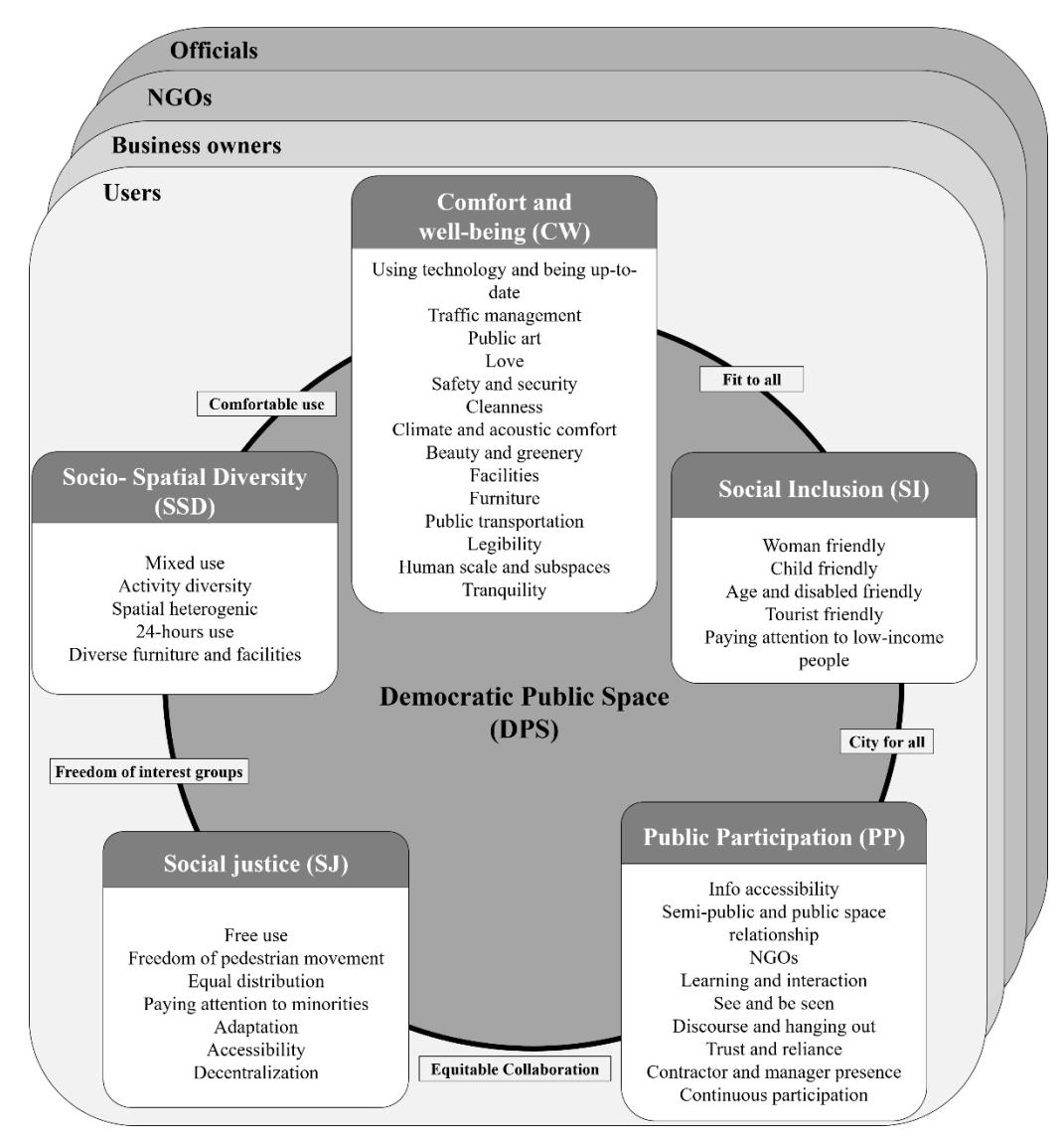
Figure 1 Proposed framework for assessing democratic public spaces (authors).
Materials and Methods
Study Area
Tehran, the capital of Iran, as one of the most populated cities in the world, covers some 700 km2 with a population of almost 12 million living in the city and surrounding province. It is a center for national socio-cultural events and as a result, Tehran has always had a central role in shaping other democratic public spaces nationwide. Tehran as Iran's administrative, economic, and cultural center suffers from a range of social and environmental problems (Madanipour, 2006; Dadashpoor and Nateghi, 2017; Malakooti, 2010). Zone 12 of Tehran comprises the historic central business district of Tehran city and contains a series of multipurpose public spaces, including different commercial streets used for recreation and events. 30Tir Street was selected as the case study due to its proximity to some important administrative and cultural places of Tehran, including the city park, Mashq Square, the Ministry of Foreign Affairs, the National Museum of Ancient Iran, the Glassware and Ceramics Museum (Abgineh), and Tehran University
of Art (Fig. 2). 30Tir Street is located near Mashq Square, one of the most important political and administrative centers in Tehran, which contains the Foreign Ministry office.
Figure 2 30Tir street location in Tehran.
The construction of this street dates back to 1906. After several decades, religious minorities settled in this street and built places of worship and schools. It may be the only street in the world with a mosque, a church, a fire temple, and a synagogue in close proximity. Due to its special features, this street has always been the scene of political events, so that after the 1952 demonstrations, the name of this street was changed to 30Tir (which means 20th of July in Persian).
The presence of four places of worship and their users as well as the presence of an Armenian community in the neighborhood give a special character to this street. Consequently, it must be a democratic street, a feature that is also reflected in Tehran's development plans (Manistar Parseh Consultant group, 2009).
Methodology
Given the research objective of exploring people's experience of place and emphasizing the perspective of related experts, a broad qualitative methodology was employed to gather opinions from people in the street according to Holloway and Hubbard's (2001) approach. Over seven visits in three months in 2019 (April to June), 50 semi-structured interviews were conducted with respondents including users (33), owners of businesses in the street (10), NGOs (2), and officials (5) (see Appendix A for the respondents' demographics). It is also necessary to explain that the questions did not ask the interviewees about how good or democratic the street is but about the components of DPS indirectly.
Additionally, we interviewed seven experts, including faculty members from different expertise backgrounds such as anthropology, urban planning, and architecture, who were familiar with the study area to give their general thoughts about 30Tir Street. The interviews with the faculty members were conducted in two ways: face-to-face conversation with those who were in Tehran and sending an online questionnaire to those who were in other cities. The interviews were semistructured, starting with open-ended questions and continuing on to the subjects of DPS and 30Tir Street in Tehran. All the interviews were recorded and then converted into text. We used content analysis to code and analyze the data (see Appendix B for sample interview questions).
Furthermore, a field study including notetaking, photography, a test walk, mapping, tracking, and observation, was conducted on different days and at different times, especially on weekends when most people visit this space. Although surveys, field studies and interviews are the most popular techniques to explore the nature and characteristics of public spaces (with their common limitations of being high-cost and time-consuming), social media platforms (e.g., Twitter, Facebook, and Instagram) and Location-Based Social Networking (LBSN) such as Foursquare are new virtual public spaces where social interactions take place and that can be considered among the most important sources for such studies (Bawa-Cavia, 2011; Graham, Hale, and Gaffney, 2014; Cerrone, Pau and Lehtovuori, 2015; Huang and Wong, 2015; Kim, Chae, and Park, 2018; Fredericks, Hespanhol, Parker, Zhou, and Tomitsch, 2018; Van der Hoeven, 2020). While access to the internet is limited for some people, social media, or so-called 'cyberspace', is accepted by scholars as a valid place to do research on some aspects of public space alongside real-based resources (Roick and Heuser, 2013; Shelton, Poorthuis, and Zook, 2015; Arribas-Bel et al., 2015; Anselin and Williams, 2016; Martí, Serrano-Estrada, and Nolasco-Cirugeda, 2019). Since in our case some residents and users did not have access to the abovementioned social networks, this method was used as a secondary technique to consolidate the input data and our analysis.
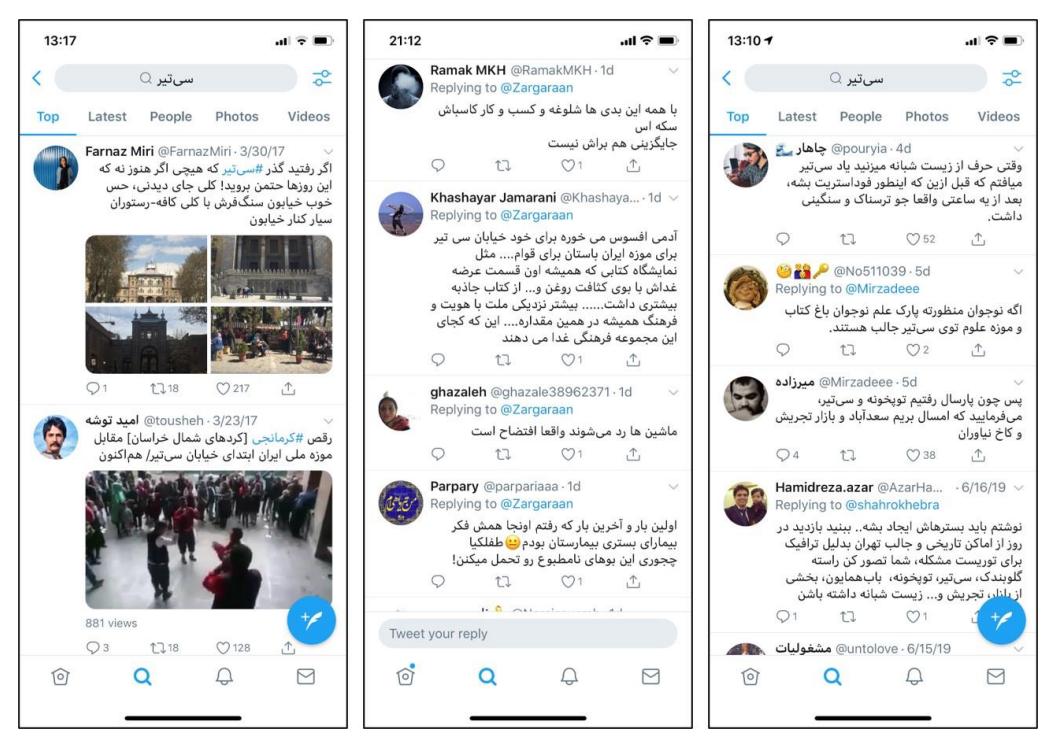
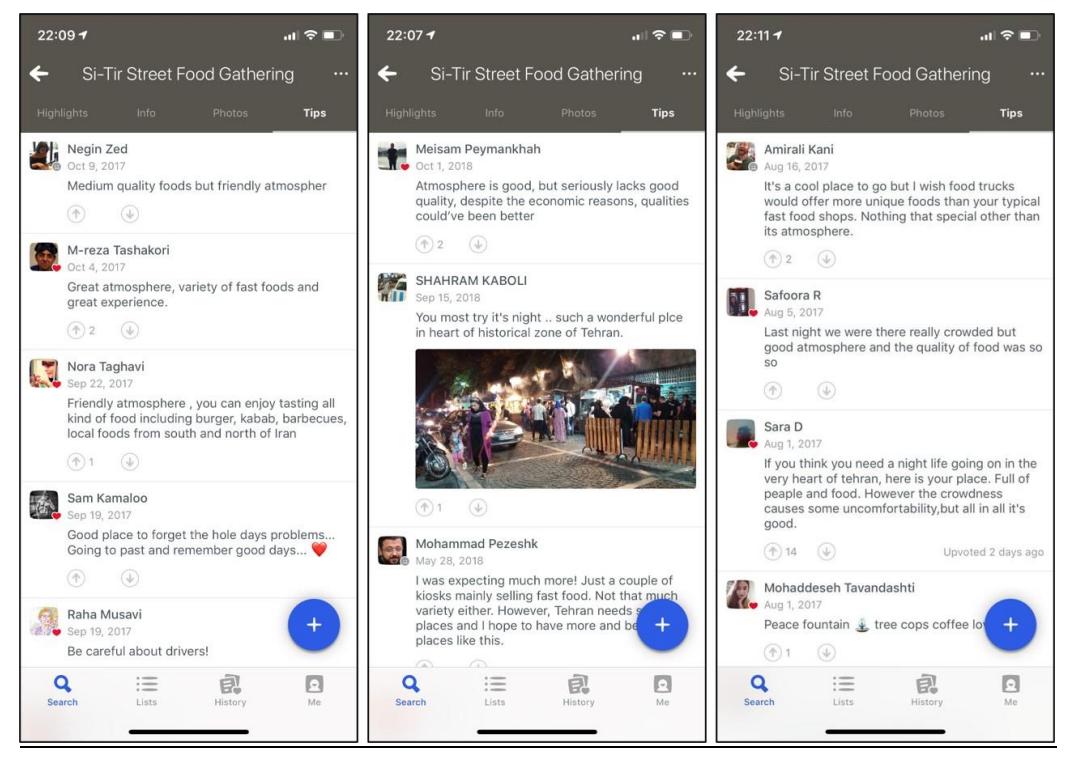
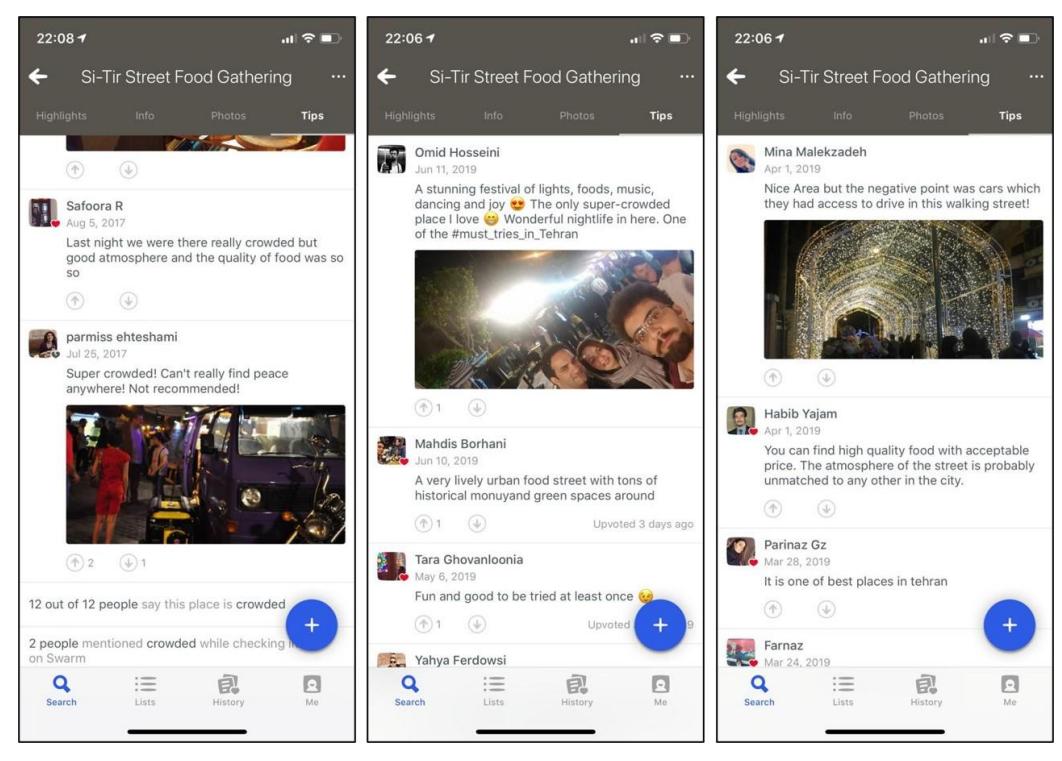
In this study, Twitter (searching '# تیرسی', which means 30Tir), Instagram (the 30Tir Street Project's official webpage called '30tirstreet' and searching the phrase '30tir street' in the search engine of Instagram) and Foursquare (as an LBSN social media) were used to collect data for assessing the 30Tir Street Project. On the official webpage of the project on Instagram, which has over 18,000 followers, all user comments on posts were collected. By searching the name of this street in the search engine on Instagram, we found photos and comments that users provided about this space. Also, by searching the hashtag '#30Tir' on Instagram, we found related content on 30Tir Street. Finally, since the main attraction for tourists visiting this street is food (it is known as a food street), we found many photos taken by users on Foursquare, which revolves around food. Thus, this social network was especially helpful in analyzing the quality of the food services, which is reflected in several components and indexes of democratic public spaces. (See appendix C for some comments of social media users.)
Results
To study the role democracy plays in the creation and maintenance of 30Tir Street, we evaluated this context based on our model, with its 5 criteria and 40 indexes.
Socio-Spatial Diversity (SSD) in 30Tir Street
Undoubtedly, the quality of mixed uses is considerable in 30Tir Street. The daytime administrative, political, and cultural functions (due to the presence of the Ministry of Foreign Affairs, the Russian Embassy, governmental and official departments and museums) of the street are replaced at night by recreational activities such as eating food, playing games, and performing art activities (Fig. 3). This feature provides both mixed and 24-hour uses of the street. Unfortunately, from the field study, we found that despite the incentives of the public to attend at night, some activities such as photography or access to the Mashq Square are forbidden to ensure the security of government buildings and spaces. As a result, the freedom of different groups is limited during the nighttime.
Figure 3 Various activities in 30Tir street.
One female interviewee, Maryam, complained about the stream of cars and people and suggested to provide more pauses in the flow of the street through small open spaces. Moreover, 30Tir users expressed negative feelings about the urban furniture's quality and form (Figure 4). As remarked by one male:
The types of furniture used in this street do not fully cover our needs. We need furniture that can be used for gathering, viewing, and connecting with others, not only for eating. (30s, male)
Figure 4 30Tir street's furniture.
Social Inclusion (SI) in 30Tir Street
Indisputably, 30Tir Street is more suitable for the free and secure presence of women compared to other Iranian urban spaces. A female interviewee, Sanam, said:
I used to be afraid to walk down the street at 9 p.m. (20s, female)
Incidentally, a male participant added:
This is the only place where I can feel at ease when my wife visits it alone at night. (40s, male)
The appropriateness of this place for women is maybe due to the fact that the project was designed and operated by a woman, who played a significant role in providing precisely such an environment (Fig. 5). Conversely, the street and its civic spaces are not proper for children or the elderly. This can be observed from the absence of appropriate facilities such as fitting furniture and a lack of sufficient safety.
Moreover, furniture is arranged on the sidewalk and prevents barrier-free mobility for the elderly and the disabled (Fig. 5). One example was given by an elderly person, Mehdi, who complained about the obstacles for pedestrians and did not feel comfortable being in 30Tir Street. He noted:
This is the first time I have come here and don't feel at ease at all. There is no place to relax, and I won't come here again. (70s, male)
Figure 5 30Tir street and visitors.
Furthermore, Foursquare users point out that services offered in the street can be enjoyed by a wide range of people with different incomes (Figure 6):
You can find high-quality foods at acceptable prices. (30s, male).
The atmosphere is lovely, and the prices are fair. (20s, female)
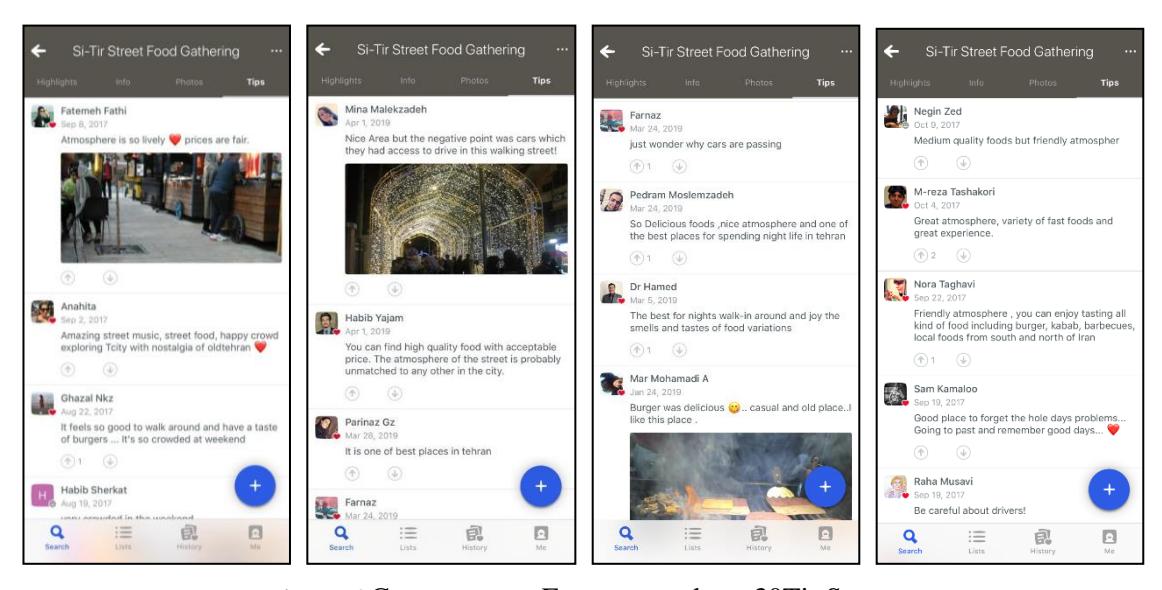
Figure 6 Comments on Foursquare about 30Tir Street.
Nevertheless, the project failed to consider tourists. As a result, there is no interaction between the street's users and cultural and historical places such as museums. It would be possible to attract food tourists, but this is not the case due to a lack of local and traditional Iranian foods.
For instance, one faculty member who concentrates on cuisine tourism stated:
Local and vegetarian food could be added to the place toward food tourism. (Personal communication, April 21)
Public Participation (PP) in 30Tir Street
30Tir Street has been able to make decent use of social media and shares information with its users about how to access the street and upcoming events, and so on. There is the official webpage on Instagram, whose name is '30TirStreet' and has more than 18,000 followers, and a Foursquare page, whose name is 'Si-Tir Street Food Gathering' (Figure 7).
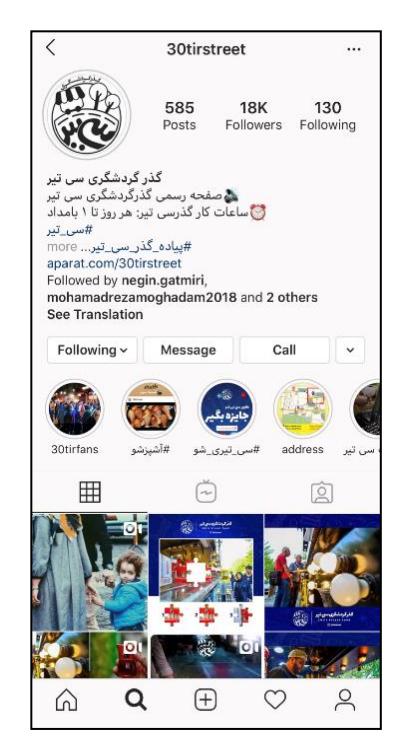
Figure 7 30Tir street on social media.
During the fieldwork, we encountered several users, like a tourist from Mashhad, who positively assessed this action:
The information I found out today made me come again to visit the religious, cultural and historical centers in the street. (40s, male)
The street has always been the center of planned events such as concerts, festivals, spontaneous folk-like music and singing (Figure 8). Mahsa, who enjoyed the street's atmosphere said:
30Tir Street is a place where you can enjoy visual and audible public art. (30s, female)
Figure 8 Casual activities in 30Tir street
During the field visit, we came to know that some people go to 30Tir Street just to spend time in urban space. This is a positive point for a public space. One participant expressed positive feelings about the street and remarked:
I come in with my motorcycle twice a month; I sit down and see people and come back. (60s, male)
There is a relative reliance and trust among users and business owners with the developer and the project managers. Their continual presence in the street has not been without effect. During one field visit (September 21st, 2019), the mayor of Zone 12 of Tehran and the developer and designer of the project were seen on the street talking to people (Figure 9).
Figure 9 Managers and decision-makers in 30Tir Street.
Social Justice (SJ) in 30Tir Street
Relative freedom is seen in the overall use of space on 30Tir Street, which may be due to the presence of national and foreign tourists as well as the history of housing various religious and cultures along this street (Figure 10).
Figure 10 Freedom in 30Tir Street.
On the other hand, despite the existence of religious minorities in 30Tir Street, the designers have not paid attention to these different religious groups in the design and construction of the street. In this regard, interviewing the developer revealed some constraints due to ideological and cultural reasons:
We had some programs about Christmas or adding international food to the project, but there were always some restrictions against our idea from the municipality and officials. (Personal communication, April 12)
A faculty member who is concerned about minorities in public spaces said about this street:
Religious minorities should be allowed to conduct their ceremonies in the street and this place should provide for the presence of these groups by designing a homogenous space. (Personal communication, May 24)
Appropriate accessibility due to its place in the heart of Tehran, convenient public transportation and proximity to the main pedestrian network of Tehran may be the most prominent features of the street.
The Ministry of Foreign Affairs may be the main center of power in this street, which sometimes influences decisions. Therefore, collaboration needs to take place between the Tehran municipality, the Ministry of Foreign Affairs, and the cultural heritage organization in achieving integrated street management toward the decentralization of power in public space. One architect who has conducted several studies on Tehran pointed out that:
The municipality has been unable to confront the Ministry of Foreign Affairs and this administrative center has always had the power to make decisions in this district. (Personal communication, May 14)
It is also necessary to note that although the Ministry of Foreign Affairs is the main controller of the space, their decisions have so far had nothing to do with the nature of the activities that take place in the street and have been more focused on imposing restrictions on traffic at certain times for special governmental events, which is also more or less common in other cases.
Comfort and Well-being (CW) in 30Tir Street
The renovation of 30Tir Street started with food three years ago, and then games, art and tourism attractions were added, creating a space where tourists could enjoy the process of being in the space and engaging with the space, thus changing the approach of attracting tourism. Related to this, the project developer said:
We welcome new and exciting ideas. (Personal communication, April 12)
Although performing music in public spaces has been challenging in Iran over the past decades, recently, we have witnessed openings in this field, especially in the public realm. Performing public arts in the form of music, fixed pantomime and singing on 30Tir Street has made this public space vital and vibrant (Fig. 11). One of the band's members who perform pop music on 30Tir Street in the weekends had an optimistic attitude and said:
I have to thank the visitors of this street for encouraging us to do our best and show our artistic abilities. (20s, M)
Figure 11 Public art in 30Tir street.
The linkage between the presence of traffic and pedestrians is well-managed so that in the mornings the street provides accessibility to vehicles (the cobbled street slowing down the traffic) and as it gets closer to the end of the day and the number of visitors increases, the street becomes a car-free zone for pedestrians only. A woman who came to the street with her baby was satisfied with the absence of cars on Friday nights and asserted that:
It is great that busy nights prohibit car traffic for the safety of our children, which makes us more comfortable in the street. (40s, female)
The following are some user comments toward the 30Tir Street Project taken from Instagram:
I enjoy every time I go there. (20s, female)
How good Iran would be if all of it it was like 30Tir Street? (40s, male)
I come several times a month and enjoy seeing happy people. (30s, male)
I have the best job in the world. (Business owner, 30s, male, personal communication)
The environmental qualities of the space, including night lighting (60 to 80 lux), cleanliness (continually maintained by the developer), climate comfort (the presence of water in summer and shading by trees), sound comfort (80 dB), and aesthetics are favorable. However, the space suffers from a lack of safety, caused by the narrow sidewalk, which is encroached by the street, parking spaces, and restrooms (Fig. 12), to the extent that one Twitter user said:
We couldn't find a parking lot, so we had to go somewhere else. (Zahra, 30s, female)
Moreover, there is not that much place to sit and relax (even for those want to eat their meal). There are plenty of negative comments about this issue on Foursquare. For instance, Parmiss expressed her feeling in these words:
Super crowded; cannot really find peace anywhere! Not recommended. (Parmiss, 30s, female)
Figure 12 Sidewalks of 30Tir street.
Furthermore, through field studies we found that almost 60% of visitors come to 30Tir Street by the subway and bus, which illustrates the efficiency of public transportation (with two subway stations and a bus terminal with 16 different routes less than 400 meters away).
Concluding Remarks
This study sought to discover and examine the major drivers of democratic public spaces from an urban design perspective. The notions of 'democracy' and 'public space' and their potential linkages were analyzed in the case of 30Tir Street in the central part of Tehran. According to our interlinked analysis of publicness and democracy in urban spaces – even though in some cases reaching a real democratic urban space might be impossible – we can define democratic public spaces as active public spaces where all people regardless of color, ethnicity, gender, age, and religion can co-create, exist, and socialize with others. All people have access to services and facilities in these spaces without any restrictions. Intellectual freedom, public participation, cultural diversity, and social interaction are some of the basic elements of such spaces. According to this definition, co-creating, co-managing, and co-existing in public spaces can lead to a democratic public space, from which all people can benefit.
To clarify the major drivers of democratic public spaces as a whole, and specifically in the case of 30Tir Street, we proposed a new framework to analyze the democratic characteristics of urban open spaces through a qualitative approach. This framework can aggregate all kinds of important criteria that were absent in previous studies. Assessing the criteria of our proposed model, i.e. social inclusion, public participation, socio-spatial diversity, social justice, and comfort, in 30Tir Street in Tehran showed that some degree of democracy has been realized in this case. Yet, to reach a full democratic public space, more harmony and cooperation between different stakeholders and policy makers is needed. One of the most important findings of this empirical study is that despite having a special geopolitical (the presence of the Ministry of Foreign Affairs) and historical context (Mashq Square) in 30Tir street, this space is 'relatively democratic'. This result can contribute to current studies on this topic in several ways.
Firstly, this study introduced a novel method to conceptualize the most important determinants of democratic public space in 30Tir Street in Tehran through using mixed qualitative data analysis, including field study, interviews, and social media networks as data sources. Although examining such criteria may be different in various contexts, this framework can also be used for other cases as an initial foundation that can be further developed. In fact, this framework can be helpful for other researchers, policy makers and planners to better analyze conditions in different cases. Yet, more research to refine the socio-economic-cultural variables and focus on various contexts coupled with quantitative research could help to develop a more comprehensive framework.
Secondly, although our findings about the suitability of using social media to gain local knowledge on urban spaces is consistent with previous studies (Shelton et al., 2015; Pablo et al., 2017), we recommend checking the applicability of social media as a data source on public spaces depending on the socioeconomic characteristics of the residents and users in advance. Considering the increased connectivity between urban spaces and democracy, using social media can support the co-creation of public spaces by attracting more citizens in the place making process in both complex geographical systems and various public spaces (Erjavec and Ruchinskaya, 2019). Finally, although alienation with participation, homogenization, resistance of groups, exclusion, and confrontation with officials are serious barriers for public spaces to become more democratic (Makakavhule and Landman, 2020), this study indicated that with a better understanding of the interrelated components of democracy and public spaces, new policies can incorporate human rights and needs in creating or transforming public spaces with the intention of forming real democratic public spaces.
Appendixes: Appendix A: Participant profiles
| No. | Gender | Age | Stakeholder | Position |
|---|---|---|---|---|
| 1 | M | 60s | Academic (7) | UC Davis professor of landscape architecture |
| 2 | M | 70s | Professor of Urban Design at Newcastle University | |
| 3 | F | 70s | Senior Research Fellow, Harvard GSD | |
| 4 | M | 40s | Professor of Social and Political Philosophy, Maastricht University | |
| 5 | M | 60s | Professor of anthropology at UT | |
| 6 | M | 30s | Assistant professor of urban design at SRTTU | |
| 7 | M | 30s | Assistant professor of urban design at SRTTU | |
| 8 | F | 30s | Designers | Designers of 30Tir street project |
| 9 | M | 50s | Official (5) | Mayer consultant |
| 10 | M | 40s | Government employee | |
|---|---|---|---|---|
| 11 | F | 30s | Government employee | |
| 12 | M | 50s | Government employee | |
| 13 | M | 40s | Government employee | |
| 14 | F | 30s | NGO (2) | Researcher of Tehran history |
| 15 | F | 60s | Social activism concerning the right to the city | |
| 16 | M | 30s | Business owner (10) | 30Tir Street food Truck manager |
| 17 | M | 40s | 30Tir Street food Truck manager | |
| 18 | F | 30s | 30Tir Street food Truck manager | |
| 19 | M | 40s | 30Tir Street food Truck employee | |
| 20 | M | 60s | 30Tir Street food Truck employee | |
| 21 | F | 20s | 30Tir Street food Truck employee | |
| 22 | M | 40s | 30Tir Street hypermarket employee | |
| 23 | F | 20s | 30Tir Street food Truck employee | |
| 24 | M | 30s | 30Tir Street real estate manager | |
| 25 | M | 40s | 30Tir Street baker | |
| 26 | F | 20s | Street user (33) | Iranian tourist |
| 27 | M | 40s | Iranian tourist | |
| 28 | M | 30s | Iranian tourist | |
| 29 | F | 30s | Iranian tourist | |
| 30 | F | 30s | Iranian tourist | |
| 31 | F | 40s | International tourist | |
| 32 | M | 60s | International tourist | |
| 33 | M | 30s | International tourist | |
| 34 | M | 40s | Tehran resident | |
| 35 | F | 30s | Tehran resident | |
| 36 | M | 10s | Tehran resident | |
| 37 | M | 30s | Tehran resident |
| 38 | F | 20s | Tehran resident |
| 39 | M | 60s | Tehran resident |
| 40 | F | 60s | Tehran resident |
| 41 | F | 10s | Tehran resident |
| 42 | F | 20s | Tehran resident |
| 43 | F | 30s | Tehran resident |
| 44 | M | 30s | Tehran resident |
| 45 | F | 40s | Tehran resident |
| 46 | M | 10s | Tehran resident |
| 47 | M | 70s | Tehran resident |
| 48 | F | 30s | Tehran resident |
| 49 | F | 70s | Tehran resident |
| 50 | M | 40s | Tehran resident |
| 51 | F | 70s | Tehran resident |
| 52 | F | 30s | Tehran resident |
| 53 | F | 70s | 30Tir Street resident |
| 54 | M | 40s | 30Tir Street resident |
| 55 | F | 70s | 30Tir Street resident |
| 56 | F | 30s | 30Tir Street resident |
| 57 | M | 60s | 30Tir Street resident |
| 58 | F | 30s | 30Tir Street resident |
Appendix B: Sample Interview Questions
From users:
How did you get here? How is the accessibility of public transport to this street?
How often do you come to this place?
What factors made you choose this place as your destination?
What is your opinion about the presence or absence of car traffic in this street?
Do you feel relaxed in this place? Which factors could be changed toward a more comfortable place?
Is 30Tir Street one of your destinations at night?
From business owners:
Are you familiar with this project's manager? How often do they visit the street?
What group are most of the visitors to this place? Do different age and gender groups use the facilities of this place?
From academics:
Which criteria come to mind when you hear the term 'democratic public space'?
What is the people's role in creating democratic public spaces?
Is 30Tir Street a democratic public space?
From designers:
Did the designers of 30Tir Street care about the use of the place by various groups?
What preparations were made for nightlife in the project?
To what extent can users make a change and personalize the place?
Has people's participation been used in decisions and designs of spaces and street components?
Appendix C: Sample Screen Shots of Social Media Comments
Foursquare