

Introduction
Information may have various impacts on urban planning performance. Understanding the urban planning process, information on urban problems, and urban uniqueness may lead to various planning responses. Innovation emerges and provides sufficient solutions to accomplish multiple goals or accelerate development. Hence, knowledge is a basic requirement for urban planners in initiating ideas to offer more creative solutions. Urban innovation is not merely based on the mastery of adapting information usage to the city. The prevailing urban planning system is prepared by using specific knowledge that is communicated and shared through various channels to the public. In the context of urban planning, information plays an important role as input to achieve planning goals and intervene in the planning system to improve conditions (Chadwick, 1978). Having a variety of initiatives in the form of interventions in the current planning system brings innovation to a city, which requires the provision of knowledge and the ability to inform and socialize the proposed solutions to the public. These two things are the concern of the technopole concept as well as the communicative city concept in creating a resilient, inclusive, and sustainable urban environment.
The technopole is an innovative concept in city development that is associated with technology, which represents the progress of knowledge creation and innovation. The technopole is a center of activities (pole) as well as a city (polis), indicated by the presence of groups of people and a variety of activities. Its specific characteristic connects it to the latest inventions and technologies, which may trigger economic activities and urban lifestyles, especially as the center of activities in an urban area. Technology as an attribute of its name reflects several issues that show that technology can support communication systems among citizens to encourage the creation of a city as a symbol of modern civilization (Gibson et al., 1992), starting with translating data as information on the urban planning framework into international languages, which plays an important role in storing and communicating and disseminating knowledge across borders. This is also supported by the fact that communication systems and telecommunication networks can combine world cultures into a single entity, where global thinking is important in introducing and promoting local resources wrapped in local culture to the world to attract and provide economic opportunities. Thus, it makes sense to use a communicative city approach in understanding the technopole concept as the chosen development theme for an urban area.
This study's objective was to identify the progress of the development of Gedebage Technopole, Bandung, Indonesia, based on the features of the communicative city framework. Two main research questions will be elaborated on this paper: (1) What are the roles and relationships of the stakeholders involved in the development of the Gedebage Technopole area? and (2) How are collaborations and networks among stakeholders established in the development of the Gedebage Technopole area? The selection of the case study location was motivated by the fact that since is designated as a Creative City by UNESCO in 2016, Bandung city has striven to develop innovative themes in developing new urban areas, one of which is the technopole theme. Thematic city development in Bandung has been previously investigated by Noviansyah and Sutriadi (2020).
According to a visual mapping of the world's scientific knowledge created by the Open Knowledge Maps application (https://openknowledgemaps.org), scientific publications on the topic 'technopolis' mainly report technological research on the development of high technology, efforts in the operationalization of specific city functions and clustering them in terms of urban development, investment and promotion, and knowledge innovation systems. Furthermore, they discuss several technological-based development cases in Russia, the USA (Silicon Valley), Malaysia, Indonesia, Bulgaria (Sofia), Greece (Athens), and Japan. In the context of urban
planning, this brings a new perspective to the planning arena, where technological innovation can play a key role in bringing progress to a specific area. Note that attention has also been paid to the cultural side of the technopolis, for example in the context of ecotourism development, recalling Gibson's statement on combining world cultures into a single entity through telecommunications networks (Gibson, et al., 1992).
Using a similar method, namely searching through Connectedpapers.com, publications using the keyword 'technopole' were more varied in their discussion than publications using the keyword 'technopolis'. However, this variation was more related to the contents of the study of each of these hubs or poles and less to their role in their surrounding areas or the wider region. These themes are particularly related to research on topics such as anthropogenic aerosols, bacteria, genomes, biodiversity, aging, autism, biochemical recurrence, cell viability, pregnancy, and abdominal or thoracic surgery.
The technopole, especially its characteristics related to innovation, technology, and thematic cluster development, brings a new atmosphere to the city planning process, providing new directions for expanding the concept of urban planning. This was alluded to by Faludi (1973) when describing the procedural theory, which discusses basic and general matters that go beyond city planning. In addition, this can also touch on substantive theory because it relates to introducing new things to the planning system, in this case, nuanced technological innovations, with technology being ubiquitous in the era of Industry 4.0.
In terms of planning within the planning domain as stated by Friedman (1987) when discussing planning tradition, the technopole concept, whose presence is studied using the communicative city concept, can at least give new color to the social learning that occurs. When the communicative city concept is successfully implemented, it can reform the planning process and activate planning grassroots movements (social mobilization).
Regions are in an entrepreneurial position to an increasing extent. Each region needs to compete with other regions for enterprises, investments, skilled personnel, and jobs. Each region's competitiveness depends on key factors such as knowledge, social capital, networks, and supporting structures. Becker (2014) states that factors such as these can be either self-organized or government-based. The potential of an area is no longer determined by its weather, climate, or natural resources but by human will, capabilities, energy, values, and organization (Kotler, 1993). Thus, regional governments need to formulate policies and plans that can increase the competitiveness of their region.
The technopole as a concept mainly refers to extensive activities in the form of research, development, manufacturing, or some combination of these three activities (Castels and Halls, 1994). Implementation of the technopole concept can foster the competitiveness of a region and foster economic development, reduce economic disparities, and encourage stakeholders to collaborate in implementing the technopole concept.
Bandung is the capital of West Java and part of the Bandung Metropolitan Area, which consists of different cities. Bandung plays a significant role in the West Java Province economy and therefore, many people seek job opportunities in Bandung, further driving population growth. The government has decided to distribute economic activities more widely by spreading city service centers (PPK) in response to this issue to give equal load to each of the city service centers. According to the current development plan of the government, one of the city service centers will be located in the Gedebage Technopole area. Implementing this concept aims to increase the economic growth in the eastern part of Bandung and distribute the population concentration in the city.
As part of the planning process, the different actors involved need to communicate with each other in implementing the issued development plan. For example, the government must share the plans and policies it has created with the community, the business sector, and academia. The actors can play different roles: the community and academia can evaluate and monitor the government's policies or plans and the business sector can partner with the government to create economic opportunities.
The development of a technopole is complex and requires different stakeholders in the process. In the context of Bandung, the development is aimed at one of the city's centers, where the goal is to distribute the strain of population growth and activities throughout the city. This requires the stakeholders' participation in the development process since the aim is to create a technologybased area that will generate economic growth around a city service center.
One of the tools that could help the government in technopole development is the communicative city concept. The communicative city concept centers on communication patterns that connect the urban community to those who plan, design, and manage cities in order to help them understand the impact of their activities and how communication impacts the community (Jeffres, 2010). The communication channels used can be supported by technology developed in the technopole itself. It is important to identify the communicative city characteristics that already exist at the start of the development to implement the technopole concept further and identify gaps between the ideal communicative city concept and the communicative city practice. It is important to identify the stakeholders involved in the development and their roles to identify existing gaps and the actions required to bridge them.
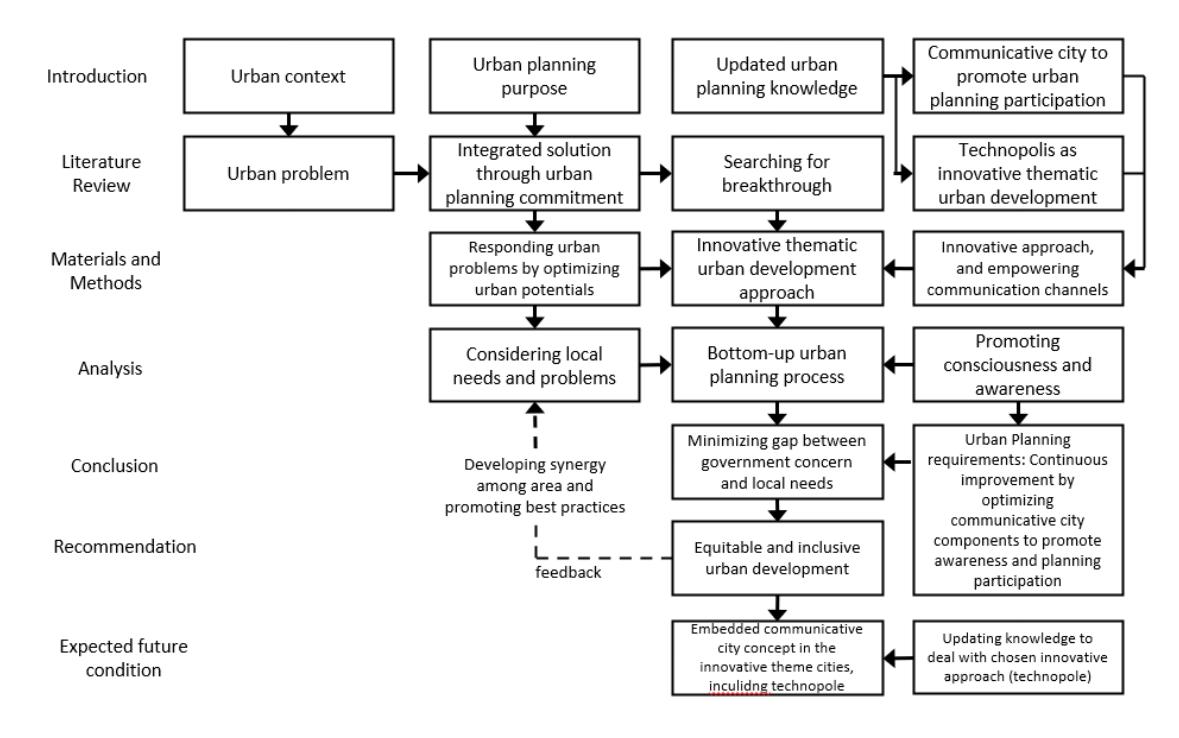
Therefore, this study explored the communicative city characteristics present in the development of Gedebage Technopole and identifying the stakeholders involved and their interrelationships. The following diagram represents the systematic discussion in this paper.
Literature Review
Repositioning the Role of Cities in the Global Economic Context
One of the most significant aspects of modern societies and cities is the digital revolution. Graham (1996) notes that the exposure to information technologies has led to the 'Third Wave' phenomenon in the evolution of cities. As information is one of the most crucial resources of cities, waves of data will affect the future stream of products and capital. Global cities will emerge when cities become the world's command centers by controlling communication channels and information systems. Sassen (1991) states that the emergence of global cities is driven by a more globalized economy and the increasing agglomeration of central capacities in a small number of locations.
Several vital points constitute the core of global cities. Firstly, the global networked information economy creates increasing competitiveness between cities. Cities that hold a great amount of information (urban data) and a large database thus become critical command centers for the international economy. The second crucial resource for cities is the quality and availability of skilled human resources, which are the engine of economic development. Kotler (1993) explains that the potential of an area is no longer determined by its climate, weather, or natural resources but by human behavior, capabilities, energy, values, and communities present within it. Information-based contemporary techniques and fresh innovations are now the core of leading transnational firms. In the future, profitability will be rooted in the innovative capacity of the workforce. Thirdly, telecommunication infrastructure will be the pillar of the 21st-century postindustrial city. This is why many regions are trying to upgrade their telecommunication infrastructure so as to enable information acquisition. Lastly, reconfiguration of institutional knowledge, such as the knowledge developed at universities and colleges, will be indispensable since they are the knowledge and information centers of the future (Blakely, 1990). Many experts expect that industrial decentralization will make the role of cities within the economic context obsolete. In spite of this, Sassen (1991) believes that cities will still be the center of multiple global economy circuits. Thus, the following entities are vital in creating a competitive city:
- 1. The city needs an extensive database to become a command center.
- 2. The city needs skilled human resources.
- 3. The city needs telecommunication infrastructure that can be used to obtain data and information to support city development.
Presently, there are two types of places within the context of global economic activity: the city itself and hi-tech clusters, or technopoles. 'Technopole' is a city development theme that enhances innovative and human resource development through the development of high technology.
Technopole
According to Castells and Hall (1994), a technopole is an area dominated by high-tech activities in the form of research, development, manufacturing, or some combination of the three. A technopole can be planned or unplanned (e.g., Silicon Valley and Los Angeles), financed privately, financed by the government, or formed by public-private partnerships. Hassink and Berg (2014) explain that a technopole includes a land-based and property-based policy form directed at the formation of spatial agglomerations of high-tech businesses and organizations. At the very core, the technopole originated from the concept of a dimensionless area of socio-cultural and local economic development that revolves around scientific and technological activities, productive activities, and community movements that support the acceleration of innovation development. At the same time, technpoles are characterized by science and technology activities, production activities, and community movements within a specific area as a development system, as demonstrated by their functional relationships and the spatial innovation system.
A technopole can be a unique place in an industrial context that musters institutions, labor, and finance, which, when combined, produce the necessary substance for regional economic development. The current trend shows that central and local governments usually favor towards the technopole concept. Most technopole sites are occupied by IT-based enterprises, innovative manufacturing companies, research institutes, and universities. Technopoles are centers of IToriented production since they can be seen as hubs of the new industrial space of the 21st century. Castells and Hall (1994) claim that technopoles are scattered worldwide but are significantly more likely found in major post-industrial cities.
The university-industry-government interdependence model, usually described as a triple-helix of relationship networks, is now considered a traditional view. The mode of knowledge transfer has evolved following evolutionary interdependence to fit more with the relationships and projects of each institution. The recent focus on open innovation put forward by Chesbrough (2009) and countless extensions of the triple-helix to higher dimensions – quadruple, quintuple, and N-tuple helices – extend the partner reach and complexity of intermediation further (Alexander and Martin, 2013). New dimensions often included in the triple-helix model (industryuniversity-government) are media and environmental challenges.
The technopole concept highlights the importance of a balanced approach of high-technology development. As an alternative to only focusing on high technology, the technopole involves the construction of new settlements, complete with a research park/technopark, a university, a technology center, and residential and cultural facilities (Oh, 2014). A technopole area must have scientific and technological infrastructure, physical infrastructure, a business base, and human resources from nearby universities and research institutions. In addition, a technopole also requires the support of political leaders, academics, culture, entrepreneurship, strong links between the scientific community and technopreneurs, information networks, technopole
incubators, and imaging embodied in synergy and communication incorporated among the actors inside it.
The key to the success of a technopole lies in the synergy between government, academia, and the business sector in creating innovation and a knowledge economy (Etzkowiz, 2008) through inter-actor communication (Jeffres, 2010). In general, technopole development has three main objectives (Hassink and Berg, 2014), namely:
- to foster economic development;
- to reduce regional economic disparities, especially in more populous countries;
- to create harmony between the triple-helix actors (academic/research institutions, government, and private companies) towards increasing innovation, competitiveness, and technology transfer.
Thus, to synergize and harmonize the stakeholders it is necessary to create a communication channel among the stakeholders. A concept that could solve this issue is the communicative city concept, which focuses on how the government creates a communication channel to maintain relationships among stakeholders.
Communicative City
In technopole development, a certain level of community attachment has to be developed, because in a technopole, technology plays a huge role in creating a communicative city. Jeffres (2010) created a development concept showing how the communicative city concept can be simplified when developing a sense of belonging among urban citizens are included in urban planning processes such as preparation, implementation, and control. This simplified concept centers on the communication patterns that connect urban communities and the relationships between the urban context and communication phenomena to give those who plan, design, and manage cities an understanding of the impact of their activities on the communication and, conversely, how the communication impacts the community (Jeffres, 2010). The communicative city is largely inseparable from the emergence of information and communication technology (ICT) inventions and communicative channels among stakeholders and their willingness to communicate.
Based on Jeffres (2010), six goals are promoted in the development of communicative cities:
- 1) Existing communication patterns and policies should increase community involvement with current plans and policies; the survival of the city is vital so it must keep its inhabitants and attract new ones, which is a prime goal of all cities.
- 2) Communication should be used to connect citizens from different backgrounds where conflict is common; people most often interact with each other when they share characteristics, not only appearance (age, ethnicity) but also interests and opinions (politics, culture).
- 3) The patterns, policies, and vehicles (media) of communication must help the most disadvantaged people in society, which is a value that is contrary to the libertarian view but consistent with the values of those who believe in positive civil society planning and action.
- 4) The communication patterns should stimulate economic activity in the city; this covers everything from advertisements to information about jobs.
- 5) The communication system should support cultural groups, artists, entrepreneurs, and the creative class in society. Artists are among the 'entrepreneurs' who are often forgotten, but the economic and cultural life of a community requires a communication system that allows such connections.
6) The communication patterns should be able to socialize the creation of shared history and new traditions among the residents.
The technopole and the communicative city as concepts have a similar aim: to push economic development and secure the city's sustainability. To achieve this and make it suitable for the people, urban developers need to understand and take on the technopole agenda. Stephen (2016) believes sustainable development is required for generating innovation while also being in a position to contribute substantially to economic growth. Molyneaux (2016) states that sustainable development could supply a balance between social cohesion, economic welfare, and judicious utilization of natural resources in a free-market and productive economy. Popescu (2017) explains that sustainable development and the green economy are influenced by two elements: promoting the rational use of available economic resources and increasing competition with prominent countries in gaining economic resources. Sutriadi (2016) further extends this by stating that the communicative city conceptually demands assistance from high technology while also requiring 'back up' from citizens and local communities to implement the technopole agenda properly.
Planning Process and Communication Channels
Most literature, studies, and research regarding communication in the planning and urban context are related to the generalized relationship between organizations, media and urban centers. Nevertheless, Jeffres (2010) has shown that the current decade is seeing the growth of communication research that targets the urban arena and benefits cities that learn from these lessons. Interest in urban communication has increased with the emergence of new technologies, for example, WiFi and internet sites extending into neighborhoods, making communication between officials and citizens easier. Hopefully, new communication technologies can help people better understand and form urban spaces and public spaces (Serra, 2007 in Jassem, 2007).
Research and studies regarding mass communications discuss the effect of the media extensively while community leaders and designers ignore it (Jeffres, 2010). As a result, decades of research on agenda setting indicate that the media has an impact on public perception, specifically by pointing out some problems excessively while ignoring others. Politicians understand that they can postpone action on significant problems if the public perceives these problems as unimportant compared to their agendas (Walsh-Childers, 1994 and Yigitcanlar, 2009). Likewise, trivial problems can be seen as major by heavy coverage from the media. This phenomenon also applies to urban problems that need to be solved by planners and policymakers.
Jeffres's (2010) research is one example of what planners and policymakers should delve into. Other significant theories that should be considered for example include works on public opinion (Cuillier, 2008), cultivation (Guo, 2002), third-person perception (Cohen and Tsfati, 2009), the quality-of-life literature (Mc Gregor, 2009), and communication technologies (Atkin and Lin, 2007), for instance, quality of life is correlated to interpersonal networks and communication competency (Nussbaum, 2007 and Segrin, 2005), communication technologies (Han, 2009 and Longley, 2008), and the influence of the media on perceptions (Jeffres, 1992 and Neuendorf, 2000).
Materials and Methods
This research employed a qualitative method with a case study approach. Qualitative research is defined as an inductive approach in acquiring a comprehensive understanding of the experience of an individual or group. According to Ross (1990), the qualitative research approach uses a 'world view' as the basis, which means that it is holistic and has the following assumptions: 1)
there is not only one reality; 2) different realities are based on how different persons perceive reality, which may change over time; 3) the context of a given situation grounds the meaning. In qualitative research, the term 'population' is not used (Spradley, 1980). Instead, a social situation consists of three elements, i.e., a place, actors, and activities, which interact synergistically. Research results from a qualitative approach apply only to certain social situations, but for application elsewhere a transfer can be done. Transferability involves the extent to which a study's findings apply to other cases of the phenomenon (Hay, 2010).
Data Collection Methods
Data collection methods can be classified into primary and secondary data collection, which we both used in our research. According to Moleong (2008), the source of data in qualitative analyses can either be words, actions, written sources, photographs, or statistical data. When viewed this way, data collection can be done through interviews, observation, documentation, focus group discussions, or document review/document study. Primary data collection is done through observation and semi-structured interviews; in semi-structured interviews, the researchers are more flexible and are not limited in asking questions to get more in-depth information so that new information is not overlooked (Hay, 2010). Researchers can use purposive or judgmental sampling methods to get critical informants. In purposive sampling, the researchers believe that the respondents can use their own discretion or their institution's considerations to choose the best person or group to be interrogated or, as in this case, to provide accurate information (Bouma, 1993). In addition, purposive sampling is considered efficient and is recommended to select informants, which can reduce bias and makes it possible to maintain the overall results of population samples (Tongco, 2007). Thus, the first thing to do is to define the resources based on specific criteria using purposive sampling and snowballsampling. The snowball sampling method is used to gain further in-depth information based on recommendations of informants. Snowball sampling is an approach to find help to get other respondents through initial contacts and recommendations from other sources (Biernacki and Waldorf, 1981).
The selected interviewees in this study were people who were familiar with the technopole concept and knew the direction of the Gedebage Technopole development plan well. In addition, they had a part in the formation of the activities at Gedebage Technopole that played a role in the provision of accessibility in support of the Gedebage Technopole plan, which is essential to the further development of Gedebage Technopole. Based on these criteria, the informants in this research were BAPPEDA (Planning Board Office) Bandung City, the Department of Spatial Planning of Bandung City, Summarecon Bandung, ITB (Institut Teknologi Bandung) Innovation Park, and local officers at the district and the subdistrict level, and also a creative communities organization in Bandung (BCCF). Furthermore, secondary data used in this research consisted of the report on the Development Planning Area Preparation for Gedebage Technopole, the Development Masterplan for Bandung Technopole, the RTRW of Bandung (Bandung's Spatial Planning Document), the RDTR of Bandung (Bandung's Detailed Spatial Planning Document), and the profile of Kecamatan Gedebage, Kelurahan Cimincrang, and Cisaranten Kidul.
Data Analysis Method
Data analysis methods are tools to achieve research objectives. Data analysis is defined as the process of searching and arranging data derived from interviews, field notes, questionnaires, and documentation. After the data collection process, we organized the data into several categories, broke them down into units, synthesized and arranged them into patterns, decided on which information was essential and needed to be learned from, and drew conclusions from the results, which could be easily understood by ourselves and by others (Merriam, 1998). In this study, qualitative data analysis (content analysis) was done inductively by first taking the data and then forming a hypothesis.
Payne (2004) defines content analysis as searching for the meaning of written or visual material by allocating systematic contents to a predetermined list of categories and then calculating and interpreting the results. Content analysis was used to analyze the studied documents to identify the stakeholders involved in creating Gedebage Technopole and their roles. After that, the authors used social network analysis tools to understand the characteristics and relationships among the stakeholders. Interpretation of the results showed the communicative city characteristics that support the development of Gedebage Technopole and the role of communication among the actors involved in developing Gedebage Technopole. Thus, the results of this analysis can contribute to the further development of Gedebage Technopole.
Table 1. Data Requirements
| Data Needed | Component | Criteria |
|---|---|---|
| The role of the government in the formation of the core technopole | Program policy and regulatory support | Some policies support the development of the technopole area and the technopole core area |
| There is facilitation of other actors in regional development | ||
| There are policies and initiatives to accelerate the development of technopole areas | ||
| Regional support | There is infrastructure to support regional access | |
| infrastructure and facilities | There are infrastructure and strategic facilities to support regional activities | |
| The role of academia in the formation of the core | Academia as knowledge factory and provider of | Able to provide knowledge generated from research and development (R&D) activities |
| technopole | intellectual capital | Able to provide research resources and expert resources in various fields |
| Dissemination of information, knowledge, | Availability of media to publish research and development (R&D) results | |
| and innovation | There is application of research and development (R&D) results | |
| Collaboration with other | There is cooperation with the government | |
| actors | There is cooperation with the business sector | |
| The role of the business | Contribution to creating a | Availability of capital in regional development |
| sector in the formation of the technopole core area | business climate in the region | The existence of infrastructure and facilities to support activities in the area |
| There is business coaching and training in the context of regional development | ||
| Creative and innovative capabilities | The creation of added value for the resulting product | |
| There is cooperation with other actors that produce innovation as a tangible result of the company's cumulative learning process | ||
| The role of the community in the formation of the | Supervising and contributing to regional | Participate in criticizing and providing input in regional development |
| technopole core area | development | There is community involvement in the area development process |
| Media intermediary information transfer and | Able to be an intermediary for ideas and ideas related to the development of innovation | |
| creation of innovation | Able to encourage the creation of a culture of innovation |
Interviews were conducted with actors involved in the formation of the core area of Gedebage Technopole. The determination of informants to be interviewed was done using the purposive
sampling technique. Purposive sampling is a sampling technique of data sources with certain considerations. In this study, several criteria were used to assist the selection of the initial key informants who could explain the researcher's issues. The key informants were divided into four groups of actors involved in developing the Gedebage Technopolis core area during its formation phase. The key informants were selected from the four groups to provide information related to the formation of the Gedebage Technopolis core area, based on criteria determined by certain considerations and objectives.
Table 2. Informant Selection Criteria and Potential Key Actors
| No. | Actor Category | Criteria | Actor |
|---|---|---|---|
| 1. | Government | • Responsible for understanding the development of Gedebage Technopolis • Main manager of regional institutions and facilitators of other actors (stakeholders) • Providing regional support infrastructure • Understands the activities of organizing cooperation between actors involved in the development of the Gedebage Technopolis core area | • Bandung Planning Agency (Bappeda and Distaru) • Bandung • Department of Communication and Information • Department of Public Works Service • Department of Cooperatives, MSMEs, Industry and Trade • Regional Financial and Asset Management Office |
| 2. | Academia | • Provides new knowledge resulting from research and development (R&D) activities • Applies and disseminates knowledge for the development of the technopark/innovation park and the technopole • Can provide research resources and expert resources in various fields • Understands the activities of implementing cooperation between actors in regional development | • Bandung Institute of Technology • LPiK/ITB Innovation Park • Telkom University • Computer University • Padjadjaran University |
| 3. | Business (industrial/ private) sector | • Provides capital for regional development • Provides goods needed for the execution of product ideas (production) • Provides regional infrastructure • Engages in the development of creative entrepreneurs • Understands the activities of organizing cooperation between actors in the development of the Gedebage Technopole core area | • Summarecon Bandung • PT Telkom • PT INTI • PT Biofarma |
| 4. | Public/local community | • Criticizes and provides input in regional development • Is involved in the process of developing the Gedebage Technopolis • Understands the activities of organizing cooperation between actors in the development of Gedebage Technopole | • Bandung Creative City Forum • Youth organization • Gedebage District • Cisaranten Kidul Village • Cimincrang Kelurahan Village |
The key informants who were selected according to the above criteria were then further developed through the snowball sampling method. Snowball sampling is a sampling technique to obtain data, which are initially small in number but gradually increase based on information obtained from previous informants. This was done to supplement insufficient information obtained from previous informants. The table below is a list of the informants interviewed in this study.
Respondents Actor Government • Bandung Planning Agency (Bappeda and Distaru) • Department of Communication and Information (Diskominfo) • Department of Public Works Service (Dinas Pekerjaan Umum) • Department of Cooperatives, MSMEs, Industry, and Trade (Dinas Koperasi, UMKM, Perindag) • Department of Financial and Asset Management Office (DPMPTSP) Academia LPiK/ITB Innovation Park Business sector Summarecon Bandung Public / local society Gedebage District Officer Cisaranten Kidul Village
Table 3. Selected Informants
Analysis
With a total population of 2,481,469 inhabitants, the population density of Bandung city in 2015 reached 14,832 inhabitants/km2 , where the Gedebage subdistrict had the lowest density with 3,748 people/km2 , while the Bojongloa Kaler subdistrict had the highest population density with a population density of 39,988/km2 (Bandung Central Statistical Agency, 2017). The development of the core area is an integral part of Gedebage Technopole, developed to be the driving force of the development of East Bandung and to reduce the large dependence on PPK Alun-Alun (Bandung City Planning Board, 2015) as the second goal of the development of Gedebage Technopole. Building an out-of-the-way technopole in the countryside is frequently seen in countries with congested and overpopulated urban areas as a way to minimize regional economic inequalities (Hassink and Berg, 2014).
The next section will explain the existence of communicative city characteristics facilitating the initial development of Gedebage Technopole and the roles of the actors who are involved in the initial development of Gedebage Technopole and the interrelationships among them. The communicative city characteristics obtained from our analysis of the Gedebage Technopole development practice were compared with ideal conditions to see if there were any gaps between them.
Existence of Communicative City Characteristics in Supporting the Initiation Development of Gedebage Technopole
The communicative city concept focuses on communication patterns that connect communities within the city and the relationships between the urban context and communication phenomena so that people who plan, design, and manage cities can identify and understand the impact of their activities on the communication and how the communication affects the urban communities in return (Jeffres, 2010). The communicative city can solidify the realization of the technopole agenda, where the community can effortlessly accept ICT and other new technologies. Table 4 lists the existing communicative city characteristics supporting the initial development of the Gedebage Technopole.
Table 4. Existing Communicative City Characteristics in the Initial Development of Gedebage Technopole
| No City Characteristics 1. Community attachment | Communicative Communicative City Characteristics Analysis in the Development of Gedebage Technopole | ||
|---|---|---|---|
| • Local citizens at the establishment stage of area development still act passively by accepting and not provocatively rejecting the development of the technopole area in their environment. • Local citizens are involved as unskilled laborers in the construction of the development of areas, such as drivers and truck tarpaulin openers for logistics/leveling of land in the area. • The current communication patterns and policies and local communities' conditions have not enabled the active involvement of the local community, especially in the process of formulating existing plans and policies. | Community attachment is encouraged by existing communication patterns that are covered by policies. | ||
| 2. | Interaction network among actors | • Although Summarecon Bandung remains focused on property development, Summarecon works together and communicates with ITB Innovation Park to create a technopole area that is in line with the concept of creating intellectual capital and innovative ecosystems in regional development, as well as to increase the involvement of other actors in the realization of the communicative city themes and the development of a technopole area within it. • At first, the development of the area – as in township development in general – with various communications and inputs from the Bandung municipal government, there is a rebalancing of the area so that office and commercial areas become proportional in realizing a balance between work, life and play activities in the area, so the area's development can better accommodate various activities and various community groups with different backgrounds within it. • The communication embodied in the synergy among the actors involved connects actors from different backgrounds, although this is still limited at the formation stage. | Communication with community organizers is an essential factor to develop an interaction network among citizens with diverse backgrounds in order to create mutual understanding and mitigate conflicts. |
| 3. | Accommodating disadvantages | • The city government provides socialization to the community and facilitates the developers to prioritize the empowerment of local communities in the development of the region. • Summarecon has provided training to the community to be involved in the construction process and to be drivers in support of regional logistics even when local interest is still low. • The training provided by the government for local communities is still limited, and the implementation of the trainings tends to be outside the residence, causing reluctance of community members to participate. • The existing communication patterns, channels and policies have sought to accommodate and develop local communities as potentially the most disadvantaged groups in the development of areas to be empowered in the process of regional development through recommendations made by the government to developers in particular. | The communication system must support the most disadvantaged members of the community through suitable communication patterns, channels and policies. |
| 4. | Possibility of creating economic activity | • The city government prioritizes the transfer of Bandung's government center to the Gedebage Technopole as an example for other actors, especially to encourage the development of economic activity in Gedebage Technopole, which will provide a multiplier effect for the surrounding areas. • The existing communication patterns are not optimally able to stimulate the development of economic activity in the development of the area because in this case the government is | As a backbone of urban development, economic activity is considered to be stimulated by the |
| No | Communicative City Characteristics | Communicative City Characteristics Analysis in the Development of Gedebage Technopole | Ideal Condition |
|---|---|---|---|
| limited to making appeals and giving an example for other actors; moreover, the absence of specialized institutions in the development of the area led to a mechanism of cooperation and a division of roles among actors in the development of the region that is not optimal yet. • At the establishment stage of Gedebage Technopole, knowledge-based economic activity, which is the core of Technopole development, is still charged only by ITB Innovation Park as a strategic partner of Summarecon Bandung. | communication patterns, especially to enhance the relationship among employers, workers, investors, and entrepreneurs with business locations. | ||
| 5. | Determining community organization | • On a city scale, the city government provides various training and capacity building programs for the community, supported by a New Entrepreneurship Creation (WUB) program. • To support the business climate and activities in the core area of Gedebage Technopole, Summarecon Bandung provides sharing of support facilities in the area, such as the concept of a walkable community, and walkable development that can support the creation of communication systems that can in turn support activities of cultural groups, artists and the creative class in the community. • The government plays a role in providing support for the provision of strategic facilities and infrastructure, including developing an integrated terminal (TOD = transit-oriented development), mass transit as a feeder for fast trains, Light Rail Transit (LRT), development of education areas, a floating mosque, and retention pond areas for water catchments and flood controls in support of the development of areas and communication systems for the various community groups within them. • In the formation stage of the area, a creative community has not been able to develop yet, because there is no infrastructure capable of supporting activities to develop it yet. In addition, the development of a creative community itself tends to be organic in and cannot necessarily be forced in the formation | Cultural organizations and artist as urban entities have to be accommodated in developing a sufficient communication system |
| 6. | Considering cultural and history | stage of a region. • The municipal government together with kecamatan (district) and kelurahan (ward) provides intensive socialization of the development of the area along with preparing the community to increase its capacity so it can be actively involved in the creation of innovation and the development of a knowledge based economy to support the development of the area, which is a new culture for the local community members, most of whom have livelihoods as traders, day laborers and unskilled workers. • The communication and socialization patterns that have been used by the government, the kecamatan, and the kelurahan has not yet been able to create urgency to develop a culture of innovation, to develop a knowledge-based economy, and to build capacity in the community. | The tradition and history of an urban community have to be considered in choosing appropriate communication patterns in order to cope with diverse residents and generations. |
From Table 4 several conclusions can be drawn:
• No communication patterns have encouraged community attachment between the government and citizens. The involvement of citizens in the development is only as unskilled labor. There has been no involvement of citizens in formulating the plans of Gedebage Technopole development.
- In the Gedebage Technopole development process, the stakeholders already engaged and communicated with each other and gave input for the development process.
- Several actions were taken by the developer to engage the local community with the development. However, this was limited to trainings offered by the developer as part of the communication patterns of the government as recommended.
- The city government prioritizes the transfer of Bandung's government center into Gedebage Technopole to stimulate economic activities. However, the communication patterns are not optimized to stimulate economic activity in the technopole development area.
- The government has already taken action to support cultural and organizational communities to accommodate and develop sufficient systems through training and transportation development. However, the infrastructure needed to accommodate a creative community has not been developed yet.
- The communication patterns, especially through lower-level municipal government organizations were not able to reach and engage citizens.
Throughout the analysis, gaps between the existing communicative city characteristics and the ideal condition were revealed. These gaps need to be bridged to optimize the process of Gedebage Technopole development. When the communication patterns have been optimized, the developer can move on to the sustainability plan to generate a supply balance between social cohesion, economic welfare, and judicious utilization of natural resources, as Molyneaux (2016) described.
The communicative city concept supports a conducive environment to provide the development of research and knowledge-based economy as well as the technopole concept, which also supports the development of science and knowledge. The communicative city concept has some elemental similarities with the technopole concept, one of which is the utilization of ICT. The development of a communicative city with a technology theme can be equated to technopole development (Sutriadi, 2016). The communicative city can help to actualize the technopole agenda, where the community can effortlessly accept ICT and other new technologies. The next element is communicative cities and technopoles using high technology, especially ICT, in carrying out activities within it. In the communicative city concept, more ICT usage leads to the allocation of communication channels to the community in the hope that community members can communicate well with each other. In the communicative city concept, the community has a significant role to play in the field of communication, so that people can express their aspirations. If communication runs well within a technopole, it can be used as capital to refine the ability of researchers and entrepreneurs to enhance their innovations (Sutriadi, 2016).
Roles and relationships between stakeholders in the initial development of Gedebage Technopole
This section discusses our analysis of the roles of the actors involved in establishing the Gedebage Technopole and their interrelationships. The actors involved in the establishment of the Gedebage Technopole are grouped into four categories: 1) government, 2) academia, 3) the business sector, and 4) the community, according to the concept of multiple helices (Carayannis, 2016). Firstly, the government is defined as an organization that has the authority to manage a country as a political entity and has agency using authority/power. The government has the authority to create and apply laws and policies in certain areas. In this analysis, we looked at the role of the local government and the role of the central government. Secondly, we analyzed the role of academia in the establishment of the Gedebage Technopole. According to Etzkowitz (2008), academics are capable of conveying creativity and technology. They are expected to take part in disseminating and implementing science, art, and technology as well as being agents who can create the constructive values needed for technopole development. Thirdly, we analyzed the role of the business sector in the establishment of the Gedebage Technopole. The business sector plays a role by providing capital in the formation and development of the area as well as infrastructure to support the region. Fourthly, we analyzed the role of the community in the development Gedebage Technopole. In the concept of multiple helices, the community can be the community at large or local communities in the area. The community is involved in the development of Gedebage Technopole in order to create a culture of innovation as well as the determinants of the development direction based on the local context. One direction is, for example, the development of smart industry in the Gedebage Technopole, directed to represent local products.
Besides analyzing the roles of each of these four actors in the development of Gedebage Technopolis, this section also discusses the interrelationships that are formed among them, which are a manifestation of the communication between them in the realization of the communicative city concept in support of the initial development of the core area of Gedebage Technopole.
A. The Government's Role in the Initial Development of Gedebage Technopole
In technopole development, the government'srole is fundamentally to allocate local infrastructure and land-use management. However, the government's role may extend to other activities, such as science park management, venture capital activities, employee training programs, and publicprivate partnership development (Scott, 1993). Regarding the establishment of the Gedebage Technopole core area, the government has the role of providing legal support and regulatory policies along with regional/local infrastructure.
Concerning the development of the area, the government collaborates with the other actors as well as with different levels of government itself. Intergovernmental cooperation is mainly done by the provision of accessibility to the region and is based on the division of authority, which also determines the source of financing.
Table 5. Government's Role in the Initial Development of Gedebage Technopole
| Indicator | Benchmark | Analysis | |
|---|---|---|---|
| Regulatory and program policies support | The existence of policies that support the development of the Gedebage Technopole and the Gedebage Technopole core area. The existence of facilitation together with other actors in the establishment of the Gedebage Technopole area. The existence of policies and initiatives to accelerate the development of the region. | • In the Appendix of RPJMD Regional Rules of Bandung year, 2013-2018 it is mentioned that the development of a new primary center of Bandung City in Gedebage will be realized with the theme of Bandung Technopole. • The municipal government has several roles, including in the area of strategic policy (according to the Bandung Planning Board Office) based on regulations and industrial policies, and implementation and supervision conducted by governmental agencies in accordance with their respective duties and functions. • The city government provides socialization to the community and facilitates the developers, prioritizing the empowerment of local communities in the development of the area. • The Gedebage Technopole core area is directed to be a driver of regional development in East Bandung. • The city government prioritizes the transfer of Bandung's government center to Gedebage Technopole to set an example for other actors to participate in and commit to the development of Gedebage Technopole. | |
| Supporting infrastructure | There is infrastructure to support access to | • The central government (Ministry of PUPR (Public Works and Housing Development)), the provincial government (Dinas Bina | |
| Indicator Benchmark | Analysis | |
|---|---|---|
| and facilities in the Gedebage Technopole/ Gedebage Technopole core area | the Gedebage Technopole area. The presence of infrastructure and strategic facilities to accelerate the development of the area. | Marga (Highways Office)) and the Bandung city government (Public Works Office, Department of Spatial Planning and DPKAD) work together to support access to the region. • The government plays a role in providing support for the provision of strategic facilities and infrastructure, such as the development of an integrated terminal (TOD), mass transit as a feeder for fast trains, Light Rail Transit (LTR), an education area, a floating mosque, and a retention pond as an area for water reservoirs and flood controllers. |
It can be seen from the table that the city and central government have different roles in the development of Gedebage Technopole. However, they have a different scope of responsibility. The municipal government is responsible for initiating the technopole development and empowering the local communities, while the central government is responsible for supplying essential transportation facilities for the technopole development.
B. Academia's Role in the Initial Development of Gedebage Technopole
Etzkowiz (2008) states that academia's role needs to be acknowledged as a component that is inclined to convey creativity and technology. In the establishment phase of the Gedebage Technopole, academics are guided by ITB Innovation Park as a strategic partner of Summarecon Bandung in Technopole Development. In the formation phase, Technopole development is driven by a triple helix, i.e., the government, the business sector, and academia. ITB is an academic driver who contributes to the creation of new knowledge and intellectual capital.
Table 6. Academia's Role in the Initial Development of Gedebage Technopole
| Indicator | Benchmark | Analysis | |
|---|---|---|---|
| Academia as a knowledge factory and provider of intellectual capital | Able to provide knowledge that is generated from research and development activities (R&D). Able to provide experts and expert resources on various fields of knowledge. | • ITB tends to increase research activities from year to year and has a large potential in research activities and provision of knowledge for the development activities (R&D). • ITB research in innovation is grouped into four categories of research: creative industry (41%), health and sports (13%), energy and manufacturing (38%), biotechnology (8%). • The technological innovation ecosystem at ITB Innovation Park is now supported by approximately 1700 studies per year, 300 of which are innovation research, 59 innovation-based startups, 153 ready-to-commercial patents, and strong industry cooperation. | |
| Dissemination of information, science, and innovation | The presence of media to publish research and development (R&D) activity output. The existence of the application of research and development activity (R&D). | • Besides focusing on educating students to become qualified graduates, ITB also has intellectual capital in the form of the results of studies produced by both students and lecturers. Most of ITB's research results are presented at international conferences and published in scientific journals. • The results of lecturers and undergraduate, graduate, and postgraduate students are generally research reports, seminar/journal publications, mostly laboratory work or reporting. A gap still exists between the real needs in the community and the results from the university. • As capital to realize more innovation in integrated management of ITB Innovation. ITB's products include XIRKA System-on-Chip (SoC), Broadband Wireless Access (BWA), 3D Scanner & Render Farm, Early Detection of Standard International Heart Disease at affordable prices, Electric Vehicle Delivery e-Trik. | |
| Indicator | Benchmark | Analysis |
|---|---|---|
| Cooperation with other actors | There is cooperation/support from the government. | • Kemenristekdikti provides funding support to ITB Innovation Park for developing the masterplan and DED production; in 2018, ITB will be supported for the physical development of a technopark in Gedebage. • In the development of market opportunities for the commercialization of innovation products, ITB has collaborated with several companies, including Indosat, in establishing a lab to support innovations in information communication technology, Microsoft in establishing a Microsoft Innovation Center (MIC), with Komatsu Ltd. and PT Komatsu |
| Indonesia in the field of education, research and community services, with PT Chevron Indonesia to update the Petrophysics Laboratory, with KOICA in establishing cyber security facilities, with Research in Motion (RIM) in the development of ICT-based business. |
Academia plays a vital role in technopoles, especially in enhancing innovation in the technopole area. In this case, ITB plays a crucial role because it has a lot of intellectual capital and is experienced in research, design, and publication. ITB has many partnerships with companies that provide information communication technology, which can benefit a place that requires technology development.
C. Business Sector's Role in the Initial Development of Gedebage Technopole
Cooke (1998) defines a regional innovation system as a system in which companies and other organizations, such as universities, research institutes, banks, chambers of commerce, innovation support institutions, and government departments, regularly participate in interactive learning through an institutional environment characterized by the presence of social attachment. In this case, Summarecon is one of the most prominent landowners and providers of infrastructure and supporting facilities to Gedebage Technopole with a land area of 300 hectares.
Table 7. The Role of the Business Sector in the Initial Development of Gedebage Technopole
| Indicator | Benchmark | Analysis |
|---|---|---|
| Contribution to the creation of a business climate in the Gedebage Technopole area | Able to provide capital for the development of the Gedebage Technopole area. Able to provide supporting infrastructure and facilities in the area. Able to provide business coaching and training for the establishment and development of the area. | • Summarecon Bandung is one of the most dominant landowners in Gedebage Technopole with a total area of 300 ha out of the 800 ha of the entire Gedebage Technopole area being developed. • Summarecon Bandung provides land grant support, infrastructure, and supporting facilities for the area, walkable community, walkable development, intermodal station, and Bandung Great Street. • Summarecon Bandung offers trainings to the local community to get involved in the construction process as drivers in support of regional logistics. |
| Creative and innovative capabilities | There is added value creation for the resulting product. There is cooperation with other actors who produce innovation as a tangible result of the company's cumulative learning process. | • Although Summarecon Bandung has property development as their bread and butter, to build a technopole region in accordance with its concept, they cooperate with ITB Innovation Park in creating the intellectual capital and ecosystem for the development of the region. • At the start of the development of the area, as in township development in general, there is a rebalancing of office and commercial areas, with various inputs from the city government, so that a proper balance between work, life, and play activities can materialize in accordance with the technopole concept. |
Summarecon Bandung, as the developer, provided land and support for infrastructure, facilities, a station and a street so that the government did not need to develop the infrastructure by itself. However, to actualize the technopole concept, they need input from academia.
D. The Community's Role in the Initial Development of Gedebage Technopole
The community as one of the actors in technopole development has a critical mass. Critical mass of talent is able to attract more talent. A critical mass of good companies draws capital. Critical mass allows the occurrence of economies of scale in relatively shorter time periods, the procurement of resources, and the construction of specialized infrastructures, such as laboratories or manufacturing facilities. This reduces the market risk for specialized services and vendors, thus supporting their supply. The critical mass of companies provides managers and employees some choice, so that even if their own company fails, there are potential workers around. Critical mass is not only desirable but indispensable (Phillips, 2014). The presence of few local people, i.e., a lack of critical mass, creates the challenge of attracting outside talent and capital. On the other hand, the presence of a large number of competent local communities can become human capital in developing Gedebage Technopole, which can encourage the creation of innovation and regional development.
Table 8. The Role of the Community in the Initial Development of Gedebage Technopole
| Indicator | Benchmark | Analysis |
|---|---|---|
| Supervise and contribute to the Gedebage Technopole | The community provides criticism and input for the development of the area. | • In the beginning, many local citizens rejected the plans because they were worried about changes in the region, but this was counteracted by intense socialization by the municipal government. • Local citizens provide land for area development, access, and supporting facilities. • Local citizens are involved as unskilled laborers in the construction of the |
| development area | The community is involved in the process of area development. | development of areas, for example drivers or truck tarpaulin openers for logistics/leveling of land. • Local citizens at the stage of area formation still play a passive role by accepting and not provocatively rejecting the development of the technopole area in their environment. |
| Intermediary media information | Able to intermediate ideas related to innovation development. | • Local citizens already know that the development of the region will be based on high technology. • Although the productive age of the local communities around the area is quite high, the percentage of the population with undergraduate degrees as qualification to actively engage in technopole development is very low, at |
| transfer and innovation creation | Able to encourage the creation of an innovation culture. | only 5% of the total population of productive age. • At the stage of area establishment, local citizens have not been actively involved in the development of innovation and the creation of an innovation culture to support the development activities in the core area of Gedebage Technopole. |
From Table 8 it can be concluded that the community plays the role of providing criticism and input in the development of the technopole. However, the community has passively accepted the government plan without input or provocative objections against the development. Another involvement of the community is that they provide unskilled labor for the Gedebage Technopole development.
The relationship between actors in the initial development of Gedebage Technopole
According to Castells and Hall (1994), for technopole development it is not enough to provide only a physical network. Opening social networking and removing barriers to networking is also necessary. In this case, the communicative city provides an encouraging environment that supports the development, while the technopole also supports this by developing science and knowledge. Communicative channels correspond with access, which is one of the major urban development issues in developing countries; ICT offers alternative access by promoting online access to support the urban development process (Sutriadi, 2016).
Based on the identification of roles and relationships between government, business sector, academia, and the community in the establishment of Gedebage Technopole, the interrelationships between actors are important for the creation of innovation and the enhancement of regional competitiveness (Carayannis, 2016). Interaction among stakeholders that represent relevant sides in the context of economies and firms, such as academia, industry, policies, and hybrid organizations created from the combination of several parties, can be represented in a multiple helix ecosystems for sustainable competitiveness. The interrelationships between the actors in the initial development of Gedebage Technopole is presented in Table 9.
Table 9. Relationship between actors in the Initial Development of Gedebage Technopole
| Government | Academia | Business Sector | Community | |
|---|---|---|---|---|
| Government | • Central Government (Ministry of PUPR (Public Works and Housing Development)), provincial government (Dinas Bina Marga), and municipal government (Dinas PU (Public Works Office), Department of Spatial Planning and DPKAD) work together in providing accessibility support to the development of the region • The central government provides support for the provision of infrastructure and strategic facilities related to the development of an integrated terminal and a feeder for the fast train in the region. | • Bappenas issued a budget plan in the development of ITB Innovation Park channeled through Kemenristekdikti, as well as providing guidance that is a standard prerequisite for the development of science/technology parks in Indonesia. • Kemeristekdikti gave a land grant recommendation to Summarecon Bandung for ITB Innovation Park. • Kemenristekdikti provides funding support for ITB Innovation Park for developing the masterplan, the Detailed Engineering Design (DED); in 2018, ITB was supported for the physical construction of Technopark ITB in Gedebage and the Ganesha campus. | • Provides support for the masterplan of regional development with a clear regional development vision of the government and provides accessibility support in the area. • Provides strategic facility support, among others, with the development plan of TOD, an integrated terminal and a feeder for the fast train. • The Bandung Planning Board Office prioritizes the transfer of government functions around Gedebage Technopole, which is also able to provide a multiplier effect and acceleration of activity growth around the area. | • The municipal government recommends prioritizing the empowerment of local communities in the development of the area according to their capacity. • The municipal government together with the kecamatan (district) and kelurahan (ward) provides intense socialization about the development of the area and the preparation of the community to increase its capacity. • On a city scale, the municipality provides various training programs and capacity building for the community, supported by the creation of the New Entrepreneurship Creation (WUB) program. |
| Government | Academia | Business Sector | Community | |
|---|---|---|---|---|
| Academia | • The development of ITB Innovation Park in the core area is directed to be a driver of the development of the eastern Bandung region. | • Provide knowledge generated from R&D activities. • Provide research resources and experts related to the creation of innovations in regional development. • Act as strategic partners that will create an innovative ecosystem, industrial ecosystem and downstream ecosystem in the region. | Indirectly provide socialization to the general public related to the development plan of ITB Innovation Park as an integral part of the development of Gedebage Technopole and openly share social insight into 'technology literacy.' | |
| Business Sector | • The development of Gedebage Technopole as part of the Bandung Technopole development plan can distribute the burden of activities at city service centers and is able to cultivate creativity and innovation that can improve the competitiveness of the region. | • Summarecon provides land grant support for ITB IP through Kemenristekditi in industrial development and activities in the area. • The Summarecon land grant with PLN provides two electrical substations of the Java-Bali Transmission Line, supporting the activities of ITB Innovation Park within the core area. | • Employs local communities. • Provides trainings to local communities to become involved in the construction process of the area. • Provides positive externalities in the provision of facilities and access to the local residence area. | |
| Community | • Provide land for the construction of supporting infrastructure provided by the government in support of the development of the region. • Available human capital for the development of the area supported by local people of productive age is quite high. | • Local communities provide land for the development of ITB Innovation Park located in the core area of Gedebage Technopole. | • Provide land for area development, access and supporting facilities in the area. • Local citizens are involved as manual laborers, among others as drivers and openers of truck tarpaulins. • Local citizens are passively involved in accepting area development and are not provocatively resisting the development of the area. | - |
Based on Table 9 it can be concluded that each stakeholder has a relationship with the other. The business sector, which in this case is Summarecon Bandung, provides the land for the development and the infrastructure that is going to be built so that the government does not have to spend money on the internal infrastructure on the site. However, the central government still needs to provide high-technology infrastructure for the technopole. On the other hand, academia provides intellectual capital and opportunities to create innovations and give input to the developer to develop the technopole concept. The business sector utilizes the local community by creating job opportunities and generating support for the plan.
Conclusion
The general findings of this study show the existing condition of a newly developed large-scale residential area in the eastern part of Bandung City based on the technopole development theme. The impression of a dormitory town is still very strong compared to the impression of a technopole. As a new residential area, neighborly relations still have to be built and guided. The next step would be an effort toward the creation of community attachment. Currently, community attachment is not strong. The developer needs to increase community attachment initiatives by developing neighborhood unit systems such as neighborhood associations or RT (RT = Rukun Tetangga) and combining groups of RTs into community units or RW (RW = Rukun Warga). This smallest governmental unit at the local level may lead to community attachment initiatives, especially to support understanding, implementing, and even controlling urban planning policy. Then, local awareness actions can be directed toward the technopole development theme.
The case study location still having the characteristics of a dormitory town leads to the understanding that most of the residents do not work in the local environment, because a dormitory town is not self-contained and requires a relationship with other places or hubs, especially for employment opportunities, where the employment tends to be dominantly in services. As a newly developed area, we can still find productive paddy fields in Gedebage that will later turn into urban areas with technopole-based activities. This also indicates that the transfer of non-urban areas to urban (technopole) areas will result in the loss of agricultural-based jobs. In fact, the workforce in the agricultural sector becoming available can be seen as an opportunity since it can potentially be transformed to work in activities that fulfill the technopole theme. The challenge is how to prepare the transformation process toward technopole-based jobs. Thus, the case study did not reveal strong indicators of job creation to increase citizen welfare.
In terms of initiating and promoting community attachment, continuous action is needed. It requires learning from other places as best practices, including learning from the origin of the communicative city concept, especially in the social and economic contexts. In this case, community attachment is a collaborative and participatory planning action for branding purposes and actions related to the technopole concept as an implementation theme for regional development, including combining the improvement of public services with developing business activities that constitute the technopoles' mainstay economy. At the location of the case study, this is not yet clearly found. To reconfirm the political will and the strength of the spatial plan, several city service centers should be relocated to the Gedebage Technopole area in an effort to increase community attachment. Another challenge is to begin constructing technopolis buildings fostered by public universities on land donated by the developer, to create an innovation ecosystem and increase the technology readiness levels of products and services. Another essential thing to do related to technological development from the point of view of community attachment and the communicative city concept is a public campaign to encourage collaboration and citizen participation in the technopole development as well as to increase the economic attractiveness of the technopole location.
Several things are related to the absence of promotion of the possibility of creating economic activity, such as the characteristics of the workers in the case study location and the efforts of the government and the developer in providing technopole-based employment. Another thing is how to prepare for the transformation of employment for those who have skills outside of technopolebased employment. Part of this process is to provide trainings to prepare a technopole-based workforce.
Meanwhile, the success of the technopole is determined by the existence of an innovation ecosystem, which is a challenge in the case study location because this is not merely related to human resources but also to the regional planning process and business processes, the choice of technology to be developed, and how to create regional competitiveness. In this regard, it is crucial to start analyzing the backward and forward linkage of products and services derived from the technopole. Furthermore, it is necessary to look for small and medium enterprise activities that are quick-yielding and in parallel to be active in finding economic anchor industries as a first step, which is explained not only in the form of a detailed spatial plan but also in the form of a business canvas so that the role of each of the existing stakeholders is clear.
The first step that must be taken related to employment opportunities and regional economic development is to recapitulate the characteristics of the existing workers as well as the characteristics of the workers that the technopole needs to bridge the discovered gaps. Thus, it will become clear how these gaps can be bridged, for example by optimizing local resources. Skilled workers also have to be attracted from outside through the creation of employment opportunities. In addition to optimizing the development of the technopole, these skilled workers from outside can also be used as instructors who train local workers to transform their activities into technopole-based economic activities. The local workforce in question consists mainly of people who work in non-urban activities on non-urban land, which will be turned into urban areas, where technopole-based activities will be carried out.
On the other hand, residents of new settlements in technopole locations are mostly workers in the service sector who can also help develop the technopole by participating in developing jobs related to the technopole, so that from the standpoint of regional independence, this can reduce dependence on employment opportunities outside of the case study location, which will also support zero transportation efforts.
In the regional context, the case study has strategic value that is still idle, especially the potential opportunities for intervention because at the study location there will be a Bandung-Jakarta Fast Train station, which will connect the study location with other urban hubs, including the Soekarno-Hatta international airport in Jakarta. This economic potential can also be supported by the implementation and adaptation of national policies related to regional development incentives.
The characteristics of the study location as a newly developed large-scale housing estate are marked by the large number of migrants living in this settlement, who have insufficient knowledge of local history and culture. However, the area next to the Technopole, namely Ujung Berung and its surroundings, which was developed according to the theme Sundapolis, is an area rich in history and culture, especially Sundanese culture based. In fact, the local self-help group, Wallagri, has a variety of cultural-based activities and they are also very aware of the history and culture related to the origin of Gedebage. Therefore, to yield multiple effects from technopole development – not only related to competitive economic potential but also to the existence of cultural identity – can be done by providing opportunities for Sundapolis activists to help bring forward cultural characteristics, including local wisdom that can later be synergistic with efforts to develop the technopole further. In turn, this local culture can make the innovation ecosystem in Gedebage Technopole stronger and more characteristic.
Academia, the business sector and the government were the actors in the initial development of Gedebage Technopole. The government started acting long before the area's construction, primarily through policy support and funding. Nevertheless, the presence of clear communication patterns between the actors involved has caused a tendency of high dependency between the actors in carrying out their roles, while the absence of an active role of the local community in the creation of innovation and development of the area has created a communication pattern and interaction between the actors in the initial development of the area that is still a simple triple helix model, where only the government, academia, and the business sector fulfill their respective roles. However, the interrelationships, communication patterns, and active synergy between the actors are still not optimal. Recognizing the development actors is vital because the key to success for a technopole lies in the synergy that is created between the development actors (Etzkowiz, 2008); non-optimal synergy among the actors hinders the creation of a multiple helix ecosystem as a sustainable regional and national competitiveness engine.
In conjunction with the discussion of the communicative city in the eye of the urban planner, at least three out of the six communicative city characteristics, i.e., community attachment, potential in creating economic activities, and considering culture and history, and also communication patterns and interactions among development actors in the development area, still demonstrate a simple triple helix model. Active synergies among actors have not been created optimally to support the initial development of the Gedebage Technopole core area in PPK Gedebage. Several gaps need to be bridged, especially in the existing communicative city practice, to move on to the next stage, the sustainable development of the technopole.
Based on the results of this study, we give the following recommendations for the realization of the communicative city concept in support of the initial development of Gedebage Technopole to run more optimally.
Table 10. Recommendation For Each Actor Related to Gedebage Technopole Development
| No. | Actor | Recommendation |
|---|---|---|
| 1 | BAPPEDA Kota Bandung (Bandung Planning Board) | Provide comprehensive area development direction and effective communication patterns to potentially related offices to achieve communicative city substance in support of the development of Gedebage Technopole. |
| 2 | Dinas KUKM Kota Bandung (Bandung City Small and Medium Enterprises Office) | Carefully inventory the data and potential of cooperatives, micro, small and medium enterprises around Gedebage Technopole area to create further communication patterns between the government and the community that can stimulate the growth of economic activities in the area, and conduct various training programs to improve the capacity of the local community to actively engage in the development of the technopole area. |
| 3 | Dinas KOMINFO Kota Bandung (Communication and Information Office of Bandung City) | Integrate Bandung's smart city development model with the development of the technopole area as an effort to create communication patterns and policies that can increase community attachment to the existing plan and policies and to connect community members with diverse backgrounds. |
| 4 | Kecamatan Gedebage, Foster a sense of urgency among the local community by enhancing Kelurahan Cimincrang their capacity to engage actively in knowledge-based economic Cisaranten Kidul | |
| No. | Actor | Recommendation |
|---|---|---|
| activities that will be developed in the area as well as generating new | ||
| historical and cultural innovations related to the local community. | ||
| 5 | Summarecon Bandung | Develop networks and cooperation with other potential actors that will |
| generate innovation as a tangible result of their cumulative learning | ||
| process and create communication that can connect different actors with | ||
| diverse backgrounds. | ||
| 6 | ITB Innovation Park | Develop a variety of strategies to engage anchor industries that play an |
| essential role in attracting other industries in the creation of innovation | ||
| and a knowledge-based economy to develop communication patterns by | ||
| sharing knowledge with other actors, especially in the provision of | ||
| intellectual capital for the development of the area. |