

Introduction
"To make cities and human settlements inclusive, safe, resilient and sustainable" states Sustainable Development Goal (SDG) 11 of the United Nations (Goals, 2019). This is a challenge when urbanization is occurring rapidly. The United Nations (2018) estimates that about two-third of the population will be living in cities by 2050. Rapidly urbanized cities have fewer space for green infrastructure due to obstacles that constrain the amenity of vegetation, combined with a crowded and congested living ecosystem and resource competitiveness. Besides, a huge effort is required to provide sufficient food supply to more than six billion urban residents (Adnan, Nordin, & Ali, 2018). The issues of food and resource deficiency have become apparent during the lockdowns in many cities in the world due to Covid-19, including Malaysia (Pandiyan, 2020).
Moving towards a circular economy is required to achieve SDG11. The principles of the circular economy enable cities to maximize resource utilization and minimize their ecological footprint, consequently reducing heat and optimizing space usage. Urban agriculture has been recognized as an effective innovation to support the circular economy (Grard, Claire, Nastaran, 2018). Among the variety of urban agriculture initiatives, rooftop farming (RTF) is an efficient solution in view of the lack of space and the greenhouse problem in congested cities (Appolloni et al., 2021). Telosa, a built-from-scratch city in the United States is one of the first models of a sustainable city protected by urban farming as one of the core metrics.
RTF is the cultivation of fresh produce on top of a building (Fernandez-Cañero et al., 2013), also referred to as 'crops in the cloud'. This pro-environmental activity has gained enormous popularity in Japan, Canada and Germany in recent years (Stadler, Baganz, Vermeulen, & Keesman, 2017). RTF mitigates heat, reduces air pollution, saves energy, and increases the food supply for urban residents (Akaeze & Nandwani, 2020; Bevilacqua, 2021; Karachaliou, Santamouris & Pangalou, 2016). Also, it may induce positive emotions, improve pro-environment behavior of residents, and the social connection and well-being of neighborhoods through collective greenery activities (Nelli, 2020).
Despite these benefits, RTF is limitedly applied in most urbanizing cities in Asia, where particularly rooftop spaces of residential buildings are largely unused. Urban expansion in Asia is concentrated in metropolitan areas; the rapid emergence of the high-rise residential building environment has contributed to increased carbon dioxide emissions, and has made residents aware that appropriate action must be taken to reduce the damage to the environment (Tong, 2018). It is necessary to revamp urban planning and policies to allow for RTF (Appolloni et al., 2021; Loo, 2015).
The benefits of RTF for cities have been widely acknowledged, but the level of acceptance by the public and residents needs further investigation (Sanyé-Mengual et al., 2020). To implement RTF, understanding the likelihood of urban individuals participating in RTF is pivotal (Zhang, Fukuda & Liu, 2019). Behavioral concepts, such as perception and attitude, awareness and proenvironment behavior play important roles in determining the likelihood of participating in RTF (Everett & Lamond, 2019). According to Khan et al. (2020), there is an urgent need to examine the role of awareness, knowledge and attitudes of consumers and motivational factors that affect their willingness to improve pro-environment behavior.
This study investigated the likelihood and determinants of RTF by residents of high-rise buildings in Penang Island (hereafter, 'Penangites' is used to refer to the residents of Penang Island), Malaysia. Several studies have been conducted to examine the feasibility of RTF, mainly from an engineering and technology point of view (Ledesma, Nicolic and Pons-Valladares, 2020) and in developed countries, namely, the USA, Japan and Germany (Appolloni et al., 2021). Behavioral studies on RTF at the societal group level need further attention (Sanyé-Mengual et al., 2020; Stroka et al., 2021), especially from an Asian perspective. As such, this paper may provide an insightful look at ways in which Asian cities move towards a circular economy system, especially through RTF, which does not only emphasize environmental benefits but also offers plenty of social and economic prospects (Akaeze & Nandwani, 2020). More importantly, successful RTF could assist rapidly urbanized cities in achieving sustainable city status.
Literature Review
Behavior is defined here according to the theory of planned behavior (TPB) (Icek Ajzen, 1991). This theory argues that intention is determined by perception and attitude/behavior control (Icek Ajzen, 1991; Forward, 2009). The intentions of individuals are stimulated by the perceived ease or difficulty of performing the behavior of interest or social pressure from people that are important or influential in their lives, and not only based on their attitudes towards certain types of behavior. Individual moral norms play an essential role in examining individual intention towards certain behavior. When individual moral norms are enhanced, it can increase the explanatory power of the TPB model (Beck & Ajzen, 1991).
The Extended TPB has been employed extensively in understanding the transition towards the adoption of more sustainable and pro-environmental lifestyles (Yeh, Guan, Chiang, Ho and Huan, 2021). Specifically, the theory has been applied to examine the relationship between environmental knowledge and awareness and environmental consciousness in the transition to cleaner forms of pro-environmental behavior; the role of the individual environmental awareness and knowledge towards finding solutions; the relationship between attitudes and proenvironmental actions (Yadav & Pathak, 2017; Emekci, 2019; Liu, Liu & Mo, 2020; Liu, Ma, Qu & Ryan, 2020; Xu, Wang & Yu, 2020; Fu, 2021). In Beijing, Zhang et al. (2019) found that attitude, perceived behavioral control, and social norms significantly affected the respondents' willingness to participate in a 'green roof' initiative. Liu et al. (2020) proposed to add daily pro-environment behavior as a construct to the TPB model.
Pro-environment behavior, also called 'green behavior' is a set of planned activities that minimize harm to the environment or fulfill social and individual needs arising from environmental conservation (Khan et al., 2020; Steg & Vlek, 2009). Chan et al. (2014) suggest that the proenvironment behavior of an individual can be developed under different environmental inspirations, i.e., concern, awareness and knowledge.
Knowledge and awareness play a significant role in individual decision making towards environmental and sustainability concerns (Kaplan, 1991; Zsóka et al., 2013). They can be applied interchangeably. According to Xu et al. (2020), environmental awareness is highly correlated with pro-environment behavior. The pro-environment behavior of consumers grows with their level of environmental awareness (Tudor, Barr & Gilg, 2008; Zsóka et al., 2013). For instance, individuals with higher environmental awareness tend to buy eco-labelled products and organic fruits, and participate in pro-environment activities such as recycling (Xu et al., 2020). Thus, it could be hypothesized that the higher the environmental knowledge and awareness of individuals, the higher the likelihood of participating in RTF.
Environmental consciousness is an individual feeling towards environmental issues (GuoMin, 2019). The general public's consciousness of the impact of development on the environment has increased due to the serious deterioration of the environment and ecology. Some individuals spend efforts to correct harm to the environment by participating in sustainability-related activities and fulfilling corporate social responsibility through companies they work with (Sabokro et al., 2021). Thus, consumers' environmental consciousness is crucial in pro-environment behavior (Chuah et al., 2020). Consumers with high environmental consciousness are highly likely to prefer green products, for example, staying at green hotels (Verma & Kumar, 2018). Hence, the following hypothesis was developed: environmental consciousness of individuals towards RTF increases the likelihood of participating in RTF.
The insight into a product or service to a user is known as its perception. Product perception is developed when a user analyzes, identifies, gathers, organizes and evaluates a product (Grebitus, Printezis, & Printezis, 2017). Individual perceptions are necessary when evaluating the well‐being advantages provided by urban green spaces (Zambrano-Prado, 2021). Public perception refers to the consciousness of stakeholders in an urban city. Generally, it is critical for further implementation of the perception of innovative products and services (Specht & Sanyé-Mengual, 2017). Studies have revealed that consumers may perceive RTF as a productive activity or merely a socially oriented activity (Kim et al., 2018; Specht & Sanyé-Mengual, 2017; Karachaliao et al., 2016; Li et al., 2019). However, during the initial stages, the innovation of RTF relies heavily on public perception and acceptance (Specht, Siebert, & Thomaier, 2016). Thus, the following hypothesis was developed: a positive perception of RTF of individuals increases the likelihood of participating in RTF.
TPB argues that the intention and attitudes towards a behavior drive the behavior (Ajzen, 2008). Attitudes represent what an individual likes and dislikes (Verma, Chandra, & Kumar, 2019). The relationship between the environmental attitudes of the public and their support for the conservation of the environment has been proven. Liu et al. (2020) state that consumer intention towards purchasing green products is influenced by their environmental point of view. In a competitive atmosphere, a greater understanding of the public's attitude is useful in trying to increase public awareness and sustainability behavior (Owens & Driffill, 2008). In particular, urban stakeholders' attitudes are crucial for its successful implementation and represent one of the key factors influencing urban development (Fiore, Specht & Zanasi, 2021). Thus, the following hypothesis was developed: positive attitudes/behaviors of individuals towards RTF increase the likelihood of participating in RTF.
Figure 1 illustrates the research framework of this study. The hypotheses are stated as the likelihood of participating in RTF being influenced by the individual awareness of the benefits of RTF, environmental knowledge and awareness, environmental consciousness, perception and attitudes/behaviors.
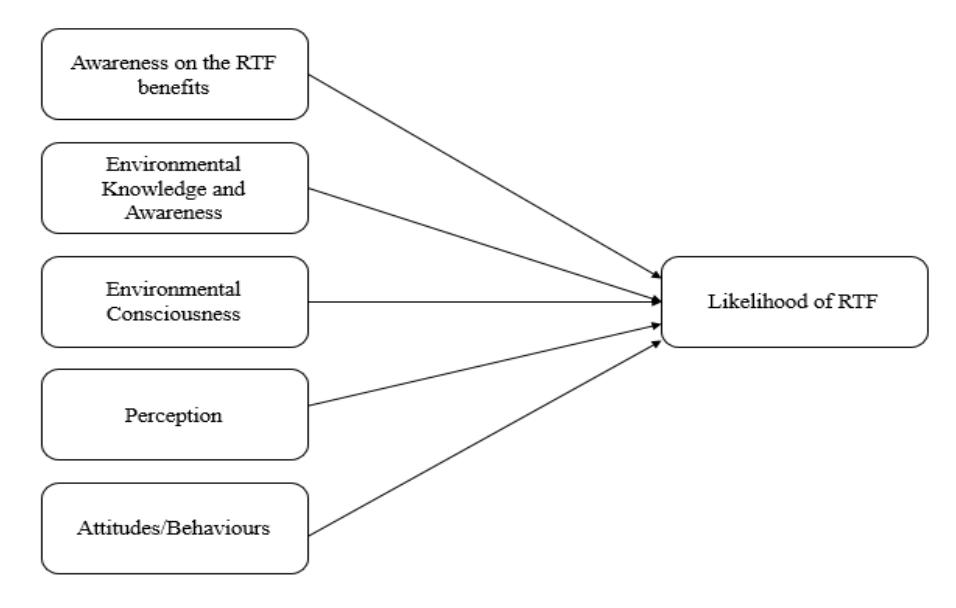
Figure 1. Research Framework.
Method and Data
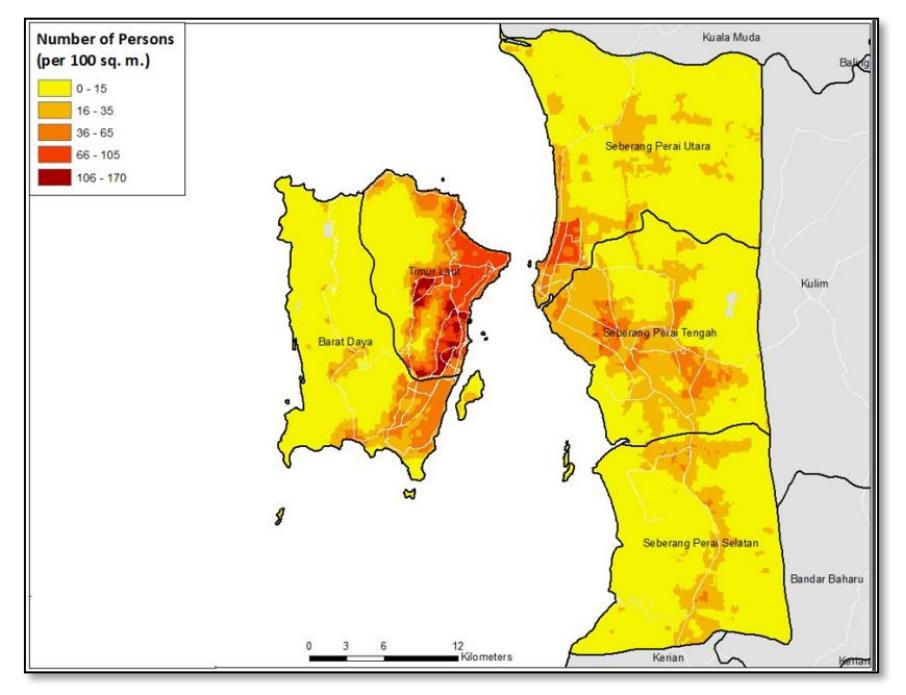
Figure 2. Population distribution, Penang Island. Source: World Bank, 2020
Penang Island is the constituent island of the second smallest state in Malaysia, with the population estimated at 794,292 people in 2020 (City Population, 2021). The island consists of two districts: Timur Laut (Northeast) district and Barat Daya (Southwest) district, with a population density of 4,677km2 and 1,374/km2 respectively (City Population, 2021). There are approximately 988 buildings on the island, mainly distributed along the east coast. Among those buildings, about 87% are used for residential purposes (Emporis, 2022).
The unit of analysis of this study were Penangites who live in high-rise residential buildings, namely, flats, apartments, and condominiums, ranging in age between 18 and 65 years old. Data were collected from the densest cities located on the east side of Penang Island, namely, Georgetown, Jelutong, Gelugor, Bayan Lepas, and Air Itam. These cities have high numbers of residential buildings. To safeguard the sufficiency and statistical power of the sample size, Krejie and Morgan's calculator was employed to determine the sample size. As the population of Penang Island is just under 800,000, the sample size needed was 323 respondents. The non-probability sampling method was used to collect the data using a well-structured questionnaire. Questionnaires were distributed among residents of high-rise residential buildings across Penang Island. Prior to the survey, the questionnaire was pretested with six respondents, consisting of residents and the management team of a high-rise residential building.
The independent variables of the study were: awareness of the benefits of RTF, environmental knowledge and awareness, environmental consciousness, perception, and attitudes/behaviors. The relationship between the likelihood of participating in RTF and its determinants was estimated using an ordered Probit model. This is an analysis with a two-step approach. First, factor analysis is conducted to obtain factor scores by using dimension reduction in SPSS; next, the ordered Probit model is estimated using Stata. A description of the independent variables is shown in Table 1.
Abbreviation Explanation Type of Data RTFBenefit RTFBenefit measures if the respondent is aware of the benefits that may brought by RTF. 6 Likert scale EnvAware Environmental awareness indicates the knowledge and awareness of the respondent of environmental matters and solutions. 6 Likert scale EnvConscious Environmental consciousness measures the respondent's feeling towards environmental issues. 6 Likert scale Attitude Attitude measures what the respondent likes and dislikes and the respondent's decisions based on their environmental attitude. 6 Likert scale Perception Perception measures the consciousness of innovative products and services of stakeholders in an urban city. 6 Likert scale
Table 1 Variable Abbreviations and Description
In the ordered Probit model, it is implicitly assumed that ɛ follows a normal distribution. Suppose the underlying relationship to be characterized is:
\[y^* = X^T \beta + \varepsilon\] where ∗ is the exact but unobserved dependent variable (perhaps the likelihood of using clickand-drive), X is the vector of independent variables, and β is the vector of regression coefficient to be estimated. Further suppose that while ∗ cannot be observed, instead the categories of response can be observed as:
\[y = \begin{cases} 0 & \text{if } y^* < 0 \\ 1 & \text{if } 0 < y^* \le u_1 \\ 2 & \text{if } u_1 < y^* \le u_2 \\ \vdots \\ N & \text{if } u_{N-1} < y^* \end{cases}\]
Then the ordered Probit technique will use the observations on y, which are a form of censored data on ∗ , to fit the parameter vector β.
Results
Table 2 presents the respondent profile of the study. Specifically, the sample consisted of 41 percent male and 59 percent female respondents. This is slightly below the statistics of males in Penang, who account for half of the population (Department of Statistics Malaysia Official Portal, 2019). The median age of the participants was 27 years, with respondent age ranging from 15 years to 64 years. About 29 percent of respondents were married. Two-thirds of respondents were employed while one-third were in the category of 'others'. Most respondents were private employees (60 percent); five percent were public servants.
| Demographic variables | Frequency | Percentage (%) | |
|---|---|---|---|
| Gender | Male | 133 | 41 |
| Female | 191 | 59 | |
| Age | 15-64 years | 320 | 99 |
| 65 years and older | 4 | 1 | |
| Marital status | Single | 230 | 71 |
| Others | 94 | 29 | |
| Occupation | Employed | 212 | 65 |
| Self-employed and others | 112 | 35 | |
| Income | B40 | 193 | 60 |
| M40 | 120 | 37 | |
| T20 | 11 | 3 | |
| Employment | Private employee | 196 | 60 |
| Public servant | 16 | 5 | |
| Self-employed | 30 | 9 | |
| Farmer | 1 | 1 | |
| Pensioner | 5 | 2 | |
| Employed | 53 | 16 | |
| Housewife | 17 | 5 | |
| Unemployed | 6 | 2 | |
| RTF feasibility | Yes | 206 | 64 |
| No | 118 | 36 | |
| Likelihood of RTF | Likely | 210 | 65 |
| Unlikely | 114 | 35 | |
Table 2. Respondent Profile
Self-employed accounted for 9 percent of respondents, while 2 percent were unemployed. Farmers, pensioners, housewives and 'others' formed the remainder. The income segments of the sample consisted for 60 percent of B40 (household income below US$ 1170), 37 percent of M40 (US$ 41170 to US$ 2650), and 3 percent of T20 (above US$ 2650).
Two-thirds of respondents expressed their interest to participate in RTF and thought that it is feasible in Penang Island. Females seemed to be more interested compared to males. Respondents without children had a higher likelihood of participating in RTF compared with respondents with children. Finally, the likelihood of participating in RTF among condominium residents was 7 percent higher compared to residents living in an apartment, and 4 percent higher compared to residents living in a flat.
Table 3 presents the result from the ordered Probit model. The Chi-square statistics (Table 3) is significant, which implies that the model is statistically significant in terms of explaining the likelihood of participating in RTF. However, the relatively low pseudo R2 (0.0883) suggests that a relatively large proportion of the variation in the likelihood of participating in RTF of the current sample was unexplained by the model. This may indicate (in common with many previous studies) that important potential explanatory variables were not included in the analysis.
| Variable | Coefficient | Robust Std. Err. |
|---|---|---|
| RTFBenefit | 0.1773 *** | 0.0569 |
| EnvAware | 0.1016 * | 0.0598 |
| EnvConscious | -0.1270 ** | 0.0558 |
| Attitude | 0.0970 | 0.0673 |
| Perception | 0.1051 ** | 0.0518 |
| Number of observations | 324 | |
| Wald chi2 (5) | 93.34 | |
| Prob > chi2 | 0.0000 | |
| Pseudo R2 | 0.0883 | |
Table 3. Ordered Probit Model Estimation Result
Among the five variables, RTFBenefit, EnvAware, EnvConscious, and Perception were significant, while Attitude was not significant. RTFBenefit was significant at 1 percent level, EnvConscious and Perception were significant at 5 percent level, while EnvAware was significant at 10 percent level.
Respondents that were aware of the benefits of RTF had a higher likelihood of participating in RTF. With a one-unit increase in RTFBenefit score, the likelihood of participating in RTF will increase by 0.18, when the other variables are held constant. With a one-unit increase in EnvAware score, the likelihood of participating in RTF will increase by 0.10, ceteris paribus. Further, with a one-unit increase in EnvConscious score, the likelihood of participating in RTF will decrease by 0.13, while the other variables are held constant. Moreover, with a one-unit increase in Perception score, the likelihood of participating in RTF will increase by 0.11, ceteris paribus.
The result revealed that Attitude plays no role in the likelihood of participating in RTF, which indicates that the likelihood of participating in RTF is not determined by individuals' attitude. In other words, the likelihood of participating in RTF is an interest that can be cultivated, since it is not based on the natural characteristics of individuals.
Log pseudolikelihood -481.16295 *** significant at the 1% level, ** significant at the 5% level, * significant at the 10% level
| RTFBenefit | EnvAware | EnvConscious | Attitude | Perception | |
|---|---|---|---|---|---|
| RTFBenefit | 1 | ||||
| EnvAware | 0.5314 | 1 | |||
| EnvConscious | 0.4714 | 0.6221 | 1 | ||
| Attitude | 0.6558 | 0.5366 | 0.4943 | 1 | |
| Perception | 0.7287 | 0.6017 | 0.5344 | 0.7520 | 1 |
Table 4. Multicollinearity Estimation Result
Table 4 shows the multicollinearity among the variables. Except for Perception and Attitude (0.7520), correlations between most variables were modest (less than 0.7).
Discussion and Implications
The result from the ordered Probit model revealed that awareness of the benefits of rooftop farming, environmental knowledge and awareness, environmental consciousness and perception are important factors that determine the likelihood in participating in the RTF. Interestingly, although environmental consciousness is significant, it had an inverse relationship with RTF. Possibly, environmentally conscious individuals are less likely to be involved in RTF. This may due to a lack of information provided by the local government on the procedure and requirements in implementing RTF (Penang Green Council, 2020). Penangites may worry that RTF will damage the roof and cause water leaking or hygienic problems for the residents. This is in line with the result of the interview that was conducted between the investigator and building management officers. According to the building management officers, RTF will not be encouraged without proper technical and legal guidelines on the implementation.
Besides, the descriptive model analysis done with the data collected shows that females have a higher likelihood of participating in RTF compared to males. This is consistent with the Food and Agriculture Organization of the United Nations (2020), which states that women may be able to understand the fundamental knowledge of agriculture more efficiently than man, which leads them to be interested in this field, thus increasing productivity, reducing hunger, and improving children's nutrition and health. Also, respondents who are single are more likely to participate in RTF than those who are married or 'others'. Probably, the number of children and time limitations are associated with marital status. Single respondents would have more time, money and energy to spend on farming. Others may be committed more heavily to family matters than social and environmental benefits. Thus, campaigns or initial RTF plans may begin to target these groups and later extend the attention to their families and friends. The local authority may assist the female community group by providing knowledge, equipment, and advance the technology of RTF to those who like to grow vegetables in a rooftop garden.
Likewise, the likelihood of participating in RTF of residents from condominiums was higher than that of residents living in an apartment or flat. Compared to flats or apartments, those who live in condominiums may be more highly educated and have a higher income. These people may have deeper knowledge of the benefits of RTF, more concern about the environment and sustainable issues. Hence, the RTF initiative or campaign could start with condominium residents. Once there are successful cases, the RTF model could be applied in flats and apartment residentials, especially government quarters flats and apartments. The local authority should start considering producing RTF guidelines to assist Penangites in implementing RTF, since about two-thirds of Penangites are likely to participate.
Conclusion
This study identified important determinants of likelihood to participate in RTF, namely, awareness of the RTF benefits, environmental knowledge and awareness, and perception. Residents that possess environmental knowledge and awareness, and a positive perception towards the benefits of RTF are more likely to participate in RTF. The findings also showed that RTF is generally acceptable for residents in Penang. Hence, it should be promoted and widely implemented on the island. RTF will enhance fresh food output and utilization of empty spaces in Penang Island for greeneries. It may also benefit consumers towards self-sustainability in a long-term perspective.
This study found that environmental consciousness may hinder the interest in RTF. Hence, to further promote RTF, especially to the environmentally conscious group, an RTF implementation guideline is crucial at this moment. Such a guideline is important to ensure that RTF is legally and properly implemented without creating leakages and damages to rooftops. The local authority has an important role to play in putting forward policies to support RTF.
To obtain a more in-depth understanding of the potential and possibility of RTF in the community, future research on urban agriculture/RTF areas may utilize different research methods. Research may apply a qualitative method to gauge detailed information from building management, local authorities, and even from the commercial buildings. The experimental research method will also be useful as it could yield tangible results that are able to convince the participants to continue efforts of their own initiative.