

Introduction
The concept of a tourist village is currently a widespread rural development trend. It aims to exploit the potential of the local environment as a tourist attraction that provides social, economic, and environmental benefits (Gavrilă-Paven, 2015). Tourist villages are one of the developing attractions in the tourism sector (Masitah, 2019). The effective development of tourism villages is contingent upon the accurate identification of the area's potential (Astiti et al., 2021; Augusty et al., 2022; Pertiwi & Nugroho., 2023; Sari et al., 2023). The existence of marketing activities in the tourism sector aims to establish sustainable and responsible development so that stakeholders can increase awareness of the importance of maintaining a balance between the goal of pursuing destination growth and maintaining the sustainability of natural, cultural, historical, social, and economic resources in these destinations. Social capital and collective action influence the realization of society's resilient capacity to adapt to crises such as the COVID-19 pandemic.
Social relationships play an important role in shaping adaptive capacity. Opportunities for adaptation arise from economic, ecological, institutional, and social capital. Adaptation through social capital can be reactive, anticipatory, spontaneous, planned, and short-term or long-term (Gulliver et al., 2022; Lioutas & Charatsari, 2021; Whitmee et al., 2015; You et al., 2022). According to the natural disaster literature, adaptation can be categorized into various types, such as preventing loss, tolerating loss, changing activities, and changing location. In this research, the concept of adaptation was investigated in relation to the post-pandemic situation in a tourist village (Pelling & High, 2005).
The tourism sector coordinates transportation, accommodation, tourists, and other related aspects. Because tourism is closely related to various aspects of life, especially economic and social, through direct interaction with tourists, steps had to be taken to suppress the spread of COVID-19. In seeking to minimize the spread of COVID-19, the Indonesian government established its Large-Scale Social Restrictions (PSBB) policy in July 2020 as a form of tourism support – a significant step for the government. The Indonesian government continued with the implementation of community activity restrictions (PPKM). This policy affected the movement of tourists, especially in tourist villages. During the PSBB and PPKM periods, tourist villages in their management had to comply with the health protocols that were in place, such as limiting the number of visitors, implementing physical distancing, using masks, and providing hand washing facilities. Some tourist villages had to temporarily close their operations to reduce the risk of spreading COVID-19. However, with the right steps, tourism villages could continue to play a role in supporting the local economy and tourism when the PSBB ends by implementing the New Normal (Dewi, 2022).
The government called on the public to change their lifestyles, referred to as the New Normal (Rathbone et al., 2022). This unique situation required people to adjust their usual daily activities (Górska et al., 2022). The New Normal encourages tourist villages to adapt by implementing innovative practices to accommodate the requirements and preferences of tourists in the postpandemic era. This encompasses the implementation of stringent health measures, the advancement of digital tourism, and the expansion of tourism offerings to align with evolving safety and comfort criteria. In light of the considerable obstacles, it is anticipated that tourist villages will undergo sustainable development in the current era of adaptation (Dewi, 2022; Maharani & Mahalika, 2020; Prachayagringkai et al., 2023; Seyitoğlu & Ivanov, 2022).
The policies set by the government of Indonesia impact all tourism related aspects, especially those very visible from the decline in tourist visits (Yang et al., 2022). Rural tourism, which is vulnerable to changes and disasters such as the COVID-19 pandemic (Guo et al., 2022), has seen a greater impact than other tourism sector areas. Sambirejo Village in the Special Region of Yogyakarta (Daerah Istimewa Yogyakarta/DIY), Indonesia was one of the tourist villages hardest hit by the COVID-19 pandemic. Sambirejo Village has various physical and non-physical tourist objects. The most famous tourist object, and the main tourist attraction in Sambirejo Village, are the Tebing Breksi. The pandemic and the policies implemented by the Government of Indonesia have decreased tourist arrivals, which has also impacted tourism income and the economy of the people in Sambirejo Village. The Tebing Breksi tourist attraction generated IDR 8 billion in revenue in 2019, which declined by 80% to IDR 1.6 billion in 2020. Inevitably, implementing social restrictions to break the distribution chain of COVID-19 directly impacted visitor numbers to the Tebing Breksi tourist attraction. Before, there were up to 20,000 visitors per day in 2019, which decreased to only around 12,000 visitors per day in 2020 (Ilyasi, 2020).
Using social capital was an important part of responding to the COVID-19 pandemic and preventing the virus from spreading further. Social capital in rural communities plays a major role in everyday life, especially in social relations, which are synonymous with close kinship relations (Shalsi et al., 2022). Social capital is a resource in social connections and interactions in life, which refers to networks owned by individuals, relationships based on trust, and reciprocal norms (Antinyan et al., 2022). Social capital can be used by communities that work together to achieve common goals and mutual success (de Neufville & Baum, 2021). Sustainable development relies heavily on the presence of social capital (Aprilia et al., 2023; Arizkha et al., 2023; Dzvimbo et al., 2023; Nugraha et al., 2022). Collaboration is based on the norms of beneficial reciprocity and trust built into the network (Gulliver et al., 2022).
Some studies have shown that trust is a non-financial attribute that governs a person's behavior throughout life (Abakar et al., 2018; Kuziemski & Misuraca, 2020). Social capital is the basic capital for successfully implementing collective action (Coleman, 1988). In addition, social capital can also overcome obstacles that occur in its performance. Collective action is an action that is not carried out unilaterally but is a joint action with the same goal, such as the common goal of building a tourist village. The success of community- and government-led collective action can be facilitated by investing in and using social capital (Kurnia, 2021). Social capital focuses on the relationship between individuals in a network and within the network it is based on strong trust and binding norms. So, with that, social capital focuses more on solidarity between individuals, tolerance, and bonds between individuals. The fact that social capital plays a role as the basic capital in social life, especially in communities in tourism development areas, is undeniable. More than that, social capital is also a form of capital needed in unwanted situations and even disasters, such as the COVID-19 pandemic (Hidayati, 2024).
Studies have explored the impact of social capital and collective action on society's resilience to crises like the COVID-19 pandemic (Kamara et al., 2019; Karimatunnisa & Pandjaitan, 2018; Malihah et al., 2021; Naafi'a, 2021; Prayitno, Dinanti, Rahmawati, et al., 2022; Prayitno, Dinanti, Efendi, et al., 2022; Prayitno et al., 2024; Putri et al., 2023; Rathnayaka et al., 2022; Siankwilimba et al., 2022; Siankwilimba, Hiddlestone-Mumford, et al., 2023; Ssennoga et al., 2022; Wu et al., 2022). For example, Naafi'a (2021) examined adaptation based on social capital among salt farmers in the face of the challenges of high-import government policy. The community took adaptive action as a form of adaptation to the difficulties they faced by trying to adjust the price of salt in the market and reduce spending (Naafi'a, 2021). Likewise, Malihah's (2021) research examined women's empowerment in adapting new habits in response to COVID-19 in villages. The community's experience, knowledge, and aspirations during the COVID-19 pandemic are the social capital that Malihah (2021) demonstrated can be used to build women's resilience (Malihah et al., 2021). Similarly, Siankwilimba et al. (2023) looked at the impact of COVID-19 on the resilience of gender market systems and supportive extension models or services (Siankwilimba, Hiddlestone-Mumford, et al., 2023).
In addition, Karimatunnisa's (2020) research has revealed that social capital utilizes capital to increase and adapt to changes that occur in social and environmental aspects after a disaster. Karimatunnisa's (2020) research shows that rural communities have good social capital. They strengthen community relations so that social capital can play a role in community resilience in disasters (Karimatunnisa & Pandjaitan, 2018). As a result, social capital is crucial to achieving collective action and forming resilient communities, which in turn constitutes a form of community adaptation to crisis and problems (Karimatunnisa & Pandjaitan, 2018; Prayitno et al., 2024; Putri et al., 2023). Even though the concept of social capital is the basic capital of implementation on which the success of collective action depends, its application is certainly not accessible due to differences in the interests and perceptions of each individual (Ssennoga et al., 2022). Thus, participation and a strong willingness to cooperate are needed to achieve collective action (Prayitno et al., 2024; Wu et al., 2022). The ability to adapt to change can identify the social resilience of a society. Through social stability, a community can overcome various risks of environmental change (Putri et al., 2023; Rathnayaka et al., 2022).
In line with this theory, collective action as an adaptive capacity for solving problems does not just appear by itself (Ssennoga et al., 2022). Rather, it is based on the initial capital in the social life of society, namely social capital. Social capital contributes to influencing the success of the implementation of collective action through the following elements: trust, which is the basis for building networks, and reciprocal norms that limit individuals from taking unilateral benefits but rather to look for mutual gain or successin achieving goals (Prayitno et al., 2024; Wu et al., 2022). Furthermore, the ability to adapt to change can help identify community resilience. Through social stability, a community can cope with the various risks of change in its environment (Putri et al., 2023; Rathnayaka et al., 2022).
This study focused on the social capital of communities living in tourist village areas and how this social capital supported the success of collective action in dealing with the COVID-19 pandemic, with a further focus on realizing community resilience in the tourism village of Sambirejo, located in Special Region of Yogyakarta, Indonesia. The findings of this study shed light on various facets, including the attributes of individuals residing in rural areas, their level of social capital, the community's reaction to the COVID-19 pandemic, and their capacity to overcome the obstacles they encountered. This study employed a quantitative methodology, utilizing two distinct analytical techniques to accomplish the research aims. The first step was to do a descriptive statistical study to elucidate the attributes of the tourist village community. This study also used structural equation modeling (SEM) to better understand and rate the connection
between three main factors: community resilience, collective action, and social capital (Y. Liu et al., 2022). This analysis was conducted within the specific context of community adaptation in managing the COVID-19 pandemic in Sambirejo Village.
Literature Review
Social Capital
Portes (Portes, 1998) explains that social capital is a form of ability that guarantees profits by utilizing membership in social networks or related structures. Meanwhile, Woolcock (Woolcock, 1998) argues differently: social capital is the degree of community social interest. In general, social capital focuses on mutual trust between people, norms that apply in their environment, and networks that the community can use to solve existing problems together. Although social capital has various forms depending on the experts referred to, in general, social capital exists in the form of rules accompanied by sanctions, imperatives and desires, power relations, constraints accompanied by sanctions; social groups formed deliberately, and social groups. Furthermore, it is unconsciously formed (Coleman, 1988).
Putnam defines social capital as formed by trust, networks, and norms (Putnam, 2000). These three forms are resources that describe social life in a society and are used as the basic capital of society to act together more effectively and responsibly in achieving common goals that have been set. The social capital variable in this study refers to Putnam's opinion. This is because these three forms of capital are the basic capital of the community in achieving a common goal, namely the development of tourism in Sambirejo village. In another context, the social capital approach can be interpreted as offering access to conceptually examine the process of adaptive capacity building. Social capital is seen as a positive value. Social capital has elements that can encourage people to behave and act productively and innovatively (Amalia, 2015; Prayitno et al., 2024; Putri et al., 2023). However, social capital is not always positive. One of the negative impacts of social capital is ostracism toward people who do not have authority; this may also happen to small communities that have a lower socio-economic status or to ethnic or minority communities. The inequality is very clear. Many cases of corruption and the growth of social control may cause negative actions to occur.
Collective Action
Collective action arises from the trust between people in the same environment and with the same goals (Villalonga-Olives & Kawachi, 2015). Collective action is systematically defined as a concept of solidarity, commitment, and collective identity. Studies agree that with unified social capital, communities have remained a united force in development while maintaining peace and tranquility over many years. Social capital could be attributed to the reason why some communities are more developed than others, as postulated by Acemoglu and Robinson (Acemoglu & Robinson, 2012). According to Kurnia, collective action can be measured in several ways, including (Kurnia, 2021):
- 1. The intensity of collective action is measured by the number of actions that are followed by the community to achieve a common goal of solving problems for the benefit of the entire community.
- 2. The variety or type of collective action is measured by the number of types of collective action followed by the community in achieving common goals.
3. The willingness to participate is measured by awareness of community participation and willingness to participate in collective action to achieve common goals.
Collective action can occur due to social capital, first in society, and then encourage joint action to achieve goals with mutual benefits (Grootaert & Van Bastelar, 2002; Prayitno et al., 2024). Collective action can be divided based on the role of the actor who drives the action (Ostrom & Ahn, 2008). For instance, several studies on social capital and adaptation during the COVID-19 pandemic have shown that collective action was carried out by more than only single individuals (Karimatunnisa & Pandjaitan, 2018; Prayitno et al., 2024; Wu et al., 2022). Todaro and Smith (2015) postulated that collective action is carried out based on initiation, both from community initiatives and from the government, especially in social life (Todaro & Smith, 2015). Because of the decentralized nature of community life, village governments were best positioned to coordinate responses to the COVID-19 epidemic in rural areas. The results demonstrated that the ownership of social capital influences the success of implementing collective action (Kamara et al., 2019; Prayitno et al., 2024; Villalonga-Olives & Kawachi, 2015). The study on Sambirejo Village expanded these results, which examined the importance of social capital in achieving community resilience in adapting during the COVID-19 pandemic through its dimensions of norms, trust, and networks.
Community Resilience
Resilience is a form of individual capacity to respond healthily and productively to adversity or trauma. Individuals who experience shocks in their lives feel anxiety, shock, and stress. In this case, resilience plays a role in controlling these feelings. Resilience also helps individuals take action and seek new experiences to see life as progress. In other words, resilience is an individual's ability to adapt to unpleasant conditions. Resilience is not only concerned with maintaining the ability to respond to disturbances, it also considers a distinction between incremental adjustments and system transformation (Nelson et al., 2007). Resilience is a form of capacity individuals possess in dealing with changes, difficulties, failures, and problems in their lives that lead to decision-making in carrying out positive actions (Panzer-krause, 2022).
Several factors affect resilience in society. First, the existence of social support for an individual is a form of supporting factor affecting resilience. Resilience is a dynamic action showing that an individual can overcome problems by showing adaptive actions when facing major obstacles or difficulties. In other words, resilience is a person's ability to rise successfully to adverse conditions despite exposure to severe risks. A study by Todaro and Smith (Todaro & Smith, 2015) found that smallholder farmers and the population have embedded resilient tenets developed over years of experience using their traditional ecosystems. This is an area (Siankwilimba, Mumba, et al., 2023) delved deeper into exploring bio ecosystems and sustainable resilience. However, the magnitude of resilience differs from one community to another depending on leadership and predisposing factors such as environmental and economic conditions.
Community Adaptation Patterns
Adaptation is the effort of communities, individuals, or humans to survive by adjusting their activities, life paths, and location conditions to create opportunities that can be used to increase capacity. Adaptation is a community's method of making decisions and taking action to increase its ability to deal with future environmental disturbances or changes (Nelson et al., 2007). The concept of adaptation is sometimes forced on local communities because of unwanted changes coming from outside (Adger, 2003; Arfidiandra et al., 2020; Prayitno, Dinanti, Rahmawati, et al., 2022) Increasing individual capacity due to adaptation action is one of the tangible forms of good governance and management structure. Therefore, increasing the capacity of an individual, group, or organizational institution to adapt to change can be undertaken by transforming the capacity into action. In doing so, individual adaptive qualities can be realized. Thus, adaptive action is one of the efforts to make decisions, take action, and change attitudes to respond to all aspects of life and reflect the existing social norms to respond to environmental change (Nelson et al., 2007).
Individuals can undertake adaptation to improve their capacity to respond to environmental changes. Adaptation to environmental change can be interpreted as adjusting to the observed difference. In addition, the adaptation process is expected to respond to stimuli from the external environment that hurt, reducing adverse change. In increasing community resilience, some mechanisms or systems are still maintained to control the function, structure, and number of changes. A sound resilience management system is necessary, and flexibility must be prioritized to maintain community stability. Most systems-thinking scholars have submitted that community adaptivity can be learned in schools and through experience (Peters, 2014; Sterman & Isenberg, 2000; Villalonga-Olives & Kawachi, 2015). Although it can be known, other scholars have deemed it a complex system that measures community resilience to new complex challenges (Duboz et al., 2018; Peters, 2014; Villalonga-Olives & Kawachi, 2015).
Social Capital, Adaptation, and Collective Action
Social capital is human capital used in social interaction and achieving goals. Social capital also contributes to the success of implementing collective action as a form of activity in dealing with a pandemic. There are various types and levels of collective action, among them individual-level, formal, or group-level informal. These actions usually solve problems and become solutions in a movement that demands joint success. Adaptation to changes due to COVID-19 is defined as a decision-making process and a form of action that describes the community's efforts to deal with changes that have occurred in their lives, both changes that have happened, are happening, and will happen in the future (Nelson et al., 2007).
Social capital is important in realizing common goals that cannot be achieved individually. Dealing with non-physical shocks or disasters such as COVID-19, especially in rural communities with close kinship relationships, is urgently needed. Social capital is the capital that underlies people's desires and movements in acting so that the condition of social capital is reflected through trust, norms, and good networks. Then, the chance of success of the actions taken is also high. Through social capital, people will work together and find solutions to their problems to create community resilience. Community resilience can be realized through various collective actions sought by the community to overcome existing issues (Kurnia, 2021). Several studies by social scientists have argued that a collective responsibility gives rise to oneness or togetherness in achieving set goals and missions (Prayitno, Dinanti, Rahmawati, et al., 2022).
Methods
Based on the research objectives to be achieved, the approach method used was quantitative. The determination of this approach was based on input in descriptive statistical analysis and SEM analysis using ordinal data (1-5) from the results of the primary survey through a questionnaire. Descriptive statistical analysis was used to explain the characteristics of the respondents in Sambirejo Village. The structural model relating social capital variables, collective action, and community resilience was tested, analyzed, and described in this research using SEM analysis. The utilization of SEM analysis in this research is justified due to its ability to depict a multifaceted relationship model between variables that is not solely unidirectional but also mutually influential.
SEM analysis enables the modeling of latent variables that possess several formation indicators, hence facilitating the measurement of intricate constructs such as social capital, collective action, and resilience. The current study also used SEM analysis to investigate a complex and multifaceted research question. Specifically, it looked at the connection between community social capital and collective action in dealing with the problems caused by the COVID-19 epidemic, to make communities stronger. SEM was used to model the three variables of social capital, collective action, and community resilience to describe the adaptation patterns carried out by residents of Sambirejo Village (Y. Liu et al., 2021).
The input data were obtained from the results of a questionnaire on social capital, societal adaptation, and group action for this research, collected through a series of in-depth interviews with key persons in Sambirejo Village, such as the head of Sambirejo Village, the Secretary, the Director of BUMDes (Village Owned Enterprises Agency), and the Head of Pokdarwis (Tourism Awareness Group). Social capital, collective action, and resilience were determined using a questionnaire. The questionnaire questions were adjusted based on the research indicators. One of the indicators was the social capital variable trust in fellow villagers. Questionnaire questions included: 'Do you really trust your fellow citizens?' Likewise, the collective action and community resilience variables were adjusted to each of their constituent indicators (Figure 1).
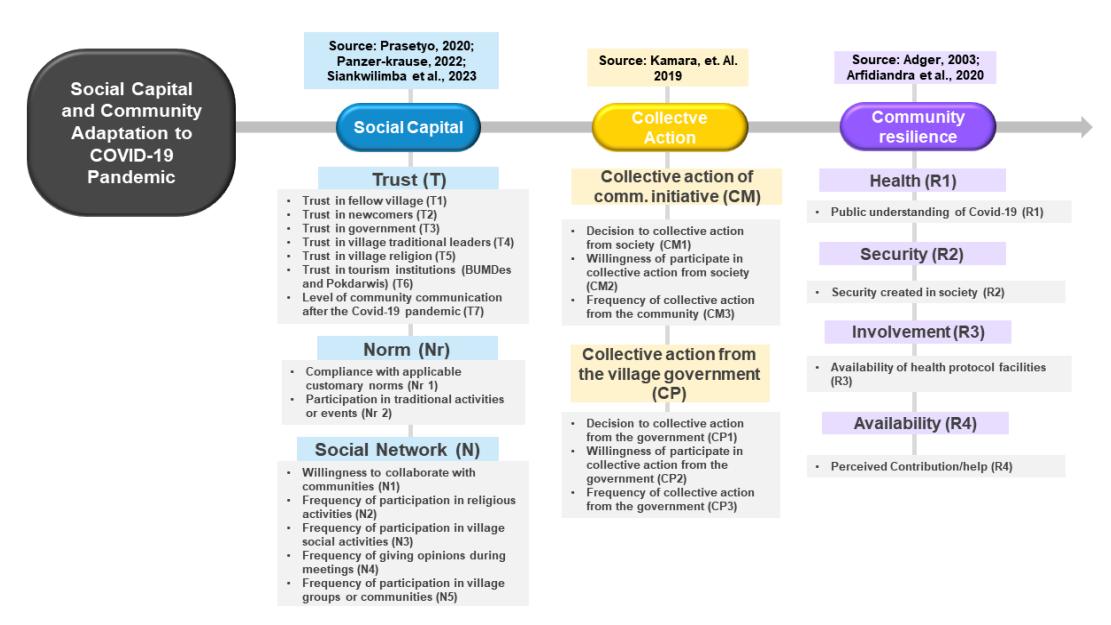
Figure 1. Research variables.
Questionnaire data collection was carried out during the post-COVID-19 pandemic period on July 22, 2022, in Sambirejo Village. This research accessed a population of 5,648 residents in Sambirejo Village, and used probability sampling, or proportionate random sampling. The distribution of samples in this study was based on the number of hamlets in Sambirejo Village. The distribution of sample proportions based on hamlets included Sumberwatu Hamlet with 24 samples, Dawangsari Hamlet with 50 samples, Kikis Hamlet with 106 samples, Gedang Hamlet with 59 samples, Mlakan Hamlet with 79 samples, Gunungcilik Hamlet with 46 samples, Gunungsari Hamlet with 74 samples, and 62 samples from Nglekong Hamlet. The number of respondents totaled 500. This amount was necessary to prevent bias in the research and satisfy
SEM analysis's minimal data processing requirements to model the research results. For SEM to be effective, there have to be 200 to 400 respondents in each effective sample size (Narimawati & Sarwono, 2007).
Semi-structured interviews were conducted. Semi-structured interviews are a type of interview process that uses an interview guide developed from topic selection and questioning; they can be used in various situations, unlike structured interviews (Sugiyono, 2016). By asking the parties invited to the interview for their thoughts and opinions, this type of interview aims to identify issues more directly. The interviewees included farmers in the Sambirejo Village and employees of Tebing Breksi; it is possible that some Tebing Breksi employees also worked as farmers. The questionnaires were distributed proportionally and evenly over the three hamlets, which were expected to reflect the overall condition of Sambirejo Village.
Structured interviews were used to support the results of the SEM analysis and descriptive statistical analysis. The structured interviews allowed for a deeper contextual understanding of the conditions of the village and the community in it, both in social, cultural, and environmental contexts. This is important to enrich the interpretation of the SEM analysis results with the relevant context. Furthermore, in descriptive statistical analysis, structured interviews provide a clear picture of the sample characteristics and distribution of variables needed to provide an interpretation of the results. Using structured interviews not only helps to understand how social and cultural factors affect the variables that are studied but also leads to a more in-depth conversation about how to understand the outcomes of descriptive statistics and SEM analysis. Social capital has three components, namely trust (T), social norms (Nr), and social networks (N). Collective action includes government action, as taken by the Sambirejo Village government's departments with their respective authorities, and community action, as taken by the Sambirejo Village community itself (Antinyan et al., 2022; Ostrom & Ahn, 2008). Community resilience consists of people's understanding of COVID-19, security created in the community, availability of facilities that support protection in the form of health protocols, and contribution/assistance that is felt (Chandra et al., 2018; Yip et al., 2021). Refer to Figure 1 for a detailed explanation of the research variables and sources.
Confirmatory Factor Analysis (CFA) Measures for Each Indicator of Social Capital
The initial step in the first stage of SEM analysis involved confirming the model using the data obtained from the research questionnaire. Confirmatory Factor Analysis (CFA) is the stage that specifically examines social capital variables such as trust, social networks, and norms. A CFA was conducted to ascertain the accuracy of all social capital variables. Subsequently, a SEM analysis was conducted to investigate the association between latent variables. This level encompasses the inclusion of social capital, collective action, and community resilience as variables. The SEM analysis findings demonstrated the magnitude of the impact exerted by each of these variables. This study employed SEM analysis to test the hypothesis that social capital and collective action play a significant role in shaping society's capacity to confront crises such as the COVID-19 pandemic. The primary objective was to assess society's resilience in adapting to such challenges. CFA analysis was carried out before carrying out the SEM analysis. CFA analysis confirms whether all indicators can describe the variables studied (Haryono, 2016). Then, social capital variables were described in the constructs in the CFA, tested and described in the CFA analysis model. The output from the CFA analysis was then used as input for the SEM analysis.
Relation between Community Resilience and Social Capital
The following analysis is a SEM analysis. This is the second generation of analysis for analyzing relationships that can be used to measure indicators and variables and simultaneously handle measurement errors. Through SEM analysis, the hypothesis testing between latent variables can be described (Holipah et al., 2019). This is because SEM is a multivariate analysis showing causation so a linear relationship between observational and latent variables can be described in the SEM model (Ismail, 2022). The structural model of SEM was characterized and tested in this study to determine the relationship between the constructs of social capital variables, collective action variables, and community resilience variables for people in the study area during the COVID-19 pandemic. The community of Sambirejo was organized into a single model to make it easier to spot the interconnections between its various components.
Results
Research Location Characteristics
Sambirejo Village, the focus of this study, is located in the Special Region of Yogyakarta (Daerah Istimewa Yogyakarta/DIY) (Figure 2) and has become one of Indonesia's most popular tourist destinations thanks to its successful efforts to cultivate its inherent tourist attractions.
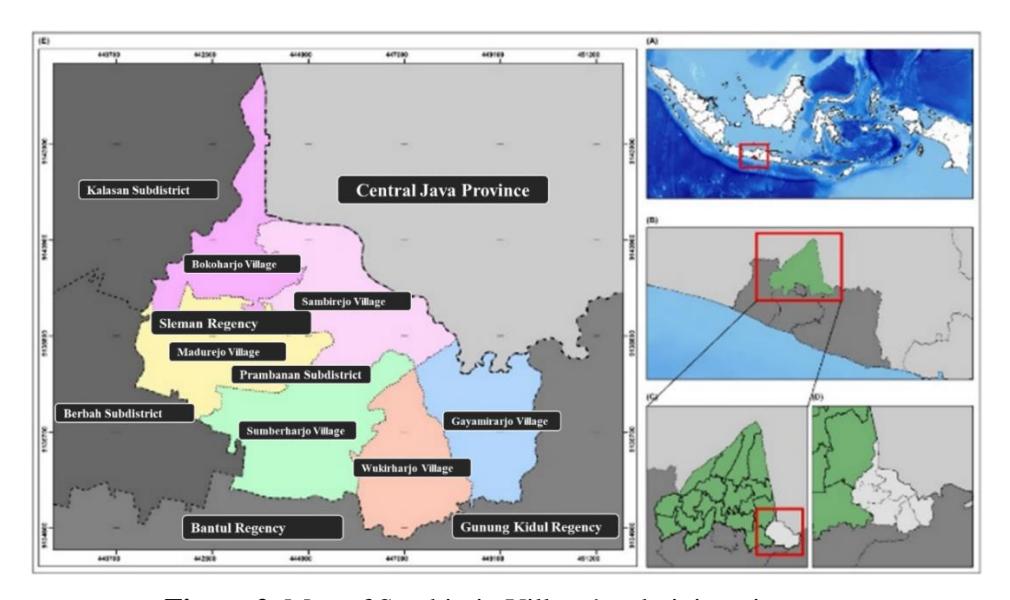
Figure 2. Map of Sambirejo Village's administrative area.
In conducting this study, it was important to first determine the characteristics of Sambirejo Village's community. This study was conducted to determine the characteristics of the respondents in terms of age, gender, education level, income level, and type of work (Table 1). In line with Wang (Wang et al., 2021), the community's traits affect people's decisions when confronted with ongoing change. Of the 500 respondents, 88%, or 441 people, were of working age (15-65) or older. The increased availability of physically and intellectually capable people in Sambirejo Village may present a chance to expand the local tourism industry. Of the respondents, 356 (71%) of the respondents were male. The large percentage of male respondents highlights the significance of men's involvement in the Sambirejo Village infrastructure development and tourism destination administration. In the Sambirejo Village, men are seen to play a significant role in many facets of the tourism industry. The majority are former miners from Tebing Breksi who have switched careers. However, women – the majority of whom are the spouses of former miners – tend to work in the tourism industry in sales and service roles, such as operating food booths at Tebing Breksi's food court or as street sellers. Some women also run stores in popular tourist destinations.
| Demographic | Characteristics | Number |
|---|---|---|
| Gender | Male | 359 |
| Female | 141 | |
| Age | Young age (0-14) | 0 |
| Productive age (15-64) | 382 | |
| Elderly (>65) | 118 | |
| Main occupation | Farmers | 298 |
| Farm worker | 78 | |
| Civil servant | 159 | |
| Entrepreneur | 32 | |
| Trader | 10 | |
| Member of People's Representative Council | 1 | |
| Income (IDR) | Less than Real Minimum Wage (RMW) of the region | 345 |
| More than Real Minimum Wage (RMW) of the region | 155 |
Table 1. Respondent Characteristics
Around 15% (73) of the respondents were uneducated; 34% (172) were elementary school graduates; 20% (99) were junior high school graduates; and 25% (126) were senior high school graduates. The remainder were graduates of associate programs and bachelor's programs. The data indicated that the education level of the respondents in Sambirejo Village was relatively low. Of the respondents, 121 (24.2%) worked as farmers and laborers. Studies have shown that rural dwellers in developing countries are engaged in agricultural activities for their livelihoods (Maulu et al., 2021; Siankwilimba, 2021). Few respondents held positions as employees, civil servants, entrepreneurs, or builders. A number of respondents also had tourism-related secondary jobs. Many of the respondents worked as officers at Tebing Breksi, such as ticketing officers, photographers, food sellers, parking attendants, patrol officers, and managers. This was based on the decision of the Village Government, in collaboration with BUMDes and Pokdarwis Tlatar Seneng, to involve ex-miners in the management of Tebing Breksi tourism. There were more than 500 villagers in Sambirejo working at Tebing Breksi Tourism.
The respondents' ability to secure income depends on their education and employment. Of those polled, 69% earn less than the real minimum wage (RMW) of Sleman Regency, which is IDR 1,839,429.56 per month. The income of a significant section of the people living in Sambirejo Village is undetermined because they are farmers. The harvest season was crucial to the farmers' income during the COVID-19 pandemic. Several respondents reported that selling their agricultural products was difficult. Education affects the minimum wage; individuals with a low level of education typically earn the minimum wage or less.
Confirmatory Factor Analysis (CFA)
This study used CFA to identify reliable measures of social capital's three components: social norms, trust, and social networks. Fourteen pre-CFA social capital variables (Table 2) needed verification. Indicators that did not fulfill the criteria or were invalid based on the loading factor value were removed from the CFA procedure. If the indicator's loading factor is less than 0.700, it can be considered legitimate. Indicators T2, T4, T6, T7, N2, N5, and Nr1 were all incorrect in the initial CFA model. The vast majority of the calculated composite reliability values for latent variables/constructs had higher significance than 0.700 (trust: 0.799 and social network 0.795), with only social norm having significance less than 0.700 (social norm: 0.698).
Based on their loading factor values, several indicators were deemed invalid or unsuitable for use. For example, T2, T4, T6, and T7 were all disregarded signs on the confidence variable. Meanwhile, N2 was one of the indicators left out of consideration for the social network variable, while Nr1 was left out for the social norm variable. Yet, the composite reliability value was still less than 0.700 in the norm variable. The trust variable composite reliability maxed out at 0.840. Therefore, after identifying the invalid indicators to be discarded, the next stage of CFA was the recalculation of the new model using the inputs from the first step (Figure 3).
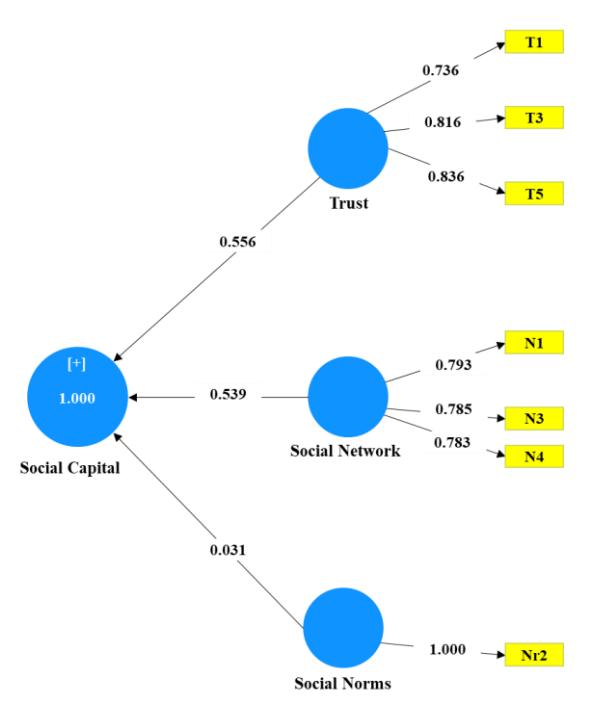
Figure 3. Second stage of CFA.
The second model (Figure 3) demonstrates that all indicators were correct, so none were eliminated. Indicators of social capital were broken down into seven categories in the second model. Furthermore, the composite reliability was between 0.83 and 1.00, which shows that each component in the model used in this study accounted for more than 50% of the variance in the results (trust: 0.839, norm: 1.000, and social network: 0.830). The highest composite reliability value of 1.000 was in the norm variable. The composite reliability value of 0.830 for the social network variable was the lowest value.
The CFA's second stage found seven indicators of social capital, all indicators were more than 0.700 (valid). For example, trust in others (T1), trust in the village government (T3), trust in a local religious leader (T5), participation in daily events or activities (Nr2), willingness to work together for the common good (N1), involvement in community social activities (N3), and openness to voicing one's opinion (N4) are all indicators that can be used to gauge the state of a society's social capital.
Social Capital, Collective Action, and Adaptation in Rural Areas
SEM examined the connection between Sambirejo villagers' social capital, collective activity, and adaptation. Two models were compared to examine the dynamic between social capital, collective action, and resilience in Sambirejo Village (Figure 4 and 5).
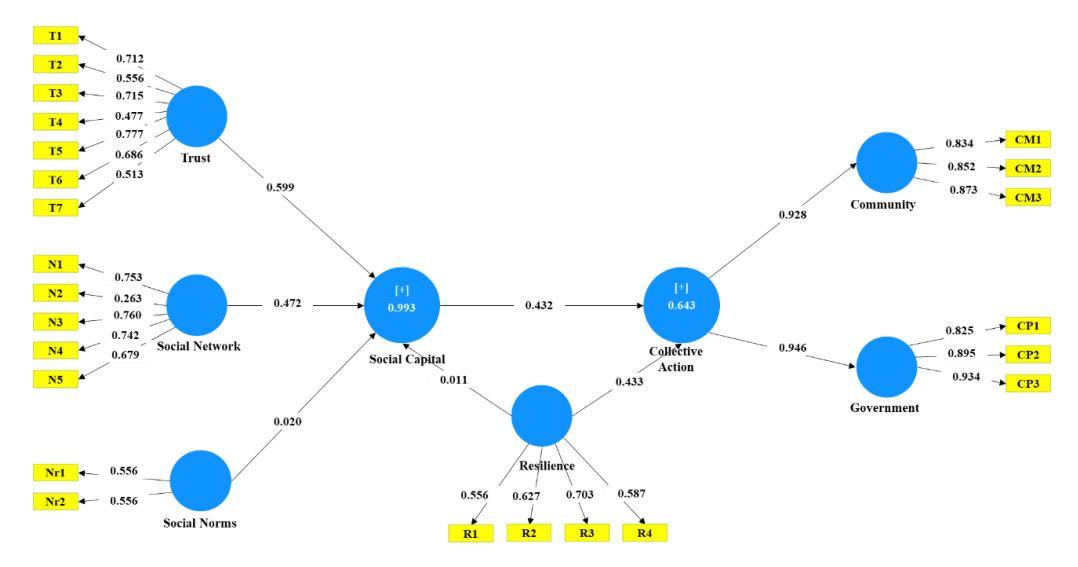
Figure 4. First SEM model.
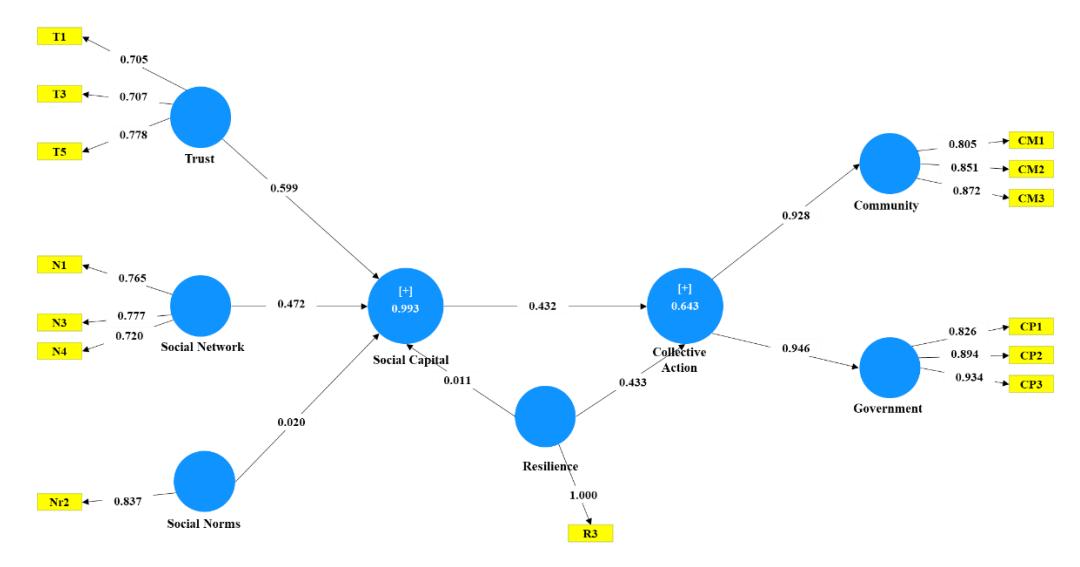
Figure 5. Second SEM model.
Model 1 of SEM (Figure 4) shows that the social network variable was directly related to trust and social norms via route coefficients. In addition, the path coefficient shows that social capital and collective action were directly related latent variables. The third latent variable, resilience, was associated with the first two. Since the outer loading value was more than 0.700, the six collective action indicator feasibility test findings did not lead to eliminating any indicators from the model.
Model 2 (Figure 5) shows a unidirectional association between trust and social norms, path coefficients, and network variables. In addition, the latent quality of life and resilience variables were directly related to the path coefficient of social capital. As shown in Table 2, the instrument feasibility test found that three indicators for the latent resilience variable were not reliable because their loading factor value was less than 0.700. The value of the R square calculation shows that it was 0.999 for social capital (very good). The R square for social capital indicates that trust, social networks, and social norms may account for a full 100% of the variance in the exogenous latent variable. Therefore, with an R square value of 0.552, the endogenous collective action variable is explained by the social capital variable (with a value of 0.999).
| Variable | Indicator | Loading Factor | Validity |
|---|---|---|---|
| Trust | T1 | 0.705 | Valid/Accept |
| T3 | 0.707 | Valid/Accept | |
| T5 | 0.778 | Valid/Accept | |
| Social Norm | Nr2 | 0.837 | Valid/Accept |
| Social Network | N1 | 0.765 | Valid/Accept |
| N3 | 0.777 | Valid/Accept | |
| N4 | 0720 | Valid/Accept | |
| Collective Action | CM1 | 0.805 | Valid/Accept |
| CM2 | 0.851 | Valid/Accept | |
| CM3 | 0.872 | Valid/Accept | |
| CP1 | 0.826 | Valid/Accept | |
| CP2 | 0.894 | Valid/Accept | |
| CP3 | 0.934 | Valid/Accept | |
| Resilience | R3 | 1.000 | Valid/Accept |
Table 2. Model Fit of SEM.
Discussions
Results from structural equation modeling suggest that social capital, collective action, and community resilience all play a role in Sambirejo Village's ability to adapt to the COVID-19 pandemic. Coleman's (1988) theory that social capital may make the occurrence of collective action more likely (Prasetyo, 2020) is supported by the observation that this association exists, which is consistent with Coleman's theory. Following this, social capital, and collective action develop community resilience, which is ultimately needed to overcome the already existing issues (Islami & Umiyati, 2020). Similarly, in Sambirejo Village, residents were urged to pool their resources and work together to stop the spread of the deadly COVID-19 virus. Trust, social standards, and social networks are all components of social capital in a community. Further, as shown by the second SEM model (Figure 4), trust is the element that has the most significant impact on the success of collective action in Sambirejo Village, as shown by the findings of this research. Residents of Sambirejo Village were willing to make collaborative efforts to combat the COVID-19 epidemic because the level of trust between their neighbors and the Sambirejo Village authority is high. Due to the availability of social capital, the community is equipped with the resources necessary to address the difficulties by the COVID-19 outbreak (Archambault & Ehrhardt, 2022). More effectiveness and efficiency are the results when social capital is high. Trust and the free exchange of information are the two most valuable forms of social capital. One of the most crucial factors in establishing both official and informal social networks is trust, which serves as the bedrock of social capital. The information gained through trust can then be transformed into knowledge that can be employed and traded (Prayitno et al., 2024).
The level of involvement in activities or events is the factor that leads the community of Sambirejo Village to take collective action (Jackman & Miller, 1998). The research findings align with the observations made in the field by individuals directly involved in tourism-related activities, such as managers, parking attendants, photographers, patrol officers, and food sellers. The extent to which individuals participate in gatherings or pursuits organized by the community is another factor that influences the value of social networks' contributions to social capital (J. Liu et al., 2014). Sambirejo Village was encouraged to be ready to meet the New Normal brought on by the COVID-19 pandemic due to the positive interactions between the village communities and the village government. The presence of social capital affects the expansion of economic growth and the facilitation of development. Under this situation, enhancing social capital is essential, particularly for the sake of the local community's economy. In light of the current circumstances where the COVID-19 pandemic was affecting the economic collapse of the Sambirejo Village community, social capital could stimulate cooperation in other collective acts to develop community resilience. The development of a society capable of withstanding a variety of social and economic pressures through adaptation is an essential component of the overall goal of creating a resilient community. On the other hand, adaptation is a task that must be overcome. In this scenario, the function of social capital is to be found in networks and interactions with other people (Prayitno et al., 2024; Putri et al., 2023).
The hamlet's government in Sambirejo is preparing for the community's readiness to mature and adapt to new circumstances. The resiliency of Sambirejo Village can be supported through collective efforts, including collective acts taken by the community and collective measures taken by the village authorities. The following are examples of collaborative activity that occurred in Sambirejo Village:
(1) From the community:
a. Security activities, carried out in the form of night patrols to guarantee the protection of the community environment during the COVID-19 pandemic.
(2) From the village government:
- a. Education concerning COVID-19, as an appeal to prevent the spread of COVID-19, information about COVID-19 was disseminated at the neighborhood, hamlet, and village levels through village heads, billboards, and banners.
- b. Since the beginning of the COVID-19 epidemic in 2020, low-income citizens were eligible for monthly financial assistance and food aid.
- c. The establishment of infrastructure facilities cooperated with Bank Pembangunan Daerah (Regional Development Banks of Yogyakarta) to prevent the spread of COVID-19, including the distribution of free masks, the installation of handwashing stations equipped with water and soap, and the routine application of disinfectant (Figure 6).
Figure 6. The village government cooperated with Bank Pembangunan Daerah (Regional Development Banks of Yogyakarta) to provide sinks and soap at Tebing Breksi.
According to the CFA and SEM analyses, the people living in Sambirejo village had healthy levels of social capital. In addition, they had such high trust in one another that it motivated them to take collective action. This helped to strengthen the community's ability to bounce back from adversity in Sambirejo Village.
Conclusion
This research proved the important role of social capital, collective action and community resilience in adapting to the challenges of the COVID-19 pandemic in Sambirejo Village. Overall, the main result is that social capital drives community collective action and ultimately contributes to community resilience. This is proven in this research hypothesis, that social capital is capital that facilitates communities in collaborating to face challenges and recover from the impact of the COVID-19 pandemic. Trust is a component of social capital that influences the success of collective action. Through trust between communities, it becomes capital that mitigates the impact of the pandemic, where the collection and distribution of resources is more easily distributed and on target. The results of this research also highlight that the role of social capital is important in the economy, this is reflected in the cooperation that exists between communities and community resilience. Furthermore, the results of this research show that the social capital of rural communities in Sambirejo Village has used collective action to support the implementation of the tourist village concept, thereby increasing the village's potential as a tourist destination. Future recommendations are to maintain and strengthen social capital, which can be achieved by fostering involvement in community activities. Apart from that, collaboration is needed between the government and other parties such as the community and business actors. Through this collaboration, it is hoped that cooperation and unity can be achieved in achieving common goals. More than that, considering that Sambirejo Village has great tourism potential, it is important to implement sustainable tourism, which will maintain sustainability not only in the economic aspect but also as a form of community anticipatory resilience when unexpected situations such as a pandemic occur.
Acknowledgement
Financial support for this research was provided by the DRTPM, the Ministry of Education, Culture, Research, and Technology, and LPPM Universitas Brawijaya (Contract No. 708.14/UN10.C10/TU/2023).