

Introduction
Since China opened up and began its reforms in the late 20th century, the country has witnessed one of the most rapid and expansive urbanization trajectories the world has ever seen. Moving away from an agriculture-based economy, China's transition to urbanization has driven its economic boom, lifting hundreds of millions out of poverty (J. Zhang, 2021). This urban expansion has undoubtedly brought great benefits to the nation's economy, but it has also widened existing socio-economic inequalities. One of the greatest income inequalities is between urban areas and rural areas; the latter are now behind in income levels, employment, and access to basic services (Zhong et al., 2022a).
The income gap is exceptionally pronounced in western China. These areas have always suffered severe structural constraints in infrastructure, economy, and industrialization, compared to the more affluent eastern provinces. Although income inequality in the western regions has gradually improved since 2022, starting from a Gini coefficient of 0.471, the urban-rural gap still remains quite high (OECD, 2022). Bridging this gap is a central objective of China's broader development strategy, as the country strives towards 'common prosperity' and an even distribution of economic opportunities for all.
New-Type Urbanization (NTU) was first instituted in China through the formal adoption of the National New-Type Urbanization Plan (2014-2020), which in itself became a strategic policy model. What is fundamentally different about urbanization of quotas from normal urbanization is that urbanization no longer transforms land uses and configurations or breaks ground for infrastructural mega-construction in a city. In a radical break with earlier approaches, NTU is essentially people-centered, with special emphasis on 1) transforming rural migrants into urban citizens with full access to public services; 2) environmental sustainability; and 3) addressing the goal of reducing regional disparities. The essence of the innovation in NTU is that smaller and medium-sized cities, especially county towns, should develop as integrated urban-rural hubs rather than relying on a few big metropolitan cities for such development (M. Chen et al., 2016).
The global debate on urbanization between agglomeration economies and spatial inequality is stalled in a deadlock (Harvey, 2009). The NTU strategy in China is an interesting state-led model for imposing agglomeration economies to address spatial inequality. There is, however, little empirical evidence for the argument's efficacy, particularly in less developed regions. Most studies focus on national aggregates or on the developed eastern regions in China, leaving a knowledge gap in hinterland areas such as western China. This study attempted to fill that gap, adding an international perspective to the research to glean whether and how such a policy-led decentralized urbanization model might be a feasible option for other developing countries in their quest for inclusive growth without the intensification of extreme urban primacy and spatial inequalities that have oftentimes afflicted the process of rapid urbanization in Latin America, Africa, and parts of Asia.
At the 20th National Congress of the Communist Party of China in 2022, the country's urbanization strategy underwent a major revision, now emphasizing a people-centered approach. The previous paradigm focused on increasing city sizes and infrastructure development, while the conventional paradigm emphasizes improving urban quality of life. Rural-urban integration is one of the most important objectives, using county towns as major nodes. That is exactly what it represents: a shift from the earlier model, which was biased toward megacities, to decentralization and balance that benefits rural residents, especially those in western China.
Theoretical conjectures link income inequality to New-Type Urbanization in two ways: through economic transformation and public service provision. Economic transformation, in this sense, results in the upgrading and diversification of county towns, creating non-farm job opportunities for rural residents. Thereby, rural residents may shift directly from low-paying agricultural work to high-paying industrial and service work without the added burden of moving far from their rural settlements. This directly affects an increase in income for rural people (J. Zhang et al., 2023; Zhong et al., 2022b). In the meantime, better public service guarantees, say, better education and health services, as well as better roads in the rural areas and nearby towns further reduce the costs of living and vulnerability faced by rural households, boost human capital, bring overall improvement in well-being, and therefore increase indirect investment income conversion (He et al., 2025).
This research examined how NTU affects the income gap between typical urban and rural populations in western China, grounded in these strategic priorities. The special panel data set comprised 176 counties across 21 regions, spanning 2013 to 2022. A comprehensive index of New-Type Urbanization was developed to conduct regression analyses in empirical tests to determine whether this shift can narrow the urban-rural income gap. The research evaluated the effects of urbanization at the county and city levels to determine whether prioritizing a larger reduction in income inequality would lead to a substantial shift toward county towns.
This study analyzed the different impacts of NTU across various levels of jurisdictional transformation, particularly on the economic welfare of urban and rural inhabitants, specifically in western China. The relationship between NTU and income distribution was empirically studied and important insight was drawn for policy formulation to guide a more just socioeconomic development framework in China at a deeper level than mere dollar-counting. The results of the study are therefore expected to be useful for regional policymakers, since socioeconomic inequality will be reduced even as the fullest possible resources are committed to maximizing the returns of urbanization.
The study enriches academic discourse in several significant ways. It offers first-hand empirical evidence on the locus of decision-making regarding urbanization policy and shows that in western China, county-led urbanization is a more potent equalizer than city-level urbanization. The NTU index is further decomposed into constituent parts amenable to historical and quantitative analysis. One cannot deny the importance of economic transformation and public services, regarded as two distinctive mechanisms for addressing inequality. Most importantly, this research further supports the argument that large cities are not the best conduits for convergence and growth, thereby advancing a more universally appealing belief in models of spatially balanced development into the public discourse on urbanization and inequality.
Literature Review
The nexus between urbanization and income inequality has attracted considerable academic attention for a long time. Many studies have investigated how urbanization may affect income inequality, especially between urban and rural populations. Meanwhile, the precise effect of urbanization on income inequality remains a hotly debated topic, especially given China's peculiar reform path. The different facets of urbanization have been studied for their effects on industrial growth and public service provision, as well as on labor market dynamics and migration.
The Impact of Urbanization on Income Inequality
The Kuznets postulate has been a vital point in the debate on urbanization and income inequality. According to Kuznets, income inequality tends to increase during the early stages of economic development and urbanization; ultimately, it will begin to decline when a particular level of development is reached. Empirical tests done in China showed contradictory results. The research by Yao and Jiang (2021) indicates that increased urbanization may also help in reducing the urban-rural income gap. This means that the most significant opportunities for higher-paid employment seem to arise mainly from industrialization and diversification in urban economies, leading to a loss of urban-associated jobs, with some positive effects on rural access to infrastructure and services that may lead to better living standards and less poverty. In contrast, Wu and Rao (2017) contend that the early-stage effects of urbanization aggravated income inequality in China. They argue that urbanization deepened regional differences, concentrating wealth in cities and leaving rural areas behind.
Inequality is a complex subject closely linked to urban concentration. In certain research findings, higher urban primacy implied increased national inequality, whereas a more polycentric urban system enjoyed a positive relationship with inclusive development (Glaeser & Maré, 2001; He et al., 2024). This affirms the literature on planning and development, which hails 'secondary city development' as a regional balancing endeavor (UN-Habitat, 2022). Thus, China's NTU, which focuses on county towns, is a large-scale experiment in this development
strategy. It implements the 'urban-rural linkages' notion stressed in Sustainable Development Goal 11 to produce functional territories that bridge the urban-rural divide (UN-Habitat, 2019).
In recent years, however, it has been argued that a new form of urbanization in China that was introduced after the 18th National Congress of the Communist Party in 2012 should adopt a more inclusive development model, which would promote the well-being of people in contrast with mere economic growth, focusing on optimizing industrial structures and public services. Unlike in the past, where urbanization was mostly done in large cities, the new model considers the development of counties and small towns as important centers of regional integration and more balanced urban-rural development.
Heterogeneous Effects of Urbanization at Different Administrative Levels
A region's effectiveness in its urbanization should therefore be assessed by its effects on the urban-rural income gap, while keeping in mind that these effects vary greatly across administrative levels. In recent times, the feasibility of decentralizing urbanization has gained more attention, at least from the perspective of promoting more county-level urbanization to rectify regional inequalities.
Shi et al. (2022) confirmed the significance of county-level urbanization as a vital factor to spatially balance regional development through industrialization and improvement of living standards in less-developed areas. This viewpoint aligns with a national policy shift outlined in the 2022 Opinions, which promotes urbanization and positions county towns as key hubs. According to Pan et al. (2023), county towns are important linkages between rural and urban areas and as such constitute significant sites for promoting inclusive economic growth. By promoting small towns of this kind, the Chinese government aims to turn rural areas into vibrant economic spaces, helping to bridge the urban-rural income gap.
Theoretically, a smaller town that is also the county seat is assumed to exert a greater spillover effect on the surrounding countryside than larger city districts farther away. This brings about proximity to the distribution of socioeconomic opportunities, technologies, and infrastructure (X. Zhang et al., 2024). This is also in line with the principle of inclusive growth, because it anticipates greater participation by the people in the development process. County towns, which are links, bring down the barriers to accessing the urban economies and public facilities for rural residents, making this urbanization process even more inclusive and directly favorable to the rural populace (Li et al., 2024).
Previous studies have quantitatively analyzed the relationship between county-level urbanization and income inequality. Yu, Hu & Hou (2024) recommend that this new countylevel urbanization can promote income distribution by improving public service access and employment opportunities for rural residents. Urbanization at the county level is also believed to offer a more sustainable solution to the income gap through resource redistribution and broader sharing of urbanization benefits, especially in western China, where rural populations are said to have been disadvantaged in accessing large-scale urbanization benefits.
Economic Transformation and Public Service Provision
A focal point in the new and emerging urbanization paradigm is economic change and improvements in the delivery of public services. Some authors, such as Ma et al. (2025) and Xia et al. (2024), contend that this form of urbanization transforms the economy to reduce the urban-rural income gap through industrial upgrading, new job creation, and increased productivity in both urban and rural areas. Through this, investment attraction, local economic development, and income increases for urban and rural people can be achieved by facilitating the optimization of industrial structures in county towns and small cities.
Besides economic transformation, what NTU seeks is public service improvement. This involves making healthcare, education, and social welfare more accessible and equitable across all cross-urban and rural areas. As indicated by Shan et al. (2021), it has been observed that providing quality public services in rural areas reduces the cost of living, reduces poverty risks, and improves job prospects for low-income rural dwellers. This function of public service provision is necessary to enhance rural households' human capital, thereby reducing their vulnerability. As Jiang (2024) states, public services for education and health in rural and nearby towns provide welfare beyond benefits and improve the quality of human capital, indirectly affording income convergence. Thus, rural dwellers with service facilities equal to those available to urban dwellers will also help narrow the income disparity between the two.
Research Hypotheses
Drawing from the reviewed literature, this paper puts forward the following four main hypotheses:
- 1. H1: The development of New-Type Urbanization positively influences the reduction of the income gap between urban and rural residents.
- 2. H2: Economic transformation, driven by industrial upgrades, helps narrow the income gap between urban and rural areas.
- 3. H3: Improvements in public services positively reduce the income gap between urban and rural populations.
- 4. H4: Promoting NTU through county-level development has a greater impact on narrowing the income gap than focusing on urban districts.
The methodologies described earlier were utilized to empirically analyze the hypotheses by using panel data from 176 counties spread across 21 cities in western China
Data and methods
Data sources
The present study covered western China, focusing on 176 counties under 21 cities, over the years 2013-2022. It was based on reports from the National Bureau of Statistics and provincial yearbooks, which helped examine income inequality and county-level Theil index indicators. In addition, with our sample carefully selected to exclude areas with very high urbanization rates (greater than 90%), we expected to better understand overall provincial inequalities.
Variable Selection
The study investigated the urban-rural income gap, a core indicator of economic inequality. We calculated the income gap as the ratio of urban residents' disposable income per capita to rural residents' net income per capita. In addition, we used the Theil index as an alternative measure of the urban-rural income gap to verify our results. The Theil index was fitting for our goals because it measures changes not only in urban and rural incomes but also in the population structure of both areas, thus making it more sensitive to income divergence (Wang & Ouyang, 2008). The measure of the Theil index can be derived from the following formula:
\[Theil_{ii} = \frac{UP_{ii}}{P_{ii}} \times ln \left(\frac{UP_{ii}}{P_{ii}} / \frac{UZ_{ii}}{Z_{ii}}\right) + \frac{RP_{ii}}{P_{ii}} \times ln \left(\frac{RP_{ii}}{P_{ii}} / \frac{RZ_{ii}}{Z_{ii}}\right)\](1)
where i represents the county (city, district); t represents the year; \(Theil_{it}\) is the Theil index; \(UP_{it}\), \(RP_{it}\), and \(P_{it}\) represent the total income of urban residents, the total income of rural residents, and the total income of urban-rural residents, respectively; \(UZ_{it}\), \(RZ_{it}\), and \(Z_{it}\) represent the urban permanent population, the rural permanent population, and the total urban-rural permanent population, respectively.
The independent variable in this paper is the NTU index. Referring to the National New-Type Urbanization Plan (2014-2020) and other relevant policy documents – fully considering the positive effects brought about by the transformation and upgrading of the industrial structure to ensure that residents can obtain roughly equal essential public services in an accessible manner – this paper constructs a comprehensive NTU index system from the two dimensions of economic transformation and public service guarantee (Table 1). It uses the min-max normalization method to treat secondary indicators non-dimensionally and assign objective weights (entropy weight). To compare the heterogeneous impact of NTU on the income gap between urban and rural residents at the county and city levels, this study constructed a county-level NTU index and a city-level NTU index, respectively, and investigated the heterogeneous impact of economic transformation and public service guarantee on the income gap in the process of NTU development from different dimensions.
Table 1. New-Type Urbanization index indicator system.
| Dimension | Weight | Indicator | Weight | Combination weight | Type |
|---|---|---|---|---|---|
| GDP per capita (10,000 yuan) | 0.248 | 0.147 | + | ||
| Economic transformation | Per capita retail sales of consumer goods (10,000 yuan) | 0.266 | 0.158 | + | |
| 0.593 | Rationalization of industrial structure | 0.332 | 0.197 | - | |
| Optimization of industrial structure | 0.154 | 0.091 | + | ||
| Public service guarantee | Primary school student-teacher ratio | 0.285 | 0.116 | - | |
| Middle school student-teacher ratio | 0.226 | 0.092 | - | ||
| 0.047 | Number of beds in medical and health institutions (per 10,000 population) | 0.233 | 0.095 | + | |
| Number of technical personnel in medical and health institutions (per 10,000 population) | 0.256 | 0.104 | + |
Note: The calculation method for rationalizing and optimizing industrial structures is based on (Y. Zhang et al., 2021).<sup>2</sup>
The rationalization of industrial structure is measured using the Theil index, defined as \(TL = \sum_{i=1}^{n} (\frac{Y_i}{Y}) \ln (\frac{Y_i/L_i}{Y/L})\). In this case, \(Y_i\) and \(L_i\) are the output and the employment of the sector, and Y and L are the total output and employment. Lower TL values signify a more rational structure. The optimization of industrial structure is reflected in the output percentage from tertiary industries relative to secondary industries, indicating a shift towards a more advanced service economy.
Using the entropy-weighting method, the weights for the secondary indicators and primary dimensions were determined. In terms of objective weighting techniques, this method assigns higher weights to indicators that provide more information and greater differentiation across the sample (Benoit et al., 2020). The weight of the 'Public service guarantee' indicator (0.047) is smaller than that of the 'Economic transformation' indicator (0.593), because, regarding the sample of counties and years in western China, public service indicators have less variation across them than economic indicators. This reflects the current developmental reality in western China, as the more dynamic and discriminative component of urbanization is economic transformation. However, this may understate the normative importance of public services, so we analyzed their impact separately in our regression models. The control variables, in addition to the NTU index, included the following variables that may affect the urban-rural income gap: public finance budget expenditure, commonly cultivated land area, total investment in fixed assets, internet broadband access users, and total merchandise exports (Cheng & Zhang, 2019; Liu et al., 2022). The definitions of the main variables are shown in Table 2. Considering the impact of price fluctuations across different years, this paper uses the CPI index to adjust the relevant data, with 2013 as the base year.
Table 2. Definition of primary variables and results of descriptive statistical analysis.
| Name of variable | Definition | Mean value | SD |
|---|---|---|---|
| City-level NTU index | 22.680 | 10.365 | |
| City-level economic transformation index | 20.552 | 11.232 | |
| City-level public service guarantee index | Obtained through the calculation of the | 25.782 | 10.321 |
| County-level NTU index | NTU index evaluation system | 19.127 | 12.104 |
| County-level economic transformation index County-level public service guarantee | 16.103 | 12.224 | |
| index | 23.518 | 13.516 | |
| Income gap between urban and rural residents | County-level ratio of per capita disposable income of urban residents to per capita net income of rural residents | 2.226 | 0.357 |
| Theil index | County-level Theil index | 0.075 | 0.337 |
| County-level per capita public finance | 0.075 | 0.032 | |
| Public finance budget expenditure | expenditure (10,000 yuan) | 0.645 | 0.364 |
| Commonly cultivated land area | County-level per capita commonly cultivated land area (unit: hectare) | 0.002 | 0.002 |
| Total investment in fixed assets | County-level per capita investment in fixed assets (10,000 yuan) | 3.180 | 1.897 |
| Internet broadband access users | County-level ratio of internet broadband access users to the permanent population | 0.205 | 0.132 |
| Total merchandise exports | County-level per capita merchandise exports (10,000 yuan) | 0.088 | 0.750 |
Note: The city-level and county-level indices (e.g., New-Type Urbanization, economic transformation, public service) are composite scores calculated from the indicator system in Table 1, with higher scores indicating a higher level of development.
Model specification
Given that the data used in this paper were panel data, the Hausman test indicates that a fixed-effects model is preferable to estimate the impact of NTU on the urban-rural income gap. The specific benchmark econometric model is set as follows:
\[\label{eq:definition} Difference_{it} = a_0 + a_1 Urbanization_{it}^{1} + a_2 Urbanization_{it}^{2} + a_3 Control_{it} + County_i + Year_t + e_{it}(2)\]
In the above formula, Difference represents the income gap between urban and rural residents of the i-th county (city, district) in the t-th year; Urbanization represents the NTU index of county (city, district) i in the t-th year, while its coefficient α1 represents the extent to which the NTU index affects the income gap between urban and rural residents. It is worth noting that this paper separately uses both the county-level index and the city-level index in the regression analysis. On this basis, the aforementioned NTU index is split into the economic transformation index and the public service guarantee index to test the heterogeneous impact of NTU on the urbanrural income gap at the county and city levels. In addition, Controlit represents the control variables, Countyi is the county fixed effect, Yeart is the year fixed effect, and εit is a random error term.
Results and Discussion
Results of the New-Type Urbanization index
Figure 1 shows a scatter plot of the economic transformation index and the public service guarantee index at the county and city levels during the sample period. A strong correlation exists between the two indices. Specifically, at the city level, the simple regression coefficient of the economic transformation index (x) and the public service guarantee index (y) was 0.521, and it was significantly positive at the 1% level; at the county level, the simple regression coefficient of the economic transformation index (x) and the public service guarantee index (y) was 0.487. It was significantly positive at the 1% level. This shows that, whether at the city or county level, the economic transformation and public service guarantee in the process of NTU can maintain a relatively consistent pace of development. No situation exists where one thing is attended to while another is lost, indicating an overall positive and progressive development trend.
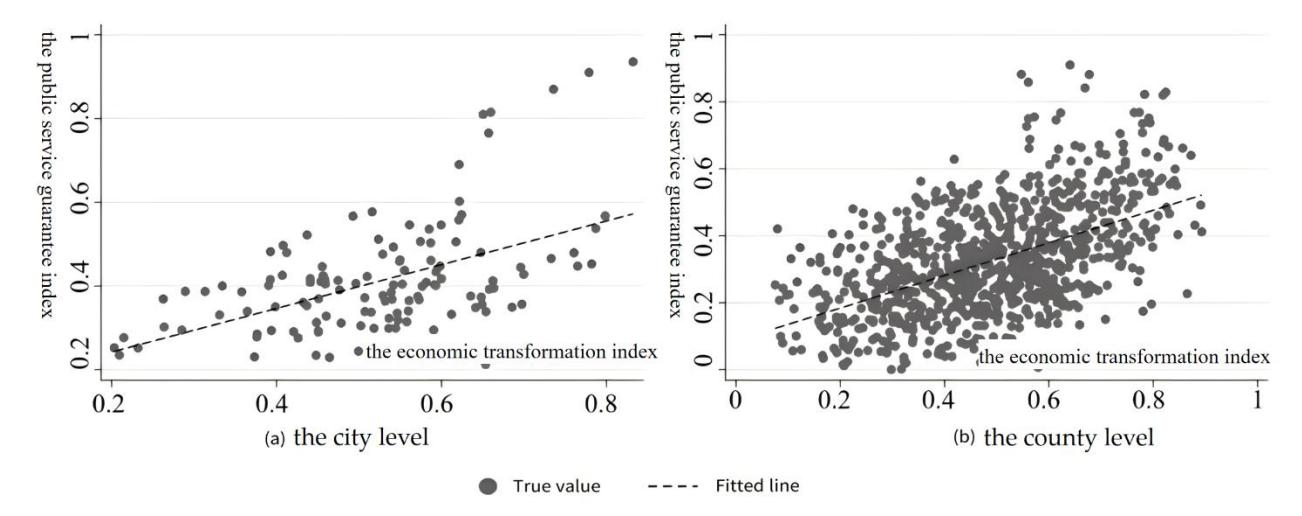
Figure 1. Scatter plot of the economic transformation and public service guarantee indexes.
Table 3 presents the descriptive statistics of the NTU index for each city and its subordinate counties during the sample period. Overall, the city-level NTU index has a significantly higher average value than its county-level counterpart. According to the annual
results, both the county-level and city-level NTU indices showed stable year-on-year growth, and the average gap between the two indices narrowed from 3.846 in 2013 to 2.343 in 2022. As for each city's NTU index, most had relatively balanced scores in 2022, with most scores falling between 20 and 35, indicating relatively coordinated regional development. The average value of the NTU index for the city districts was 36.404, which is more impressive than 21.873 for the county towns. The possible reason for this phenomenon is that the city districts are generally located in city centers, with better location advantages, so they have a stronger ability to attract population. According to the results in Table 3, during the process of promoting key tasks in NTU construction, the average scores of the corresponding sub-evaluation indices for economic transformation and public service guarantee, as well as the average scores of the NTU index in the city districts were higher than those in the county towns.
Table 3. Descriptive statistical analysis results of the county-level New-Type Urbanization-related variables.
| N 6 11 | Total sample | Sub-sample of the city districts | Sub-sample of the county towns | |||
|---|---|---|---|---|---|---|
| Name of variable | Mean value | SD | Mean value | SD | Mean value | SD |
| County-level NTU index | 26.754 | 13.272 | 36.404 | 16.509 | 21.873 | 7.633 |
| County-level economic transformation index | 24.640 | 14.251 | 34.284 | 18.277 | 19.762 | 8.267 |
| County-level public service guarantee index | 29.827 | 13.253 | 39.482 | 15.627 | 24.943 | 8.462 |
| County-level urbanization rate of the permanent population | 49.926 | 12.466 | 60.027 | 14.511 | 44.817 | 7.143 |
Benchmark regression results
Table 4 presents the regression results of the NTU index on the income gap between urban and rural residents. Only county- and year-fixed effects are controlled in columns (1) and (2). The empirical results show that city- and county-level NTU significantly narrowed the urban-rural income gap. The coefficient of -0.041 for the county-level index (column 2) is both statistically and economically significant. Given that the mean income gap was 2.226 (Table 2) and the standard deviation of the county-level index was 12.104 (Table 2), an increase by one standard deviation in the county-level urbanization index corresponds to a decrease in the ratio of the income gap by about 0.496 (that is, -0.041 * 12.104), which is considerable compared to the mean. In columns (3) and (4), ex-ante economic and social characteristic variables are added, including public finance budget expenditure, area of commonly cultivated land, year-end loan balances of financial institutions, total investment in fixed assets, number of internet broadband access users, and total merchandise exports. The regression results indicate that the positive effect of NTU on narrowing the income gap is still significant. In columns (5) and (6), the Theil index is used as an alternative to measure the income gap between urban and rural residents. The regression results remain significant, indicating that the positive impact of NTU on narrowing the income gap is robust, and thus Hypothesis 1 is supported.
Table 4. Regression results of the New-Type Urbanization index on the income gap between urban and rural residents.
| Variables | The incomresidents | e gap betwe | Theil index | ||
|---|---|---|---|---|---|
| (1) | (2) | (3) | (4) | (5) | (6) |
| City-level NTU index | - 0.035*** (0.002) | - | - 0.021*** (0.003) | - | - 0.002*** (0.000) | - |
|---|---|---|---|---|---|---|
| County-level NTU index | 0.041*** (0.002) | 0.037*** (0.003) | 0.003*** (0.000) | |||
| Public finance budget expenditure | - 0.074*** (0.024) | -0.054** (0.023) | -0.005* (0.003) | -0.004 (0.003) | ||
| Commonly cultivated land area | -9.746** (4.020) | -8.642** (3.746) | - 1.341*** (0.477) | - 1.226*** (0.463) | ||
| Total investment in fixed assets | -0.012** (0.005) | -0.008* (0.005) | -0.001** (0.001) | -0.001 (0.001) | ||
| Internet broadband access users | - 0.597*** (0.088) | -0.113 (0.093) | - 0.053*** (0.010) | -0.021* (0.011) | ||
| Total merchandise exports | 0.029*** (0.008) | 0.009 (0.008) | 0.003*** (0.001) | 0.001 (0.001) | ||
| Constant | 2.738*** (0.030) | 3.063*** (0.038) | 2.751*** (0.034) | 3.076*** (0.045) | 0.125*** (0.004) | 0.152*** (0.006) |
| County fixed effects | Yes | Yes | Yes | Yes | Yes | Yes |
| Year fixed effects | Yes | Yes | Yes | Yes | Yes | Yes |
| Number of observations | 1760 | 1760 | 1760 | 1760 | 1760 | 1760 |
Note: ***, **, and * denote significance at 1%, 5% and 10%, respectively.
Table 5 shows the regression results of the economic transformation index and the public service guarantee index on the income gap between urban and rural residents. The results indicate that economic transformation and public service guarantee significantly contribute to narrowing the income gap at both the city and county levels. Thus, hypotheses 2 and 3 hold. Compared with the city level, similar to the regression results in Table 4, the absolute values of the regression coefficients for the economic transformation index and the public service guarantee index at the county level are more significant, which further confirms the comparative advantage of promoting the NTU development with the county as the basic unit. The possible reason is that NTU at the county level is not only conducive to absorbing and transferring population to avoid 'big city malaise' but also to form a coordinated development situation among large, medium, and small towns, and has more significant potential in promoting NTU and narrowing the income gap between urban and rural residents.
Table 5. Regression results for the new sub-dimensions of urbanization on the income gap between urban and rural residents.
| Variables | The income gap between urban and rural residents | Theil index | |||||||
|---|---|---|---|---|---|---|---|---|---|
| (1) | (2) | (3) | (4) | (5) | (6) | (7) | (8) | ||
| City-level economic transformation index City-level public service guarantee index County-level | - 0.014*** (0.002) | - 0.018*** (0.003) | - | - 0.001*** (0.000) | - 0.002*** (0.000) | - | |||
| Variables | residents | The income gap between urban and rural | Theil index | |||||
|---|---|---|---|---|---|---|---|---|
| (1) | (2) | (3) | (4) | (5) | (6) | (7) | (8) | |
| economic transformation index County-level | 0.035*** (0.003) | 0.003*** (0.000) | ||||||
| public service guarantee index | - 0.024*** (0.003) | - 0.002*** (0.000) | ||||||
| Quadratic term of the explanatory variable | Yes | Yes | Yes | Yes | Yes | Yes | Yes | Yes |
| Control variables | Yes | Yes | Yes | Yes | Yes | Yes | Yes | Yes |
| County fixed effects | Yes | Yes | Yes | Yes | Yes | Yes | Yes | Yes |
| Year fixed effects | Yes | Yes | Yes | Yes | Yes | Yes | Yes | Yes |
| Number of observations | 1760 | 1760 | 1760 | 1760 | 1760 | 1760 | 1760 | 1760 |
Note: ***, **, and * denote significance at 1%, 5% and 10%, respectively.
Heterogeneity analysis based on administrative division categories
In China, county-level urbanization refers to the development of all county-level administrative units, including counties, county-level cities, and city districts. In contrast, county urbanization, in a narrow sense, refers to urbanization centered on county towns relative to city districts (SU, 2021). Since Reform and Opening Up, China's urbanization strategy has evolved from "from partial county to partial city and then to prominent county" (Liu et al., 2021). Under new-type of urbanization, county towns are essential intermediaries connecting central cities and rural villages and towns. Compared with the city districts, do the county towns – which are highly expected to perform well – have a more effective impact on narrowing the income gap between urban and rural residents? This paper divides the total sample into sub-samples for the city districts and the county towns to test their heterogeneous impact on narrowing the urban-rural income gap.
According to Table 6, the coefficients for the county-level NTU index were all significantly negative at the 1% level. Still, the absolute value of the coefficient was substantially more significant in the county town sub-sample than in the city district sub-sample. Furthermore, in the city district sub-sample, the county-level economic transformation index was only significantly negative at the 10% level, and the corresponding coefficient (0.006) was much lower than its value in the county town sub-sample (0.018). The main reason may be that county towns serve as the link connecting the socioeconomic growth of urban and rural areas; their development achievements can benefit both urban and rural residents simultaneously. Especially for rural residents, the development of county towns is beneficial, as it facilitates local employment, enabling them to earn income from non-agricultural activities while continuing to manage agricultural operations and care for their families. Additionally, the development of county towns benefits rural residents by enabling them to enjoy the external economies brought about by public infrastructure construction during the urbanization process (Luo et al., 2021).
In addition to this, we found that these results offer fresh insight into Kuznets' hypothesis for western China. It seems that urbanization has an ongoing and persistent negative correlation with the increasing income gap, which implies that this region is very likely on the downward slope of the Kuznets curve with greater development denoting higher equality. This is contrary to eastern China, which is still at lower development levels, where urbanization initially proved to worsen inequality (G. Chen et al., 2016). Our study's finding that county towns have done better than city districts contradict the historical trend in the east, where large cities became the main engines of growth. Even more illuminating is the singularity of the NTU strategy, which purports to devolve development into counties to avoid the high-inequality phase characteristic of agglomerated metropolitan growth.
Table 6. Results of the heterogeneity analysis based on administrative division categories.
| Variables | district | Sub-sample of the city | Sub-sample of the county town | ||||
|---|---|---|---|---|---|---|---|
| (1) | (2) | (3) | (4) | (5) | (6) | ||
| County-level NTU index | - 0.015** * (0.004) | - 0.023** * (0.004) | |||||
| County-level economic transformation index | - 0.006* (0.003 ) | - 0.018** * (0.004) | |||||
| County-level public service guarantee index | - 0.016** * (0.004) | - 0.014** * (0.004) | |||||
| Quadratic term of the explanatory variable | Yes | Yes | Yes | Yes | Yes | Yes | |
| Control variables | Yes | Yes | Yes | Yes | Yes | Yes | |
| County fixed effects | Yes | Yes | Yes | Yes | Yes | Yes | |
| Year fixed effects | Yes | Yes | Yes | Yes | Yes | Yes | |
| Number of observations | 480 | 480 | 480 | 1280 | 1280 | 1280 | |
Note: ***, **, and * denote significance at 1%, 5% and 10%, respectively.
Conclusion and Policy Recommendations
This research provides empirical evidence that New-Type Urban development significantly reduced urban-rural income inequality in western China. Economic transformation and public service provision are the two most important channels through which NTU affects income distribution, while county-level urbanization has more equalizing effects than city-level initiatives. However, such findings go beyond mere statistical correlation and rather validate a paradigm shift in the development strategy, placing emphasis on the strength of county-led development and questioning the age-long paradigm that equates development to metropolitan agglomeration (Glaeser & Maré, 2001). These findings support the polycentric urban development model in the planning literature, which holds that secondary cities are integral to achieving balanced regional growth (UN-Habitat, 2022).
Thus, it can be seen that China's NTU, which focuses attention on county towns, is a largescale, state-driven experiment in putting into operation the concept of 'urban-rural linkages' that is at the heart of Sustainable Development Goal 11. Our findings thus prove that the strategy effectively lends functional territories that cross the town-country divide, going beyond
traditional core-periphery models. Moreover, the persistent inverse correlation between NTU and inequality suggests that the area is on a downward trajectory, escaping the high-inequality stage associated with the most rapid, primate-city-focused growth in eastern China (G. Chen et al., 2016) and other developing regions. This nicely highlights the promise of decentralized urbanization as an instrument of 'inclusive development' at the outset.
To maximize the benefits of NTU, policymakers in northwestern China should prioritize the following policies: firstly, develop county-town industries that align reasonably well with the skill endowments of the local rural labor force. This could include agricultural processing, ecotourism, and renewable energy, among others, providing non-farm jobs without jeopardizing the livelihood of agriculture. Secondly, priority should be given immediately to building other aspects of human investment, particularly secondary and vocational education, as well as rural healthcare clinics, to help alleviate the out-of-pocket burden on rural households. Thirdly, investigate policies that allow rural residents to retain land rights as they seek employment in nearby county towns, thereby protecting their safety net and mitigating urbanization risks. Finally, the fiscal capacity of counties should be strengthened by enhancing central government transfers to less developed counties, thereby breaking the vicious cycle of poor public service provision and the attraction of economic activity.
Acknowledgements
This research was funded by the National Social Science Foundation Project of China, grant number 23CMZ025, and the innovation team construction project on the 'Theory and Practice of Three Rural Issues with Chinese Characteristics' at the Sichuan Academy of Social Sciences.
Declaration of conflict of interest
The authors declare that they have no conflict of interest. The founding sponsors had no role in the study's design, data collection, analysis, interpretation, manuscript writing, or decision to publish the results.
Authors' contributions
All authors contributed equally to the conception and writing of the manuscript. All authors critically revised the manuscript and approved the final version.