

I. INTRODUCTION
Solar power system is an energy conversion system that can convert sunlight energy into electricity using photovoltaic technology that works on the principle of the photoelectric effect. The solar cell (photovoltaic) is made of a special material, namely a semiconductor. Solar cells consist of at least 2 semiconductor layers, one layer containing a positive charge and the other a negative charge. When enough photons from sunlight are absorbed by the negative layer of the solar cell, electrons will be released from the negative layer to the positive layer thereby creating a voltage difference. This voltage difference will produce electricity.
Since the oil crisis in the 1970s, the use of electricity from renewable energy has received considerable attention from many countries in the world, including from solarenergy. The use of sunlight as an alternative energy source is a world concern because in addition to its unlimited amount, its use also does not cause pollution that can damage the environment.
Indonesia as a tropical country located around the equator has a very large potentialfor solar energy, which is around 200,000 MW. However, of this potential, only around 150 MW or 0.08% has been realized [1].
Considering that the electrification ratio in Indonesia has only reached 55-60% and almost all areas that have not yet been electrified are rural areas far from power plants, solar power system which can be built in almost any location is a very suitable alternative to be developed.
Sukawijaya Village is just a neighbor of Jakarta. It is located about 20 km from east border of the capital. Even so, the village is included in the Bekasi Regency, the Province of West Java. The village is in what may be described as a lowland topography, where most of its land area (93%) is rice fields and the rest is residential. That is why most of the people works as farmers and farm workers. The general profile of Sukawijaya Village is described in Table 1 (Data source: Profil Desa Sukawijaya Kecamatan Tambelang Kabupaten Bekasi Tahun 2020).
TABLE 1. GENERAL PROFILE OF SUKAWIJAYA VILLAGE
| Total area | 446.5 ha | |||
| Rice field area | 413.5 ha | |||
| Residentials area | 33 ha | |||
| Population | 5,339 inhabitans | |||
| (1,509 families) | ||||
| Elevation | 2.5 m from sea level | |||
| Average | 28-33 deg C | |||
| temperature | ||||
| Rainfall | 1,280 mm/hm | |||
Several community service activities from universities had been accomplished in Sukawijaya Village for empowering its people, such as socialization of technopreneur and internet marketing by University of Bhayangkara in 2020 [2], creating a site-plan for tourism village [3] as well as installation of a wind turbine for electricity by Bandung Institute of Technology in 2021 [4]. This paper describes the community service activity in installing a small-scale solar power system as an alternative electricity source from renewable energy at this village which has been successfully done in late 2022.
Sukawijaya Village, which is located at 6.15 degrees south latitude and is located not far from the coast of the Java Sea, has quite hot sun exposure throughout the day. This condition is very suitable for utilization of solar power system.
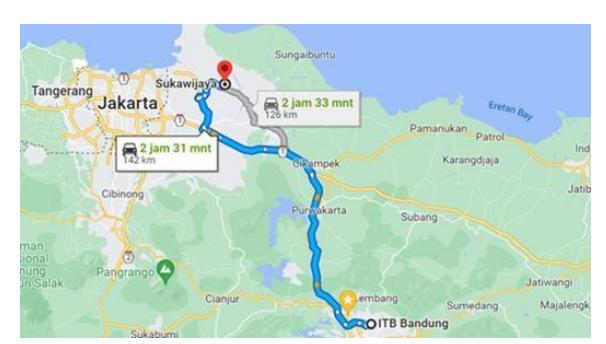
FIGURE 1. LOCATION OF SUKAWIJAYA VILLAGE BETWEEN JAKARTA AND BANDUNG (SOURCE: GOOGLEMAP)
Sukawijaya Village, which is located at 6.15 degrees south latitude and is located not far from the coast of the Java Sea, has quite hot sun exposure throughout the day. This condition is very suitable for utilization of solar power system.
In addition, this village has a plan to become a tourism village. Site-plan of Sukawijaya Vilage as a tourism village has been established [3]. Even the community has initiated some 3D paintings as spots for selfies as well as water tourism where tourists can take a boat down the river while enjoying instagrammable sceneries [5], [6]. Therefore, the installation of solar power system can be used not only for harvesting energy but also as a means of technology education to support village tourism programs.
II. METHODOLOGY
This community service activity began with a field survey. The intensity of sunlight exposure and possible places suitable for placing solar panels were observed at this stage. Afterwards, the design of a solar power system is carried out, namely determining thecapacity and type of solar panels as well as their supporting electrical equipment. In addition, the supporting structure for solar panel installation was also designed: size, material used, andangle of inclination of the solar panel installation. The next stages were to procure all the necessary equipment and install them at a predetermined location. Finally, a workshop on the function, working principle, and maintenance of solar power system are also conducted as a means of educating village residents.
FIGURE 2. METHODOLOGY OF COMMUNITY SERVICE ACTIVITY ON INSTALLING A SMALL-SCALE SOLAR POWER SYSTEM AT SUKAWIJAYA VILLAGE
FIGURE 3. WORKSHOP ON EDUCATING PUBLIC ABOUT SOLAR POWER SYSTEM WAS CARRIED OUT ATTENDEDBY SOME COMMUNITY MEMBERS AND LEADERS
FIGURE 5. THE HEAD OF CENTER FOR RURAL AREAS EMPOWERMENT INSTITUT TEKNOLOGI BANDUNG OFFICIALLY HANDED OVER THE INSTALLED SMALL-SCALE SOLAR POWER SYSTEM TO THE LOCAL GOVERNMENT OFFICIALS
III. IMPLEMENTATION
Based on field survey that the village has been connected to electricity network of State Electricity
Company (Perusahaan Listrik Negara, abbreviated as PLN), we chose to implement a 600 Wp on-grid solar power system at Sukawijaya Village. Three polycrystalline solar panels, each 200 Wp (specification is shown in Table 2), are arranged in series as the main component. Polycrystalline type was chosen for the main reason of less cost compared to monocrystalline. Besides, polycrystalline solar panels work better in areas that is rich in sunlight as in this village. A 1000 W tie-grid inverter is used to convert direct current resulted from solar panels to alternating current and then send it to electrical grid. Some AC and DC circuit breakers are used to protect the system from damage caused by overcurrent/overload or short circuit as well as a surge arrester used for lightning protection. The solar panels are installed in open space supported by light steel frames with height of about 1.5 meter from the ground and inclination angle of 15 degrees facing to the north as a study has reported that inclination of 10-15 degrees gives maximum power in the area of Java Island [7].
A workshop explaining what solar power system and its functions are, how it works, what people should do for maintenance, etc. was carried out in order to provide basic knowledge about solar power system to community. The event was attended by community members including several community leaders. At the end the solar power system wasofficially handed over to the local government representatives.
TABEL 2. SPECIFICATION OF EACH 200WP POLYCRYSTALLINE SOLAR PANEL
| Peak Power (Pmax) | 200 W | ||
| Cell Efficiency | 16.93 % | ||
| Max Power Voltage (Vmp) | 35.6 V | ||
| Max Power Current (Imp) | 5.62 A | ||
| Open-Circuit Voltage (Voc) | 43.6 V | ||
| Short-Circuit Current (Isc) | 6.05 A | ||
| Power Tolerance | +/- 3% | ||
| Series Fuse Rating | 12 A | ||
| Max System Voltage | 1000 V DC | ||
| Operating Temperature | -4 to +85 °C | ||
| Dimension | 1,320x990x35 mm | ||
Figure 3. Solar panels supported by light steel frames (left); inverter, circuit breakers, surgearrester installed in panel box (middle); Watt meter for monitoring the generated power at any time (right).
IV. SIMULATION
Operations of the installed solar power system during first year is simulated using PVSyst software [8]. PVSyst is a software package that is used for the process of learning, sizing, and analyzing data from the complete solar power system. PVSyst was developed by the University of Geneva which is divided into grid-connected systems, stand-alone systems (grid-isolated system with storage), pumping systems, and direct current networks for public transportation (DC-grid). ). PVSyst is also equipped with a database from a wide and diverse range of meteorological data sources as well as data of solar power system components. Some examples of meteorological data sources that can be used by PVSyst are from MeteoNorm V8.0 (interpolation 2010-2014), NASA-SSE (1983- 2005), PVGIS (for Europe and Africa), Satellite-Light (for Europe), TMY2/3 and SolarAnyWhere (for USA), EPW (forCanada), RetScreen, Helioclom and Solar GIS (paid) [9]. Figure 6 describes summary of the installed solar power system. Grid-Connected System means that the system is directly connected to the electricity network system. This simulation describes the performance of the system in the first year. Sheds on ground is the type of solar power system construction used in this project that is ground mounted. Tilt isthe angle of inclination of the panel to the ground surface (in degrees) and azimuth is the direction the panel is facing (since the site is located at the southern latitude of the earth, 0° isnorth). Near shadings are possible
shadows that can cover panels from sunlight. In this project, the type of shadings used is the generic setting "Linear shadings" because there areno objects covering the PV panels. User's needs are the destination of delivering the generated power.
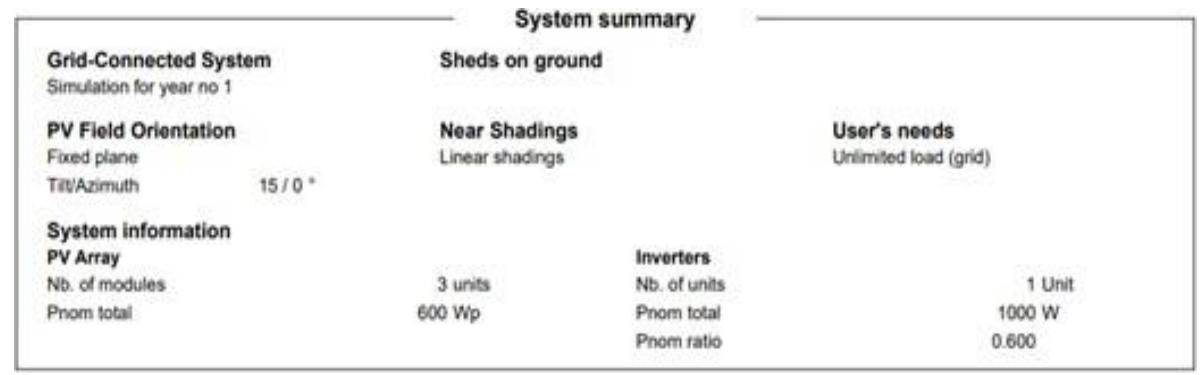
Figure 6. Summary of the installed solar power system
In this project it is network/grid. In the PV Array section, the PV modules used are 3 panels with a total power of 600 Wp. In this project, an inverter with a power capacity of 1000W is used. Thus, the ratio between PV power and inverter power is 0.6. In this simulation, MeteoNorm 8.0 is used as meteorological data source.
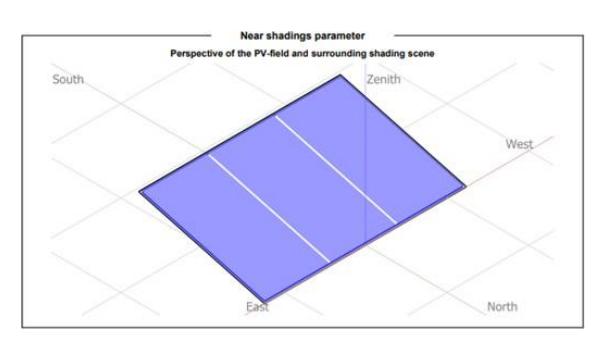
Figure 7. 3D modelling of the installed solar panels.
Table 3 shows important parameters related to the simulated PV mini-grid system. These parameters are irradiance, ambient temperature, energy produced by the solar power system, energy entering the grid, and the performance ratio (PR) of the system. Each existing parameter is displayed in a span of a month and a year. It can be seen that the total irradiance in one year is 1,779.1 kWh/m2 and the average ambient temperature is 26.01°C. Under these conditions, the PV array can produce an annual energy of 893.26 kWh and the energy absorbed into the grid is 857.8 kWh. There is a decrease in value due to system losses, especially in modules, inverters and cables. Apart from that, it can also be seen that the resulting PR value is 79.7% so that it can be said that this system is working well. It was shown that the greatest amount of energy entering the grid was in August, which was 82.73 kWh. Meanwhile, July and
September were not much different, namely 81.97 kWh and 79.96kWh. This happens because in these months, Indonesia is experiencing a dry season which results in at least rainy time. Therefore, the energy produced is greater because the longer the sun shines during the dry season. In addition, in these months, the position of the sun tends to be in the north. Because the PV array has a tilt angle of 15° facing north, the angle of incidence of the sun becomes perpendicular and produces greater energy.
Tabel 3. Main simulation results of the installed solar power system in the first year
| GlobHor kWh/m² | DiffHor kWh/m² | T_Amb °C | EArray kWb | E_Grid kWh | PR ratio | |
|---|---|---|---|---|---|---|
| January | 123.8 | 71.31 | 25.52 | 56.53 | 54.16 | 0.796 |
| February | 140.5 | 82.12 | 25.37 | 66.58 | 63.92 | 0.802 |
| March | 146.7 | 86.21 | 25.95 | 72.38 | 69.48 | 0.797 |
| April | 145.3 | 72.35 | 25.99 | 75.04 | 72.06 | 0.794 |
| May | 146.3 | 74.26 | 26.58 | 78.84 | 75.73 | 0.796 |
| June | 141.8 | 67.16 | 25.85 | 78.73 | 75.65 | 0.800 |
| July | 154.9 | 73.56 | 25.82 | 85.28 | 81.97 | 0.800 |
| August | 163.0 | 75.42 | 26.14 | 86.08 | 82.73 | 0.795 |
| September | 165.3 | 85.03 | 26.14 | 83.21 | 79.96 | 0.795 |
| October | 173.4 | 95.60 | 26.76 | 82.82 | 79.58 | 0.795 |
| November | 143.5 | 85.04 | 26.01 | 66.60 | 63.91 | 0.798 |
| December | 134.6 | 79.20 | 25.93 | 61.18 | 58.66 | 0.798 |
| Year | 1779.1 | 947.25 | 26.01 | 893.26 | 857.80 | 0.797 |
In addition, an important parameter that needs to be considered is the PR value or Performance Ratio. Performance Ratio (PR) is the ratio between the AC electrical energy produced by the system and the results of theoretical calculations that will be produced by thesystem if the module converts the received irradiance into electrical energy based on the system's capacity. This theoretical calculation is based on measured irradiance data in the field. The annual average PR generated by the solar power system is 79.7% with the maximum PR value being in February, which is 80.2%, and the lowest is in April, which is 79.4%.
Figure 8 shows the total energy production per installed kWp. From the graph, it can be seen that the red color is usable energy, while the purple color indicates losses from thePV array, and the green color indicates losses from the system. The average energy that canbe used in 1 year is 3.92 kWh/kWp/day. In addition, the average total losses of energy production from the PV array is 0.84 kWh/kWp/day, and losses from the system are 0.16 kWh/kWp/day.
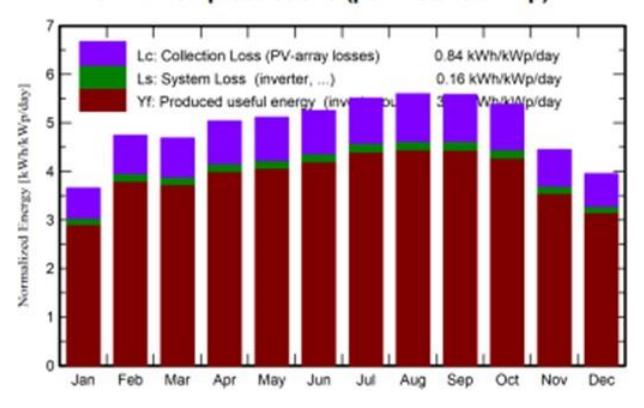
FIGURE 8. NORMALIZED TOTAL ENERGY PRODUCTION IN THE FIRST YEAR
Figure 9 illustrates the losses of the installed solar power system. It can be seen that the irradiance of 1,779 kWh/m2 can be converted into energy of 1036 kWh. But because in the solar power system there are many losses, the final energy that can be used is 858 kWh. The biggest losses contained in the system are losses due to temperature, which is equal to 7.14%. This is due to the ambient temperature of the environment where the system is installed. Other losses that affect the system are Light Induced Degradation (LID) losses. LIDlosses are losses that occur during the first few hours of a crystalline PV module being exposed to the sun. In addition, there are also mismatch losses that occur because of the PLTS system. In the inverter there are several MPPT whose strings have different numbers and positions, causing a mismatch. In addition, there are also ohmic losses caused by the DC cable used. The longer the DC cable used, the greater the ohmic losses. After the electrical energy enters the inverter, this energy will experience other losses due to the efficiency of theinverter. So that an energy of 858 kWh is obtained which can be injected into the grid and used.
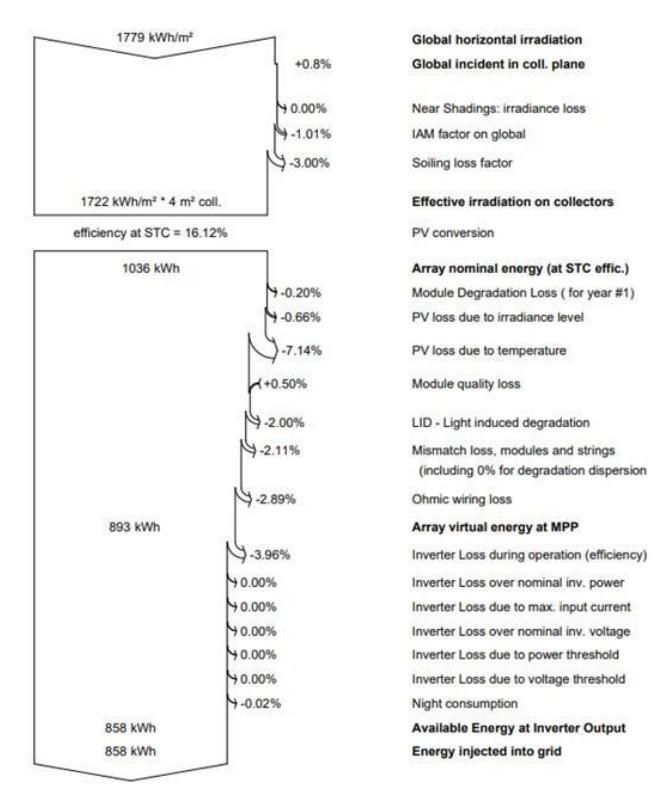
FIGURE 9. THE LOSSES OF THE INSTALLED SOLAR POWER SYSTEM.
V. CONCLUSION
This community service activity is succeeded in installing a small-scale solar power system atSukawijaya Village. It is a grid-connected solar panel system with capacity of 600Wp. Simulation using PVSyst software package shows that the system has performance ratio of 79.7% and may produce electricity of 858 kWh per year. This solar power system installed atthe village has function not only as electricity source from a clean and renewable energy but also as a means of education regarding energy conversion.
ACKNOWLEDGMENT
The authors gratefully acknowledge the contributions of Tourism Awareness Group (Kelompok Sadar Wisata, abbreviated as Pokdarwis) Kalidozer for their voluntary help on the implementation of this community service activity.
REFERENCES
- [1] A. Pribadi, "Indonesia Kaya Energi Surya, Pemanfaatan Listrik Tenaga Surya oleh Masyarakat Tidak Boleh Ditunda", Press Conference No. 303.Pers/04/SJI/2021, Ministry of Energy and Mineral Resources of Republic Indonesia.
- [2] R. Purnomo and T. D. Putra. (2020, Jul.). Pemberdayaan sumber daya Desa Sukawijayamelalui teknologi informasi. Jurnal Sains Teknologi dalam Pemberdayaan Masyarakat [Online]. 1(1), pp. 33–38. Available:https://www.researchgate.net/publication/343729129 _Pemberdayaan_Sumber_
Daya_Desa_Sukawijaya_melalui_Teknologi_Informasi
- [3] A. Nurdini, D. Larasati, N. F. Hadianto, M. A. Lubbu, K. Agustriana. (2022). Denyut Asa Desa Sukawijaya: Rencana Tapak Wisata Agraria. (1st ed.) [Online]. Available:https://issuu.com/lppmitb/docs/buku_sukawijaya_low _resolution?e=46589440/93506389
- [4] Hendarko. "Menangkap angin berkebun energi", Bulletin Terap, vol.001, Jan, 2022 [Online]. Available: https://pengabdian.lppm.itb.ac.id/terap/menangkap_angin_berke bun_energi
- [5] https://www.pikiran-rakyat.com/jawa-barat/pr-01309475/kalidozer-kampung-3-dimensi-ala-warga-bekasi [accessed on Dec 7, 2022]
- [6] https://gobekasi.id/2019/04/03/mengintip-kali-dozerbuatan-warga-tambelang-yang- instagramable [accessed on Dec 7, 2022]
- [7] E. A. Karuniawan. (2021, Sep.). Analisis perangkat lunak PVSyst, PVSol, dan HelioScope dalam simulasi fixed tilt photovoltaic. Jurnal Teknologi Elektro [Online]. 12(3), pp. 100– 105. Available: https://publikasi.mercubuana.ac.id/index.php/jte
- [9] I. Saputra, "PVSyst, software simulasi PLTS" [Online]. Available: https://mynameis8.wordpress.com/2019/10/16/pvsystsoftware-simulasi-plts/