

I. INTRODUCTION
Along with the development of technological advances and modernization, it creates new cultures and habits for its followers. The stagnant growth of culture is one of the consequences ofthe inequality of social values [1]. Ancient traditions are slowly being considered old-fashioned and outdated, creating a perspective ofreluctance in carrying out, continuing and believing in them. People are starting to abandon ancient traditions that are deemed exaggerated and unreasonable. In other hand, the era of technology encourages people, especially the younger generation, to think realistically [2]. Basically, ancient traditions that grow in the surrounding environment characterize the form of education and the nature of the people. A tradition is spread because it is a form of necessity and advice that has a purpose or message in it [3]. One of the forms of tradition is abstinence or commonly
referred to as myth. Abstinence itself has a hidden message as a form of reminder or advice to the listener.
In Banyumas Regency, which is located in Central Java province, hasits own traditions and stories.Taking the element of abstinence in cultural traditions or what Banyumas people call PepaliBanyumasan has values and messages contained in the stories. One of them is the abstinence of Kuda Dhawuk Abrit, which is generally believed to be a message of abstinence to control oneself from evil lust, greed, and revenge [4]. Recently, Banyumas Regency is facing waste problem, andthe main waste is food waste.
Linking abstinence from Kuda Dhawuk Abrit with food waste issue is essential. It can be oneof Banyumas values to prevent food waste. Food waste is one of the factors that cause piles of debris in Indonesia. According to National Waste Management Information System (SIPSN) fromthe Ministry of Environment and Forestry (KLHK) in 2020, it is stated that total food waste reached 40% of 199 districts and cities [5]. Therefore, the Banyumas people shall concern about behavioral issues related to the norms and characteristics to prevent food waste and the most significant data is obtained by household waste at 38.11% [6] (Figure 1).
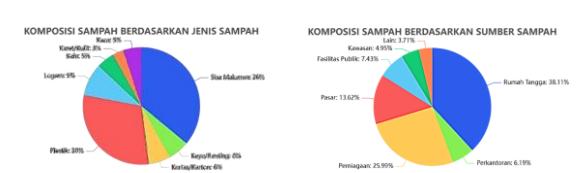
FIGURE 1. WASTE COMPOSITION BASED ON (A) WASTE TYPE (B) WASTE SOURCE IN BANYUMAS (SIPSN,2022).
People's habits in consuming and managing the needs tend to take everything that can be reached. In other words, the impulsive behavior of each society has a greater stimulus in decision-making [7]. It is an impulsive behavior that leads to the accumulation of food waste with the actorscoming from consumers with consumptive lifestyles but poor management of their needs [8]. Another reason for the driving factor in creating food waste is consumer behavior. In reality, food
waste also arises along the course of the food chain. It is important to highlight the forms of food waste behavior in order to better understand the causes and realities that occur in society.
Moreover, the focus of today's business market is on the younger generation ranging from millennials, X generation, to Z generation [9]. The fact that food wastage also occurs among youngpeople is alarming. The habit of taking more than one can enjoy is one form of encouragement to generate household food waste. The need to raise awareness among young people is a concern to find out how much the level of food purchase management, awareness of food waste, concern about food wasting behavior, and intention to be food efficient are important goals [10].
Therefore, this research aims to find the relationship between banyumas values, awareness, household routines, and anti-food waste lifestyle. The objective of this study is to know young people who have intentions and awareness in planning and managing food waste, as well as to explore the forms of anti-food waste attitudes that exist among young people in relation to the cultural values of Pepali Banyumasan.
A. Literature Review and Hypothesis Development
The research was modeled using several focuses that refer to cultural awareness and Banyumasan culture embodied in the habits of the Banyumas people. The approach was chosen tounderstand and find out the behavior patterns of young consumers towards food waste. This research assessed consumer perspectives consumption patterns as a reality related to beliefs, socialconstruction, and context [11]. The phenomenon offood waste is gradually becoming a socialissue that shapes people's personalities. The personality in question is defined as consumer habits, in this case the younger generation whose grip on cultural values that prioritize the importance of living in harmony between actions and intentions is fading. The need for awareness in managing all needsaccording to portions to preserve and sustain life can be started through food consumption, whichwill also be related to cleanliness and environmental care [12]. The socio-cultural approach helps the author to better understand the behavioral tendencies of young consumers towards handling food waste. Investigating the forms of actions chosen and carried out by consumers is expected toplay a greater role in understanding local culture and its relationship with growing behavior in dealing with food waste problems.
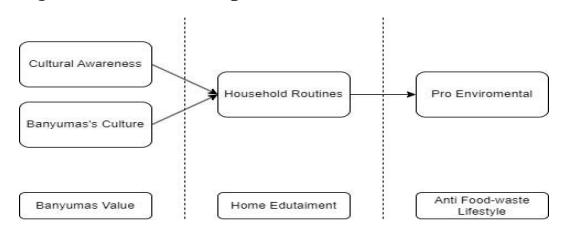
FIGURE 2. CONCEPTUAL MODEL
In addition, there is a positive relationship between diet and surrounding culture. It also revealed that the Banyumasan (local) form of culture and cultural awareness has an opportunity in the setting and lifestyle of young consumers. Therefore, it is necessary to test the patterns of behavior, attitudes, and actions that young consumers will take in response to food waste handling in terms of their sociocultural knowledge and household routines[13]. The model can be seen in Figure 2.
The formation of social values in a growing society affects the mindset, mental attitude, and behavior that develops within the scope of the people's culture [14]. The lifestyle of a people generally refers to how a person is able to accept or personally believe in the behavior that occurs around him, including local culture. Therefore, the cultural component can be the key that explainsthe forms of behavior that occur in society [15]. Understanding of culture indirectly has a correlation with support for environmental protection. This also has implications for environmentalawareness. The suitability of local culture is believed to be able to encourage people participation. The fundamental difference between that research and this study is the objective taken. Younger people have different tendencies from older people. Therefore, this study examines the behavior of young consumers towards their household routines and cultural awareness [16]. Therefore, Thehypothesis is set as follows,
H1: The routine of young consumer households in Banyumas in managing food waste is positively influenced by cultural awareness.
Culture is believed to have noble values that contain beliefs, rules, norms and traditions that have been learned by a group of people. The generation of food waste at the household level is influenced by the consumer decisionmaking process. People's shopping habits that have been "ingrained" raise questions about the management of purchasing household needs [17]. The localBanyumasan and Javanese culture explains the noble values that build life in society. Some examples are pepali, pepali in Indonesian is called abstinence. Still related to Javanese eating habitsthat prohibit the practice of wasting food and leaving food [18]. Therefore, it is necessary to have information related to the form of connection between culture and household behavior of the younger generation as an effort to minimize food waste. Therefore, The hypothesisisset asfollows,
H2: Household routines of young consumers in Banyumas in managing food waste are positivelyinfluenced by Banyumas culture.
The need for the environment cannot be denied in everyday life. The need to preserve the environment should be a public responsibility [19]. This can be started from the smallest scope ofthe household which includes the routine and management in it. Someone who has a character with concern and action towards environmental problems is called pro-environment.
Pro-environmental behavior has perceptions with environmentally friendly values, behavioral control, and knowledge of norm values [20]. These perceptions interact positively when associated with household management initiatives. Household management is accompanied by the management of household supplies and expenditures to be aligned between needs and purchases. Therefore, The hypothesis is set as follows,
H3 : The pro-environmental behavior of the Banyumas people is positively influenced by thehousehold routines of young consumers.
Reassessing the core of the growing culture that the surrounding community believes is inherent in all activities. This relates to the scope of culture that can understand the environment and respond to things so as to avoid uncertainty and confusion. Koentjaraningrat in his work wroteseveral elements of culture with some of them choosing knowledge systems and social systems [21]. The belief brings the results of cooperation between the communities to adjust themselves. Along with these conditions, the population of Indonesia is increasingly starting to be dominated by young people, up to 64.69% of the total population [22]. This is what triggers questions relatedto food waste behavior that is mostly produced by young people. The pattern of household routinescannot be denied to be born in the smallest group, starting from the family. Family education or home edutainment is thought to have an influence on the household routines of young consumers,which is the link to creating characteristics with environmental awareness.
Focusing on how cultural values can influence proenvironmental behavior through household activities. However, if explored, culture contains the totality of human life patterns which are born from the reflection of the culture around them at the time of growing up. If the topicof discussion is returned to the problem at hand, the issue of food waste. Household routines have a clear correlation as a link between the other two variables, namely the value of awareness in culture while still holding the principle of protecting the surrounding environment.
Targeting the current condition of the younger generation that has a significant impact on the changing times, related to their household routines, cultural awareness is basically needed because it is related to the values of norms that develop in society [23]. Not only as a producer of food waste, but the power of the young has a great influence on the local ecosystem related to foodin particular and knowledge, which can positively impact on improving moral character towards the environment [24]. Therefore, The hypothesis is set as follows,
H4: Household routines of consumers in Banyumas mediate the relationship between pro- environmental behavior and Banyumasan culture.
H5: Consumer household routines in Banyumas mediate the relationship between pro-environmental behavior and cultural awareness values
II. METHOD
A. The Covered Respondent
The method used was a quantitative with a survey which was distributed online and offlineto the Banyumas people. The number of respondents were 409, which were divided into online (223) and offline (185). There was a total of 42 questions and four variables on the questionnaire,including cultural awareness, Banyumas culture, young consumers' household routines, and pro- environmental behavior. The questionnaire also recorded demographics including gender, domicileof origin within the Banyumas Regency area, age, occupation, latest education, and income per month. The Likert scale model was chosen as a tool to measure respondents' participation with a scale range of one to seven where the number one indicatesstrongly disagree to five which meansstrongly agree. The explanation of each variable can be seen in Table 1.
B. SEM-PLS Model
SEM-PLS (Structural Equation Modeling-Partial Least Square) was chosen because of its function related to measuring the relationship between variables which allows combining regression analysis with factors and paths [21]. The structural formulation reference model was chosen to determine the relationship that occurs between each latent variable. The formulation of the model used Smart PLS software. SEM-PLS is divided into two assessments; model evaluationand structural model analysis. The description is explained in the next sub-section.
1) Evaluation of Model
This stage was to test the validity and reliability of the model. This step must be passed to gain valid and reliable data. In validity, there are three criteria must be considered, including convergent validity, AVE (Average Variance Extracted), and Discriminant Validity, while reliability testing used Composite Reliability [22]. The value on Convergent Validity explains the measuring value of indicators and variables. The Loading Factor value is generally said to be satisfied if the value is more than 0.7. However, in some cases such as initial research, the Loading Factor value can be stated sufficient with a minimum value of 0.5 to 0.6. Average Variance Extracted (AVE) has minimum is 0.5. The standard reliability test value can be determined by comparing the value of the square root of the AVE or by comparing the Latent Variable Covariancewhich has a minimum value of 0.6.
2) Structural Model Analysis
The structural model was made to analyze a relationship and getting the significance value. The Bootstrapping procedure was run to analyzing the structural model. The function is to reduce and reduce abnormalities in the structural model.
TABLE 1. VARIABLE OF THE MODEL
| Variable | Code | Indicator | Variable | Code | Indikator |
|---|---|---|---|---|---|
| Cultural Awareness | KB1 | Actions toward local cultural customs | Household Routine | RT1 | Inventory check before shopping |
| KB2 | Preserving local cultural habits | RT2 | Utilization of food ingredients that are still available | ||
| KB3 | Application of Banyumasan cultural habits in daily activities | RT3 | Shopping list before shopping | ||
| KB4 | Preserving the local culture of Banyumasan value | RT4 | Adhering to the purchaseplan lis that has been made | ||
| Banyumasan Culture | BB1 | Knowing Banyumasan value | RT5 | Organizing food according to portions | |
| BB2 | Existence of Pepali Banyumasan | RT6 | Refrigerator to store food | ||
| BB3 | Know the meaning and content of | RT7 | Storage tools affect thecause of food waste |
III. RESULT AND DISCUSSION
A. Respondent Demographics
Respondents were focused on natives of Banyumas Regency with an age range from 13 to 36 years old. The total number of respondents successfully obtained was 409 respondents who were young consumers. After the data
accumulation process, we obtained some respondent data based on their demographics (Table 2). Male respondents have a proportion of 43.77%, while women are 56.23%. When compared according to the type of work, the percentage of students / students / not yet working has the largest share of 76.04%, entrepreneurs / self-employed / traders of 21.27%, and civil servants of 2.69%. In the demographic table, a summary of the characteristics of respondents who have been involved in the survey can be seen. As shown in the table, the percentage of respondents is 43.77% male and 56.23% are female respondents.
| TABLE 2. | DEMOGRAPHIC | OF RESPONDENT |
|---|---|---|
| N | % | Variable |
| Variable | N | % | Variable | N | % | ||
|---|---|---|---|---|---|---|---|
| Gender | Male | 179 | 43.77 | Elementary School | 18 | 4.4 | |
| Female | 230 | 56.23 | Latest | Junior High School | 49 | 11.98 | |
| Age — | 13-18 | 105 | 25.67 | Education | High School | 253 | 61.86 |
| 19-23 | 225 | 55.01 | Diploma | 22 | 5.38 | ||
| 24-36 | 79 | 19.31 | Bachelor | 67 | 16.38 | ||
| Job | Student/Unemployed | 311 | 76.04 | < 500.000 | 236 | 57.7 | |
| Enterpreneur/Self- employed/Merchant | 87 | 21.27 | - | 500.000 - 1.500.000 | 88 | 21.52 | |
| Civil Servants | 11 | 2.69 | Salary (IDR) | 1.600.000 - 2.600.000 | 46 | 11.25 | |
| Food Waste Knowledge | Yes | 259 | 63.33 | 2.700.000 - 4.000.000 | 26 | 6.36 | |
| No | 150 | 36.67 | > 4.000.000 | 13 | 3.18 |
In addition, this study focuses on young consumers with an age range of 13-36 years with the results of the highest percentage of respondents of 55.01% at19-22 years. The last education and salary earned are included in order to provide an overview of respondents to other factors that can potentially affect food waste management by confirming the existence of food waste processing knowledge.
B. SEM-PLS Results
The SEM PLS model is used to describe the correlation between the criteria made, namelythe value of banyumas, household routines, and pro-environmental behavior. In order to be said tobe good, it needs several tests such as validity tests (Convergent Validity, Average Variance Extracted (AVE), and Discriminant Validity) and reliability tests using Composite Reliability. Initial testing can see the Cross-Loading Factor value which is more than 0.5. If it has been fulfilled,the concept and final model can be seen in Figure 2. Final Model. The next value fulfillment is in the validity value in the form of Convergent Validity and AVE with a minimum value of 0.5. Acceptable test results are then continued for reliability tests with test standards higher than 0.6. The results obtained for the model are reliable. When referring to the Cronbach Alpha standard, the results on the model have a value above 0.7, which means that the construct model has reliability. The (HTMT) table measures the correlation between two measurements, provided that if the Confidence Interval value is smaller than one, it means that the two constructs have high discriminant validity.
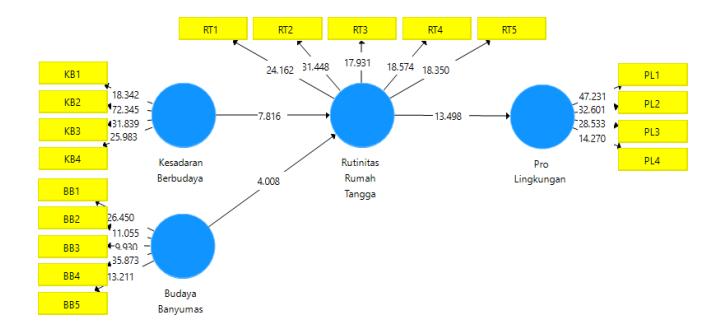
FIGURE 3. FINAL MODEL
In Figure 3, it is shown that the household indicator mediates between cultural awareness and banyumasan culture with pro-environment. The purpose of mapping the processed model istodetermine the factors that have performance and interrelationships between constructs. In the model picture above, it is shown that there are no variables that have low and excessive priority values. The model represents the possibility of five hypotheses that will be obtained through this data processing.
Table 3 shows the AVE, composite reliability, and Cronbach alpha results. The AVE (Average Variance Extract) calculation is the average extra variance with a value of more than 0.5as a determinant. In SEM, the AVE value of 0-1 is used as a convergent value while the AVE valueequal to 1 meansthat it only has 1 indicator. The results of the AVE value are consistent at a valueof 0.5 to 0.6 with the lowest value at 0.512 and the highest at 0.68, which meansthat the correlationof each indicator is absolute.
TABLE 3. AVE, CRONBACH'S ALPHA, AND COMPOSITE RELIABILITY
| Cronbach's Alpha | rho_A | Composite Reliability | Average Var. Extract (AVE) | |
|---|---|---|---|---|
| Banyumas Value | 0.766 | 0.773 | 0.839 | 0.512 |
| Cultural Awareness | 0.842 | 0.851 | 0.894 | 0.680 |
| Pro Environment | 0.798 | 0.815 | 0.869 | 0.626 |
| Household Routines | 0.780 | 0.786 | 0.849 | 0.529 |
TABLE 4. HTMT (HETEROTRAIT MONOTRAIT)
| Banyumas Value | Cultural Awareness | Pro Environment | Household Routines | |
|---|---|---|---|---|
| Banyumas Value | - | - | - | - |
| Cultural Awareness | 0.606 | - | - | - |
| Pro Environment | 0.496 | 0.794 | - | - |
| Household Routines | 0.507 | 0.585 | 0.693 | - |
Table 4 showsthe HTMT validitytestresult. The cultural awareness has a good / significant validity discriminant correlation with Banyumas culture because it has a value below 0.90. The next correlation pro-environment has a significant correlation with Banyumas culture, proenvironment Also has a significant correlation with cultural awareness, it shows that Banyumas residents have a positive influence on environmental awareness on Banyumas culture and culture awareness. The next correlation, namely household routine to Banyumas culture has a significant correlation, household routine to culture awareness has a significant correlation and household routine to proenvironment is also significant, indicating that household routine has a positive influence on the three correlations. Based on these results, it can be concluded that the HTMT value indicates that the tested model has sufficient validity and discriminant validity.
In table 5, it is shown that five hypotheses have a correlation that affects each other significantly if the p value <0.05 based on the bootstrapping p-value results that the correlation ofBanyumas culture to household routine and pro-environment has a significant effect and the correlation of cultural awareness to household routine and proenvironment also has a significant effectso that the value of pepali in Banyumas can be said to be still very thick and affects awareness of the importance of protecting the environment (awareness of food waste management).
TABLE 5. PATH COEFFICIENT STRUCTURED MODEL
| Hypothesis | Path | Original Sample (O) | P Values | |
|---|---|---|---|---|
| H1 | Banyumas Value -> Household Routine | 0.219 | 0.000 | |
| H2 | Cultural Awareness - > Household Routine | 0.388 | 0.000 | |
| H3 | Household Routine -> Pro Environment | 0.563 | 0.000 | |
| H4 | Banyumas Value -> Household Routine - > Pro Environment | 0.124 | 0.000 | |
| H5 | Cultural Awareness- > Household Routine-> Pro Environment | 0.219 | 0.000 | |
C. Practical Implication and Contributions
The purpose of this study focuses on determining the relationship point and the amount ofvalue that influences between the selected criteria or variables, namely the household routines of the younger generation that mediate betweenBanyumasan values and pro-environmental activities in Banyumas Regency. The results presented show that there is a positive activity between Banyumasan values and proenvironmental behavior mediated through household routines. Household routines become a bridge that connects anti-food waste culture and lifestyle. This research contributes theoretically to the development of culture and attitudes of young consumers,to find out the form of anti-food waste lifestyle while still paying attention to socio-cultural elements. The creation of a model depicting actors and sociocultural conditions towards food waste is expected to help reduce the accumulation of food waste. Future research on this study can take the topic of discussion on the influence of household routines with local socio-cultural elements and their relationship to home edutainment in shaping anti-food waste personalities.
The practical implication in this research is to perspective the relationship between household routines that are created daily with socio-cultural conditions, especially Banyumasan culture. How local culture that has existed since long ago is able to influence the habits and routinesof the people, especially the younger generation who are starting to leave traditional culture. In addition, this study can also be used as a literature study related to this field or those that are still related.
IV. CONCLUSION
Generation Z, as the future of the country, is often reluctant to embrace Indonesian values and cultural roots. Culture is the result of human work that is passed down in symbolic form: communication, preservation, ways of development, and attitudes to life. Tradition or culture reflects the personality and education of the people raised in their environment. Traditional cultural practices arise from needs and advice with various purposes. The relationship between Banyumasvalues, education at home, household routines with the anti-food waste lifestyle of young consumers has a significant influence. For this reason, the need for early education about local culture and traditions that can increase
literacy in food processing needs to be done. Cultural values that can still be preserved will be lost if the younger generation fails to preserve them.
ACKNOWLEDGMENT
This study is one of the outcomes of the PKM (Student Creativity Program) funded by theMinistry of Education. In addition, the author would like to thank to Industrial Engineering team for helping with the survey and finding respondents. The author is also grateful to all those who helped and provided support for the running of this research.
REFERENCES
- [1] G. Serafica, "5 Faktor Penghambat Perubahan Sosial Budaya," Kompas.com, 2022. https://www.kompas.com/ skola/read/2022/10/24/103000669/5-faktor-penghambatperubahan-sosial-budaya?page=all
- [2] B. A. Faris and M. Hamzah, "Lunturnya Minat Generasi Muda Terhadap Seni dan Budaya Nasional," indonesiana.com, 2019. https://www.hipwee.com/narasi/lunturnya- minat-generasimuda-terhadap-seni-dan-budaya-nasional/
- [3] F. Nurhakiki, "Filosofi Tradisi Brokohan Di Desa Tasik Malaya Kabupaten Asahan," Medan, 2021.
- [4] Y. Wisnu, "Pepali Banyumasan Masih Dipercaya Warga, Begini Praktiknya," Solopos.com, 2022. https://www.solopos.com/pepali-banyumasan-masihdipercaya-warga-begini-praktiknya-1231458
- [5] S. P. Wisanggeni, M. P. Rosalina, and A. Krisna, "Sampah Makanan Indonesia MencapaiRp 330 Triliun ,"Kompas.id. 2022. [Online]. Available: https://www.kompas.id/baca/ekonomi/2022/05/18/sampahmakanan-capai-lebih-rp- 330-triliun
- [6] Hidup Kementrian Lingkungan, "SIPSN Sistem Informasi Pengelolaan Sampah Nasional," Https://Sipsn.Menlhk.Go.Id/, 2022. https://sipsn.menlhk.go.id/sipsn/public/data/timbulan
- [7] P. E. S. Pradnyani, "Aplikasi Pemesanan Food Waste Terintegrasi Berbasis Android," Researchgate.Net, no. April, 2021, doi: 10.13140/RG.2.2.22786.61121.
- [8] R. A. Cahyono and A. S. Cahyana, "Model Pengendalian Food Waste Pada Supermarket Dengan Menggunakan Sistem Dinamik," J. Produkt., vol. 1, no. 01, pp. 18–23, 2021, doi: 10.36815/jurva.v1i01.1378.
- [9] L. Bravi, B. Francioni, F. Murmura, and E. Savelli, "Factors affecting household food waste among young consumers and actionsto prevent it. Acomparison among UK, Spain and Italy," Resour. Conserv. Recycl., vol. 153, no. September 2019, p. 104586, 2020, doi: 10.1016/j.resconrec.2019.104586.
- [10] K. Janssens, W. Lambrechts, A. Van Osch, and J. Semeijn, "How consumer behavior indaily food provisioning affectsfood waste at household level in the Netherlands," Foods,vol. 8, no. 10, 2019, doi: 10.3390/foods8100428.
- [11] N. Sirola, U. M. Sutinen, E. Närvänen, N. Mesiranta, and M. Mattila, "Mottainai!-A practice theoretical analysis of Japanese consumers' food waste reduction," Sustain., vol. 11, no. 23, 2019, doi: 10.3390/su11236645.
- [12] U. M. Sutinen, "Addressing food waste with a socio-cultural approach to social marketing," J. Soc. Mark., vol. 12, no. 2, pp. 256–274, 2022, doi: 10.1108/JSOCM-12- 2020-0246.
- [13] I. Elshaer, A. E. E. Sobaih, M. Alyahya, and A. Abu Elnasr, "The impact of religiosity and food consumption culture on food waste intention in Saudi Arabia," Sustain., vol. 13, no. 11, pp. 1–17, 2021, doi: 10.3390/su13116473.
- [14] M. Luma and N. Djafri, "Urgensi Nilai Sosial dan Budaya Masyarakat dalam Pendidikandi Era Society 5.0," J. Ilm. Multidisiplin, vol. 2, no. 1, pp. 9–16, 2023, [Online]. Available: https://jurnal.aksarakawanua.com
- [15] K. Kaplan Mintz, L. Henn, J. Park, and J. Kurman, "What predicts household waste management behaviors? Culture and type of behavior as moderators," Resour. Conserv.Recycl., vol. 145, no. September 2018, pp. 11–18, 2019, doi: 10.1016/j.resconrec.2019.01.045.
- [16] H. Lu and R. Sidortsov, "Sorting out a problem: A co-production approach to householdwaste management in Shanghai, China," Waste Manag., vol. 95, pp. 271–277, 2019, doi: 10.1016/j.wasman.2019.06.020.
- [17] J. Ananda, G. G. Karunasena, A. Mitsis, M. Kansal, and D. Pearson, "Analysingbehavioural and socio-demographic factors and practices influencing Australian household food waste," J. Clean. Prod., vol. 306, no. September 2020, p. 127280, 2021, doi: 10.1016/j.jclepro.2021.127280.
- [18] Yevvon Yi-Chi Chang1, W. Chu-yen, C. Chilumbu, H. Wanying, and S. Hou-wang, "DoesCulture Matter? Motivations and Barriersto Minimizing Household Food Waste,"2nd ICOHOTH Conf. Kuala, no. June, p. 12, 2019.
- [19] W. H. Ko and M. Y. Lu, "Evaluation of the professional competence of kitchen staff to avoid food waste using the modified delphi method," Sustain., vol. 12, no. 19, pp. 1–11,
- 2020, doi: 10.3390/su12198078.
- [20] M. I. Hamzah and N. S. Tanwir, "Do pro-environmental factors lead to purchase intention of hybrid vehicles? The moderating effects of environmental knowledge," J. Clean. Prod., vol. 279, 2021, doi: 10.1016/j.jclepro.2020.123643.
- [21] A. K. Anam, A. Tuti, and V. Ratnasari, "Klasterisasi Mutu Pendidikan SMA di Indonesia," J. Sains dan Seni ITS, vol. 9, no. 2, pp. 1–4, 2020.
- [22] F. Romadlon, F. Lestiana, and N. A. Putri, "An Exploration of Personal Decision as Mediating Effect between Passenger Concern and Airport Service Information During COVID-19 Outbreak," Int. J. Technol., vol. 13, no. 3, pp. 664–676, 2022, doi: 10.14716/ijtech.v13i3.4887.
- [23] B. E. Mikkelsen, "Fighting Food Waste—Good Old Boys or Young Minds Solutions? Insights from the Young Foodwaste Fighters Club," Youth, vol. 3, no. 1, pp. 1–17, 2022, doi: 10.3390/youth3010001.
- [24] K. Dobernig and K. Schanes, "Domestic spaces and beyond: Consumer food waste in the context of shopping and storing routines," Int. J. Consum. Stud., vol. 43, no. 5, pp.480–489, 2019, doi: 10.1111/ijcs.12527.