

Introduction
Neodymium (Nd) is one of elements in variety of modern industries such as steel industry, electronic components, fluorescent lamps, basic dyes, energy saving lamps and high quality optics (Dolak et al., 2015; Andersson et al., 1999). Neodymium is one of REE (Rare Earth Elements) did not find naturally as metallic element but exist in form of carbonate, oxide, phosphate and silicate minerals as trivalent cations, which are available found in hard rock and placer deposits of the earth's crust (Zulfikar et al., 2020).
Monazite, the second most important RE phosphate mineral, generally contains ~70% oxides of REEs comprising high content of Ce and La along with remarkable presence of Nd, Pr, and Sm (Dolak et al., 2015; Andersson et al., 1999; Rao et al., 2004).
One of the innovations of adsorption method is utilisation of ion imprinted polymers or IIPs as selective sorbent functional material to element ion on retention, separation and praconcentration. Imprinted polymers technology allowed through replacing template molecules by metal ions. The selectivity of IIPs causes the presence of memory effect from interaction between metal ion and polymer with specific ligan, coordination geometry, charge, and metal ion size (Singh and Mishra, 2009). Neodymium (III) Ion-Imprinted Polymers (Nd-IPs) from polymerization of methyl metaacrylate with divinyl benzene in the presence of a metal complex Nd (III) ion -Xylenol Orange (XO) has been synthesized and evaluated after contact with HCl 0,1 M using FT-IR and SEM characterization (Zulfikar et al., 2020). Adsorbent based on material imprinted polymer has selectivity (Zhang D et al, 2006), specific area, and also high adsorption capacity to remove and recover rare element like Neodymium (III) ion. Then, to prove their
The focus of this paper is evaluation retention parameters of Neodymium (III) ion-Imprinted Polymers (Nd-IPs) such as pH, contact time of adsorption, initial concentration of solution, isotherm adsorption and kinetic study were optimized and compared with Non Imprinted polymer (NIP).
Methods
Chemical
All standard and solution used, i.e., Neodymium Oxide \((Nd_2O_3)\) standard solution (Merck, Darmstadt, Germany), Yittrium nitrate, Lantanum nitrate [Sigma-aldrich, St Louis, MO, USA], Xylenol Orange (XO) solution, Divinyl Benzene (DVB), methyl methacrylate (MMA), benzoyl peroksida (BPO) (Fisher Scientific, Leicestershire, UK). All standard and solution used, i.e., 2- methoxy ethanol, acetic acid, methanol, acid chloride were of SupraSolv grade (Merck, Darmstadt, Germany).
Characterization of retention properties of Neodymium-Imprinted Polymers (Nd-IPs) and NIPs
The capacity of neodymium adsorption was carried out via a batch technique in order to investigate the effects of phosphate ion on retention capacity and the percent recovery. The concentration of Nd(III) ion in the water phase remains after adsorption was measured by taking a certain amount of water phase then being treated in accordance with the steps in Arsenazo(III) methods. Percent of the Nd(III) ion adsorbed (% adsorption), Ci = initial concentration, Ce = adsorption concentration was calculated using the equation below.
\[\% A = \frac{Ci - Ce}{Ci} x100 \tag{1}\]
performance, retention parameters properties such as pH, initial concentration of solution, kinetic and isotherm adsorption studies need to be evaluated (Zhang et al., 2011).
a. Analytical Chemistry Research Group, Faculty Mathematics and Natural Sciences, Institut Teknologi Bandung, Jl. Ganesha no. 10, Bandung 40132, Indonesia
The adsorption capacity of an adsorbent is obtained from the mass balance of the sorbate in a system with solution volume V, which expressed as:
\[q_e (mg/g) = \frac{Ci - Ce}{m} x V\] (2)
The measurement of Nd(III) ion by Arsenazo (III)
A certain amount of Nd(III) ion solutions were pipetted and put into a 10 mL volumetric flask. 1 mL of 2 M acetate buffer (pH 3.7) and 0.65 mL of 0.05% (v/v) Arsenazo (III) were then added to the flask. The solution was diluted up to 10 mL with the addition of demineralized water. 15 minutes after the solution was prepared, absorbance measurements were performed by using the UV-Vis spectrophotometer at a wavelength of 653 nm.
Effect of contact time from adsorption of Neodynium (III) ion
10 mg of Nd-IPs and NIPs were contacted with 20 mL Neodymium standard solution 10 mg.L\(^{-1}\) at variation of contact time from 1 to 30 minute. Then the solution was centerifuged and filtered. The filtrate then analysed by Arsezano (III) method.
Effect of pH from adsorption of Neodynium (III) ion
10 mg of Nd-IPs and NIPs were contacted with 20 mL Noedymium standard solution 10 mg.L\(^{-1}\) at variation of pH from 2 to pH 7 during 2 hours. Then the solution was centerifuged and filtered. The filtrate was analysed by Arsezano (III) method.
Effect of ion concentration and adsorbent mass from adsorption of Neodynium (III) ion
10 mg of each Nd-IPs and NIPs contacted with 20 mL of Nd standar solution 10 mg.\(L^{-1}\) for 20 minute at variation concentration from 5 to 30 mg.\(L^{-1}\) (Effect of Ion concentration). In other hand, Nd standar solution with same quantities and method were repeated at variation adsorbent mass from 10 to 100 mg (Effect of adsorbent mass). Then centrifuged at 3900 rpm, the supernatant was filtered then the filtrate was analysed by Arsezano (III) method.
Selectivity
\(50\,mg\) of Nd-IPs contacted with 20 mL of replicate standard solution contains (Nd(III), La(III), Y(III), dan Ca(II)) with two different composition 1:1:1:1 and 2:1:1:1 at pH 5 for 20 minutes. Then centrifuged at 3900 rpm, the supernatant was filtered then analysed by ICP-OES.
Result and Discussion
Nd-IPs synthesis based on biner copolymer complex with Methyl methacrylate (MMA) as monomer with Xylenol Orange (XO)-Nd(III) ion (Nd-XO) as ligand complex, and Divinyl benzene as crosslinking. Polymerisation products have been proved using FTIR and SEM to functional group of chemical interaction and determine morphology surface (Rao et al., 2004). Nd(III) ion in Nd-IPs can be removed with 0.1 M HCl solution and it has been released by the batch method. Adsorption capacity of Nd-IPs and NIPs was observed with several parameters such as contacted with Nd(III) ion at pH influence, contact time optimization, initial concentration, isotherm and kinetic adsorption at batch method.
pH optimization was one of parameter influence of Nd(III) ion adsorption at Nd-IPs. Nd-IPs and NIPs contacted with Nd(III) ion at
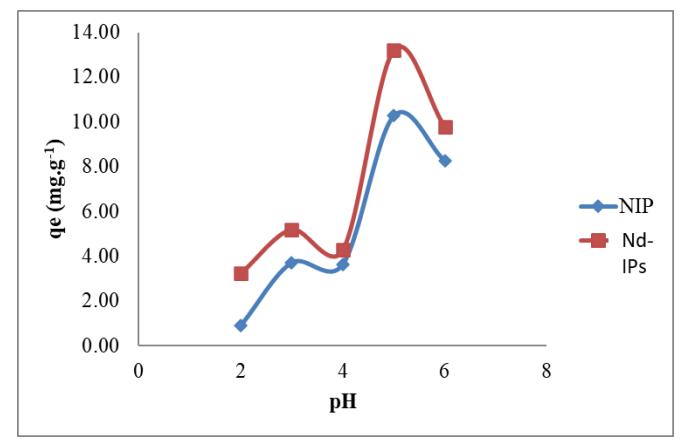
pH 3-7. Figure 1.
Figure 1. pH influence for adsorption capacity of Nd-IPs and NIPs.
Adsorption capacity of Nd-IPs and NIPs increase as well as pH optimized at pH 5. That's means, adsorption capacity decreased cause the protonation of OH\(^-\) as functional group of XO from Nd-IPs and make interaction of Nd(III) ion lower with active site of Nd-IPs and Nd can precipitated as base, Nd(OH)<sub>3</sub>, Ksp = \(3.2 \times 10^{-23}\) (CRC Handbook of Chemistry and Physics, 2007).
Increasing of initial concentration of Nd(III) effect ion total adsorbed at Nd-IPs and NIPs. It cause of the collision more abundance and reached active site at Nd-IPs and NIPs optimized until 20 mg.L\(^{-1}\). Active site from Nd-IPs and NIPs were saturated of Nd (III) ion concentration above 20 mg.L\(^{-1}\) see at Figure 2.
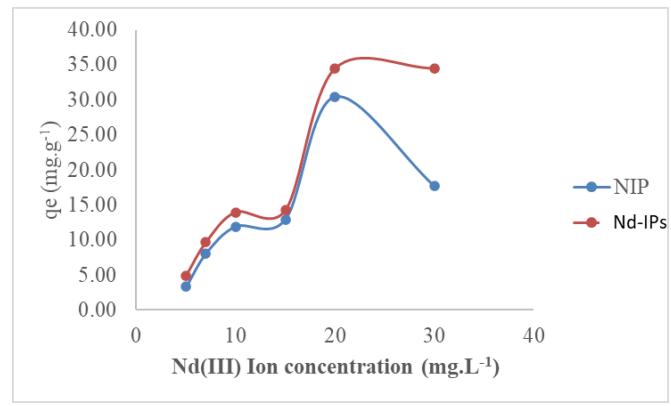
Figure 2. Adsorption capacity of Nd-IPs and NIPs vs Nd (III) ion.
The value of adsorption capacity reached at 34.46 mg.g\(^{-1}\) for Nd-IPs and 30.42 mg. g\(^{-1}\) for NIPs. It was better than previous study which has adsorption capacity value for Nd-IPs at 9 mg.g\(^{-1}\) ( Moussa et al., 2017). Size and geometry of Nd (III) ion increase the adsorption capacity of Nd-IPs.The maximum adsorption capacity for Nd (III) ion is 30.46 mg.g\(^{-1}\) at pH 5 with optimization of contact time of 20 minutes. Adsorption capacity increase because the availability of active site at ion adsorption of Nd (III) ion in Nd-IPs and NIPs (Figure 3). Increasing time, the number of active sites were decreased so that the adsorption rate was decreased.
Figure 3. Adsorption capacity of Nd-IPs and NIPs with contact time.
Adsorption data have been analyzed using Freundlich adsorption isotherm in linear and non linear model (Figure 4). Adsorption of Nd (III) ion by Nd-IPs follow Freundlich adsorption isotherms with
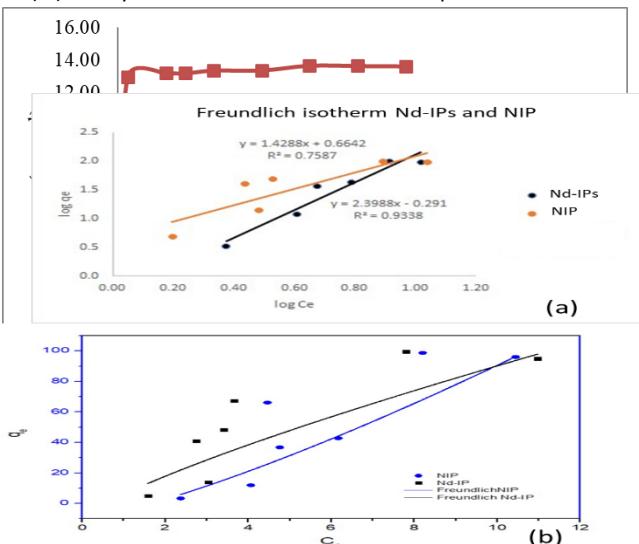
linearity reach 0.9338 in linear model and 0.7095 for non linear model
Figure 4. Freundlich isoterm adsorption linear model (a) and non linear form of Nd(III) ion of Nd-IPs and NIP.
The adsorbent has heterogeny surface and hallow formed due to MMA and DVB copolymer (Zulfikar et al., 2017)
Kinetic adsorption of Nd(III) ion for Nd-IPs was evaluated with pseudo-second order and pseudo-first order Lagergren (Sahoo and Prelot, 2020). This model function to identified interaction of sorption between analyte and adsorbent. Pseudo-first order kinetic
model was showed that analyte was sorbed at one active site. Meanwhile, Pseudo-second order kinetic model identified the analyte adsorbed in two active sites. Linear equation of pseudo-first order model followed at equation (3) between log \((q_e-q_t)\) and t (minute) (Sahoo and Prelot, 2020):
\[log(q_{e} - q_{t}) = log q_{e} - \frac{k_{1}}{2.303}t\] (3)
\(q_e\) and \(q_t\) were adsorption capacity of metal ion at equilibrium state and current time \((mg.g^{-1}),\;t\) was contact time metal ion with adsorbent (minute) and \(k_2\) was pseudo second order kinetic reaction coefficient (g m g^{-1} minute^{-1}) and \(k_1\) was pseudo first order kinetic reaction coefficient t (menit^{-1}). Relation between log (\(q_e-q_t\)) and t was prediction the curve of linearity of physicalsorption model and for pseudo second order model for chemisorption interaction. Liniear equation of pseudo second model followed at equation (4) (Hoo, 2006). This equation was conducted the curve between \(t/q_t\) and t (minute) (Sahoo and Prelot, 2020):
\[\frac{t}{q_t} = \frac{1}{k_2 q_g^2} + \frac{1}{q_g} t \tag{4}\]
For kinetics study with Pseudo-order reaction kinetics model, the pseudi-first order and pseudo-second order Lagergren models used to study the kinetics of ion adsorption reaction Nd (III) by Nd-IPs.
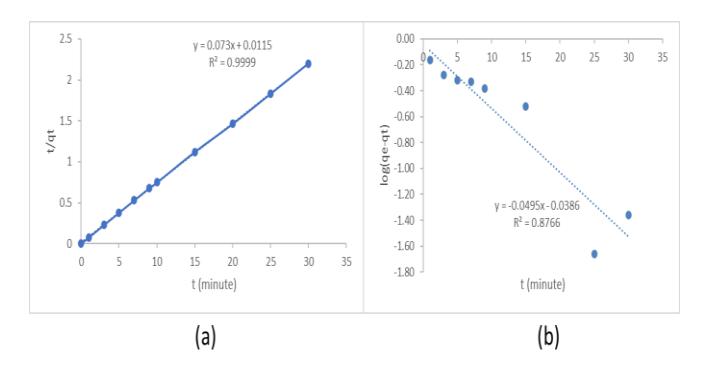
Figure 5. Model curve pseudo-second order one- Lagergren (a) and pseudo-first order Langergren, (b) Nd(III) ion element adsorption by Nd-IPs.
Reaction kinetic adsorption Nd(III) ion allowed kinetic adsorption model pseudo-second order, based on correlation coefficient value close to 1. Kinetic parameter was showed in Table 1.
| pseudo-second order | |
| Pseudo-first ord | ler | Pseu | do-second or | der | Experiment | |
|---|---|---|---|---|---|---|
| K1 | R2 | \(q_e\)(mg.g\(^{-1}\)) | K2 | R2 | \(q_e\)(mg.g\(^{-1}\)) | qEks(mg.g⁻¹) |
| 0.1139 | 0.8766 | 0.91 | 0.4639 | 0.9999 | 13.69 | 13.68 |
Selectivity coefficient of Nd-IPs to ion \(Nd^{+3}/La^{+3}\) are 1.35 and 1.38. And selectivity coefficient value of 1.35 and 1.40 for \(Nd^{+3}/Y^{+3}\) (Table 2).
Selectivity tested was important factor for metal Ion-Imprinted polymers such Nd-IPs application. The several rare elements ions, Nd(III), La(III), Y(III) and Ca(II) with composition Nd:La:Y:C (1:1:1:1)
and (2:1:1:1) were mixed 0.05 g Nd-IPs into 10mL solution have been obtained variety number of the distribution coefficient (Kd) and selectivity coefficient showed in Table II. Selectivity was given from Nd-IPs contact with rare element ion and others. Based from the selectivity data from Table II. Lantanum, Ytrium and Calsium were disturbing ion in selectivity test of Nd-IPs, then Nd(III) ion was more higher than others (Zhang L et al., 2011).
| Kd | α | Kd | Α | ||
|---|---|---|---|---|---|
| Ion metal | Composition 1:1:1:1 | Composition 2:1:1:1 | |||
| Nd+3/ La+3 | Nd+3 | 0.39 | 1.35 | 0.27 | 1.38 |
| La+3 | 0.29 | 0.20 | |||
| Nd+3/ Y +3 | Nd+3 | 0.39 | 1.35 | 0.27 | 1.40 |
| Y +3 | 0.29 | 0.19 | |||
Table 2. Selectivity (α) and ion distribution coeficient (Kd)
Selectivity coefficient define as capability neodymium ion contact on memory effect template and selective with Nd(III) ion.
Conclusion
Retention properties characteristic of Neodymium (III) ion-Imprinted Polymers (Nd-IPs) with Xylenol Orange were evaluated using batch method. Optimizing their adsorption capacity was 30.36 mg.g−1 , at pH 5 and contact time was 20 minute. Adsorption process of Nd(III) ion for Nd-IPs was followed by Freundlich isotherm adsorption and pseudo-second order kinetic model. Selectivity of Nd(III) ion has been optimized with its concentration higher than other disturb ion (La and Y).
Conflict of Interest
We have no conflict to declare.
Acknowledgements
This research dedicated to analytical chemistry research group of ITB to support the research equipment and financial support from LPPM ITB development of capacity for young researcher
References
Andersson, H.S. et al. (1999) 'Study of the nature of recognition in molecularly imprinted polymers, II [1]: influence of monomertemplate ratio and sample load on retention and selectivity', Journal of Chromatography A, 848, pp. 39-49. doi:10.1016/S0021- 9673(99)00483-5.
Raton, B.L. (2007) 'CRC Handbook of Chemistry and Physics, 88th ed. Editor-in-Chief: David R. Lide (National Institute of Standards and Technology). CRC Press/Taylor & Francis Group. 2640 pp. Journal of American Chemical Society, 130, pp. 382-384
Dolak, I. et al. (2015) 'Ion-imprinted polymers for selective recognition of Neodymium(III) in environmental samples', Industrial and Engineering Chemistry Research, 54, pp. 5328-5335. doi:10.1021/acs.iecr.5b00212.
Rao, T.P., Daniel, S., Gladis, J. M. (2004) 'Tailored materials for preconcentration or separation of metals by ion-imprinted
polymers for solid-phase extraction (IIPSPE)', TrAC Trends in Analytical Chemistry, 23, pp. 28-35. doi:10.1016/S0165- 9936(04)00106-2.
Singh, D.K., and Mishra, S. (2009) 'Synthesis of a new Cu(II)-ion imprinted polymers for solid phase extraction and preconcentration of Cu(II)' Chromatographia, 70, pp. 1539-1545. doi:10.1365/s10337-009-1379-2.
Zhang, D. et al. (2006) 'Selective adsorption and steric recognition by molecularly imprinted polymers: a study on molecular selfassembly and its effect on selectivity', High Performance Polymers, 18, pp. 949-960. doi:10.1177/0954008306069132.
Moussa, M.,et al. (2017) 'Selective solid phase extraction of lanthanides from tap and river waters with ion imprinted polymers. Analytica Chimica Acta, 963, pp. 44-52. doi: 10.1016/j.aca.2017.02.012
Sahoo, T. R., and Prelot, B. (2020) 'Chapter 7-Adsorption processes for the removal of contaminants from wastewater: the perspective role of Nanomaterials and nanotechnology', Elsevier. pp.161-222 doi: 10.1016/B978-0-12-818489-9.00007-4
Zhao, J. et al. (2007) 'Synthesis of Zn(II) ion imprinted solid-phase extraction materials and its analytical application, Analytica Chimica Acta, 603, pp. 87-9. doi:10.1016/j.aca.2007.09.024.
Zhang, L. et al. (2011) 'Adsorption and selective separation of neodymium with magnetic alginate microcapsules containing the extractant 2-ethylhexyl phosphonic acid mono-2-ethylhexyl ester', Journal of Chemical and Engineering Data, 56, pp. 2280-2289. doi:10.1021/je101270j.
Zulfikar, M.A., Zarlina, R., Rusnadi, Handayani, N., Alni, A., and Wahyuningrum, D. (2017) 'Separation of Yttrium from Aqueous Solution Using Ionic Imprinted Polymers', Russian Journal of Non-Ferrous Metals, 58(6), 614–624. doi: 10.3103/S1067821217060189
Zulfikar. M.A. et al. (2020) 'Effect of phosphate ion on sorption of Nd(III) ion from aqueous solution using ion imprinted polymers', AIP Conference Proceedings, 2237, 02041. 1-5. doi:10.1063/5.0005598.