

INTRODUCTION
Globalization has entered a modern and advanced phase thanks to the rapid development of today's technology. Technology is essentially created to make it easier for humans to carry out their activities. The current rapid technological development has made it so that almost no activity can be done without depending on technology. Technology has influenced various aspects of life, including how children play. Nowadays, many students are accessing various popular online games, such as Player Unknown's Battleground (PUBG), Mobile Legends, Free Fire, Hago, and many other online game applications. Online games have become one of the most popular forms of entertainment among elementary school students.
Correspondence author: Muhammad Ridho Alifandi, Universitas Lambung Mangkurat, Indonesia. Email: muhammadridhoalifandi@gmail.com
DOI: http://dx.doi.org/10.5614/jskk.2025.10.1.8 e-ISSN: 2654-8860 . p-ISSN: 2477-1791
Online games are multiplayer games that can be played simultaneously via an internet connection. These games can be played on various platforms such as personal computers, laptops, gaming consoles, and smartphones (Agung Sidhiq Hidayat et al., 2024).
An expert on video game addiction in the United States, Mark Griffiths from Nowingham Trent University, found that nearly one-third of early teenagers play online games every day. "More concerning is that around 7% of them play at least 30 hours a week." (Syahran, 2015). A high gaming duration is defined as more than 5 hours of gameplay, 3–5 hours is considered moderate, and 1–2 hours is considered low. Likewise, high gaming frequency means playing daily, 3–5 times a week is moderate, and 2 times a week is low (Sandya & Ramadhani, 2021). Online games have significant impacts on children, both positive and negative. The negative effects of playing online games include (1) aggressive behavior, (2) antisocial tendencies, (3) foul language, (4) depression and constant anxiety, (5) reduced concentration. On the other hand, the positive effects include (1) improved thinking skills, (2) increased thinking speed, (3) enhanced brain activity, (4) increased attentiveness and concentration, (5) Train a sense of sportsmanship towards the opponent, and (6) get used to more activities (Fajarini et al., 2024).
The phenomenon that occurs in the field with the pampering of players, online games have a big impact, children are more active in playing online games with their gadgets compared to having to play or do physical activities. According to Kueh, Kuan, & Morris in (Daryanto et al., 2022) physical activity refers to all body movements that require calories, be it working, studying, traveling, etc. Meanwhile, exercise is part of physical activity that is carried out in a planned, structured and repetitive manner in order to improve the health and fitness of the body.
Physical fitness is defined as the ability of an individual to perform activity continuously without excessive fatigue and still be able to perform other activities. A person's level of physical fitness affects both their physical and mental readiness to handle workloads (Rohmah & Muhammad, 2021). Based on specific functions, physical fitness is categorized into three groups: by occupation, by condition, and by age. For students at the elementary, junior, and senior high school levels, physical fitness plays an essential role in growth because it improves bodily
functions, fosters emotional and social development, enhances competitive spirit, and supports academic achievement.
Previous research, such as that conducted by (Moh. Ro'isul Huda, 2023), focused on the relationship between the frequency of playing online games and the physical fitness of junior high school students. While the study provided valuable insights, similar research at lower educational levels, such as elementary school students, remains limited. Therefore, this study aims to examine the impact of online games on the physical fitness of elementary students specifically those in grades IV, V, and VI which has yet to be widely explored in existing literature. The novelty of this research is expected to contribute to a deeper understanding of how technology affects the physical development of children in elementary education.
Based on the aforementioned explanation, the hypothesis proposed in this study is that online gaming has a negative impact, leading to a decline in students' physical fitness. The sample in this study consisted of male students from grades IV, V, and VI at State Elementary SchoolSimpang Empat 2, located in Simpang Empat District, Banjar Regency. After considering the existing issues, the researcher was motivated to conduct a study entitled "The Impact of Online Games on the Physical Fitness of Elementary School Students at State Elementary School Simpang Empat 2".
METHODS
Design
The research method used was correlation research. According to (Saputra et al., 2024) correlation research is a type of non-experimental research where a researcher measures two variables to understand and assess the statistical relationship between them without external influence. This study used a quantitative research approach. According to Sugiyono in (Kusuma Wardani et al., 2024) quantitative research is based on positivism philosophy and is used to study specific populations or samples. Data collection uses research instruments, and data analysis is quantitative/statistical with the aim of describing and testing predetermined hypotheses. There are two variables in this research: the independent variable (X) and the dependent variable (Y). In this case, variable X is online
gaming, and variable Y is physical fitness.
Participants
The researcher used purposive sampling. According to Sugiyono, purposive sampling is a sample determination technique based on specific considerations, focusing on research objectives and specific characteristics of the samples (Wilinny et al., 2019) . With this method, selected samples possess essential characteristics of the population, making them considered sufficiently representative. The sample of this study amounted to 37 male students in grades IV, V and VI of State Elementary School Simpang Empat 2.
Research Instrument
The instrument used by the researcher was the Nusantara Student Fitness Test (TKPN) to measure physical fitness levels. The test consisted of several components: measuring height and weight, the V Sit and Reach to assess flexibility of the back and hamstring muscles; Sit-Up to measure abdominal muscle strength and endurance for 60 seconds; Squat Thrust to evaluate muscular endurance, body control, balance, coordination, and agility; and the PACER test to measure the cardiorespiratory endurance (Darumoyo et al., 2025).
Data Analysis
Data analysis was conducted using a non-parametric test. The correlation between variables X and Y was measured using Spearman's correlation. In statistics, correlation analysis aims to measure the degree of linear relationship between two or more variables. The Spearman correlation test is a non-parametric statistical test used to determine the relationship between two or more ordinal-scale variables. Spearman's correlation coefficient is non-parametric because the data obtained are not normally distributed (Nurhalijah et al., 2024). Data analysis was conducted using the SPSS program.
RESULTS
The data obtained from the online game impact variable (X) were measured using observation questionnaires completed by a total of 37 student participants.
Table 1. Dist Frequency Distribution of Online game Impact Scores (X)
| Class | Interval | Frequency | Percentage% |
|---|---|---|---|
| 1 | 1-2 | 6 | 16% |
| 2 | 3-5 | 11 | 30% |
| 3 | >5 | 20 | 54% |
| Total | 37 | 100% |
Based on the table above, out of the 37 samples, in the 1–2 interval class, there were 6 students who were not addicted to playing online games (16%) categorized as low, meaning the students had played online games but rarely. In the 3–5 interval, 11 students (30%) were categorized as moderate balancing online gaming and social activities. In the >5 interval, 20 students (54%) were categorized as high indicating online game addiction. The distribution of online game impact scores is shown more clearly in Figure 1 below.
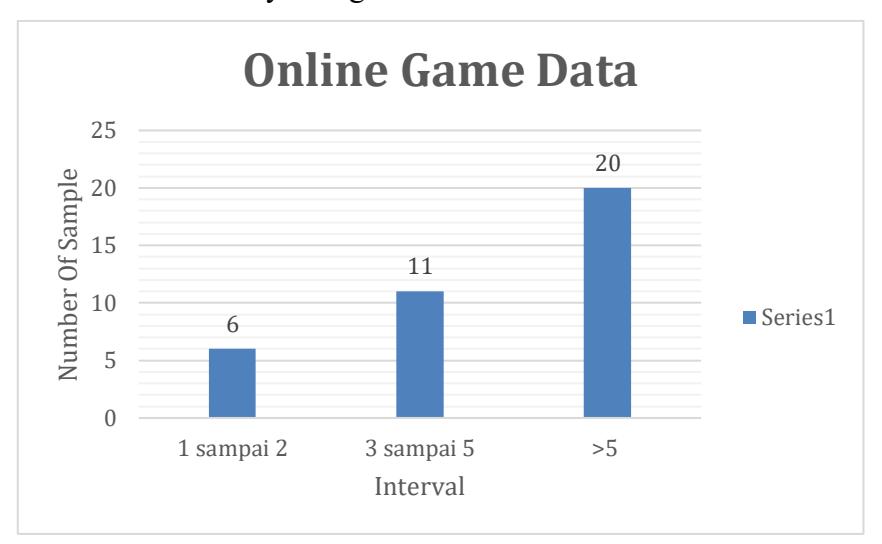
Figure 1. Online Game Histogram
The data for the physical fitness variable (Y) were obtained using the National Student Physical Fitness Test (TKPN), completed by all 37 students.
Table 2. Frequency Distribution of Physical Fitnes Scores
| Class | Interval | Frequency | Percentage% | |
|---|---|---|---|---|
| 1 | <1 | 0 | 0% | |
| 2 | 1-1,9 | 23 | 62% | |
| 3 | 2-2,9 | 14 | 38% | |
| 4 | 3-3,9 | 0 | 0% | |
| 5 | >4 | 0 | 0% | |
| Total | 37 | 100% | ||
Based on the table above, for physical fitness distribution (Y), 0 students (0%) were in the "very low" category (<1), 23 students (62%) were in the "low" category (1– 1.9), and 14 students (38%) were in the "enough" category (2–2.9). There were no students in the "good" (3–3.9) or "very good" (>4) categories. The distribution of physical fitness scores is illustrated in Figure 2 below.
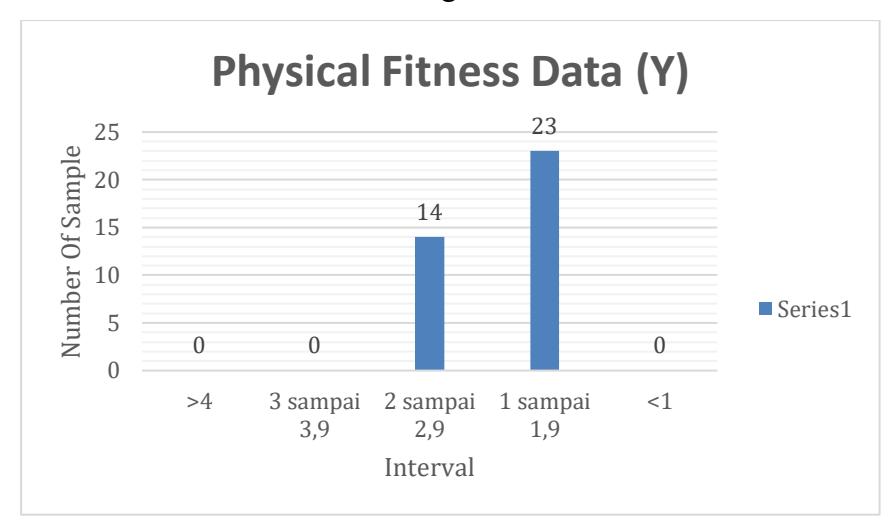
Figure 2. Physical Fitnes Histogram
Data analysis was conducted using a non-parametric test. The correlation between variables X and Y was calculated using Spearman's correlation. Data analysis was assisted using the SPSS program. The hypothesis tested was: there is no significant relationship between online gaming (X) and physical fitness (Y). The results are presented in the table below.
Table 3. Hypothesis Test Result
| Variable | Correlation Coefficient | Rscalculated | Rstable | Category | |
|---|---|---|---|---|---|
| Online Game | 0.266 | 0.111 | > | 0.05 | Not Significant |
| Physical Fitnes | Not Significant | ||||
It can be concluded that H₀ is accepted and H₁ is rejected, where H₀ states that there is no significant relationship between the duration of playing online games (X) and physical fitness (Y) among male students in grades IV, V, and VI at SDN Simpang Empat 2. This means that online gaming activity does not have a negative
impact on the physical fitness of students in grades IV, V, and VI at SDN Simpang Empat 2, with a significance value of 0.111 (p > 0.05) and a correlation coefficient value of -0.266. The direction of the correlation is negative, and the strength of the relationship tends to be weak or negligible, indicating no significant relationship between playing online games and students' physical fitness.
DISCUSSION
This study was conducted to determine the impact of online games on the physical fitness of students in grades IV, V, and VI at State Elementary School Simpang Empat 2. The research results showed that the students who played online games were generally categorized as having high engagement, indicating addiction. The physical fitness results from the National Student Physical Fitness Test (TKPN) showed that most students had low physical fitness levels.
Based on the Spearman correlation calculation between variables X and Y, it was found that there was no significant relationship between playing online games and physical fitness. The significance value was 0.111 (> 0.05), and the correlation coefficient was 0.266. This indicates a very weak and statistically insignificant relationship between the two variables. This finding is also in line with a study by (Sururudin Achmad, 2023) titled 'The Relationship Between Online Game Duration and Teenagers' Physical Fitness Levels in Klopogodo Village, Gombong District, Kebumen,' which found a hypothesis test significance value of 0.360 (greater than 0.05), and a t-value lower than the t-table (1.367 < 2.080), indicating no significant difference between online and offline gaming on physical fitness. Similarly, a study by (Waluyo & Lontoh, 2021) titled 'The Relationship Between Online Game Playing Intensity and Physical Activity of Medical Students at Tarumanagara University,' showed no significant relationship (p-value = 0.652) between online gaming intensity and physical activity.
Several factors may have influenced these results, including the physical activity levels of respondents who might still be relatively active. For instance (Adhianto & Arief, 2023) found a significant correlation between physical activity and physical fitness among junior high school students, with a correlation coefficient of 0.244 and a significance value (p) of 0.046. This suggests that higher
levels of physical activity contribute to better physical fitness, implying that game playing may not directly reduce students' fitness levels. In addition, the duration of game play may have been relatively normal or the types of games played may not have had a major impact on physical activity reduction. Another factor contributing to low physical fitness could be the limited time allocated for physical education (PE) classes. Research has shown that 25 minutes/week of moderate to vigorous physical activity in schools is insufficient based on national recommendations. Meanwhile, PE classes in elementary schools last 4x35 minutes per week under the KTSP curriculum, though there is no conclusive research proving whether this duration significantly contributes to students' physical fitness (Prianto et al., 2022).
The small sample size (n=37) may also have affected the statistical power of the test, meaning that actual relationships may not have been detected as statistically significant. Additionally, other variables such as eating habits, exercise routines, and sleep/rest patterns which were not controlled in this study could be confounding factors influencing the results. A well-structured and controlled diet is important for growing children since all body activities require adequate energy intake. Proper nutrition can support improved physical fitness. Likewise, regular and directed exercise habits positively influence physical fitness. Sufficient sleep and rest are also essential to allow children's bodies to recover, enabling them to perform daily learning and play activities more optimally and comfortably (Sriratih & Muzaffar, 2022). Thus, although in theory online gaming can affect physical fitness, the results of this study are not strong enough to support that hypothesis. Further research with a more complex design and larger sample size is needed.
CONCLUSSION
Based on the research results and data processing, it can be concluded that online games do not negatively impact students' physical fitness, as variables X and Y are not categorized as harmful. The test for significance using Rs calculated = 0.111 > Rs table = 0.05 indicates a value greater than the significance level. Therefore, H₀ is accepted and H₁ is rejected. The correlation coefficient is 0.266, with a negative correlation direction and a weak relationship strength. In other words, there is no significant relationship between online gaming and the physical fitness of male students in grades IV, V, and VI at State Elementary School
Simpang Empat 2, Simpang Empat District, Banjar Regency.
REFERENCES
- Adhianto, K. G., & Arief, N. A. (2023). Hubungan Aktivitas Fisik Terhadap Kebugaran Jasmani Peserta Didik Sekolah Menengah Pertama. Jambura Journal of Sports Coaching, 5(2), 134–141. https://doi.org/10.37311/jjsc.v5i2.20978
- Agung Sidhiq Hidayat, Diyono, & Warih Anjari Dyah K. (2024). Hubungan Durasi Bermain game Online Terhadap Nyeri Carpal Tunne Syndrome Pada Pengguna Wifi Corner Di Telkom Sragen. Physio Journal, 4(1), 6–13. https://doi.org/10.30787/phyjou.v4i1.1288
- Darumoyo, K., Widhiya, A., Utomo, B., & Septianingrum, K. (2025). Optimalisasi Kebugaran Jasmani Siswa di MIN 6 Ngawi melalui Tes Kebugaran Pelajar Nusantara ( TKPN ). 4(1), 1–12. https://doi.org/10.60004/komunita.v4i1.122
- Daryanto, D., Purbodjati, P., & Anita Kumaat, N. (2022). Pengaruh Intensitas Penggunaan Smartphone Terhadap Kebugaran Jasmani Dan Keterampilan Sosial Siswa. Bravo's : Jurnal Program Studi Pendidikan Jasmani Dan Kesehatan, 10(3), 219. https://doi.org/10.32682/bravos.v10i3.2706
- Fajarini, S. D., Mukhlizar, & Valentin, R. K. (2024). Bahaya Penggunaan Gadjet Dan Game Online Bagi Anak usia Sekolah Dasar. Jurnal Abdimas Serawai, 4(2), 58–72. https://doi.org/10.36085/jams.v4i2.6566
- Kusuma Wardani, D., I'anatuzzakiyah, Khotimah, K., & Umardiyah, F. (2024). Analisis Korelasi Untuk Menentukan Hubungan Game Online dengan Motivasi Belajar Siswa. In Exact Papers in Compilation (Vol. 6). https://doi.org/https://doi.org/10.32764/epic.v6i1.1074
- Moh. Ro'isul Huda. (2023). Hubungan antara frekuensi bermain game online dan kebugaran jasmani pada anak usia 13-15 tahun di SMP Negeri 24 Surakarta. Universitas Sebelas Maret Surakarta. https://digilib.uns.ac.id/
- Nurhalijah, S., Cahyati, N., Romadhona, A., Mauliani, N., & Rahayu, M. (2024). Analisis Korelasi Spearman Untuk Mengetahui Hubungan Antara Penggunaan Media Sosial Dan Tingkat Produktivitas Akademis Mahasiswa Agribisnis ( Studi Kasus : Universitas Sultan Ageng Tirtayasa ). Jurnal Ilmiah Wahana Pendidikan, 10(16), 800–809.
- Prianto, D. A., Utomo, M. A. S., Abi Permana, D. A. P., Mutohir, T. C., & Suroto. (2022). Survey Tingkat Kebugaran Jasmani dan Faktor Yang Mempengaruhi
- Tingkat Kebugaran Jasmani Siswa Sekolah Menengah Pertama di Sidoarjo. Jurnal Segar, 10(2), 49–56. https://doi.org/10.21009/segar/1002.01
- Rohmah, L., & Muhammad, H. N. (2021). Tingkat Kebugaran Jasmani dan Aktivitas Fisik Siswa Sekolah. Jurnal Universitas Negeri Surabaya, 09(01), 511–519. https://ejournal.unesa.ac.id/index.php/jurnal-pendidikan-jasmani
- Sandya, S. N., & Ramadhani, A. (2021). Pengaruh Intensitas Bermain Game Online Terhadap Prokrastinasi Akademik Mahasiswa. Psikoborneo: Jurnal Ilmiah Psikologi, 9(1), 202. https://doi.org/10.30872/psikoborneo.v9i1.5680
- Saputra, A., Ramadi, & Imam, R. (2024). Dampak Game Online terhadap Kebugaran Jasmani Siswa Kelas V SDN 007 Melayu Tengah Kecamatan Tanah Putih Tanjung Melawan Kab. Rokan Hilir. https://doi.org/https://doi.org/10.31258/jassi.3.2.355-364
- Sriratih, A., & Muzaffar, A. (2022). Survei Tingkat Kebugaran Jasmani Pada Siswa Kelas VIII SMP Negeri 11 Muaro Jambi Pasca Masa Pandemi. Cerdas Sifa Pendidikan, 11(2), 119–129. https://doi.org/10.22437/csp.v11i2.19712
- Sururudin Achmad. (2023). Hubungan Antara Durasi Bermain Game Online Terhadap Tingkat Kebugaran Remaja Desa Klopogodo Kecamatan Gombong Kebumen. November, 1919–1929.
- Syahran, R. (2015). Ketergantungan Online Game Dan Penanganannya. Jurnal Psikologi Pendidikan Dan Konseling: Jurnal Kajian Psikologi Pendidikan Dan Bimbingan Konseling, 1(1), 84. https://doi.org/10.26858/jpkk.v1i1.1537
- Waluyo, F. C., & Lontoh, S. O. (2021). Hubungan intensitas bermain game online terhadap aktivitas fisik mahasiswa Fakultas Kedokteran Universitas Tarumanagara Angkatan 2019-2020. Tarumanagara Medical Journal, 3(2), 322–329. https://doi.org/10.24912/tmj.v4i1.13725
- Wilinny, W., Halim, C., Sutarno, S., Nugroho, N., & Hutabarat, F. A. M. (2019). Analisis Komunikasi Di PT. Asuransi Buana Independent Medan. Jurnal Ilmiah Simantek, 3(1), 1–6. https://simantek.sciencemakarioz.org/index.php/JIK/article/view/146