

INTRODUCTION
Indonesia, is the country with population around 240 million people, the fourth biggest population country in the world. Indonesia consists of 17,508 islands, about 6,000 of which are inhabited. These scattered islands location provide challenges for infrastructure development, including the development of sanitation infrastructure.
Nowadays, around 71,06% of urban population and 32,47 % of rural population are served by the save on site sanitation system[1]. Save sanitation here defined as the house hold that already have septictank but the condition of septic tank are not measured. For centralized sanitation system, the percentage of people served only reached 2,33% which only served the urban area[1] . The rest are still doing open defecation.
Domestic wastewater is estimated to contribute about 70% of organic loading in rivers in urban areas in Indonesia[2]. Most of domestic wastewater in Indonesia comes from greywater, which is flowing through the sewer or drainage system without treatment, if exist, from where it mainly flows into aquatic system. Combination with inappropriate waste management, in most cities, greywater contaminates some rivers that have function as source of drinking and cleaning water.With existing condition of wastewater treatment in Indonesia, contamination of the water body by constituents from domestic wastewater and the higher cost of water supply production are inavoidable
The trend of urbanization also makes the wastewater treatment management more challenging. As consequences from the urbanization, not only increasing demand of water supply but also raising the possibility of contamination of the water body by inappropriate disposal of domestic wastewater. The cost of treating water will be high while the higher contamination of water body is unavoidable. Here is where the greywater separation and reuse can be seen as an opportunity to overcome the high demand of water supply by reusing the high amount of wastewater disposed. Greywater is household wastewater streams that generated from the kitchen (dishwashers and kitchen sinks), bathrooms (shower, baths and hand wash basins) and laundry (washing machines or by hand). Greywater constitutes 50-80 % of the total household wastewater, represent the largest part of the wastewater from households, office and schools[3][4][5]. If the black and greywater can already be separated from the housing level, the greywater which is almost 80% volume of total wastewater can be treated with lower technology which leads to lower treatment cost and can be safely used for the water supply for non drinking purpose such as greywater reuse in urban agriculture.
Greywater separation from blackwater is not really difficult to be implemented in Indonesia. Not like the countries that already have good integrated wastewater system, where the plumbing system in the houses already design to collect both from the blackwater source and the greywater source and discharged to the primary sewer system, in Indonesia common system are the blackwater collected and discharged to the septic tank or the sewer system if available while the greywater collected together mixed with the rain water discharge and discharged to the drainage system. With this separation, we can try to collect the greywater without discharge it directly into the city drainage system and treat the greywater separately.
To be able to separate greywater and reuse it, non centralized systems will be a convenience solution than the centralized system. Non centralized system is known of its flexibility and adaptability to the local condition of the urban areas as well as grow with the community as its population increases[6]. In Indonesia the awareness of the opportunity and the advantages of greywater separation and treatment already rise on the last 10 years. There are some projects related on the greywater treatment that will be discussed further in this paper. Although the awareness are raising the development are not quite significant, one of the main reason is the acceptance of the people about reusing the wastewater which for common people considered as dirty water. Further campaign strategy of greywater reuse need to be design and implemented with collaboration from many stake holder related to water issues in Indonesia.
METHODS
All information in this paper is collected through several methods such as publish literature review, especially standards and greywater treatment systems; or unpublish literature that come from internal report or material especially for wastewater management in Indonesia. For supporting limited data and information about sanitation condition and greywater quality, it used analyses of result from field survey and sampling in Bandung City.
On site surveys were conducted for three months; with almost 300 respondents; in 2009. Limited water quality sampling of mixed greywater was undertaken to get a general understanding of the overall quality of greywater in urban area.
Domestic Wastewater Management in Indonesia Existing condition
In Indonesia, the responsibilities of wastewater management especially on providing the wastewater treatment infrastructure facilities held by the city/regency level government where the planning done by the city planning agency (Bappeda) and the construction project held by the city human settlements agency (Dinas PU) with assistance from the central government from the National Planning Agency (Bappenas) and Ministry of Public Works. The regulation and audit made by the Ministry of Environment and in the city/regency level done by the Regional Environmental Agency (BPLHD / Bapedalda). The water institutional base in Indonesia are as shown on Table 3.1.
Wastewater management in Indonesia currently still in challenging phase. Even from the National Social Economic Survey (SUSENAS) held on 2007 by National Agency of Statistics shows that in total 77,15% or around 90,5% of urban population and 67 % of rural population are already have access to basic sanitation, but the quality of sanitation and the wastewater treatment are not suitable enough yet.
Only 11 big cities have centralized wastewater treatment plants with total capacity 425.817 m3 /day which only 26,5 % of its total capacity is used (MoPW Indonesia, 2009)* while the rest 486 city/regency still depend on the septic tank which its quality are not guarantee and also with condition where the distance between septic tank and the deep well are quite close. The existing centralized wastewater treatment facilities are shown on the Table 3.2.
Inadequate sanitation facilities especially the service from centralized wastewater treatment facilities mainly due to the availability of budget for sanitation infrastructure. According to the Ministry of Public Works Indonesia*, the estimated investment cost for centralized wastewater treatment facilities are around 200 USD per capita consist of around 30 USD per capita for the treatment plant, 145 USD per capita for the primary sewer system, and 25 USD per capita for the connecting system and house connection. The high investment cost of the primary sewer system are the main reason of the high percentage of idle capacity of the built treatment plant. ADB study** stated that the economical loss related to inadequate sanitation are around 4,7 billion USD per year (around 2% from total GDP of Indonesia).
Table 3.1 Water Institutional Base In Indonesia
| Organi | zation | Responsibilities | ||||||
|---|---|---|---|---|---|---|---|---|
| Planning & Coordination | ||||||||
| Central Level | BAPPENAS, national deagency | velopment planning | Water resources loan & intergovermental coordination | |||||
| Provincial Level | BAPPEDA, provincial de agency | evelopment planning | Spatial planning & intergovermental coordination | |||||
| Water Resources Deve | lopment & Management | |||||||
| Central Level | Ministry of Public Works for Water Resources (DG | Management & Planning for the development of water resources | ||||||
| Ministry of Forestry | Catchment management guidance | |||||||
| Provincial Level | Provincial Water resource | es Services | Provincial planning, design and implementation quality and guidance | |||||
| Water Supply Sanitation | on & Pollution Control | |||||||
| Ministry of Public Work Human Settlements | s, Directorate Generale | Design and setting guidelines for the water supply and domestic wastewater | ||||||
| Ministry of Home Affair | rs & Directorates | Monitoring & evaluation & coordination w/ local govmnt | ||||||
| Ministry of Health | M&E of water quality, sanitation, & hygine promotion | |||||||
| Ministry of The Environ | ment | Setting standards for wastewater discharge into the env | ||||||
| Ministry of Industry | Industrial wastewater pollution control | |||||||
| Ministry of Mining and | energy | Control of groundwater licenses & abstraction for water supply | ||||||
| Central Statistics Bureau | ì | Collect of statistical data | ||||||
| City Public Works Agen | cy | Implementing the Infrastructure development | ||||||
Source: Indiyani, Presented on Wastewater Reuse Course, Singapore 2009.
Table 3.2 Existing Centralized Wastewater Treatment Plant In Indonesia
| City | System | Total Capacity | Used Capacity Installed House Connections | ||
|---|---|---|---|---|---|
| (m3/day) | (m3/day) | ||||
| Medan | UASB | 60.000 installed 10.000 | 16,000 | 11.769 target 18.000 | |
| Prapat | Aerated Lagoon | 2,000 | 400 | 220 | |
| DKI Jakarta | Aerated Lagoon | 13,815 | 13,815 | 1,318 | |
| Bandung | Lagoon | 243.000 installed 80.000 | 40,000 | 97,952 | |
| Cirebon | Lagoon | 24.566 installed 20.547 | 9,667 | 13.165, waiting list 14.585 | |
| Yogya | Aerated Lagoon | 15,500 | 7,314 | 11,000 | |
| Surakarta | Aeration & Facultative Pond, | 4,536 | 1,679 | 10,983 | |
| Biofilter | |||||
| Bali | Aerated Lagoon | 51,000 | 31,185 | 8.647, on DSDP 2 target 15.000 | |
| Banjarmasin | Rotating Biological Contractor 5,100 | 5100 | 1.973 | ||
| Balikpapan | Extended Aeration | 800 | 723 | 9.865, on 2015 target 17.273 | |
| Tangerang | Oxydation Ditch | 5,500 | |||
Source: MoPW Indonesia, 2009*
Even for the last 6 years the Government of Indonesia keep increasing the budget for sanitation sector, the increasing of the budget are not fast enough. Beside that, wastewater sector seen as the non profitable sector. The tariff of wastewater service are very low even in some city are free. This fact makes the operational and maintenance of the wastewater treatment plant are difficult to run by the Wastewater Enterprise without subsidize by the city annual budget. From The National Planning Agency Observation on 2005, known that currently the sanitation inftastructure investment are around 3 USD cents per capita/year while the ideal amount are 5,2 USD per capita/year*. If the investment reach the ideal number it would increase the productive time of the people around 34% - 79% and decreasing the health care cost around 6% - 19%.
On 1996-1999 JICA*** made observation of water quality from 32 river in 26 different cities in Indonesia with results 29 of 32 observed river have fecal coli, Dissolved Oxygen, , BOD, COD, NH3, Cd, Pb, Cu, Zn, surfactants, and SO4 concentration above the treshold value limit and predicted that the contamination value will be increase day by day. From this observation also founded that almost 60 percent of the contaminant comes from domestic wastewater. Another important part of this observation was all the river that was observed are the urban river which used as the water source for the local water supply enterprise. This facts leads to another problem on water supply production. The higher contaminant contains on the raw water the higher also the production cost of drinking water.
From The National Action Plan Study for Wastewater Sector of Ministry of Public Works Indonesia* there are formula to count the relation between water supply production cost with BOD concentration of the raw water source.
Production Cost (Rupiah) = \[194,57 + 9,71 \text{ BOD (mg/l)}\] (1)
Based on the formula (1) the production cost of water supply will increase around Rp 10,- ( 0,1 cent USD) for every m3 water for every mg/l BOD consist on the raw water source used.
Relating the formula with JICA observation where founded that the BOD of the river water were around 8 mg/liter to 32,5 mg/ liter, can be concluded that by the year 1996-1999 economics effect of BOD concentration to the cost of drinking water production are around Rp 8,- to Rp 325,- per m3 or around 2-82 % from the average tariff of water supply that time. This number are increasing also day by day which given more trouble for the local water supply
enterprise. Currently, there are 343 local water supply enterprise (PDAM) which 129 of it less healthy and 78 stated unhealthy or around 58 % PDAM are not in a good condition both in financial matter and production efficiency (MoPW, 2011)****.
- * Presentation of Director of Environmental Sanitation, Ministry of Public Works, on Media Workshop, December 2008Study
- ** ADB of Impact of Bad Sanitation in Indonesia, 2008
- *** JICA study of River in Indonesia 1995-1999
- **** Supporting Agency of Water Supply System Development of Indonesia Database, 2011.
Sanitation Facilities ( Study case : Bandung City )
Bandung City is one of 11 city in Indonesia that already had centralized wastewater treatment system. The plant, called IPAL Bojongsoang, has capacity 89,000 m3/day and cover treatment for Eastern Part of city. Nowadays, the work capacity is only 40,000 m3/day. Previously, the wastewater that come from Eastern and Western Region was planned to treat in 2 separate Wastewater Treatment Plant (WWTP). Currently, in western region, for around 23,000 m3/day of wastewater generated, there is no treatment exists. Therefore all wastewater from the sewer in the western region is discharged directly to the Citepus and Cikapundung River[7] .
The information gathered during on site survey provided a general overview of sanitation facilities in this city. The limited centralized wastewater treatment has forced the housing complexes to treat its blackwater with an onsite system ( septic tank) and direct the greywater through open channel straight into rivers. In Bandung, the main sanitation facilities are septic tank. These facilities, individual and communal septic tank accounts for 83% of respondents. For low income class, communal septic tank is the main sanitation facilities. Using of individual septic tank increased with rising income. About 75 % of respondent separate greywater from blackwater. Research from other cities, like Surabaya and Cirebon, also show the same trend [2]. Disposal of untreated greywater mostly to city drainage.. This mode of route accounts for 58 % of the major avenues of greywater disposal identified by the residents. Another significant greywater disposal route, around 30 %, is discharging greywater directly to water bodies or river. Only 12 % of interviewees discharge their greywater to septic tanks[8]. Most of respondent were conscious of clean water scarcity and indicated a willingness to conserve water and reuse greywater. Many of them prefer to build community greywater treatment, even 30 % of interviewees choose individual greywater treatment system.
Separation of greywater plumbing that exists in many urban areas in Indonesia is an advantage. For all scenarios of greywater treatment system that possible, separate greywater plumbing is a prerequisite[9]. With this separation, it will easy to collect the greywater , then treat it or reuse it directly. What kind of treatment is directly relating with greywater characteristic and reuse purpose.
Greywater Characteristic and national standard
The main constituents of greywater are salts and organic substances[9]. Many studies have been conducted to characterize domestic wastewater in the world such as for European and North American countries, Australia, and Middle East countries that face scarcity of water like Israel and Jordan. Only limited information is available on typical characteristics of greywater in Indonesia or its neighborhood that have tropical condition with relatively abundant rainfall. Even average annual freshwater per capita amounts to 15,000 m3, this abundance is not equally distributed among the island or, and the city.
Table 3.3 Domestic Greywater Characteristics in Indonesia and ASEAN Countries
| Malaysia [13] | Vietnam [14] | |||||
|---|---|---|---|---|---|---|
| Parameter | Lab.Balai Lingkungan Permukiman [10] | Pusdakota Surabaya [11] | Ecotech Garden, Bandung [12] | Bandunga | ||
| Q (l/p/d) | 60 – 178 | 225 | 80 – 110g | |||
| pH | 8.5 | 7 – 7.5 | 5.5 – 8.8 | 7.1 | ||
| EC (MS/cm) | 243 - 1860 | |||||
| SAR (mg/L) | 0.8 – 4.5 | |||||
| COD (mg/L) | 317 | 530 -1220 | 184 | 189 - 1171 | 212 | 208 |
| BOD | 189 | 200 - 490 | 74 | 111 – 690 | 129 | 151 |
| COD/BOD | 1.64 | |||||
| TSS | 48 | 27 - 194 | 76 | 63 | ||
| TN (mg/L) | 14 - 129 | 33.7 | 4 – 113 (as TKN) | 37 | 24.2 | |
| NH4-N | 13 | |||||
| TP (mg/L) | 6 - 11 | 0.414 | 0.8 – 48 | 2.4 | 4.9 | |
| PO4-P | 0.4 – 31 | |||||
| Na+ (mg/L) | 17 - 68 | |||||
| MBAS (mg/L) | 18.4 | 0.9 - 24 | ||||
| Boron | 0.02 – 0.47 | |||||
| Faecal Coli cfu/100 mL | (1.6 – 2.9) *1013 | 240 – 2.4*109 | 6.6*103 | |||
| Oil and Grease (mg/L) | < 0.05 (grease) | 28 - 146 | 190 |
a: based on field sampling, 2009;
Greywater characteristic that illustrate on Table 3.3 are highly variable because is generated as a result of living habits of the people, households income, the products used and the nature of the installation. Field sampling and surveying at Bandung show many interesting tendencies that need to be confirmed with other research in the future. High income household have tendency higher consumption of water and kind of personal care or household cleaning products. Low income household prefer to use cheaper product, sometimes meaning low quality, that giving higher value of some parameter such as TDS, EC, TP and TKN. Quantity of greywater also influenced by existing water supply service and infrastructure, number of household members and age distribution. Greywater composition are closely related to the volumes produced. Where little water is used, high strength greywater exhibits similar characteristics as conventional domestic wastewater. In places where water consumption is high the volume of greywater is greater but more diluted[10] .
Greywater is often considered by the public as safer than blackwater. However it is well established that it can still pose considerable health risks if not used appropriately. Pathogenic organisms in greywater may derive from three main sources: fecal contamination, food handling, and opportunistic pathogens, such as those found on the skin or respiratory organs (eg., nose and mouth)[15]. High value of Faecal Coliform in Indonesia's greywater need to be considered as part of source control, treatment and reuse system (Table 3.3).
Raw greywater treatment is a prerequisite for storage and use. The aim of treatment is to overcome esthetic, health and technical problems, which are caused by organic matter, pathogens and solids, and to meet reuse standards [16]. Greywater can be reused for many purposes such as garden and crop irrigation, industrial use, ornamental lakes and streams, vehicle washing and toilet use. Different reuse applications require different quality standards and thus different treatment system. In order to reuse greywater, some countries already developed water quality standard for reclaimed domestic wastewater, but not specifically greywater.
Indonesia Government realize that establishment of water quality standard that is based on specific designated beneficial water uses will not realistic from Indonesia environmental condition currently. Then, approach of Indonesia regulation for water quality standard based on water classification. However, if comparing with other standard, it can be concluded that Indonesia standard still too strict. For instance, BOD concentration, compare with China regulation and microorganism parameter, compare with WHO guidelines. In general, the adopted standards (Table 3.4) almost resemble drinking water quality and do not consider significant variation in the qualities required for different use options[16]. But, the important thing, based on Indonesia greywater quality, the use of untreated greywater is not recommended. Then, greywater treatment system that consists of different treatment steps, might be considered, depending on the required quality of the effluent or reuse purposes.
Table 3.4 Water quality standards and criteria for domestic water recycling in different countries
| Standards | Turbidit y NTU | BO D mg/ L | CO D mg/ L | SS mg/ L | DS mg/ L | pH | N mg/ L | P mg/ L | Boro n mg/L | MBA S g/L | O& G g/L | FC cfu/100m l | EC cfu/100m l |
|---|---|---|---|---|---|---|---|---|---|---|---|---|---|
| Indonesiai,[1 7] | |||||||||||||
| Class 1a | 2 | 10 | 50 | 1000 | 6-9 | 0.5 | 0.2 | 1 | 200 | 1000 | 100 | 1000 | |
| Class 2b | 3 | 25 | 50 | 1000 | 6-9 | (-) | 0.2 | 1 | 200 | 1000 | 1000 | 5000 | |
| Class 3c | 6 | 50 | 400 | 1000 | 6-9 | (-) | 1 | 1 | 200 | 1000 | 2000 | 10000 | |
| Class 4d | 12 | 100 | 400 | 2000 | 6-9 | (-) | 5 | 1 | (-) | (-) | 2000 | 10000 | |
| US-EPA[16] | |||||||||||||
| Unrestricted Usee | 2 | < 10 | 6-9 | ND | |||||||||
| Restricted Usef | < 30 | < 30 | 6-9 | < 200 | |||||||||
| WHOk | |||||||||||||
| Restricted irrigation | < 10(5) | ||||||||||||
| Unrestricted irrigationg | < 10(3) | ||||||||||||
| Drinking qualityh | < 5 | 6.5 - 8.5 | 50 | ||||||||||
| Chinai,[16] | |||||||||||||
| Toilet flushing | 5 | 10 | 6-9 | 10 | 3 | ||||||||
| Cleaning car | 10 | 15 | 6-9 | 10 | 3 | ||||||||
| Lawn Irrigation | 10 | 20 | 6-9 | 20 | |||||||||
a; drinking water quality, b; water that is intended for water recreation, aquaculture, livestock, irrigation, c; aquaculture, livestock, irrigation, d; irrigation
e;urban uses, crops eaten raw, recreational impoundments, f; restricted access area irrigation, processed food crops, non food crops, aesthetic impoundments, construction uses, industrial cooling, and environmental reuse
g; crops eaten raw
h; drinking water quality, 1993
i; Nitrogen are for ammonia measurements
Greywater Treatment System Anaerob system
Anaerobic treatment for wastewater in general has some advantages compared to the conventional aerobic system. Some of the advantages are can be implemented in low cost budget, consume less energy or even produced enery, flexible on the treatment scale unit, flexible with wide range of wastewater quality, produce less sludge, have higher loading rate, the organism contained at the anaerobic sludge are more resilient and can be keep for long period[18] . For an area with limited space available, anaerobic treatment will be a good options, with its high loading rate compare to the aerobic treatment, it can treat the same amount of wastewater by smaller unit.
The concern of anaerobic treatment are some limitations that this treatment have. The main concern of limitation that anaerobic system has is that the system needs more maintenance of the process condition which resulting the needs of higher skilled operator of the treatment plants.
Treating greywater with anaerobic treatment will need some consideration, especially on the nutrient requirements fom the wastewater to be able to perform good efficiency of bacteria on performing the anaerob sludge. The main component to be measure are C:P ratio and the N and S availability on the water that we want to be treat. On the mixed wastewater the availability of nutrients would not be an issue, where from the urine especially, the majority portions of the macro nutrients are available. On the separated greywater, the macronutrients contained are quite low. According to M.Pidou et.al[19] the biological treatment for greywater have in average 19 hours Hydraulic Retention Time (HRT) for greywater with BOD around 300-1200 mg/L.
For greywater which main source are from laundry and bathroom, one of the main concern are the high presence of anionic surfactants from detergent. In the experiment of Lucia Hernandez Leal[20], which compare the anaerobic treatment by a sequencing batch reactor with UASB for anaerobic treatment on treating greywater shows that the anaerob processes perform less COD removal (51%) compare to the aerobic process (90%) due to the high amount of surfactants.
There are not many literature using anaerobic system to treat greywater mainly the greywater was treated with constructed wetland or with conventional aerobic system. This due to the consideration that there are not enough macro nutrients in greywater that are needed to be able to perform ideal anaerobic condition that produce energy. Until now the implementation of ABR on SANIMAS which is low cost and required small space (compared to constructed wetlands) perform quite good and have acceptable effluent quality especially in removing organic substances, but the additional advantages of anaerobic treatment such as energy production cannot be achieved.
Sanimas
The objective of SANIMAS is to improve sanitation condition for urban poor people based on comunity demand and choice and to protect the environment from further contamination. In Principle SANIMAS leads to behaviour changing to protect people and the environment. Technology choice for SANIMAS based on : low cost, efficiency, simple operation and maintanance, limit of energy, appropriate technology.
Criteria for SANIMAS development :
- Urban area with high population density/ slum/ poor with population density > 150 inhibitants/ha who do not have adequate sanitation facility that fulfill the quality standard
- Have a space area 80m2 150 m2
- Willing to contribute in this project (in cash & in kind).
- The Local Government willing to share certain amount of fund for this project.
- Simple construction and using local materials as much as possible.
- Technology choice done by the community itself and met the local demand.
Technology used on SANIMAS was based on DEWATS system. On this system the greywater and blackwater are treated separately. There are some technology choices that can be decided by the community. The commonly chosen was communal toilets and washing facilities with combination of treatment with digester for the blackwater and with baffled reactor or filter for the greywater. The design of baffled reactor can be seen on the picture below:
Figure 1 ABR Design ( BORDA, 2008)
In Anaerobic Baffled Up-Flow Reactor (ABR) the incoming wastewater directed to pass through active bacteria sludge in each baffled chamber while integrated settler prevents larger solids entering the baffled section while in Anaerobic Filter Reactor the incoming wastewater directed to pass through active bacteria located on filter-material surface.
The effluent of ABR used on SANIMAS can be safely dispose directly to the water body but in some area fish pond or wet garden are used as secondary treatment before the effluent dispose into the water body. This ABR requires only around 80-150 m2 for around 100 HH (around 400 inhabitans) quite small compared to the constructed wetlands. Another advantages is that the treatment plant were built underground so the upper part can still be used (in some very dense area the ABR built under the small road between houses.
SANIMAS funded by the central government, provincial government, city/regency government, and just a little amount from the community itself. Until now the replication of community based sanitation very depend on the initiative from the central and local government to look for the area that needed the program. The initial budget for SANIMAS per location around 100 HH are between 200-300 million rupiahs.
ABR and AF
Another alternative for greywater treatment has been done by Indriani and Herumurti[21] using a combination of Anaerobic Baffled Reactor (ABR) and Anaerobic Filter (AF). Wastewater samples were taken from households in eastern Surabaya. Reactor I consisted of 4 ABR and 1 AF compartments, while Reactor II consisted of 3 ABR and 1 AF compartments. HRT for Reactor I was 25.36 hour, while Reactor II was 27.02 hour. Organic concentrations used in this study were 20, 30, and 35 mg PV/L for Reactor I, and 50, 100, and 150 mg COD/L for Reactor II. The highest
PV removal of Reactor I and Reactor II were 54.54% and 64.75%, respectively. The highest COD removal on Reactor II was 68.98%.
From this experiment, it was found that ABR-AF reactor was not suitable for treating greywater because the organic loading of common households' greywater is not high enough to reach sufficient organic loading rate for ABR-AF (1-3 kg COD/m3 .hari). This type of reactor are more suitable for high organic loading wastewater, because for the same reactor volume, a higher removal efficiency could be obtained (>90%). For lower organic loading wastewater (greywater), constructed wetland or phytoremediation would give better performance because they can work optimally at low organic loading rate (7.5-8 g BOD/m2 .hari[22] .
Another experiment with ABR has done by Soewondo, Madyanova, and Indiyani[23][24] using greywater taken from one four stars hotel in Bandung. Reactor 1 consists of 4 chambers, Reactor 2 consist of 3 chamber, and Reactor 3 consist of 3 chamber with stones as filter on the last chamber. The variation applied on the detention time with 48 hours and 72 hours and with 3 different dilution 2 times, 4 times and 6 times. The main parameters examined in this experiment are COD and Linear Alkyl Benzenesulfonat (LAS). The highest efficiency of COD removal are 87, 04% achieved by the 3rd reactor with detention time 72 hours with influent COD concentration around 792-1023 mg/L (2 times dilution) while the worst achieved by the 2nd reactor with 48 hours detention time and influent COD concentration around 320-462 mg/L (2 times dilution . For LAS removal the highest efficiency were 91% achieved by the 1rd reactor with 48 hours detention time and 6 times dilutions, while for the 3rd reactor with 72 hours detention time have the worst result of LAS removal by only 12% efficiency.
From the results we can see that COD removal with ABR will be efficient when high concentration of COD are being used, the longer detention time also gives better results. The presences of filter also help the COD degradation because the filter became the place where the microorganism lived so the contact area of organism and the greywater are higher. For LAS degradation this tendency didn't occur. In contrary the addition of filter and the longer detention time gives worse results for the LAS degradation.
Constructed Wetland
There are many researches demonstrating satisfy efficiency of constructed wetland for removal organics and microorganism from wastewater. BOD removal rates range from 68.5 to 92.7%[25]. The different kind of CWs show different capacities in treating pathogens according to differences in their internal structures and/or applied HRT. However, none of the effluents comply with current standards with regards to pathogens[13] . It can be achieved by the introduction of disinfection unit [12] .
Pusdakota Surabaya
Prihandrijanti [9] has done some experiments to treat greywater using Horizontal Subsurface Flow Constructed Wetland (HSFCW). In these experiments, two kinds of media were used for the Horizontal Subsurface Flow Constructed Wetland (HSFCW): gravel and charcoal. There were also two kinds of plants used: Typha angustifolia (Cattail) and Phragmites australis (Reed). Cattails and reeds can be found easily in Indonesia, especially in natural wetland areas or along slow-moving water bodies. They grow fast, long-lasting, do not need special maintenance and resistant to pests.
The characteristics of the influent to HSFCW can be seen in Table 1. According to Metcalf & Eddy[26], COD range of 528-1220 mg/l and BOD5 range of 200-1220 mg/l have a middle strength. Total Solids content was in the category strong. NH4-N of 14-129 mg/l was categorized as middle strength and Phosphate content of 6-14 mg/l was considered as weak. Only the Total Coliform numbers (1012-1013 CFU/100 ml) was very strong/high. It is possibly because the influent was a combination of greywater from bath/washing place and filtrate from a precomposting tank for faeces; thus the coliform come mostly from the pre-composting tank.
pH range of influent and effluent during these experiments was 7-9. Temperature of the effluent had a higher trend (28-30.5°C). From these experiments, cattails removed high
percentage of NH4-N, which are 94.98% for gravel media and 96% for charcoal media; thus from 71.53 mg/l NH4-N in influent to 2.86 mg/l NH4-N in effluent. For phosphate, the highest % removal (41%) has been achieved by gravel with cattails, which was from 9.39 mg/l PO4 in influent to 5.54 mg/l PO4 in effluent. Meanwhile, the highest COD removal (74.08%) was achieved by charcoal with reeds, whereas the highest BOD5 removal was achieved by cattails (88.75% and 88.50% for gravel and charcoal media respectively). COD concentration has been decreased from 527.76 mg/l to 136.79 mg/l, and BOD5 concentration was reduced from 200 mg/l to 22.50 mg/l.
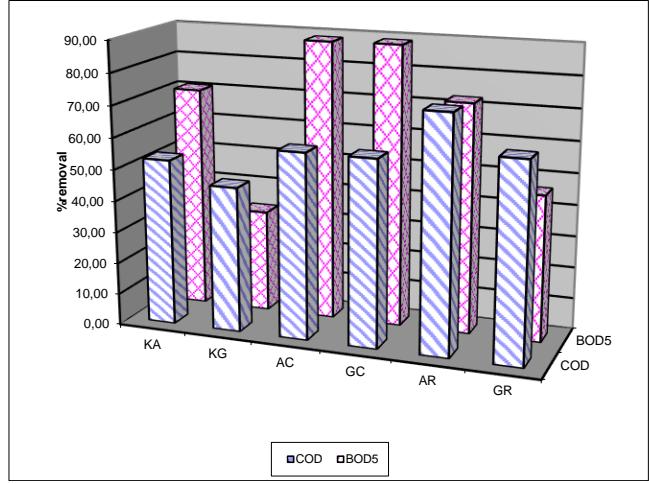
Figure 1. % removal of COD and BOD5
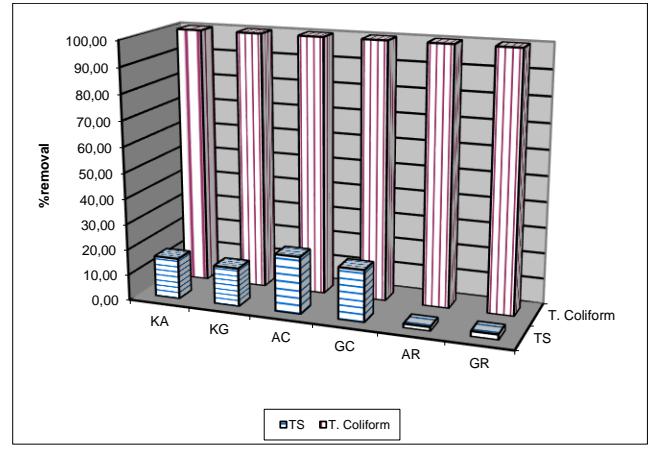
Figure 2. % removal of Total Solids and Total Coliform
Figure 2. shows that HSFCW was effective in removing Total Coliform, with the % removal reaching 100% in all variations. However, in these experiments, the HSFCW was not too effective to remove Total Solids. The highest % removal of Total Solids (22.37%) was achieved by charcoal-cattails, which reduced the Total Solids concentration from 807 mg/l to 626.50 mg/l.
As a general conclusion, Cattails had a better general performance in reducing the concentration of the parameters analysed in these experiments, except for COD where Reeds had a better performance. For type of media, gravel performed in general better for the reduction of ammonium and phosphate, whereas charcoal showed higher % removal for COD, BOD5 and Total Solids, although for Total Solids the difference between % removal of charcoal and gravel was not significant.
Ecotech Garden
Single House in Bandung[12]
Ecotech Garden actually is a modification of Surface Flow Constructed Wetland system. The U shaped ecotech garden has a length of 5.15m, width of 0.40m and depth 0.30m. Aesthetic aquatic plants with a periodic blooming season were used in this system and comprise among others such as Pontedoria cordata, Casablanca, Echinodorus paleafolius, Sagittaria japonica, Typha sp and Cana sp. Non blooming species like Equisetum hymale and Cyperus papyrus is used for the system as well.
The decrease of pollutants observed were 57%, 59%, 28%, 2%, 39%, and 46% for BOD, COD, TN, TP, MBAS and SS, respectively. Even reduction of TN and TP is low, the aquatic plant still growth well and able to bloom although E.hymale need 2 months to start growing. Some factors that influenced lower percentage of pollutant removal are no pre-treatment and discharge control, surface flow type, short detention time and high hydraulic loading. Two last factors can be improved by making enlarge surface area, that sometimes difficult in order limitation land availability in urban house.
According to Hidayat[12] , advantage of Ecotech Garden application are helping improve household garden aesthetic, decreasing concentration of disposed greywater to the drainage or river and giving additional income with sale the seedlings. The construction cost of this system is US$ 14.6/sqm.
Figure 3 The Schematic Form of the Ecotech Garden [12]
Dano Housing Site in Sumedang City[27]
For this project, Ecotech Garden was used for treating greywater with urban aquaculture purposes. There are approximately 150 households at the Dano housing site, however only 25 households (92 people) that involved. The dimensions of Ecotech Garden unit include length, width and depth of 3m, 2m and 0.75 m (+0.25 m free board) respectively. Natural soil is used for the media treatment of 0.167 – 0.170 L/sec domestic wastewater inflow. Topographic conditions are the important factor for using gravitational flow beside it will make easier and lower cost of operation and maintenance. The estimation level difference between the sewer system and fish pond is two meters (Figure 4).
Aquatic plants selected for Eco-Technology system are Typha sp, Pontederia Cordata and Cyperus alternifolius. However, after one year only one species (Cyperus alternifolius) had grown abundantly, shifting the area of the two other plant species. In general, water quality parameters resulted from this system did not met standard for fishery, i.e BOD, COD, TP, Detergent and Phenol but DO. The efficiency of this system reach 86.5 % for detergent reduction, 44%, 61%, 64% and 27% for BOD, COD, TP and Phenol reduction. Lower efficiency of the system due to mixing greywater with water from paddy irrigation drainage. Nevertheless, production of fish in the fish pond can improve protein consumption and income of the owner as well.
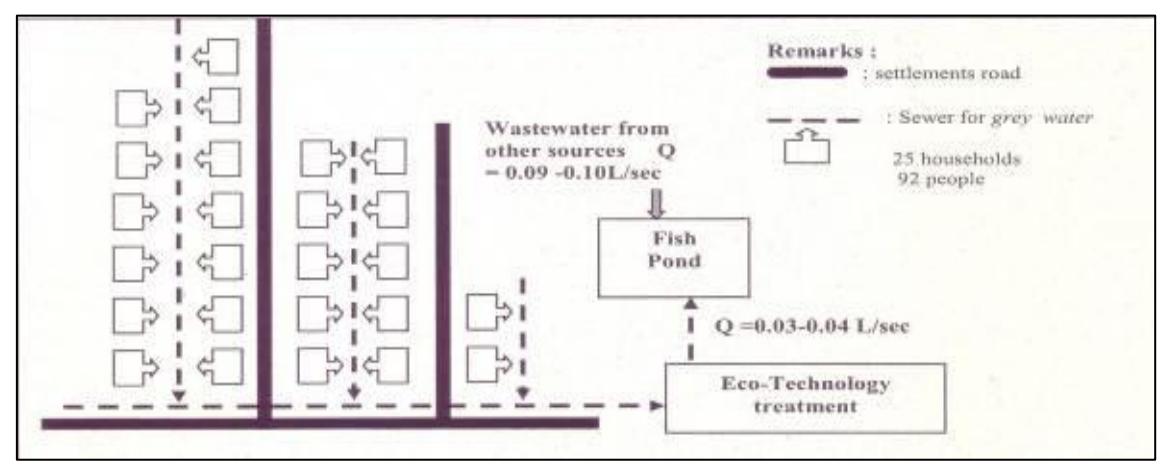
Figure 4 Diagram of Re-used Greywater by Ecotechnology for Small Scale Fish Pond[10]
Combination of Constructed Wetland and Activated Carbon[28]
For this research, Savitri used combination of Vertical Flow System (VFS) and Horizontal Subsurface Flow System (HSsF ). The system is divided to 3 compartments: inlet, treatment and outlet zone. Inlet and outlet zone consist of big size gravel, while treatment zone having 3 layers of media. Top layer using soil media with plant Sagittaria montevidensis, middle layer using sand from Cimalaka area and bottom layer with small gravel.
Wastewater from laundry activities is used as source of water that characterize as high strength[26]. The influent have 1090 mg/L BOD, 1816 mg/L COD, 7,7 mg/L TP and 210 mg/L MBAS. With 15 days of hydraulic retention time, the system show good performance for decreasing content of all parameter. Additional activated carbon in the top layer giving best result with reduction efficiency around 95 % even almost 100% for phosphate elimination.
Wastewater Garden[29]
Some applications of constructed wetland to treat greywater have been implemented in Indonesia. For example, Taman Bali which is an acronym for Taman Buangan Air Limbah (Wastewater Garden-WWG). The Taman Bali concept applies phytoremediation through ornamental aquatic plants which is arranged aesthetically in a garden to treat greywater. Several places in Indonesia that have waste water treatment using this method are Environmental Impact Control Agency (BAPEDALDA) Headquarters in Sanur-Bali, several tourism/diving resorts and exclusive residences areas spreading in Bali and Sulawesi. Some species of plants which are suitable for this application and can be easily found in Indonesia or most tropical countries are Typha angustifolia, Neptunia plena, Thyponodorum lindleyanum, Myriophyllum aquaticum and Sagittaria lancifolia.
Before enter the WWG system, greywater enter settling tanks for pre treatment to avoid clogging in the system. WWG system have depth 1m, that fill with coral media (small stone or gravel) with diameter 5mm-10mm dor 80cm height. Plant was growth with making a hole as deep as 40 cm from surface. This system adopt Horizontal Subsurface Flow System (HSsF) with water position not exceed 10 cm below the surface. The effluent from the system is used for irrigation.
Biofilters[2]
The tested biofilters can be classified as macro- and membrane biofilters. Macro biofilters can be further classified into two categories: attached and suspended. Membrane sub-categories are submerged and side stream. A Submerged Aerobic Biofilter (SAB) has been tested for treating artificial greywater. Support material for attaching the microorganism was bioball which was made from polypropylene with diameter 3.33cm, height 2.6cm and weight 4.7+ 0.2g. The dimension of the reactor is 14 cm in diameter, 180 cm in height and 18 liters in volume.
This system has higher efficiency than activated sludge system, especially for low organic loading. But, compared to anaerobic condition, its need more energy and the organic degradation is not always significant. Using two kind of aeration, continuous and intermittent, this research show that there are no significant effect to the rate of of organic removal.The average COD removal for continuous aeration, two hours and four hours intermittent aeration are 83%, 81%, and 87% respectively. But, aeration mode affected the efficiency of ammonium removal. The intermittent aeration in SAB system could reduce the use of energy when the aeration system is turned down.
DISCUSSION
Currently, off site domestic wastewater treatment has very limited coverage against total population and serves only 11 cities in Indonesia. Due to limitation, majority of Indonesians have access to private or community sanitation facilities such as pit latrine and septic tank. People that lived near the river usually flow their domestic wastewater treatment directly to the river. As a result, domestic wastewater is estimated to contribute about 70% of organic loading in rivers in urban areas in Indonesia.
Most of domestic wastewater in Indonesia comes from greywater. Greywater generation quantity in Indonesia compare with other country in Europe, Africa or Middle East is bigger, especially because clean water is considered as cheap commodity and abundant water in rainy season. Although from recent researches, the area that have problem with water supply or faced water scarcity increasing from time to time, particularly on the islands of Java, Bali and Nusa Tenggara Timur. With growing rate of population 1.66%, it is expected to grow to 280 million by the year 2020. In the same time, it estimated about 52% of the population will live in urban surroundings. The main sectors in Indonesia utilizing the freshwater resources are basically domestic-municipal water uses (8%), industrial uses (1%) as the smallest fraction with agriculture using 91% of the freshwater resources (World Bank, 2008). Then, reuse greywater or using reclaimed greywater can be best option for starting saving water.
In Indonesia, most of greywater discharge to city drainage which flow then to the river or directly go to the river without treatment. Some researches show that Indonesian greywater quality enters middle or high strength. Then, it needed appropriate treatment system for comply Indonesian standard, that compare with other standard have higher requirement. The high cost of develop centralized wastewater treatment system force many experiments and projects with decentralized or on site approach. For Indonesia, there are 2 popular systems, one based on anaerobic system, the other is planted filter system or known as constructed wetland/reed bed.
One biggest challenge on implementing low cost greywater treatment system are the willingness from the community itself. Until now the majority of community based or low cost sanitation system that exist and being used by the community are initiated by the government and funded by the government. A master plan on implementing the low cost greywater treatment system are absolutely needed to overcome the challenge on implementation and replication of the program where we expected the community to be actively participated an even to be the one who made the initiative movement.
On the implementation, ABR more likely chosen by community cause of several reasons. Firstly, the ABR can be constructed underground therefore direct contact between wastewater and people can be minimized while with constructed wetland the risk of contact with the greywater is higher and can be dangerous in the community with high number of kids (risk of fallen, mosquito, etc). The second reason was ABR need less space than constructed wetland where with only 80- 150 m2 area around 400 inhabitants can be served while wetland needs 1-2 m2 per person. Cost for implementing ABR also competitive around 500,000 rupiahs/capita.
On other site, constructed wetland could be another good option. As tropical countries, Indonesia is rich with local aquatic plant biodiversities. Application of constructed wetland could improve ecosystem, environment aesthetic beside reduction of contaminant. Unfortunately, this system still has less performance than anaerobic system. It can be improved by modification of media such as addition of charcoal, woodchip and activated carbon. Using of Free Water Surface (FWS) system like Ecotech Garden can increase health risk of direct contact and mosquito breed. It can be solved by using subsurface plumbing pipe and CWs where water level below the surface. Furthermore, constructed wetland is easier to maintain than other system like ABR. Another factor that also important to get good performance of constructed wetland is pre treatment of greywater in settling tanks. The main reason is to avoid clogging in the system. Moreover it will pose to demand of larger area that hard to comply in urban area in Indonesia.
Nevertheless, anaerobic pre-treatment of greywater is recommended, particularly when greywater concentrations are high. The reasons are: (1) deficiency nutrients to sustain microorganism in aerobic treatment, (2) most of greywater pollutants are anaerobically biodegradable, (3) anaerobic treatment could produce less and stable sludge that is easily dewatered, and (4) no need energy for aeration, even can produce energy from methane generation[16] .
One concept that also important to be noted that treated greywater still have nutrient or at least, is water that can be reused for activity that not require drinking water quality, specifically in Indonesia for irrigation that take 91% of water demand. For irrigation application, using reclaimed greywater always related with health risk. Pathogens in greywater may cause diseases through direct contact as well as through the consumption of contaminated plants and or through peripheral vectors like mosquitoes. Additionally, greywater can contain elevated levels of surfactants, oils, boron and salts, which may alter soil characteristics, damage vegetation and polute groundwater.
CONCLUSION
- Majority portion of greywater plumbing in Indonesia already separated from the blackwater which made the possibility of greywater reuse higher.
- Average water consumption in Indonesia is quite high compare to majority country in the world, resulting high quantity of greywater that needed to be treated.
- Variation of the greywater quality influenced by quality and availability of drinking water supply, lifestyle, personal care and household product usage, number of family member and dan the quality of greywater plumbing system.
- Majority greywater in Indonesia can be categorized as middle and high strength wastewater.
- Existing greywater treatment in Indonesia mostly have been done with high initial cost and support from third party. This could be a challenge to develop further implementation and replication of low cost greywater treatment and reuse.
- Two most popular systems to treat greywater in Indonesia are ABR and constructed wetland where ABR is most likely chosen.
ACKNOWLEDGEMENTS
Mayrina Firdayati would like to thank Schlumberger Foundation for the grant of Faculty for the Future Program.