

INTRODUCTION
Since its publication and introduction in 1930, the refrigerant based on chloro-fluor such as CFC and its family had taken a very important role in the development of refrigeration systems. This happened because in additional to have the suitable physical and thermal properties as a refrigerant it has also other desirable characters such as, very stable, non-flammable, non-toxic, compatible with most component materials and relatively inexpensive substance. Only after people knew about the hypothesis that the CFC cause the depletion, then, through several conventions i.e. Vienna Convention (March 1985), Montreal Protocol (September 1987) and their amendments, people try to ban the use of ODS. Other environment issues such as greenhouse gases and global warming made even more difficult in the R&D to obtain the final solution in ODS replacement.
Hydrocarbon refrigerant such as propane was already used since long time ago even before the era of those synthetic refrigerants. In the context with the effort of taking into consideration of the two significant environmental issues i.e. ozone depleting potential (ODP) and global warming potential (GWP), many investigators have put their attentions on the possibility of using the natural refrigerants such as HC NH3, CO2 and others. In the context of the mostly use refrigerants which are the family of CFC and HCFC, some investigators<sup>[1-8]</sup> proposed the application of HC as their substitutes. The similarity of the thermodynamic properties, its compatibility to most refrigeration component materials, and other advantageous features, unlike most HFC such as R134A or its mixtures, the HC could be considered as a drop-in refrigerant substitution.
On 13 May 1992, Indonesia ratified the Vienna Convention and Montreal Protocol and its Amendment a few years later, and has decided to ban the CFC commercialization started from January 1, 1998 with 5 years transition period. The use of HC as an alternative refrigerant to substitute the CFC has been introduced by the Inter University Research Center for Engineering Sciences
(IURC-ES, ITB), the Swiss Contact, together with other institutions since 1996with the main target, for several reasons, is the refrigeration service sector. Therefor, in particularly for the refrigeration service sector and R12, four options are now available i.e. to continue using R12 until the year of 2003, to convert to R134a, to convert with HCFC blends such as Suva, KLEA and others, or to convert to HC. Some applications of HC refrigerant as the results of conversion from R12 have been presented in previous papers<sup>[6-8]</sup> such as for domestic refrigerators, large-scale milk cooling units, automobile AC, cold storage and other related activities are reported and discussed.
Although, the phase out for HCFC is not as urgently as CFC, the attention of investigators to explore the reliability of HC application has been very high<sup>[1-5]</sup>. In addition to the two environmental issues as mentioned previously, for Indonesian refrigeration service sector, the issues of energy efficiency and other economic advantages of HC substitution for HCFC<sup>[5]</sup> can become very prospective. This paper deals with the retrofit and conversion from R22 to HCR22 on an AC chiller Carrier Type 30-GB-070-910. The retrofit of chiller was mainly the implementation of safety features and conversion to HC refrigerant. A series of measurements to evaluate its performance has been carried out on the same chiller for both cases i.e. before and after
conversion, while it was in use. Retrofitting procedure, refrigerant conversion, test procedure and data analyses are discussed in this paper.
SYSTEM DESCRIPTION
The retrofitted chiller is one among three identical chillers of air-cooled condenser type produced by Carrier under serial product number of 30-GB-070-910. Each chiller consists of two units vapor compression cycle refrigeration i.e. one is low pressure part with single compressor and the other is the higher pressure part with parallel twin compressors, as shown in Fig. 1. The chillers are of the oper air type and installed in the back yard of the building as shown in Fig. 2. Each chiller has four condenser fans of 1 HP and two of 5.5 HP. Three identical chilled water pumps of 50% from design flow rate were installed. Basic specifications of each pump are the rating power 1 HP, speed 2910 rpm, product serial number ETA 65-16.
For normal condition, the produced chilled water is supplied to 14 air handling units (AHU) of different size and types. During the test, only 6 AHU were operated. The air conditioning system has been operating since 1980 and being used mainly for human comfort purpose of the Process Technology Laboratory under the Agency for the
Fig. 1. Air conditioning system configuration
Fig. 2. Chiller Plant.
Assessment and Application of Technology (BPPT) located in Serpong, Tangerang. It is a 1000 m<sup>2</sup> and two floors building.
RETROFIT AND CONVERSION
Only one chiller has been retrofitted and converted from original condition in which using R22 as refrigerant to appropriate HC refrigerant. The replacement refrigerant is HYCOOL HCR 22, which is produced locally and available in the Indonesian market.
The chiller retrofit consists mainly of isolating the electrical box from compressor cabin, installing an additional mechanical ventilation system of compressor cabin, installing the HC sensor and alarm system, sealing the electrical components, and minor reparation and replacement of some components of the refrigerant piping system.
Using the refrigerant recovery machine, the existing R22 was recovered and emptied. As it is indicated in the attached specification plate, the recovered R22 was about 80 kg. After being evacuated using vacuum pump, the chiller was filled with the HCR12. The amount of replacing HC refrigerant charge was only 35 kg.
TEST OBJECTIVE AND PROCEDURE
The test was carried out on line while the air conditioning system was in operation. The objective of test was to get the information on the chiller performance before and after being converted and make some evaluations on the reliability of this refrigerant conversion. In additional to parameters that can be measured by the already installed measuring instruments, some additional performance parameters were also performed. These include the electrical
power of compressors, inlet and outlet chilled water temperature, chilled water flow rate, ambient temperature, dry and wet bulb temperature of outdoor, return, and discharge air of each AHU. The measurement of electrical power consumed by the compressor consists of the active and reactive power as well as the total power and \(\cos\phi\) factor.
The parameter measurements were carried out during four different days. Two days were dedicated for the system condition before conversion and the other two days were done after the conversion. Electrical power and chilled water temperature measurements were done and recorded continuously during the test duration using the data acquisition system. For cross checking the results, the continuous measurements were also done on the condenser intake and discharge air, as well as eventually on the outdoor, return, and discharge air of each AHU. During the test, only the chiller under test was operated and the others were shut down. In the mean while, only 6 AHU were used.
All these test activities were done by the Energy and Resources Laboratory (LSDE) using mobile energy audit facilities in coordination with the Thermodynamics, Motor and Propulsion Laboratory of the Assessment and Application of Technology (BPPT).
TEST RESULTS AND ANALYSES
Fig. 3 and 4 show the inlet and outlet chilled water temperature and the calculated cooling production resulting from the obtained measured data on March 10, 1999. Other test on chiller with R22 refrigerant was also carried out on March 12, 1999. The results are not shown here but basically they are similar and can be available at The IURC-ES, ITB. The
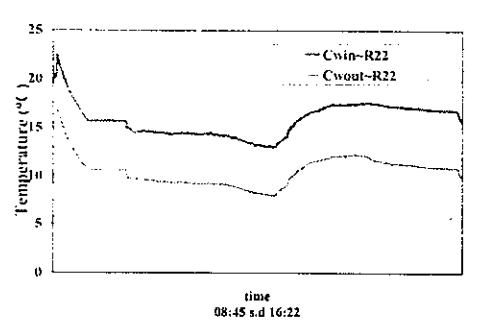
Fig. 3. Chilled water temperature with R22.
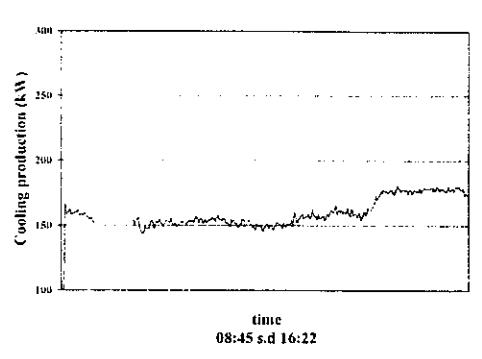
Fig. 4. Cooling production with R22.
retrofit and conversion took place about a week.
After being converted to HCR 22, the similar test was also carried out for two days. This was done on March 20 and 22, 1999. Fig. 5 and 6 show the results of measurement on chilled water temperatures and cooling production during the test on March 22, 1999.
It can be observed from Fig. 3 and 5 that due to relatively low of cooling load in the morning and the transient effect after start up, the chilled water temperatures were also relatively lower and tend to decrease. In the afternoon, the chilled water temperatures increase almost continuously with the average level was higher than 10 C for chilled outlet temperature which was above the setting point of 6 C. This was probably due to the excessive cooling load compare to the cooling capacity of the tested chiller.
From Fig. 4 and 6 revealed that the calculated cooling production for the two cases in average were significantly different. The cooling production of the chiller using HCR 22 was much higher than compare to that before conversion. Since the tests were not carried out on the same day, the comparison of the above parameters may not be appropriate.
Fig. 7 and 8 show the recorded instantaneously electrical power consumed by the compressors. It can also be seen here by comparing the two curves, the use of HC as
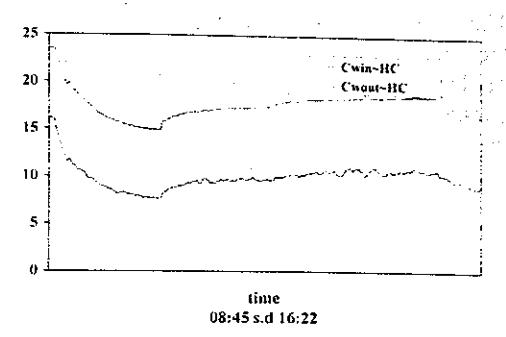
Fig. 5. Chilled water temperature with HCR22
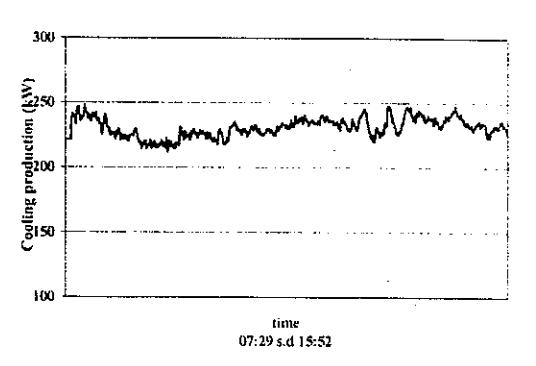
Fig. 6. Cooling production with HCR22.
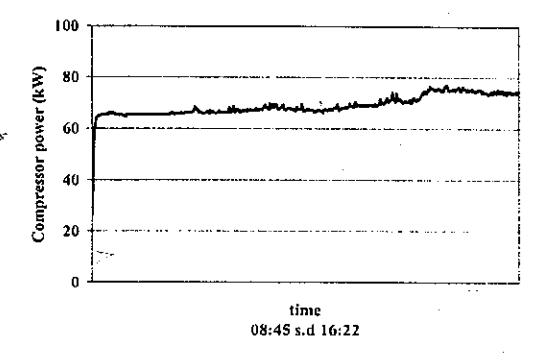
Fig. 7. Compressor power with R22.
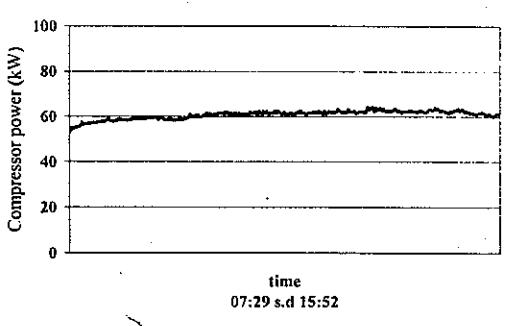
Fig. 8. Compressor power with HCR22.
refrigerant has reduced the power consumption of compressors from average about 70 kW to 60 kW. The indication of increase on the cooling production and decrease on electrical power shows that the use of HC has indeed improved the system performance.
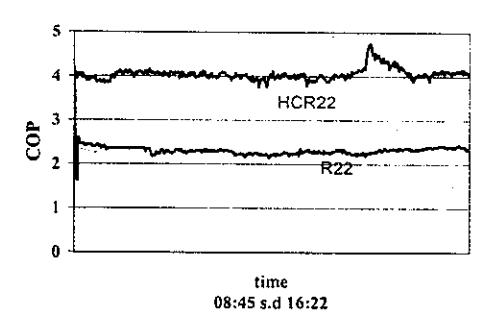
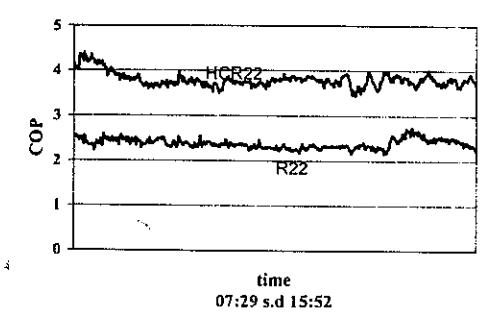
The more elaborated and complete results of the four days test are shown in Table 1 and Table 2 which representing the case for the condition before and after conversion, cases as shown in Fig. 9 and 10 assure this conclusion, and this is in agreement with earlier studies presented by other investigators<sup>[2,4,9]</sup>.
Table 1. Test results of the AC chiller before conversion.
| Maximum | Minimum | Average | ||||
|---|---|---|---|---|---|---|
| Parameter | 10/04 | 12/04 | 10/04 | 12/04 | 10/04 | 12/04 |
| Ambient temperature (C) | 31.61 | 33.93 | 26.32 | 25.85 | 28.85 | 29.76 |
| 2. Chilled Water - in (C) | 22.41 | 20.25 | 12.87 | 12.73 | 15.79 | 16.21 |
| - out (C) | 16.85 | 14.42 | 7.86 | 7.32 | 10.47 | 10.33 |
| 3. Cooling production (kW) | 179.58 | 196.04 | 143.66 | 152.34 | 159.24 | 176.89 |
| 4. Compressors power (kW) | 77.24 | 80.55 | 65.44 | 67.94 | 68.98 | 74.16 |
| 5. COP | 2.57 | 2.75 | 2.24 | 2.17 | 2.30 | 2.39 |
Table 2. Test results of the AC chiller after conversion.
| Maximum | Minimum | Average | ||||
|---|---|---|---|---|---|---|
| Parameter | 20/04 | 22/04 | 20/04 | 22/04 | 20/04 | 22/04 |
| 31.87 | 32.48 | 25.51 | 25.85 | 28.84 | 29.85 |
| 18.47 | 23.49 | 13.32 | 14.82 | 17.30 | 17.62 |
| - out (C) | 10.35 | 16.04 | 6.00 | 7.48 | 9.17 | 9.91 |
| 266.97 | 247.82 | 217.89 | 211.90 | 243.45 | 230.85 |
| 64.46 | 64.50 | 55.44 | 53.01 | 60.05 | 60.80 |
| 5. COP | 4.74 | 4.39 | 3.75 | 3.46 | 4.06 | 3.80 |
respectively. The numbers listed in the tables are of maximum, minimum and average values of main parameters that characterized the chiller performance. From this overall comparison seems that the use of HC as refrigerant gave a better performance compare to previous condition using R22. The instantaneous COP comparison between both
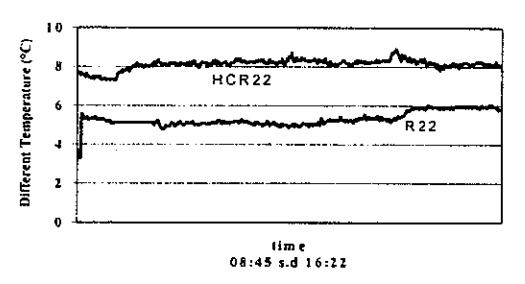
(a) Data of March 10 and 20.
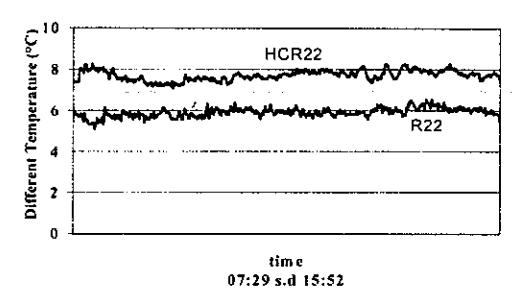
(b) Data of March 12 and 22.
Fig. 9. Chilled water temperature different.
The consumed electrical powers by the compressors shown in Table 1 and 2, both
(a) Based on data of March 10 and 20.
(b) Based on data of March 12 and 22
Fig. 10. COP comparison.
represent only the electrical active powers. The observations from the obtained data, the electrical reactive powers were also reduced to about 8 to 10 %. Therefor from the economical aspect, the saving incentive come not only from the improvement of the energy efficiency, but could also come from electrical bill due to the reduction of electrical reactive power and the possibility of the shifted electrical cost category.
CONCLUSION
The retrofit and conversion of chiller from R22 to hydrocarbon refrigerant HCR22 has been performed on one of three AC chillers used in a laboratory building. The retrofit consists basically of minor component reparations, implementing the safety aspect.
The online test, which was carried out for two days for each case i.e. before and after conversion, showed that the AC system performed better for the case of hydrocarbon. The average cooling production increased up to about 9.5 %, while the electrical power consumption decreased to about 16 %.
Therefor, In addition to the environment issue, the application of hydrocarbon can also contribute as an alternative solution to the energy saving and operating cost reduction issue.
ACKNOWLEDGEMENT
The authors would like to thank the Swiss Contact for the financial support and The Laboratory of Energy and Energy Resources (LSDE) for providing the online measurement facilities.