

Introduction
Indonesia has ratified the Montreal Protocol and its Amendment in 1992, and has decided to ban the commercialization of the CFC started from January 1, 1997. CFC phase out has been creating a strong impact, particularly to those who use the refrigeration. To assist the users in solving to the problem in extending the use of existing refrigeration, various activities related to this purpose has been launched.
The use of R 134a and other equivalent HCFC blends are now becoming popular since most of refrigerators and Air Conditioning system manufacturers are Japanese companies who substitute the R12 with those refrigerants on new products. As an alternative, the Inter University Research Center for Engineéring Sciences (IURC-ES, ITB) together with other institutions have launched a program to popularize the use of Hydrocarbon (HC) as R12 drop-in substitute with particular emphasize on the service sector
through retrofitting of the already used equipments. The use of HC as substitute refrigerant of R12 for several applications such as for domestic refrigerators, large-scale milk cooling units, automobile Air Conditioning (AC), stationary AC and other related activities have been reported and discussed [1-3].
It was shown that the HC applications as refrigerants in those refrigeration units since 1996 have shown several advantages such as the improvement of performance, no need major replacement of equipment, more competitive refrigerant cost, etc. The disadvantageous flammability risk which is higher than CFC or HFC, for many cases can be avoided by implementing the appropriate standards. One among guideline to use HC safely is to avoid the Low Explosion Limit (LEL) when the HC leaks out from the refrigeration/AC units. The restriction of maximum refrigerant charge related to the volume of space to where refrigerant could leak out is one among the parameters be considered during the refrigerant conversion. For some
particular applications this restriction is becoming a constraint.
The development of HC based refrigerant with higher LEL has been developped by IURC-ES ITB on the name of HCR12*LFS and HCR22*LFS. The present of HC is only approximately 40 % by weight therefore it will be appropriate to reduce the flammability of refrigerant at least from the HC charge reduction.
This paper present the results of performance test of HCR12*LFS as refrigerant and its comparison to that of CFC12, and hydrocarbon refrigerant HCR12. The tests are performed as a co-operation program between IURC-ES ITB and Laboratory for Thermodynamics, Engines and Propulsion Systems (LTMP - BPP Teknologi).
- erformance Testing of Air Conditioning System.
In order to compare the performance of an air conditioning system utilizing HCR12*LFS as refrigerant to that of CFC12 and HCR12, AC system test facility in LTMP - BPP Teknologi located in Serpong is used as the test object.
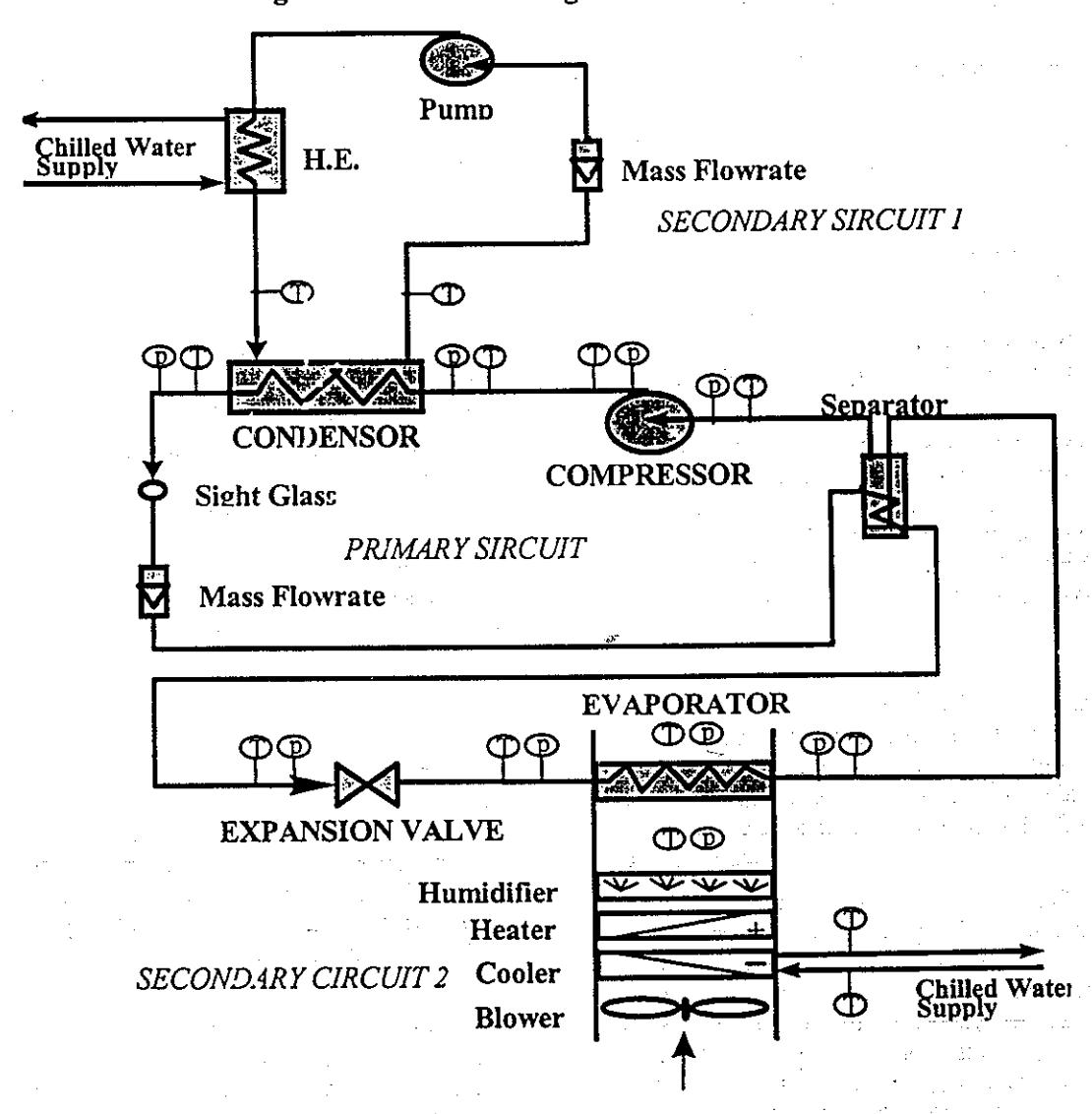
The system comprises of AC system components set up in a closed refrigerant loop/circuit as can be seen in Figure 1. The evaporator is installed at the end of an air tunnel providing regulated air-flow in accordance with the required condition. Air-flow, temperature and humidity across the evaporator is set in accordance with the test requirements, simulating the cooling load. Heat sink for the condensor is a closed water loop integrated with chilled water system as is seen as secondary circuit 1 in the figure.
Temperature and pressure sensors are installed at inlet and outlet sides of each component. For refrigerant flow measurement, a coriolis flowmeter is installed in condensor outlet. Specification of the main components in the test system are as follows:
- Compressor: Open type/ reciprocating, 15 kW maximum power, 2980 rpm
- 2. Evaporator: Finned tube type, 16 kW max thermal capacity, with dimension of 890 x 531 x 270
- Condensor: Vertical shell and coil type, 26 kW max thermal capacity, 400 mm length, 219 mm diameter
- 4. Expansion valve: Needle valve type.
On refrigerant charging, water temperature in secondary circuit for condensor cooling is set to 26° C and water flow is set to 0.61 kg/s. Air temperature in secondary
circuit for evaporator loading is set to 27° C with airflow of 0.6 kg/s and air humidity of 75 %. The condition is maintained during the test.
To get approximately similar condition, refrigerant charging is performed until the following condition are achieved: condensation temperature of 39° C and evaporation temperature of 1° C. Ambient temperature during the test is 30-31° C, and humidity of 88 %. This condition is set as basic test condition for performance comparison of the refrigerants.
Performance comparison of CFC12, HCR12 AND HCR12+LFS
Test conditions for comparison purposes are set to be similar for these three different refrigerants, and the results show the differences in performance parameters for these refrigerants.
Table 1 summarize the performance comparison between CFC12, HCR12 and HCR12LFS for the above set condition. Limited information on physical properties for these alternative refrigerants make it difficult to evaluate the coefficient of performance for these refrigerants using the refrigerant side refrigerating effect and compressor thermal power. Therefore, the measured air-side refrigerating effect and measured compressor electrical power are used for determining system Coeficient of Performance (COP). Parameters that are considered for comparison purpose are: system COP, and refrigerant flowrate/kW. Among CFC12. HCR12 AND HCR12+LFS, HCR12+LFS show the highest COP, and also the lowest refrigerant flow rate per kW of refrigeration effect. For first evaluation, HCR12+LFS can be considered to be the best refrigerant for the purpose, as it shows the best performance parameters among the tested refrigerants. Considering the safety aspect, the reduced HC concentration in the HCR12*LPS refrigerant, which will reduce the flammability of HC refrigerant, also makes it favourable for public unit applications.
Before, during and after each test, thorough checking of the system are performed. No leak or visible damage found, and no part replacement required.
TABLE 1. PERFORMANCE COMPARISON OF CFC12, HCR12 AND HCR12+LFS
| Type of refrigerant | Compressor inlet temp. "C | Evaporation pressure kPa | Condensation pressure kPa | Compresso r ratio | Refrigeration effect KW | Flow rate/kW Kg/s / kW | Electrical Power kW | СОР |
|---|---|---|---|---|---|---|---|---|
| CFC12 | 28.2 | 320 | 1108 | 4.60 | 19.8 | 5.5 x 10⁻³ | 12.0 | 1.65 |
| HCR12 | 25.4 | 326 | 1013 | 3.74 | 21.5 | 2.5 x 10⁻³ | 11.7 | 1.84 |
| HCR12*LFS | 25.2 | 332 | 1132 | 4.32 | 20.9 | 1.2 x 10⁻³ | 10.8 | 1.94 |
Figure 1. Schematic diagram of AC test installation
Conclussions
The test confirms that application of HCR12 and HCR12*LFS refrigerants in air conditioning system improve the performance and there is no need of any replacement of equipment. The disadvantageous flammability risk which is higher than CFC or HFC, can be avoided by implementing the appropriate standards, and in the case of HCR12*LFS this risk is lowered.
The results also show that HCR12*LFS gives better performance improvement compare to HCR12. But it should be stressed that this test results are for tests done on this one specific piece of hardware, and may not be generalized to all situations. The relative rankings of the refrigerant may not hold true for conditions typical of other applications. Similar tests should be conducted for other application to confirm these results.
Performance comparison for CFC12, HCR12 and HCR12*LFS refrigerants performed in air conditioning system test installation at this stage confirm the results gathered during previous studies. Further study for the impact of these alternative refrigerant application on broader aspects is still on-going, and should be continued.
Acknowledgement
The study that was done in LTMP and IURC-ES ITB was financially supported by Swisscontact. Therefore, the authors gratefully acknowledge those parties that have supported the research.
References:
- J.R.Sand, Ph.D., E.A. Vineyard, P.E., R.J. Nowak, P.E., Experimental for Performance of Ozone-save Alternative Refrigerants, ASHKAE Technical Data Bulletin Vol 6, no.1.
- A.Suwono and W. Ardiansyah, Study on Thermodynamic Properties of propane/naturalbutane and its possibility to be used as refrigerant substituting R-12, Journal Mechanical Engineering, 10, 2, 1994.
- N.P.Tandian, A Suwono, C.A.Sylva. and A.D.Pasek, Application of Propane-Butane Mixture as refrigerant in Milk Cooling Unit, Proc. of Int. Conference on Fluid and Thermal Energy Conversion, Yogyakarta, July 21-24, 1997.
- 4. A.Suwono, N.P.Tandian, A.D. Pasek, T.Hardianto and T.A.F.Sóelaiman, Indonesian Experience on Hydrocaroon Application as Refrigerant Substituting the Phasing-Out of CFC, Proc.Refrigeration Science and Technology,
THIRD ANNOUNCEMENT CALL FOR PAPERS
INTERNATIONAL CONFERENCE ON FLUID AND THERMAL ENERGY CONVERSION 2000
July 2 - 6, 2000
http://www.uic.edu/~mansoori/FTEC2000.html http://www.pauir.itb.ac.id/FTEC2000
Hyatt Regency, Bandung, INDONESIA
THIRD ANNOUNCEMENT CALL FOR PAPERS
INTERNATIONAL CONFERENCE ON FLUID AND THERMAL ENERGY CONVERSION 2000 (FTEC 2000)
July 2 - 6, 2000, Hyatt Regency, Bandung, INDONESIA
BACKGROUND
The growth of both world population and economic increases the consumption of energy. Since the amounts of available conventional energy resources become scarcer with time. development of new or renewable energy technology and improvements of conventional technology are needed to fulfill the energy demand in the future. A good understanding of the mechanisms involved in every step of energy transformations from the primary to the end-use forms of energy is needed for both the improvements and innovations of the technology. This conference provides an opportunity for exchanging information among researchers working on fluid and thermal energy conversion problems. The first International Conference on Fluid and Thermal Energy Conversions was held on December 1994 in Bali attended by participants from more than 30 countries. The participants agreed to held the conference regularly in Indonesia every three years. Hence, the second Conference was held on July 1997 in Yogyakarta attended by more than 100 participants from around the world, and the third conference is planned to be held in Jakarta.
SCOPE
Papers describing current research on fluid and thermal energy conversion science and technology are hereby solicited including:
Heat and Mass Transfer.
Thermodynamics.
Fluid Mechanics.
Thermal Energy Conversion Systems:
- o power plants (gas, oil, coal, nuclear),
- o refrigeration.
- o direct energy conversion (DEC).
Hydropower and Fluid Machinery.
DEADLINES
| E-di-tustion up to | April 30, 2000 |
|---|---|
| Early registration up to | • |
| Deadline for papers | May 31, 2000 |
| Notice of acceptance | June 15, 2000 |
| Preliminary Program | June 15, 2000 |
INTERNATIONAL SCIENTIFIC COMMITTEE
Norwegian University of Science and A.M. Bredesen Technology, Norway, Bong Tet Yin Nanyang Technological University. Singapore. Y.T. Chew National University of Singapore, Singapore. Universite de Perpignan, France. M. Daguenet C.A.J. Fletcher CANCES, The University of New South Wales, Australia. C. Tournier Universite de Valenciennes, France. C.H.M. Machielsen Delft University of Technology and Material Science, The Netherlands, A. Saito Tokyo Institute of Technology, Tokyo, Japan. J.B. Saulnier ENSMA, Poitiers, France. Sularso Institute Technology of Bandung, Bandung, Indonesia. K. Suzuki Kyoto University, Japan, H. Usui Kobe University, Japan Delft University of Technology and A.H.M. Verkooijen Material Science, The Netherlands. S.H. Winoto National University of Singapore, Singapore. K. Watanabe Keio University, Japan, REGISTRATION Extended abstract and registration form should be submitted to either: Prof. A. Suwono
Thermodynamics Laboratory Inter University Research Center for Engineering Sciences
Institute of Technology of Bandung Jalan Tamansari 126, Bandung 40132
INDONESIA. Tel.: (62-22) 250.2342
Fax: (62-22) 250.2342
E-mail:ari@termo.pauir.itb.ac.id or thermo@ibm.net
Prof. G.A. Mansoori Thermodynamics Research Laboratory Department of Chemical Engineering University of Illinois at Chicago Chicago, IL 60680
USA.
Tel.: (1-312) 996.5592 Fax: (1-312) 996.8305 E-mail: mansoori@uic.edu
REGISTRATION FORM
INTERNATIONAL CONFERENCE ON FLUID AND THERMAL ENERGY CONVERSION 2000
| Name | |
|---|---|
| (Prof./ | Dr./Ms./Mr.): |
| First | |
| Mickelle | Last |
| Affilia | ion: |
| • | |
| Mailin | g Address: |
| City: | Postal Code: |
| - | |
| State: _ | Country: |
| Phone. | Fax: |
| t:-maii | |
| Numbe | r of accompanying person(s): |
| Please | tick the appropriate boxes: |
| ᆜ | I intend to attend the conference. |
| Ц | My organization/company is interested in displaying |
| instruments, books, journals or posters during the conference. | |
| П | |
| _ | I wish to contribute a paper with the following title: |
| Paper is enclosed. | |
| Paper will be mailed separately. | |
| I wish to attend a short course with the following topic: | |
Can be copied for registration purpose.