

M E S I N
Jurnal Teknik Mesin Vol. 21, No. 1, April 2006
Diterbitkan oleh : Program Studi Teknik Mesin, FTI
Institut Teknologi Bandung
Surat ijin : STT No. 964/DIT-JEN/PPG/STT/1982.
MESIN Vol. 21 No. 1 i
DAFTAR ISI
| Analisis besar kesalahan magnitude fungsi respon frekuensi hasil pengujian dengan metode eksitasi kejut akibat keterbatasan panjang waktu rekam | |
|---|---|
| Agusmian Partogi, Zainal Abidin dan Komang Bagiasna | 1 |
| Modifikasi top cyclone untuk meningkatkan kinerja suatu pabrik semen Prihadi Setyo Darmanto dan Arief Syahlan | 10 |
| Influence of sintering temperature and holding time on tensile strength and shrinkage of pvc specimen on indirect pressure-less sintering process S.A. Widyanto, S. Riyadi, A.E. Tontowi, Jamasri and H.S. Rochardjo | 16 |
| Crack detection using operating deflection shape | |
| Tran Khanh Duong , Djoko Suharto, Komang Bagiasna, Zainal Abidin | 21 |
| Pack carburizing pada sprocket sepeda motor dengan material baja karbon rendah | |
| Budi Hartono Setiamarga, Novi Kurniawati dan Umen Rumendi | 28 |
M E S I N
Jurnal Teknik Mesin
Vol. 21, No. 1, April 2006
S.A. Widyanto, S. Riyadi, A.E. Tontowi, Jamasri and H.S. Rochardjo
Teknik Mesin, Fakultas Teknik, Universitas Gadjah Mada, JL.Teknika Utara, Yogyakarta
E mail: susilo70@yahoo.com
Ringkasan
Proses sintering telah terbukti sebagai proses manufaktur yang dapat menghasilkan suatu komponen makanik dengan kompleksitas geometri tinggi. Pengembangan proses sintering alternative terus dilakukan untuk mendapatkan proses termurah. Suatu solusinya yang disebut dengan indirect pressure-less sintering diusulkan pada penelitian ini. Proses ini secara umum dalam pembuatan suatu part diawali dengan penataan serbuk dengan mesin deposisi, dan dilanjutkan dengan proses sintering dalam furnace konvensional. Parameter-parameter optimal yang meliputi temperature sintering dan waktu penahanan dalam proses ini dioptimasikan dalam paper ini. PVC powder and sand casting (silica) digunakan sebagai bahan produk dan supporting powder. Variasi temperature sintering adalah 100, 105, 110, 115 dan 120°C, sedangkan waktu penahanan adalah 2, 4, 6 dan 8 jam. Parameter optimal didapatkan dengan pengukuran kekuatan tarik dan penyusutan specimen. Hasil penelitian menunjukkan bahwa stabilitas dimensi specimen tidak dapat dipertahankan pada temperature sintering sebesar 115°C dengan waktu penahanan lebih dari 2 jam. Pada temperature sintering lebih tinggi dari 120°C, material PVC langsung meleleh sehingga volume specimen meningkat. Hal ini disebabkan karena terjadinya pengikatan supporting powder. Kekuatan dari mekanisme ikatan diukur pada temperature sintering lebih dari 107°C. Pada temperature sintering 113°C dengan pemvariasian waktu penahanan (2-8 jam) menghasilkan variasi kekuatan tarik terpanjang.
1. INTRODUCTION
In process production, rapid prototyping and rapid tooling are types of technology which are commonly used for problem solving of geometric complexity [1].
In application, rapid prototyping and rapid tooling commonly consumes material in solid freeform fabrication (SFF), in which it is a typical form for layer manufacturing process application. This process enables to make a 3D-interior porous profile in specific part [2].
MESIN Vol. 21 No. 1 16
Generally, rapid prototyping or event rapid tooling process makes a product with layer by layer in which each layer is bonded by layer before it. One of rapid prototyping technologies is Selective Laser Sintering process (SLS). In SLS, the sintering process is run by laser system as a heat source. High cost reason causes, SLS technology limited applicable in commercially industrial process [2].
In this research, a solution process which was called indirect pressure-less sintering was proposed. Generally, principle work of this process can be explained as following: powder is settled to match with data of 3D image (3D-CAD) by deposition equipment on layer by layer. More geometric complexity of product, especially for the overhang shapes, the indirect pressure-less sintering needed support powder, in which this support powder must have a higher melting point temperature than one of product powder. Finally, the complete deposition powder was sintered in a furnace. This process can be shown in Fig. 1,
Figure 1. Schematic process of indirect pressure-less sintering
As an initial development of indirect pressure-less sintering process, the optimal strength and shrinkage of specimen with varying sintering temperature and holding time were investigated in this study.
2. PRINCIPLE OF SINTERING PROCESS
Sintering process is the compaction of powder in which the powder is bounded each others with diffusion bonding. The binding mechanism of powder is due to heating process weather with or without compaction. Sintering temperature is set at lower than melting point temperature of composedly particle. Generally, the heating process is conducted in 8 to 24 hours [3].
In sintering process, the total volume or pores volume shrinks. Several occur at the same time consisting of: thermal activation of material in powder mass or porous compaction, decreasing surface area that was followed by increasing of particle contact and changing of geometric pores [4]. As long as sintering process, the total of free energy usually decreases proportional with decreasing of total surface area of particle [5].
In the crystalline sintering process, the changing porosity is presented in equation 1.
\[A_{S} \exp \left[ \frac{-E_{S}}{RT} \right] \exp(-\beta X^{n}) \tag{1}\] where: \(A_s\) is Arrhenius coefficient of sintering, \(E_s\) is activation energy of sintering, R is gas constant, \(\beta\) is sintering constant and \(X^n\) is compact fraction, which is approximated with decreasing of particle dimension and the measuring of fluid viscosity of powder in all range temperature, n=1 and \(\beta \approx 10\) for powder of nylon-11 [6].
The stage of sintering process is a changing geometric interval in which the dimension of pore could decrease. According to its definition, sintering process consists of three stages, which are: initial stage, intermediate stage and final stage. Along initial stage, point contact of particles usually increased until to achieve 60 to 65 percent [5]. In the point contact, cohesive neck grew in atom solid state condition under melting point temperature and in bonding microstructure scale [7].
Intermediate stage is signed by the continuing of joining particles until the continuous pore channels have shaped, the density increased from 65 to 90 percent and pore starts loosing from cylindrical channels. While in the final stage, continuous pore channels loosed and changed to individual pore [5]. Three stages above can be illustrated as Fig. 2.
Figure 2. a) initial stage of sintering process that presents a point contact of accompany particles, b) the final of initial stage that signed by obtaining of neck growth, c) intermediate stage in which the particle contact continued and obtained continuous pore channels, d) final stage, pore was obtained on contact angle of accompany particle
17 MESIN Vol. 21 No. 1
3. RESEARCH METHODOLOGY
3.1 Variation of Sintering Temperature and Holding Time
This research is aimed to find optimal sintering process parameters which consist of temperature sintering and holding time. It was obtained by measuring tensile strength and shrinkage of the specimens. Specimens are composed of PVC cream materials and the support powder of sand casting material which variation of dimensions up to 297 \(\mu\)m. The temperature and holding time were set on 100, 105, 110, 115, 120°C and 2, 4, 6, 8 hours respectively.
3.2 Experiment
Initially, each experiment of indirect pressure-less sintering was conducted with placing the moulding specimen in the midst of support powder placed in a box. The dimensional box is 45 mm x 45 mm x 45 mm. This structure was then heated in electrical furnace at variation of temperature and holding time. Set-up of this structure is presented in Fig 4.
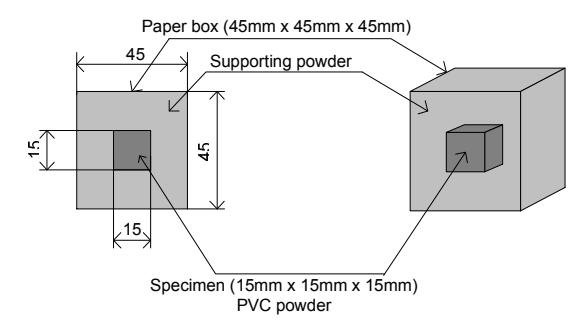
Figure 4. Set-up of locating specimen in the midst of support powder in indirect pressure less sintering
The shrinkage was measured by calliper with accuracy of 0.05 mm. The measurements were conducted in 3 (X, Y and Z) directions.
Figure 5. Shrinkage of specimen were measured by calliper
4. RESULTS AND DISCUSSION
The shrinkage phenomenon in X, Y and weight (Z) direction, which was resulted by varying sintering temperature (100 to 120°C) and holding time (2 hours to 8 hours), can be shown in Fig 6 and 7.
Figure 6. Shrinkage of specimen dimension in X-Y direction due to varying sintering temperature and holding time
Figure 7. Shrinkage of specimen dimension in X-Z direction due to varying sintering temperature and holding time
MESIN Vol. 21 No. 1
According to Fig 6, The occurring shrinkage until the sintering temperature of 115°C with holding time of 2 hour in X direction tend the same as the one in Y direction. In weight (Z) direction, the dimension of base specimen tends to be bigger than the upper part dimension. This was caused by the weight of the powder of up specimen forced the powder of base specimen, such that the powder of base specimen flew to side and to button of specimen. This condition is clearly shown at sintering temperature higher than 115°C with holding time longer than 2 hours. This confirms that the PVC powder by melting increases it's flow-ability. In this condition the dimension of specimen could not be maintained.
The correlations between shrinkage and holding time in each direction are shown in Fig 8 and 9.
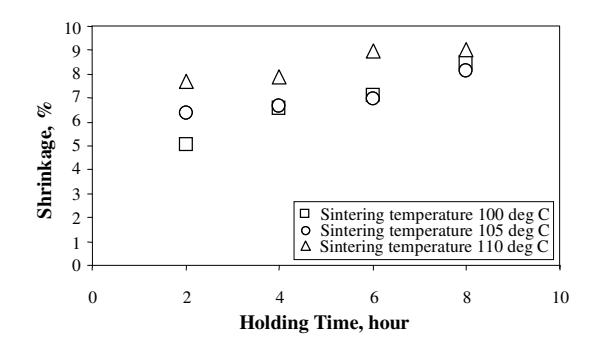
Figure 8. Correlation between shrinkage and holding time on each sintering temperature in X direction
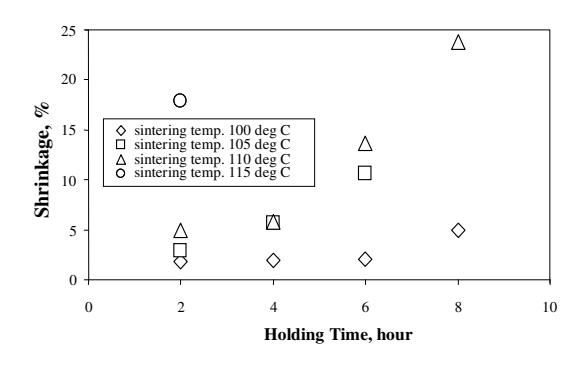
Figure 9. Correlation between shrinkage and holding time in weight direction
The shrinkage of total volume in each condition of varying sintering temperature and holding time are presented in Fig 10. Increasing sintering temperature and holding time enhanced occurring shrinkage of total volume of the specimens.
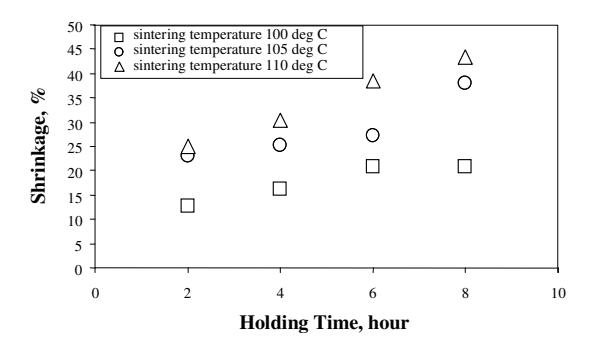
Figure 10. The shrinkage of total volume.
The results of tensile strength tests indicated that the sintering temperature until 107°C, specimens are very fragile so that it can not be measured their strength. When the sintering temperature was higher than 107°C, increasing of sintering temperature and holding time enhanced tensile strength of the specimen. Effect of sintering temperature and holding time to tensile strength is presented in Fig 11. This plot indicates that the binding mechanism among particles is started at sintering temperature higher than 107°C. The strength of binding mechanism is enhanced by increasing of holding time. The optimal effect of holding time on increasing the strength of the specimens occurs at sintering temperature of 113°C.
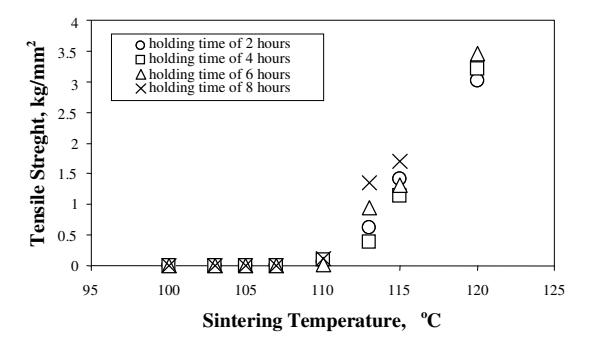
Figure 11. Correlations of sintering temperature and tensile strength in variation of holding time.
5. CONCLUSIONS
The sintering temperature influences the occurring shrinkage rate. In sintering temperature until 115°C and holding time of 2 hours, the dominant shrinkage occurs in weight direction. While in sintering temperature of 115°C with holding time longer than to 2 hours, the dimension of specimen can not be maintained. PVC material directly melted and bound the support powder when the temperature sintering higher than 120°C.
19 MESIN Vol. 21 No. 1
The strength of binding mechanism could be measured when sintering temperature was higher than 107°C. According to Fig 11, using sintering temperature of 113°C with varying the holding time (2-8 hours) could be given the longest variation of tensile strength and the occurring shrinkage could be maintained (lower than 115°C) so that this was suggest to applicable as optimal parameter in indirect pressure-less sintering.
6. REFERENCES
S. Das, M. Wohlert, J.J. Beaman, and D.L. Bourell, Producting Metal Part with Selective Laser Sintering/Hot Isostatic Pressing, JOM, pp.17-20, 1998
- 2. S. Kumar, Selective Laser Sintering: A Qualitative and Objective Approach, JOM, pp. 43-47, 2003
- M.E. Fayed and L. Otten, Handbook of Powder Science and Technology, 2<sup>nd</sup> Edition, Chapman and Hall – ITP, 1997, New York
- 4. F. Thummler and R. Oberacker, An Introduction to Powder Metallurgy, Book 490, The Institute of Materials, 1993, London
- 5. M.W. Barsoum, Fundamentals of Ceramics, 1<sup>st</sup>, McGraw-Hill, 1997, Singapore
- 6. T.H.C. Child, and A.E. Tontowi, Selective Laser Sintering of a Crystalline and a glass-filled crytalline polymer: experients and simulations, ImechE, Vol. 215, pp. 1481-1495, 2001
- 7. R.M. German, Powder Metallurgy Science, 2<sup>nd</sup> Edition, Metal Powder Industries Federation, 1994, New Jersey
MESIN Vol. 21 No. 1 20