

M E S I N
Jurnal Teknik Mesin Vol. 22, No. 2, Oktober 2007 ISSN 0852-6095
Diterbitkan oleh : Program Studi Teknik Mesin,
Fakultas Teknologi Industri - ITB
Surat ijin : STT No. 964/DIT-JEN/PPG/STT/1982.
MESIN Vol. 22 No. 2 i
DAFTAR ISI
| Thermodynamic property model of wide-fluid phase n-butane. Chan Sarin, I Made Astina, Prihadi Setyo Darmanto dan Haruki Sato | 44-54 |
|---|---|
| Sifat mampu nyala dan massa optimum refrigeran campuran R-290/R-22 Sebagai alternatif pengganti R-22 | |
| Ari Darmawan Pasek, Aryadi Suwono, Novianti Nugraha dan Usman Rosyadi | 55-61 |
| Optimisasi proses pemesinan EDM wire cut untuk modus gerak sirkular menggunakan algoritma genetik. | |
| Sigit Yoewono Martowibowo dan Adriansyah | 62-68 |
| Effects of hydrogen addition into intake air on hydrocarbon emission of gasoline engines at cold start condition. | |
| Arief Haryanto, Wiranto Arismunandar dan Gerard George Engel | 69-72 |
| Particle size distribution and rheological characteristic of trimethylolethane treated by cationic surfactant. | |
| Yuli Setyo Indartono, Hiromoto Usui, Hiroshi Suzuki, Satoshi Tanaka, Kousuke Nakayama, Yohiyuki Komada dan Tetsu Itotagawa. Mu | 73-80 |
| Pemanfaatan system CAD/CAM/CAE dalam reverse dan forward engineering untuk turbin Francis. | |
| Indra Djodikusumo, Lukman Santoso dan Rahmat Haris. Mu | 81-89 |
M E S I N
Jurnal Teknik Mesin
Vol. 22, No. 2, Oktober 2007 ISSN 0856-6095
Arief Hariyanto<sup>(1)</sup>, Wiranto Arismunandar<sup>(1)</sup>, Gerard George Engel<sup>(2)</sup> <sup>(1)</sup>Conversion Energy Reaserch Division, Faculty of Industrial Technology, Institut Teknologi Bandung, <sup>(2)</sup>PT Total Oil Indonesia
Ringkasan
Proses start, terutama pada saat start dingin, merupakan kondisi yang harus diperhatikan berkaitan dengan pengurangan emisi gas buang karena menghasilkan gas HC yang relative tinggi. Beberapa metoda telah ditawarkan dan diaplikasikan untuk mengurangi emisi gas buang selama proses start. Di dalam paper ini akan dibahas tentang penambahan gas hydrogen ke dalam aliran udara masuk untuk mengurangi emisi gas HC, pada saat start dingin. Menggunakan metoda ini, proses pembakaran selama proses start dapat berlangsung lebih sempurna. Paper ini akan menjelaskan pengujian yang dilakukan untuk mendapatkan jumlah hydrogen yang optimum, yang harus ditambahkan selama proses start pada berbagai kondisi temperature air pendingin, sehingga dapat secara efektif mengurangi konsentrasi total gas HC pada tiap kondisi temperatur. Hasil pengujian menunjukkan bahwa konsentrasi gas HC di dalam gas buang sangat dipengaruhi oleh temperatur mesin dan dapat diturunkan secara signifikan dengan menggunakan penambahan gas hydrogen ke dalam udara masuk ke mesin.
1. INTRODUCTION
Cold start is defined as the engine start process at the time when the coolant temperature is equal to the ambient. At cold start condition, fuel is injected excessively to ensure the ignitability of mixture. As the coolant temperature rises, the amount of injected fuel is gradually reduced. At warm-up temperatures, mixtures are set nearly stoichiometric, where the air-fuel ratio is nearly 14.6. At steady state/operational temperatures, mixtures are set slightly lean, to promote fuel efficiency. Figure 1 shows the common fuel injection characteristic during engine start process.
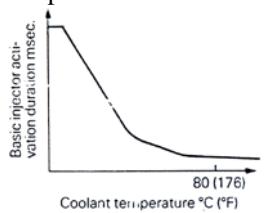
Figure 1. Fuel injection characteristic during engine start[11].
Wall wetting of injected fuel on the intake system due to the extra rich mixture characteristic applied in cold start condition results in significant emission of unburned hydrocarbon (HC) in the exhaust gas. At low temperatures, with relatively low solubility limit of fuel in air, some amount of fuel do not mix with air upon injection, but form thin layers on the intake runner instead. Subsequently, these layers will evaporate, and enter the combustion chamber. Physical characteristics of these layers do not promote mixture formation. As the result, despite entering the combustion chamber, the layers escape the combustion process, and exit the combustion chamber as HC concentration in the exhaust gas.
Addition of hydrogen into intake air extends the solubility limit of fuel in air. As the result, for the same amount of air, more fuel can be diluted in air as mixture, which minimizes the formation of unmixed fuel layers on the intake system.
MESIN Vol. 22 No.2
The experiment conducted with gasoline direct injection has shown an improvement of cold start performance. The fuel injection system of Toyota 7K-E engines is using simultaneous injection, instead of sequential injection. This simultaneous injection can increase the wall wetting which then produce higher HC emission.
As gaseous fuel, hydrogen has the widest flammability limit and the highest laminar burning speed among others[5]. The presence of hydrogen in fuel-air mixture increases the flammability limit and the burning speed of the mixture. This improvement leads to the possibility of operating the engine with lean mixture, which improves fuel efficiency. For the same duration of combustion, the increase in laminar burning speed increases the distance of flame propagation.
With longer distance of flame propagation, crevices inside the combustion chamber, which are least likely to be swept by the flame front during normal combustion, can now be reached. As the result, better possibility for the mixture filling the crevices to be burned, which leads to reduction in HC concentration in the exhaust gas.
2. THE EXPERIMENT
The hydrogen is fed into the intake manifold to mix with intake air. The flow of hydrogen is set in volumetric base, ranging from 0-500 cc / minute. The coolant temperatures at which the engine is started are 28°C (to simulate cold start condition), 50°C (To simulate start process at warm-up condition), and 70°C (to simulate start process at post-operated condition). Analysis is made based on the total of HC concentration during the first 2 seconds of start process, at each coolant temperature.
3. EXPERIMENTAL APPARATUS
The experiment is conducted using a 1.8 liter Toyota 7K-E Gasoline engine. Table 1 shows the specification of the engine.
Table 1. Specification of Gasoline Engine.
Type : 4 Cylinder in line 4 Stroke OHC
Bore : 80.5 mm Stroke : 87.5 mm Compression Ratio : 9.0 Firing Order : 1-3-4-2
Maximum Power : 60 kW at 4800 Rpm
Maximum Torque : 14.5 kg.m at 1800 Rpm Fuel System : Electronic Fuel Injection (EFI) Coolant System : Water-External circulation Lubrication system : Circulation Pump Fuel : Pertamina Premium RON 88
HC emission measurement is conducted using a Cambustion HFR 400 FFID, which has the sampling rate of 100 Hz. This level of sampling rate is considered sufficient to support a high frequency measurement of HC concentration in ppm \(C_3\) base. The sample probe of the FID is fitted directly into the exhaust manifold. The FID runs on Ultra High Purity Hydrogen and compressed air. Measurement data are logged using a National Instrument USB6009 data acquisition system combined with a PC based data acquisition interface developed using National Instrument Labview 8.0.
Hydrogen is fed into the intake system by means of a solenoid valve actuated electronically using the digital output of the USB6009. This valve acts as a final gate for hydrogen prior entering the intake system. In case of emergency, the hydrogen flow can be cut off immediately through this valve. Supply of hydrogen is taken from the hydrogen supply of the FID. Flow rate of hydrogen is controlled using a manually adjusted metering valve, which is connected to a flow meter. The hose through which the hydrogen flows is fitted into the throttle body. Figure 2 shows the insertion line of hydrogen into the intake system.
Figure 2. Insertion line of hydrogen.
Thermocouples are fitted in the water circulation system to provide coolant temperature data. An AVL Indimeter is used to provide engine rotation signal, which is used as auxiliary information. A Complete scheme of experimental apparatus is shown in Figure 3.
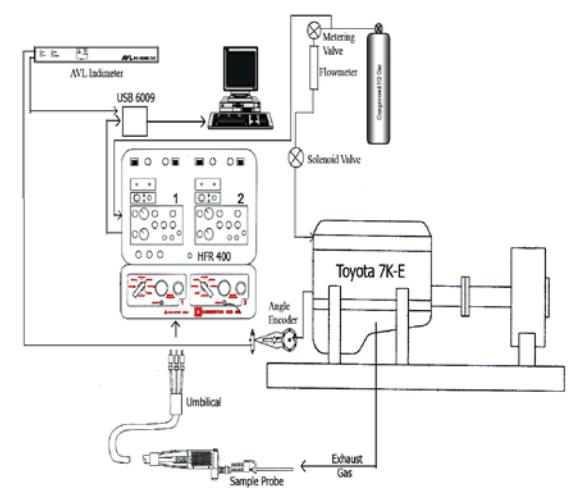
Figure 3. Scheme of experimental apparatus.
4. RESULTS AND DISCUSSION
Figures 4 and 5 show two examples of measurement plot obtained from the experiment.
70 MESIN Vol.22 No.2
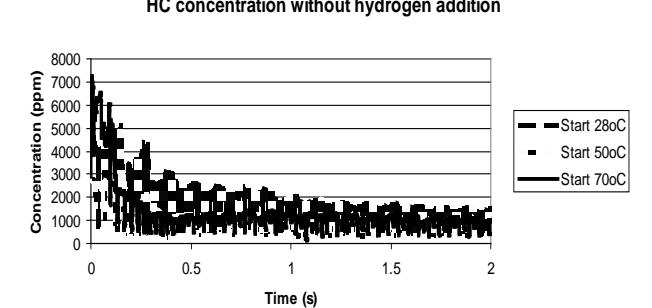
Figure 4. HC concentrations without hydrogen addition. HC Concentration at 200cc/min hydrogen addition
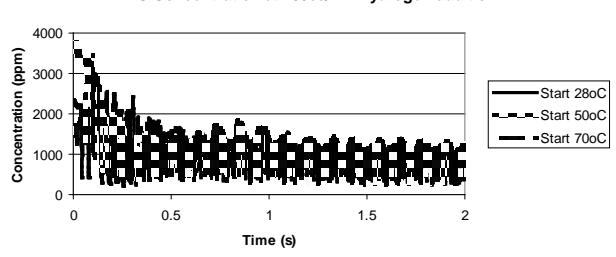
Figure 5. HC Concentrations at 200 cc/min hydrogen addition.
Figure 6 shows the total HC concentration during the first 2 seconds of start process.
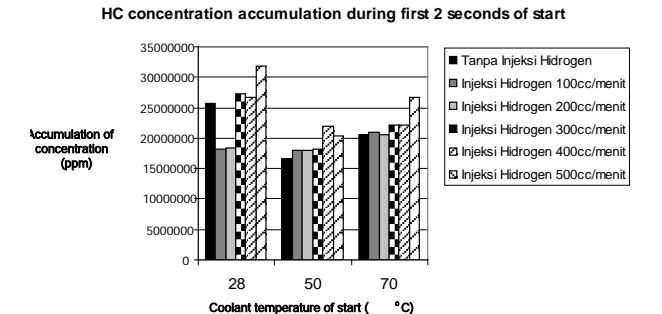
Figure 6. Total HC during the first 2 seconds of start
For start process at 28o C coolant temperature (cold start), HC emission for conventional start (without hydrogen addition) reaches the highest value among conventional start process at other test temperatures. This result complies with the theoretical explanation for high HC concentration during cold start due to fuel spray condensation. Figure 7 shows an example of a common the fuel injection pattern during cold start, reproduced from Mitsubishi Galant '88. The Galant engine, which has sequential injection, is using simultaneous injection during cold start. The Toyota 7K-E engines, which using simultaneous injection systems, have the similar injection pattern during starting as well.
Figure 7. Common fuel injection pattern during cold start[11].
Excessive fuel injection during the cold start process is indicated by the duration of injector opening. It can be seen from the pattern that fuel is injected into all cylinder regardless of the stroke occurring at each cylinder. As a result, some amount of fuel escape the combustion process, and exit the combustion chamber as HC concentration in the exhaust gas. Hydrogen addition at the flow rate of 200 cc/min leads to the highest reduction in total HC concentration at 28o C start temperature. About 37.7% reduction of total HC concentration is obtained upon the addition of hydrogen at 200 cc/min. Hydrogen addition at the rate of 500 cc/min is found to be ineffective. At this rate of flow, the air-fuel mixture becomes over rich due to excessive amount of hydrogen. At excessive addition, some hydrogen does not mix with intake air, but enter the combustion chamber independently instead. Due to its density, which is far lower than density of air-fuel mixture, hydrogen fills the upper part of the combustion chamber, which is relatively closer to the spark plug. Upon combustion, the area occupied by air-hydrogen mixture will be the first to be swept by the flame front. As a result, some fuel-air mixture misses the combustion process, and exits the combustion chamber as HC concentration in the exhaust gas.
For start process at 50o C coolant temperature, addition of hydrogen is found to be ineffective. Referring to the fuel injection characteristic shown in Figure 1, fuel injection is reduced as the coolant temperature rises. At warm up temperatures, air-fuel mixtures are set near stoichiometric. Theoretically, stoichiometric air-fuel ratio produces the lowest level of HC emission at conventional start process. Addition of hydrogen at this condition promotes the formation of rich mixture, which leads to high HC concentration in the exhaust gas.
For start process at 70 o C, addition of hydrogen at flow rates of 100-400 cc/min is found to be still effective to reduce total HC concentration. Addition of 100 cc/min hydrogen is found to be the most effective, with 17.8% of reduction in total HC concentration compared to conventional start. At this temperature, which can be considered as steady state operational temperature, mixtures are set slightly lean to promote fuel efficiency. However, lean mixtures have the nature of poor flammability, which leads to misfires and partial
MESIN Vol. 22 No.2 71
burning. Misfires and partial burning are known to cause high HC emission. Due to its wide flammability limit, the presence of hydrogen in fuel-air mixture expands the possibility of the engine to be run with lean mixture, while reducing misfire and partial burning phenomena. As in start process at 28°C, addition of hydrogen at 500cc/min promotes the formation of rich mixture, which leads to high total HC concentration.
5. CONCLUSION
Addition of hydrogen into intake air at flow rates of 100-400 cc/min is effective to reduce the total of HC concentration in starting process. At the cold start, the reduction of HC emission is found to be most effective, which could be reduced down to 37.7% of total HC emission.
At warm-up temperature, it is not necessary to apply hydrogen addition since the level of HC emission is already at the lowest due to its mixture characteristic of nearly stoichiometric.
At operational start temperature / in conditions where the engine has been previously operated, hydrogen addition at the flow rates of 100-400 cc/min is still effective to reduce HC emission by extending the flammability limit of lean mixtures.