

1 Introduction
1.1 Prologue
Supposed that one day we are not feeling really well. When it is getting worse, a common thing to do will be finding a doctor, get a prescription, go find a drugs store then, having the medicine on hand, and follow those drugs therapy without no further question. In this case, there is two
1 Term 'facility' is widely understood as buildings, utilities, systems, equipment, machines, controls, and measuring instruments
parties that we have no doubt about: the doctor and the pharmaceutical industries which producing the medicinal products. The doctors would do their integrity, bound under their oath. And how about the pharmaceutical industries? If the drug says let say 10 mg active ingredients, how can you be so sure that it must be 10 mg composition really there? Because if some point less, the drugs therapy will be useless, at the other hand, if the actives inside is much more than it should and somehow touching the human safety for toxicity limit, surely it will become threat for the health.
If for instance, this 10 mg we are talking delivered on a tablet, the accurate composition has a lot thing to do with the effectiveness of several station of process flow called formulation mixing, granulating, and dry granule blending. It is also on the tablet-press process stage that we assure there is no segregation happens.
More challenging story if we are talking about patients who must stay on the hospital. Most of the time the patients will relate to the drug route called parenteral, medication that must delivered through bloodstream (by intravenous) or through muscle (by intramuscular). Not only the patients, even the hospital believes that the parenteral drugs definitely safe. Safe means it contains the accurate medication formula composition. And further more thing to be aware is, injecting drugs substance directly through the bloodstream is like opening several gate of human nature metabolism of disease protection. Then it becomes mandatory that parenteral drugs must be free from foreign particle, free from microbial that potentially infecting, such as bacterial, germ, virus, endotoxin. This kind of product, only has such a producibility if manufactures in a pharmaceutical industries environment called sterile facility.
When the patient has only very little option but accepting the medicinal consumption, it become a regulatory authority obligation to guarantee that the drugs producing and distribution will have a product quality and patient safety assurance. Even they give a term for pharmaceutical –and biopharmaceutical- industry as the one of so called 'highly regulated industries'. One thing that this kind of industries should provide is the organization function named Validation.
1.2 The Challenge
An obligation to perform validation activities for the industry gives a challenge to the extent to which the validation activity is done. How wide it is and how deep it is. The journey of validation always refers to the final goal: Validated product and therefore having validated process as the logical consequences. The definition of the process validation currently refer to regulatory words is:
"Process validation is defined as the collection and evaluation of data, from the process design stage through commercial production, which establishes scientific evidence that a process is capable of consistently delivering quality product. Process validation involves a series of activities taking place over the life-cycle of the product and process" [1].
Conceptually the above activities include 3 stages:
- Stage 1 Process Design: The commercial manufacturing process is defined during this stage based on knowledge gained through development and scale-up activities.
- Stage 2 Process Qualification: During this stage, the process design is evaluated to determine if the process is capable of reproducible commercial manufacturing.
- Stage 3 Continued Process Verification: Ongoing assurance is gained during routine production that the process remains in a state of control.
This paper is focusing to know more about the activities on the Stage 2 Process Qualification, where the key word of validation activity at this stage is collecting and analyzing as scientific evidence that "the process is capable of reproducible commercial manufacturing". And before doing any further data collection on all process parameter and quality attributes to ensure the process capabilities, there are activities to conduct defined as a qualification to all facilities involved in the manufacturing process to deliver the products, from raw materials to commercial goods. The facility qualifications (including all production machinery involved) are part of the validation activity stage in the pharmaceutical industry. This includes:
Building Qualification: Although not as stringent as superconductor industry, the pharmaceutical industries have an obligation to set a room class standard on production facility. This standard refers to the Clean Room and Clean Air Device Classification [2]. When a production room is designed to be controlled following the standard, covering the conditions of temperature, humidity, room-to-room differential pressure, the number of particles counts, viables and non viables, the demand for building design should have a positive contribution on clean room controlling effort.
Validation activity is to provide a scientific evidence that the building built by the design and its intended to used. There is a common step such: Design qualification (DQ), to verify that the design made, which certainly involves architects, civil engineers, mechanical and electrical engineers, is accepted as a pharmaceutical industry building design. Installation Qualification (IQ), as a verification activity to assure that the building installation constructed according to the design that has been made.
Furthermore, nowadays buildings commonly apply technology such as BAS (Building Automation System) or some advance thing called intelligence building. Automation and logic intelligence applied to buildings can be functionality or energy efficiency purpose, which follows the need of validation phase to perform the Operational Qualification (OQ), which will test its objectives acceptance criteria or even simulated the worst case scenario. The worst case in a pharmaceutical engineering perspective is a scenario that may have a highest risk on threatening product quality and patient safety of the product produced inside this building.
For example, in one application of the sterile facility, one of the common practice in sterile facility buildings is the ease of supervision and a possibility of an activity record in the production facilities. Once developed a design of sterile production that all sides of the wall are made by glass that people can see thru in every direction, which then equipped with CCTV on the outside. It is designed such a control so that the system is able to perform algorithms by the parameters input of the clean room and the lighting requirements in the room, which results in output on the operational arrangement of the HVAC (Heat, Ventilating and Air Conditioning), lighting system and motorized curtain installed on the outside glass walls. Validation will conduct to provide evidence in normal operation and even in worst case situation, the clean room standard parameter achieved and in control.
Utilities System Qualification: Facilities defined as utilities are well known as a mechanical, electrical and or electronic equipment or system that has a functionality to support so that the production machines work according to their design and its intended to use. It can be a common thing such as electric power supply in all pharmaceutical industry facilities, HVAC, Water supply, Steam supply, Compressed Air and Gas Supply.
Electric power supply is the energy source that in business process perspective is critical for manufacturing operational activity. There is almost no possibility for manufacturing industries to run without electricity. No matter this electrical energy comes from. Is it from public power source, or its own power generation.
In the pharmaceutical industries, the installation and operational of electric power systems may not have a direct impact on GMP environment2 . It is only concerned in the availability and stability where the verification test already become mandatory in functionality engineering domain as one of the acceptance criteria of project deliverables.
A common practice for validation involvement is to simulate the worstcase scenario that could arise from the power availability. For examples if such a power failure situation happens at a sterile facility operation. To create conditions to fulfil the clean room class standard so that a production room can be qualified as a sterile facility, it certainly needs electricity. HVAC is a system that usually consumes the most electric power in sterile facilities. Any condition of power failure can be a risk that is likely to occur. How long it is should be scientifically determined and simulate. If a company has backup electricity, the duration of power failure can be controlled. And the system is able to maintain its conditions in the range of acceptable HVAC parameter within the power
2 Something that gives impact on product quality and patient safety, in pharmaceutical industrial knowledge is known with the term "GMP environment"
failure duration during validation challenge. It includes the system recovery challenge after power available again, so the rooms achieve its clean room classification.
A complex pharmaceutical facility project, involving large buildings, a large number of rooms, differ clean room classification by dividing zones so that many AHU (Air Handling Unit) units are needed there, a qualification activity in such scope will usually consume the greatest resources in the entire process of facilities validation. Starting from the DQ to verify and give a challenge question about the choice decision of the system used. Does it use a Refrigerant Heat Exchanger Unit? Is it the Water Cooling System? Air Cooled Water Chiller? Or Water Cooled Water Chiller? How many AHU zones define? And to achieve a clean room classification, the use of HEPA (high-efficiency particulate air) is a must. Does it use a terminal filtration approach? Why? Or using a central HEPA?
Next verification activity will be an IQ, to verify all system components that should be installed according to the design. Not only its main components installed such as chiller unit, pump, AHU, several HEPAs, but it can also involve the necessary protocol of the installation process itself. For example, regarding the installation of ducting for sterile room, fabrication of ducting that have no effort to mitigate particle contamination risk that might happen so that when it is installed the clean state can be difficult to reach by the initial cleaning process, will become a critical for attention.
A complex HVAC system will usually be integrated in a control system like BAS (Building Automation System). This is where the scope of OQ is needed. HVAC system which consists of many zones there, an activity called balancing (regulating flow, damper adjustment, air change, and achieving room-to-room differential pressure) is the most time consuming activity for reaching the acceptance criteria during validation.
Operationally well-qualified is a prerequisite for the next validation step, Performance Qualification (PQ). Validating the fulfilment of cleanliness quality attribute requirements on Cleanroom Standards [2]. Where cleanroom classification of a class-room A, B, C and D binds to the choice of sterile production facilities, while in Indonesia also
recognized the requirements of class-room E for non-sterile. Class-E is a Class-D without microbial (viable particle) parameter. Fulfilment of cleanroom classification requirements, mainly is the achievement of quality requirements for the number of particles counts in the room, but the engineering approach has been scientifically proved that this requirement will only be achieved if other quality requirements including temperature, humidity, room-to-room differential pressure, air-change, HEPA filter integrity [3] are achieved. Then the HVAC system can be said to be well validated. For example, doing a challenge test for one of the parameters such as temperature that must be proven for 5 consecutive days for the sterile class, sometimes in this 5 days, there is also a fine tuning attempt to improve system capability as seen from the qualification data for the following temperature parameters:
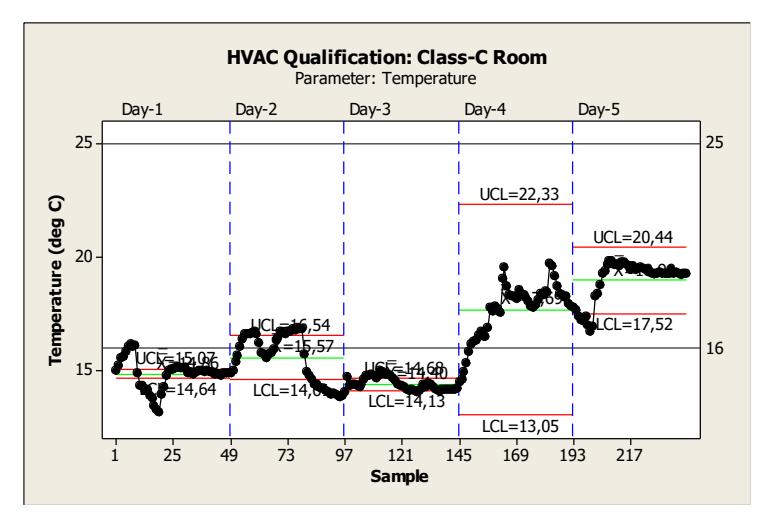
Figure 1 Graphic of sterile class Room-C temperature optimization example during validation activity.
Following the graph shown, the effort to achieve the validated state for the system is not just only doing a simple adjustment. It can be seen that there must be a delicate room-balancing activity, door seal adjustment in every room to maintain a good temperature capability. It can be also an optimizing the dehumidifier operation as humidity and temperature are like see-saw parameters.
Scope of water supply in pharmaceutical industries purpose put in several qualities of compendia water. If we refer to USP (US Pharmacopeia) [4], there are many standard quality of water that pharmaceutical industries
can choose to fulfill the requirement needs. It starts with drinking water definition as a baseline for feed water input to the next treatment following the specific purpose. In this compendial water, the definition is specified variously in such as Purified Water, Water for Injection, Water for Hemodialysis, Sterile Purified Water, Sterile Water for Injection, Sterile Water for Irrigation, Sterile Water for Inhalation, Bacteriostatic Water for Injection. Every definition has a specific water treatment process and a unique quality attribute. IQ and OQ phase relatively has similar idea among all system, machinery, instruments, and equipments. In water supply, PQ has already stated to follow a standard qualification protocol [5] and its best practice for sampling plan procedure [6].
In rough explanation, the test demonstration for PQ as a part of validation activity will be a normal system operation with all process parameter ranging withing in control situation. Before the water use for production, it is a phase one, in minimum 2 weeks' operation, the enough sample amount for quality test is taken in every point of use (POU) every day at the same sampling time for every POU. Quality attributes include some physical, chemical and microbial properties of the compendial water definition requirement [4]. If only the test is passed, then coming the phase two that the water is approved for production used, and the same sampling activity continuous for the next minimum 2 weeks. Passing this phase will make the industry to continuing for one-year sampling on only selecting POU and extended interval (i.e., once a week). The validation report will become evidence of water quality capability for annual cycle.
Other scope such as steam supply, also covering the similar understanding on compressed air supply and gases supply, there is a certain quality that has to achieve for pharmaceutical purpose. It can be included—but not limited to—the consideration of cleanliness, purity, and physical property stability. In this scope, something that it can be unique and carefully demonstrated its capability for a validation purpose is also at the PQ phase. And it can be varied. It always begins with the URS (User Requirement Specification) mentioning its intended to use. For most cases, in pharmaceutical sterile facility, steam supply is used for the sterilization process with steam-heat sterilization method. Before conducting the validation of sterilization process, the capability of steam quality has to be scientifically proved that it is capable for sterilization process.
The minimum requirement is defined as "Clean Steam" grade. In special case application mostly at sterile facility, should use "Pure Steam". And the guideline of steam quality uses the standard of steam sterilizer [7]. Its covering the analysist of such quality attribute that its condensing should be qualified as "Water for Injection" include in physical, chemical and microbial accepted criteria properties. This validation challenges the "Steam Purity" terminology. And for the definition called "Steam Quality", the parameter test would be dryness, a maximum noncondensable gas content allowed and the superheat criteria. Steam Purity is to assure that steam used for sterilization can lead no contamination of the sterilized article, while Steam Quality is to ensure if the steam itself has no impact on sterilization process effectiveness. Because during sterilization process then, people can only monitor the sterilizing parameters on temperature and the sterilization time.
DQ-IQ-OQ-PQ as a default activity as a part of validation plan. And it is always become a standard protocol for facility validation which is in GMP environment determine as a qualification object, the facilities that has to be on qualified state before they are used.
Process Machinery Qualification: Process machinery for pharma industries actually are similar to all machinery that process some general raw material to finished goods. It just depends on the process materials form. It is in bulk, powder, solid, liquid, emulsion, and even gas. These will need a common engineering equipments such as mixer, dry powder blender, emulsifier, transfer pumps, conveyor, tank, piping and its accessories, siever, grinder, bottle filling machine. Some will become special if we talk about drugs preparation and its packaging. Effervescent drugs will need a special material and machine to produce. Some drugs are serve in granule, which definitely need a granulation machine. Or tablet that has to be made in a tablet-press machine. Or capsule that divide in two definitions as a hard capsule or soft capsule, which those two have a totally different arrangement of equipment and process train. Some advance technology applies become more popular option in liquidsterile facility is a machine called Blow-Fill-Seal. It is a plastic-bottle filling machine. But instead the bottle was already pre-formed as a packaging material supply, this machine also do the plastic bottle forming and the product filling directly then.
The most popular issue for process machinery is about the product contact surface area. In best practice, it has to be SS316L material used. Other options can become beneficiary as long as they are having enough evidence scientifically that these others material are in an acceptable risk to product quality and patient safety.
Packaging machineries also has a wide variety following the drugs packaging design that sometime decide by product marketing demand. For primary packaging, the common machines used at pharmaceutical are a blistering machine, tablet-stripping machine, bottle filling (whether it fills a liquid form drugs, in dry powder, or even tablets or capsules), tube filler (plastics or aluminium), sachets, pillow packs. While a secondary packaging varies widely such as catch-covering machine, cartoning, shrinker.
All those kind machineries can divide in two general purpose. Machine for sterile product processing, or non-sterile. The sterile process machinery purpose is always designed for sterile environment. There is a surface finished roughness standard, or even some component designed to be single-use disposable, while some machine manufacturer developed a machine type called "through the wall installation", when the component arrangement of the machine divide in two groups for accessing. Parts of machine that only facing the clean-room area for production, while other can only be reach from technical area for only maintenance activity. All this idea is made to achieve the qualified state during validation.
Providing scientific evidence for the process machinery will also follow the DQ-IQ-OQ-PQ to validate. And for machine manufacturers, after we assess them and then justified that they have enough GMP knowledge, some of qualification activity can become their part. But mostly this commercial option does not come cheap. Generally speaking, in engineering perspective, there are a standard guideline published in ASTM (American Society for Testing and Materials) for a new machines specification, design and verification, as describe bellow:
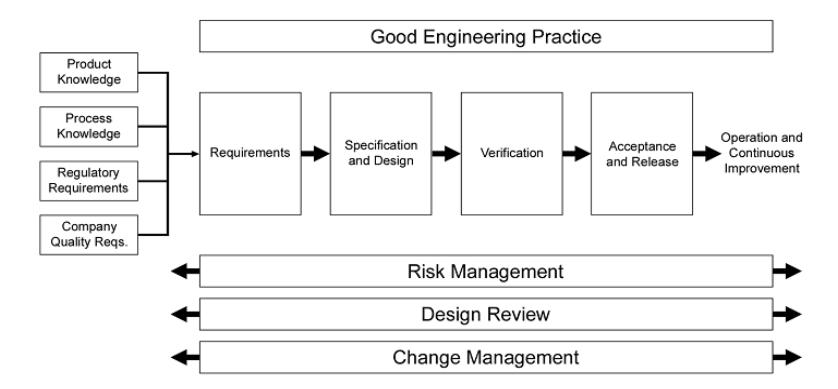
Figure 2 The Specification, design, and verification process per ASTM E2500
While in GMP perspective, the DQ-IQ-OQ-PQ activities was integratedly put there.
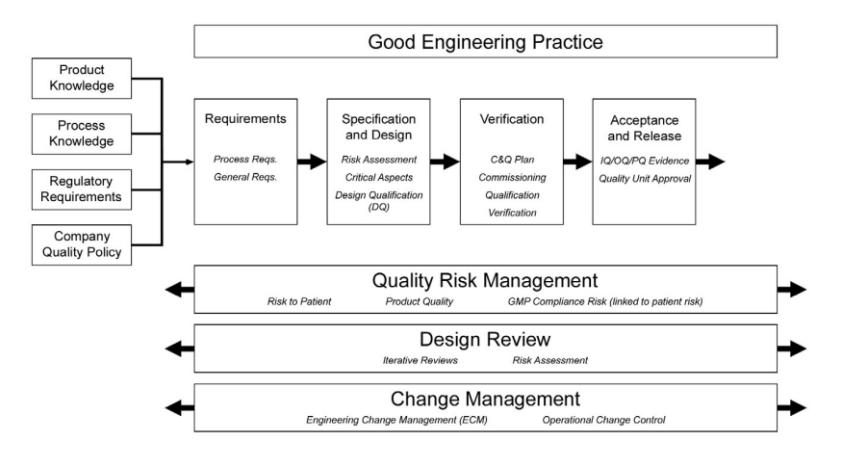
Figure 3 Integrating engineering concept (ASTM E2500) with GMP perspective demand as a part of the facilities validation activities as a GEP [8] 3 .
PQ in processing machine in some cases are using the product quality attribute. But careful justification is needed. Because not all product quality attribute is always become machines responsibility. The mixing
3 Knowledge in GMP environments are commonly defined in term GxP as a derivative word with similar understanding. 'X' can be widely defining as a scope of which 'good practices' should be applied. ASTM E2500 as an engineering baseline for GMP is known as GEP (Good Engineering Practices) then.
machine that equipped with dissolving feature might not always mean that some product quality attribute like -for example- solution uniformity will become the performance test parameter. Solution uniformity has a lot thing to do with raw material properties such a solubility. OEE (Overall Equipment Effectiveness)4 concept [9] is used in common for assessing the machine performance.
Storage and Transport Validation is another story as one scope of the facilities validation in pharmaceutical manufacturing. It can become a risk for product quality chain distribution. If one drugs are designed to be stored in Cool Room definition [10]. This room definition is in range 8 to 15 ⁰C. Validation will have to provide scientific evidence that the drugs are always in temperature range through the pipeline distribution.
Begin in the storage, no matter it is in a chamber or a storage building, an activity that commonly defined as thermal validation mapping have to conduct. A number of sensors put in a storage with the number of pieces and sensors location are justified in geometrically order or base on risk approach. Then a route mapping for the drugs distribution to the outlet will be determined for a worst-case route scenario to simulate. One temperature sensor put inside the drugs shipment to log the temperature condition along the way. The sensors are collected then, and the temperature data will be analyzed.
A vaccine that requires a storage and distribution below 8 ⁰C, sometimes can make a validation decision to do QD-IQ-OQ-PQ for even a cold storage vehicle for its transporting as a necessity.
Measuring Instruments Calibration. Almost all of the validation scientific evidence come from measurement quantitative data. Temperature, pressure, humidity, mass, mixing-tool rotation speed, airflow, etc. Most of it is a process parameter that come from sensing device and displaying it in human readable indicator or electronic record log. Analog or digital, mechanically or electronically. To ensure the measuring instrument accuracy is a fundamental thing before conducting facilities verification and confirm it as a qualified. The procedure that 4 OEE is a measuring tool to assess the machine performance as a part of continuous improvement activities for production process equipment maintenance in TPM (Total Productive Maintenance).
commonly known as calibration. A large number of calibration object in pharma facilities will lead industries to build their own calibration laboratories, only off course there has to be a standard to follow [11].
The measuring instruments can be varied. From a just as simple as glass thermometer, until a complex sophisticated measuring device like a moving scale which designed and electronically programmable for formulation weighing on multiple range accuration class. Some organization put the calibration function and validation in a separate department. But in a lot of pharmaceutical industries made the calibration function as a sub-job description of validation department.
Typically, about 80% of calibration object in pharmaceutical industries is in temperature, mass and pressure unit. Most of temperature calibrations are on room temperature indicator and machine thermoindicator. Analytical balance and industrial scale are at most of the mass unit calibration. While a differential pressure gauges can be up to 70% pressure instrument population. A room-to-room differential pressure gauges mostly, measuring such a delicate pressure difference not more than 60 Pascal's. Careless calibration strategy can lead to falseacceptance validation.
Analytical Instruments Qualification: Process parameter measuring instruments will be approached with calibration for accuracy assurance. While a quality attributes need an analytical method for its determination. An active drugs assay, dissolution test, tablet hardness, liquid product viscosity, disintegration test, etc., can only be prepared in a standard laboratory. It needs the analytical instrument to be qualified before use. Validation and qualification of analytical methods and equipment are required [12]. And also its laboratories HVAC should follow a DQ-IQ-OQ-PQ scheme.
More challenging situation when a pharma industry has a sterile production facility then should be having a microbiology test laboratory as a consequence. There is a stringent safety laboratory standard to follow. More stringent standard applied can always mean more effort for validation.
Computer System Validation (CSV). Information technology become in common these days in all life sectors. In manufacturing industry field, it is enhancing the automation era that already come previously. Production line that some several decades ago introduced with the automation technology such as SCADA (Supervisory Control and Data Acquisition) continued with electronics data management requirement. Data capture, storage, data processing, recording, analyzing, data distribution therefor a 'based on data' decision making. Data life-cycles that now manage electronically and computerize, and some of it definitely become an impact to product quality and patient safety.
Pharmaceutical industries have an obligation to record every batches of drugs produce and keep this record available until product expiration duration time. This batch record should follow GDocP (Good Document Practices) guide. Most of pharmaceutical industries nowadays applying a batch recording electronically. The computer system then integratedly covering from the automation until data recording that should be always available for retrieving and audit trail.
Even now, we are facing the industry 4.0 challenge (pharmaceutical engineers are projecting this concept to Pharma 4.0 terminology), where the above idea expands then to the drugs autentification requirement. Something that recently known as a serialization. A drugs track and trace. Not only about batch data recording but also the electronic system capability to track and trace in every single smallest packaging drugs product.
It requires to qualify the system then. DQ-IQ apply to all component system based on URSs intended to use. Machine interface, communication protocol, data networking, server, PC, information system architecture. OQ will demonstrate the electronic operational system refer to its scope. Qualified to the URS must follow with the activity to collect an evidence that it comply to the authority regulation for data electronics [13]5 . The system has to challenge its functionality and robustness for electronics recording, data integrity, password management, electronics signature, audit trail, and the reliability for back-up and data recovery. These complete validation activity is now popular as a CSV (Computer System Validation).
5 The GxP of this scope, known as GAMP (Good Automated Manufacturing Practicing) [14].
2 Undesired Outcome
All of the validation obligation can lead to industries that can become attempting redundant resources. Most of the time, Validation team is defined with the terminology as part of an organization function called a Quality Unit, as a one role of a Quality Assurance responsibilities. Separate from engineering function since they have a different role in the organization. Specialist or generalist strategy can always end up with more workforce requirement for every multiplying scale project.
The specialist strategy option, there will require a complete team for every disciplines background need. While the generalist strategy will face the lack of competence situation then do "if you know nothing, you do everything" decision that whether it gives impact on GMP requirement or not, it is always considered as a validation object.
It seems that there is no choice left since third-party validation usually consume a high cost percentage. A cost reduction strategy sometimes followed with the design very close to the baseline, or even just below it, that make fragile situation during validation especially when it should be challenged in worst-case scenario. While for a conservative decision will put the design far away above a baseline to avoid headache during validation.
3 Strategic Initiatives
3.1 Continual Product Knowledge and Process Understanding Learning
Facilities in pharmaceutical industries is like a scope area that pharmacist, microbiologist, chemist and engineer has to gather their idea together. Product design and knowledge that come from pharmacist, microbiologist or chemist thinking have to be shared specially to process engineers to propagate discussion and effectively defined the requirement facilities for those product profile quality attributes. Silo-thinking mentality among professional disciplines must be ended.
A tablet target product profile for example, has to be clearly defined to engineer its design space. Physical properties, such as dimension, weight consistency, hardness of the tablet, can be considered influenced by tablet-press machine performance. Existing product for an expanding
new facility, or new product to suite new facility, or even new product that fit for existing facilities, all the possibilities leave for engineers to always continuously aware about product knowledge.
Existing product that has a validated status justified at Stage 2 and Stage 3 Process Validation, will have a running data collection, whether its process parameter or its quality attribute. This continuously running data statistically will indicate the process behavior that lead to process understanding learning. Process engineer will always analyze this understanding that can also describe the facilities reliability.
Validation leaders, at the other hand, before conducting a validation sequence on pharma facility qualifications, whether for a new similar product facility, renovated, or just to do re-validation for updating the qualification status on continued verification (stage 3), are always gathering information for validation plan. The more information they had, will lead to the more qualification scope can be justified without onsite verification. The information that can only be extracted from an updated product knowledge and process understanding that continuously product designer and process engineer learn on day to day basis.
A complete detail product knowledge and process understanding can become a scientific justification to minimize validation execution without threatening GMP expectation.
3.2 Apply Risk Base Thinking
Doing a verification in every detail component for a new facility is necessary for a commercial and functionality engineering purpose. Validation can only pay more attention on the most important thing to GMP consideration. In most case, engineering and GMP purpose can lead to a bias decision followed by a duplication workforce set up. It comes from a paradigm that everything important for functionality engineering is always give impact to product quality and patient safety.
Regulatory authority actually gives a guidance corridor with a consideration that industries have to know better about their product and process. What important that give an impact to quality can be defined by the method called QRM (Quality Risk Management) [15].
One protocol following the QRM Guideline that I have ever developed to minimize a duplication task between functionality engineering verification and validation role is described below:
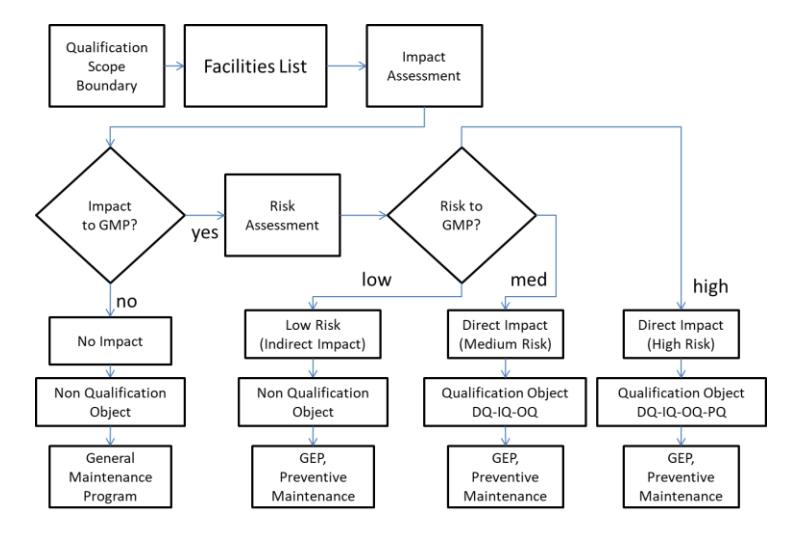
Figure 4 Flowchart for rationale guidance to do risk assessment with QRM. The purpose is to prioritize on validating the GMP only scope to avoid duplication with engineering verification
Measuring instrument calibration, for initial arrangement, industries usually follow the interval for re-calibration in annual basis. But after several times re-calibration, industries can also use a science and risk base approach to justify the extending of the next re-calibration [16].
One case-study can be shown below in some pharma industry calibration laboratory. Its industry grows so that the number of calibration object also grow. But with careful study on drift in every individual object calibration result since 2015, extending calibration interval can give result in controllable calibration order. This effort can extend the needs of two additional workers (calibration technician) planned for 2015 until 2018.
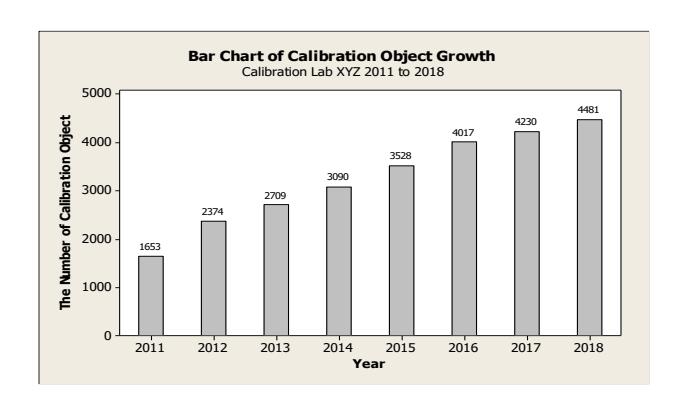
Figure 5 Calibration object growth can be expected as more calibration order
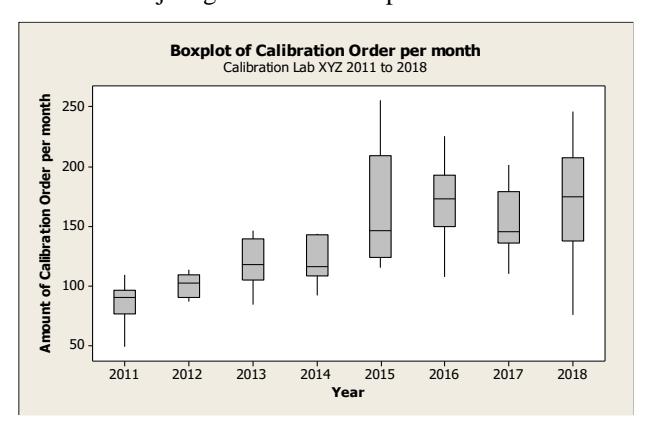
Figure 6 In 2015 the monthly calibration order can be controlled although the number of calibration object still grows (Figure 5)
3.3 Built a Strong GEP Environment
In general manufacturing industries, especially for industries that involving a large number of machinery are suggested to practice a good strategy for project delivering and facilities maintenance. A guidance like ASTM E2500 or a lean manufacturing concept described in 8 pillars TPM (Total Productive Maintenance) can be used as a reference [17]. There is no once and perfect application. It always requires continuous improvement to get better and better.
This strategic initiative can be a foundation in pharmaceutical industries. With a good planning and rationale justification from quality point of view, the initiative can become a GEP baseline. Applying GMP is just
putting any additional quality elements in this foundation. Strong foundation makes an elements stay still. And the rigid elements is always a good news for a validation.
3.4 Validated Facility as a Project Deliverable Performance Indicator
For a new and a renovated pharmaceutical facility, engineering team at the most cases pay much more attention at commercial and facilities functionality perspective. Project deliverable are assessed only at the functionality engineering check-list then. And a legal hand-over from a project contractor and the owner representative is usually done before the validation team is completing this facilities qualification sequence. Because a lot of project contracts are emphasizing only at functionality fulfillment. If some GMP deviation arise during validation, it binds only a little responsibility to the contractor. The burden of unqualified facilities is on the operational process owner a process engineer then.
A better approach suggests that project delivering phase on commissioning activity should be planned with qualification job as a unity task before hand over. Its benefit for the project deliverable is enlarging the completed one ensuring focus is on quality-critical system feature rather than diluting effort across all system feature [18]. Engineering performance indicator on project delivering not only in commercial and functionality, but expand to GMP quality perspective with the validation is a part of the team member since at early stage of project phase.
4 References
- [1] Guidance for Industry: Process Validation General Principle and Practices, Current Good Manufacturing Practices (CGMP) Revision 1, U.S. Department of Health and Human Services Food and Drug Administration Center for Drug Evaluation and Research (CDER) Center for Biologics Evaluation and Research (CBER) Center for Veterinary Medicine (CVM), 2011.
- [2] ISO 14644-1:2015, Cleanrooms and associated controlled environments, ISO, 2015.
- [3] ISPE Good Practice Guide: Heating, Ventilation, & Air Conditioning (HVAC), International Society for Pharmaceutical Engineering (ISPE), First Edition, 2009.
- [4] USP <1231> Water for Pharmaceutical Purposes, United States Pharmacopeial Convention – National Formulary (USP-NF), www.usp.org/usp-nf.
- [5] WHO Technical Report Series, No. 929, Annex 3: WHO Good Manufacturing Practices: Water for Pharmaceutical Use, World Health Organitation (WHO), 2005.
- [6] ISPE Good Practice Guide: Sampling for Pharmaceutical Water, Steam and Process Gases, International Society for Pharmaceutical Engineering (ISPE), First Edition, 2016, www.ispe.org.
- [7] Sterilization – Steam Sterilizers – Large Sterilizers, The European Standard EN 285, 1996.
- [8] ISPE Baseline Guide vol. 5: Commissioning & Qualification, International Society for Pharmaceutical Engineering (ISPE), Second Edition, 2019, www.ispe.org.
- [9] Hansen, Robert.C., Overall Equipment Effectiveness, First Edition, Industrial Press Inc, 2001.
- [10] USP <659> Packaging and Storage Requirements National Formulary (USP-NF), www.usp.org/usp-nf
- [11] ISO 17025, General requirements for the competence of testing and calibration laboratories, ISO/IEC 17025, Third Edition, 2017.
- [12] Huber, Ludwig, Validation and Qualification in Analytical Laboratories, Second Edition, Informa Healthcare USA Inc, iiiiv, 2007.
- [13] US FDA, Code of Federal Regulation (CFR) 21 Part 11, Electronic Records; Electronic Signatures - Scope and Application, FDA Guidance for Industry, 2003.
- [14] The Good Automated Manufacturing Practice (GAMP): Guide for Validation of Automated Systems, GAMP 4 (ISPE/GAMP Forum, 2001), http://www.ispe.org/gamp/
- [15] ICH Guideline Q9 on Quality Risk Management, Committee for Human Medicinal Products, EMA/CHMP/ICH, 2015.
- [16] ISPE Good Practice Guide: A Risk-base Approach to Calibration Management, International Society for Pharmaceutical Engineering (ISPE), Second Edition, 2010, www.ispe.org.
- [17] Nakajima, Seiichi, Introduction to TPM: Total Productive Maintenance, Productivity Press, First Edition, 1998.
- [18] ISPE Good Practice Guide: Apllied Risk Management for Commissioning and Qualification, International Society for Pharmaceutical Engineering (ISPE), First Edition, 2011.