

Abstrak
Suatu model kopel tiga dimensi hidrodinamika dan transpor sedimen HydroQual, Inc., (2002), ECOMSED, diterapkan untuk mensimulasi variasi transpor sedimen kohesif melayang di Estuari Delta Mahakam. Hasil simulasi menunjukkan bahwa pasut dan variasi musiman dari debit sungai adalah penyebab utama dari variasi konsentrasi sedimen melayang di daerah ini.
Simulasi satu tahun distribusi sedimen melayang memperlihatkan bahwa sedimen kohesif yang memasuki Selat Makassar terutama ditransporkan ke arah selatan melalui Muara Jawa dan Muara Pegah.
Jangkauan maksimum dari aliran sedimen memasuki Selat Makassar terjadi pada bulan Januari dan minimum pada bulan Oktober. Hasil simulasi juga menunjukkan bahwa pengaruh debit sungai terhadap konsentrasi sedimen di Tanjung Bayur lebih kecil daripada di lokasi-lokasi yang lain.
Kata-kata kunci: Model hidrodinamika dan transpor sedimen tiga dimensi, Estuuri Delta Mahakam, konsentrasi sedimen kohesif melayang, pasut, debit sungai.
1. Introduction
Estuaries are transitional areas that trap abundance of particulate and dissolved matter that come from various sources. Estuaries play an important role in filtering sediment that goes to the sea. This filtering role makes them crucial systems for study the effect of human activities to sediment dynamics which in the long run will affect morphological evolution of the estuaries, such as migration of river mouth and formation of deltas. In estuaries tides and tidal current are two major driving forces, which play important roles in transporting sediment and shaping their morphologies.
Estuary of Mahakam Delta, which is located in eastern Kalimantan, has potential natural resources, which can provide a valuable income for the Indonesian government and its society. The area plays an important role as a valuable natural resource for the
Catatan: Usulan makalah dikirimkan pada Juli 2005 dan dinilai oleh peer reviewer pada tanggal 02 Agustus 2005 - 14 Nopember 2005. Revisi penulisan dilakukan antara tanggal 18 Nopember hingga 19 Januari 2006.
1. Study Program of Oceanography, GM-ITB
activities of human beings, such as living marine resource in the form of fish and shellfish, transportation, and recreation. In addition, the coastal area of Mahakam Estuary, which has high primary productivity, is potential for developing aquaculture farming, especially shrimps and fishes. Fishing industry (e.g., shrimp pond culture) has been rapidly developed in the area.
Unfortunately, the harmful effects of society on this resource such as marine pollution, poor control of aquatic environment and of fisheries management, and also poor understanding of transport processes of sediments in suspension have resulted in documented cases of reduced yields in some of the major commercial fisheries and deposition in waterways which requires high cost of dredging. Influence of sediments in the estuary is not only limited to its role on material transport and deposition but also to the estuarine ecosystem.
The suspended sediments play an important role in an estuary because they provide habitat for benthic organism, transport absorbed toxic substances, and limit light availability. Dense cohesive sediment suspensions could inhibit light penetration, affect photosynthesis and causing a decrease in phytoplankton production, and consequently affect the whole food chain.
To overcome this problem, an understanding of relationships between the physical environment and marine ecosystem is required. In general, optimal conditions of temperature, salinity, and circulation will produce abundant fish stocks, whereas unfavorable environmental conditions can lower abundance. Therefore, both for scientific and practical reasons it is desirable to have a better understanding on the management of living marine resources and to have the ability to predict accurately the sediment transport processes in the estuary.
The Mahakam Estuary provides an ideal case for studying estuarine dynamic and sediment transport. For centuries sediments have been carried by Mahakam River and trapped in the Mahakam Estuary to form Mahakam Deltas. Interaction between fresh water flow and tides and tidal current entering from strait of Makassar plays an important role in forming the deltas.
With the development of both computer and numerical methods by means of mathematical equations for solutions of time-dependent flows, numerical simulation has become an economic and effective way to obtain the required flow parameters and to provide a gain insight to sediment transport processes compared to the high cost of performing field observations. Mathematical modelling has been extensively applied in sedimentary studies in estuaries. It gives significant contribution for understanding and prediction of estuarine problems that allows developing a rational contingency planning.
Therefore, in this paper we address to model water circulation pattern and suspended sediment transport in the Mahakam Estuary by using a fully integrated three-dimensional (3D) hydrodynamic and sediment transport model, ECOMSED, developed by HydroQual, Inc., (2002), USA.
2. Methodology
Simulation of suspended sediment in the Mahakam Estuary was carried out by means of the coupled 3D hydrodynamics and sediment transport model. The 3D hydrodynamics model was used to simulate water circulation in the area and to generate current field as the input for sediment transport model. The sediment transport model was then run to simulate the movement of suspended cohesive sediment in the
2.1 Hydrodynamic model
The hydrodynamic model is described by the conservation laws of momentum and water mass which is represented by the following governing equations:
The continuity equation is:
\[\frac{\partial U}{\partial x} + \frac{\partial V}{\partial y} + \frac{\partial W}{\partial z} = 0 \tag{1}\]
The momentum equations are:
\[\frac{\partial U}{\partial t} + U \frac{\partial U}{\partial x} + V \frac{\partial U}{\partial y} + W \frac{\partial U}{\partial z} - fV = -\frac{1}{\rho_o} \frac{\partial P}{\partial x} + \frac{\partial U}{\partial z} \left[ K_M \frac{\partial U}{\partial z} \right] + F_x\]
(2)
\[\text{[rumus tidak dapat ditampilkan dengan baik — lihat PDF asli]}\]
\[\frac{\partial}{\partial z} \left[ K_M \frac{\partial V}{\partial z} \right] + F_y \tag{3}\]
\[\rho g = -\frac{\partial P}{\partial z}\] where \(U\), \(V\), and \(W\) are velocity (4) components in \(x\), \(y\), and \(z\) direction respectively; \(t\) is time; \(\rho_o\) is the reference density; \(\rho\) is the in situ density; \(g\) is the gravitational acceleration; \(P\) is the pressure; \(K_M\) is the vertical eddy diffusivity of turbulent momentum mixing; \(f\) is the Coriolis parameter; and \(F_x\) and \(F_y\) represent the terms of horizontal mixing processes.
2.2 Sediment transport model
The sediment transport model used in this study is the 3D advection-dispersion equation for transport of sediment, as follow:
\[\frac{\partial C}{\partial t} + \frac{\partial UC}{\partial x} + \frac{\partial VC}{\partial y} + \frac{\partial (W - W_S)C}{\partial z} =\] \[\frac{\partial}{\partial x} \left( A_H \frac{\partial C}{\partial x} \right) + \frac{\partial}{\partial y} \left( A_H \frac{\partial C}{\partial y} \right) + \frac{\partial}{\partial z} \left( K_H \frac{\partial C}{\partial z} \right)\] (5)
where C represents the concentration of suspended sediment; \(W_s\) is the suspended sediment settling velocity; t is time, and U, V, W are velocity in x, y, and z direction respectively; \(A_H\) is horizontal diffusivity; and \(K_H\) = vertical eddy diffusivity.
In solving the governing Equation (5), boundary conditions needed to be prescribed, as follow:
\[K_H \frac{\partial C}{\partial z} = 0\] , \(z \to \eta\) (6a)
\[K_H \frac{\partial C}{\partial z} = E - D , z \to -H\] (6b)
where E and D are resuspension and deposition flux respectively; \(\eta\) = water surface elevation; and H = bathymetric depth.
2.2.1 Deposition of cohesive sediments
The deposition rate for cohesive sediments depends directly upon the sediment flux approaching the bed and the probability of the flocs sticking to the bed and is commonly described by the formula presented by Krone (1962) as follow:
\[D = -W_{s}CP \tag{7}\] in which D is depositional flux; \(W_s\) is settling velocity of the cohesive sediment flocs; C is cohesive suspended sediment concentration near the sedimentwater interface; and P = probability of deposition.
2.2.2 Resuspension of cohesive sediments
Based on both laboratory experiments (Parchure and Mehta, 1985; Tsai and Lick, 1987; Graham, et al., 1992) and field studies (Hawley, 1991; Amos et al., 1992), it has been reported that only a finite amount of sediment can be resuspended from a cohesive sediment bed exposed to a constant shear stress as a result of armoring. According to formulation of Gailani et al. (1991), the amount of fine-grained sediment resuspended from a cohesive sediment bed can be written as:
\[\varepsilon = \frac{a_0}{T_d^m} \left( \frac{\tau_b - \tau_c}{\tau_c} \right)^n \tag{8}\] where \(\varepsilon\) is resuspension potential; \(a_0\) is constant depending upon the bed properties; \(T_d\) is time after deposition; \(\tau_b\) is bed shear stress; \(\tau_c\) is critical shear stress for erosion; and m, n = constants dependent upon the depositional environment.
The resuspension rate of sediments, which is needed in the Equation (6b), is then given by
\[E = fE_{tot} (9)\] where f is fraction of sediment in cohesive bed and.
3. Model Application
3.1 Model area
Figure 1 shows the computational domain and bathymetry of Mahakam Estuary located at 0° 10' 00" -1°03' 00" S and 116° 59' 00" - 118° 00' 00" E. The model area comprises Mahakam River, Delta of Mahakam and western part of Makassar Strait. The region of Mahakam Estuary was simulated in the model using horizontally finite difference mesh of 468 x 490 grid squares, equally spaced at 200 m interval, and vertical grid of 3 \(\sigma\)-levels (Figure 1).
3.2 Simulation design
The main forcing for the model is tidal elevation, which is imposed at the open sea boundaries and is obtained by carrying out tidal prediction based on 8 tidal constituents (M<sub>2</sub>, S<sub>2</sub>, N<sub>2</sub>, K<sub>2</sub>, K<sub>1</sub>, O<sub>1</sub>, P<sub>1</sub>, and Q<sub>1</sub>) published by the Ocean Research Institute, University of Tokyo. In addition to the tidal elevation data, initial data of temperature, salinity, and suspended sediment concentration were supplied to the model in order to realistically compute water circulation, temperature, salinity, and transport of sediments. The initial temperature and salinity data were taken from the Levitus data (1982) and the Indonesian Institute of Sciences, whereas the initial data of suspended sediment concentration were supplied by the Indonesian Institute of Sciences.
Allen et al (1979) in Davis (1985) have reported that water circulation pattern in Estuary of Mahakam Delta is dominantly affected by tides and since the area is incised by fluvial distributaries (river channels) and tidal channels, which are relatively narrow, wind effect on water circulation in the area is neglected in the present study. Hence, in responses to seasonal changes of the monsoon mechanism, which generally plays an important role in the Indonesian coastal ocean circulation, mean monthly discharge of the Mahakam River, in which showing large seasonal variation, was taken as the model input (Figure 2).
A one-year simulation of river discharge-and tidedriven circulation in 2005 was then carried out to
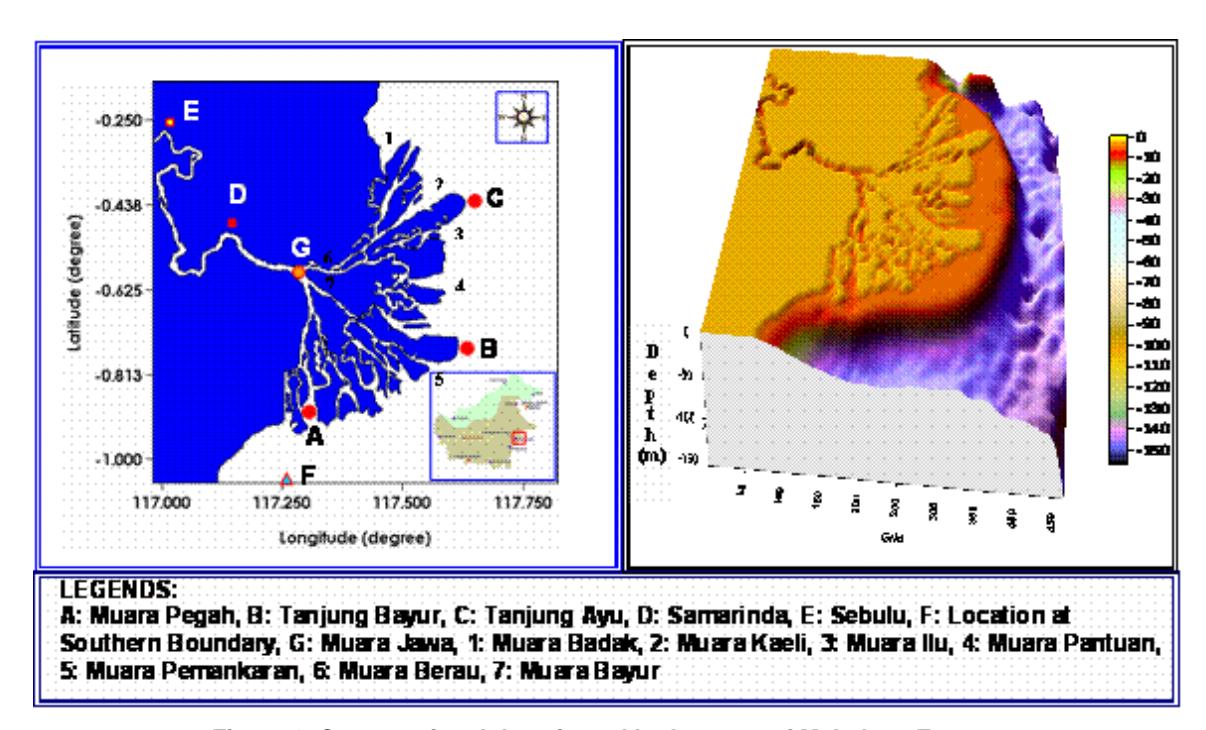
Figure 1. Computational domain and bathymetry of Mahakam Estuary (Source: Dishidros TNI AL, 2003)
obtain a better understanding of suspended sediment distribution of turbid coastal water of the Mahakam Delta and to investigate its variability.
4. Results and Discussions
4.1. Model verification
4.1.1 Hydrodynamic model
For model verification, the simulated water surface elevation is compared to that of field measurements at Muara Jawa (marked G in Figure 1), which is carried out by Tuijnder (2003) from IMAU (Institute for Marine and Atmospheric Research Utrecht), Utrecht University, the Netherlands. The verification results of water elevation at that place can be seen in Figure 3. From the figure, it is shown that the model predicts the free surface elevation quite well, mainly for the tidal phases, but the amplitude smaller in the order of less than 0.3 m.
Current velocities are complement of the tidal elevation. Figure 4(a) shows comparison of the predicted and measured surface velocity component in x direction (U) of Tuijnder (2003) in the period of 30 June - 8 July 2003 at Muara Jawa (marked G in Figure 1). Generally, one can see that the simulated surface velocity shows a good agreement with that of the measured one, mainly for the tidal current phases. However, the magnitude of predicted results is weaker, with a mean error of about 39.73 %. The difference between the predicted and measured results is probably caused by the estimation of the effect of the bottom friction which does not reproduce adequately the nonlinear interaction of the extremely strong tidal currents with the bottom topography. In addition, the inaccurate discharge rate from surrounding rivers may also contribute to the error of prediction.
4.1.2 Sediment transport model
In this study, the simulated suspended concentration of cohesive sediment is compared to that of field measurements at Muara Jawa (marked G in Figure 1) carried out by Tuijnder (2003) and is also compared to the field data of Budhiman (2004).
Figure 4(b) shows comparison of the predicted and measured suspended concentration of Tuijnder (2003) in the period of 30 June - 8 July 2003 at Muara Jawa (marked G in Figure 1, at depth of about 4 m). As can be seen, model results agree well with the general trend of the measured data. In general, the agreement between the numerically simulated and the measured concentration is reasonably encouraging, with a mean error of about 38.74 %. The difference between the model results and the field data is probably due to the inaccurate definition of the sediment source from the Mahakam River. The inaccurate discharge rate of the suspended sediment from the river and the assumption of homogenous cohesive sediment in the computational domain can be other sources of inaccurate prediction.
Meanwhile, the comparison of suspended sediment concentration between the predicted and the measured results of Budhiman (2004) in the period of 3 - 5 July 2003 at several stations is shown in Figure 5. One can
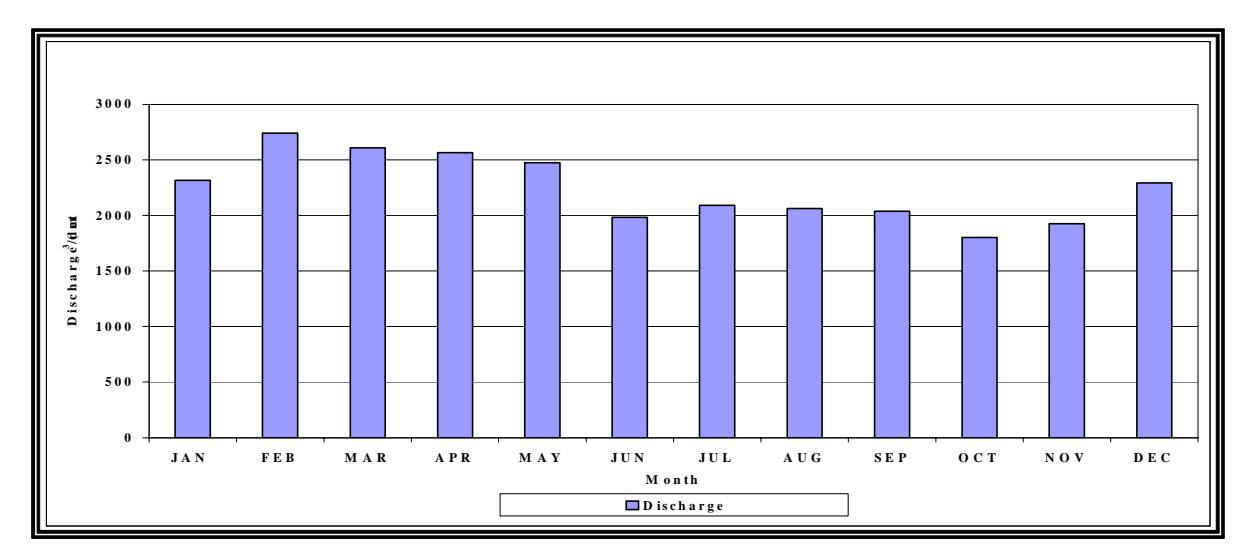
Figure 2. Mean monthly discharge of the Mahakam River based on data of 1993-1998 (Source: Research Institute for Water Resource Development, the Ministry of Public Works, Indonesia, 2003)
see, from the Figure 5, the simulation results show a good agreement with the measured data, with a mean error of about 19.05 %.
4.2 Simulation results
4.2.1 Surface water circulation pattern
Figure 6 shows tide- and river discharge-driven circulation at depth of 0.5 m for spring ebb and flood condition in January and October, respectively. Tidal elevation at Muara Jawa (marked G in Figure 1) was chosen as the reference time of the flood and ebb condition. The figure clearly shows the existence of currents that flow back and forth representing flood and ebb conditions. At spring ebb condition (Figures 6a and 6b), the currents coming from the Mahakam River flow into the Makassar Strait through river and tidal channels that exist in the Estuary of Mahakam Delta. Otherwise, at spring flood condition (Figures 6c and 6d) they flow into the Mahakam River. The river discharges clearly influence the circulation. The river discharge in January is stronger than that in October. Consequently, one can observe that at spring ebb condition there is an increase of the magnitude of the currents in January compared to that in October (Figures 6a and 6b). In addition, it is found that the currents coming from the Mahakam River flow into the Makassar Strait mainly through Muara Pegah (marked A in Figure 1).
4.2.2 Sediment concentration distribution pattern
Figure 7 shows distribution of predicted sediment concentration at depth of 0.5 m in January (7a and 7b), in April (7c and 7d), in July (7e and 7f), and in October (7g and 7h) for spring and neap ebb condition, respectively.
From the Figure 7, one can see that the suspended
cohesive sediment discharged to the Makassar Strait from the Mahakam River is mainly transported southward, namely through the Muara Jawa and the Muara Pegah (marked G and A in Figure 1, respectively).
The one-year simulation of suspended sediment distribution shows that the sediments seems to spread farthest in February and reach minimum distance of distribution in October in accordance with the monthly sediment discharge of the Mahakam River.
The magnitude of the currents during spring tide is stronger that that during the neap one and as a consequence it results in the greatest bed erosion. Hence, the suspended sediment concentration during spring tide is higher that that during the neap one.
4.2.3 Correlation between the river discharges and the suspended sediment concentration
Figure 8a shows correlation between the Mahakam River discharges and the suspended sediment concentration (SSC) at Muara Pegah (marked A in Figure 1) for spring ebb condition. Meanwhile, Figure 8b shows correlation values between the Mahakam River discharges and the SSC at Muara Pegah, Muara Jawa, Muara Pantuan, Muara Kaeli, and Tanjung Bayur (marked G, A, 4, 2, and B in Figure 1, respectively) for spring and neap tides.
From the figures, one can see that there is a strong correlation between the Mahakam River discharges and the SSC, namely the stronger river discharges exist, the higher SSC will occur. The correlation values between the Mahakam River discharges and the SSC at Tanjung Bayur (marked B in Figure 1) are smaller than those at the other regions (Figure 8b). Therefore, at Tanjung Bayur (marked B in Figure 1),
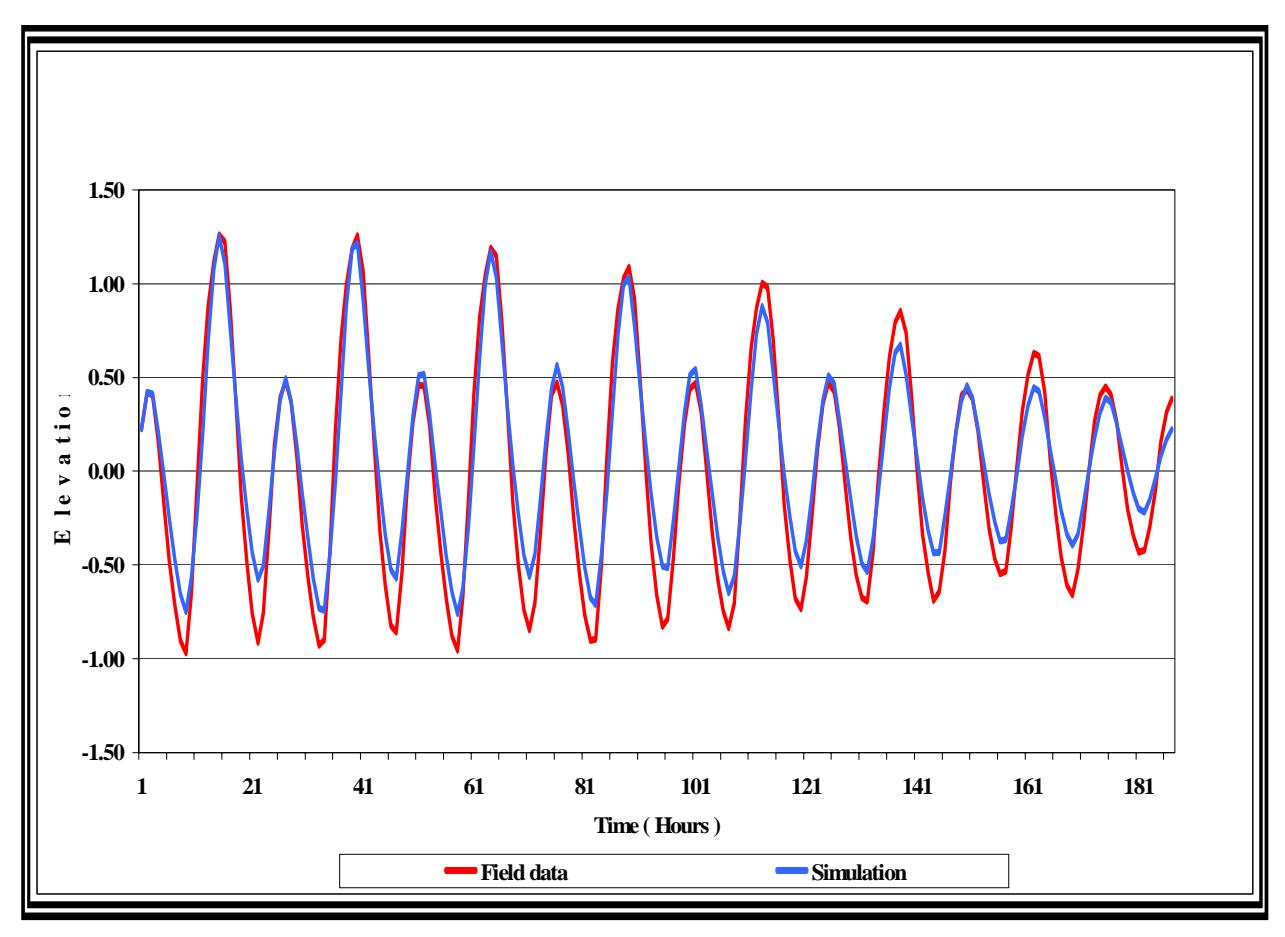
Figure 3. Sea level comparison between the simulation results and field data of IMAU in the period of 30 June 2003 to 8 July 2003 at Muara Jawa (marked G in Figure 1)
strong tidal current is more dominant to cause the high SSC compared to the suspended sediment discharges from the Mahakam River.
4.2.4 Correlation between the river discharges and distances of turbidity front
Correlation between the Mahakam river discharges and distances of turbidity front from Muara Pegah (marked A in Figure 1) towards the Makassar Strait for neap ebb condition can be seen in Figure 9. In this study, the SSC of about 150 mg/l was chosen as the reference value to determine the turbidity front. From the Figure 9, it is found that at the region there is a strong correlation between the Mahakam River discharges and the distance of the turbidity front, namely the stronger river discharges exist, the farther distance of turbidity front will be.
The simulation results in Figure 9 show that the maximum distance of the turbidity front of about 18.6 km occurs in February, while the minimum one of about 13.2 km occurs in October. The correlation values between the Mahakam River discharges and the distances of the turbidity front from the Muara Pegah
(marked A in Figure 1) are r =0.74 (for spring ebb condition ), r = 0.96 (for neap ebb condition ), r = 0.22 (for spring flood condition), and r = 0.76 (for neap flood condition). As can be seen from the calculated correlation values, the ebb conditions are more dominant on increasing the distance of the turbidity front because the river discharge-driven currents flow in the same direction to the tide-driven circulation during the ebb conditions.
To obtain a better understanding of the variation of turbidity front distances from Muara Jawa to Muara Pegah (marked G – A in Figure 1, respectively), we made the vertical profile of suspended sediment concentration. Figures 10a and 10b show distribution of the suspended sediment concentration in transect along the Muara Jawa – Muara Pegah during neap ebb condition in January and in October, respectively. The simulation results in Figures 10a and 10b show that the high suspended sediment concentration is increasing with distance from Muara Jawa to Muara Pegah in February than that in October. In this condition, the maximum distance of the turbidity front of about 30 km occurs in February, while the minimum one of about 17 km occurs in October.
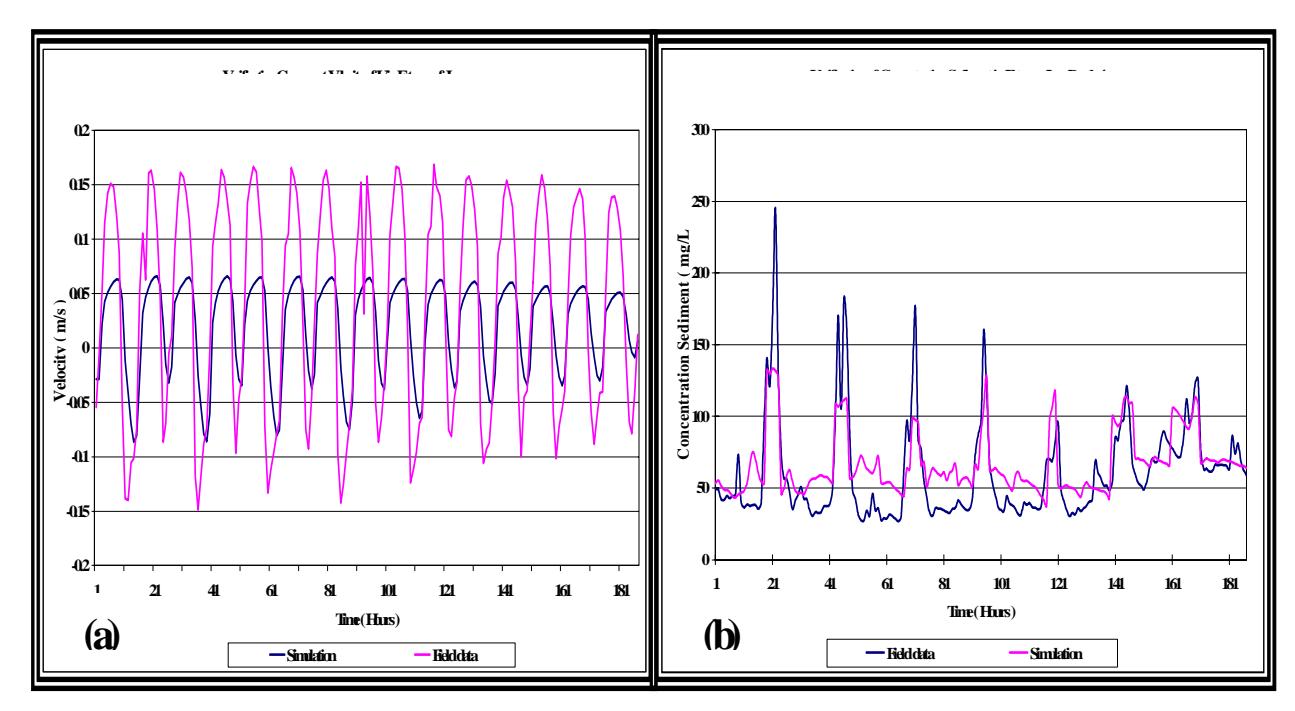
Figure 4. Model verification of (a) velocity components in x direction (U); (b) suspended sediment concentration at depth of about 4 m between the simulation results and field data of IMAU in the period of 30 June 2003 to 8 July 2003 at Muara Jawa (marked G in Figure 1).
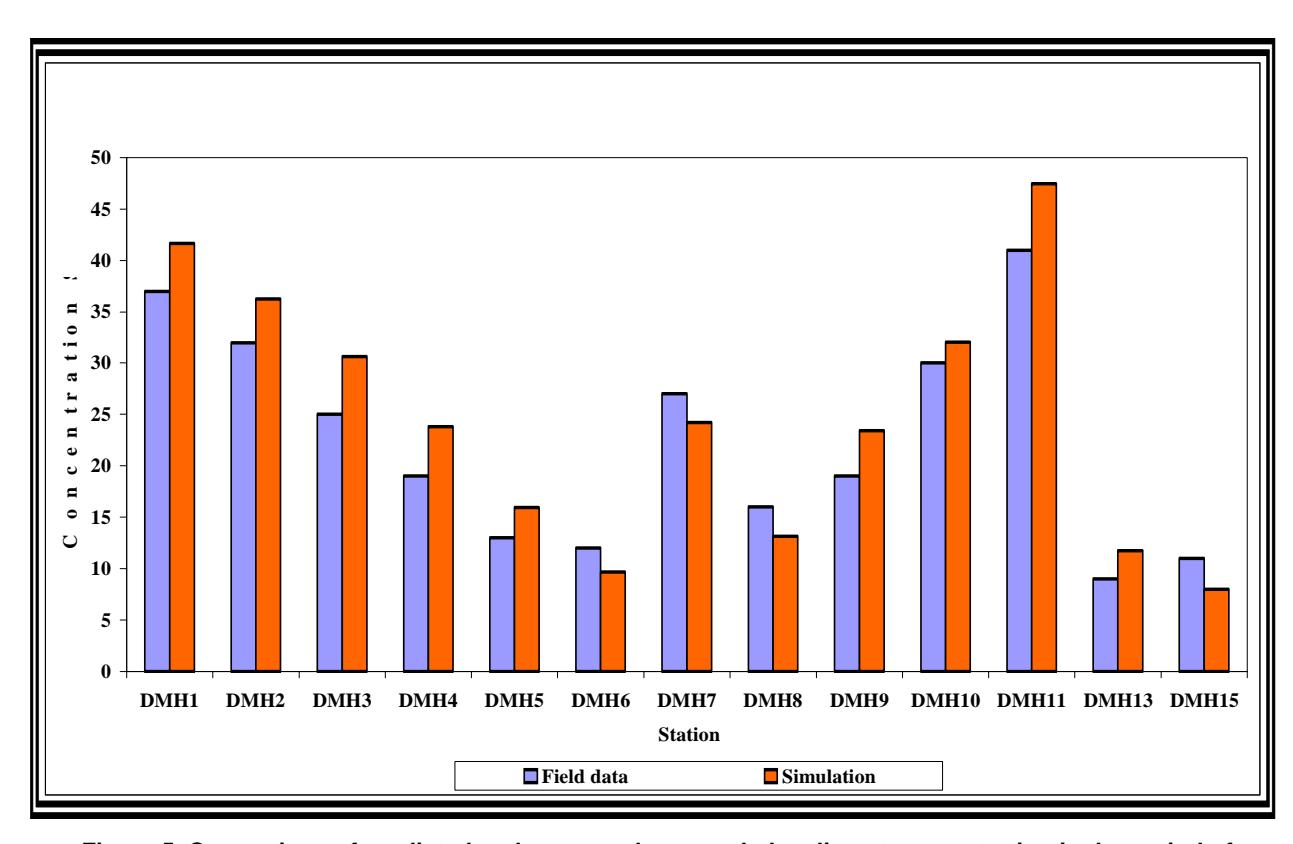
Figure 5. Comparison of predicted and measured suspended sediment concentration in the period of 3 - 5 July 2003 at several stations (Source of the measured data: Budhiman, 2004)
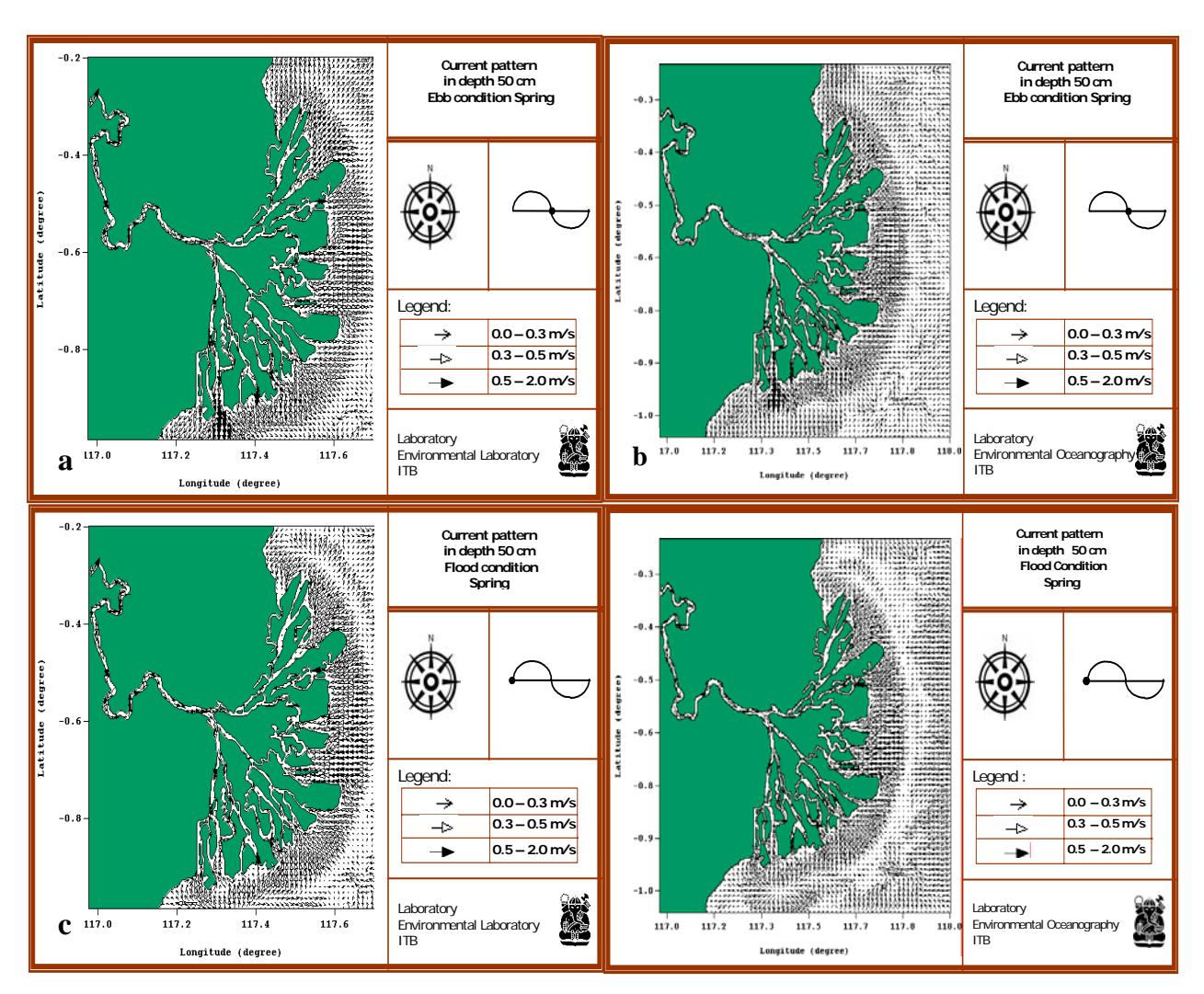
Figure 6. Tide-and River Discharge-driven circulation at depth of 0.5 m for spring ebb condition in (a) January; (b) October; and for spring flood condition in (c) January; (d) October
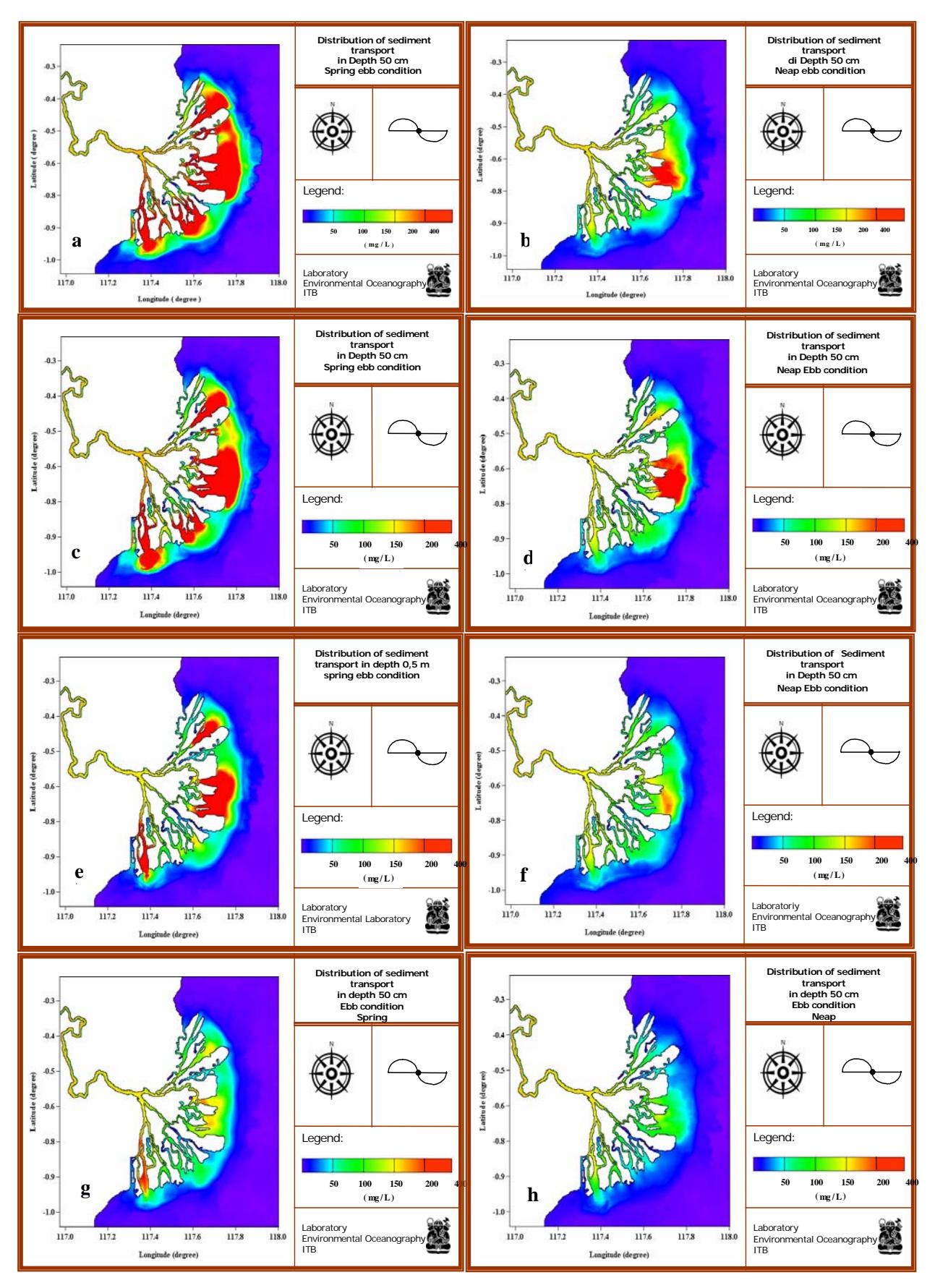
Figure 7. Predicted sediment concentration distribution at depth of 0.,5 m in January (a and b), in April (c and d), in July (e and f), and in October (g and h) for spring and neap ebb condition, respectively
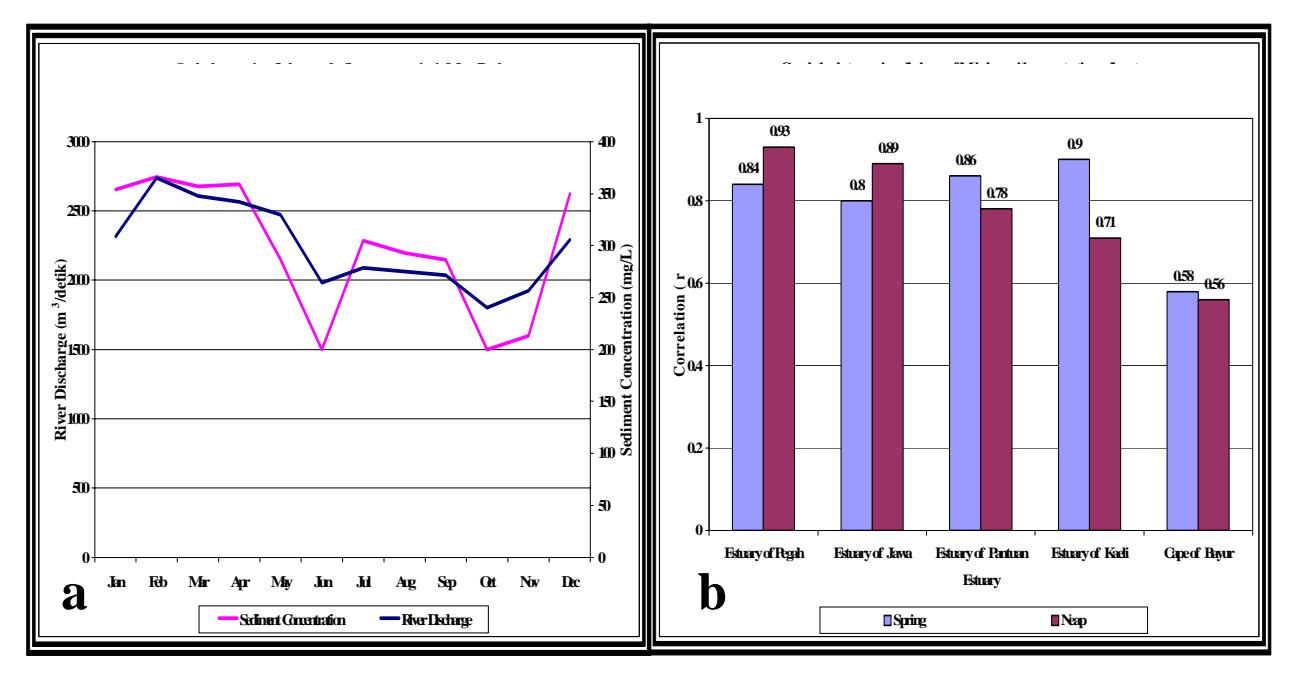
Figure 8. (a). Correlation between the Mahakam River discharges and the suspended sediment concentration (SSC) at Muara Pegah (marked A in Figure 1) for spring ebb condition: (b), Correlation values between the Mahakam River discharges and the SSC at Muara Pegah, Muara Jawa, Muara Pantuan, Muara Kaeli, and Tanjung Bayur (marked G, A, 4, 2, and B, respectively) for spring and neap tides
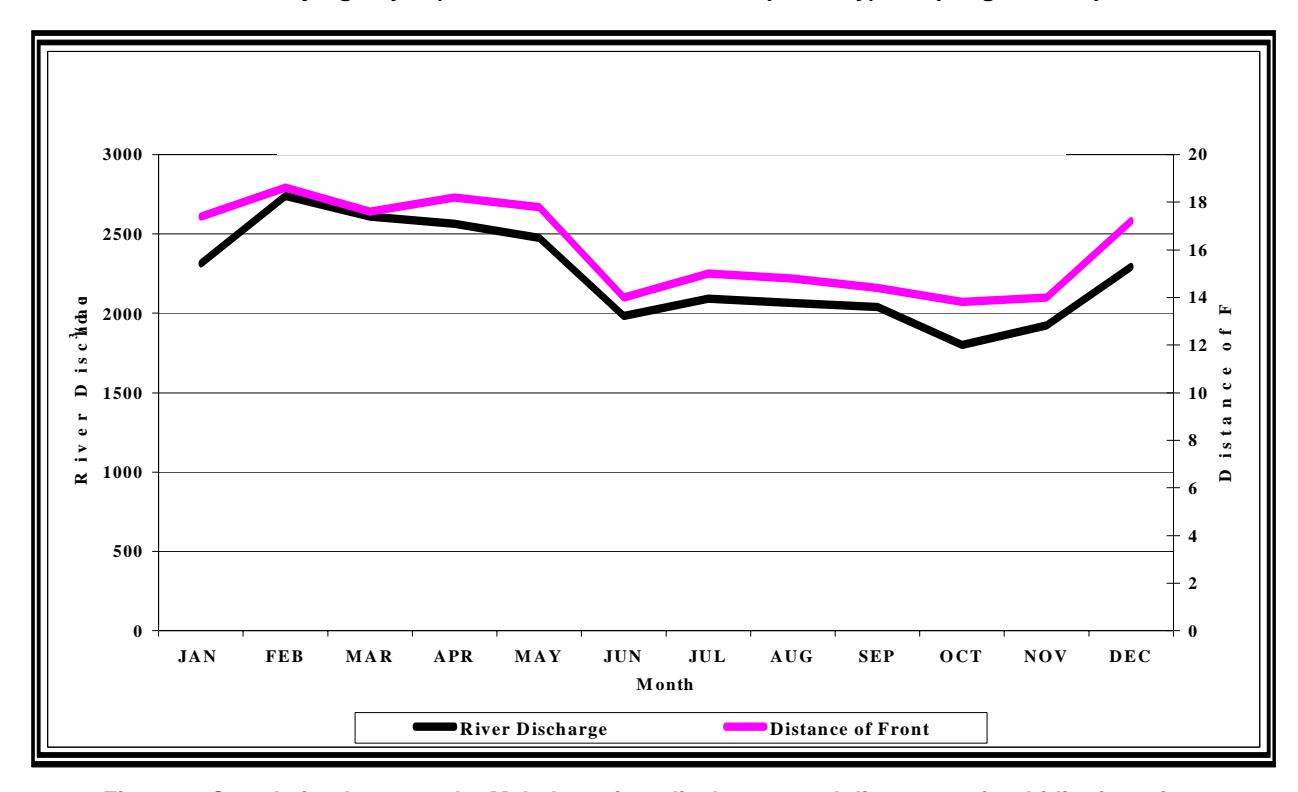
Figure 9. Correlation between the Mahakam river discharges and distances of turbidity front from Muara Pegah (marked A in Figure 1) towards the Makassar Strait for neap ebb condition
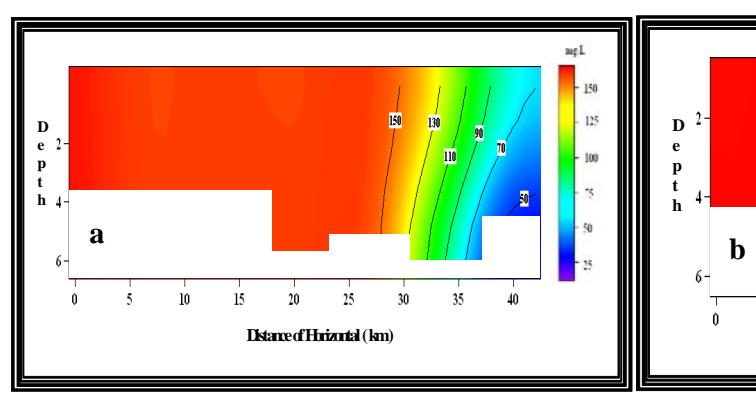
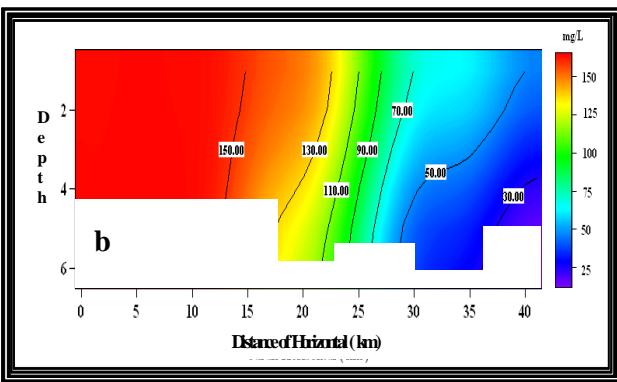
Figure 10. Suspended sediment concentration in transect along Muara Jawa – Muara Pegah (marked G – A in Figure 1) at neap ebb condition; (a).in January, (b). in October.
5. Conclusions
The coupled 3D hydrodynamics and sediment transport model called ECOMSED has been applied to predict suspended cohesive sediment fluxes in the Estuary of Mahakam Delta whose environment has been rapidly changing due to the development of its coastal area, such as development of extensive aquaculture (shrimp ponds), deforestation upstream locations, and conversion of mangrove forest. This causes many hazardous situations such as catastrophic beach erosion and disrupted navigation because of the excess of sediment materials.
The application of the model to the Mahakam Estuary showed that tides and seasonal variation of river discharges are the main causes of variations in the SSC in this area. At spring tide, the SSC is higher that that during the neap one due to the stronger current. Meanwhile, during the neap tide, river channels of this region have higher SSC because of the ebb current and river discharge.
The one-year simulation of suspended sediment distribution shows that the suspended cohesive sediment is mainly transported southward, namely through the Muara Jawa and the Muara Pegah (marked G and A in Figure 1, respectively) and seems to spread farthest in February and reach minimum distance of distribution in October. The investigation of correlation between the river discharges and the SSC at some areas shows that the river discharge less influences the SSC at Tanjung Bayur (marked B in Figure 1) compared to the other locations.
In general, the coupled 3D hydrodynamics and sediment transport model used in this study is able to simulate suspended sediment transport in the Mahakam delta waters. The application of the model to the area can also be extended to predict the morphological processes, namely bed level changes and beach erosion. As an extension of this research program, these kinds of studies are currently being conducted.
6. Acknowledgements
We gratefully acknowledge the support from the Ministry of Research and Technology of Republic of Indonesia for funding this research under grants of RUT-XI.