

D. M. Priyantha Wedagama
Department of Civil Engineering, Faculty of Engineering, Udayana University Bukit Jimbaran - Bali, Indonesia 80361, E-mail: priyantha.wedagama@gmail.com
Abstrak
Prioritas penanganan jalan merupakan salah satu tugas berat dan penting yang dihadapi oleh pengambil keputusan pada pemerintah daerah. Pada kenyataannya, penentuan penanganan jalan dapat dilihat sebagai permasalahan pengambilan keputusan yang melibatkan banyak kriteria yang bersifat kompleks. Metode proses hirarki analitik (AHP) telah banyak digunakan untuk menentukan bobot kriteria di dalam penentuan prioritas penanganan jalan. Akan tetapi karena keragu-raguan merupakan hal yang lazim terjadi di dalam pengambilan keputusan, maka teknik fuzzy dapat dikombinasikan ke dalam metode AHP. Pada studi ini penentuan prioritas penanganan jalan kabupaten untuk kondisi rusak berat di Kabupaten Badung, Bali dilakukan dengan metode Fuzzy AHP (FAHP) dan TOPSIS. Data penelitian digunakan dari studi sebelumnya di Kabupaten Badung yang menggunakan metode AHP dan SK.NO.77/KPTS/Db/1990. Metode FAHP digunakan untuk pembobotan kriteria sedangkan metode TOPSIS digunakan untuk penentuan urutan ruas jalan yang akan mendapat penanganan. Metode AHP memberikan hasil yang sedikit berbeda dengan metode SK.NO.77/KPTS/Db/1990. Sementara itu FAHP dan metode TOPSIS memberikan hasil yang sama dengan metode SK.NO.77/KPTS/Db/1990. Hal ini kemungkinan karena kedua metode tersebut menggunakan volume lalu lintas sebagai faktor yang paling berpengaruh pada penelitian ini. FAHP dan metode TOPSIS lebih disarankan untuk digunakan di dalam penentuan prioritas penanganan jalan di Kabupaten Badung.
Kata-kata Kunci: Penanganan Jalan, Fuzzy AHP, TOPSIS.
1. Introduction
Determining road handling priority is one of crucial assignments faced by the decision makers in the local government in Indonesia. Regencial government has long been using 'SK.No.77/KPTS/Db/1990' of Directorate General of Highways to determine regencial road handling priority (Karya, 2004, Suyasa, 2008). This method, however, only considers the Annual
Daily Traffic and Net Present Value (NPV) to determine such priority. In fact, determining road handling priority is considered as a complicated multicriteria decision making problem. This also should include road conditions, local policies, economic factors, local people objectives and regional discrepancies adjustment.
In order to incorporate these criteria, the Analytic Hierarchy Process (AHP) was used in a previous study to determine regencial road handling in Badung regency (Suyasa, 2008). A complex decision problem was structured as a hierarchy and broken down into a hierarchy of interrelated decision elements (criteria, sub-criteria and alternatives). In this past study, the criteria included road conditions, traffic volumes, economic factors and policies and 16 of sub criteria (refers to Figure 4). Questionnaires were distributed amongst 20 experts to obtain their preferences regarding Badung regencial road handling priority. Pairwise comparisons for each level considering goal of these experts are carried out using a nine-point scale. Each pairwise comparison (PC) corresponds into an estimate of the priorities of the compared decision makers requirements (Saaty, 1986). The study summarised that the AHP is effective and more logical than 'SK.NO.77/KPTS/Db/1990' in determining regencial road handling priority.
The AHP method however, may not completely reveal a way of human thinking. This is because the decision makers typically tend to express interval judgments rather than sorts of single numeric values. The PC ratios in the AHP are in crisp real numbers and decisions always consisting vagueness and variety of meaning. The descriptions of decision makers are typically linguistic and vague. Fuzziness and vagueness are typical in many decision-making problems, so that fuzzy sets could be integrated with the pairwise comparison as an extension of the AHP (Chang, 1996 in Vahidnia, et.al, 2008, Kwong & Bai, 2002). Fuzzy AHP (FAHP) method should be able to tolerate vagueness. Therefore, FAHP is qualified in describing a human's judgement of vagueness when complex multi-attribute decision making problems are considered (Dagdeviren, et.al, 2009, Erensal et al., 2006 in Vahidnia, et.al, 2008).
Meanwhile, Technique for Order Preference by Similarity to Ideal Solution (TOPSIS) is one of valuable multi atribute decision making techniques which is straightforward and easy to apply. This technique was firsly proposed by Hwang & Yoon in 1981 (Ballı & Korukoğlu, 2009). Using this technique, the best alternative would be the one that is nearest to the positive ideal solution and farthest from the negative ideal solution (Ballı & Korukoğlu, 2009). The positive ideal solution is a solution that maximizes the benefit criteria and minimizes the cost criteria, whereas the negative ideal solution maximizes the cost criteria and minimizes the benefit criteria. In other words, the positive ideal solution is made of all best values of reasonable criteria, while negative ideal solution containing all worst values of realistic criteria (Wang & Elhag, 2006 in Dagdeviren, et.al, 2009).
In this paper, regencial road handling priority is examined with Fuzzy Analytic Hierarchy Process (FAHP) and TOPSIS method for Badung Regency as the study case. FAHP is employed to determine the weights of the criteria by decision makers and subsequently TOPSIS method is used to determine rankings of road links. Numerical study and comparison with the previous study result are also illustrated.
2. Theoretical Review
2.1 Fuzzy sets and fuzzy numbers
Fuzzy set theory was firstly introduced by Zadeh in 1965 (Ballı & Korukoğlu, 2009, Dagdeviren, et.al, 2009, Vahidnia, et.al, 2008). This was developed due to the rationality of uncertainty because of imprecision or vagueness. These fuzzy set and fuzzy logic are able to represent vague data and are able to develop a powerful mathematical model particularly for uncertain systems in industry, nature and humanity; and facilitators for common-sense reasoning in decision making in the absence of complete and accurate information.
Meanwhile, the classical set theory is based on the basic concept of set consisting either a member or not a member. In this theory, however a sharp, crisp, and explicit difference occurs between a member and nonmember for any well defined set of entities. In addition, there is a very accurate and obvious limit to suggest whether an entity fits into the set. On the other hand, many real-world applications cannot be explained with classical set theory. A fuzzy set is an extension of a crisp set. Crisp sets take account only full membership or non-membership at all, while fuzzy sets tolerate partial membership.
Fuzzy numbers are the particular categories of fuzzy quantities. A fuzzy number is a fuzzy quantity M that correspond to a simplification of a real number r. Logically, M(x) would be able to use as an indicator for measuring the closeness of M(x) estimating r. A fuzzy number M is a convex normalized fuzzy set. A fuzzy number is normally described with a given real numbers interval in which each grade of membership values between 0 and 1. Using different fuzzy numbers is allowed depending on the situation. Triangular and trapezoidal fuzzy numbers are commonly used in practice. In fact, it is more common to work with triangular fuzzy numbers (TFNs) since they have straightforward calculation. In addition, they are more practical to describe work processing in a fuzzy environment. A triangular fuzzy number, M is hown in Figure 1 (Ballı & Korukoğlu, 2009):
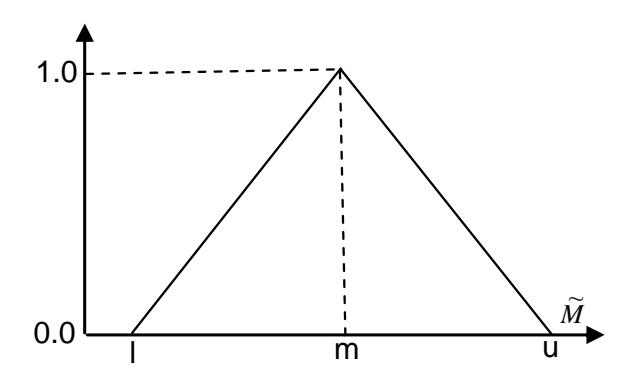
Figure 1. A Triangular Fuzzy Number, M
TFNs are characterised with three real numbers, stated as (l,m,u). The parameters l, m and u respectively, specify the smallest possible, the most promising and the largest possible values illustrating a fuzzy event. Their membership functions are described as follows:
\[\mu(x / \widetilde{M}) = \begin{cases} 0, & x < 1, \\ (x-1)/(m-1), & 1 \le x \le m \\ (u-x)/(u-m), & m \le x \le u \\ 0, & x > u \end{cases}\]
There are many operations on triangular fuzzy numbers. However, within this paper only describes three basic operations. Presume there are two positive triangular fuzzy numbers consisting \((l_1, m_1, u_1)\) and \((l_2, m_2, u_2)\) so that :
(1)
\[(l_1, m_1, u_1) + (l_2, m_2, u_2) = (l_1 + l_2, m_1 + m_2, u_1 + u_2)\] (2)
\[(l_1, m_1, u_1) \cdot (l_2, m_2, u_2) = (l_1 \cdot l_2, m_1 \cdot m_2, u_1 \cdot u_2)\] (3)
\[(l_1, m_1, u_1)^{-1} \approx (\frac{1}{u_1}, \frac{1}{m_1}, \frac{1}{l_1})\] (4)
2.2 Fuzzy AHP
Assume \(X = \{x_1, x_2, x_3, \ldots, x_n\}\) is an object set and \(G = \{g_1, g_2, g_3, \ldots, g_n\}\) is a goal set. According to fuzzy extent analysis (Chang, 1992 in Balli and Korukoglu, 2009), each object is taken and extent analysis for each goal, \(g_i\), is conducted, respectively. Therefore, m extent analysis values for each object can be obtained, with the following signs:
\[M^1\] \(g_i\), \(M^2\) \(g_i\),......\(M^mg_i\), for \(i=1,2,\).....,\(n\), where \(M^jg_i\) \((j=1,2,....,m)\) all are TFNs. The extent analysis method can be described into several steps as follows (Chang, 1992 in Balli and Korukoglu, 2009):
Step 1: The value of fuzzy synthetic extent with respect to the i<sup>th</sup> object is defined as:
\[S_{i} = \sum_{j=1}^{m} M_{g_{i}}^{j} \otimes \left[ \sum_{i=1}^{n} \sum_{j=1}^{m} M_{g_{i}}^{j} \right]^{-1}\] (5)
In order to obtain \(\sum_{j=1}^{m} M_{g_j}^{j}\), the fuzzy addition operation of m extent analysis values is carried out for a particular matrix such that
\[\sum_{j=1}^{m} M_{g_i}^{j} = \left(\sum_{j=1}^{m} l_j, \sum_{j=1}^{m} m_j, \sum_{j=1}^{m} u_j\right)\] (6)
and to obtain \(\left[\sum_{i=1}^{n}\sum_{j=1}^{m}M_{g_{i}}^{j}\right]^{-1}\) the fuzzy addition operation of \(M^{J}g_{i}(j=1,2,...,m)\) values is conducted such that
\[\sum_{i=1}^{n} \sum_{j=1}^{m} M_{g_i}^{j} = \left( \sum_{i=1}^{n} l_i, \sum_{i=1}^{n} m_i, \sum_{i=1}^{n} u_i \right)\] (7)
The inverse of the vector above is calculated such that:
\[\left[\sum_{i=1}^{n}\sum_{j=1}^{m}M_{g_{i}}^{j}\right]^{-1} = \left(\frac{1}{\sum_{i=1}^{n}u_{i}}, \frac{1}{\sum_{i=1}^{n}m_{i}}, \frac{1}{\sum_{i=1}^{n}l_{i}}\right)\](8)
Step 2: Since \[\widetilde{M}_1 = (l_1, m_1, u_1)\] and \(\widetilde{M}_2 = (l_2, m_2, u_2)\)
are two triangular fuzzy numbers, the degree of possibility of \(M_2=(l_2,\ m_2,\ u_2)\geq M_1=(l_1,\ m_1,\ u_1)\) defined as :
\[V(\widetilde{M}_{2} \ge \widetilde{M}_{1}) = \sup_{y \ge x} \left[ \min \left( \mu_{\widetilde{M}_{1}}(x), \mu_{\widetilde{M}_{2}}(y) \right) \right]\](9)
and can be equivalently expressed as follows:
\[V(\widetilde{M}_2 \ge \widetilde{M}_1 = \operatorname{hgt}(\widetilde{M}_2 \cap \widetilde{M}_1 = \mu_{M_2}(d)) \quad (10)\]
\[= \begin{cases} 1, & \text{if } m_2 \ge m_1 \\ 0, & \text{if } l_1 \ge u_2 \\ \frac{l_1 - u_2}{(m_2 - u_2) - (m_1 - l_1)}, & \text{otherwise} \end{cases}\](11)
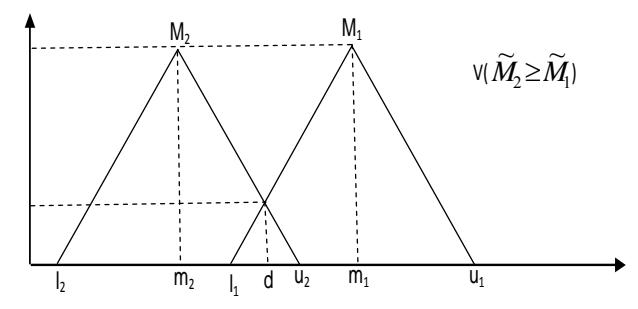
Figure 2. The Intersection between M<sub>1</sub> and M<sub>2</sub>
Figure 2 describes Equation (11) in which d is the ordinate of the highest intersection point D between
\[\mu_{M_1}\] and \(\mu_{M_2}\).
In order to compare \(M_1\) and \(M_2\), both the values of V
( \[\widetilde{M}_1 \geq \widetilde{M}_2\] and V ( \(\widetilde{M}_2 \geq \widetilde{M}_1\) ) are required.
Step 3: The degree possibility for a convex fuzzy number to be greater than k convex fuzzy \(M_i\) (\(i = 1,2, \ldots, k\)) numbers can be defined as:
\[V(M \ge M_1, M_2, .....M_k) = V[(M \ge M_1) \text{ and } (M \ge M_2)\]
and.....\((M \ge M_k)] = \min V[(M \ge M_i), i = 1,2...,k\)
(12)
On the assumption that \(d(A_i) = \min V(S_i \ge S_k)\) for k = 1,2,..., \(k \ne i\), the weight vector is given by
\[W' = (d'(A_1), d'(A_2), \dots d'(A_n))^{T}\] (13)
where \(A_i = (i=1,2,....n)\) are n elements.
Step 4: The normalised weight vectors are obtained as follows:
\[W = (d(A_1), d(A_2), \dots d(A_n))^{T}\] (14)
where W is a non-fuzzy number and is computed for each main and sub criteria.
Considering W as an input for Equation (16), subsequently TOPSIS method is performed to determine the final ranking of the alternatives.
2.3 TOPSIS
TOPSIS method is computed into several steps as follows (Hwang & Yoon, 1981 in Balli and Korukoglu, 2009):
Step 1. Decision matrix is normalised using Equation (15):
\[\mathbf{r}_{ij} = \frac{w_{ij}}{\sqrt{\sum_{j=1}^{J} w_{ij}^{2}}} \quad \mathbf{j} = 1, 2, 3, \dots, \mathbf{J} \; ; \; \mathbf{i} = 1, 2, 3, \dots, \mathbf{n}\] (15)
Step 2. Weighted normalised decision matrix is created:
\[v_{ij} = W_{ij} * r_{ij}, j = 1,2,3,...,J; i = 1,2,3,....n\] (16)
Step 3. Positive ideal solution (PIS) and negative ideal solution (NIS) are determined:
\[A^* = \{v_1^*, v_2^*, \dots, v_n^*\}\] maximum values (17)
\[A^{-} = \{v_{1}^{-}, v_{2}^{-}, \dots, v_{n}^{-}\}\] minimum values (18)
Step 4. Positive ideal solution (PIS) and negative ideal solution (NIS) are determined:
\[d_i^* = \sqrt{\sum_{j=1}^n (v_{ij} - v_j^*)^2}\], j = 1,2,...................................
\[d_i^- = \sqrt{\sum_{j=1}^n (v_{ij} - v_j^-)^2}\], \(i = 1, 2, \dots, J\) (20)
Step 5. The closeness coefficient of each alternative is calculated:
\[CC_i = \frac{d_i^-}{d_i^* + d_i^-}, i = 1, 2, \dots, J\] (21)
Step 6. By comparing CC<sub>i</sub> values, the ranking of alternatives are determined.
3. Case Study Area and Data Descriptions
Badung regency is located in the Southern Bali as shown in Figure 3. It has has a total roads lengths of 703.32 km (Statistics of Bali Province, 2008). Of these roadways, about 80% are regencial roads while the rest including provincial roads and national roads. Total regencial roads lengths are 552.17 km.
In the previous study (Suyasa, 2008), the problem was firstly divided into a hierarchy of interconnected decision elements including goal, the main and sub criteria and alternatives for road handling priority. The decision team making consisting 20 experts including government officers, legislators and local prominent persons in Badung regency were involved in constructing these decision elements (refers to Figure 4). Secondly, comparison analyses were performed by constructing pairwise comparison matrices for the main and sub criteria. The matrices were based on a standarised comparison scale of 9 levels (refers to Table 1). All weight vectors were multiplied with the weight coefficient of the element at a higher level. These procedures were repeated upward for each level, until the top of the hierarchy was reached (Saaty, 1986). As the results, all weight vectors of main and sub criteria were presented in Figure 4.
Figure 3. Case study area – Badung Regency
Meanwhile, the secondary data obtained from the Department of Public Works of Badung regency presented the condition scores of all sub criteria for each alternative road link. The judgements therefore, were conducted for each alternative (road link). Once the overall weight coefficient for each alternative is obtained so that the highest weight coefficient value is the best alternative.
The past study also used 'SK.NO.77/KPTS/Db/1990' of Directorate General of Highways in determining road handling priority in Badung regency. This method, however, only considers the Annual Daily Traffic and Net Present Value (NPV) to determine such road handling priority. The priority is determined by combining between traffic volumes and road surface conditions on each road link reflecting the expected benefit value of each road link upgrading.
This value is then compared with the operating costs of each road link upgrading to assess the project feasibility. Top priority is put on a road link with the highest NPV. If several road links have the same NPV then top priority will be put on a road link with the lowest operating cost. Financially, the lower the operating cost the higher the profit so that priority is put more on a road link with lower operating cost.
Meanwhile, the secondary data has also identified that 7, 41, 210, and 154 road links were under severe, damage, moderate and good conditions respectively. This paper however, limits the analysis of road handling priority only to those road links under severe circumstances. The results are shown in Table 2. Based on that table, both AHP and 'SK.NO.77/KPTS/Db/1990' suggested the same priority for road link numbers 90, 252, 165 and 353 and different priority for the rest.
Table 1. Scale used for Pairwise Comparison (PC)
| Intensity of Importance | Qualitative Definition | Explanation |
|---|---|---|
| 1 | Equally important | Two activities contribute equally to the objective |
| 3 | Moderately more important | Experience and judgements slightly favour one activity over another |
| 5 | Strongly more important | Experience and judgements strongly favour one activity over another |
| 7 | Very strongly more important | An activity is favoured very strongly over another and dominance is demonstrated in practice |
| 9 | Extremely more important | The evidence favouring activity over another is of the highest possible order of affirmation |
| 2,4,6,8 | Intermediate values | When compromise is needed |
| Reciprocals of the above numbers | ciprocal value when compared with with i. | If activity i has one of the above assigned to it when compared with activity j, then j has the re |
Source: Saaty (1986)
Table 2. Road handling priority using AHP and SK.NO.77/KPTS/Db/1990
| No. | Road Link Number | Road Links | AHP | SK.NO.77/KPTS/Db/1990 |
|---|---|---|---|---|
| 1. | 248 | Pererenan – Padang Lenjong | 3 | 1 |
| 2. | 400 | Beringkit – Gegadon | 1 | 2 |
| 3. | 153 | Br. Pempatan Sembung – Balangan | 2 | 3 |
| 4. | 90 | Gerih – Latu | 4 | 4 |
| 5. | 252 | Balangan – Desa Sembung | 5 | 5 |
| 6. | 165 | Ungasan – Pura Massuka | 6 | 6 |
| 7. | 353 | Kantor Kades Cemagi - Kuburan | 7 | 7 |
Source: Suyasa (2008)
4. Numerical Study
Data from previous study (Suyasa, 2008) are adopted to determine Badung regencial road handling priority for seven road links under severe circumstances. These seven road links shown in Table 2 are evaluated under a fuzzy environment. The hierarchic view for the main and sub criteria and their weights applied for Badung regencial road handling priority are shown in Figure 4.
An AHP's crisp pairwise comparison matrix (refers to Table 1) used in the previous study (Suyasa, 2008) is fuzzified using the TFN f = (l,m,u) shown in Table 3. Both lower (l) and upper (u) bounds present the uncertain range that may occur within the expert's preferences. These TFNs are used to build the comparison matrices (both the main and sub criteria) of FAHP based on pairwise comparison technique. With reference to experts's preferences, a fuzzy pairwise comparison matrix (PCM) for the main criteria is shown in Table 4.
Table 3. Conversion of Crisp PCM – Fuzzy PCM
| Crisp PCM value | Fuzzy PCM value | Crisp PCM value | Fuzzy PCM value |
|---|---|---|---|
| 1 | (1,1,1) if diagonal | 1/1 | (1/1,1/1,1/1) if diagonal |
| (1,1,3) otherwise | (1/3,1/1,1/1) otherwise | ||
| 2 | (1,2,4) | 1/2 | (1/4,1/2,1/1) |
| 3 | (1,3,5) | 1/3 | (1/5,1/3,1/1) |
| 5 | (3,5,7) | 1/5 | (1/7,1/5,1/3) |
| 7 | (5,7,9) | 1/7 | (1/9,1/7,1/5) |
| 9 | (7,9,11) | 1/9 | (1/11,1/9,1/7) |
Source: Prakash (2003)
Table 4. A Fuzzy PCM (Main Criteria)
| A | B | C | D | |
|---|---|---|---|---|
| A | (1,1,1) | (1,2,4) | (1,1,3) | (1,2,4) |
| B | (1/4,1/2,1/1) | (1,1,1) | (1,2,4) | (1,3,5) |
| C | (1/3,1/1,1/1) | (1/4,1/2,1/1) | (1,1,1) | (1,3,5) |
| D | (1/4,1/2,1/1) | (1/5,1/3,1/1) | (1/5,1/3,1/1) | (1,1,1) |
Where:
A = Road condition B = Traffic Volume C = Economic Factors D = Policies
Using Equation (5) the synthesis values for the main criteria were determined as follows:
ScA = \[(4.00, 6.00, 12.00) \otimes (1/35, 1/20, 1/11.48) = (0.114,\]
ScB = \((3.25, 6.50, 11.00) \otimes (1/35, 1/20, 1/11.48) = (0.093,\)
\[ScC = (2.58, 5.50, 8.00) \otimes (1/35, 1/20, 1/11.48) = (0.074,\]
\[ScD = (1.65, 2.00, 4.00) \otimes (1/35, 1/20, 1/11.48) = (0.047,\]
Using Equation (11) these fuzzy values were compared and obtained as follows:
\[V(ScA \ge ScB) = 0.97\], \(V(ScA \ge ScC) = 1.00\), \(V(ScA \ge\)
\[V(ScB \ge ScA) = 1.00, V(ScB \ge ScC) = 1.00, V(ScB \ge\]
\[V(ScC \ge ScA) = 0.96\], \(V(ScC \ge ScB) = 0.92\), \(V(ScC \ge\)
\[V(ScD \ge ScA) = 0.54\], \(V(ScD \ge ScB) = 0.53\), \(V(ScD \ge\)
Using Equation (12) priority weights were computed as follows:
\[d'(A) = min(0.97, 1.00, 1.00) = 0.970\]
\[d'(B) = min (1.00, 1.00, 1.00) = 1.000\]
\[d'(C) = min(0.96, 0.92, 1.00) = 0.920\]
\[d'(D) = min(0.54, 0.53, 0.61) = 0.530\]
Based on the results above, weight vectors W' were equal to (0.970, 1.000, 0.920, 0.530) and the normalised weight vectors W were equal to (0.284, 0.292, 0.269, 0.155). Weight vectors for the sub criteria were computed in the same way as with the main criteria. All weight vectors including for the main and sub criteria are shown in Figure 5.
Based on Figure 5, traffic volume is the main criteria with the highest weight and subsequently is followed by road conditions, economic factors and policies. In other words, under fuzzy environment traffic volume is the most important factors to determine Badung Regencial road handling priority, in particular for these seven roads under severe circumstances. On the other hand, the AHP method concluded that road conditions was the most significant factor to determine such road handling priority and subsequently was followed by traffic volume, economic factors and policies (refers to Figure 4).
Meanwhile, priority values of the seven road links for each sub criteria are shown in Table 5. These values are normalised using Equation (15). The normalised weight matrix is constructed by multiplying each value with their weights. All weighted values that form each sub criteria are accumulated and the weight of each main criteria are multiplied as shown in Table 6.
Table 5. Priority values of the seven road links
| Road Link Number | A11 | A12 | A13 | A14 | A15 | A16 | B11 | B12 | B13 | B14 | B15 | C11 | C12 | D11 | D12 | D13 | |
|---|---|---|---|---|---|---|---|---|---|---|---|---|---|---|---|---|---|
| 248 | 0.182 | 0.111 | 0.143 | 0.143 | 0.111 | 0.143 | 0.204 | 0.230 | 0.217 | 0.223 | 0.217 | 0.222 | 0.066 | 0.143 | 0.200 | 0.333 | |
| 400 | 0.182 | 0.111 | 0.143 | 0.143 | 0.111 | 0.143 | 0.148 | 0.177 | 0.166 | 0.184 | 0.166 | 0.190 | 0.107 | 0.143 | 0.200 | 0.333 | |
| 153 | 0.091 | 0.222 | 0.143 | 0.143 | 0.222 | 0.143 | 0.218 | 0.199 | 0.188 | 0.117 | 0.188 | 0.190 | 0.247 | 0.143 | 0.000 | 0.000 | |
| 90 | 0.182 | 0.111 | 0.143 | 0.143 | 0.111 | 0.143 | 0.198 | 0.104 | 0.154 | 0.146 | 0.154 | 0.152 | 0.203 | 0.143 | 0.200 | 0.000 | |
| 252 | 0.091 | 0.222 | 0.143 | 0.143 | 0.222 | 0.143 | 0.102 | 0.147 | 0.139 | 0.194 | 0.139 | 0.139 | 0.077 | 0.143 | 0.200 | 0.333 | |
| 165 | 0.136 | 0.111 | 0.143 | 0.143 | 0.111 | 0.143 | 0.103 | 0.107 | 0.101 | 0.088 | 0.101 | 0.089 | 0.277 | 0.143 | 0.000 | 0.000 | |
| 353 | 0.136 | 0.111 | 0.143 | 0.143 | 0.111 | 0.143 | 0.026 | 0.037 | 0.035 | 0.048 | 0.035 | 0.019 | 0.022 | 0.143 | 0.200 | 0.000 | |
| Where: | |||||||||||||||||
| A11 | = | Hollow Road | B11 | = | Light Truck | C11 | = | B/C Ratio (NPV) | |||||||||
| A12 | = | Subsided Road | B12 | = | Medium & Heavy Trucks | C12 | = | Construction Costs | |||||||||
| A13 | = | Cracked Road | B13 | = | Light Vehicle | ||||||||||||
| A14 | = | Tyre Path | B14 | = | Bus | D11 | = | District Level | |||||||||
| A15 | = | Road Shoulder | B15 | = | Motorcycle | D12 | = | Regencial Level | |||||||||
| A16 | = | Road Gradient | D13 | = | Provincial Level |
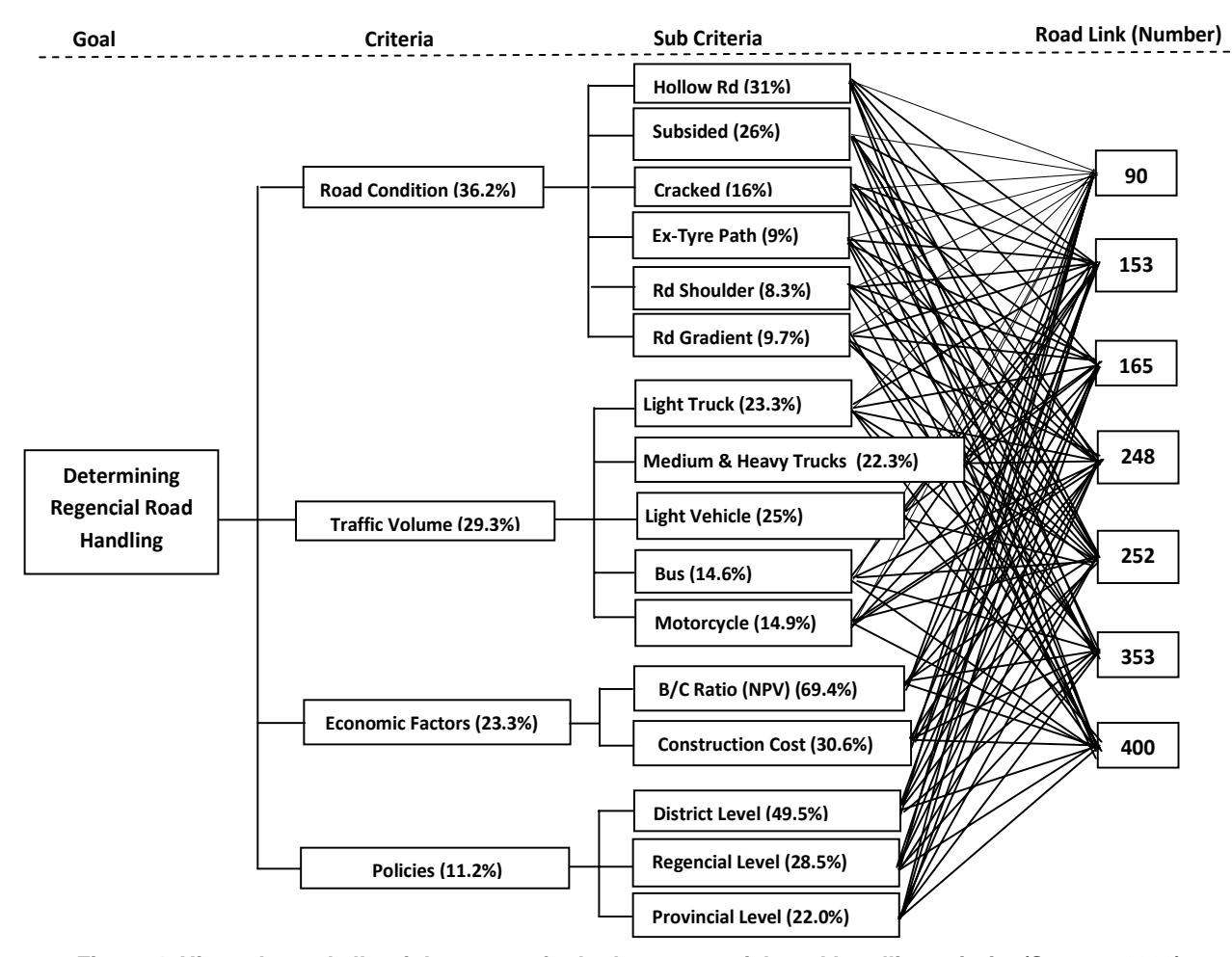
Figure 4. Hierarchy and all weight vectors for badung regencial road handling priority (Suyasa, 2008)
Table 6. Total weighted values of main criteria
| Road Link Number | A | В | C | D |
|---|---|---|---|---|
| 248 | 0.024 | 0.038 | 0.027 | 0.019 |
| 400 | 0.024 | 0.029 | 0.026 | 0.019 |
| 153 | 0.026 | 0.032 | 0.034 | 0.005 |
| 90 | 0.024 | 0.027 | 0.027 | 0.013 |
| 252 | 0.026 | 0.025 | 0.019 | 0.019 |
| 165 | 0.022 | 0.018 | 0.024 | 0.005 |
| 353 | 0.022 | 0.006 | 0.003 | 0.013 |
Where:
A = Road condition B = Trans
B = Traffic Volume
C = Economic Factors D = Policies
The final ranking of road links is determined using TOPSIS method. The positive and negative ideal solutions are determined by taking the maximum (A*) and minimum (A¯) values respectively for each criterion:
\(A^* = (0.027, 0.038, 0.034, 0.018)\) and \(A^- = (0.022, 0.006, 0.003, 0.005)\).
Using equation (19) and (20), the distances of each firm from positive ideal solution (PIS) and negative ideal solution (NIS) are computed. The closeness cofficient (CC) of each road link is obtained using Equation (21). Finally, the ranking of these road links is determined with regard to CC values as shown in Table 7. Based on the previous study results (Suyasa, 2008), the final ranking of road links using AHP and 'SK.NO.77/KPTS/Db/1990' is also shown in Table 7.
The AHP method produced somewhat different priority to 'SK.NO.77/KPTS/Db/1990' method for road link numbers 248, 400 and 153 and the same priority for the rest. Interestingly, FAHP and TOPSIS method give the same result to 'SK.NO.77/KPTS/Db/1990' method. This is probably best explained by the fact that they similarly considered traffic volumes as the most significant factor. FAHP and TOPSIS method however, use four main criteria (refers to Figure 5), while SK.NO.77/KPTS/Db/1990 only considers the Annual Daily Traffic and Net Present Values in determining road handling priority. FAHP and TOPSIS method therefore, are considered more comprehensive than SK.NO.77/KPTS/Db/1990 method. In addition, FAHP and TOPSIS method have considered vagueness and fuzziness of the decision makers compared to the AHP. FAHP and TOPSIS method therefore, are preferred to the AHP and SK.NO.77/KPTS/Db/1990 method.
Further examinations however, are required to obtain comprehensive conclusions regarding the application of these methods. This may be carried out by investigating more on regencial road handling priority under different circumstances (i.e. good, moderate and damage) in Badung regency using FAHP and TOPSIS method.
5. Conclusions
- 1. In this study, road handling priority for seven road links under severe circumstances in Badung Regency is determined using FAHP with TOPSIS method. For evaluation purpose, the results of this study are compared with the previous study for the same set data. FAHP found that traffic volume was the most important factors to determine handling priority for road links under severe circumstances in Badung regency. On the other hand, the AHP suggested road conditions as the most significant factor in determining such road handling priority.
- 2. The past study results using the AHP and 'SK.NO.77/KPTS/Db/1990' method are compared with those of FAHP and TOPSIS method. The AHP method gave a somewhat different result to 'SK.NO.77/KPTS/Db/1990' method. On the other hand, FAHP and TOPSIS method give the same result to 'SK.NO.77/KPTS/Db/1990' method. This is probably best explained by the fact that they similarly considered traffic volumes as the most significant factor. In fact, FAHP and TOPSIS method have considered vagueness and fuzziness of the decision makers compared to the AHP and SK.NO.77/KPTS/Db/1990 in determining handling priority for road links under severe circumstances in Badung regency. FAHP and TOPSIS method therefore, are preferred to the AHP and SK.NO.77/KPTS/Db/1990 method in determining road handling priority in Badung regency. Further study however, is required to obtain comprehensive conclusions regarding the application of these methods. This may be carried out by investigating more on regencial road handling priority under different circumstances (i.e. good, moderate and damage) in Badung regency using FAHP and TOPSIS method.
Table 7. Ranking of road links for road handling
| No. | Road link Number | Road Link | AHP | SK.NO.77/KPTS/Db/1990 | Fuzzy AHP & TOPSIS | CC Values |
|---|---|---|---|---|---|---|
| 1. | 248 | Pererenan – Padang Lenjong | 3 | 1 | 1 | 0.859 |
| 2. | 400 | Beringkit – Gegadon | 1 | 2 | 2 | 0.744 |
| 3. | 153 | Br. Pempatan Sembung – Balangan | 2 | 3 | 3 | 0.736 |
| 4. | 90 | Gerih – Latu | 4 | 4 | 4 | 0.684 |
| 5. | 252 | Balangan – Desa Sembung | 5 | 5 | 5 | 0.587 |
| 6. | 165 | Ungasan – Pura Massuka | 6 | 6 | 6 | 0.473 |
| 7. | 353 | Kantor Kades Cemagi - Kuburan | 7 | 7 | 7 | 0.144 |
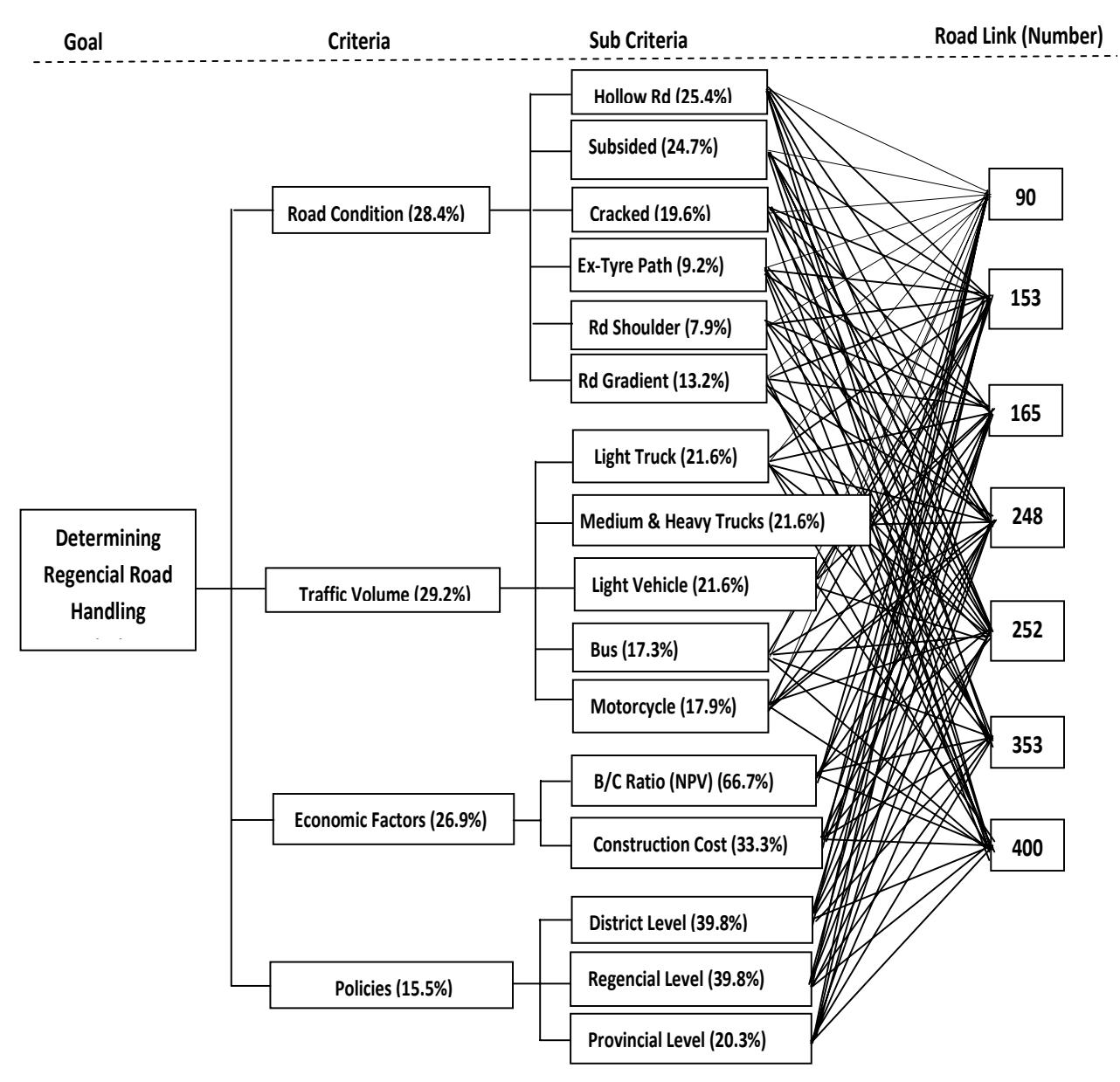
Figure 5. All weights vectors obtained by using FAHP