

I Gusti Bagus Siladharma
Department of Civil Engineering, Faculty of Engineering, Udayana University, Bukit Jimbaran - Bali Email: siladharma@gmail.com
Abstrak
Pemecah gelombang ambang rendah, termasuk pemecah gelombang tenggelam, dapat dipergunakan sebagai pelindung pantai dari serangan gelombang. Stuktur dengan ambang lebar ini dibangun sejajar pantai dengan puncak berada pada muka air atau sedikit di bawahnya. Fungsi utama dari bangunan ini adalah melindungi pantai dari gelombang dengan cara mereduksi energi gelombang datang atau sebagai penghalang gelombang. Bangunan ini berfungsi dengan baik dengan meredam sebagian energi gelombang. Transmisi gelombang pada pemecah gelombang ambang rendah tumpukan batu sudah banyak diteliti dan menghasilkan beberapa formula yang dihasilkan dari tes 2 dimensi. Gelombang yang datang menyudut terhadap struktur tidak diperhitungkan karena sangat terbatasnya penelitian transmisi gelombang dalam kondisi 3D. Menggunakan data 3D dari Seabrook (1997), analisis dilakukan untuk interaksi gelombang-struktur dan formula empiris transmisi gelombang diturunkan. Interaksi gelombang-struktur dalam model 3D lebih komleks dari model 2D. Kekompleksan dalam model 3D termasuk adanya proses difraksi pada ujung-ujung pemecah gelombang, Hasil penelitian menunjukkan bahwa tinggi puncak relatif, tinggi gelombang relatif, dan lebar puncak merupakan parameter yang sangat berpengaruh terhadap proses transmisi Rumus empiris diturunkan berdasarkan analisis statistik. Rumus transmisi gelombang memasukkan parameter-parameter yang merepresentasikan proses-proses fisik seperti fluktuasi muka air, yang berkorelasi dengan gelombang pecah, overtopping gelombang, disipasi akibat gesekan permukaan, dan transmisi gelombang melalui bangunan.
Kata-kata Kunci: Transmisi gelombang, gelombang serong, pemecah gelombang ambang rendah.
1. Introduction
In recent years a number of low-crested structures, including submerged structures, have been built. These structures with a wide crest can be built parallel to the shoreline and the crest is set up below or a little above the water level. The primary function of this structure is to protect the coastal area from wave action by reducing the incoming waves or by acting as a barrier to sea waves. It has been noted that low crested rubble mound structures where the crest is above or slightly below water level, are more likely to be economical over traditional mound structures. Abdul Khader and Rai (1980) noted that submerged structures are less
costly to construct and maintain than conventional structures. Ahrens (1984) described a reef type structure as possibly the optimum structure for many situations. It is also noted that low crested structure with infrequent overtopping is considerably less expensive per unit length than the traditional structure since the cost of a rubble mound increases rapidly with the height of the crest. Losada et al., (1992) stated that submerged mound structures have been used for shoreline protection because of their low cost and aesthetics.
The design of low crested coastal structures requires that the expected amount of wave transmission and reflection be determined with confidence. Wave runup and overtopping of the structures will cause wave transmission. There is a decrease in the transmitted energy because of reflection and dissipation of some of the transmitted wave energy.
Numerous studies on stability and wave transformation at low crested structures or obstacles have been conducted in the past. As regards wave transformation, early studies involved regular waves at submerged structures (Dick and Brebner, 1968; Dattatri et al., 1978). Also, Petti and Ruol (1991, 1992), Liberatore and Petti (1992), and Driscoll et al., (1992) have investigated submerged structures using irregular waves. Beji and Battjes (1993) investigated the propagation of irregular waves over a submerged obstacle. Losada and Giménez-Curto (1981), and Ahrens and Titus (1985) have described run-up and run-down phenomena on various smooth and rough slopes due to regular and irregular waves. Results show that run-up on smooth slopes is mostly influenced by the surf similarity parameter; while on a rough permeable slope run-up is influenced by friction and permeability of the armour layer.
The behaviour of many types of structures in transmission and reflection was examined by many researchers in different ways; bring many results and expressions (e.g. Dick and Brebner 1968, Dattatri et al,. 1978, Abdul Khader and Rai 1980, Seelig 1980, Alssop 1983, van der Meer 1991, van der Meer and Daemen 1994 and d'Angremond et al., 1996). Seabrook and Hall (1998) tested rubblemound submerged breakwaters with variation in the relative freeboard and the relative crest width within a wide range. Most of the results suggested that water depth and structure geometry are the most significant parameters affecting wave transmission. Wave characteristics (wave height and period) and structure permeability was also found to affect wave transmission.
Mostly the above studies were conducted using 2D test model. Effect of 3D model has been rarely involved on the existing formula. In some implementations, low crested structures are not parallel to the coast, therefore wave attack is not perpendicular to the structures
resulting more complex wave transformation processes. The complex, three dimensional wave-structure interactions include diffraction of the wave passing by the tip of the structure. When wave travel into the breakwater, it separates the wave zone (in front of the breakwater) and the sheltered zone (behind the breakwater). There will be transfer of energy across the zone where wave crests will spill into the sheltered zone and troughs will be filled with water from the sheltered zone. This phenomenon does not occur in the 2D tests where the test model is usually constructed across the entire width of the test flume.
This paper discusses the development of empirical model for wave transmission at low crested breakwaters under wave action based on three-dimensional test data conducted by Seabrook (1997). The procedure adopted here was to carry out the regression analysis on a number of primary parameters in order to assess their relative effects on wave transmission. In cases when the primary variables could not represent the relationship well, a number of secondary parameters were then derived on the basis of the initial analysis. The primary parameters are the dimensionless parameters derived using dimensional analysis such as the relative crest height, hc/Hi, the relative crest width, B/Hi, the wave steepness, Hi/Lo, etc. The secondary parameters are combination of primary parameters that are assumed to be important in these processes. Therefore, the development of the design equations undertaken by assuming the wave transmission is due to the primary parameters and their combinations.
The development of the models considered here use both linear and non-linear forms of equations. A linear model was firstly used in order to determine the relationship between dependent and independent variables. In cases where wave transmission could not be described using the linear model, a non-linear model was used in order to evaluate the relative importance and relationship (direct or inverse) between independent and the dependent variables.
2. Brief Description of the 3D Testing by Seabrook (1997)
The tests were undertaken in the wave basin at Queen's University Coastal Engineering Research Laboratory, Kingston, Ontario, Canada. The basin is approximately 30m x 35m x 1.2m and equipped with a wave generator that is capable of generating regular and irregular waves. The model was constructed on the flat floor of the basin and a concrete beach was developed at the slope of 1:10 to dissipate wave energy and to minimize the reflection from the testing area. The breakwaters were constructed from stones with D50c = 0.004m for the core and two layers of armour with D50a = 0.037m. Three different crest widths were modeled during the tests. A typical cross-section of the breakwater models is shown in Figure 1.
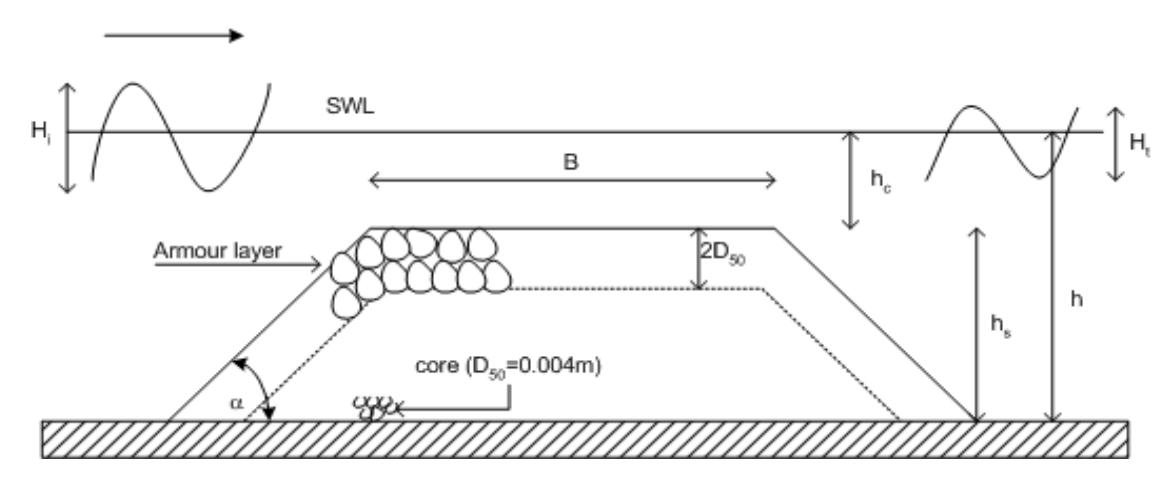
Figure 1. Cross-section of the breakwater model (not to scale)
The breakwaters were tested with incident waves at 90° and 60° to the shoreline. In order to minimize the effect of disturbances outside the testing area, waves guides were constructed perpendicular to the wave paddle, from the paddle to the beach. Eight wave probes and two velocity probes were used to measure the wave conditions. One probe was located offshore of the breakwater to define the incident waves and others were located behind the breakwater to define the wave transmission and effect of diffraction. No measurements were taken for reflected waves.
Irregular waves were used for all of the wave trains tested. The target waves were generated from a JON-SWAP spectrum with Philips constant aP = 0.0081 (Philips, 1958) and peak enhancement factor g = 3.3. The heights of targeted waves varied from 0.032m to 0.095m and the wave periods ranged from 0.95sec. to 1.98sec. All data sampling was undertaken using the GEDAP data acquisition system and was analyzed using the GEDAP data analysis package. Detail discussion of the GEDAP can be found in Miles (1989). The transmission coefficients were defined at each probe location based on the transmitted significant wave heights. The wave probe located offshore was used to define the incident wave height. A summary of the experiments including the range of specific dimensionless variables is summarized in Table 1 and the configuration of the 3D testing as shown in Figures 2 and 3. Detail description about this experiment can be found in Seabrook (1997).
3. Diffraction Phenomenon
Theoretical analysis of diffraction of sea waves by breakwaters has been presented by many researchers (e.g. Penney and Price, 1952; Dean and Dalrymple, 1984; Goda, 1985). Even for a relatively simple problem, a calculation of diffraction is quite complicated. Penney and Price investigated the diffraction process of a long straight breakwater for incident waves from different directions. The problem has been solved by assuming that the height of the waves is small compared with their wavelength, so that the small amplitude wave theory may be applied. The solution can be used for uniform water depth and perfectly reflecting structure. For being incident normally, the solution yields the wave crest pattern in the x,y plane and the distribution of the wave height throughout the affected area. When the incident waves approach at an angle to the breakwater, the wave pattern is in polar coordinates (r,j) instead of (x,y) where r is radial distance from the end and j is an angle from the breakwater (Figure 4).
When waves approaching a structure at a finite length, diffracted waves will occur at each end of the structure. The wave patterns can be developed by combining the results for semi-infinite structure diffraction at each end (Sorensen, 1993). Behind the structure, the height of waves will decrease and along the lines where the wave crests from each end meet, the highest waves will occur as a result of the summation of the heights of the two component waves from the individual diffraction. The effect of diffraction is usually characterized by a diffraction coefficient, Kd, where Kd = Hd/Hi, Hd is the diffracted height at a point of interest and Hi is the incident wave height. Diffracted height at the point of interest is affected by the radial distance, r, the angle, j, and the incident wave direction, jo.
3.1 Effect of wave direction
The effect of wave direction in the transmission process was observed using the data from probe 2 for wave direction of 90º and probe 4 of wave direction of 60º. The two probes were placed at the same position relative to the breakwater and at same distance from the breakwater. Figure 5 shows the plot of transmission coefficients, Kt, against the relative crest height, hc/Hi, for both probes 2 and 4. Plot shows that transmission coefficients from probe 2 are relatively lower than transmission coefficients of probe 4 that are in conformity with the diffraction theory. According to Penney and Price (1952) and Wiegel (1962), higher waves will occur for smaller wave directions.
Table 1. A Summary of data sets used in development of the design equation
| Variable | Expression | Range |
|---|---|---|
| The relative wave height | Hi/D50 | 0.58 - 2.64 |
| The relative crest height | hc/Hi | (-5.91) - (-0.32)* |
| The wave steepness | sop | 0.005-0.06 |
| The wave angle | jo | 60º - 90º |
| The surf similarity parameter | x | 2.66 - 9.87 |
| The relative crest width | B/Hi | 1.97 - 37.65 |
| The slope angle | cot a | 1.5 |
| The permeability of the core | P | permeable |
| The grading of material | D50a/D50c | 9.25 |
* Note: negative hc/Hi ratios indicate submerged conditions
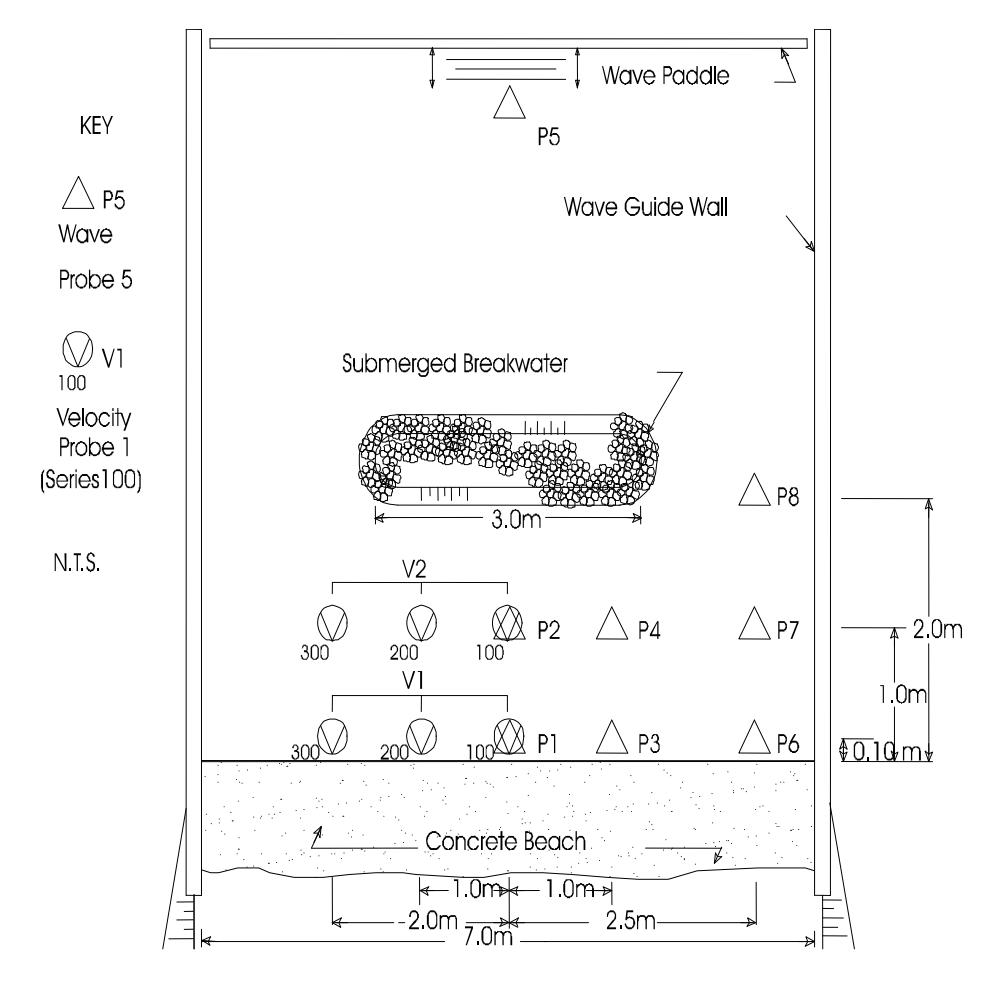
Figure 2. 3D Testing set-up at waves direction of 90º Source: Seabrook (1997)
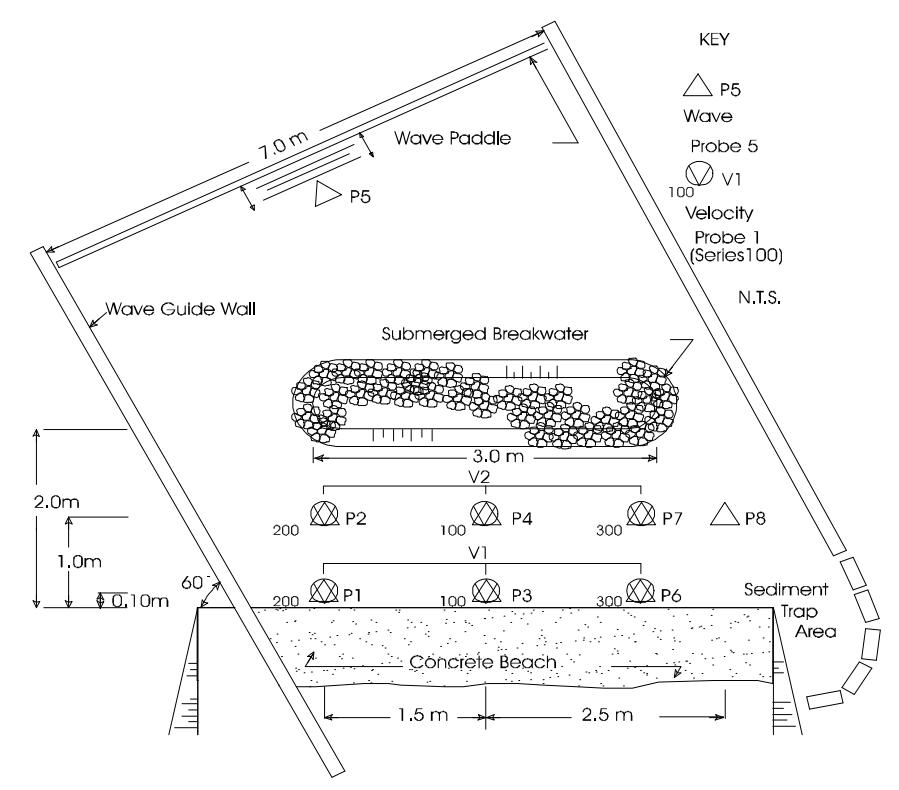
Figure 3. 3D Testing set-up at waves direction of 60º Source: Seabrook (1997)
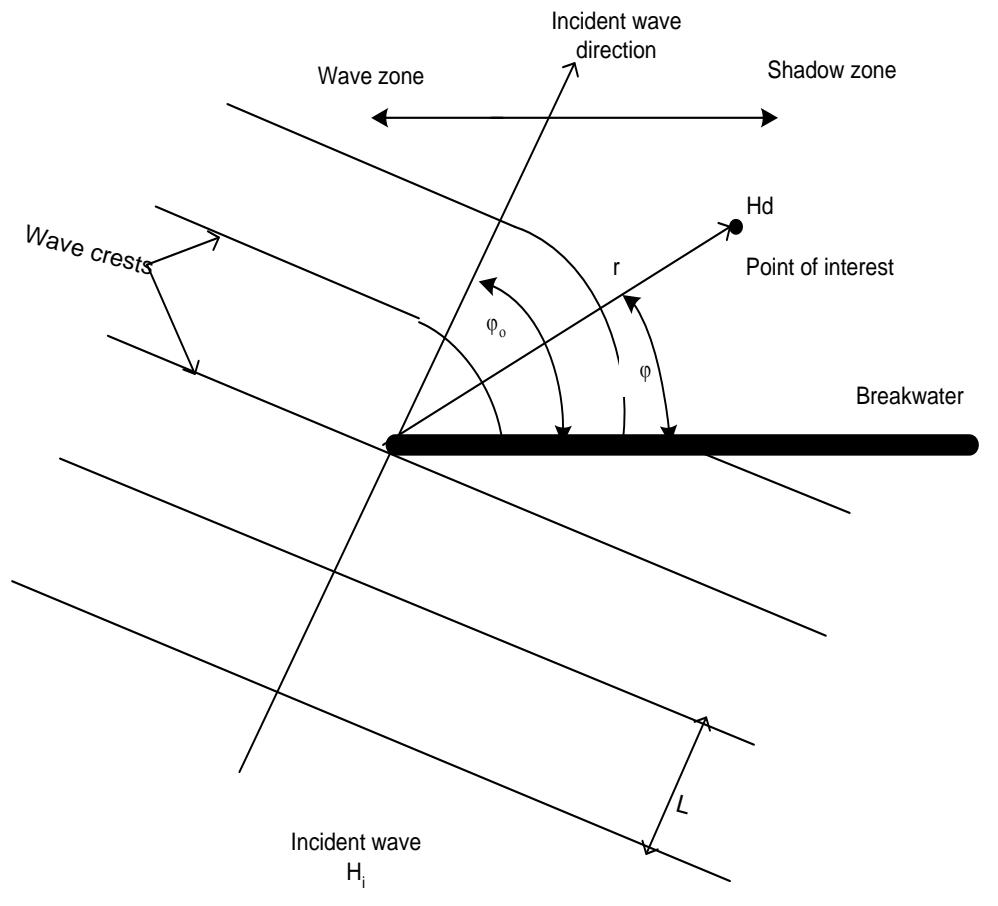
Figure 4. Wave diffraction behind a breakwater for oblique incidence of waves
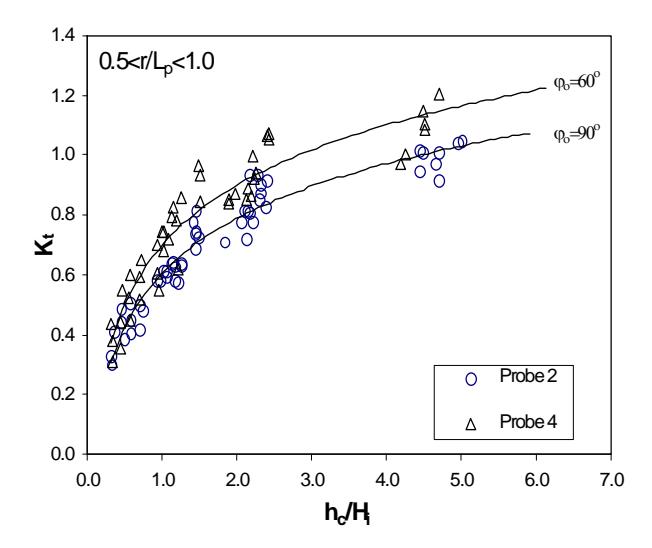
Figure 5. Effect of incident wave direction (probes 2 and 4 at the same location and distance to the breakwater)
3.2 Effect of angle of location from the breakwater
In order to evaluate the effect of angle of location of a point with reference to the breakwater, Figure 6 is plotted. Transmission coefficients calculated from probes 2 and 4 both for \(j_0 = 90^{\circ}\) wave direction are plotted against h<sub>c</sub>/H<sub>i</sub>. Probes 2 and 4 were located on the centerline of the breakwater at distances of 1m and 2m from the toe of the breakwater, respectively. A general trend can be observed that for higher values of the angle (probe 4), higher transmitted waves occur; agreeing with the theoretical results where for higher value of an angle yields to higher diffraction coefficients as well as transmission coefficients. Examining Figure 7 where transmission coefficients from probes 1 and 2 at 90° waves direction are plotted, results in higher transmission for greater angle, j. Again, this confirms the diffraction theory where for greater j, the diffraction coefficient increases, hence higher transmission.
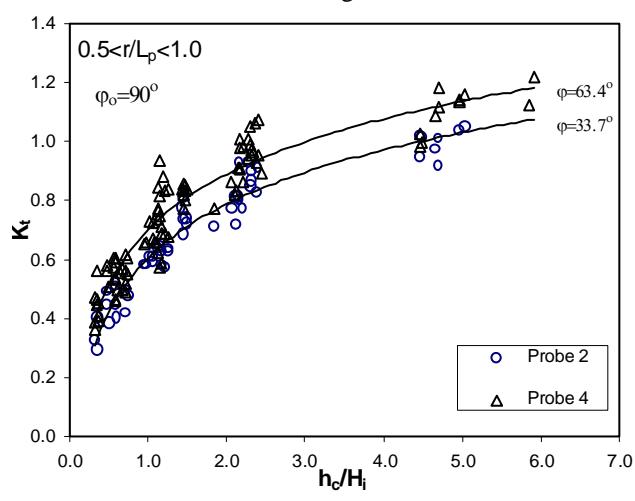
Figure 6. Effect of angle from the breakwater to the point of interest at normally incident waves (probes 2 and 4 at the same distance to the breakwater)
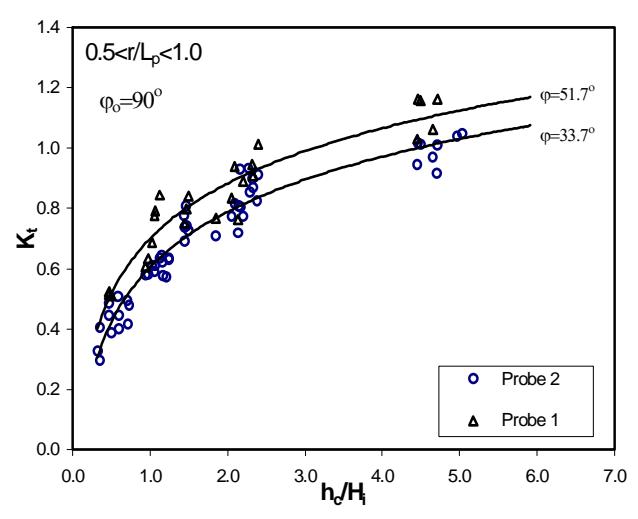
Figure 7. Effect of angle from the breakwater to the point of interest at normally incident waves (probes 1 and 2 at the center line of the breakwater)
3.3 Effect of relative radial distance, r/L<sub>n</sub>
Radial distance of a point of interest on leeward side of breakwater is a square root of \(x^2\) and \(y^2\), where x is distance in x direction and y is distance in y direction from the end of breakwater. In this region the diffracted waves tend to decrease for larger distance x and y since obvious fact that the reduction becomes more effective farther away the end. Figure 8 shows the plot of the transmission coefficients from probe 2 at 90° for two different range of relative radial distance, r/L<sub>p</sub>. It shows that the transmission coefficients for higher values of r/ L<sub>p</sub> are slightly lower than lower values of r/L<sub>p</sub>. For a given jo and j values, decreasing wave periods resulting in larger values of r/L<sub>p</sub> and decreasing of diffracted waves as noted above.
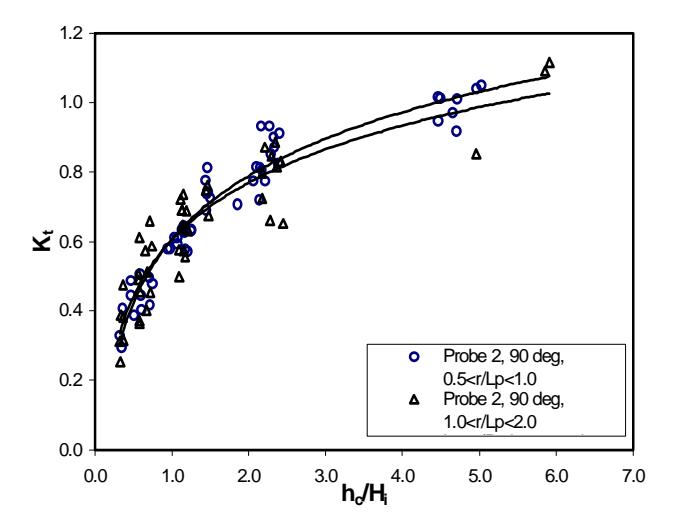
Figure 8. Effect of relative radial distance from the tip of breakwater to the point of interest at normally incident way
4. Development of Wave Transmission Model
4.1 General consideration
The considerations herein that were used in developing a relationship in this investigation include a possible range of application in the field. Some of the mechanisms and variables involved in the wave transformation, in this case wave transmission processes are water depth, wave breaking over the crest, wave overtopping, dissipation by friction, and penetration through the structures. The wave transmission processes across the breakwater can thus be described by the following dimensionless variables (detail discussion about development of the model can be found in Siladharma, 2001):
- 1. The relative crest height, \(h_c/H_i\), or \(h_c/D_{50a}\): It characterizes the role of water depth. These parameters are found to be the most important factors affecting the wave transmission mechanism over low crested breakwaters. A decrease in water depth will lead to wave breaking over the crest of the structure, thereby reducing transmission.
- 2. The relative wave height, H<sub>i</sub>/D<sub>50a</sub>: Wave transmission increases as the wave height decreases.
- 3. An internal flow parameter, \(B^2/L_pD_{50a}\): The effective flow through the structure increases as the crest width decreases. Also, bigger diameters of armour stone lead to increased void volume thus increasing the flow within the structure.
- 4. Friction over the surface of the structure: This is seen to be an important parameter affecting wave transmission on a rubble mound breakwater. The parameter H<sub>i</sub>h<sub>c</sub>/BD<sub>50a</sub> reflects the role of surface friction.
4.2 Development of the Model
The development of the model was carried out using statistical analysis. Firstly, a correlation in the data was established by plotting the transmission coefficients against dimensional and dimensionless variables. Parameters that were found to be significantly influencing the transmission process were then used to develop the model. The diffraction process seems to be significantly affecting the transmission of waves in 3D tests besides other processes appear in 2D tests (see Seabrook and Hall, 1998). Therefore diffraction process that usually occurs in 3D tests was added. It was evaluated that the incident wave direction, jo, and length, L<sub>p</sub>, radial distance, r, from the tip of the breakwater and angle, j, from the breakwater to the point of interest are all significant in influencing the diffraction process.
It was noted the 3D testing produced sometimes transmission coefficients greater than 1.0. Even though this situation is possible at site specific locations under directional spectral transformation and complex reflection and diffraction conditions, it is likely that 3D testing apparatus and analysis procedures have introduced some error into the measured K<sub>t</sub> values (Seabrook, 1997), therefore, any K<sub>t</sub> value greater than one was removed from the data set before developing the model.
Regression analysis was performed within the data sets to find the fitted parameters for predicting the values of K<sub>t</sub>. The resulting alternative design equation of the regression analysis for K<sub>t</sub> is
\[\begin{split} K_t &= -0.869 e^{\left(-\frac{h_c}{H_i}\right)} + 1.049 e^{\left(-0.003\frac{B}{H_i}\right)} - 0.026\frac{H_i h_c}{BD_{50a}} - 0.005\frac{B^2}{L_p D_{50a}} + \\ &0.003\frac{h_s}{h} \times \frac{r}{L_p} cos(\phi - \phi_o) \end{split} \tag{1}\] where Kt is the transmission coefficient, h is the water depth, hc is the depth of submergence or freeboard, hs is the structure height, Hi is the incident wave height, B is the crest width, Lp is the local wave length, D50a is the nominal diameter of armour units, r is radial distance from the tip of the breakwater to the point of interest, i is the angle from the breakwater to the point of interest and jo is the incident wave direction.
It should be noted that several other forms and combinations of variables were tested with no significant improvement in predicting Kt for the range of observa-
Figure 9 shows a relatively good fit between estimated and measured values and provides adequate answers for \(K_t\), with the squared correlation coefficient (\(R^2\)) equal to 0.854 and standard error of estimate (s) being 0.07. The equation shows physical process as related to depth of submergence, h<sub>c</sub>/H<sub>i</sub>, hence is related to wave breaking, the relative crest width, B/H<sub>i</sub>, friction by structural roughness and length, H<sub>i</sub>h<sub>c</sub>/BD<sub>50a</sub>, the internal flow resistance parameter, \(B^2/L_pD_{50a}\), and the diffraction process that is represented by the last term in the above equation.
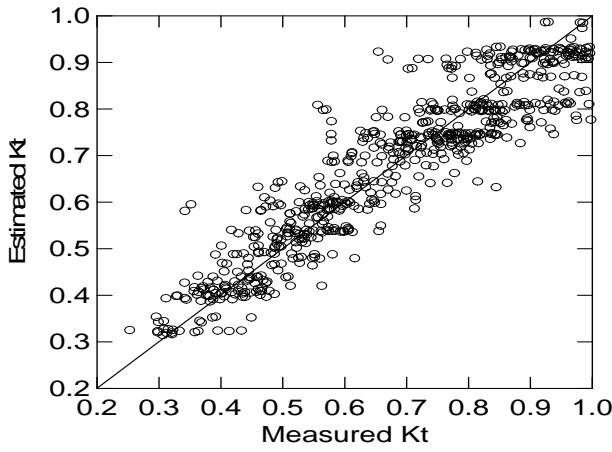
Figure 9. Estimated and measured K<sub>t</sub> of 3D equation
In order to evaluate the suitability of the equation, a sensitivity analysis was carried out using the value of 95% confidence interval as shown in Figure 10. The equation is in the form
\[\begin{split} K_{t} &= C_{1} \exp \left(-\frac{h_{c}}{H_{i}}\right) + C_{2} \exp \left(C_{3} \frac{B}{H_{i}}\right) + C_{4} \frac{H_{i} h_{c}}{B D_{50}} + C_{5} \frac{B^{2}}{L_{p} D_{50}} + \\ & C_{6} \frac{h_{s}}{h} x \frac{r}{L_{p}} \cos (\phi - \phi_{o}) \end{split} \tag{2}\] where \(K_t\) is the transmission coefficient, h is the water depth, \(h_c\) is the depth of submergence or freeboard, \(h_s\) is the structure height, H<sub>i</sub> is the incident wave height, B is the crest width, L<sub>p</sub> is the local wave length, D<sub>50a</sub> is the nominal diameter of armour units, r is radial distance from the tip of the breakwater to the point of interest, i is the angle from the breakwater to the point of interest and jo is the incident wave direction.
The value selected for h<sub>c</sub>/H<sub>i</sub> was between 0.169 and 3.125, \(B/_{Hi}\) between 1.95 and 37.5, \(H_ih_c/BD_{50}\) between 0.02 and 1.57, \(B^2/L_pD_{50}\) between 0.29 and 20.62, and the diffraction term between 0.54 and 1.49. Result shows that coefficient C2 is the most sensitive having a minimum variation in the response of about 2.2% and maximum variation of about 4.8%, with the average value being 3.3%. The performance of 3D equation to predict K<sub>t</sub> was also evaluated using 2D data. Figure 11 shows that the 3D equation predicts relatively well K<sub>t</sub> values in the range of \(0.4 \le K_t \le 0.8\).
5. Conclusion
- 1. The above equation is developed based on the 3D test data for irregular waves. The wave transmission equation includes parameters that are considered to be representing physical processes such as water depth fluctuation, wave overtopping, dissipation due to surface friction, and transmission through the breakwater. The use of the models should be restricted to the range of the variables tested. Application outside this range of variables may result in incorrect estimates.
- 2. A proposed equation developed to predict K<sub>t</sub> based on 3D data is in a good agreement when comparing with 2D test data, but seems unable to predict K<sub>t</sub> when the water level at or below the crest level. It should be noted that the equation is derived using 3D testing results conducted for submerged condition; therefore the use of the equation should be for the same condition. However, since the equation is developed using a wide range of variables and relevant physical processes, the models may be used for preliminary designs.
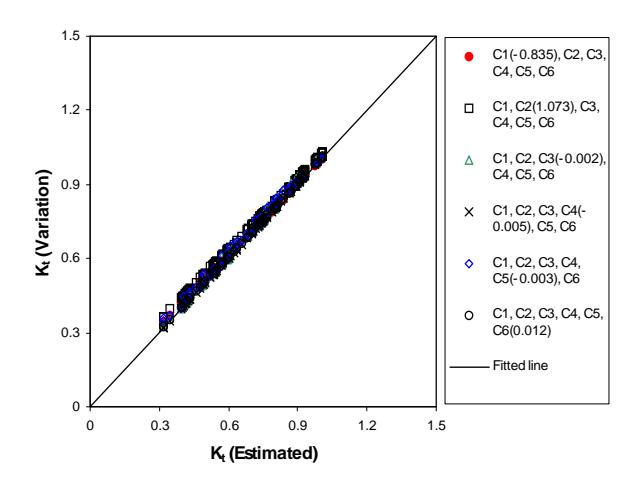
Figure 10. Sensitivity of K<sub>t</sub> to variation of +95% confidence interval in regression coeffients
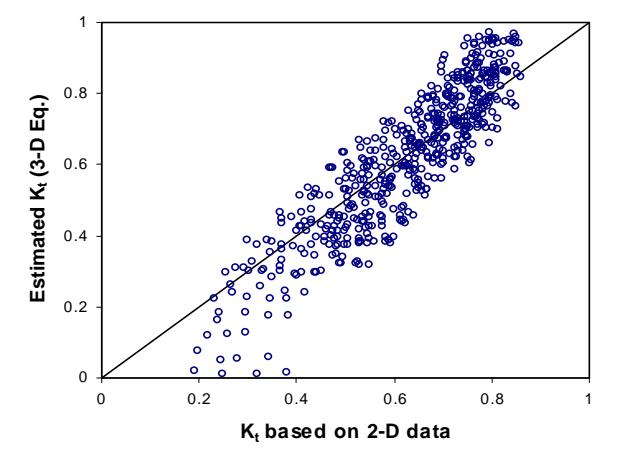
Figure 11. Comparison between 3D equation and 2D data for submerged condition
6. Acknowledgement
The author would like to thank Stuart Seabrook, Queen's University, ON, Canada, for making available the valuable datasets.