

D.M Priyantha Wedagama
Department of Civil Engineering, Faculty of Engineering, Udayana University, Bukit Jimbaran-Bali, Indonesia 80361, E-mail: priyantha.wedagama@gmail.com
Abstrak
Studi ini meneliti prilaku evakuasi penduduk lokal jika terjadi tsunami di Provinsi Bali yang meliputi pilihan tujuan perjalanan ke tempat berlindung (privat atau publik) dan waktu respon (cepat atau lambat). Data dikumpulkan dari dua wilayah pantai yaitu pantai Kuta dan Sanur dengan menyebarkan kuisioner Stated Preferences (SP) kepada penduduk lokal. Data meliputi preferensi rumah tangga terhadap pemilihan tempat berlindung dan pilihan waktu respon jika terjadi tsunami, data pribadi, sosial ekonomi, jarak tempat tinggal ke tepi pantai, dan pengalaman terhadap bencana alam Analisis dilakukan menggunakan model regresi logistik biner. Hasil studi menunjukkan faktor-faktor yang berpengaruh terhadap pemilihan tempat berlindung adalah tingkat pendidikan, jumlah unit mobil yang dimiliki rumah tangga dan tidak mempunyai pengalaman terhadap bencana alam lainnya (selain Tsunami). Faktor-faktor yang berpengaruh terhadap waktu respon penduduk adalah umur, total pendapatan rumah tangga per bulan kurang dari 3 juta rupiah, jumlah unit mobil dan sepeda motor yang dimiliki rumah tangga. Studi ini menyarankan agar pemerintah daerah mulai mensosialisasikan alternatif tipe dan lokasi tempat berlindung saat evakuasi, mengingat kemampuan pemerintah yang tentunya terbatas di dalam menyediakan tempat berlindung jika terjadi tsunami. Pemerintah daerah juga diharapkan mengkaji tipe dan jumlah armada angkutan masal yang harus disediakan saat terjadi tsunami.
Kata-kata Kunci: Tsunami, tempat berlindung, waktu respon, regresi logistik.
1. Introduction
A high-tech tsunami early warning system has been officially placed in several locations in Indonesia coastal areas in November 2008. This system aims to reduce the recurrence of tsunami impact, especially fatalities as occurred in 2004 in several Asian countries including Indonesia (in particular the Province of Nanggroe Aceh Darussalam). This 1.4 trillion worth of equipment is able to detect and predict earthquakes in the sea within the next five minutes whether a tsunami will occur or not.
Meanwhile, it has long been identified that Indonesia is at the intersection of three plates consisting the Eurasian, Indo-Australian and Pacific. Bali province, as one of the most preferred tourist destinations, is located in the path of Indo-Australian plate which is certainly potential to be affected by the tsunami. An equipment of tsunami early warning system therefore, has been allocated in Kuta beach in the southern coast of the Bali island. Having used this system, people residing in the coastal areas are expected to respond and to evacuate immediately in case of tsunami.
Natural disasters including the tsunami have destructive effects on human casualties and material damages. In a such situation, evacuation is the best alternative to ensure the public safety. The key success of evacuation plan is the capability to transport people to a safe location. Various analytical models however, have been developed to estimate travel demand during evacuation in the event of natural disasters (Faulkner, 2001; Fu and Wilmot, 2004; Charnkol and Tanaboriboon, 2006). These models are used to plan evacuation time and determine the effectiveness of evacuation as part of a proactive strategy of action. One important aspect of the evacuation model is the human behaviour. The human behaviour in question is to translate the knowledge of human beings who were evacuated in the event of a disaster into quantitative measures (Charnkol and Tanaboriboon, 2006).
Travel demand forecasting for evacuation is different to that of daily activities (travel to work, shopping, education and recreation). For the evacuation plan, travel demand forecasting is primarily based on evacuation behaviour. It is therefore, very crucial to understand the factors that may influence people's decisions during evacuation.
Tsunami is in fact quite often occurred in the Caribbean Sea, the Mediterranean, Indian and Atlantic Ocean. Tsunami evacuation models however, have been rarely developed in comparison with the evacuation floods, cyclones and hurricanes models (Faulkner, 2001; Charnkol and Tanaboriboon, 2006). In addition, having learned the tsunami experiences in Thailand, Bali province, especially in the southern coast, requires a transportation planning application procedures for evacuation in the event of a tsunami. This requires a comprehensive understanding of what will happen and how to response in the event of tsunami and the impact of tsunami on evacuation behaviour. In order to establish the evacuation plan, an analytical model is required to describe human behaviour during evacuation in the event of a tsunami.
The dominant factors that may influence evacuation behaviour consisting the choice a refuge or shelter and the response time in the event of a tsunami. In this study, the choice analyses of both shelter and response time do not consider transport mode and route choices that can be used during evacuation. Many factors however, may contribute to shelter choice and response time in case of tsunami, so that variables used in this study are restricted to follow previous studies in Thailand by Charnkol, et.al, (2006 & 2007). These include personal data, household characteristics distance of residence from the coastline and previous experiences of both tsunami and other natural disasters. This study aims to support in developing a tsunami evacuation management system in the future and is expected to provide recommendations for tsunami evacuation plan.
2. Literature Review
2.1 Previous studies
A previous study by Charnkol and Tanaboriboon (2006) examined the evacuation behaviour of local residents and tourists in the event of a tsunami in Thailand. Evacuation behaviour data were collected in two coastal areas of Phuket and Phang-nga. Behaviour analysis was conducted to investigate human responses to tsunami early warning. This analysis particularly determined human evacuation patterns (fast, medium or slow) for which the condition is divided into four intervals of preparation and response time of 60, 45, 30 and 15 minutes respectively. Preparation and response curve represents the time to start evacuation and move to a safe place. Preparation and response curves were then estimated and compared between local residents and tourists. Evacuation models were developed with binary logistic regression model to estimate the possibility of any local residents and tourists to be in a group (for example, a group that sooner or later response). The results of this model is a natural reaction of tsunami evacuation including response time and evacuation behaviour.
Another study was also conducted on the coast of Phuket, Thailand by Charnkol et.al (2007) which examining the alternative of a travel destination or a location used as a refuge (shelter) in the event of a tsunami and the factors that affect local residents and tourists to choose such a site. Trip destination model was developed using logistic regression models describing the shelter choice (either public or private). The results of this study indicated that the estimated goal of this trip is not only describing the information about the preferred shelter type but is also used to plan the materials required during evacuation.
Meanwhile, a study by Fu and Wilmot (2004) assuming that the decisions taken at the time of evacuation in case of typhoons or storms are based on a binary choice at a certain time. Binary logit model was developed to determine the evacuation behaviour by the household. The behaviour is determined using the economic characteristics of the household, the characteristics of cyclone/hurricane and the policies adopted by local governments in relation to natural disasters. Based on the analysis, logit model is able to explain the dynamic of human behaviour during evacuation.
2.2 Logistic regression
Logistic regression is useful for predicting a binary dependent variable as a function of predictor variables. The goal of logistic regression is to identify the best fitting model that describes the relationship between a binary dependent variable and a set of independent or explanatory variables. The dependent variable is the population proportion or probability (P) that the resulting outcome is equal to 1. Parameters obtained for the independent variables can be used to estimate odds ratios for each of the independent variables in the model (Washington, 2003).
The specific form of the logistic regression model is:
\[\pi(x) = P = \frac{e^{\beta_o + \beta_1 x}}{1 + e^{\beta_o + \beta_1 x}}\](1)
The transformation of conditional mean \(\pi(x)\) logistic function is known as the logit transformation. The logit is the LN (to base e) of the odds, or likelihood ratio that the dependent variable is 1, such that
Logit (P) = \[LN\left(\frac{P_i}{1 - P_i}\right) = B_o + B_i \cdot X_i\] (2)
where:
\(\mathbf{B}_{\mathrm{o}}\): the model constant
\(B_{i}\): the parameter estimates for the independent variables
\(X_i\): set of independent variables (i =
1,2,....,n
: probability ranges from 0 to 1
: the natural logarithm ranges from negative infinity to positive infinity
The logistic regression model accounts a curvilinear relationship between the binary choice Y and the predictor variables Xi, which can be continuous or discrete. The logistic regression curve is approximately linear in the middle range and logarithmic at extreme values. A simple transformation of Equation (1) yields
\[\left(\frac{P_i}{1 - P_i}\right) = \exp^{-B_o + B_i \cdot X_i} = \exp^{-B_o} \cdot \exp^{-B_i \cdot X_i} \tag{3}\]
The fundamental equation for the logistic regression shows that when the value of an independent variable increases by one unit, and all other variables are held constant, the new probability ratio [P<sub>i</sub>/(1-P<sub>i</sub>)] is given as follows:
\[\left(\frac{P_i}{1 - P_i}\right) = \exp^{B_o + B_i(X_i + 1)} = \exp^{B_o} \cdot \exp^{B_i \cdot X_i} \cdot \exp^{B_i}\] (4)
When independent variables X increases by one unit. with all other factors remaining constant, the odds \([P_i/(1-P_i)]\) increases by a factor exp \(^B_i\). This factor is called the odds ratio (OR) and ranges from 0 to positive infinity. It indicates the relative amount by which the odds of the outcome increases (OR>1) or decreases (OR<1) when the value of the corresponding independent variable increases by 1 unit.
There is no true R<sup>2</sup> value in logistic regression. as there is in Ordinary Least Squares (OLS) regression. Alternatively, Pseudo R<sup>2</sup> can be a proxy of an R<sup>2</sup> including Cox & Snell Pseudo-R<sup>2</sup> and Nagelkerke Pseudo-R<sup>2</sup> (Charnkol, et.al, 2007).
Cox & Snell Pseudo-R2 = R2 = 1 - \[\left[\frac{-2LL_{null}}{-2LL_k}\right]^{2/n}\] (5)
The null model includes only the constant while the k model contains all explanatory variables in the model. Cox & Snell R<sup>2</sup> value cannot reach 1.0, so that Nagelkerke is used to revise it.
Nagelkerke Pseudo-R2 = R2 = \[\frac{1 - \left[\frac{-2LL_{null}}{-2LL_{k}}\right]^{2/n}}{1 - (-2LL_{null})^{2/n}}\] (6)
A Hosmer-Lemeshow Test is used to carry out the goodness of fit measure. The null hypothesis for this test is that the model fits the data, and the alternative is that the model does not fit. The test statistic is conducted by first breaking the data set into roughly 10 (g) groups. The groups are constructed by ordering the existing data by the level of their predicted probabilities. The data are ordered from least likely to most likely for the event. The equal sized groups are formed. From each group, the observed and expected number of events is computed for each group. The test statistic is.
\[\hat{C} = \sum_{k=1}^{g} \frac{(O_k - E_k)^2}{v_k} \tag{7}\]
The Hosmer-Lemeshow test (H-L test)
\(O_{\nu}\)Observed number of events in the kth
Expected number of events in the kth
Variance correction factor for the kth group
If the observed number of events differs from what is expected by the model, the H-L test will be large and there will be evidence against the null hypothesis.
3. Case Study Area and Data Collection
3.1 Case study area
The case study area is located in the coastal areas of Kuta and Sanur beach as shown in Figure 1. Both locations are considered as the most favourite tourist destinations in Bali. In fact, in Kuta beach has been allocated a device of tsunami early warning system.
Kuta beach areas used as research locations cover three sub districts of Seminyak, Legian and Kuta. Meanwhile, Sanur beach areas cover three sub districts of Sanur, Sanur and Sanur Kaja Kauh. Based on data obtained from Badung and Denpasar City Central Bureau of Statistics in 2010, the number of population in the study areas in 2009 is presented in Table 1.
Urban neighborhoods chosen as the study area are located on the waterfront. When the tsunami struck, these areas are initially affected. It is realised however, that there are still many potential locations affected by the tsunami given their location on the waterfront. Compared to other waterfront locations however, these two sub-districts are having higher population density and are the most favourite tourist destinations in Bali southern coastal areas.
Table 1. Number of local residents in case study area
| Sub Dis tricts | Population (persons) | Sub Districts | Population (persons) |
|---|---|---|---|
| Sanur | 16089 | Seminyak | 4153 |
| Sanur Kaja | 8822 | Legian | 3422 |
| Sanur Kauh | 13960 | Kuta | 11856 |
| Total | 38871 | Total | 19431 |
3.2 Data collection
The number of population of each study area is used to determine the sample size. Using a 10% precision, the number of sample taken in Sanur and Kuta coastal areas were 100 respondents respectively (Yamane, 1967). These samples distributed evenly on each sub district in the case study area. The respondent selection is based on household (of local resident) locations in neighbourhood environment, i.e by the main and local roads and in the alley. These household locations are intended to represent the economy class of the respondents. On the assumption that the respondents who lived by the main and local roads and in the alley are upper, middle and lower classes respectively.
Data are collected by distributing Stated Preference (SP) questionnaires and interviewing local residents in both areas (Kuta and Sanur coastal areas). This questionnaire contained two hypothetical scenarios in which the respondents are asked to give preference or willingness of their shelter choice and response time in the event of tsunami. There are four questionnaires withdrawn from Sanur coastal areas. As a result, there are 196 samples used for this study consisting 96 and 100 samples for Sanur and Kuta coastal areas respectively.
Before the interview, the respondents are thoroughly explained to the study purpose and with every point in the questionnaire. Due to lack of information on the available shelters however, many variables including the distance from local resident's home to the nearest shelter, shelter capacity and facility are not included as
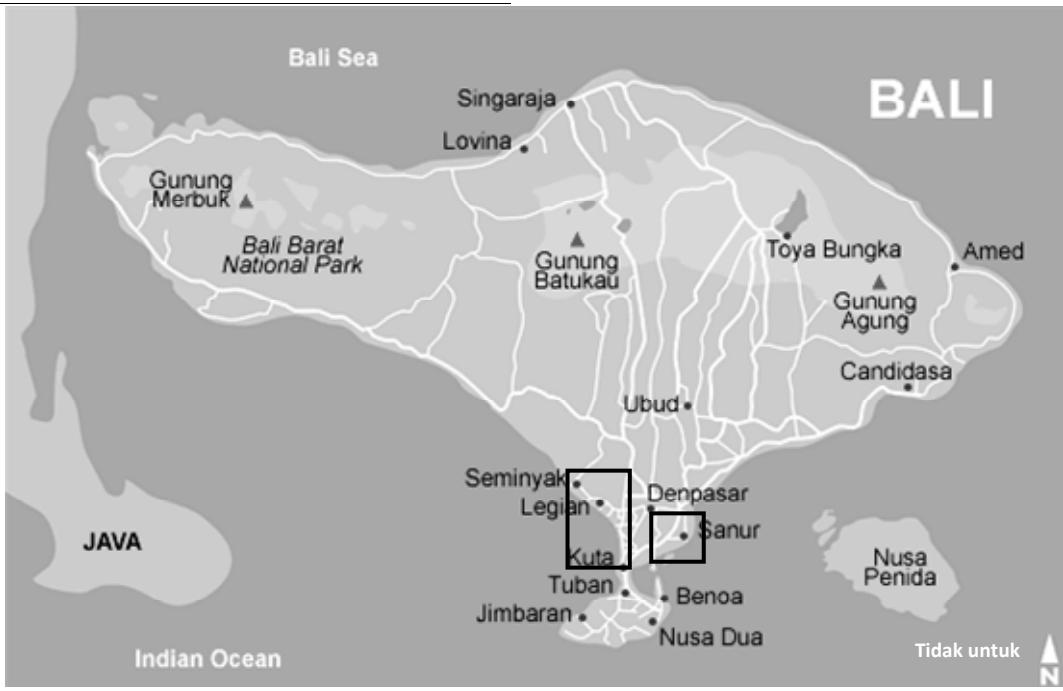
Figure 1. Case study area
predictors. It is realised however, in making evacuation decisions, evacuees are more likely considering safer places when given evacuation orders, objective and subjective risk factors. More importanly, social and economic factors are the primary determinants of the destination decision (Whitehead et al., 2000 in Charnkol and Tanaboriboon, 2006). These factors therefore, are highly considered and employed as the predictors (independent variables) in the choice process as shown in Table 2.
There are two scenarios conducted for this study. The first scenario is a shelter choice in case of tsunami (code = 0 and 1 for private and public shelters respectively). During the interview, respondents were given description of shelter's locations and the difference between shelter's types (e.g private and public shelters). Public shelter is a temporary shelter owned by public and it has only a very minimal protection facilities compared to private shelter which consisting hotel or resort or buildings owned by family or friends.
The second scenario is the response times required by the local residents to prepare and evacuate to safer places when tsunami warning is given. Based on a previous study by Charnkol and Tanaboriboon (2006), time interval of tsunami from detected to struck the coast in Thailand was two hours eleven minutes. In that previous study, the response times given for the respondents were 60, 45, 30 and 15 minutes respectively. Generally, this is considered to be a sufficient time to evacuate if the early warning system detector works well (Charnkol and Tanaboriboon, 2006). Having considered above, the response
times employed for this study are 60, 45, 30 and 15 minutes respectively. Respondents for this study are expected to answer according to their real household conditions.
Discrete variables classified into several categories or codes are called dummy variables. In the analysis of data using SPSS version 15, then dummy variable must be designed so that both independent variables and dependent variables can be read by the SPSS. A dependent variable on a logistic regression model is a categorical variable or discrete variable. As for the independent variables (independent variables) can be either categorical variables (discrete) or continuous variables as shown in Table 2.
Meanwhile, the ordered logit model has been initially examined for the response time choice data. However, the p-value (sig) for the test of parallel lines of the ordered logit model is less than 5% (p<0.001). This indicates that there is no ordinal nature in the categories, thus the ordered logit model does not fit the response time choice data (Chan, 2005). As the results, the respondents are classified into two groups, a group with fast responses (15 and 30 minutes with code = 1) and slow responses (45 and 60 minutes with code = 0).
4. Model Development and Analysis
A hypothesis testing is conducted on dummy independent variables to review the statistical variability of each dummy variable classification. Based on survey data, each classification percentage of dummy
Table 2. Study variables
| No. | Dependent Variables | Classification and Code |
|---|---|---|
| 1. | Type of shelters | Private = 0 (private owned) |
| Public = 1 (state owned) | ||
| 2. | Response time | Slow (response time 45 & 60 minutes) = 0 |
| Quick (response time 15 & 30 minutes) = 1 | ||
| No. | Independent Variables | Classification and Code |
| 1. | Marital status | Not married = 0 |
| Married = 1 | ||
| Divorced/Separated= 2 | ||
| 2. | Gender | Female = 0, Male = 1 |
| 3. | Age | Umur (tahun) |
| 4. | Education level | Elementary school = 0 |
| Junior high school = 1 | ||
| Senior high school = 2 | ||
| University = 3 | ||
| 5. | Household members | Persons |
| 6. | Income per month | < 1 million rupiahs = 0 |
| 1 - 3 million rupiahs = 1 | ||
| 3 – 5 million rupiahs = 2 | ||
| > 5 million rupiahs = 3 | ||
| 7. | Car owned | Unit(s) |
| 8. | Motorcycle owned | Unit(s) |
| 9. | Distance from coastline | Distance (m) |
| 10. | Previous experience of tsunami | No = 0, Yes = 1 |
| 11. | Previous experience of other natural disaster | No = 0, Yes = 1 |
independent variables is obtained. The percentage is calculated for a hypothesis testing for each classification. This is carried out to eliminate the variable classification that have a significance level of less than 5% as shown in Table 3.
The results of this hypothesis test are as follows:
- a. Marital status is not used as independent variables because the variability of that category is not significant. This means that the case study area have a high homogeneity of marital status in which most of respondents are married.
- b. Gender category is statistically significant so it can be used as an independent variable.
- c. A low proportion for the category of graduated from elementary school so it is not statistically significant. This category is combined with the category of graduated from junior high school and defined as a new category of graduated from junior high school
- d. A low proportion of household monthly income below 1 million rupiahs so it is not statistically significant. This category is combined with total income between 1and 3 million rupiahs and defined as a new category of total monthly income less than 3 million rupiahs.
- e. The experience of the tsunami-affected respondents has a very low proportion so it is not statistically significant, thus it is not used as an independent variable.
- f. Other natural disaster experience is statistically significant so it can be used as an independent variable.
After conducting this statistical test, the study variables are used for the input data in the model development using a logistic regression model. The dummy variables used in this study are shown in Table 4. In addition, Table 4 shows that two models are developed in this study consisting shelter choice and response time models.
Tabel 3. Hypothesis testing: statistics data
| 95% confidence interval | |||||
|---|---|---|---|---|---|
| Description | X | N | Sig. | Lower | Upper |
| Marital Status | |||||
| Not married* | 4 | 196 | 0.020 | 0.0 | 0.0 |
| Married | 181 | 196 | 0.923 | 0.9 | 1.0 |
| Divorced* | 11 | 196 | 0.056 | 0.0 | 0.1 |
| Gender | |||||
| Female | 74 | 196 | 0.378 | 0.3 | 0.4 |
| Male | 122 | 196 | 0.622 | 0.6 | 0.7 |
| Education Level | |||||
| Elementary | 14 | 196 | 0.071 | 0.0 | 0.1 |
| School* | |||||
| Junior High | 8 | 196 | 0.041 | 0.0 | 0.1 |
| School* | |||||
| Senior High | 102 | 196 | 0.520 | 0.5 | 0.6 |
| School | |||||
| University | 72 | 196 | 0.367 | 0.3 | 0.4 |
| Household Income per month | |||||
| < 1 million* | 6 | 196 | 0.031 | 0.0 | 0.1 |
| 1 – 3 million | 100 | 196 | 0.510 | 0.4 | 0.6 |
| 3 – 5 million | 50 | 196 | 0.255 | 0.2 | 0.3 |
| > 5 million | 40 | 196 | 0.204 | 0.1 | 0.3 |
| Previous experience of tsunami | |||||
| No | 193 | 196 | 0.985 | 1.0 | 1.0 |
| Yes | 3 | 196 | 0.015 | 0.0 | 0.0 |
| Previous experience of other natural disaster | |||||
| No | 153 | 196 | 0.781 | 0.7 | 0.8 |
| Yes | 43 | 196 | 0.219 | 0.2 | 0.3 |
Note:
*) Not statistically significant at the 5% (95% confidence interval consisting 0) with:
X = Number of classification and N = Number of data/samples
Tabel 4. Variables used in the model development
| No. | Dependent Variables | Variable Name, Code & Classification |
|---|---|---|
| 1. | Shelter Choice | Evac_loc = 0 (Private) |
| Evac_loc = 1 (Public) | ||
| 2. | Response Time | Respond = \(0\) (Slow) |
| Respond = \(1\) (Fast) | ||
| No. | Independent Variables | Variable Name, Code & Classification |
| 1. | Gender | Gender = 0 (Female) |
| Gender = 1 (Male) | ||
| 2. | Education Level | Education = 1 (< Junior High School) |
| Education = 2 (Senior High School) | ||
| Education \(= 3\) (University) | ||
| 3. | Household Income per month | Income = \(1 (< 3 \text{ million rupiahs})\) |
| Income = \(2(3-5 \text{ million rupiahs})\) | ||
| Income = \(3 (> 5 \text{ million rupiahs})\) | ||
| 4. | Previous experience of natural disaster | \(Expr_other = 0\) (No) |
| \(Expr_other = 1 (Yes)\) | ||
| 5. | Age | Age (years) |
| 6. | Household members | Famili no (person(s)) |
| 7. | Car owned | LV (Unit(s)) |
| 8. | Motorcycle owned | MC (Unit(s)) |
| 9. | Distance from coastline | Distance (m) |
5. Results and Discussion
The relationship between independent and dependent variable in the model is examined as shown in Table 5. This table shows that shelter choice and response time models have chi-square test values of 41.002 and 44.147 respectively at 5% significance level. This shows that the two models are structured to have a significant relationship between independent and dependent variables.
Washington, et al. (2003) describes that in a logistic regression model, the higher the value of pseudo R<sup>2</sup> (goodness of fit), the better the model. However, this is not always the case. O'Donnell and Connor (1996) states this practical value can be ignored because in a logistic regression model there is no default value for the pseudo R<sup>2</sup> to measure the goodness of fit of a model. This value has an upper limit, which both theoretically and empirically are always less than one. Hosmer and Lemeshow test (H-L test) therefore may be used to examine the goodness of fit of a model.
The H-L test value is equal to or less than 5% means that there is a significant difference between the model and the observations since the developed model
Table 5. Significance of the developed models
| Shelte | r Choice Mo | odel | Resp | onse time M | lodel |
|---|---|---|---|---|---|
| Chi- square | degree of freedom | Sig. | Chi- square | degree of freedom | Sig. |
| 41.002 | 4 | .000 | 44.147 | 5 | .000 |
Tabel 6. Determination coefficient of the developed models
| Shelter C | hoice Model | Respo | nse Time Model |
|---|---|---|---|
| Cox & | Nagelkerke | Cox & | Nagelkerke R2 |
| Snell R2 | R² | Snell R2 | T (Mgellierine It |
| .189 | .261 | .202 | .290 |
at 95% confidence level can not predict the value of observation. In contrast, if the statistical value of H-L test is greater than 5% then the model is able to predict the value of observations at 95% level of confidence. Table 7 shows the significance values of H-L test for two developed models are greater than 5%. The two logistic regression models, i.e shelter choice and response time models are significant and able to predict the value observation at 95% confidence level.
A criteria to examine the classification model accuracy used is generally 25% or higher than the data proportion. This analysis is used to examine whether the full model is significantly different to the null model (a model with constant and with no independent variables). For a shelter choice model, the data proportion is \(0.342^2 + 0.658^2 = 0550 (55\%)\) and the model accuracy is 72.4%. The shelter choice model accuracy is greater than its data proportion. Similarly for a response time model, the data proportion is 0.28 <sup>2</sup> + \(0.72^{2} = 0.596 (59.6\%)\) and the model accuracy is 78.1%. The response time model accuracy is greater than the data proportion. Both shelter choice and response time full models therefore, are significantly different and better than their null models.
Significant variables in the model are analysed to examine factors which influencing shelter choice and response time of local residents in Kuta and Sanur coastal areas. Table 9 shows that standard error (SE) value of each independent variable is less than 2.0. This indicated that no multicollinearity (strong dependence amongst the independent variable in the model) presents in both models.
Tabel 7. H-L test for shelter choice model
| Shelte | er Choice M | odel | Response Time Model | |||
|---|---|---|---|---|---|---|
| Chi- square | degree of freedom | Sig. | Chi- square | Degree of freedom | Sig. | |
| 3.543 | 6 | .738 | 8.329 | 8 | .402 | |
Tabel 8. Classification model accuracy
Data Proportion
| N | N Marginal Percentage | N | Marginal Percentage | |||||
|---|---|---|---|---|---|---|---|---|
| Shelter | Private | 67 | 34.2% 65.8% | Response | Slow | 55 | 28% | |
| Choice | Public | 129 | Time | Fast | 141 | 72% | ||
| Model | Accuracy | |||||||
| Observed | Predicted | Observed | Predicted | |||||
| Private | Public | % Correct | Slow | Fast | % Correct | |||
| Private | 27 | 40 | 40.3 | Slow | 22 | 33 | 40.0 | |
| Public | 14 | 115 | 89.1 | Fast | 10 | 131 | 92.9 | |
| Overall Percentage 72.4 Overall Percentage | centage | 78.1 | ||||||
Tabel 9. Significant variables in a shelter choice model
| Shelter Choice Model | Response Time Model | ||||||||
|---|---|---|---|---|---|---|---|---|---|
| Variables | В | SE | Sig. | Exp(B) | Variables | В | SE | Sig. | Exp(B) |
| Education(1) | 2.631 | .813 | .001 | 13.884 | Age | 060 | .026 | .023 | .942 |
| Education(2) | 1.214 | .369 | .001 | 3.368 | Income(1) | -1.752 | .607 | .004 | .174 |
| LV | .622 | .259 | .016 | 1.863 | Income(2) | 245 | .675 | .717 | .783 |
| Expr_other(1) | 1.458 | .403 | .000 | 4.297 | LV | 817 | .272 | .003 | .442 |
| Constant | -1.786 | .491 | .000 | 0.168 | MC | .693 | .224 | .002 | 2.000 |
| Constant | 3.520 | 1.302 | .007 | 33.800 | |||||
where.
Graduated from Junior High School Education(1)
Education(2) : Graduated from Senior High School
Age of respondent (as a head of Age a family)
Have no previous experience of Expr other(1):
other natural disaster
Household income < 3 mllion rupi-Income(1)
ahs per month
Household income 3-5 mllion rupi-Income(2)
ahs per month
LV Number of car owned by household
Number of motorcycle owned by MC
household
The significant factors influencing shelter choice at 5% significance level are education level, household car ownership and no previous experience of natural disasters (other than tsunami). The significance of each factor can be seen from the expected value of the independent variable (Exp (B)) in Table 9. The likelihood ratios of selecting public to private shelters are as follows:
- a. Respondents who graduated from junior high school (or lower) are nearly 14 times greater than those who graduated from the university.
- b. Respondents who graduated from high school are approximately three times greater than those who graduated from the University.
- c. Respondents who have no previous experience of natural disaster (other than tsunami) are almost four times more than those who do have.
- d. A household owning at least one car is almost two times more than that does not
Respondents who graduated from the university are less interested in public shelters than those who had lower education. In other words, those who had lower level education would have been more interested in public shelters than those who had higher education. Respondents who had lower education possibly are not aware of or having less information about private shelters availability in their surrounding areas. In addition, respondents who have at least one car prefer public to private shelters. This may be explained to the fact that public shelters including an open space area or a football court can also be used as car parking area during evacuation.
Respondents who had no experience of other natural disaster (other than tsunami) also prefer public to private shelters than those who did. Those respondents who had natural disaster knowledge's (but tsumami) possibly consider private shelters are more safer than public shelters. In fact, about 78% of respondents (refer to Table 3) had no natural disaster knowledge's. Generally, this specifies that introducing disaster knowledge is important to the local community in Bali.
Based on the shelter model results, the local government therefore, has to commence socialising the alternative types of shelter that can be used especially on private property during evacuation. This is certainly due to the local government limitation in providing public shelter in the event of a tsunami.
The significant factors influencing response time at 5% significance level are respondent's age (head of the family), total household income per month less than 3 million rupiahs, and household cars and motorcycle ownerships. The significance of each factor can be seen from the expected value of the independent variable (Exp (B)) in Table 9. The likelihood ratios of choosing fast to slow responses are as follows:
- a. Older respondents are 5.8% (0942-1 = 0.058) less than those younger respondents.
- b. A household with total income less than 3 million rupiahs per month is 83% less than a household with total income greater than 5 million rupiah per month.
- c. A household owning car is 56% less than that does not have.
- d. A household owning motorcycle is two times more than that does not have.
Based on the response time model results, the local government is expected to consider the priority and the way for evacuating the older age group of local residents and for families with low income in the event of tsunami. In addition, the local government should consider the appropriate type of mass transport fleet for evacuation in case of tsunami.
In a previous study by Charnkol and Tanaboriboon (2006), the response patterns of permanent residents in the event of tsunami are significantly influenced by the number of family members, residence distance to the coastline, previous knowledge of natural disasters, previous experience of tsunami and boat or ship ownerships. These factors are different to the findings in this study. This is possibly due to different demographic characteristics between local residents in coastal areas in Bali and Thailand. In addition, knowledge and previous experience of tsunami between local residents in coastal areas in Bali and Thailand may significantly contribute to the response patterns.
Further studies however, are still required to investigate tsunami evacuation more thoroughly. In addition, more potential predictors (e.g. the distance from local residences to the nearest shelter, shelters capacity and facility, and evacuation routes) should be considered in the developed model.
6. Conclusions
- 1. The significant factors that influence shelter choices in the case of tsunami are education levels, car ownerships and no previous experience of other natural disasters.
- 2. The privately-owned shelter tends to be selected by local residents with: higher education levels, no light vehicles and previous experiences of natural disasters other than tsunami.
- 3. The significant factors that influence the response time in case of tsunami population are age of respondent (head of the family), total household income per month less than 3 million rupiahs, and household car and motorcycle ownerships.
- 4. Fast response time tends to be chosen by a younger respondent, a household with total income per month greater than 5 million rupiahs and a household with no car but a motorcycle.
- 5. This study suggested that the local government should begin to socialise the alternative types and locations of the shelter that could be used at the time of evacuation, especially that owned by private. This is certainly due to the local government limitation in providing shelter in the event of a tsunami. Having considered the local residents groups of age and vehicle ownerships, the government is expected to consider the number and the types of mass transport fleet that must be provided when the tsunami hit.