

Abstrak
Sebagai negara berkembang, Indonesia menghadapi masalah serius dalam mengelola sampah padat seperti plastik. Setiap tahun, Indonesia memproduksi sekitar 5,4 juta ton sampah plastik, akuntansi untuk 14% dari total produksi sampah negara. Pemanfaatan sampah plastik sebagai pengganti agregat sebagian di campuran perkerasan aspal beton akan menjadi salah satu solusi untuk mengurangi masalah lingkungan dari tingginya volume sampah plastik. Penelitian sebelumnya menunjukkan bahwa dimungkinkan untuk menggunakan sampah plastik di perkerasan jalan untuk meningkatkan kinerja perkerasan jalan dan umur pelayanan jalan. Studi ini mengkaji kinerja campuran aspal beton yang mengandung berbagai variasi jumlah sampah plastik sebagai pengganti agregat sebagian yang dibandingkan dengan yang campuran konvensional. Sampah plastik yang digunakan dalam penelitian ini berukuran kecil yang lolos saringan nomor 30 dan tertahan di saringan nomor 40, yang akan menggantikan (berat) sebagian dari agregat mineral. Semua campuran disiapkan menggunakan 5,82% kadar aspal optimum. Kinerja karakteristik aspal beton dikaji menggunakan uji Marshall, uji kekuatan tarik tak langsung (ITS), uji modulus kekakuan tarik tak langsung (ITSM), dan uji Cantabro Loss (CL) yang dikaitkan dengan kekuatan, modulus kekakuan, dan karakteristik durabilitas. Secara umum, hasil laboratorium menunjukkan bahwa campuran aspal beton yang mengandung limbah plastik memiliki kinerja lebih tinggi dari campuran beton aspal konvensional.
Kata-kata Kunci: Sampah plastik, Agregat, Aspal beton, Kinerja campuran aspal beton.
1. Introduction
Many cities in developing countries face serious problems in managing solid waste. Rapid development and changing lifestyles in growing cities mean that the composition of waste has also changed from mainly organic materials to mainly plastics, paper, and packaging materials. The issues related to waste disposal have become challenging, as more land is needed for the ultimate disposal of these solid wastes. Several major cities in developing Asian countries have reported problems with existing landfill sites (Idris, et al. 2003).
Using industrial waste materials as asphalt in concrete pavement cannot only eliminate environmental problems but also as many studies have shown they can also improve some of the properties of the pavement (Tuncan, et al. 2003). According to data from Indonesia's Ministry of Environment, Indonesia produces approximately 5.4 million tons of waste plastic annually, which accounts for 14% of total solid waste production in Indonesia. Therefore, there is a need to investigate the application of new materials, such as low-cost waste plastic, to anticipate that problem. The use of recycled waste plastic is of a great importance in Indonesia, particularly for the reduction of environmental problems. Waste plastic used in asphalt is a promising prospect for the road pavement construction industry.
The use of concrete asphalt as a wearing course mixture has been wide spread in Indonesia, and the most common mode of failure on Indonesian roads is permanent deformation (rutting), especially in the wheel track. This has resulted in increased traffic volume. Indonesia has climatic conditions that are much warmer than either the European countries or the United States of America. The heavy loaded and high ambient temperature means that the maximum, mean, and minimum pavement temperature in Indonesia are 50°C, 37.5°C, and 25°C respectively (Aschuri, et al, 2003).
A previous study showed that modifiers such as fly ash and polymer, when included in an asphalt concrete mixture, impart greater stability and strength (Terrel, 1993). The objective of this study was to investigate the performance of the asphalt concrete mixture containing varying amounts of waste plastic as a partial aggregate substitution compared to that of the conventional mixture. The asphalt concrete characteristics studied were strength, stiffness modulus, and durability, as measured by the Marshal test, the ITS test, the ITSM test, and the CL test.
2. Material Used
The bitumen used was penetration grade bitumen 60/70, which is widely used in Indonesia for asphalt concrete. The waste plastic used in this study was obtained from local household waste, and was predominantly composed of polypropylene (PP). The waste plastic was chopped into small pieces of approximately passing sieve number 30 and retained sieve number 40 (see Figure 1).
Aggregate used in this study was crushed stone obtained from Padalarang, West Java (the proportion of aggregate can be seen in Table 1). The filler defined in this study is the material passing through 0.075 mm sieve and the filler type used in the asphalt concrete is limestone.
Figure 1. Chopped waste plastic
Table 1. The grading of aggregate
| No | Opening (mm) | 0/ D |
|---|---|---|
| % Passing | ||
| ¾ inch | 19 | 100 |
| ½ inch | 12.5 | 95 |
| 3/8 inch | 9.5 | 86 |
| No.4 | 4.7 | 65 |
| No. 8 | 2.36 | 43 |
| No.16 | 1.18 | 36 |
| No.30 | 0.6 | 29 |
| No.40 | 0.42 | 25 |
| No.50 | 0.3 | 22 |
| No.100 | 0.15 | 14 |
| No.200 | 0.076 | 7 |
| PAN | 0 |
3. Methodological Approach
3.1 Determination of optimum waste plastic content in mix
The Marshall test method was used to determine the optimum bitumen content for unmodified bitumen. This was found to be 5.82% by weight of total mixture. Binder used in the asphalt concrete mixture was penetration grade bitumen 60/70, and the variations of waste plastic (PP) as an aggregate substitute used in the mixture were 25%, 50%, and 100% by weight of retained sieve number 40.
The selection of the optimum waste plastic content used in the mixture was based on Marshal's parameter compared to Indonesian specifications of asphalt concrete (see Table 2). As shown in Table 2, the asphalt concrete prepared using waste plastic proportion of 25% as a partial aggregate substitution of retained sieve number 40 fulfilled all requirements of Indonesian specification for asphalt concrete. Further waste plastic proportion of 25% by weight of retained sieve number 40 was selected for more detailed examination in a laboratory performance investigation.
3.2 Test used
The performance tests used in this research examined strength, stiffness modulus, and durability. The tests used to determine strength and moisture susceptibility are the Marshall stability test, the ITS test, and the ITSM test. The durability test used in this study was the CL test, which evaluates the resistance to disintegration between aggregate and bitumen.
3.2.1 Marshall Test
The Marshall test was carried out using the Marshall compaction hammer on specimens under two conditions. The first condition is an un-soaked specimen and the second is a soaked specimen, with the specimen placed into a water bath at 60° C for twenty-four hours before the test was carried out.
Determination of the optimum bitumen content and the optimum waste plastic proportion as an aggregate substitution was based on the Marshall test, using the relationship between Marshall parameters and bitumen content. Marshall parameter relationships consist of relationships between the variation of bitumen content and The Void in Mix (VIM), The Voids in Mix Aggregate (VMA), the volume filled asphalt, and stability and flow. Further, the optimum bitumen content and waste plastic proportion were selected for making the specimens used in assessing indirect tensile strength characteristics.
3.2.2 Indirect Tensile Strength (ITS) Test
In accordance with BS EN 1697-23 (2003), the ITS test was used to measure indirect tensile strength and to better understand the crack failure pattern. The specimens were manufactured using the Marshall compaction hammer at optimum bitumen content and a waste plastic proportion of 25% by weight of retained sieve number 40. ITS testing was conducted in this study using two conditions. The first was an un-soaked specimen and the second was a soaked specimen, with the specimen placed into a water bath at 25°C for twentyfour hours before the ITS test for both conventional and modified asphalt concrete.
3.2.3 Indirect Tensile Stiffness Modulus (ITSM) Test
The ITSM test was used to determine the stiffness modulus of bituminous mixture using the universal machine testing for asphalt (UMATTA) protocol. In accordance with BS EN 12697-26 (2004), the ITSM test was used to measure stiffness modulus. ITSM testing was carried out at 25°C, 38°C, and 50o C for both conditions, i.e. un-soaked and soaked specimens, with the specimens placed into a water bath at 60°C for twenty-four hours before the ITSM testwas carried out. The percentage of retained stiffness was calculated, with the retained stiffness in a ratio mixture stiffness of conditioned specimen over mixture stiffness after immersion.
3.2.4 Cantabro Test
The Cantabro test was used to assess the durability of bituminous mixtures in terms of resistance to disintegration between aggregate and bitumen under the effect of traffic. In accordance with BS EN12697-17 (1996), the Cantabro test was used to measure resistance to disintegration, which is presented as Cantabro loss value. The Cantabro test results also have been used to assess a much wider range of materials such as HRA, DBM and SMA (Woodside, et al., 1997).
Table 2. Determination of waste plastic proportion in mix
| Marshall's Parameter | Specification (Kimpraswil, 2000) | 0% | 25% | 50% | 100% |
|---|---|---|---|---|---|
| Void in Mix Aggregate (VMA) % | Min. 15 | 16.66 | 17.25 | 17.39 | 20.39 |
| Void in Mix (VIM) % | 3,5-5,5 | 4.41 | 3.67 | 2.41 | 3.23 |
| Volume Filled Asphalt (VFA) % | Min. 65 | 73.52 | 78.87 | 86.17 | 84.20 |
| Stability (kg) | Min. 1000 | 1891.05 | 2632.95 | 2913.18 | 2615.34 |
| Flow (mm) | Min. 3 | 4.49 | 5.52 | 5.26 | 5.91 |
| Marshall Quotient (MQ) (kg/mm) | Min.300 | 426.34 | 476.75 | 553.49 | 440.48 |
Note: = Fulfill the requirement of Indonesian Specification
4. Results and Discussion
4.1 ITS and Marshall test results and discussion
A summary of the ITS and Marshall test results for both conventional and modified asphalt concrete at dry and wet conditions were interpreted in a percentage of retained tensile strength and retained Marshall stability (see Tables 3 and 4).
The results showed that the asphalt concrete mixture prepared using modified aggregate exhibited better tensile strength and Marshall Stability on both conditions, i.e wet and dry. This indicated that the modified mixture gave more resistance to stripping potential than the conventional mixture. However, the percentage of tensile strength retained and Marshall Stability retained of both mixture compositions was higher than 80%, as recommended by Indonesian specifications.
The ITS crack failure patterns are shown in Table 3. All test specimens that failed can be classified in combination; these are specimens with a limited tensile break line and larger deformed areas close to the loading strips. The failure pattern for both mixtures appears similar. This indicates that the waste plastic present in the mixture has no apparent effect on the failure pattern.
4.2 ITSM test results and discussion
A summary of the average stiffness modulus for mixtures with and without waste plastic under a range of temperatures from at 25°C, 38°C, and 50o C for both conditions (wet and dry) is given in table 5.This result shows that the stiffness modulus reduced rapidly with increasing temperature. These findings agree with previous research (Aschuri, et al. 2003).
Table 3. ITS (Indirect Tensile Strength) Test Results
| Type of Mix | AC-WC Conventional | AC-WC Modified | ||||
|---|---|---|---|---|---|---|
| Condition | Dry | Wet | Dry | Wet | ||
| Crack type | Combination | Combination | Combination | Combination | ||
| P (kN) | 13.47 | 12.83 | 15.46 | 14.51 | ||
| D (mm) | 101.2 | 101.2 | 101.2 | 101.2 | ||
| t (mm) | 61.2 | 61.7 | 63.5 | 62.5 | ||
| St (kPa) | 1380.77 | 1307.80 | 1529.43 | 1462.41 | ||
Table 4. The results of tensile strength retained and retained Marshall Stability
| Type of Mix | |||||||
|---|---|---|---|---|---|---|---|
| Parameter | AC-WC Conventional | AC-WC Modified | |||||
| ITS Wet (kPa) | 1307.80 | 1462.41 | |||||
| ITS Dry (kPa) | 1380.77 | 1529.43 | |||||
| TSR (%) | 94.72 | 95.62 | |||||
| Marshall Stability Wet (kg) | 1769.761 | 2138.86 | |||||
| Marshall Stability Dry (kg) | 1890.05 | 2632.95 | |||||
| Retained Marshall Stability (%) | 94 | 81 | |||||
Table 5. ITSM results
| Modified Mix | Conventional Mix | |||||||||||
|---|---|---|---|---|---|---|---|---|---|---|---|---|
| Item | 25OC | Dry 38OC | 50OC | 25OC | Wet 38OC | 50OC | 25OC | Dry 38OC | 50OC | 25OC | Wet 38OC | 50OC |
| Resilient Modulus (MPa) | 6545 | 2603 | 1274 | 4705 | 1496 | 648 | 4684 | 1167 | 588 | 3846 | 1038 | 334 |
| Total Recoverable | ||||||||||||
| horz. Deformation (µm) | 1.70 | 4.2 | 8.5 | 2.3 | 7.07 | 16.5 | 4.84 | 9.6 | 18.9 | 2.87 | 10.4 | 33.2 |
| Peak Loading Force (N) | 1028 | 997 | 992 | 1019 | 1020 | 996 | 2021 | 1011 | 1005 | 1009 | 1014 | 1025 |
| Recoverable horz. Deformation-1 (µm) | 0.7 | 2.8 | 2.19 | 1.2 | 4.4 | 5.3 | 3.4 | 4.6 | 12.4 | 1.2 | 6.9 | 14.57 |
| Recoverable horz. Deformation-2 (µm) | 0.97 | 1.37 | 6.32 | 1.17 | 2.70 | 11.22 | 1.41 | 4.94 | 6.41 | 1.65 | 3.39 | 18.63 |
| Seating Force (N) | 92 | 98 | 99 | 100 | 92 | 95 | 185 | 98 | 98 | 93 | 95 | 96 |
The stiffness modulus of mixtures containing modified aggregate was higher than that of the conventional control mixture. This may indicate that some improvement in strength was obtained, or it could signify that the waste plastic present as aggregate in the mixture was stiffer than the virgin aggregate. To examine the effect of waste plastic in asphalt concrete mixtures on moisture susceptibility, the percentage of retained mixture stiffness was used as an indicator of whether the mixture had low or high moisture susceptibility. The results showed that the percentage of retained mixture stiffness modulus of the modified mixture was lower than that of the conventional mixture (see Figure 2). However, previous research indicated that moisture damage to the surface could occur when the percentage of retained mixture stiffness is below 70% to 75% (Stuart, 1990).
4.3 Cantabro test results and discussion
The Cantabro test was carried out to measure the effect of modified bitumen in the bituminous mixture on resistance to disintegration between aggregate and bitumen. The initial weight of each test specimen was recorded before placing it in a Los Angeles machine without the steel balls. The Cantabro loss (CL) is the percentage of CL after 300 rotations of the Los Angeles drum (the results are shown in Table 6).
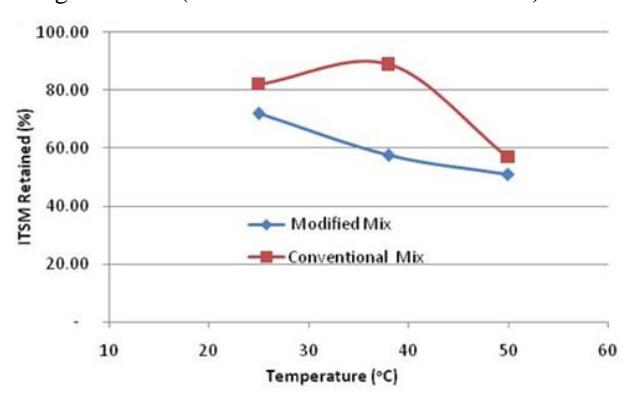
Figure 2. The relationship between ITSM retained and temperature
Table 6. Cantabro test results
Condition Dry Wet AC Unmodified Modified Unmodified Modified A (gram) 1089.1 1090.8 1093.5 1092.5 B (gram) 959.9 921 936.9 828.8 CL (%) 11.9 15.6 14.3 24.14
Note: A = Initial Weight before testing B = Final Weight after 300 cycles CL = Cantabro Loss (CL)= ((A-B)/A)
The asphalt concrete mixture using modified aggregate had a higher percentage of CL than the conventional mixture (see Table 6). This indicated that the use of waste plastic as an aggregate substitution in the asphalt concrete mixture could not improve mix durability in terms of improving particle loss or disintegration. This may be due to the fact that waste plastic as an aggregate substitution in the mixture causes the mixture to become stiffer, in turn causing a decrease in its ability to absorb vibration and impact during testing.
To examine the effect of waste plastic in asphalt concrete mixtures on moisture susceptibility, the percentage of CL was calculated in dry and wet conditions as an indicator of whether the mixture had low or high moisture susceptibility. The results indicated that the ratio of CL between wet and dry conditions for the modified mixture was higher than that of the conventional mixture (see Table 6). It was found that the use of waste plastic in the asphalt concrete mixture in wet conditions reduced aggregate-binder adhesiveness.
5. Conclusions
The following summaries have been drawn:
- 1. The use of waste plastic as a partial aggregate substitution can increase significantly the values of Marshall stability, tensile strength, and the stiffness modulus of asphalt concrete.
- 2. Increasing the test temperature caused reduction in mixture stiffness modulus. However, the stiffness modulus of the modified mixture was higher than that of conventional mixture.
- 3. The addition of waste plastic in the mixture caused a reduction in both moisture susceptibility and particle loss due to disintegration.
- 4. In general, the performance of asphalt concrete mixtures prepared using waste plastic as a partial aggregate substitution was better than that of conventional mixtures.
5 From this study, it could be recommended that asphalt concrete mixtures prepared using waste plastic as a partial aggregate substitution would be better if it applied in the mixture as a base course.