

Abstrak
Rasio antara kapasitas aksial pondasi tiang yang diukur melalui percobaan uji beban dengan kapasitas yang dihitung melalui formula dapat dianggap sebagai model error N yang menggambarkan kesalahan epistemic dalam perhitungan pondasi tiang. Data statistik N yang diperoleh dari berbagai lokasi dapat dianggap sebagai kecendrungan umum kesalahan (general error trend) yang melekat pada formula yang digunakan. Hasil percobaaan beban pada lokasi tertentu dimana bangunan terletak harus menjadi indikator langsung akan variasi kapasitas aksial tiang pada lokasi tertentu. Pada studi ini model error awal sebagai nilai kecendrungan umum dapat di update melalui kerangka teorema Bayes. Pengaruh kesalahan akibat friksi dalam alat tekan hidrolik disertakan dalam formulasi. Statistik nilai N yang baru dapat digunakan untuk menentukan kapasitas tiang ataupun angka keamanan yang dipakai dalam perencanaan untuk mencapai target keandalan tertentu.
Kata-kata Kunci: Kapasitas aksial fondasi tiang, teori bayes, ketidakpastian epistemik, angka keamanan, kesalahan model matematik.
1. Introduction
Friction capacity prediction of pile foundation driven in clay soils may be estimated using the conventional methods such as the α, β, or λ methods. Comparison between measured and predicted capacity for each method exhibits scatter of capacity due to simplification in bearing capacity formulae (Figure 1). The model error N has been introduced to denote this discrepancy. Statistics of N have been evaluated based on data gathered from various sites where each site is characterized by specific driving process, clay properties, measuring techniques etc. Therefore, statistics of N obtained from such a wide range of friction piles may be considered only as a general-error trend in capacity prediction, providing crude estimates of the model error in the absence of more specific data from the site. Of course, if information is available for a specific site, these prior statistics of N may be updated accordingly (Sidi, 1986)
Ideally, the objective of a pile load test program would be to obtain a reasonably accurate histogram to describe the variation of pile capacities throughout the site. Obviously, this is not feasible as the number of pile tests required would be much larger than those normally
performed in pile test program. However, the results of even a few load tests, whether proof-test or test to failure, should provide direct evidences of the pile capacity at a given site. Bayes theorem has been used (e.g., Tang and Ang, 1973; Moses, 1979; Tang, 1981) as a rational basis for combining new data with previous data to revise assessment of uncertainty and reliability. This study is devoted to the development of procedures for updating model error (N), and subsequently the predicted pile capacity with a results of single failure test.
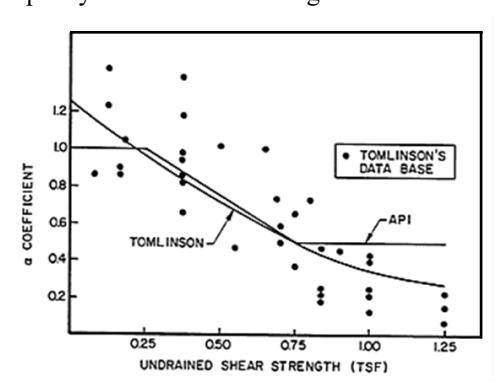
Figure 1. The scatter between predicted and measured pile capacities (Sidi, 1986)
2. Aleatory Uncertainty and Epistemic Uncertainty in Pile Capacity Prediction
In any engineering modeling, including pile capacity prediction, the sources of uncertainty may be classified into two broad types: (1) those that are associated with natural randomness; and (2) those that are associated with inaccuracies in the prediction and estimation of reality, mainly due to adopted mathematical simplification. The former may be called aleatory type, whereas the latter the epistemic type (Ang and Tang, 2007).
Among the components of uncertainty associated with determination of pile capacity, those due to inherent natural variability or aleatory uncertainty such as soil property and variability within a soil medium, are generally irreducible. Others might involve professional or judgemental uncertainties for which a full-scale test program or direct field measurements may be performed to reduce their respective levels of uncertainty. Therefore, it would be convenient to separate these two types of uncertainty:
\[Q_t = N Q_s \tag{1}\] where N = systematic model error or epistemic uncertainty of pile capacity, \(Q_s\) = static capacity based on either the \(\alpha\), \(\beta\), or \(\lambda\) methods as described in e.g., API 1984. The variables \(Q_t\), N, and \(Q_s\) are all random quantities: \(Q_s\) represents the inherent variation in pile capacity (Vanmarcke, 1977 and Tang and Sidi, 1984); N is epistemic uncertainty in pile capacity representing a conglomeration of different model uncertainties such model error in static equation, time effect, rate of loading effect, etc. The Bayesian updating process is used to reduce the epistemic uncertainty, but not the natural or inherent randomness of \(Q_s\).
3. Basic Formulation
Capacity of a pile can be measured in pile tests. However, in practically all load test programs, the true capacity of a pile, namely \(Q_t\), may not be always measured exactly. When the applied load in a load test is determined from hydraulic pressure, the measurements of applied axial loads can be in error due to friction in hydraulic jacks (Coyle and Sulaiman, 1970). Moreover, an uncalibrated load cell, or manometer used in reading the applied load may also contribute to the measurement error (Fellenius, 1984). Hence, upon recognizing these additional source of error, the anticipated measured capacity \(Q_t\) obtained from a load test program will be a random variable itself, which may be expressed as
\[Q_{r} = N_{j} N Q_{s}\] \[= N Q_{s}^{*}\] (2)
Where \(Q_s^*\) is given by
\[Q_s^* = N_j Q_s \tag{3}\] and \(N_j\) is a correction factor due to load measurement error. The effect of load measurement error increases the variability of the inherent part of pile bearing capacity given by
\[\Omega = \left(\Omega_{O_o}^2 + \Omega_{N_o}^2\right)^{0.5} \tag{4}\] where \(\Omega = c.o.v\) of the inherent part of pile bearing capacity. Statistics of the correction factor \(N_j\) corresponding to typical load test procedures is given in Fellenius (1984).
Invoking the Bayesian updating formula (e.g., Ang and Tang, 1975), the updated distribution of N with respect to load test results is given by
\[f_{N}^{"}(n) = k L(q_{r} | n) f_{N}^{'}(n)\] (5)
in which k= normalizing constant, \(L\left(q_r\mid n\right)=\) likelihood function of measured capacity for a given value \(n,\ q_r=\) measured capacity from load test, and \(f_N\) (n) distribution of N prior to the load test. The likelihood function can be written as
\[L(q_r \mid n) = f_{Qr}(q_r \mid n) \tag{6}\] where \(f_{Or}(q_r \mid n) = p.d.f\) of pile capacity over a site evaluated at \(q_r\), for a given N = n. Hence, Equation 5 becomes
\[f''_{N}(n) = k f_{Qr}(q_r | n) f'_{N}(n)\] (7)
By integrating over the uncertainty reflected in the posterior p.d.f of N, a marginal p.d.f of pile capacity \((Q_t)\) itself can be found, which is commonly referred to as the predictive distribution given by
\[f_{Qt}(q_{t}|q_{r}) = \int_{\mathbb{R}} f_{Qt}(q_{t}|n) f_{N}^{"}(n) dn\] (8)
and the updated reliability of pile foundation, denoted for instance by the event that load effect \(L_e\) would be less than \(O_h\) could be calculated from
\[P''(L_{e} \le Q_{b}) = \int_{n} P(L_{e} \le Q_{b}|n) f_{N}''(n) dn\] (9)
4. Updating with Single Failure Load Test
Evaluation of Equation 7 would require the p.d.f of N and \(Q_r\). The works by Kay (1976), Olson and Dennis (1982), and Sidi (1986) which indicate that model error N and pile capacity \(Q_r\) at a particular location within a site could be fitted by the lognormal distribution. Monte Carlo study performed by Madhav and Arumugam (1979) showed that \(Q_s\) may be fitted by either normal or lognormal p.d.f. In this study \(Q_s\) and \(N_j\) are assumed to be lognormal. This assumption is consistent with the log normality of \(Q_r\) since the product of three lognormal random variables \((N_j,\ N,\ and\ Q_s)\) should have a lognormal distribution also.
The likelihood function of \(q_r\) (single failure load test) for a given n, can be expressed as:
\[L(q_{r}|n) = \frac{1}{\sqrt{2\pi} \xi} \exp \left[ -\frac{1}{2} \left\{ \frac{\ln q_{r} - (\ln n + \lambda)}{\xi} \right\}^{2} \right]\] (10)
196 Jurnal Teknik Sipil which upon rearrangement of the terms in the exponent
\[L(q_{1r}|n) = L(q_{1r}|\ln n) = \frac{1}{\sqrt{2\pi} \xi} \exp \left[ -\frac{1}{2} \left\{ \frac{\ln n - (\ln q_{1r} + \lambda)}{\xi} \right\}^{2} \right] (11)\] in which \(\lambda\) and \(\xi\) are the parameters in the lognormal p.d.f of Q<sub>s</sub> . Equation 11 shows that the likelihood function of q<sub>r</sub> is identical to a normal p.d.f of ln n with a mean equal to (ln \(q_{\text{r}}\) - \(\lambda)\) and standard deviation equal to ξ. In terms of ln n, Equation 5 becomes
\[f''_{\ln N}(\ln n) = k L(q_{r} | \ln n) f'_{\ln N}(\ln n)\] (12)
Following Tang (1971), \(f_{\ln N}^{"}(\ln n)\) should have a normal p.d.f with mean
\[\lambda_n'' = \frac{\xi_n^2 \left( \ln q_r - \lambda \right) + \xi^2 \lambda_n}{\xi_n^2 + \xi^2}\] (13)
and standard deviation
\[\xi_n'' = \left(\frac{\xi_n^2 \xi^2}{\xi_n^2 + \xi^2}\right)^{1/2} \tag{14}\] where \(\lambda_n\) and \(\xi_n\) are parameters in the prior p.d.f of N. From Equation 8, it can be shown that Q<sub>t</sub> will follow a lognormal distribution with corresponding posterior parameters
\[\lambda_t^{"} = \lambda_n^{"} + \lambda_s \tag{15}\]
\[\xi_t'' = \left(\xi_n^{n2} + \xi^2\right)^{1/2} \tag{16}\]
respectively, and the updated mean and standard deviation of Q<sub>t</sub> are given by (see e.g., Ang and Tang, 1975)
\[\mu_{t}^{"} = \exp\left\{\lambda_{n}^{"} + \lambda + \frac{1}{2}\left(\xi_{n}^{"} + \xi^{2}\right)\right\}\] \[\tag{17}\]
\[\sigma_t'' = \mu_t'' \left\{ \exp\left(\xi_n''^2 + \xi^2\right) - 1 \right\}^{1/2}\] (18)
where \(\lambda_t^{"}\) and \(\sigma_t^{"}\) = the updated mean and standard deviation after conducting one load test.
5. Implementation of the Probabilistic Model
The effect of single failure test on the updated model error N is demonstrated in Figure 2. The updated mean value of N, namely \(\overline{N}\), increases as the ratio of \(q_r/Q_s\)increases. In other words, \(\overline{N}\) is directly proportional to the observed bias (q<sub>r</sub>/Q<sub>s</sub>) obtained from a single pile load test at a particular site. Figure 2 also shows the effect of load measurement error during the load test on the updated mean and c.o.v of model error N for the case of \(\overline{N} = 1.2\) (i.e., measured value overestimates the actual capacity by 20%) and the corresponding c.o.v of 10%. Compared to the case of no friction in the jack (i.e., \(\overline{N}_i = 1.0, \Omega_{N_i} = 0.0\)), the updated mean of the model error N is reduced by 7% to 17% as q<sub>r</sub>/Q<sub>s</sub> increases from 0.5 to 2.0. The updated c.o.v \(\Omega''_{\rm N}\) is also increased 22%. Therefore, if friction is suspected to be present in the loading jack, neglecting this factor in the updating process would overestimate pile reliability.
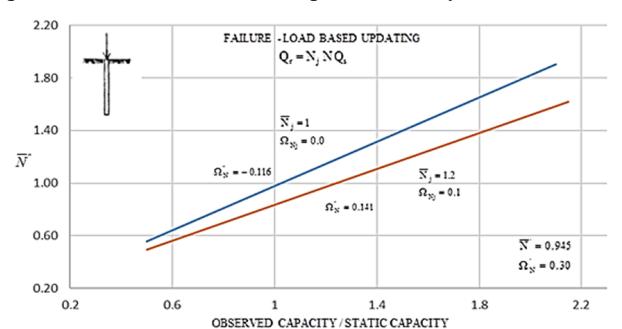
Figure 2. Model error updating with single failure-test (Sidi, 1986)
Figure 3 shows that substantial reduction in c.o.v of N is observed when the overall uncertainty of pile capacity is dominated by systematic error (i.e., c.o.v of N > c.o.v of Q<sub>s</sub>). In contrary, little benefit would be gained if uncertainty in Q<sub>s</sub> larger than that of N. If the inherent variability of \(Q_s\) given by \(\xi_s = 0.4\) and the uncertainty of N given by \(\xi_N' = 0.2\), the the updated of \(\xi''_N\) equal to 0.18, it is only 10 % reduction from the original \(\xi'_{N}\) = 0.2. However, if \(\xi_s = 0.15\) and \(\xi'_N = 0.3\), the posterior \(\xi\)"<sub>N</sub> = 0.14, it is almost 50% reduction from the original value.
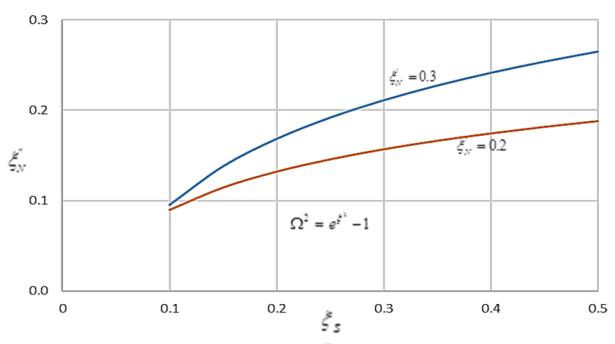
Figure 3. Variation of \(\xi^{"}_{N}\) with \(\xi_{S}\) (Sidi, 1986)
In the above procedure, the epistemic uncertainty (N) and inherent variability or aleatory capacity associated with pile capacity prediction are treated separately. the updating schemes affect only the epistemic one, not the inherent part. In other words, the uncertainty in the inherent part remains the same as it is before incorporating load test result. The inherent part in this case should be interpreted in a more general sense, it includes any factors which are not affected by the outcome of load test, e.g., the inherent spatial variability of the undrained shear strength, load measurement error, or the effect of loading rate N, in the common static load test.
If the epistemic uncertainty due to the model error of pile capacity has been updated due to a result of single pile load test, then subsequently the factor safety used in design procedures may be updated through a probabilistic frame work.
6. Conclusions
Based on the results of this study, the following conclusions can be made:
- 1. The mean value of updated of model error N is directly proportional to the ratio \(q_r\) and the static predicted capacity. The effect of load measurement error would overestimate the mean value of N by 20%.
- The effect of load measurement error due to friction in the jack would increase by the uncertainty of N by 22%.
- 3. Substantial reduction in c.o.v of N is observed when the overall uncertainty of pile capacity is dominated by systematic error, i.e., when \(\xi_s\) only 50% of \(\xi\)'<sub>N</sub>, the reduction of the uncertainty of N would reach a value of 50%.
- 4. In contrary, little benefit would be gained if uncertainty in \(Q_s\) larger than that of N. For a ratio of \(\xi_s\) / \(\xi\)'<sub>N</sub> equal to 2, the reduction in uncertainty only 15%.
- 5. The updated value of model error N can be used for updating the factor of safety used in design practice based on a certain safety index or to revise the predicted nominal capacity of pile foundation.