

Abstrak
Pemanfaatan limbah industri yang memiliki sifat pozolan banyak digunakan dan dimanfaatkan untuk menggantikan sebagian semen dalam campuran beton. Fly ash dan microsilica merupakan bahan-bahan bersifat pozolan dapat dimanfaatkan dalam membentuk ternary cementitious system. Nilai slump, porositas dan kuat tekan beton menjadi parameter dalam studi ini dalam melihat karakteristik beton yang menggunakan ternary cementitious system berbahan semen, fly ash dan microsilica. Tiga jenis campuran, yaitu campuran normal yang hanya menggunakan semen OPC sebagai bahan pengikat, campuran menggunakan semen OPC-fly ash-microsilica tanpa superplasticiser, dan campuran menggunakan semen OPC-fly ash-microsilica dengan tambahan superplasticiser dibuat untuk dibandingkan karakteristik betonnya. Penggunaan fly ash dan microsilica memperbaiki nilai slump beton segar serta terbukti memperkecil nilai porositas dari beton sehingga kuat tekan beton yang dihasilkan meningkat sejalan dengan uumur beton. Penurunan porositas dan peningkatan kuat tekan beton cukup signifikan dengan penambahan fly ash dan microsilica.
Kata-kata Kunci: Fly ash, microsilica, ternary cementitious system
1. Introduction
Concrete is a material that has been extensively consumed in construction industry. In general, raw materials of concrete are widely available in the field except cement, thus concrete becomes a famous material to use in construction industry. On the other hand, the maintenance of construction manufactured concrete is relatively easy and simple. Those factors significantly contributes to reduce construction cost of concrete buildings in comparison with others materials.
Compressive strength of concrete is a predominantly mechanical parameter to measure the quality of concretes. Water to cement (w/c) ratio is the principal variable to develop the quality of concrete, as Abram's postulate that ''for a given cement, method of test and age, the compressive strength of a fully compacted concrete depends only on the free water/cement
ratio" (Neville and Brooks, 1990). Cement is a hydraulic binder material and one of the materials which has significant effect on developing the quality of concrete. However, it is a relatively expensivemanufactured material needed in concrete buildings. Since it is a predominant need and high consumed in concrete buildings, a lot of research on cement replacement with alternative pozolanic materials such as ash rice husk, fly ash (Chopra et al., 2015), microsilica (Nili and Ehsani, 2015), metakaolin (Bai et al., 2000), and ground granulated blast furnace-ggbs (Babu and Kumar, 2000) have been carried out. The use of more than one of pozolanic materials to produce ternary cementitious system will beneficially induce to the properties of concrete. Therefore, this study investigates on the effect of ternary cementitious system of cement, fly ash and microsilica on the concrete properties which are workability, porosity and strength.
2. Pozolanic Materials
2.1 Fly ash
Fly ash is one of the three waste material results in coal combustion furnace in which it has pozolanic behaviour. As a waste material of coal combustion furnace, the physical and chemical properties of fly ash will be different at every single coal combustion furnace. The chemical and physical properties of fly ash on different countries (French and Smitham, 2007), are shown in Table 1 and 2.
2.1 Microsilica
Microsilica or silica fume is a furnace waste material in the manufacturing of silicon and ferro silicon metal. It is a material in form of noncrystalline polymorph silicon dioxide (Razak and Wong, 2011). In general, microsilica is powder with average diameter of 150 nm and having physical and mechanical properties as shown in Table 2 and 3 respectively.
Table 1. Chemical properties of fly ash (French and Smitham, 2007)
| Australia | Austria | Canada | France | Europe | Japan | NeCountry therlands | Spain | UK | USA | |
|---|---|---|---|---|---|---|---|---|---|---|
| Humidity | <1.0 | <1.0 | - | - | - | <1.0 | <1.0 | <1.5 | <0.5 | <3.0 |
| Loss of ignition | <4.0-6.0 | <5.0 | <12.0 (6.0) | <7.0 | <7.0 | <5.0 | <5.0 | <6.0 | <7.0 | <6.0 |
| SiO2 | - | - | - | >40 | - | >45 | - | - | - | - |
| SiO2 + Al2O3 | - | - | - | - | - | - | - | - | - | - |
| SiO2 + Al2O3 + Fe2O3 | - | - | - | - | - | - | - | - | - | <70 (50) |
| MgO | - | - | - | - | - | - | <4.0 | - | - | - |
| CaO (total) | - | - | - | - | - | - | <5.0 | - | <10 | - |
| CaO (free) | - | <5.0 | - | <1.0(2.5) | - | - | ||||
| Na2O terlarut | - | - | - | - | - | - | - | - | - | - |
| Na2O + K2O | - | - | - | <6.0 | - | - | - | - | - | - |
| Na2O equivalent | - | - | - | - | - | - | - | - | - | |
| Alkali evailability | - | - | - | - | - | - | - | - | - | |
| SO3 | <3.0 | <3.5 | - | <2.5 | <3.0 | - | <2.5 | <4.5 | <2.0 | <5.0 |
| Cl | - | <0.1 | - | <0.1 | <0.1 | - | <0.1 | - | <0.1 | - |
| Glass | - | - | - | - | - | - | >70 | - | - | - |
Table 2. Physical properties of cement, microsilica dan fly ash (Razak and Wong, 2011)
| Item | Ordinary Portland Cement | Microsilica | Fly ash | |
|---|---|---|---|---|
| (OPC) | ||||
| Specific gravity | 3.11 | 2.52 | 2.22 | |
| Average particel size (μm)2 | 23 | 9.50 | 9.4 | |
| Specific surface area (m2 /kg) | ||||
| metode Blaine | 340 | - | - | |
| metode serapan Nitrogen (BET) | 4200 | 9500 | 21300 | |
| Standard consistency (%) | 27.4 | - | - | |
| Setting time (min) | - | - | - | |
| awal | 110 | - | - | |
| Akhir | 300 | - | - | |
100 Jurnal Teknik Sipil
Table 3. Chemicals property dari microsilica (Razak and Wong, 2011)
| Microsilica | Composition |
|---|---|
| SiO2 | 81.35 |
| \(Al_2O_3\) | 4.48 |
| \(Fe_2O_3\) | 1.42 |
| CaO | 0.80 |
| MgO | 1.47 |
| \(SO_3\) | 1.34 |
| Na2O | - |
| K2O | - |
3. Experiment Overview
3.1 Materials
Materials used in this study were coarse aggregate with diameter ranging from 16 mm down to 5 mm, and fine aggregate ranging between 4.5 mm and 0.30 mm. Cement type I (OPC) with specific surface area of 338 m<sup>2</sup>/kg, Fly ash complied with BS EN450-1 kategori B (2005) and slurry microsilica complied with BS EN 12363-1(2005), and poly-carboxylate polymer based superplasticiser were used to produce specimens.
Three different concrete mixes were observed to investigate the effect of using fly ash and microsilica in concrete mix, particularly in terms of workability, porosity and compressive strength as shown in Table 4.
3.2 Compressive strength of hardened concrete
Compressive strength of hardened concrete was applied on six specimens of 100 x 100 x 100 mm cubes according to BS EN 12390-3: 2001 (2001), Figure 1.
Compressive strengths of hardened concrete specimens were computed based on equation (1) as follow:
\[f_c = \frac{P_{\text{max}}}{A} \tag{1}\]
Where \(f_c\) is compressive strength (MPa), \(P_{max}\) is maximum load (N), A is cross section area of specimen \((mm^2)\).
Table 4. Concrete mix propotions
| Item | Normal | MSFA* | Sp-MSFA** |
|---|---|---|---|
| Cement | 1.00 | 1.00 | 1.00 |
| Total water | 0.31 | 0.31 | 0.31 |
| Coarse agregate | 2.66 | 2.66 | 2.66 |
| Fine agregate | 1.14 | 1.14 | 1.14 |
| Fly ash | - | 0.15 | 0.15 |
| Microsilica | - | 0.11 | 0.11 |
| Superplasticiser | - | - | 0.002 |
3.3 Workability of fresh concrete
Consistency of fresh concrete was observed to evaluate the characteristics of fresh concrete when adding fly ash and microslilica. The consistency test method used for fresh concrete was slump test according to BS EN 12350-2 (2009).
3.4 Porosity of concrete
Total volume of pores in concrete is used to identify the level of concrete porosity (Neville, 1995). Cubes of 100 x 100x 100 mm were investigated to quantify the porosity of concrete. Equation (2) was applied to quantify porosity of concrete according to BS EN 772-4 (1998), as follow:
\[Porosity(\%) = \frac{W_2 - W_1}{W_2} \tag{2}\] where \(W_1\) is weight of oven dry specimen, and \(W_2\)is weight of saturated surface dry specimen. The method used to find out \(W_1\) and \(W_2\) is shown in Figure 2.
Figure 1. Compression test machine
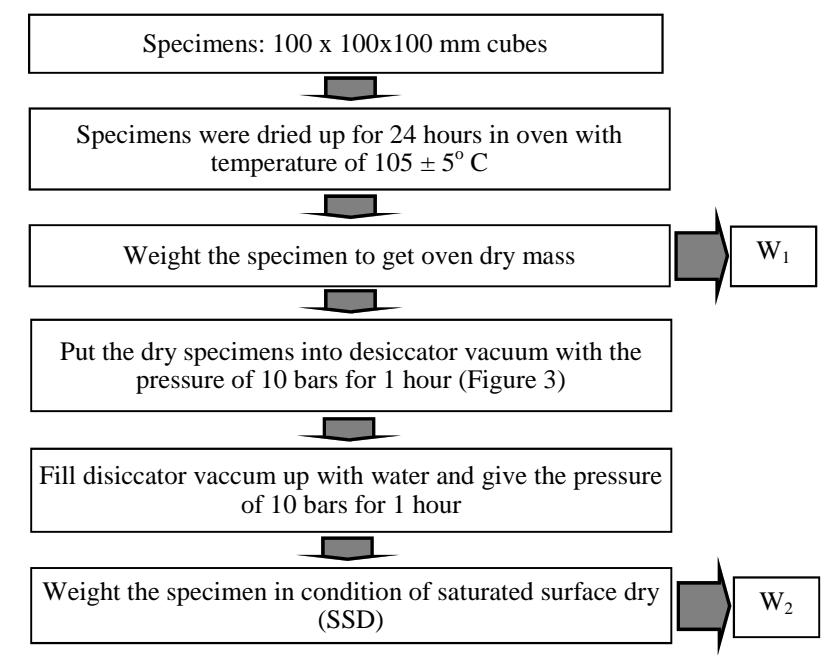
Figure 2. Flowchart to measure the porosity of concrete
Figure 3. Dessicator Vaccum
4. Result and Discussion
Workability or consistency of fresh concrete is a parameter to quantify fresh concrete to be casted in the field. Measuring height drop or vertical settlement of fresh concrete (slump value) is a simple way to identify the workability and consistency of the fresh concrete. Slump value of fresh concrete is dependent on materials' constituents of concrete. W/c ratio is a significant parameter in producing high slump value - workable fresh concrete (Mehta, 1986). As the w/c ratio of mix design remains same, other constituents of materials will play an important role in increasing the slump value. The effect of using fly ash and microsilica in the concrete mix on slump value is shown in Figure 4. For a given normal concrete mix with w/c ratio of 0.31, the slump value of fresh concrete was 20 mm. However, normal concrete mix with additional fly ash and microsilica have a slump value of 35 mm. Adding fly ash and microsilica in the normal concrete mix was found to increase the slum value around 75 % compared to slump value of the normal concrete mix. It indicates that fly ash and microsilica give an a noticeable effect on the workability of fresh concrete. Physical characteristic of fly ash and microsilica, in which average particle size is smaller than OPC-Table 2, plays a significant effect on increasing the workability of fresh concrete. As the aim of superplasticiser is to gain an applicable and workable fresh concrete, a fully compacted concrete can be accurately achieved. Adding superplasticiser by 2% of the cement weight in the concrete mix prompts to have a proper slump value, i.e. 100 mm slump value, as shown in Figure 4.
The measurement of concrete porosity with the age of 14, 28, and 56 days was carried out as shown in Figure 5. For normal concrete (blue diamond) at the age of 14, 28 1nd 56 days, the concrete have porosity of more than 2%. Concrete mix added by fly ash and microsilica tends to have hardened concrete with less porosity than normal concrete. Increasing workability of fresh concrete by adding superplasticiser significantly reduce the porosity of hardened concrete. The porosity of concretes drops to less than 1%. Finesses of fly ash and microsilica particles and the use of superplasticiser in the mix play important roles to make a fully compacted fresh concrete. Moreover, segregation and bleeding of concrete did not happen. Thus, these are factors that encourage the making concrete with less porosity.
Concrete compressive strength is a parameter that is used to determine the quality of concrete. Compressive strength of concrete manufactured with 3 different concrete mix designs is shown in Figure 6. Concrete compressive strength with the age of 14, 28 and 56 days are compared. Hardened concretes added by fly ash and microslilica tend to have higher compressive strength than normal concrete. However, concrete strength with the age of 14 days is below the compressive strength of normal concrete. For hardened concrete manufactured with concrete mix added by fly ash, microsilica, and superplasticizer, the concrete strength is the highest of all ages. This study shows that adding pozolanic materials in normal concrete mix significantly increases compressive
strength of hardened concrete. Physical properties of pozolanic materials (fly ash and microsilica) give benefit in avoiding segregation and bleeding of fresh concrete during full compaction. Chemicals property of
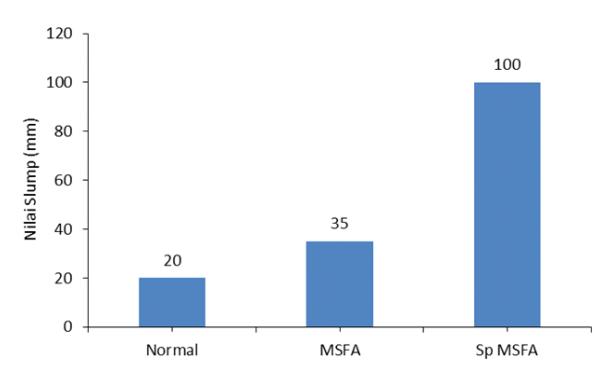
Figure 4. Slump value of concrete
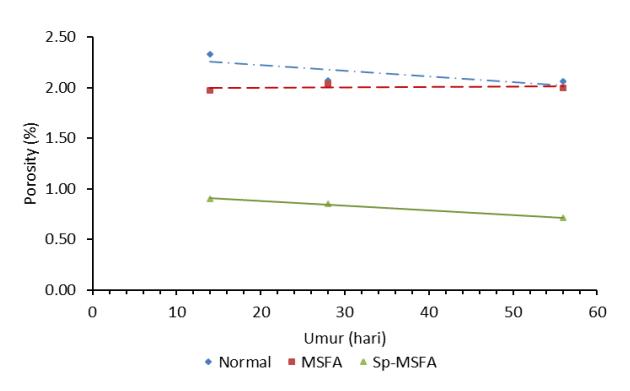
Figure 5. Porosity of concrete
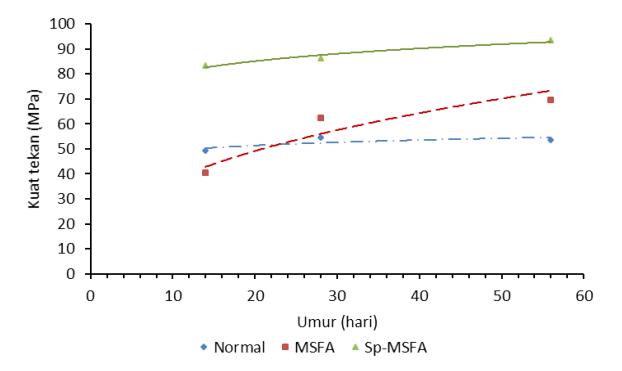
Figure 6. Compressive strength of concrete
pozolanic materials helps to transform and redistribute pores in concrete by doing pozolanic reaction with free calcium hydroxide to form new calcium silicate (Aitcin, 1998) and improves paste strength. Thus, fly ash and microslica are important materials to form ternary cementitious system in order to achieve high strength concrete.
5. Conclusion
Some conclusion that can be drawn on this study are as follows:
- 1. Fly ash and microsilica are influential materials in ternary cementitious system to reduce porosity of concrete.
- 2. Superplasticiser was found to play significant effect on producing high strength concrete using ternary cementitious system consist of fly ash and microsilica.