

Abstrak
Hot Mix Asphalt (HMA) merupakan jenis campuran beraspal yang umum digunakan sebagai material perkerasan lentur. Namun, HMA memiliki kelemahan dari sisi temperatur pencampuran dan pemadatan yang tinggi, sehingga menghasilkan gas CO<sub>2</sub> dan Gas Rumah Kaca (GRK) yang berdampak buruk terhadap lingkungan. Dengan demikian, dibutuhkan suatu jenis campuran beraspal dengan temperatur pencampuran dan pemadatan yang lebih rendah. Salah satu alternatif yang dapat dilakukan adalah dengan menambahkan zat aditif Sasobit<sup>®</sup> ke dalam aspal. Penelitian ini mencari kadar zat aditif Sasobit<sup>®</sup> terbaik yang dapat ditambahkan ke dalam aspal sehingga diperoleh temperatur pencampuran dan pemadatan yang terendah. Kadar zat aditif Sasobit® yang diteliti sebesar 1%, 2% dan 3% terhadap berat aspal, kadar sasobit yang lebih tinggi dari 3% tidak direkomendasikan karena akan mengakibatkan aspal semakin cair. Hasil penelitian menunjukan penambahan kadar zat aditif Sasobit® sebesar 3% dapat menurunkan temperatur pencampuran dan temperatur pemadatan sekitar 7ºC lebih rendah dibandingkan dengan campuran tanpa zat aditif Sasobit®. Selanjutnya penelitian ini membandingkan kinerja campuran beraspal yang menggunakan zat aditif Sasobit® (campuran Warm Mix Asphalt/WMA) dengan campuran beraspal yang tidak mengggunakan zat aditif Sasobit® (campuran Hot Mix Asphalt/HMA). Kinerja campuran yang diteliti antar lain Stabilitas Marshall, Modulus Resilien UMATTA dan Fatigue. Hasilnya, campuran WMA yang mengggunakan zat aditif Sasobit® sebesar 3% memiliki nilai stabilitas marshall 1160 kg dimana nilai ini lebih tinggi dibandingkan dengan stabilitas marshall yang diperoleh untuk campuran HMA yaitu 1075 kg. Akan tetapi, hasil pengujian UMATTA pada suhu 25°C dan 45°C menghasilkan nilai modulus resilien tertinggi pada campuran WMA (3080 Mpa dan 315 Mpa). Hasil pengujian kelelahan Campuran WMA lebih lentur dikarenakan memiliki nilai modulus elastisitas 4854 MPa dan flexural stiffness 4551 MPa pada regangan Tarik 500με dibandingkan dengan HMA.
Kata Kunci: HMA, WMA, sasobit®, temperatur
1. Introduction
Flexible pavement is the most widely used type of pavement. Until now, both the implementation technology and the type of material continue to develop to reduce CO2 and Greenhouse Gas (GHG) emissions, which then causes global warming, where the negative impact of road construction is pollution that comes from the process of making, laying and maintaining roads. One form of concern for the environment in the field of pavement construction is by making a green construction-based Warm Mix Asphalt (WMA), where the warm asphalt mixtures with various types of additives can reduce the mixing temperature, so it is expected to reduce CO<sub>2</sub> emissions from material fuel consumption during production, as well as cost savings for fuel user.
Concrete asphalt or so-called concrete asphalt layer is the surface layer of road pavement structure with a continuously graded asphalt mixture type which is expected to provide higher stability and durability. The problems in the field with the use of the concrete asphalt layer is the occurrence of early damage to the Asphalt Concrete- Wearing Course (AC-WC), where in the wear layer there is a greater potential for damage due to direct contact with the vehicle load.
Based on this background, an effort is needed to develop the use of warm mix asphalt for Asphalt Concrete-Wearing Course (AC-WC) with 60/70 asphalt pen materials and Sasobit® as an additive which could reduce the mixing temperature. Asphalt modification by adding Sasobit to reduce the mixing temperature is also expected to improve the performance of mixture, such as: durability and flexibility. Thus, cracks that are prone to warm asphalt mixtures can be overcomed by concrete asphalt mixtures. In addition, it is expected that this study can produce laboratory characteristic values of the warm asphalt mixture and the optimum percentage of addition of Sasobit® in the mixture in order to obtain optimum performance.
The purpose of this study are:
(1) Evaluate the optimum content of Sasobit® additives on the decrease of mixing temperature and compaction in the laboratory; (2) Analyze the effect of Sasobit® additives into asphalt pen 60/70 on the value of Complex Shear Modulus (\(G^*\)) and Phase Angle (\(\delta\)) by conducting a test using the Dynamic Shear Rheometer (DSR) and (3) Evaluate the value of the Resilient Modulus and fatigue of the AC – WC (HMA) mixture using asphalt pen 60/70, with AC-WC (WMA) mixture using 60/70+ Sasobit® asphalt pen at certain mixing temperatures and compaction.
In several countries, previous studies on warm mix have been conducted, one of them is by Cao and Ji (2011). Based on laboratory test results, it is recommended to use 3% Sasobit® in the mixture to obtain optimum results. Then it is also important to note that in the selection of the asphalt to be mixed with Sasobit®, the asphalt nature affects the results more than the Sasobit® percentage used.
Meanwhile, another researcher (Hanafi, conducted a laboratory test evaluation by using 3% Sasobit® and 1% Leadcap® additives from the asphalt weight. The value of WMA mixing and compaction temperatures with Sasobit® additives at 147°C / 137°C and with Leadcap® at 152°C / 143°C were obtained, where the Marshall result showed that the stability of HMA mixture is higher than the WMA mixture. The result of UMATTA test at 25°C and 45°C temperatures gave the highest value of resilient modulus for WMA mixture with Sasobit® additive (3150 Mpa).
2. Sasobit® Material and Laboratory Tests
Sasobit<sup>®</sup> crystalline is a good, long chain aliphatic poly methylene hydrocarbon produced from a coal gasification using the fischer-tropsch (FT) process, also known as the FT hard wax. Sasobit® melts in the temperature ranging between 185°F to 239°F (85°C to 115°C) and it is completely dissolved in the asphalt in temperatures above 239°F (115°C). Sasobit® is a product produced by the Sasol Wax United States. The additive for warm mixes with the Sasobit® can melt at temperatures that are low enough and entirely dissolved in asphalt, in addition it may also reduce the viscosity and increase the resistance to permanent deformation as well as not affecting the asphalt property in low temperature. In a previous study, Sasobit® was mixed at the optimum contents of 3% (Kuswian H, 2013).
Stiffness Modulus
This test was conducted to determine the resilient modulus of the asphalt mixture. The resilient modulus is the level of material elasticity and stiffness which is theoretically derived from the relationship between stress and strain of a material. The resilient modulus can be used, among others, as an assessment to predict stress, strain and displacement, and can be used as an approach to pavement planning or to evaluate pavement performance.
In this study, the resilient modulus was obtained by using the Universal Material Testing Apparatus (UMATTA), which refers to BS EN 12697-26-2004 Annex F. The test is classified as a non-destructive test that do not damage the test materials as the load given is relatively small. The UMATTA consists of a Control and Data Acquisition System (CDAS) device, a personal computer device and an integrated software.
Fatigue Cracking
Fatigue is a phenomenon of crack occurrences due to repeated loads that occur due to repetition of stresses or strains whose limits are still below the material strength limit (Yoder et al.,1975). The stress and strain values depends on the wheel load, stiffness and the basic nature of the pavement as a whole. According to SHRP-A-410 (1994), laboratory test methods that are good enough and possible to be used in measuring the nature of mixtures that affect fatigue performance are:
- 1. Direct axial tensile
- 2. Indirect tensile
- 3. Flexture fatigue test; with 2, 3 and 4 bending points.
- 4. Rotating bending
The resistance-to-fatigue test can use a four point loading test tool.
3. Research Methodology
The method used in this study is a laboratory experimental method. The primary data collection was carried out through a series of tests on aggregates, asphalt and mixtures. This study was conducted in the laboratory of the Bandung Institute of Technology and the Laboratory of Health Services of the Ministry of Public Works and Public Housing. In broad outline, this study can be seen in the following flow diagram.
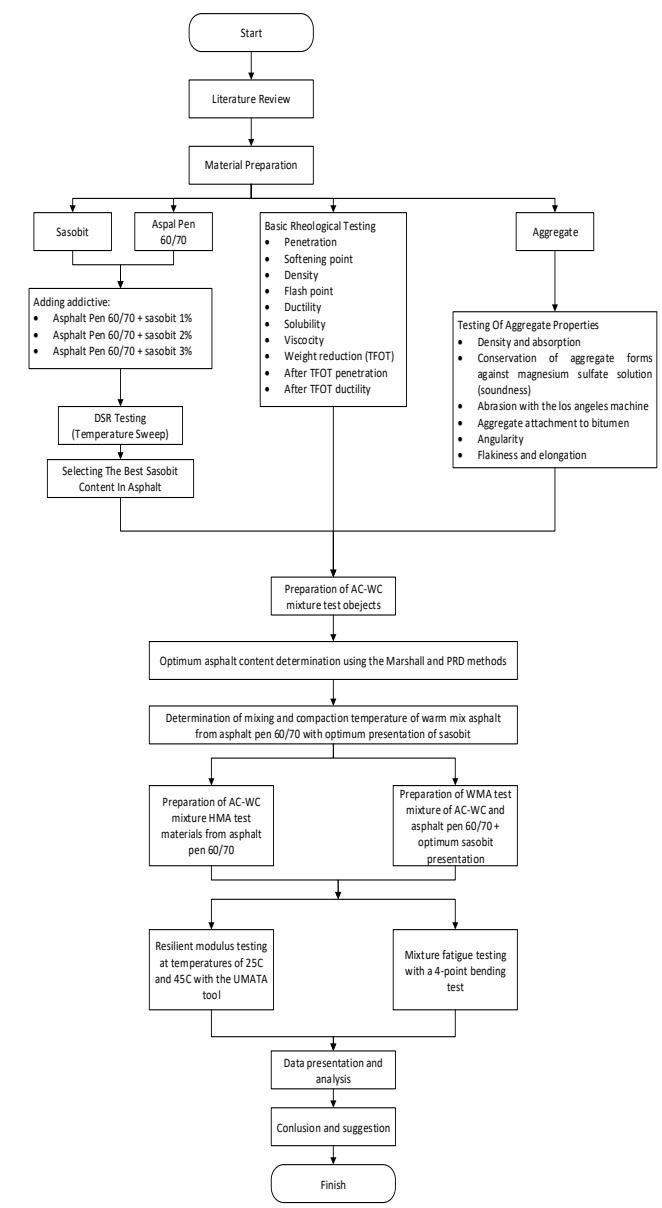
Figure 1. Research flowchart
4. Data Presentation and Analysis
4.1 Marshall stability
Stability is an empirical parameter to determine the ability of the pavement layer to withstand permanent deformation when receiving traffic loads without permanent changes in shape such as waves, rut, and bleeding (Asphalt Institute, 1989). The main factor that influences the stability value of a mixture is the aggregate gradation and the asphalt content. The stability value according to the general specifications of Bina Marga (2010 Edition:Revision 3) is limited to a minimum of 1000 kg for the modified asphalt concrete mixture. Comparison of the stability values of each mixture can be seen in Figure 2
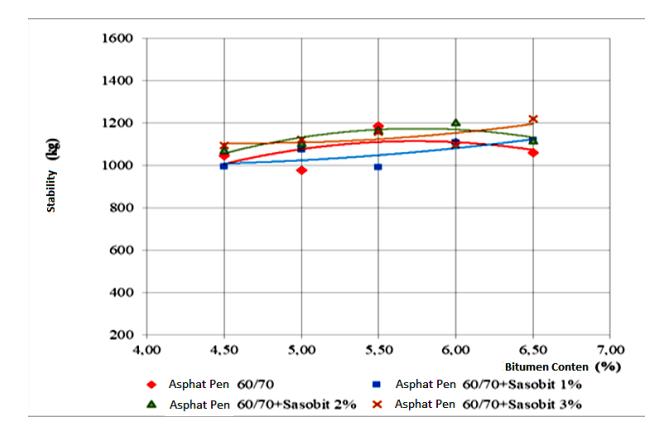
Figure 2. Marshall stability test results
Optimum Asphalt Content is the asphalt content that produces a mixture that satisfies all elements of Marshall parameters. The relationship between the optimum asphalt content of the asphalt pen 60/70 mixtures with various variations of Sasobit® can be seen in Figure 3.
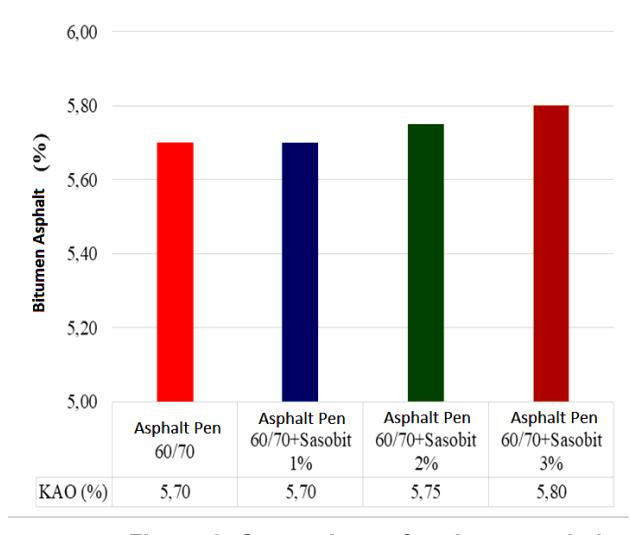
Figure 3. Comparison of optimum asphalt contents
From the Figure 3, it can be seen that the value of the Optimum Asphalt Content in the asphalt pen 60/70 mixture + Sasobit 3% (Warm Mix Asphalt) generates the highest value among asphalt pen 60/70 mixtures, and the asphalt pen 60/70 mixture + Sasobit 1% (Hot Mix Asphalt) has the lowest asphalt content. this shows that the ability to flow of asphalt pen 60/70 and Asphalt Pen 60/70 + Sasobit 1% (Hot Mix Asphalt) is better, so it does not need a lot of asphalt to fill the voids. Furthermore, the asphalt content will be used to determine the compaction and mixing temperature of the warm mix.
4.2 Analysis of the selection of the best sasobit® contents in asphalt
The parameters to be examined are the relationship between Performance Grade (PG) and viscosity value. The following is a Performance Grade (PG) table with viscosity value.
Table 1. Performance grade (PG) with viscosity value.
| No | % | PG | Viskosity (eSt) | |||
| Sasobit | 120 | 130 | 140 | 160 | ||
| 1 | 0% | 66.9 | 998 | 674 | 349 | 146 |
| 2 | 1% | 71 | 800 | 543 | 344 | 142 |
| 3 | 2% | 72.1 | 796 | 501 | 259 | 116 |
| 4 | 3% | 70.4 | 789 | 477 | 216 | 107 |
Because this study used the Warm Mix, it is recommended to use a low PG and a low viscosity value, which is obtained at Sasobit Content of 3%. For asphalt with a low viscosity value, the compaction and mixing temperature are also low. This might affect the quality of the asphalt used, because the implementation at low temperatures allows no damage to the asphalt pen. Besides that, Pen 60/70 + Sasobit 3% asphalt has a high value of stability compared to other mixtures, so it can withstand permanent deformation when receiving traffic loads without any permanent changes in shape such as rutting and bleeding.
4.3 Modulus testing data analysis
The resilient modulus is an elasticity modulus based on a reversable deformation. The asphalt, gradation, temperature and loading time factors affect the resilient modulus. The higher the temperature, the smaller the resilient modulus value is because the asphalt is visco-elastic, which means, it can change from viscous to elastic or vice versa due to the influence of temperature. The test results at 45°C show the smallest resilient modulus value compared to the one at 25℃ and can be seen in Figure 4.
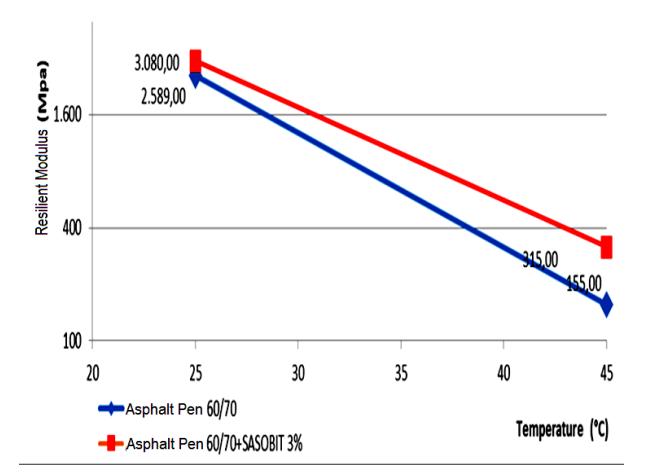
Figure 4. Relationship between the resilient modulus and temperature
Table 2 Table 2 shows the largest percentage reduction in Resilient Modulus occurs in an increase in test temperature from 25ºC to 45ºC in warm mix asphalt with 3% of Sasobit. This shows that the addition of 3% Sasobit at low temperatures results in a lower resilient modulus value, which indicates that the mixture has a higher level of elasticity (bigger total recoverable deformation) so that the base layer is better at holding cracks.
Table 2. Resilient modulus value at a certain temperature
| Mixture Type | Resilient Modulus (MPa) | % | |
|---|---|---|---|
| 25°C | 45°C | Decrease | |
| asphalt pen 60/70 | 2.589 | 155 | 94,01 |
| asphalt pen 60/70 + SASOBIT 3% | 3.080 | 315 | 89,77 |
4.4 Fatigue test data analysis
The strain given to the tested mixture consisted of 3 (three) levels: 500 με, 600 με, and 700 με. The choice of strain level was based on the requirements of AASHTO T 321-03 which requires strain values ranging from 250 με - 750 με. However, in field conditions, the occurred strains were less than 500 με. The relationship between strain and fatigue life for each mixture variation is presented in Figure 5.
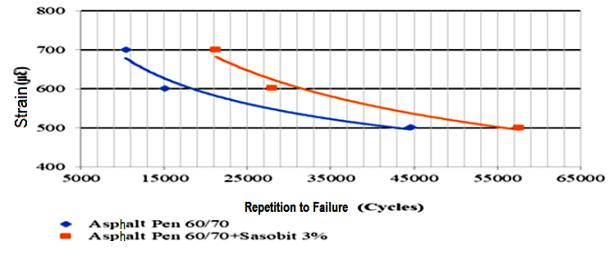
Figure 5. Comparison between fatigue life and strain
Figure 5 shows that the asphalt pen 60/70 + Sasobit 3% has a higher repetition to failure than the asphalt pen 60/70. Previously, it was explained that the asphalt pen 60/70 + Sasobit 3% produced a smaller stress and had a smaller modulus of elasticity, so the asphalt pen 60/70 + Sasobit 3% was more flexible than the asphalt pen 60/70. Since the asphalt pen 60/70 + Sasobit 3% is more flexible, the fatigue life must be longer than the asphalt pen 60/70.
Table 3. Comparison between tensile strain and the repetition to failure (cycles)
| Mixture | Tensile Strain | Tensile Strain | Initial Flextural | Repetition to failure |
|---|---|---|---|---|
| Type | (με) | (kPa) | Stiffness | (Cycles) |
| 501 | 2.402 | 4790 | 44560 | |
| asphalt pen 60/70 | 601 | 3.01 | 5006 | 15050 |
| 700 | 3.707 | 5296 | 10410 | |
| 500 | 2.274 | 4551 | 57550 | |
| asphalt pen 60/70+Saso | 602 | 2.354 | 3913 | 27990 |
| bit 3% | 700 | 3.611 | 5156 | 21220 |
5. Conclusion
The conclusions from the data processing and analysis result in this study are as follows:
- 1. The addition of Sasobit® in the AC-WC mixture increases the Marshall stability, where the asphalt pen 60/70 + Sasobit® 3% mixture has a marshall stability value of 1160 kg; this value is higher than the marshall stability obtained for the asphalt pen 60/70 mixture, which is 1075 kg.
- 2. The use of Sasobit® additives of 3% is more effective to decrease the mixing temperature to 147°C and the compaction temperature to 137°C, where at this level the values of VIM, VMA, VFA, stability and flow still meet the requirements.
- 3. The results of the DSR data analysis show that the addition of Sasobit® caused an increase in the value of the complex shear modulus and a decrease in the phase angle, making the asphalt more elastic, especially at low temperatures. The Sasobit additive does not change the Visco-Elastic properties of asphalt, and the Performance Grade values for each asphalt with and without additives do not change — at the PG value of 66.9 from the analysis results.
- 4. Based on the results of the UMATTA test at temperatures of 25°C and 45°C, the highest values were found in the mixture of asphalt pen 60/70 +Sasobit® 3% (3080 Mpa and 315 Mpa). In addition, the comparison result of the resilient modulus of the UMATTA test results with the theoretical approach show that the Nottingham equation ratio is 1.064 for the asphalt pen 60/70 and 1,911 for the asphalt pen 60/70 + Sasobit® 3% mixture.
- 5. The fatigue resistance test with strain control showed that the asphalt pen 60/70 + Sasobit® 3% mixture can increase the fatigue life, compared to the asphalt pen 60/70 mixture. The theoretical fatigue life gives a higher value than the test results, therefore it is necessary to do a calibration with the adjustment factor (fp) of 1.4290 so that the theoretical fatigue life value is near to the test conditions.
- 6. It can be concluded that in this study, in terms of the decrease in the temperature of mixture's compaction and fatigue resistance, the optimum mixture was obtained for Sasobit® mixture of 3%.
6. Suggestions
Based on the results of the study, the following suggestions are proposed:
Further research is needed to mix the AC-WC in the form of a permanent deformation and fatigue test at stress control condition to find out the characteristics of a warm mixture with the addition of Sasobit<sup>®</sup>.
It is necessary to conduct a further test for warm mix asphalt of AC-WC with 2.5% Sasobit® content to determine the optimum value of the mixture and to analyze the effect of the addition of Sasobit® into the asphalt pen 60/70 on the value of Complex Shear Modulus (\(G^*\)) and Phase Angle (\(\delta\)) by conducting a test using the Dynamic Shear Rheometer (DSR) tool.