

I Made Agus Ariawan
Department of Civil Engineering, Faculty of Engineering, Udayana University Bukit Jimbaran - Bali, 80361 E-mail: agusariawan17@unud.ac.id
D. M. Priyantha Wedagama
Department of Civil Engineering, Faculty of Engineering, Udayana University Bukit Jimbaran - Bali, 80361 E-mail: priyantha@civil.unud.ac.id
Abstrak
Penelitian ini bertujuan untuk memodelkan dan menganalisis persepsi wisatawan domestik yang mengendarai sepeda motor terhadap keselamatan lalu lintas di Provinsi Bali. Structural Equation Model disusun untuk menganalisis hubungan kausal antara karakteristik, persepsi dan sikap pengendara sepeda motor. Hasil studi menunjukkan bahwa wisatawan domestik usia muda dibandingkan yang berusia lebih tua saat mengendarai sepeda motor lebih kecil kemungkinannya untuk berkendara dengan kecepatan tinggi di jalan raya. Sementara itu, tingkat pendidikan wisatawan domestik tidak berpengaruh secara signifikan dalam peningkatan kesadaran terhadap keselamatan berlalu lintas saat mengendarai sepeda motor. Wisatawan domestik yang teridentifikasi pengendara sepeda motor yang agresif cenderung berperilaku yang beresiko seperti berkendara dengan kecepatan tinggi di jalan raya. Berkendara dengan kecepatan tinggi juga berkontribusi signifikan terhadap tingkat keparahan korban luka-luka akibat kecelakaan lalu lintas. Studi lanjutan terkait temuan pada penelitian ini dibahas pada artikel ini dan beberapa inisiatif untuk meningkatkan keselamatan lalu lintas bagi pengendara sepeda motor di Bali.
Kata Kunci: Wisatawan domestik, sepeda motor, persepsi, keselamatan lalu lintas
1. Introduction
Motorcycles have been considered as the most common way of travelling around Bali where is viewed as one of popular tourist vacation spot in Indonesia. In fact, more than 80% of mode shares in Bali were motorcycles (Statistics of Bali Province, 2018). Many international and domestic tourists prefer either leasing an automobile with or without driver or a motorcycle in Bali to the existing public transport due to its lack of service quality. On the other hand, traffic rules and regulations in Bali have been considered not to meet with driving or riding standard patterns (Wedagama, 2017). For instance, motorcycles passed another vehicle through the left side or pulled out into traffic without looking and expecting other road users to give away.
Past studies conducted in Indonesia have examined
various psychological and psychosocial factors affecting local motorcyclist behaviour such as intentions and aggression, sensation seeking and attitudes, (Joewono et.al., 2015; Susilo et.al., 2015). Tourist safety may be tricky as lots of tourists while riding on the road are regularly unaware of traffic risks they will challenge in an unusual environment. Tourists choosing mode of transport eventually are conscious of their personal safety while on the road (Nutsugbodo et.al, 2018), the risk confronted by tourists however, is of concern to road safety researchers because the probability to get involved in a road accident even as on vacation.
Preceding studies counselled that figuring out and analysing the effect of various motorcyclist perceptions is critical to planning and building up excessive excellent responses to enhance motorcyclist safety (Duong and Parker, 2018; Kaplan et.al, 2018).
Provided that motorcycles are distinctly prevalent and favoured mode of transport and are over signified in traffic accidents in Bali, an investigation is needed to increase motorcycle safety in Bali by means of examining variety of psychosocial factors contributing motorcycle riding behaviour. Had the recognition of Bali as a well-known tourist spot and the vast operate of motorcycles, it's far important to take a look at these elements in samples of domestic tourists with an attention to advance motorcycle traffic safety policies in Bali.
The study therefore, aims to model and analyse motorcyclists' perception on motorcycle traffic safety using a case study of domestic tourists in Bali. This research entails socio-demographic traits of motorcyclists focusing to education level, age, gender, exposure in relation to distance travelled, riding license ownerships and experiences of minor accidents and casualties for the past three years. Many motorcyclists may also use this information to make ideal adjustments in their riding styles. This study is expected providing the understanding of road safety problems from a domestic tourists' point of view and important data on components influencing motorcyclist risky riding behaviour.
2. Methods
A self-reported questionnaire was prepared for this study in samples of domestic tourist riding motorcycle. The survey changed into modified from past motorcycle safety research surveys constructed in the Australian context (Watson et al, 2007; Rowden, et.al, 2009). A past study by Ulleberg and Rundmo (2003) indicated that self-reported driving/riding behaviour is appropriate method to be used for cross sectional survey as it showed a constant behaviour pattern and expected a steady indicator of driving behaviour. As the matter of fact, motorcyclists may not perfectly consider on their affiliation in traffic accidents and casualties for the remaining 3 years. As said in advance, a self-reported technique is practicable to carry out unnamed surveys that provide profound statistics approximately unusual behaviour and its motivational factors (Lajunen et al., 2004 in Steg & Brussel, 2009).
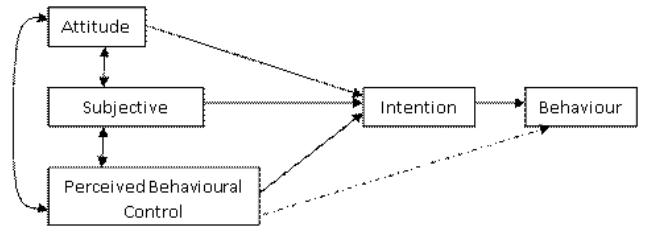
Figure 1. Theory of planned behaviour
The questionnaires were circulated to 200 randomly selected domestic tourists riding motorcycle in Bali. Because of missing data however, the effective respondents contained in the analysis were 184 domestic tourists riding motorcycle aged range between 17 and 64 years (mean age = 28, SD = 8.98, 86 females and 98 males).
As presented in Figure 1, Theory of Planned Behaviour (TPB) was become a concept that associated between human behaviour and human belief (Ajzen, 1991). The idea of TPB is to augment on the analytical ability of the Theory of Reasoned Action (TRA). Attitude towards perceived control over the behaviour, social norm with respect to the behaviour, the behaviour and are generally determined to expect behavioural intentions with a distinguished grade of precision. Behavioural intention is stated a sign of a personal willingness to carry out a given behaviour. It is expected to be an immediate basis of behaviour. Behavioural intention is recognised as the exceptional predictor of behaviour. For precise discussions on TPB the reader is suggested to Ajzen (1991).
All components of this planned behaviour theory are interpreted into a case of domestic tourists riding behaviour and motorcycle traffic safety. TPB is subsequently used as a basis to conduct the (selfreported) questionnaire. The constructed questionnaire contained of three main sections consisting of a complete of 56 key questions as shown in Table 1. The questionnaire received data relating to respondents' perceptions, descriptions on self-riding reported riding behaviour, respondents' personal traits and riding experiences respectively.
Table 1. The designed questionnaire
- I. Perceptions on riding a motorcycle
- Q2. Six reasons to ride a motorcycle (1: Not important at all; 7: Very Important).
- Q4. Eight perceptions on risky riding behaviours while riding (1: Strongly disagree; 7: Strongly agree).
- Q5. Seven types of attitudes while riding over the past 12 months (1: Never; 7: Always).
- Q6. Twenty two perceived behaviours on traffic law and offensive riding (1: Strongly disagree; 7: Strongly agree)
- II. Road traffic accident and casualties of motorcyclists had in the last 3 years whilst riding on-road
- Q21. Four types of minor accidents (single and multiple accidents)
- Q22. Four types of casualties (single and multiple accident casualties)
- III. Motorcyclist' descriptions and riding license ownership
- Level of education
- Riding experience (license ownership)
- Travel distances
- Age
- Gender
90 Jurnal Teknik Sipil
The perceptions of domestic tourist riding motorcycles have been indicated with responses to elements containing perceptions on riding a motorcycle, road traffic accident and casualties of domestic tourist had in the last 3 years, demographic traits and riding license ownership. Items questioned to the respondents have been used to assess their subjective evaluation of their perceptions on riding motorcycles ranging from 1 (not important at all) to 7 (very important). In addition, the respondents were enquired to assess their subjective evaluation on risky riding behaviour extending from 1 (strongly disagree) to 7 (strongly agree) and to assess their attitudes while riding over the past 12 months ranging from 1 (never) to 7 (always). Second, the respondents have been required to assess subjective evaluation of perceived behaviours on traffic law and offensive riding ranging from 1 (strongly disagree) to 7 (strongly agree).
As mentioned earlier, this study is to examine the psychosocial elements associated with self-reported intentions to perform perceptions of domestic tourists riding motorcycle on traffic safety. In principle, a high risk motorcyclist does not have to encounter a serious accident but should have a 'high risk' of having one (Tunnicliff, 2006). The demographic variables including education level, riding experiences (license ownerships) and kilometres travelled have been found to influence motorists behaviour in relation to traffic safety (Hassan and Abdel-Aty, 2013; Joewono, et.al, 2015). Hence, this study specifically incorporates the characteristics of motorcyclists in terms of riding license ownerships, education levels, age, gender, motorcyclist' perceptions on riding motorcycles and exposure in terms of distance travelled.
Hypothesised models below are involved to examine the association among the items presented in Table 1:
H1: demographic traits and riding experiences are believed to affect motorcyclist' risky behaviours (i.e. cornering & speeding)
H2: demographic characteristics and riding experiences are believed to affect motorcyclist' aggressive riding.
H3: accident and casualty experiences are believed to influence motorcyclist' risky behaviours (i.e. cornering & speeding).
H4: accident and casualty experiences are believed to influence motorcyclist' aggressive riding.
H5: aggressive riding are believed to affect motorcyclist' risky behaviours (i.e. cornering & speeding)
At large, these measures are deemed as relevant to signify the perceptions of domestic tourists riding motorcycle in Bali. Regular riding styles in Bali were noticed contrarily to these in the developed countries. For example, motorcyclists in Bali are habitually twisting amongst unmoving or moving motor vehicles to move forward of the crowded traffic.
3. Model Development
Considering both items on Table 1 and hypothesised models above, the perception data have been assigned on a 7-point Likert scale and are statistically ordinal variables. All perception data were examined with Principal Component Analysis (PCA) while the reliability analysis was performed with Cronbach's Alpha. PCA is used to characterise uncorrelated linear combinations of covariates from the correlated ones to avoid multicollinearity. PCA is also employed to verify that the selected linear combinations containing maximum variance.
The circumstances for accomplishing the PCA for this study were seen in which rotated principal component loadings and reliability values more than 0.7 with 20% or more explained variances and eigenvalues more than 1 (Hooper, et.al, 2008). Eigenvalues are suitable to examine number of factors put in the analysis while, the cronbach's alpha coefficient of 0.7 or greater is usually counted as the minimum acceptable value (Kline in Fyhri and Backer-Grøndahl, 2012; Ma et.al in Hassan and Abdel-Aty, 2013). In addition, an alpha value of 0.8 indicates the scales have high levels of internal consistency (Loo, et.al, 2015). This coefficient stands for internal consistency level of items within a test. By definition, a cronbach's alpha is considered as measure of scale reliability measuring the appropriateness of variables or items in evaluating a single and unidirectional latent construct (Ma, et.al in Hassan and Abdel-Aty, 2013).
Considering this study objective, the components of perceptions on risky riding as shown in Table 1 (code: Q4) are employed as the dependent variables (DVs). The PCA results were shown in Table 2. Only variables fulfill the situations for conducting the PCA are presented in the table. In other words, components of motivations for riding a motorcycle (Q2) and perceived behaviours on traffic law and offensive riding (Q6) were not included in the model constructions. Table 2 shows that two components were kept in latent variables describing 46.69% and 35.51% for variances of perceptions on risky riding and aggressive riding respectively. In addition, the items of perceptions on risky riding and aggressive riding on the models indicated a high level of consistency of 0.849 and 0.669 respectively.
As shown in Table 3, the total sample was 184 domestic tourists riding motorcycle in Bali comprised of 86 females and 98 males. The highest percentage of age of the respondent was young motorcyclists by 46.74% (i.e between 17 and 24 years), followed with ages between 25 and 39 years and between 40-59 years by 40.76% and 11.41% respectively. Meanwhile, male and female respondents were relatively equal by 46.74% and 53.26% respectively. The education level of the respondent was mainly those who passed senior high school by 50%, succeeded with those who graduated from college or universities by 48.37%. The respondents had mainly riding experiences more than
Table 2. Observed and latent variables of domestic tourists ride motorcycles
| Dependent variables | Reliability | |||||
|---|---|---|---|---|---|---|
| Observed variables | Latent variables | Loading factors | % Variance explained | Cronbach's Alpha | ||
| Q4.2 | I like the vibe of fast acceleration | 0.813 | ||||
| Q4.4 | I enjoy a genuine rush out of fast riding | Cornering and speeding | 0.859 | 46.694 | 0.849 | |
| Q4.5 | I like cornering as quick as possible | 0.760 | ||||
| Q4.7 | I enjoy my adrenaline raised while riding | 0.801 | ||||
| Independent variables | ||||||
| Q5.3 Q5.4 | Threatening other road users using any means Lost temper due to other irritated road user | Aggressive riding | 0.741 0.847 | 33.505 | 0.669 | |
Table 3. Characteristics of domestic tourists riding motorcycles
| Observed Variables | Categories | Samples (persons) | |
|---|---|---|---|
| 17-24 years - young motorcyclists (code =1) | 86 | ||
| 25-39 years - junior workers (code =2) | 75 | ||
| Ages | 40-59 years - senior workers (code =3) | 21 | |
| > 60 years - older motorcyclists (code =4) | 2 | ||
| Gender | Female (code = 0) ; Male (code = 1) | 86; 98 | |
| Elementary School (code = 1) | 1 | ||
| Junior High School (code = 2) | 2 | ||
| Education Level | Senior High School (code = 3) | 92 | |
| Tertiary Education (code = 4) | 89 | ||
| < 1 year (code = 1) | 7 | ||
| Riding experiences expressed in | 1 - 5 years (code = 2) | 55 | |
| number of years a motorcyclist owned a riding license) | > 5 - 10 years (code = 3) | 48 | |
| > 10 years (code = 4) | 74 | ||
| Less than 1000 kms (code =1) | 28 | ||
| Travel distances for the last 12 | Between 1000 & 4999 kms (code = 2) | 99 | |
| months | Between 5000 & 9999 kms (code = 3) | 26 | |
| 10000 kms or more (code = 4) | 31 | ||
| Minor accidents for the last 3 years involving 1 vehicle while riding a motorcycle and while driving another vehicle | 161 (28) | ||
| Accident and casualty | Minor accidents for the last 3 years involving ≥ 2 vehicles while riding a motorcycle and while driving another vehicle | 60 (12) | |
| experienced by motorcyclists | Minor casualties for the last 3 years involving 1 vehicle while riding a motorcycle and while driving another vehicle | 80 (12) | |
| Minor casualties for the last 3 years involving ≥ 2 vehicles while riding a motorcycle and while driving another vehicle | 51 (5) | ||
10 years by 40.21% and only 3.80% less than 1 year. There were 87.5 % and 43.48% of respondent had minor accidents and casualties respectively for the last 3 years which involving one (1) vehicle while riding a motorcycle.
Domestic tourist riding motorcycle were associated with cornering & speeding containing of statements 'I like the vibe of fast acceleration', 'I enjoy a genuine
rush out of fast riding', 'I like cornering as quick as possible' and 'I enjoy my adrenaline raised while riding'. More specifically, domestic tourists riding motorcyclists in Bali were convincingly related with statements of 'I like the vibe of fast acceleration', 'I enjoy a genuine rush out of fast riding' and 'I enjoy my adrenaline raised while riding'' with loading factors of 0.813, 0.859 and 0.801 respectively. In addition, domestic tourists riding motorcycles were convincingly
related with a statement of 'Lost temper due to other irritated road user' with loading factors of 0.847. This suggests that domestic tourists in Bali like to ride motorcycles mainly containing cornering & speeding behaviours which may have an important effect on their safety and or risk taking intentions (Watson et.al, 2007). Domestic tourist riding motorcycle were associated with cornering & speeding containing of statements 'I like the vibe of fast acceleration', 'I enjoy a genuine rush out of fast riding', 'I like cornering as quick as possible' and 'I enjoy my adrenaline raised while riding'. More specifically, domestic tourists riding motorcyclists in Bali were convincingly related with statements of 'I like the vibe of fast acceleration', 'I enjoy a genuine rush out of fast riding' and 'I enjoy my adrenaline raised while riding" with loading factors of 0.813, 0.859 and 0.801 respectively. In addition, domestic tourists riding motorcycles were convincingly related with a statement of 'Lost temper due to other irritated road user' with loading factors of 0.847. This suggests that domestic tourists in Bali like to ride motorcycles mainly containing cornering & speeding behaviours which may have an important effect on their safety and or risk taking intentions (Watson et.al, 2007).
The measures shown in Table 4 is employed to assess goodness of fit of the constructed model results as presented in Table 5. Based on Table 1, \(\chi^2\)/df, p-value, NFI, CFI and PNFI values are satisfactory. The constructed models therefore, are statistically adequate.
Figure 2 shows the conceptual structures of constructed model were developed in line with the hypothesised model, the correlations between observed and latent variables, as well as correlations among latent variables. Structure Equation Model (SEM) is used to signify a complicated relationships among latent/hypothetical/unobserved and observed variables. The use of latent variables do eliminate measurement errors so that more valid coefficients are acquired. In addition, all coefficients in the SEM model are determined simultaneously so that the significance and strength of a
Table 4. Validation measures of SEM
| Fit Indices | Test Statistics | Indicator Value | ||
|---|---|---|---|---|
| \(\chi^2\) /df | Absolute fit test | < 5 | ||
| p-value | < 0.05 | |||
| Comparative Fit Index (CFI) Normed Fit Index (NFI) | Incremental fit test | Between 0 and 1, close to 1 is better Between 0 and 1, close to 1 is better | ||
| Parsimony Normed Fit Index (PNFI) | Parsimonious fit test | > 0.5 | ||
particular relationship within the complete model are able to evaluate. In addition, this study employs validity criteria from Lai (2011) as shown in Table 4. The SEM in this study is constructed with a software of IBM SPSS AMOS (version 23). The reader interested in further specified topics on PCA and SEM may consult to Hair et al. (2010).
Figure 2 offers the conceptual path models of domestic tourist riding motorcycles in Bali with two-level influential paths from socio demographic characteristic of motorcyclists and traffic accidents and injuries experienced by the motorcyclists to two latent variables of cornering & speeding and aggressive riding in the last 12 months. For that reason, cornering and speeding was identified as endogenous variables in the SEM, while education, ages, license, gender, travel distances and a latent variables of aggressive riding in the last 12 months were indicated as exogenous variables.
The latent variables of cornering and speeding for constructed models are determined with four observed variables of Q42 (I like the vibe of fast acceleration), Q44 (I enjoy a genuine rush out of fast riding), Q45 (I like cornering as quick as possible) and Q47 (I enjoy my adrenaline raised while riding). Meanwhile, a latent variable of aggressive riding was measured with Q53 (Threatening other road users using any means) and Q54 (Lost temper due to other irritated road user).
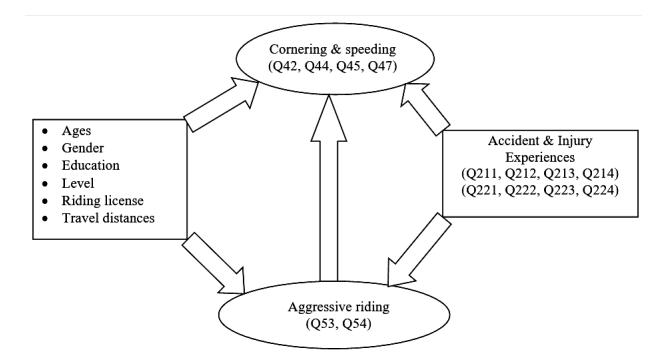
Figure 2. The conceptual model of domestic tourists riding motorcycle
4. Model Result and Analysis
The model results are introduced in Table 6. Aggressive riding (estimate = 0.432) has a positive influence on cornering and speeding. In contrast, age (estimate = -0.398) and education level (estimate = -0.534) has negative influences on cornering and speeding. In other words, these domestic tourists who had been riding motorcycle aggressively for the last 12 months tend to perceived more on risky riding. However, the older the motorcyclists and the higher the education level the less perceived on risky riding.
Table 5. Goodness of fit of the constructed model
| Goodness of fit indicators | \(\chi^2\) | df | \(\chi^2\) /df | p-value | NFI | CFI | PNFI |
|---|---|---|---|---|---|---|---|
| Model results | 395.925 | 134 | 2.955 | 0.000 | 0.674 | 0.749 | 0.529 |
Table 6 also indicated that hypotheses H1and H5have been statistically accepted for the constructed models. Further, the SEM describes that risky riding are positively influenced by age and level of education domestic tourists. This is consistent with a past study carried out in Korea (Chung and Song, 2018) which linked between age and speed in the increase of motorcycle accident severity.
In terms of age of motorcyclists, a past study in conducted Malaysia (Borhan et.al., 2018) indicated that teenage motorcyclists (16-25 years old) were greater risk takers at signalised junctions. In addition, a past study by Joewono et.al (2015) found that young motorcyclists in Indonesia were affected by different magnitudes of influencing factors in violating traffic regulations compared to more mature motorcyclists. In contrast to these past study findings, this study demonstrated that the older the motorcyclists the less perceived of risky riding. Consequently, this suggests that young domestic tourists riding motorcycles were less likely to engage in risky riding than the older ones. In this study, motorcyclists aged between 17 and 24 years (code = 1) were 46.73% of total respondent. In other words, they are about half of the total respondents. Therefore, further study is suggested to investigate age differences of domestic tourists on their perceptions of risky riding motorcycle. This study results are useful to offer further detail information in developing focusdefinite and actual traffic safety campaigns (Akaateba and Amoh-Gyimah, 2013).
Meanwhile, a past study performed in Pakistan (Waseem et.al., 2019) revealed that probability of fatal/severe injury increases for accidents involving motorcyclists with no education. In contrast, this study result indicated that the more level of education the less perceived of risky riding. In other words, level of education was no relevant to support domestic tourists becoming more aware of traffic safety riding motorcycles. This further suggests that traffic safety education should be more formally introduced at schools in Indonesia.
Table 6. Regression weight of the domestic tourists riding motorcycle model
| Relationships between variables | |||||
|---|---|---|---|---|---|
| Aggressive riding | ß | Accident & Injury experience | 0.124 | ||
| Aggressive riding | ß | Age | 0.119 | ||
| Aggressive riding | ß | Education level | 0.008 | ||
| Aggressive riding | ß | Travel distances | -0.010 | ||
| Aggressive riding | ß | Riding license | -0.113 | ||
| Aggressive riding | ß | Gender | -0.283 | ||
| Cornering & speeding | ß | Accident & injury experience | 0.053 | ||
| Cornering & speeding | ß | Aggressive riding | 0.432* | ||
| Cornering & speeding | ß | Gender | -0.258 | ||
| Cornering & speeding | ß | Age | -0.398* | ||
| Cornering & speeding | ß | Education level | -0.534* | ||
| Cornering & speeding | ß | Travel distances | 0.114 | ||
| Cornering & speeding | ß | Riding license | 0.143 | ||
| Q211 | ß | Accident & Injury | 1.000 | ||
| Q212 | ß | Accident & Injury | -0.032 | ||
| Q213 | ß | Accident & Injury | 1.271** | ||
| Q214 | ß | Accident & Injury | 0.026 | ||
| Q221 | ß | Accident & Injury j | 0.963** | ||
| Q222 | ß | Accident & Injury | 0.004 | ||
| Q223 | ß | Accident & Injury | 1.234** | ||
| Q224 | ß | Accident & Injury | 0.024 | ||
| Q42 (I like the vibe of fast acceleration ) | ß | Cornering & speeding | 1.000 | ||
| Q44 (I enjoy a genuine rush out of fast riding ) | ß | Cornering & speeding | 1.178** | ||
| Q45 (I like cornering as quick as possible ) | ß | Cornering & speeding | 0.593** | ||
| Q47 (I enjoy my adrenaline raised while riding) | ß | Cornering & speeding | 0.946** | ||
| Q53 (Threatening other road users using any means) | ß | Aggressive riding | 1.000 | ||
| Q54 (Lost temper due to other irritated road user) | ß | Aggressive riding | 1.415* | ||
** and * indicate significantly different from zero at the 0.001 and the 0.05 levels respectively
Table 6 indicates that after the measures of aggressive riding increase by one unit, measures of involvement in risky riding motorcycle (cornering and speeding) would increase by 0.43 units. This is in line with a past study found that cornering and speeding appreciably associated with intentions to traffic violation (Tunnicliff, 2006). Motorcyclists scoring high on aggressive riding therefore are considered to be more likely to interact with risky riding. The actual forces which influence individuals to take such risks, nevertheless, are still not fully understood (Borhan et.al, 2018). Meanwhile, speeding is recognised as a major contributory factor in both numbers and casualty types of traffic accidents (World Health Organization, 2015). Anti-speeding campaigns therefore are considered as important to the purpose of counteracting KSI (killed and serious injuries)
In a response to this study finding, educational initiatives are counselled to reduce traffic and speeding violations by motorcyclists. In relation to educational initiatives, adjustments in attitudes and subjective norms of motorcyclists since they were young to conform with traffic rules and regulations are recommended. These motorcyclists are compulsory to be informed of specific risky riding behaviours which considerably affecting fatal/serious accidents (Steg and Brussel, 2009). These motorcyclists should recognise the expectations of different road users particularly disapproving of speeding offences. In addition, growing attention of many factors of traffic rules that increase practices to road safety can be first of all furnished on the families, workplaces and recreational regions. This genuinely entails the social obligation and civilised values of the society (Chakrabarty, et.al, 2013).
5. Conclusions
This study found that age, aggressive riding and education level significantly influenced the perceptions of domestic tourists towards risky riding (i.e cornering and speeding) in Bali. More specifically, young domestic tourist riding motorcycle were less likely to involve in cornering and speeding than the older ones. This study therefore, recommended to examining more thoroughly on age differences of domestic tourists on their perceptions of risky riding motorcycle. It is expected that the further study results will offer more detail information in constructing particular goal and applicable traffic safety campaigns.
This study showed that the more level of education the less perceived of risky riding. This indicated that level of education has been insignificant to make domestic tourists becoming more aware of traffic safety riding motorcycles. This further suggests that traffic safety education should be more formally introduced at schools in Indonesia.
Motorcyclists scoring high on aggressive riding are considered to be more likely to interact with risky riding (i.e. cornering and speeding). In addition, speeding has been considered as a major contributory factor in both numbers and casualty types of traffic accidents. Antispeeding campaigns therefore are considered as important to the purpose of counteracting KSI (killed and serious injuries)