

Abstrak
Meskipun telah menerapkan beberapa kebijakan lalu lintas, Kota Jakarta masih saja mengalami kemacetan yang cukup parah. Saat ini, konsep dan implementasi dari transportasi perkotaan yang terintegrasi terus mendapat perhatian pada diskusi publik dan pembuatan kebijakan. Dengan terus berlanjutnya pembangunan jaringan bus rapid transit dan transportasi jalan rel, maka fasilitas Park&Ride (P&R) diprediksi akan memainkan peran penting dalam mendukung sistem transportasi yang ada. Hal ini dikarenakan fasilitas tersebut dapat berfungsi sebagai penghubung antara moda kendaraan pribadi dan transportasi public. Akan tetapi, hingga saat ini perkembangan fasilitas P&R masih belum efisien. Penelitian ini meninjau perkembangan fasilitas P&R di wilayah Metropolitan Jakarta dan melakukan survey persepsi untuk fasilitas P&R di daerah Cawang, Jakarta. Melalui survey tersebut, diketahui bahwa pengurangan waktu tunggu dan peningkatan tingkat prediktabilitas dari transportasi publik (Transjakarta BRT) akan meningkatkan minat untuk menggunakan fasilitas P&R. Berdasarkan hasil survey, diketahui juga bahwa para pengguna fasilitas P&R berharap agar tarif parkir dapat diturunkan dan agar aksesibilitas dari fasilitas P&R dan transportasi publik dapat ditingkatkan. Beberapa faktor seperti keberadaan informasi terkait fasilitas P&R, keberadaan tempat makan dan minum di sekitar fasilitas P&R, keberadaan tower atau kelengkapan untuk mengawasi fasilitas P&R, dan keberadaan dari fasilitas transfer antarmoda juga penting untuk membuat masyarakat lebih tertarik untuk menggunakan fasilitas P&R.
Kata-kata Kunci: Daerah Cawang, park and ride, bus rapid transit
1. Introduction
Worsening traffic congestion has been a daily scene in Jakarta, the capital city of Indonesia. According to Jakarta Central Statistics Agency [1], in 2015, more than 10 million people reside in Jakarta, and the population grows 1.09% annually. Moreover, Younger et al. [2] stated that during the daytime on working days the population increases by 2.5 million as people from neighboring areas, e.g., Bogor, Depok, Tangerang, and Bekasi, which are parts of Jakarta Metropolitan Area (Jabodetabek) commute to the city.
In Jakarta, based on the data by Ministry of Transportation [3], the modal share of private transport in 2015 is 62.2%, while the share for railbased and road-based public transport is 2.3% and 12.9%, respectively. The increasing ownership and overuse of private vehicles for commuting in Jakarta has caused severe congestion, which is one of the most severe of all cities in the world.
One of the most significant public transport assets of the City Government of DKI Jakarta is the Bus Rapid Transit (BRT) hereafter called Transjakarta BRT, which was first built in 2003. Figure 1 shows the trend of Transjakarta BRT's performance from 2003 to 2014, according to Sayeg [4]. Given past effort to improve Transjakarta BRT performance though, until recently, Transjakarta BRT's daily ridership now reached 400.000 passengers having reached its previous peak 380.000 passengers in 2011 [5], these are considered rather low compared to another comparable BRT systems elsewhere. Several measures have been implemented to boost Transjakarta BRT daily ridership, such as the addition of several bus feeder services, parking and nonmotorized transport facilities. However, from the last observation, it was found that BRT Transjakarta still does not have appropriate supporting P&R facilities.
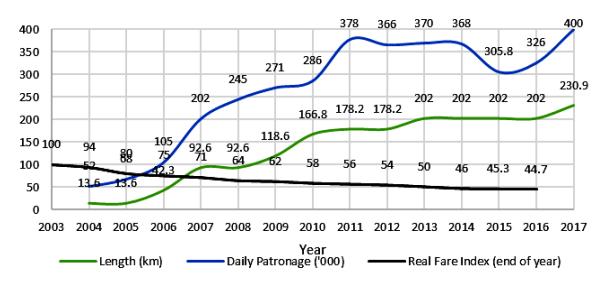
Figure 1. Trends in patronage, Transjakarta BRT length and real fares 2003-2014 Source: Sayeg [4], Greater Jakarta Transport Authority [5]
Providing a parking space around a public transport line or station (P&R facility) will encourage motorists to switch from private vehicles to public transport. The Jakarta Local Government, in the Regional Spatial Planning 2030 [6]1 , plans to develop at least nine P&R facility locations around the city border. However, some modest P&R facilities owned by private entities which are already in operation in Cawang area are not included in the development plan, though it is very potential as it is located at the busiest interchange in the eastern part of Jakarta City. Questions that arise is that whether the existence of such a modest P&R facility in Cawang area give benefits to the users and is a significant factor in increasing the ridership of the BRT TransJakarta. Moreover, what are the likely impacts, if such temporary P&R facilities are developed and upgraded to formal P&R facilities under local government initiative? The primary objective of this study is to evaluate the existing "private P&R" facilities in the Cawang area, assess the performance of the existing facilities and develop specific criteria from current users' perspective. Perspective of the current and potential Cawang P&R facility user are obtained through field survey and the benefit of the facility as well as aspects that should be improved are derived from the analysis. The study is intended to trigger further research on P&R facility in Cawang Area as well as to propose recommendation to improve the P&R facilities.
2. Literature Review
P&R is one of the measures originated from transportation demand management concept, which purpose, according to Cornejo et al. [7] is to reduce private vehicle use and shift travel demand to public transportation such as bus, bus rapid transit, and rail transport. Joewono et al. [8] and Song et al. [9] stated that a P&R facility is a parking facility, located in public transport station, which is provided to make mode transfer, from private vehicle to public transport, available and can be done quickly. One of the advantages of P&R facility is to attract mode shifting from private vehicle to public transport, thus increasing public transport ridership and alleviate traffic congestion, as stated by Franklin Regional Council of Governments [10] and Karamychev and Reeven [11]. Franklin Regional Council of Government [10] also stated that the implementation of P&R is necessary as the fuel price keep increasing which creates a necessity to develop alternative transport mode, which is more sustainable, along with its supporting facilities. P&R facility, as stated by Damanik [12], can benefit users by reducing travel time and driver/passenger exhaustion, accident risk, etc.
However, for P&R facility to be able to shift the trend to public transport, supporting systems need to be prepared. Dijk et al. [13] argued that policy package need to be introduced to support P&R, for instance, high parking charges in city centre area combined with cheap and reliable public transport that links P&R site and city centre area. Another measure that can be implemented is by reducing parking tariff in P&R parking area, improving parking convenience, security, and public transport service connected to it, as stated by Seik [14]. Asapa [15] conducted a study regarding P&R as a part of railway service in Bandung City. According to the study, the P&R facility has a very high potential, especially the one that is located close to settlement area as well as railway station. The probability of potential respondents to shift to P&R user is approximately 81.5%. The author also stated that the P&R use is highly correlated with the railway service in Bandung City. A high-quality railway service will attract more passengers, therefore leveraging the use of P&R facility. It can be concluded, therefore, that public transport improvement may attract public preference to use P&R facilities.
Despite advantages offered to support public transport use, some view P&R may also create unintended
1Provincial Government of DKI Jakarta. Regional Spatial Planning 2030. DKI Jakarta Provincial Regulation Number 1, 2012 (in Bahasa Indonesia)
impact. According to Parkhurst [16] and Sherwin [17], P&R may encourage more car trips or trip generation and discourage public transport use and other means of transport such as cycling and walking in areas between the origin and where P&R facility is located. Thus, P&R may also create a transfer of pollutants to areas beyond urban areas or rural areas as stated by Parkhurst and Richardson [18]. Moreover, Clayton et al. [19] mentioned that, according to empirical study, more public transport users, who previously did not use private vehicle at all, are encouraged to use private vehicle to get to P&R facility. Clayton et al. [19] further argued that, in some cases, the number of car traffic increases after the introduction of P&R facilities.
In this study, past literature regarding P&R evaluation is reviewed to understand factors that need to be considered to evaluate the private P&R facility in Cawang Area. Soemardjito et al. [20] mentioned the importance of physical and non-physical aspect as a part of the P&R evaluation. These aspects are valuable to understand the existing facility condition and what should be improved, from the perspective of the current and potential user. Damanik [12] and Seik [14] propose variables to identify current and potential user characteristic and evaluated the benefit of P&R to its user. Aspects that were included are respondent occupation, parking charges, age, income, the distance between origin and destination which represents accessibility, travel cost, travel time and travel mode used. Those aspects can be used to understand factors influencing P&R use and the benefit of using P&R facility. Seik [14] also added more variable such as public transport rating indicator, satisfactory index, and problem identification of P&R facility. These aspects are a valuable input to evaluate the private P&R facilities in Cawang Area.
3. Study Area
Cawang is a district area, which is located on the edge of East Jakarta. The land-use of this area is mainly business district, consisting of government and corporate buildings. A university (Indonesian Christian University - UKI) and a hospital are also located in this area. In this area, six lines of Transjakarta BRT services are connected; also Transjakarta BRT feeder bus (APTB) and commuter train are also within reach. Toll road (expressway) to other locations in Jakarta and other cities is also accessible from this area. Office blocks also stand on both sides of the street. Figure 2 shows the strategic location of Cawang area, where six Transjakarta BRT lines met and also the location of the three private parking lots.
4. Methodology and Data Collection
This study uses descriptive statistics to gain knowledge regarding the private P&R facilities in Cawang area and use it as a basis for analysis. Several relevant variables, including qualitative and quantitative variables, are defined to capture information at the sites which will be useful for the analysis. This study starts with survey
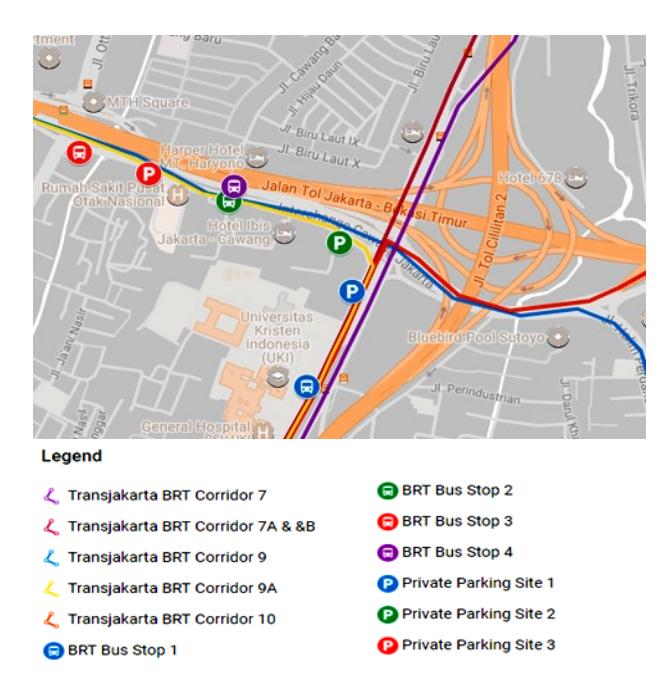
Figure 2. Arterial roads, BRT network and private parking lots in Cawang area
design followed by data collection and analysis. Firstly, to understand the benefit and potential of the
P&R facilities in Cawang Area, a survey, which consider various aspects of P&R facilities, is designed. The survey is divided into two kinds by target respondent, namely current user and potential users. Referring to past literature and condition at the sites, aspects that are explored in this study are socioeconomic characteristic, travel characteristic, park and ride facility condition, public transport condition, the situation around the destination, and informational aspects. In addition, the respondents are also asked about aspects of P&R that should be improved. After defining related information that needs to be collected during the survey, the sample size and object are then determined. For the current user, the samples/ respondent are interviewed in the P&R locations. The sampling method used is purposive sampling method. According to site observations, the capacity of the P&R facilities is as follows.
- 1. P&R Site 1 310 daily users consisting of 300 motorcycles and 10 cars
- 2. P&R Site 2 420 daily users consisting of 400 motorcycles and 20 cars
- 3. P&R Site 3 210 daily users consisting of 200 motorcycles and 10 cars
As the total capacity of the three P&R sites is 940 daily users, the sample size for this survey is determined by equation proposed by Yamane [21]2 . The precision used for this study is 10% (90% confidence level). The sample size for these three sites can be shown in Table 1.
n = , where n is sample size, N refer to population size and d is precision level.
The survey was conducted in several toll road exits close to Cawang Area to capture that kind of respondent. As the population for the potential user is not known, the survey used quota sampling approach, meaning the higher the number of samples, the more representative it is to the population. For this study, 70 respondents were interviewed in different locations (toll road exits) as shown in Table 2. All those data collected above are used to evaluate the P&R facilities, whether it gives benefit the user, leverages Transjakarta BRT ridership and has potential to attract more users if developed properly.
Table 1. Current user sample size
| No | P&R Site (Survey Location) | Sample Size |
|---|---|---|
| 1 | Site 1 | 30 |
| 2 | Site 2 | 40 |
| 3 | Site 3 | 20 |
| Total | 90 | |
Table 2. Potential user sample size
| No | Survey Location | Sample Size |
|---|---|---|
| 1 | Halim Toll Road Exit (Originating from Bekasi direction) | 15 |
| 2 | Cililitan Toll Road Exit (Originating from Depok direction) | 15 |
| 3 | East Bekasi Toll Road Exit (Originating from Bekasi direction) | 15 |
| 4 | Jatinegara Toll Road Exit (Originating from Jatinegara Direction) | 15 |
| 5 | Kebun Nanas Toll Road Exit (Originating from Tanjung Priok Direction) | 10 |
| Total | 70 |
5. Results and Analysis
The findings from the two kinds of respondent are described below. Firstly, from the current P&R user respondents it was revealed that 43% of respondent own two vehicles, 31% own one vehicle, 14% own three vehicles and the remaining own more than three vehicles. Respondents who own one vehicle means that they only own a motorcycle, while those who own two vehicles, 80% of them own car and one motorcycle, 15% own two motorcycles, and 5% of them own one motorcycle and one bicycle. Interesting to note that the majority of the current user, at 40% lives 11 to 15 km away from the P&R facility while 26% of them lives more than 15 km away. The remaining 34% lives 6 to 10 km away from the facility. Of all those current users, 50% of them get the P&R facility by car while the other 50% get to the P&R facility by motorcycle. Concerning user preference on the parking facilities as well as the connected BRT system, here are information from the respondents derived from the survey:
• Almost half of the respondent stated that the parking charge is relatively cheap and two third
- stated that they could save money by parking there and ride the BRT to get into the town centre, instead of driving to town and parking their cars in the city centre.
- Three-quarter of respondents experiences faster travel time having decided to use the private P&R facilities.
- 68% of respondents can find parking facility around their destinations, but half of them think that they feel convenient by parking their vehicles on the private P&R facility and continue their journey by using public transport.
- Almost half respondents said that leaving their car on the parking facility is safe.
- 80% of respondent stated that the main reason why they used the facilities is due to travel timesaving, as driving vehicle straight to town will experience more delay and congestion.
- Most of the respondents said that lowering parking charges as well as providing displays regarding parking location and public transport services is essential.
- 42% of respondents stated that the primary factors that encourages them to use the BRT is less travel cost, followed by 30% said due to lower travel times, as shown in Figure 3.
- 50% of the respondents think that insecurity concern and inconvenience aspect are factors that may deter them from using the BRT, while 26% stated that the main deterrence is longer headway or less frequent BRT arrivals resulting in longer waiting time.
- Regarding the BRT service, most respondents expect improvement in BRT waiting time as shown in Figure 4.
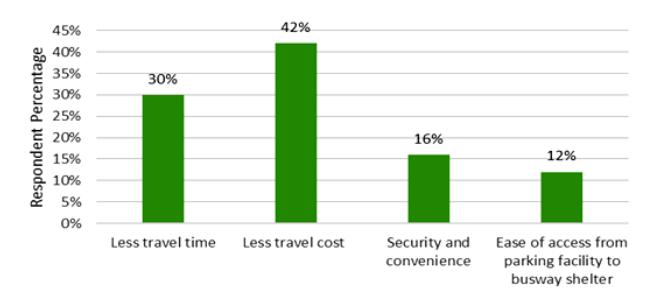
Figure 3. Factors which encourage BRT use for existing user
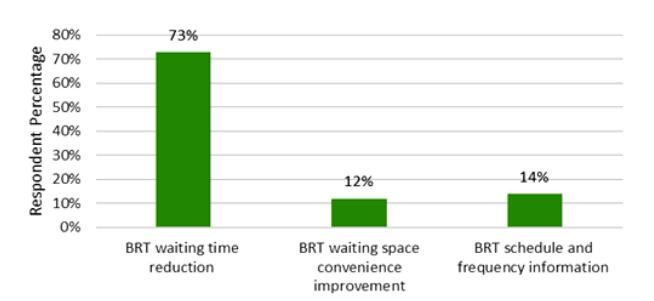
Figure 4. Expected improvement in BRT service
Secondly from 70 potentials users' respondents, a significant proportion, i.e., 67% own two vehicles comprising one car and one motorcycle, 26% own three vehicles and the remaining 7% own 4 vehicles including bicycles. For, respondents who own three vehicles, 61% of them own two motorcycles and one car, 39% own one motorcycle and two cars. Some of the important findings from the potential users are described below.
- 54% of the potential users' respondents knew about the presence of the P&R facility, while 46% still do not know about it.
- 33% of the respondents who noticed about the P&R facility, they find the information coincidently by themselves, while 21% got the notice from a circular or adverts.
- Most of them do not know about the P&R facility conditions and 33% stated that the condition of the P&R facilities is moderate.
- Most respondents, i.e., 46% potential users do not know about the walking and access facilities heading to the P&R facility, followed by 24% think that the access is on a good condition, 23% moderate and 7% perceived the facility is in poor condition.
- 64% had ever used the P&R facility and continue their trip by using BRT, while 36% have not done so. There are 44% of the respondents who think that the P&R facility and BRT service are in good condition, while 36% do not know about it. This is shown in Figure 5.
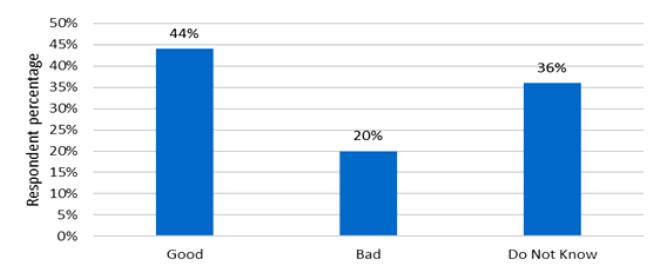
Figure 5. Perspective on P&R and connected BRT facility condition
- 60% of the potential users' respondents stated that their destinations were not reachable from BRT shelters.
- Factor that deters the respondents from using bus rapid transit service is that 53% respondents said that they do not ride BRT because of long travel time and 47% said that the low frequency of BRT is the main reason for not using it.
- The survey also posed questions on potential user's opinion about the improvements that respondents want to see in the future. The potential user's opinion can be seen in Figure 6.
- 73% of potential user respondent stated that they are willing to use P&R facility if the government decided to develop and improve the facility.
- 81% of potential user respondents are also willing to shift to Transjakarta BRT if the service has significantly improved.
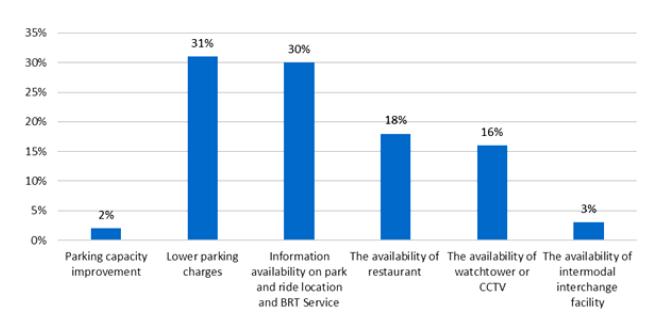
Figure 6. Expected improvement at the parking facility
Table 3. Respondent view on using P&R facility summary
| Current User | Potential User | ||
|---|---|---|---|
| No | Motivation to use P&R facility and BRT | Deterrence to use P&R facility and BRT | |
| 1 | Lower travel cost | Lack of information about P&R facility presence | |
| 2 | Lower travel time | Lack of information about access to P&R facility | |
| 3 | Secure P&R site | Destination not reachable by BRT network | |
| 4 | Cheap parking charges | BRT long travel time | |
| 5 | - | BRT low frequency | |
| No | Expected improvement on the P&R facility | ||
| 1 | Lower BRT waiting time | Lower parking charges | |
| 2 | Improved safety | Information about public transport service | |
| 3 | Improved convenience | Information about P&R location | |
| 4 | BRT service information | Broader BRT network and more reliable service | |
• Summary of respondent motivation and deterrence of using P&R facility, as well as expected improvement on the facility are in Table 3.
6. Conclusion and Recommendations
6.1 Conclusion
This study assesses the effectiveness of private P&R facilities from the perspective of current users and potential users, mainly whether it benefits the user and leverage Transjakarta BRT ridership. Some conclusions obtained from this study one :
- 1. The main motivations of the respondents to use P&R facility and continue their journey by riding the BRT are because of saving in travel cost and travel time. For the current users, the majority of this group think that the P&R facilities are good enough, although several improvements are still needed.
- 2. The primary factor to use P&R facility and BRT system is the lower travel cost and travel time.
These are the benefit of using the P&R facility which answers the first research question. Moreover, the majority of user lives 11 to 15 km away from the P&R facility by using car or motorcycle. Thus it can be concluded that P&R facility helps the current user to reach P&R station from their home (origin) thus contribute to the increase of Transjakarta BRT ridership and answer the second
- 3. On the other hand, factors that discourage the current user from using BRT is because of security concern and long headway (low BRT frequency). The presence of the P&R facility is also relatively unknown to almost half of the potential users which is a crucial aspect that needs to be addressed. However, a significant proportion of the respondents thinks that the P&R facility and BRT service is in excellent condition.
- 4. Several factors must be considered to unlock the maximum potential of P&R facility development. One of the main success factors is the reduction of parking fee and the availability of information regarding P&R facility location and transit service. The other important factor is the availability of green space and the presence of attractive built environment around P&R facility. All of these study result described above is valuable input for future P&R development.
6.2 Recommendations
Recommendations can be listed as follows.
- 1. The local government or authority should give its full support to develop P&R facilities, especially in Cawang area, as it is a very strategic place to locate P&R facilities.
- 2. For the P&R operator, business approval from local authorities should be proposed, as the current private P&R facilities still do not have it. The public, particularly those living within 15 km radius of the P&R facilities should also be informed of the presence of the P&R facilities as many are still unaware of the P&R presence.
Acknowledgement
The study and writing of this paper is made available by the support of the United States Agency for International Development (USAID) through Sustainable Higher Education Research Alliances (SHERA) program [grant number IIE00000078-ITB-1]. The funding supports this study, particularly during the analysis phase.