

Abstract
Berbagai penelitian telah dilakukan untuk mengevaluasi kelayakan dan efektivitas sistem isolasi tingkat. Hasil yang diperoleh juga cukup mengesankan, dimana sistem isolasi tingkat memberikan reduksi simpangan antar tingkat yang lebih baik dibandingkan dengan sistem isolasi dasar. Namun, studi tersebut hanya berfokus pada bangunan bertingkat rendah, padahal sistem isolasi lantai akan lebih menarik jika dapat juga digunakan pada bangunan bertingkat tinggi. Dalam studi ini, analisis numerik akan dilakukan pada bangunan berlantai 30, 40, 50, dan 60 untuk mengevaluasi lokasi isolator tingkat yang memberikan reduksi simpangan tingkat dan geser tingkat terbesar. Kemudian dicari solusi umum untuk menjadi acuan untuk bangunan dengan denah dan ketinggian yang berbeda.
Kata kunci: Sistem isolasi tingkat, lokasi optimum isolator tingkat, bangunan bertingkat tinggi.
1. Introduction
Base isolation and tuned mass dampers are structural control systems widely used to mitigate building damage due to earthquakes and other lateral environment forces. However, these two systems have drawbacks, where the base isolation system is less useful for flexible buildings. If the structure experiences a large deformation, there is a potential for collision with the retaining wall around the basement (Peng Pan, 2004), while the tuned mass damper requires a sizeable additional space and elements reinforcement (Min Ho Chey, 2007).
Structural control systems called Roof Isolation System (Villaverde, 1998) and Story Isolation System (Murakami, et al., 1999) were developed to avoid these problems. A story isolation system is a similar approach as the base isolation system, but instead, on the base, the isolator is placed between the building levels. When the isolator is placed between the top floor and the top column, the system is called a roof isolation system. Both will be referred to as story isolation systems in this paper.
Much research has been done to explore the effectiveness of the system. It was found that the story isolation system is adequate to be an alternative to the structural control system in reducing the structural responses due to earthquake excitation. However, existing studies still focus on case studies of low-rise buildings (under 20 stories).
In this study, the story isolation system will be installed in several high-rise buildings (30-60 levels) to analyze the structural response due to earthquake forces. For a flexible structure, such as a high-rise building, some complexities in the design of the structures may arise as well as in the design of the isolator itself, which should be taken into consideration. The isolator's optimum location is determined and chosen by evaluating the minimum story drift and shear when compared to those of the structures without story isolators.
2. Literature Review
The story isolation system was proposed by Murakami et al. in 1999. In their research, Murakami et al.
*Corresponding Author
designed and analyzed 14-story buildings with a story isolator between level 9 and level 10. The research resulted in the conclusion that the use of a story isolation system can reduce the structural responses due to earthquakes excitation.
The research was later developed by Tsuneki et al. (2008) with the same idea and case study. The new research resulted in additional conclusions: buildings that are isolated in the middle story are strongly affected by vibrations at a high range. The dynamic response of a building is influenced by various things that interact with the complex, such as the stiffness of the upper structure, the stiffness of the lower structure, and the weight of the upper and lower structures.
Against the shortcomings of the base isolation system, namely aesthetics and the potential for collisions with the retaining wall around the basement, Earl (2007) conducted a study on the effectiveness and feasibility of a story isolation system. The research was conducted by reviewing several alternative locations for story isolation, and it was found that for systems with a single-story isolator, the effectiveness of using the isolator decreases with increasing isolator locations, or in other words, the best location for story isolator is between level 1 and level 2.
Zhou et al., in 2016, simplified the building model with story isolators and obtained the optimum parameters of the isolator used. In the example section of numerical calculations for a 16-story building, it is found that the smallest level of roof deformation and shear forces are experienced by structures that are isolated at the lower level.
From these studies, it was found that for low- to medium-rise buildings, the isolation system is quite effective in reducing the structure's response due to earthquakes and will work optimum if placed in the lower levels of the building.
In the meantime, no research conducts a feasibility study on the use of story isolation systems in high-rise buildings. One of the most important things to consider in the feasibility study is the isolator's capacity. The difference in the number of stories above the story isolator will certainly affect the capacity needs of the isolator. Therefore, this study aims to find the story isolator's optimum location in high-rise buildings so that further research about the isolator's capacity feasibility can focus on the optimum location.
3. Design of Structure with Story Isolation
In designing the structures, the same isolator instrument type is used both in base isolation and story isolation system. For that reason, the story isolators should be designed with a similar approach as the base isolators. Story isolators must satisfy vertical load stability due to gravity and earthquake load combinations, as mentioned in SNI 1726-2019 Chapter 12. Besides, several additional requirements such as environment condition, wind forces, fire resistance, lateral restoring force, and displacement restraint need to be taken into account in the design process.
However, the structure requirements consisting of importance factor, structural configuration, redundancy, and the structural system have not yet identified whether they have the same characteristic. Therefore, an advanced research investigating the nonlinear behavior of structures with story isolation to prove this matter, needs to be carried out. Besides, regardless the structural type and the structural system which are chosen, the valid existing code (SNI-2847 and SNI-1729) should be respected in all the design stages.
4. Case Study
Four case studies of building with 30, 40, 50, and 60 levels are used. All models are reinforced concrete structures with concrete compressive strength of 40 MPa for columns and 30 MPa for beams and slabs. Square column dimensions used are different for every ten stories with a size of 550 mm at the top 10 levels, 700 mm at the next ten levels, and so on with an increment of 150 mm for every ten levels lower. Meanwhile, 350 mm width and 600 mm height beams, and slabs with a thickness of 120 mm are used at all levels. A typical plan is used for all models as follows.
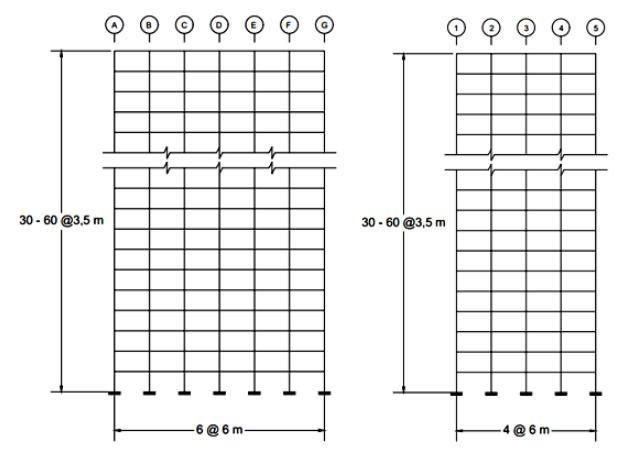
Figure 1 Longitudinal (left) and transverse (right) side view of structures without story isolators
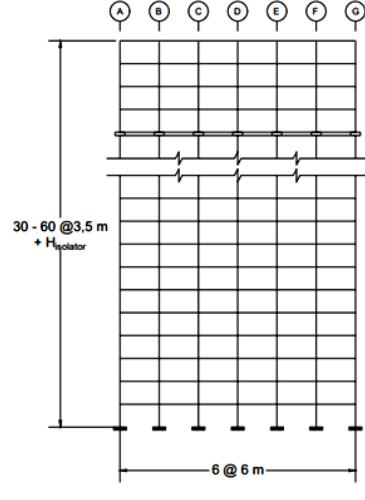
Figure 2. Longitudinal side view of structures with story isolators
Figure 3. Floor plan
Gravitational and earthquake loads are used in the analysis. The gravity load consists of reinforced concrete dead load of 2400 kg/m<sup>3</sup>, a superimposed dead load of 1.5 kN/m<sup>2</sup>, and a live load of 2.4 kN/m<sup>2</sup>. Then the Kobe, Chi-Chi, and Northridge earthquakes were used, adjusted to the Bandung City response spectrum for dynamic analysis.
Lead Rubber Bearing (LRB) was chosen to be the story isolator in this study. In this study, different LRBs were used for different levels to adjust the column's dimension above the story isolator. The six types of LRB that will be used in this study are taken as follows.
Table 1. LRB specification
| Column Width | D | Н | Κν | Ke | W |
|---|---|---|---|---|---|
| mm | mm | mm | kN/mm | kN/mm | kN |
| 550 | 600 | 407,9 | 1670 | 7,14 | 6,6 |
| 700 | 750 | 376,9 | 2610 | 11,2 | 9,1 |
| 850 | 900 | 410,8 | 3800 | 16,3 | 14,9 |
| 1000 | 1100 | 390,2 | 5600 | 24,1 | 20,7 |
| 1150 | 1200 | 385,6 | 6690 | 28,6 | 24,0 |
| 1300 | 1400 | 515,5 | 9060 | 39,1 | 51,1 |
Where
D = Diameter
H = Height of Isolator
\(K_v = \text{Axial/Vertical Stiffness}\)
\(K_e\) = Shear/Horizontal Stiffness
W =Weight of Isolator
5. Numerical Analysis
Numerical analysis was carried out for several models sequentially, ranging from structures without story isolators, to structures with isolators at levels 5, 10, and so forth. From each model, the drift and the shear forces of each story will be calculated using the Runge-Kutta integration method with a lumped mass assumption (Figure 6).
Each story is represented by one mass (m), one stiffness (k), and one damping (c) value for dynamic analysis. The story mass is calculated from the weight of structural elements and other gravity loads, the story stiffness is
Figure 4. Lead rubber bearing illustration (Bridgestone, 2015)
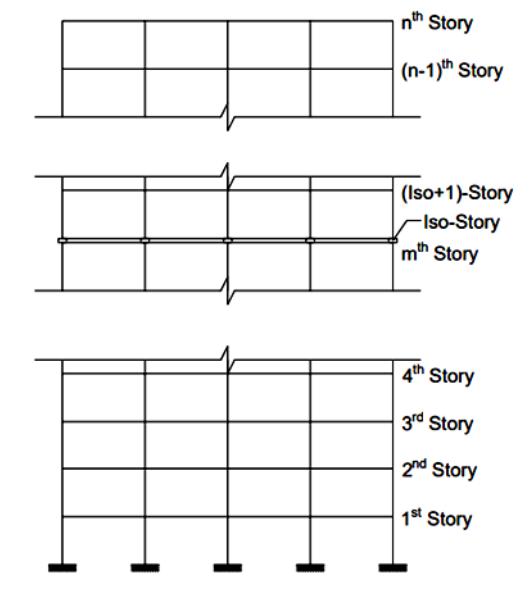
Figure 5. 2-D Structure illustration
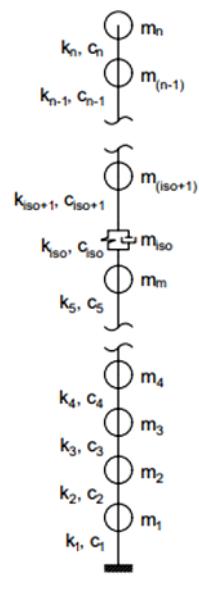
Figure 6. Structural model illustration
calculated by the lateral force-deformation method (Figure 7), and the damping is calculated using the Rayleigh damping matrix assumption that is proportional to the mass and stiffness matrix (Equation 1).
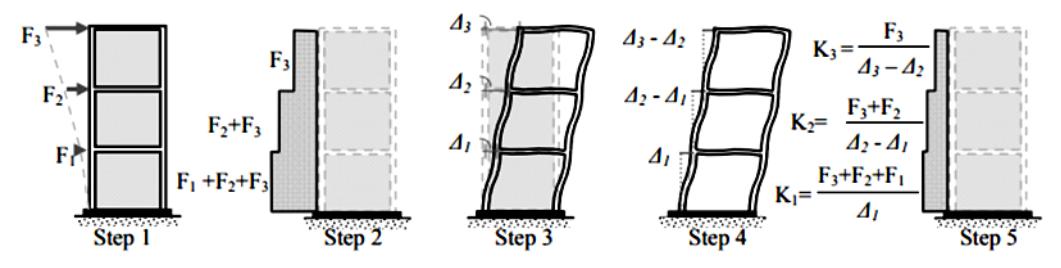
Figure 7. Lateral force-deformation method (Vijayanarayanan et al., 2017)
\[[K] = \begin{bmatrix} m_1 & \square & \square & & & & & & & & & & & \\ \square & m_2 & \square & \square & & & & & & & & \\ \square & m_2 & \square & \square & & & & & & & & \\ \square & m_2 & \square & \square & & & & & & & \\ \square & m_3 & & & & & & & & & \\ & & & \square & m_m & \square & & & & \\ & & & \square & m_{kso} & \square & \square & \\ & & & \square & \square & \ddots & \square & \\ \square & & & \square & \square & \ddots & \square & \\ \square & & & & \square & \square & \ddots & \square & \\ \square & & & & \square & \square & \square & \square & m_n \\ \end{bmatrix}\]
\[[C] = \alpha_1[M] + \alpha_2[K] \tag{1}\]
\[\alpha_1 = \frac{2\zeta}{\omega_1 + \omega_2}(\omega_1 \times \omega_2); \ \alpha_2 = \frac{2\zeta}{\omega_1 + \omega_2}\] (2)
Where m = Story-m
iso = Story isolator
n = Total story number
\(\zeta\) = Damping ratio
\(\omega_i\) = Natural frequency for mode-I
The equation of motion for the Multi Degree of Freedom (MDOF) lumped mass structure due to ground motion can be expressed in the following form.
\[[M]\{\ddot{x}\} + [C]\{\dot{x}\} + [K]\{x\} = -\ddot{x}_a[M]\{1\}\] (3)
Then the equation is rearranged into a second-order differential equation as follows.
\[\ddot{X} = M^{-1} \left[ -M\{1\} \, \ddot{X}_g(t) - C \dot{X} - K X \right] = G \left( X, \dot{X}, t \right) \tag{4}\]
The structure displacement, velocity, and acceleration responses for each time interval (\(\Delta t\)) can be calculated using the following equations.
\[X(t_n + \Delta t) = X(t_n) + \frac{1}{6}\Delta t(Y_1 + 2Y_2 + 2Y_3 + Y_4)\] (5)
\[\dot{X}(t_n + \Delta t) = \dot{X}(t_n) + \frac{1}{6} \Delta t (F_1 + 2F_2 + 2F_3 + F_4)\] (6)
\[\ddot{X}(t_n + \Delta t) = M^{-1} \left[ -M\{1\} \, \ddot{X}_g(t_n) - C \dot{X}(t_n) - K X(t_n) \right] \tag{7}\]
Where:
The analysis results are then compared to determine the optimum location of the story isolator based on the reduction of the story drift and the story shear forces compared to the structure without an isolator.
The structural model with story isolation at the optimum location is further reviewed in terms of the structural period, the story drift, and the energy to determine the story isolator's optimum location in general.
6. Story Drift and Story Shear Reduction
The maximum values of story drift and story shear forces from the analysis results for each location of the story isolator analyzed are compared with the story drift and shear forces of the structure before being given the story isolator. The reduction averages for all stories for each level insulator location (in percentage terms) are then tabulated into the following graphs.
From the analysis results in Figure 8-11, for each model, the story isolator's optimum location can be taken from the location that provides the highest drift and shear reduction as follows.
From the table above, it can be seen that the story isolator's optimum location on average based on the story drift reduction is 0.196 of the building height, and based on the story shear force reduction is at 0.238 of the building height.
7. Optimum Location Analysis
This section will discuss the results of numerical analysis in the previous section. The analysis carried out this time to obtain general results so that the research results can suit to buildings with a different height and stiffness than the case study used. Therefore, the analysis will focus on the three parameters of the analyzed building, namely the structure period, the story drift, and the energy.
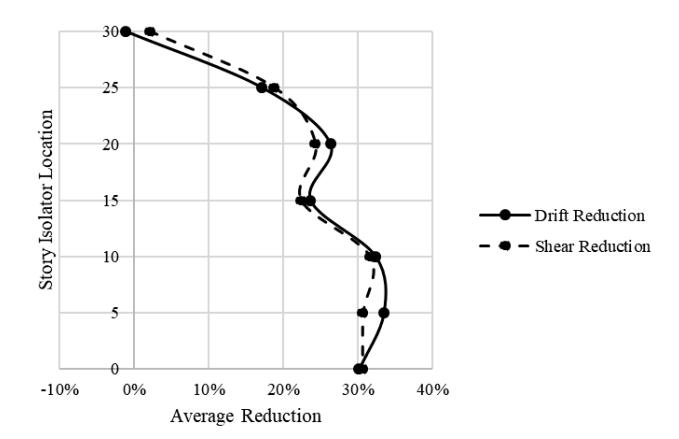
Figure 8. Average reduction for model A (30-Story Building)
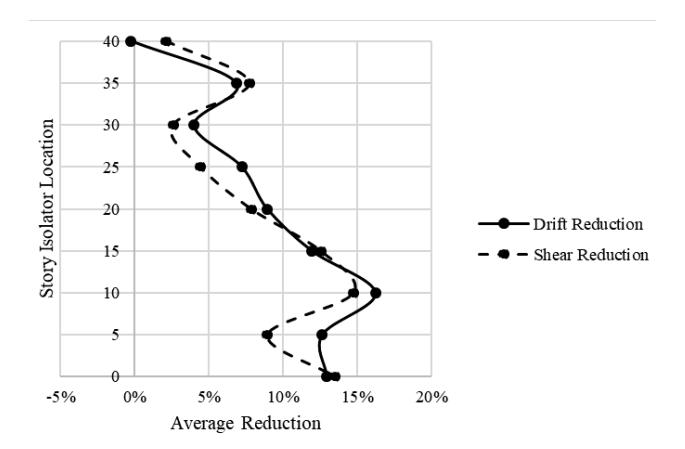
Figure 9. Average reduction for model B (40-Story Building)
7.1 Structure period analysis
The structural period is examined as one of the parameters. If the story isolation system behaves like a passive tuned mass damper, then at the optimum location lower structure (below the story isolator) and the upper structure (from the story isolator upwards) will have a similar period. This similar period causes the upper and lower structures to move in opposite phases and reduce the structural drift.
From the table above, it can be seen that the ratio of the upper and lower structure period is far from 1 second, so it can be concluded that the determination of the story isolator's optimum location has a different concept from the passive tuned mass damper system. This is because, in the passive tuned mass damper, the reduction of the structural response is only examined for the main
Table 2. Optimum story isolator location
| Model | Based on Story Drift Average Reduction | Based on Story Shear Average Reduction |
|---|---|---|
| A | Story 5 (0.167 H) | Story 10 (0.333 H) |
| B | Story 10 (0.25 H) | Story 10 (0.25 H) |
| C | Story 10 (0.20 H) | Story 10 (0.20 H) |
| D | Story 10 (0.167 H) | Story 10 (0.167 H) |
| Average | 0.196 H | 0.238 H |
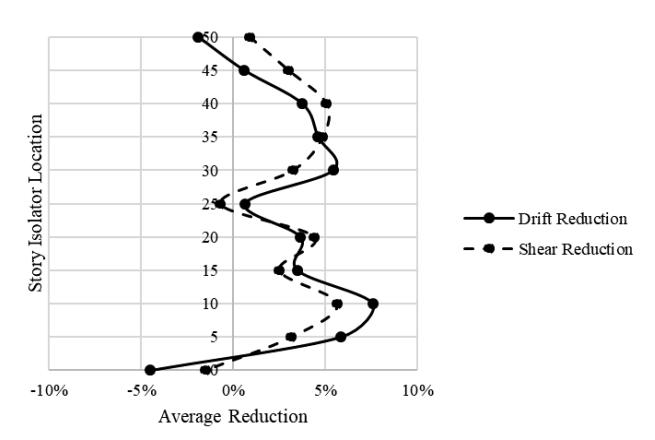
Figure 10. Average reduction for model C (50-Story Building)
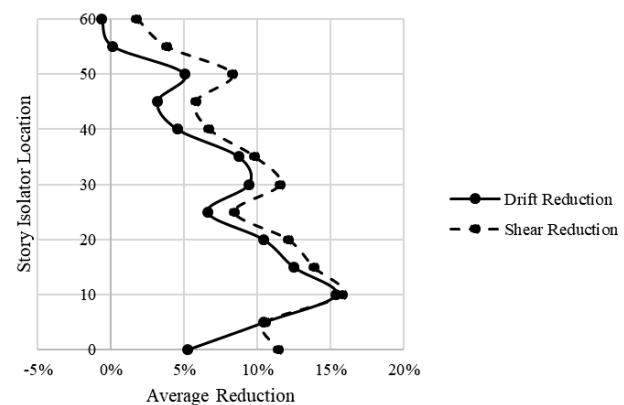
Figure 11. Average reduction for model A (60-Story Building)
structure, the additional mass response is not the main parameter. Whereas in the story isolation system, both the upper and lower structures are the main structures whose response is taken into account.
7.2 Story drift analysis
This parameter is examined because adding the story isolator to the structure changes the structure deformation shape by transferring the drift to the story isolator. So it is assumed that the optimum story isolator will be at the story with a maximum story drift. The following is a graph of the story drifts for the four models analyzed.
From the table above, it is visible that the highest story drifts are in the range 0.167 - 0.3 of the building height. This value is similar to the story isolation optimum location, which is in the range 0.167 - 0.333 of the
Table 3. Upper and lower structures period ratio
| Model | Upper Structure Period, Ttop (second) | Lower Structure Period, Tbot (second) | Ttop / Tbot |
|---|---|---|---|
| A | 4.6322 | 0.4717 | 9.8204 |
| B | 5.3116 | 1.0774 | 4.9302 |
| C | 6.1352 | 1.0580 | 5.7991 |
| D | 7.3663 | 1.0471 | 7.0351 |
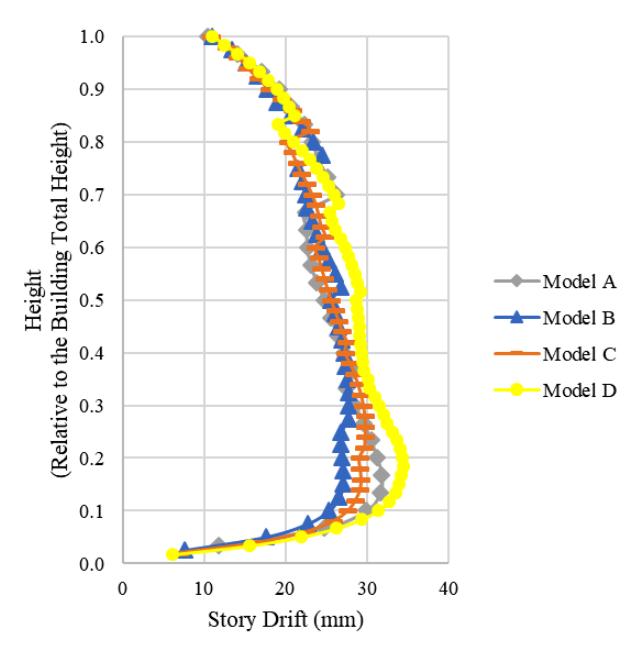
Figure 12. Structure story drift before story isolator
The locations of the largest story drifts in all four models can be seen in the following table.
Table 4. Maximum story drift location
| Model | Maximum Story Drift Location |
|---|---|
| A | Story 5 (0.167 H) |
| B | Story 12 (0.3 H) |
| C | Story 13 (0.26 H) |
| D | Story 11 (0.183 H) |
| Average | 0.228 H |
building height. So it can be concluded that this structure initial story drift is the determining parameter of the optimum story isolation location.
The main reason is that the story isolation system is changing the structure deformation shape by shifting structure drift to the story isolator. While the story isolator is installed in a location with a higher initial story drift, the story isolator's effect in changing the structure deformation shape is higher. The deformation shapes massive changes later cause the large story drifts to reduce at other stories.
7.3 Energy analysis
Apart from playing a role in changing the structure deformation shape, it is also examined whether the optimum story isolator location is related to the transfer of earthquake energy (especially spring energy) in the structure into energy in the story isolator. If it is related, then the optimum story isolation location will also be at the level with the highest spring energy.
From the table above, it is visible that the average value of the largest spring energy location is at 0.137
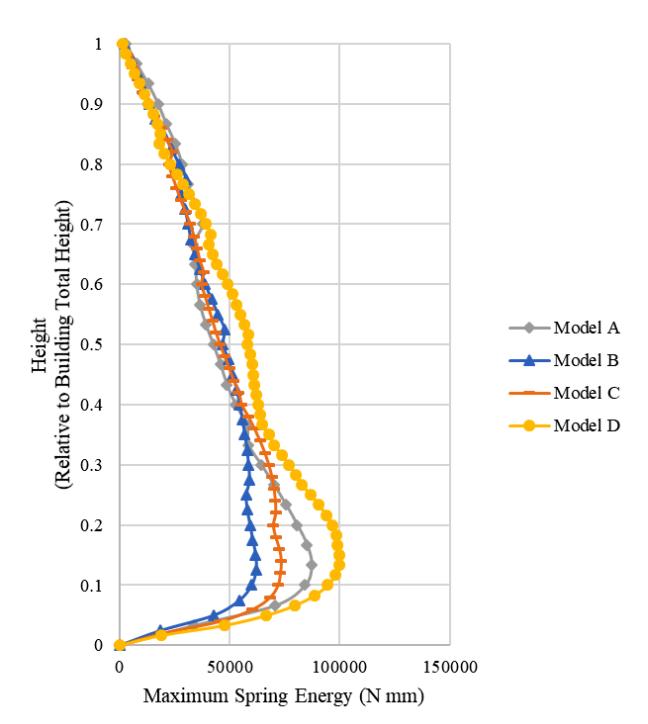
Figure 13. Maximum spring energy
Table 5. Highest maximum spring energy location
| Model | Highest Maximum Spring Energy Location |
|---|---|
| A | Story 4 (0.133 H) |
| B | Story 5 (0.125 H) |
| C | Story 7 (0.14 H) |
| D | Story 9 (0.15 H) |
| Average | 0.137 H |
H, slightly different from the story isolator's optimum location, which is around 0.2 H. This proves that although the pattern obtained is similar, the story isolator's optimum location is not at the story with the highest value of spring energy.
8. Conclusion
- 1. This study aims to find the story isolator's optimum location in high-rise buildings. It was carried out and based on avoiding the shortcomings of passive tuned mass damper and base isolation systems, as well as continuing existing research on the story isolation system in low-rise buildings.
- 2. From the analysis results of several structural models used in the study, it can be concluded that the story isolators give an optimum result if they are placed at about 0.2 of the building height.
- 3. The analysis is based on the evaluation of the story drift and the shear that occurred on each level of the building. It can also be concluded that the isolators should be placed in the structure where a maximum initial story drift before the story isolator is added so that the effect of the story isolator in better modifying the structure deformation shape is more appreciable.
Future Study Recommendation
An advanced 3-dimensional non-linear structure model can be used for further analysis to justify the behavior and structural system of structure with story isolation.
References
- Abdulmutallib, S. (2017). Modeling of Base Isolator as Structural Element. Global Journal of Engineering Science and Research Management.
- Bridgestone (2015). Seismic Isolation Product Line-Up. Bridgestone, Version 2015 vol. 1.
- Chey, M. H. (2007). Passive and Semi-Active Tuned Mass Damper Building Systems, Doctor of Philosophy thesis, University of Canterbury.
- Earl, C. (2007). Effectiveness and Feasibility of inter-Story Isolation Systems, Master of Science Thesis, Utah State University.
- Melkumyan, M. (2014). New Application of Roof Isolation System in the form of an Isolated Upper Slab for Seismic Protection of an Existing 12- Story Office Building, International Journal on Civil Engineering & Urban Planning (IJCEUP), Vol. 1, No. 1.
- Murakami, K. et al. (2000). Design and Analysis of a Building with the Middle-Story Isolation Structural System, 12th World Conference on Earthquake Engineering.
- Pan, P., et al. (2004). Response and Damage of Base-Isolated Buildings Subjected to Extremely Large Earthquakes, The 13th World Conference on Earthquake Engineering.
- Ping, T. Ying, Z., Fulin, Z. (2008). Optimal Design and Control Mechanism Study on Story Isolation System, The 14th World Conference on Earthquake Engineering.
- Ribakov, Y. dan Agranovich, G. (2008). Design of Roof Isolation Systems with Variable Friction Dampers, The 14th World Conference on Earthquake Engineering.
- Schellenberg, A. et al. (2013). Hybrid Shake Table for the Testing of Midlevel Seismic Isolation Systems, The 13th World Conference on Seismic Isolation.
- Setio, Herlien D, Setio, Sangriyadi (2019), Implementation of Active Control System Using Artificial Intelligent for Flexible Structures under Earthquake Excitations, International Conference in Commemoration of 20th Anniversary of the 1999 Chi-Chi Earthquake, Taipei, Taiwan.
- Setio, H.D., Gunawan, A.S., (2017) Numerical Study of Active Mass Damper Application on Cable-Stayed Bridge Structure Using Artificial Neural
- Network Algorithm, International Journal of Civil & Environmental Engineering IJCEE-IJENS Vol 17, No. 04, 2017
- Tsuneki, Y., et al. (2008). Middle-Story Isolated Structural System of High-Rise Building, The 14th World Conference on Earthquake Engineering.
- Vijayanarayanan, A. et al. (2017). Estimation of Storey Stiffness in Multi-Storey Buildings, The 16th World Conference on Earthquake Engineering.
- Villaverde, R. (2000). Implementation Study of Aseismic Roof Isolation System in 13-Story Building, Journal of Seismology and Earthquake Engineering: Spring 2000, Vol. 2, No. 2.
- Villaverde, R. (2002). Aseismic Roof Isolation System: Feasibility Study with 13-Story Building. Journal of Structural Engineering, Vol. 128(2): 188-196.
- Wang, S. et al. (2012). Dynamic Behavior of a Building Structure Tested with Base and Mid-Story Isolation Systems, Engineering Structures 42, 420-433.
- Zhichang, T., Jiaur, Q. (2001). Roof Isolation System A Vibration Absorber for Buildings, Tsinghua Science and Technology ISSN 1007-0214 10/21 Vol. 6, No. 5446-452.
- Zhou, Q. et al. (2016). Model Reduction and Optimal Parameters of Mid-Story Isolation Systems, Engineering Structures 124, 36-48.
Optimum Location Analysis of Story Isolation...