

Abstrak
Dua persamaan teoritis dikembangkan untuk menghitung rasio kuat geser tak teralirkan dengan tegangan efektif vertikal (rasio (su/v')) untuk tanah kohesif jenuh terkonsolidasi normal. Pendekatan tegangan efektif dijadikan dasar dalam pengembangan kedua persamaan teoretis ini. Persamaan teoretis tersebut dikembangkan menghubungkan lintasan tegangan total dan lintasan tegangan efektif. Kenaikan tekanan air pori ekses dikuantifikasi menggunakan parameter tekanan air pori A dan B dari Skempton. Persamaan teoretis dikembangkan untuk dua kondisi tegangan awal: (i) tegangan awal hidrostatik dan (ii) teganan awal Ko (non hidrostatik). Kinerja kedua persamaan teoretis tersebut dibandingkan terhadap data pengukuran lapangan dan pengujian laboratorium yang diperoleh dari literatur. Persamaan teoretis dari studi ini memiliki kinerja yang baik dalam memperhitungan rasio (su/v') yang ditunjukkan dengan dekatnya hasil perhitungan menggunakan persamaan teoretis dan hasil pengukuran lapangan maupun pengujan laboratorium. Dengan persamaan teoretis tersebut, nilai rasio (su/v') yang biasa digunakan dalam rekayasa praktis bisa dijelaskan secara mekanika tanah.
Kata-kata Kunci: Tanah kohesif jenuh, rasio c/p, tanah terkonsolidasi normal, kuat geser tak teralirkan, kuat geser efektif, persamaan teoretis.
1. Introduction
The existence of the ratio of the undrained shear strength to the vertical effective stress, (su/v') for normally consolidated cohesive soils has long been recognized (Bjerrum and Simons, 1960; Skempton and Henkel, 1953; Karlsson and Viberg, 1967; Mesri, 1975; Terzaghi et al., 1996). A reliable database of the ratio of (su/v') is available in Indonesia (Suwitaatmadja, 2011; Irsyam, 2020; Toha, 2020). Theoretical equations that explained the soil mechanics background of the ratio of (su/v') is important for development of geotechnical engineering, particularly in Indonesia. The theoretical equations need to be developed utilizing the effective stress approach since the effective stress
approach is philosophically more satisfying than the total stress approach (Holtz and Kovacs, 1981; Chowdury et al., 2010).
This paper presents the development of theoretical equations for the ratio of the undrained shear strength over effective stress (su/v') utilizing the effective shear strength parameters, Skempton's pore-water pressure parameters, and stress paths. The equations are developed for two initial stress conditions: (i) Initially hydrostatic stress condition, and (ii) Initially Ko stress condition. The performance of the theoretical equations of this study is compared with field and laboratory measurement data obtained from the literature.
2. Literature Review
Previous studies (Skempton and Henkel, 1953; Bjerrum, 1954; Kenney, 1959; Bjerrum and Simons, 1960) indicate the existence of the ratio the ratio of \((s_u/\sigma_v)\). This ratio is also known as the c/p ratio (Skempton, 1957; Karlsson and Viberg, 1967). Bjerrum and Simons (1960) related the ratio of \((s_u/\sigma_v)\) to plasticity index, PI and liquidity index, LI as follows:
\[\frac{s_u}{\sigma_v'} = 0.45(PI^{0.5})\] \(PI > 0.5\) (1)
and
\[\frac{S_u}{\sigma_v^{\prime}} = 0.18(LI^{0.5})\] \(LI > 0.5\) (2)
with the plasticity index, PI and the liquidity index, LI are in decimal.
Skempton and Henkel (1953) related the ratio of \((s_u/\sigma_v)\) to plasticity index, PI as follows:
\[\frac{s_u}{\sigma_v^{\prime}} = 0.11 + 0.0037PI \tag{3}\] with the plasticity index, PI is in percent.
Karlsson and Viberg (1967) related the ratio of \((s_u/\sigma_v)\) to plastic limit as follows:
\[\frac{s_u}{\sigma_v^r} = 0.5PL \qquad PL > 0.2 \tag{4}\] with the plastic limit, PL is in decimal.
Bjerrum (1972) performed tests on normally consolidated and lightly overconsolidated glacial clays and found that the ratio of \((s_u/\sigma_p)\) obtained from the laboratory tests varies with the value of plasticity index, PI. Mesri (1975), applied the correction factor for the vane shear test based on a study of actual embankment failures (Ladd, 1975; Ladd et al., 1977) and found that the ratio of \((s_u/\sigma_v)\) versus plasticity index, PI approaches a constant value (Figure 1) and can be expressed using the following relationship:
\[\frac{S_u}{\sigma_p'} = 0.22\tag{5}\]
Bjerrum (1972) and Ladd et al. (1977) discussed that the ratio of \((s_u/\sigma_v)\) depends on the total stress path. This finding implies the different values of \((s_u/\sigma_v)\) ratio may occurs from the field vane tests, axial compression or axial extension triaxial tests, or direct simple shear test (Holtz et al., 2011). Terzaghi et al. (1996) averaged the undrained shear strength, \(s_u\) obtained from axial compression triaxial, direct simple shear, and axial extension triaxial tests and related them with the preconsolidation pressure, \(\sigma_p\) as follows:
\[s_{u} = \frac{1}{3} \left( \frac{s_{uo} \text{(TC)}}{\sigma'_{p}} + \frac{s_{uo} \text{(DSS)}}{\sigma'_{p}} + \frac{s_{uo} \text{(TE)}}{\sigma'_{p}} \right) \mu_{t} \sigma'_{p}\] \[\tag{6}\]
\[\frac{s_u}{\sigma_p'} = \frac{1}{3} \left( \frac{s_{uo} \text{ (TC)}}{\sigma_p'} + \frac{s_{uo} \text{ (DSS)}}{\sigma_p'} + \frac{s_{uo} \text{ (TE)}}{\sigma_p'} \right) \mu_t\] (7)
where \(s_{uo}(TC)\) is the shear strength obtained from axial compression triaxial test, \(s_{uo}(DSS)\) is the shear strength
obtained from direct simple shear test, \(s_{uo}(TE)\) is the shear strength obtained from extension triaxial test, and \(\mu_t\) is the correction factor to be applied to the laboratory tests results to account for difference in time to failure in field (Terzaghi et al., 1996). By applying the correction factor \(\mu_t\), Equation (7) results a constant value as in Equation (5). Furthermore, it was found that Equations (5) and (7) were still applicable when the soil is further consolidated at greater pressure than \(\sigma_p\) (Terzaghi et al., 1996):
\[\frac{s_u}{\sigma_{uv}} = 0.22 \tag{8}\] where \(\sigma_{vc}\)' is the vertical consolidation pressure greater than \(\sigma_p\)'.
Holtz and Kovacs (1981) and Holtz et al. (2011) stated that the constant ratio of \((s_u/\sigma_v)\) might be only a coincidence.
Vardanega and Bolton (2011) used a database of triaxial, direct simple shear, and cyclic triaxial test results on silts and clays to study the strength mobilization in clays and silts. A correlation between the mobilized shear strength, \(s_u\) and the shear strength, \(\gamma\) was proposed.
Bobei and Locks (2013) performed field vane shear and piezocones tests on sensitive soft marine sediments (silty clay) in New Zealand. A correlation between the ratio of \((s_u/\sigma_v)\) and depth was proposed.
Kawamoto (2014) performed direct simple shear and triaxial tests on Hawaii lagoonal silt deposit. A correlation between the ratio of \((s_u/\sigma_v)\) and the overconsolidation ratio, OCR was obtained.
Stróżyk and Tankiewicz (2014) performed unconfined compression and triaxial tests on overconsolidated clays from Lower Silesia region, Poland. A correlation between the ratio of \((s_u/\sigma_v)\) and the overconsolidation ratio, OCR was obtained.
Persson (2017) performed direct simple shear tests on Swedish soft clays. Several empirical correlations between the undrained shear strength, \(s_u\) and the preconsolidation pressure, \(\sigma_p\)' and between the undrained shear strength, \(\sigma_u\) and Atterberg limits were obtained.
Galas et al. (2019) performed triaxial and dilatometer tests on silts and clays in Warsaw, Poland. A correlation equation among the ratio of \((s_u/\sigma_v)\), the dilatometer pressure, and the seismic velocity measured using seismic dilatometer test was obtained.
Leonards (1962) proposed a theoretical equation to calculate the undrained shear strength, \(s_u\) utilizing the effective stress approach:
\[s_{u} = \frac{c'\cos\phi' + \sigma_{v}'\sin\phi' \left(K_{o} + A_{f}(1 - K_{o})\right)}{1 + \left(2A_{f} - 1\right)\sin\phi'}\](9)
where c' is the effective cohesion, \(\phi'\) is the effective friction angle, \(A_f\) is the Skempton pore-water pressure
parameter A at failure, and \(K_o\) is the coefficient of earth pressure at rest. This equation can be rewritten as:
\[\frac{S_u}{\sigma_v'} = \frac{\frac{c'\cos\phi'}{\sigma_v'} + \sin\phi' \left(K_o + A_f(1 - K_o)\right)}{1 + (2A_f - 1)\sin\phi'}\](10)
Equation (10) is the theoretical equation to calculate the ratio of \((s_u/\sigma_v)\) utilizing the effective stress approach. For saturated cohesive soils with the effective cohesion, c' equal to zero Equation (10) becomes:
\[\frac{s_u}{\sigma_v'} = \frac{\sin \phi' \left( K_o + A_f (1 - K_o) \right)}{1 + (2A_f - 1) \sin \phi'} \tag{11}\]
Inada et al. (1981) and Sagae et al. (2006) proposed a theoretical equation to calculate the ratio of \((s_u/\sigma_v)\) utilizing the effective stress approach:
\[\frac{s_u}{\sigma_v'} = \frac{\sin \phi'}{1 + (2A_f - 1)\sin \phi'} \tag{12}\]
Despite this well-known value of the ratio of \((s_u/\sigma_v')\) commonly used in engineering practice, the mechanisms that result in the ratio values in Equations (5), (8), and Figure 1 have not been thoroughly explained. Thus, it is necessary to explain the mechanism that results in the ratio of \((s_u/\sigma_v')\). The explanation needs to incorporate the soil mechanics principles, particularly the effective stress approach.
3. Derivation of the Theoretical Equations
3.1 Assumptions and idealizations
Skempton (1954) proposed the so-called A and B porewater pressure parameters to quantify the excess porewater pressures, Du due to a change in average or mean stress and due to a change in shear stress. In addition, based on several laboratory tests, Skempton (1954), Black and Lee (1973), and Holtz and Kovacs (1981) provided some values of A and B pore-water pressure parameters for some types of soils and some stress conditions. The values of Skempton \(A_f\) (at failure) and B pore-water pressure parameters for normally consolidated saturated clays are summarized in Table 1.
Table 1. Theoretical values of skempton B and Af (at failure) pore-water pressure parameters for normally consolidated saturated clays (data from Skempton, 1954; Black and Lee, 1973; Holtz and Kovacs, 1981)
| Skempton Pore-Water Pressure Parameters | Value |
|---|---|
| В | 0.9998 |
| \(A_f\) | + 1/2 to 1 |
Table 2. Several total stress paths conditions (data from Holtz and Kovacs, 1981)
| , | , | ||
|---|---|---|---|
| Stress Path Condition | Angle of Total Stress Path to Horizontal | ||
| Initially Hydrostatic Stress condition | Initially Non-hydrostatic Stress Condition | ||
| \(\Delta \sigma_h = \Delta \sigma_v\) | 0° | ||
| \(\Delta \sigma_h = \frac{1}{2} \sigma s_v\) | 18.4° | ||
| \(\Delta \sigma_h\) = 0, \(\Delta \sigma_v\) Increases | 45° | 45° | |
| \(\Delta \sigma_{h} = -\Delta \sigma_{v}\) | 90° | ||
These values are used as basis in the derivation of the theoretical equations.
Two types of theoretical equations are derived: (i) The theoretical equation for soils with initially hydrostatic stress condition and (ii) The theoretical equation for soils with initially \(K_o\) (non-hydrostatic) stress condition. The stress paths for the soils with initially hydrostatic and initially non-hydrostatic stress conditions are shown in Table 2. The theoretical equations are developed for loading condition (\(\Delta s_v > 0\) and \(\Delta s_h \geq 0\)) that can accommodate any variations between \(\Delta s_h\) to \(\Delta s_v\). Special attention is given to the standard axial compression test stress condition which (\(\Delta s_v > 0\) and \(\Delta s_h = 0\)). This stress condition forms a total stress path angle equal to \(45^\circ\) with horizontal axis (Table 2).
Considering total and effective stress paths of several axial compression triaxial test results on normally consolidated cohesive soils (e.g., Bishop and Wesley, 1975; Law and Holtz, 1978; Holtz et al., 2011), the schematic graphs of total and effective stress paths for axial compression loading condition for two initial stress conditions are shown in Figure 1. These stress paths also indicate that there is a positive increase of pore-water pressure, \(\Delta u\) in saturated normally consolidated cohesive soils. The increase in pore-water pressure, \(\Delta u\) can be related to the Skempton A and B pore-water pressure parameters. The typical stress paths shown in Figures 1(a) and 1(b) as well as the increase of pore-water pressure, \(\Delta u\) that can be related to the values of Skempton A and B pore-water pressure parameters are utilized in the derivation of the theoretical equation.
3.2 Derivation of the theoretical equation of the ratio of \((s_u/\sigma_v)\) for normally consolidated saturated cohesive soils under initially hydrostatic stress condition
The total and effective stress paths used for the derivation of the theoretical equation of the ratio of \((s_u/\sigma_v')\) for normally consolidated saturated cohesive soils under initially hydrostatic stress condition are shown in Figure 2.
From Figure 2:
\[OC = OA + AC \tag{13}\]
\[OC = O'A - O'O + A'C'\] (14)
From Figure 2:
\[O'A = \frac{AA'}{\tan b'} \tag{15}\]
From Figure 2:
\[AA' = s_u (16)\]
From Holtz and Kovacs (1981):
\[\tan \psi' = \sin \phi' \tag{17}\]
Substituting Equations (16) and (17) into Equation (15):
\[O'A = \frac{s_u}{\sin \phi'} \tag{18}\]
From Figure 2:
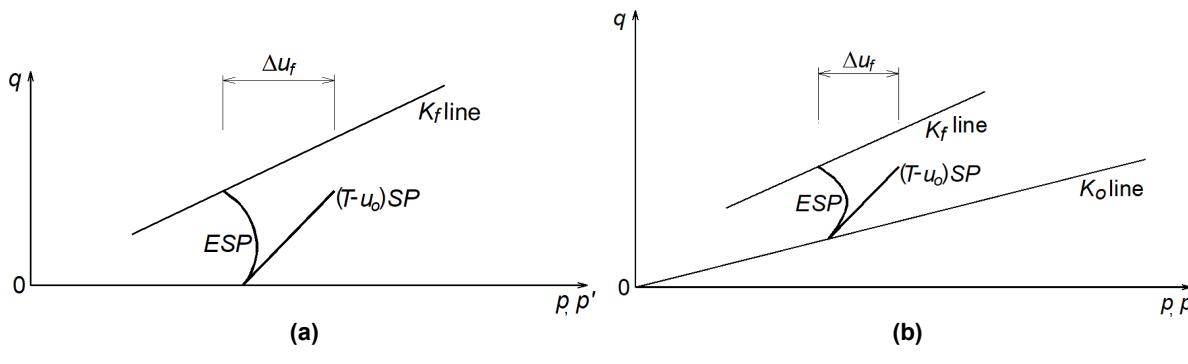
Figure 1. Schematic graphs of stress paths for axial compression loading condition: (a) Initially hydrostatic stress condition; (b) Initially non-hydrostatic stress condition
\[O'O = \frac{c'}{\tan \phi'} \tag{19}\]
From Figure 2:
\[A'C' = \Delta u_f \tag{20}\]
From the excess pore-water pressure equation of Skempton (1954):
\[\Delta u = B\Delta\sigma_3 + AB(\Delta\sigma_1 - \Delta\sigma_3) \tag{21}\]
For saturated condition, B equal to 1 is used (Table 1). At failure condition Equation (21) becomes:
\[\Delta u_f = \Delta \sigma_3 + A_f (\Delta \sigma_1 - \Delta \sigma_3) \tag{22}\]
From the definition of stress path (Lambe and Whitman, 1969):
\[\Delta q = \left(\frac{(\sigma_{1i} + \Delta \sigma_1) - (\sigma_{3i} + \Delta \sigma_3)}{2}\right) - \left(\frac{\sigma_{1i} - \sigma_{3i}}{2}\right) \tag{23}\]
\[\Delta q = \frac{\sigma_{1i} + \Delta \sigma_1 - \sigma_{3i} - \Delta \sigma_3 - \sigma_{1i} + \sigma_{3i}}{2} \tag{24}\]
\[\Delta q = \frac{(\Delta \sigma_1 - \Delta \sigma_3)}{2} \tag{25}\]
From Figure 2:
\[\Delta q = \frac{(\sigma_1 - \sigma_3)_f}{2} \tag{26}\]
Substituting Equation (26) into Equation (25):
\[(\Delta \sigma_1 - \Delta \sigma_3) = (\sigma_1 - \sigma_3)_f \tag{27}\]
The increase of minor principal stress, 3 can be related to the increase of major principal stress, 1 as:
\[\Delta \sigma_3 = I_x \Delta \sigma_1 \tag{28}\] where Ix is the influence factor of horizontal stress increase due to a vertical stress increase (Poulos and Davis, 1974). Then put 3 and (1 - 3) as a ratio:
\[\frac{\Delta \sigma_3}{(\Delta \sigma_1 - \Delta \sigma_3)} = \frac{I_x \Delta \sigma_1}{\Delta \sigma_1 - \Delta \sigma_3} \tag{29}\]
\[\frac{\Delta \sigma_3}{(\Delta \sigma_1 - \Delta \sigma_3)} = \frac{I_x \Delta \sigma_1}{\Delta \sigma_1 - I_x \Delta \sigma_1} \tag{30}\]
\[\frac{\Delta \sigma_3}{(\Delta \sigma_1 - \Delta \sigma_3)} = \frac{I_x \Delta \sigma_1}{(1 - I_x) \Delta \sigma_1}\] (31)
\[\frac{\Delta \sigma_3}{(\Delta \sigma_1 - \Delta \sigma_3)} = \frac{I_x}{1 - I_x} \tag{32}\]
\[\Delta \sigma_3 = \left(\frac{I_x}{1 - I_x}\right) (\Delta \sigma_1 - \Delta \sigma_3) \tag{33}\]
Substituting Equation (27) into Equation (33):
\[\Delta \sigma_3 = \left(\frac{I_x}{1 - I_x}\right) (\sigma_1 - \sigma_3)_f \tag{34}\]
Substituting Equations (27) and (34) into Equation (22):
\[\Delta u_f = \left(\frac{I_x}{1 - I_x}\right) (\sigma_1 - \sigma_3)_f + A_f (\sigma_1 - \sigma_3)_f \tag{35}\]
\[\Delta u_f = \left( \left( \frac{I_x}{1 - I_x} \right) + A_f \right) (\sigma_1 - \sigma_3)_f \tag{36}\]
Figure 2 indicates that the undrained shear strength, su can be related to (1 - 3)f as:
\[s_u = \frac{(\sigma_1 - \sigma_3)_f}{2} \tag{37}\]
\[(\sigma_1 - \sigma_3)_f = 2s_u \tag{38}\]
Substituting Equation (38) into Equation (36):
\[\Delta u_f = 2\left(\left(\frac{I_x}{1 - I_x}\right) + A_f\right) s_u \tag{39}\]
Substituting Equation (39) into Equation (20):
\[A'C' = 2\left(\left(\frac{I_x}{1 - I_x}\right) + A_f\right)s_u \tag{40}\]
From Figure 2:
\[OC = OB + BC \tag{41}\]
\[OC = \sigma'_{3o} + \frac{\Delta q}{\tan \alpha_{(T-u_o)SP}} \tag{42}\]
Substituting Equations (26) and (37) into Equation (42):
\[OC = \sigma'_{3o} + \frac{s_u}{\tan \alpha_{(T-u_o)SP}} \tag{43}\]
From the relationship between the effective major and minor stresses (Jacky, 1944; Jacky, 1948; Holtz and Kovacs, 1981):
\[K_o = \frac{\sigma_3}{\sigma_1} \tag{44}\]
\[\sigma_3' = K_o \sigma_1' \tag{45}\]
For horizontal ground surface:
\[\sigma_1' = \sigma_v' \tag{46}\]
Substituting Equations (45) and (46) into Equation (43):
\[OC = K_o \sigma_v' + \frac{s_u}{\tan \alpha_{(T-u)SP}}\] (47)
Substituting Equations (18), (19), (40), and (47) into Equation (14):
\[K_{o}\sigma'_{v} + \frac{s_{u}}{\tan \alpha_{(T-u_{o})SP}} = \frac{s_{u}}{\sin \phi'} - \frac{c'}{\tan \phi'} + 2\left(\left(\frac{I_{x}}{1-I_{x}}\right) + A_{f}\right)s_{u}\] (48)
\[K_o \sigma'_v + \frac{c'}{\tan \phi'} = \frac{s_u}{\sin \phi'} + 2\left(\left(\frac{I_x}{1 - I_x}\right) + A_f\right) s_u - \frac{s_u}{\tan \alpha_{(T - u_o)SP}}\] (49)
\[\sigma'_{v}\left(K_{o} + \frac{c'}{\sigma'_{v}\tan\phi'}\right) = s_{u}\left(\frac{1}{\sin\phi'} + 2\left(\left(\frac{I_{x}}{1 - I_{x}}\right) + A_{f}\right) - \frac{1}{\tan\alpha_{(T - u_{o})SP}}\right) (50)\]
\[\frac{S_u}{\sigma_v'} = \frac{K_o + \frac{c'}{\sigma_v' \tan \phi'}}{\frac{1}{\sin \phi'} + 2\left(\left(\frac{I_x}{1 - I_x}\right) + A_f\right) - \frac{1}{\tan \alpha_{(T - u_o)SP}}}\] (51)
This gives the relationship of the ratio of the undrained shear strength, \(s_u\) to the vertical effective stress, \(s_v\)' (the ratio of \((s_u/\sigma_v)\)) for normally consolidated saturated cohesive soils with initially hydrostatic condition:
\[\frac{s_u}{\sigma_v'} = \frac{\frac{c'}{\sigma_v' \tan \phi'} + K_o}{\frac{1}{\sin \phi'} + 2\left(\left(\frac{I_x}{1 - I_x}\right) + A_f\right) - \frac{1}{\tan \alpha_{(T - u_o)SP}}}\] (52)
The angle of \(\alpha_{(T-uo)SP}\) can be related to the coefficient between the horizontal to vertical stress increases, \(I_x\) as:
\[\tan \alpha_{(T-u_o)SP} = \frac{\Delta q}{\Delta p} \tag{53}\]
\[\tan \alpha_{(T-u_o)SP} = \frac{\left(\frac{(\sigma_{1o} + \Delta\sigma_1) - (\sigma_{3o} + \Delta\sigma_3)}{2}\right) - \left(\frac{\sigma_{1o} - \sigma_{3o}}{2}\right)}{\left(\frac{(\sigma_{1o} + \Delta\sigma_1) + (\sigma_{3o} + \Delta\sigma_3)}{2}\right) - \left(\frac{\sigma_{1o} + \sigma_{3o}}{2}\right)}\](54)
\[\tan \alpha_{(T-u_o)SP} = \frac{\left( (\sigma_{1o} + \Delta \sigma_1) - (\sigma_{3o} + \Delta \sigma_3) \right) - (\sigma_{1o} - \sigma_{3o})}{\left( (\sigma_{1o} + \Delta \sigma_1) + (\sigma_{3o} + \Delta \sigma_3) \right) - (\sigma_{1o} + \sigma_{3o})}\](55)
\[\tan \alpha_{(T-u_o)SP} = \frac{\sigma_{1o} + \Delta \sigma_1 - \sigma_{3o} - \Delta \sigma_3 - \sigma_{1o} + \sigma_{3o}}{\sigma_{1o} + \Delta \sigma_1 + \sigma_{3o} + \Delta \sigma_3 - \sigma_{1o} - \sigma_{3o}}\](56)
\[\tan \alpha_{(T-u_o)SP} = \frac{\Delta \sigma_1 - \Delta \sigma_3}{\Delta \sigma_1 + \Delta \sigma_3}\] (57)
Substituting Equations (28) and (46) into Equation (57):
\[\tan \alpha_{(T-u_o)SP} = \frac{\Delta \sigma_v - I_x \Delta \sigma_v}{\Delta \sigma_v + I_x \Delta \sigma_v}\] (58)
\[\tan \alpha_{(T-u_o)SP} = \frac{\Delta \sigma_v (1 - I_x)}{\Delta \sigma_v (1 + I_x)}\] (59)
\[\tan \alpha_{(T-u_o)SP} = \frac{1 - I_x}{1 + I_x} \tag{60}\]
For standard axial compression triaxial test, \(I_x = 0\) and \(\tan \alpha_{(T-uo)SP} = 1\) or \(\alpha_{(T-uo)SP} = 45^{\circ}\). This agrees with Table 2 that for axial compression loading with \(\Delta \sigma_h = 0\) as in the axial compression triaxial test, the total stress path makes an angle 45° with the horizontal axis. Therefore, for axial compression triaxial test stress condition, Equation (52) becomes:
\[\frac{s_u}{\sigma_v'} = \frac{\frac{c'}{\sigma_v' \tan \phi'} + K_o}{\frac{1}{\sin \phi'} + 2A_f - 1} \tag{61}\]
\[\frac{s_u}{\sigma_v'} = \frac{\frac{c'}{\sigma_v'(\sin\phi'/\cos\phi')} + K_o}{\frac{1}{\sin\phi'} + \frac{(2A_f - 1)\sin\phi'}{\sin\phi'}}\](62)
\[\frac{s_u}{\sigma_v'} = \frac{\frac{c'\cos\phi'}{\sigma_v'} + K_o\sin\phi'}{1 + (2A_f - 1)\sin\phi'}\](63)
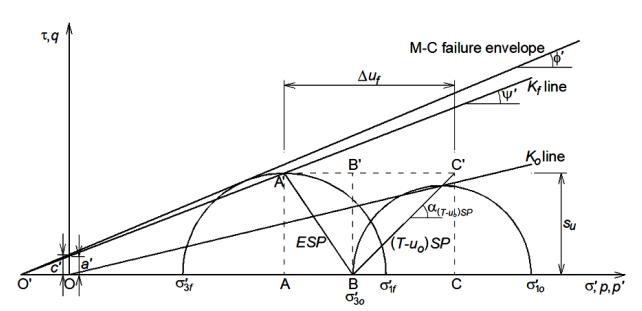
Figure 2. Mohr-Coulomb failure envelope and stress path for the derivation of the theoretical equation of the ratio of undrained shear strength, \(s_u\) to effective stress, \(s_v\)' for normally consolidated (NC) saturated cohesive soils under initially hydrostatic stress condition
3.3 Derivation of the theoretical equation of the ratio of \((s_u/\sigma_v)\) for normally consolidated saturated cohesive soils under initially \(K_0\) stress condition
Total and effective stress paths used for the derivation of the theoretical equation of the ratio of \((s_u/\sigma_v')\) for normally consolidated saturated cohesive soils under initially \(K_o\) stress condition are shown in Figure 3. From Figure 3:
\[OC = OA + AC \tag{64}\]
\[OC = O'A - O'O + A'C'\] (65)
Analogue with Equation (18):
\[O'A = \frac{s_u}{\sin \phi'} \tag{66}\]
Analogue with Equation (19):
\[O'O = \frac{c'}{\tan \phi'} \tag{67}\]
From Figure 3:
\[A'C' = \Delta u_f \tag{68}\]
From Figure 3 and the definition of stress path (Lambe and Withiman, 1969), for an axial compression test starting from initially non-hydrostatic condition:
\[\frac{(\sigma_1 - \sigma_3)_f}{2} = q_o + \Delta q \tag{69}\]
Substituting Equation (25) into Equation (69):
\[\frac{(\sigma_1 - \sigma_3)_f}{2} = q_o + \frac{(\Delta \sigma_1 - \Delta \sigma_3)}{2} \tag{70}\]
\[\frac{(\sigma_1 - \sigma_3)_f}{2} = \frac{\sigma'_{1o} - \sigma'_{3o}}{2} + \frac{(\Delta\sigma_1 - \Delta\sigma_3)}{2}\] (71)
From Figure 3:
\[s_u = \frac{(\sigma_1 - \sigma_3)_f}{2} \tag{72}\]
Substituting Equations (45), (46), and (72) into Equation (71):
\[s_u = \frac{\sigma_v^{'} - K_o \sigma_v^{'}}{2} + \frac{(\Delta \sigma_1 - \Delta \sigma_3)}{2}\] (73)
\[s_{u} = \frac{\sigma_{v}^{'}(1 - K_{o})}{2} + \frac{(\Delta\sigma_{1} - \Delta\sigma_{3})}{2}\] (74)
\[(\Delta \sigma_1 - \Delta \sigma_3) = 2s_u - \sigma'_v (1 - K_o)\] (75)
From Equation (33):
\[\Delta \sigma_3 = \left(\frac{I_x}{1 - I_x}\right) (\Delta \sigma_1 - \Delta \sigma_3) \tag{76}\]
Substituting Equation (75) into Equation (76):
\[\Delta\sigma_3 = \left(\frac{I_x}{1 - I_x}\right) \left(2s_u - \sigma_v'(1 - K_o)\right) \tag{77}\]
Substituting Equations (75) and (77) into Equation (22):
\[\Delta u_f = \left(\frac{I_x}{1 - I_x}\right) \left(2s_u - \sigma_v'(1 - K_o)\right) + A_f \left(2s_u - \sigma_v'(1 - K_o)\right) \tag{78}\]
\[\Delta u_f = 2\left(\frac{I_x}{1 - I_y}\right) s_u - \left(\frac{I_x}{1 - I_y}\right) \sigma'_v(1 - K_o) + 2A_f s_u - A_f \sigma'_v(1 - K_o)\] (79)
Substituting Equation (79) into Equation (68):
\[A^{'}C^{'} = 2\left(\frac{I_{x}}{1-I_{x}}\right)s_{u} - \left(\frac{I_{x}}{1-I_{x}}\right)\sigma_{v}^{'}(1-K_{o}) + 2A_{f}s_{u} - A_{f}\sigma_{v}^{'}(1-K_{o}) \quad (80)\]
From Figure 3:
\[OC = OB + BC \tag{81}\]
From Figure 3 and the definition of stress path (Lambe and Withman, 1969):
\[OB = p_o (82)\]
\[OB = \frac{\sigma'_{1o} + \sigma'_{3o}}{2} \tag{83}\]
Substituting Equations (45) and (46) into Equation (83):
\[OB = \frac{\sigma_v^{'} + K_0 \sigma_v^{'}}{2} \tag{84}\]
\[OB = \frac{\sigma_v'(1 + K_o)}{2} \tag{85}\]
From Figure 3:
\[BC = \frac{\Delta q}{\tan \alpha_{(T-u_{\alpha})SP}} \tag{86}\]
Substituting Equation (25) into Equation (86):
\[BC = \frac{(\Delta \sigma_1 - \Delta \sigma_3)}{2}\] \[\tan \alpha_{(T-u_n)SP}\] (87)
Substituting Equation (75) into Equation (87):
\[BC = \frac{\left(s_u - \frac{\sigma_v'(1 - K_o)}{2}\right)}{\tan \alpha_{(T - u_o)SP}}\] (88)
\[BC = \frac{s_u}{\tan \alpha_{(T-u_o)SP}} - \frac{\sigma_v'(1 - K_o)}{2\tan \alpha_{(T-u_o)SP}}\](89)
Substituting Equations (85) and (89) into Equation (81):
\[OC = \frac{\sigma_{v}^{'}(1 + K_{o})}{2} + \frac{s_{u}}{\tan \alpha_{(T - u_{o})SP}} - \frac{\sigma_{v}^{'}(1 - K_{o})}{2 \tan \alpha_{(T - u_{o})SP}}\](90)
Substituting Equations (66), (67), (80), and (90) into Equation (65):
\[\frac{\sigma'_{v}(1+K_{o})}{2} + \frac{s_{u}}{\tan \alpha_{(T-u_{v})SP}} - \frac{\sigma'_{v}(1-K_{o})}{2\tan \alpha_{(T-u_{v})SP}} = \left(\frac{s_{u}}{\sin \phi'}\right) - \left(\frac{c'}{\tan \phi'}\right) + \left(2\left(\frac{I_{x}}{1-I_{y}}\right)s_{u} - \left(\frac{I_{x}}{1-I_{y}}\right)\sigma'_{v}(1-K_{o}) + 2A_{f}s_{u} - A_{f}\sigma'_{v}(1-K_{o})\right)\](91)
\[\frac{\sigma'_{v}(1+K_{o})}{2} + \frac{s_{u}}{\tan \alpha_{(T-u)SP}} - \frac{\sigma'_{v}(1-K_{o})}{2\tan \alpha_{(T-u)SP}} = \frac{s_{u}}{\sin \phi'} - \frac{c'}{\tan \phi'} + 2\left(\frac{I_{x}}{1-I_{y}}\right)s_{u} - \left(\frac{I_{x}}{1-I_{y}}\right)\sigma'_{v}(1-K_{o}) + 2A_{f}s_{u} - A_{f}\sigma'_{v}(1-K_{o})\] (92)
\[\frac{s_u}{\tan\alpha_{(T-u_o)SP}} - \frac{s_u}{\sin\phi'} - 2\left(\frac{I_x}{1-I_x}\right)s_u - 2A_f s_u = -\frac{c'}{\tan\phi'} - \left(\frac{I_x}{1-I_x}\right)\sigma_v'(1-K_o) - A_f \sigma_v'(1-K_o) - \frac{\sigma_v'(1+K_o)}{2} + \frac{\sigma_v'(1-K_o)}{2\tan\alpha_{(T-u_o)SP}}\](93)
\[\frac{s_u}{\tan\alpha_{(T-u_o)SP}} - \frac{s_u}{\sin\phi'} - 2\left(\frac{I_x}{1-I_x}\right)s_u - 2A_f s_u = -\frac{\sigma_v^{'}c^{'}}{\sigma_v^{'}\tan\phi'} - \left(\frac{I_x}{1-I_x}\right)\sigma_v^{'}(1-K_o) - A_f\sigma_v^{'}(1-K_o) - \frac{\sigma_v^{'}(1+K_o)}{2} + \frac{\sigma_v^{'}(1-K_o)}{2\tan\alpha_{(T-u_o)SP}}\](94)
\[s_{u}\left(\frac{1}{\tan\alpha_{(T-u_{o})SP}} - \frac{1}{\sin\phi'} - 2\left(\frac{I_{x}}{1 - I_{x}}\right) - 2A_{f}\right) = \sigma'_{v}\left(-\frac{c'}{\sigma'_{v}\tan\phi'} - \left(\frac{I_{x}}{1 - I_{x}}\right)(1 - K_{o}) - A_{f}(1 - K_{o}) - \frac{(1 + K_{o})}{2} + \frac{(1 - K_{o})}{2\tan\alpha_{(T-u_{o})SP}}\right)\](95)
\[\frac{s_u}{\sigma_v'} = \frac{-\frac{c'}{\sigma_v' \tan \phi'} - \left(\frac{I_x}{1 - I_x}\right) (1 - K_o) - A_f (1 - K_o) - \frac{(1 + K_o)}{2} + \frac{(1 - K_o)}{2 \tan \alpha_{(T - u_o)SP}}}{\frac{1}{\tan \alpha_{(T - u_o)SP}} - \frac{1}{\sin \phi'} - 2\left(\frac{I_x}{1 - I_x}\right) - 2A_f}\] (96)
This gives the relationship of the ratio of the undrained shear strength, \(s_u\) to the vertical effective stress, \(\sigma_v\)' (the ratio of \((s_u / \sigma_v)\)) for normally consolidated saturated cohesive soils with initially \(K_o\) (non-hydrostatic) stress condition:
\[\frac{S_u}{\sigma_v'} = \frac{\frac{c'}{\sigma_v' \tan \phi'} + \left(\frac{I_x}{1 - I_x}\right) (1 - K_o) + A_f (1 - K_o) + \frac{(1 + K_o)}{2} - \frac{(1 - K_o)}{2 \tan \alpha_{(T - u_o)SP}}}{-\frac{1}{\tan \alpha_{(T - u_o)SP}} + \frac{1}{\sin \phi'} + 2\left(\frac{I_x}{1 - I_x}\right) + 2A_f}\] (97)
For axial compression triaxial test, \(I_x = 0\) and \(\alpha_{(T-uo)SP}\)= 1. Equation (97) becomes:
\[\frac{s_u}{\sigma_v'} = \frac{\frac{c'}{\sigma_v' \tan \phi'} + A_f (1 - K_o) + \frac{(1 + K_o)}{2} - \frac{(1 - K_o)}{2}}{-1 + \frac{1}{\sin \phi'} + 2A_f}\](98)
\[\frac{s_u}{\sigma_v'} = \frac{\frac{c'}{\sigma_v'(\sin\phi'/\cos\phi')} + A_f(1 - K_o) + \frac{(1 + K_o)}{2} - \frac{(1 - K_o)}{2}}{\frac{1}{\sin\phi'} + 2A_f - 1}\](99)
\[\frac{s_u}{\sigma_v^{'}} = \frac{\frac{c^{'}\cos\phi^{'}}{\sigma_v^{'}\sin\phi^{'}} + A_f(1 - K_o) + \frac{(1 + K_o)}{2} - \frac{(1 - K_o)}{2}}{\frac{1}{\sin\phi^{'}} + 2A_f - 1}\](100)
\[\frac{s_u}{\sigma_v'} = \frac{\frac{c^{'}\cos\phi^{'}}{v^{'}\sin\phi^{'}} + \frac{A_f(1 - K_o)\sin\phi^{'}}{\sin\phi^{'}} + \frac{(1 + K_o)\sin\phi^{'}}{2\sin\phi^{'}} - \frac{(1 - K_o)\sin\phi^{'}}{2\sin\phi^{'}}}{\frac{1}{\sin\phi^{'}} + \frac{(2A_f - 1)\sin\phi^{'}}{\sin\phi^{'}}}\](101)
\[\frac{s_u}{\sigma_v^{'}} = \frac{\frac{c^{'}\cos\phi^{'}}{\sigma_v^{'}} + A_f(1 - K_o)\sin\phi^{'} + \frac{(1 + K_o)\sin\phi^{'}}{2} - \frac{(1 - K_o)\sin\phi^{'}}{2}}{1 + (2A_f - 1)\sin\phi^{'}}\](102)
\[\frac{s_u}{\sigma_v'} = \frac{c'\cos\phi' + A_f\sin\phi' - A_fK_o\sin\phi' + \frac{\sin\phi'}{2} + \frac{K_o\sin\phi'}{2} - \frac{\sin\phi'}{2} + \frac{K_o\sin\phi'}{2}}{1 + (2A_f - 1)\sin\phi'}\](103)
\[\frac{s_u}{\sigma_v^{'}} = \frac{\frac{c^{'}\cos\phi^{'}}{\sigma_v^{'}} + A_f\sin\phi^{'} - A_fK_o\sin\phi^{'} + \frac{K_o\sin\phi^{'}}{2} + \frac{K_o\sin\phi^{'}}{2}}{1 + (2A_f - 1)\sin\phi^{'}}\](104)
\[\frac{s_u}{\sigma_v^{'}} = \frac{\frac{c^{'}\cos\phi^{'}}{\sigma_v^{'}} + A_f\sin\phi^{'} - A_fK_o\sin\phi^{'} + K_o\sin\phi^{'}}{1 + (2A_f - 1)\sin\phi^{'}}\](105)
\[\text{[rumus tidak dapat ditampilkan dengan baik — lihat PDF asli]}\](106)
\[\text{[rumus tidak dapat ditampilkan dengan baik — lihat PDF asli]}\](107)
\[\text{[rumus tidak dapat ditampilkan dengan baik — lihat PDF asli]}\](108)
This gives Equation (10). Thus, for standard axial compression triaxial test under initially \(K_0\) stress condition, the general equation (Equation (97) becomes Equation (10) from Leonards (1962).
4. Comparisons with Field and Laboratory Measurements Data
Performance of the theoretical equations from this study (Equations (52) and (97)) is investigated using the published experimental data obtained from previous studies.
4.1 Field shear strength tests consolidated glacial clay (Mesri, 1975)
The data of the relationship between the ratio of \((s_u/\sigma_v)\)and PI from Mesri (1975) is used as a comparison with
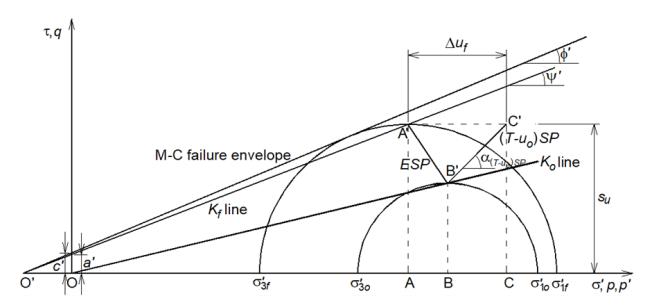
Figure 3. Mohr-Coulomb failure envelope and stress path for the derivation of the theoretical equation of the ratio of undrained shear strength, \(s_u\) to effective stress, \(s_v\)for normally consolidated (NC) saturated cohesive soils under initially hydrostatic stress condition
the theoretical equation of this study. Mesri (1975) used Bierrum's (1972) data of vane shear tests on a normally consolidated and lightly consolidated glacial clays. The relationship between the effective friction angle, \(\phi'\) and the plasticity index, PI from Holtz and Kovacs (1981) and Terzaghi et al. (1996) is used to convert the data from Mesri (1975) into the relationship between the ratio of \((s_{\nu}/\sigma_{\nu})\) and effective friction angle \(\phi\) (Figure 4 (a)).
Equation (7) shows that axial compression triaxial test was involved in building the relationship that similar as in Mesri (1975). Therefore, the data is compared with the theoretical equation for an initially hydrostatic condition for axial compression triaxial test (Equation (63). For the triaxial test, it is assumed that the value of \(I_r\) is equal to zero. It is also assumed that the effective cohesion, c' is equal to zero. Therefore, Equation (63) becomes:
\[\frac{s_u}{\sigma_v'} = \frac{K_o \sin \phi'}{1 + (2A_f - 1) \sin \phi'}\] (109)
In the absence of the measurement of the increase in pore-water pressure, typical values of Skempton porewater pressure parameter at failure A<sub>f</sub> for normally consolidated cohesive soils in Table 1 are used. Table 1 indicates that Skempton pore-water pressure parameters for normally consolidated cohesive soils at failure, A<sub>f</sub> ranges from 0.5 to 1.0. For calculating of the ratio of \((s_0/\sigma_0)\), four variations of the values of A<sub>f</sub> are used: 0.5. 0.6, 0.75, and 1.0.
The results of the calculation of the ratio of \((s_{1}/\sigma_{y})\)from the theoretical equation of this study, from the theoretical equations from Leonards (1962), and from the theoretical equation of Inada et al. (1981) and Sagae et al. (2006) as compared with the field measurements are shown in Figures 4, 5, and 6, respectively. A comparison of Figures 4, 5, and 6 indicates that the theoretical equation of this study for initially hydrostatic stress condition (Equation (109)) gives good results as compared to the measurement of Mesri (1975). In addition, the comparison of the ratio of \((s_u/\sigma_v)\) obtained from Equation (109) using A<sub>f</sub> equal to 0.6 gives the closest result with the result from Mesri (1975) as shown in Figures 4(a), 4(b), and Equation (8). Therefore, it is highly probable that the value of A<sub>f</sub> equal to 0.6 would have been the value of pore-water pressure parameter A<sub>f</sub> if the measurement of the increase in pore-water pressure had been performed for
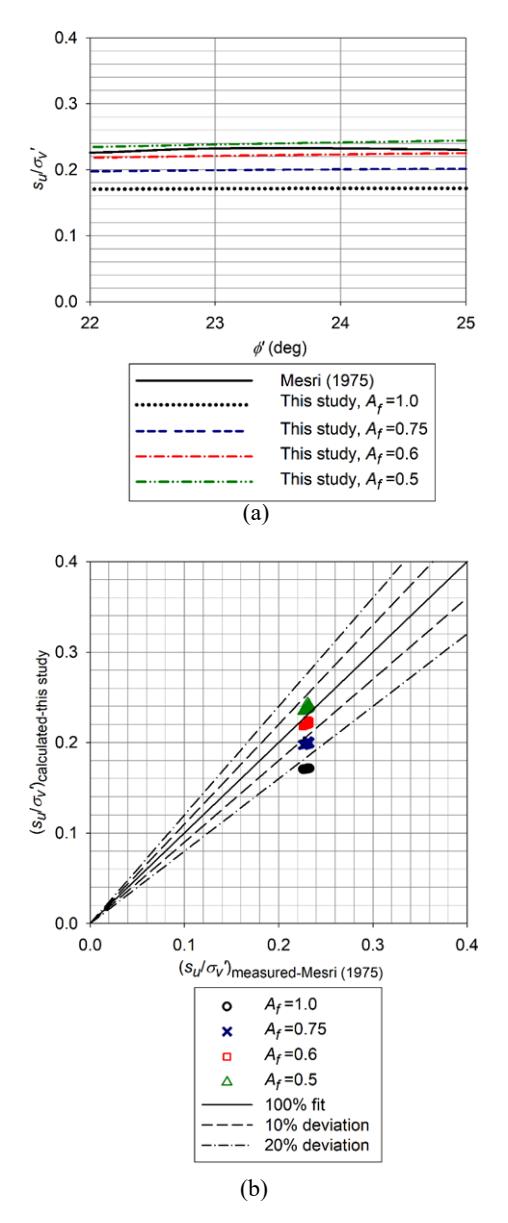
Figure 4. Relationship between the ratio of (su/v') obtained from theoretical equation of this study and the measurement data of Mesri (1975): (a) Plot in terms of the ratio of (su/v') vs. the effective friction angle, '; (b) Plot in terms of the calculated and the measured ratios of (su/v')
this case. Some deviations are found in the results using the theoretical equation from Leonards (1962) and the theoretical equation of Inada et al. (1981) and Sagae et al. (2006).
4.2 Laboratory tests of normally consolidated clay with initially non-hydrostatic condition (Bishop and Wesley, 1975)
Bishop and Wesley (1975) performed axial compression, lateral extension, axial extension, and lateral extension triaxial tests on normally consolidated clay as explained in Holtz and Kovacs (1981). Initially, Ko (non-hydrostatic) stress condition was applied to the specimen. Only axial compression triaxial test result is considered as a comparison to the theoretical equation
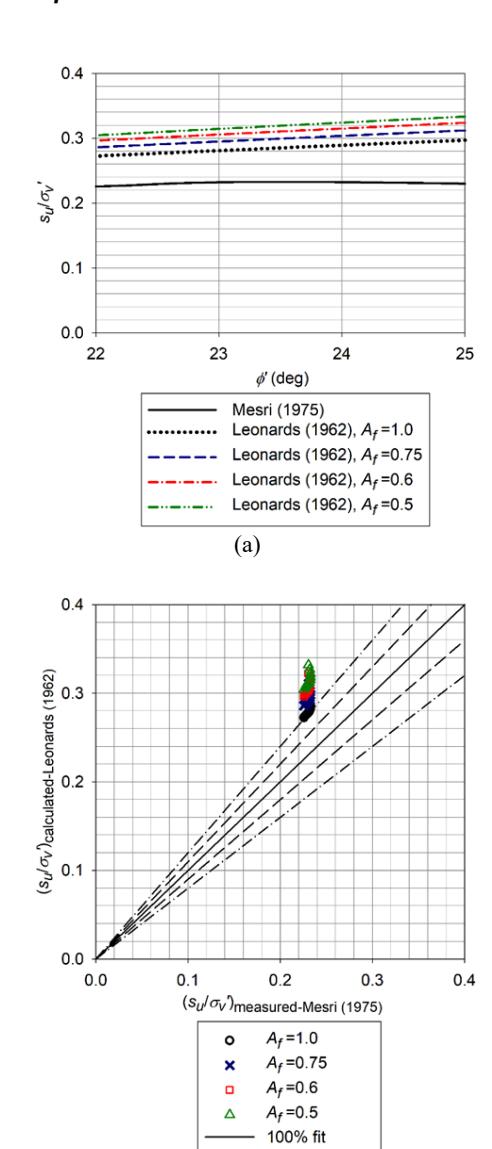
Figure 5. Comparison between the ratio of (su/v') obtained from theoretical equation of Leonards (1962) vs. the measurement data of Mesri (1975): (a) Plot in terms of the ratio of (su/v') vs. the effective friction angle, '; (b) Plot in terms of the calculated and the measured ratios of (su/v')
(b)
of this study. The definition of the undrained shear strength, su obtained from the drained triaxial test, follows Holtz and Kovacs' (1981) definition as follows:
\[s_u = \tau_f \tag{110}\] where tf is the shear strength. Table 3 shows the parameters obtained from the result of the test. For this Ko (non-hydrostatic) initial stress condition of axial compression triaxial test loading, Equation (97) becomes Equation (108).
The result shown in Figure 7 indicates that the theoretical equation of this study can predict the ratio of (su/v') for an initially hydrostatic condition well. The theoretical equation from Leonards (1962) also performs well. This good performance is because, for
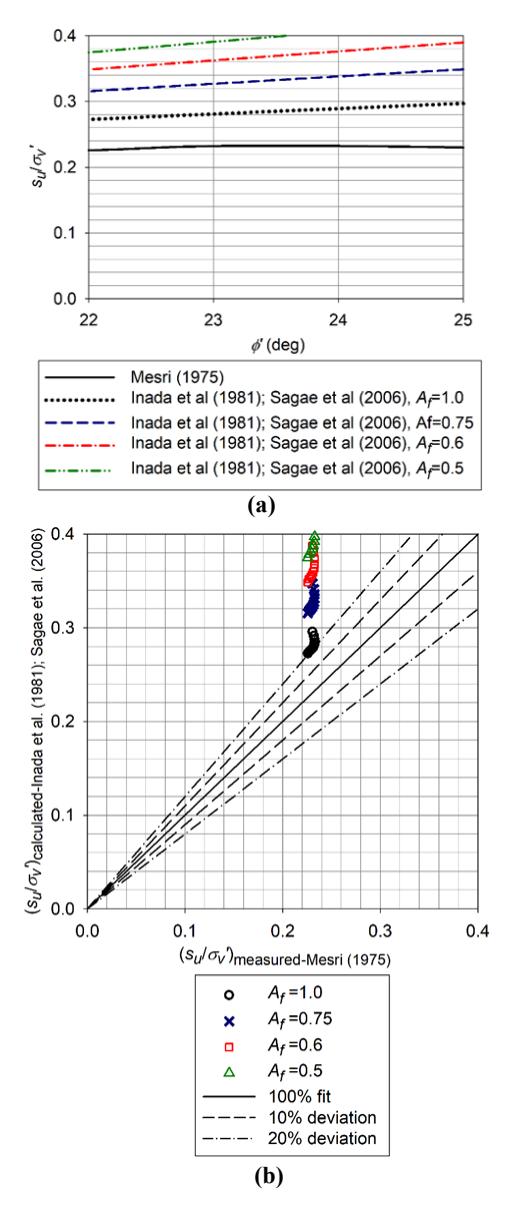
Figure 6. Comparison between the ratio of (su/v') obtained from theoretical equation of Inada et al. (1981) and Sagae et al. (2006) vs. the measurement data of Mesri (1975): (a) Plot in terms of the ratio of (su/v') vs. the effective friction angle, '; (b) Plot in terms of the calculated and the measured ratios of (su/v')
axial compression loading for initially Ko (nonhydrostatic) stress condition, the theoretical equation of this study (Equation (97)) becomes Equation (108) which is the same as Equation (10) of Leonards (1962). However, there is a deviation between the result of the theoretical equation from Inada et al. (1981) and Sagae et al. (2006) and the measured data. This condition results from the difference in the initial condition between that of the isotropic condition in the theoretical equation from Inada et al. (1981) and Sagae et al. (2006) and the initially Ko (non-hydrostatic) stress condition in the measured data.
5. Discussions
The above comparisons show that the theoretical equations (Equations (63) and (108)) perform well to
Table 3. Parameters of the results of axial compression Koconsolidated CU triaxial test on a normally consolidated clay of Bishop and Wesley (1975)
| Parameter | Value |
|---|---|
| a' (kPa) | 7.0 |
| ' (deg) | 25.7 |
| ' (deg) | 28.8 |
| c' (kPa) | 8.0 |
| uf (kPa) | 9.3 |
| pf (kPa) | 33.1 |
| qf (kPa) | 17.9 |
| su (kPa) | 17.9 |
| v' = vo' (kPa) | 27.2 |
| ho' (kPa) | 15.1 |
| Ko | 0.55 |
| 1 (kPa) | 23.7 |
| 3 (kPa) | 0.0 |
| Af | 0.39 |
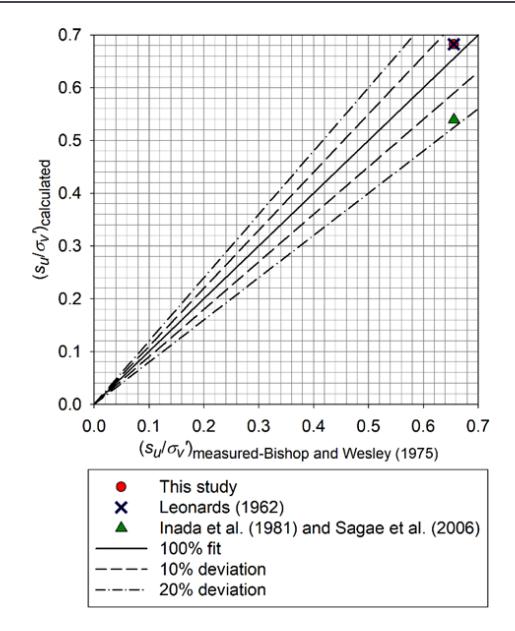
Figure 7. Comparison between the ratio of (su/v') obtained from the measurement data of Bishop and Wesley (1975) vs. the calculated values using the theoretical equation of this study and the theoretical equation of Leonards (1962) and the theoretical equation of Inada et al. (1981) and Sagae et al. (2006)
obtain the ratio of (su/v') utilizing the effective shear strength parameters, Skempton's pore-water pressure parameters, and stress paths for normally consolidated saturated cohesive soils for initially hydrostatic and initially Ko (non-hydrostatic) stress conditions. The well performance represents the applicability of the general form of the theoretical equations (Equations (52) and (97)) to compute the ratio of (su/v') for axial compression test stress condition. For axial compression triaxial test stress condition with initially Ko stress condition, the equation of this study becomes the theoretical equation of Leonards (1962). For axial compression triaxial with initially Ko equal to one stress condition, the equation of this study becomes the theoretical equation of Inada et al. (1981) and Sagae et al. (2006).
It seems that the data of Mesri (1975) follows a stress path similar to Figure 1(a). This condition causes the deviation of the calculated results from the theoretical equation of Leonards (1962) and the theoretical equation of Inada et al. (1981) and Sagae et al. (2006) from the measured data.
The data of Bishop and Wesley (1975) follows a stress path similar to Figure 1(b). This condition causes the calculated result using the theoretical equation from this study is the same as that of Leonards' (1962). The theoretical equation of Inada et al. (1981) and Sagae et al. (2006) is based on an initially hydrostatic stress condition with \(K_o\) equal to one. As this condition is different from that of the measurement by Bishop and Wesley (1975), this results in a deviation between the measured data and the calculated value from the theoretical equation of Inada et al. (1981) and Sagae et al. (2006) as shown in Figure 7.
The above comparison with the measured data shows that the theoretical equations in this study (Equations (52) and (97)) can accommodate several stress conditions. In contrast, the previously proposed equations are appropriate only for a particular stress condition. More verifications are needed to investigate performance of the theoretical equation to stress conditions other than that of the standard axial triaxial compression test. In addition, since the verification data involves data of lightly overconsolidated saturated cohesive soils, there is an indication that the theoretical equations of this study may also work for lightly overconsolidated saturated cohesive soils.
6. Conclusions
- 1. Two theoretical equations are developed to calculate the ratio of \((s_u/\sigma_v)\) for initially hydrostatic stress condition (Equation (52)) and initially \(K_o\) (non-hydrostatic) condition (Equation (97)).
- 2. The theoretical equation to calculate the ratio of \((s_u/\sigma_v)\) for initially hydrostatic condition soils (Equation (52)) utilizes at rest coefficient of earth pressure, \(K_o\) and Skempton pore-water pressure parameter at failure, \(A_f\). The corresponding stress condition of \((\Delta \sigma_1 \Delta \sigma_3) = (\sigma_1 \sigma_3)\) is used in the derivation of the theoretical equation.
- 3. The theoretical equation to calculate the ratio of \((s_u/\sigma_v)\) for initially non-hydrostatic condition soils (Equation (97)) utilizes at rest coefficient of earth pressure, \(K_o\) and Skempton pore-water pressure parameter at failure, \(A_f\). The parameter \((\Delta \sigma_1 \Delta \sigma_3)\) is derived considering \(K_o\) (non-hydrostatic) initial stress condition.
- 4. The general form of the theoretical equations (Equations (52) and (97)) can compute the ratio of \((s_u/\sigma_v)\) for variation of increase in \(\Delta s_1\) and \(\Delta s_3\) utilizing the parameter \(I_x\). These equations can be further derived for the standard axial compression triaxial stress condition (Equations (63) and (108)).
- 5. For axial compression triaxial test stress condition with initially \(K_o\) stress condition, the theoretical
- equation (Equation (97)) becomes the theoretical equation from Leonards (1962) (Equation (108) as compared to Equation (10)).
- 6. The comparisons with the measurements data show that theoretical equations perform well to calculate the ratio of \((s_u/\sigma_v)\) for normally consolidated saturated cohesive soils. The theoretical equations in this study (Equations (52) and (97) can accommodate several stress conditions. More verifications are needed to investigate the performance of the theoretical equation to stress conditions other than that of the standard axial triaxial compression test.
- Since the verification data involves data of lightly overconsolidated saturated cohesive soils, there is an indication that the theoretical equations may also work for lightly overconsolidated saturated cohesive soils.