

1. Introduction
The Indonesian construction industry is one of the main sectors to support the economic growth in the country. It provides infrastructure for other economic sectors such as agriculture, energy, tourism, manufacturing trade, and others (Budiwibowo and Wibowo, 2012). According to a report published by the World Economic Forum, the construction industry currently accounts for about 6% of the world's GDP. It is expected to reach around 14.7% by 2030. However, on the other hand, the image experienced by the construction sector is dominated by something lowtech, still relying on craft-based methods, characterized by poor performance and low quality (Craveiroa et al, 2019). The construction industry also faces considerable challenges in increasing construction capitalization and increasingly tight consumer demand for project quality and costs (Kusuma et al, 2019). Therefore, it is essential that to better support the nation's development, it is necessary for the Indonesian construction industry to invest more in the adoption, development, and application of technology (Soemardi et al, 2020).
Material technology plays an essential role in construction projects. The selection of materials in construction design will determine the overall project, from implementation methods to costs. As the demand for infrastructure development is on the rise, in the last decade, the use of concrete (including pre-cast concrete) has increased more than two folds, followed by steel and other metal-base and bituminous material (Soemardi et al, 2020). Further, a survey conducted to 40 Indonesian contractors found that the priority of using concrete and steel materials ranked at the top during normal conditions and the Covid-19 pandemic. Along with natural and processed bituminous material, concrete and steel remain the dominant materials for the construction infrastructure objects in Indonesia. On the other hand, data, and information about the history of development, utilization, and potential of
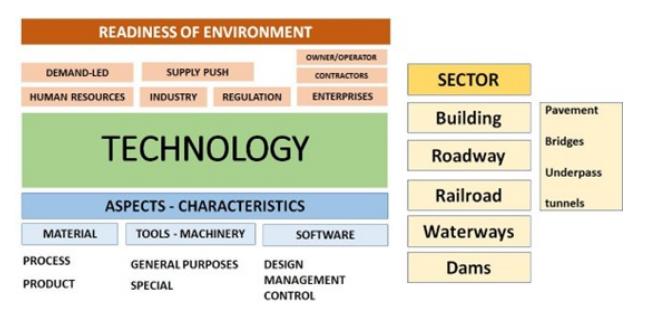
Figure 1. Construction technology development framework process.
construction technology, especially concrete and steel materials in Indonesia, is almost non-existent. In contrast, the information data is considered essential to help formulate policies regarding developing and utilizing construction technology in Indonesia.
The use of these technologies can be mapped as a technological landscape. The technology landscape in the construction industry refers to the overall technological developments and trends in the industry over a particular period. The timeline for the technology landscape in the construction industry can vary depending on the scope and purpose of the study. The timeline for the technology landscape in the construction industry can also be specific to a particular region, country, or industry sector. For example, a study on the technology landscape in the Indonesian construction industry may focus on technological developments over the past decade. Technological landscapes help answer questions on how a particular technology is adopted and utilized, coping with growing problems, and predicting future needs. Therefore, this study aims to present the technological landscape of concrete and steel construction material, providing an overall view of the historical development of the utilization, contribution, and strategy for developing future construction material technology in Indonesia. The methodology to be used is literature studies, interviews, and questionnaires.
2. Methodology
This research is focused on data developments, adoption strategies for the implementation of material technology, especially in concrete and steel. The data retrieval method is conducted from a literature study to determine the classification of technology and its development. This study uses secondary data sources obtained through literature study. The data collection is determined from various reference books, dissertations, and articles of journals, newspapers, and the internet. For this reason, the historical development of material technology in Indonesia is analyzed in four phases: pre-independence era (the 1940s), the early independence era (1945 – 1965), the pre-reform era (1965 – 1998), and the post-reform era (1999 – present).
In addition, for primary data, an online survey through questionnaire was distributed to various respondents. Respondents are dominated by contractor companies. The objective was to apply material technology in the construction industry and its supply chain and the development of material technology in their business
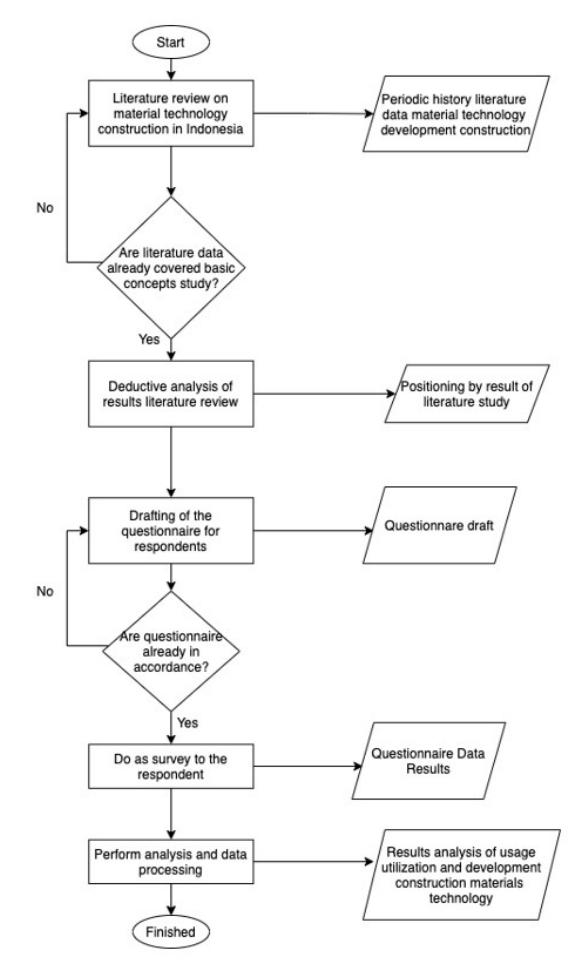
Figure 2. Research method
3. Technology Development of Construction Material in Indonesia
The development of the construction industry can be understood by reviewing the technological landscape regarding its positioning. While the development of the construction industry in Indonesia can be categorized into four phases: pre-independence era (the 1940s), the early independence era (1945 – 1965), the pre-reform era (1965 – 1998), and the post-reform era (1999 – present) (Soemardi et al, 2020), concrete and steel material technology in Indonesia has begun to develop since the days of the Dutch East Indies government. However, the technology identified and systemized by this research is after the independence of Indonesia. The following is an overview of the historical development of Indonesia's concrete and steel material technology.
3.1 Historical development of concrete construction in Indonesia
Reinforced concrete was first introduced in Indonesia during the colonial period, and its Usage has increased along with the increasing development activities in the Dutch East Indies. The use of reinforced concrete from 1901 to 1942 can be seen from the buildings and infrastructure that still exist today. In addition, since the 1950s, concrete materials have been used to construct houses and dams by Dutch companies with specific
specialties, which later became the basis for mastering the technology implementation and construction business in later periods (Soemardi et al, 2020).
The first construction using prestressed concrete was the Semanggi Bridge which Ir. Soetami built. Where it is known that the supports are not in the form of vertical pillars but tilted, this was made possible thanks to the use of prestressing technology, which was first applied in building construction in Indonesia. Furthermore, this is what caused Bung Karno to be interested in the design.
Considering its utilization as a component of concrete material which is essential in construction, the national cement demand is eventually affected by the position of the construction industry as one of the major industries in Indonesia. However, it has not caused any significant problems due to the deployment of cement manufacturing plants on various significant islands in Indonesia, which led to a balance between supply and demand. There are currently 12 cement plants, including two funded by foreign investment, operating with a combined capacity of nearly 110 million tons a year. As the number of buildings and other infrastructure increases in the coming years, the need for concrete and cement is expected to increase. Apart from traditional in-situ concrete, more projects are now using pre-cast concrete components. Currently, there are 26 pre-cast concrete plants with 43 million tons per year (Soemardi et al, 2020).
Concrete work technology will be affected by the Usage of cement materials, which have now begun to be reduced and replaced with recycled materials such as fly ash, slag, etc. Those chemical technologies, which are intended to produce a different behaviour of concrete, are still produced abroad. The use of highquality concrete has begun to exist with the development of high-rise buildings. In addition, the equipment for special construction needs has begun to be used, but all of it is still imported from abroad, such as pumps for the display of supertall buildings (Abduh et al, 2018).
3.2 Historical development of steel construction in Indonesia
Steel construction materials began to be used during the Dutch colonial period in Indonesia. This began to be recognized by the use of reinforced concrete for buildings made as structural elements. The development of the use of steel materials in Indonesia has existed since 1960. At that time, President Soekarno launched the Trikora Iron Steel project to lay the foundation for a solid national industry.
In 1962, the Ampera Bridge, a continuous steel bridge with a total span of 354 m, was built in conjunction with the construction of Gelora Bung Karno stadium, whose roof structure uses steel. Both projects mark the first use of steel profile products in Indonesia (Abduh et al, 2018).
The use of steel profile then continued with the construction of a 30-story steel structure building called
Wisma Nusantara, which began in 1964 at the initiative of the First President of the Republic of Indonesia to build the first high-rise in the capital city, Jakarta (Soemardi et al, 2020). On August 31, 1971, PT Krakatau Steel (Persero) was established. By reusing the remaining equipment from the Trikora Besi Steel project, steel wire factory, steel reinforcement factory, and steel profile factory, in 1977, President Soeharto inaugurated the operation of the largest steel producer in Indonesia.
Steel and other metal products continue to gain popularity in the construction industry, with more comprehensive applications for high-rise buildings, warehouses, factories, and private housing. The problem with steel material lies in its supply. Data from the Ministry of Public Works shows that the production of construction steel in Indonesia is currently only around 12 million tons per year, even though the installed capacity is 18.8 million tons. In addition to ordinary steel products, lightweight steel is increasingly popular for simple structures and home construction. Its characteristics make it easier to move by hand, and lighter lifting plant support is required on site. Lightweight steel is also a good design choice for earthquake-resistant structures. Currently, the average requirement of around 900 tons per year can still be met with an available capacity of 1,000 tons (Soemardi et al, 2020).
3.3 Technology development
Research and development (R&D) must be woven centrally into the organization's mission. Research and development should play a dual role in supporting and influencing the overall corporate strategy, so that it creates unique offerings for the company's priority markets and reveals strategic opportunities, highlighting promising ways to reposition the business through innovative platforms and disruptive breakthroughs (Brennan et al, 2020).
Developing technology from third parties or subsidiaries requires close communication between sender and receiver also long-term commitment and building a healthy relationship between parties (Wahab et al, 2011). Both parties should also share the same common core value (Uusitalo and Lavikka, 2020). The development of concrete and steel technologies with third parties or subsidiaries should be thoroughly developed and tested to reach a certain level of maturity and even acceptance on the market (Uusitalo and Lavikka, 2020).
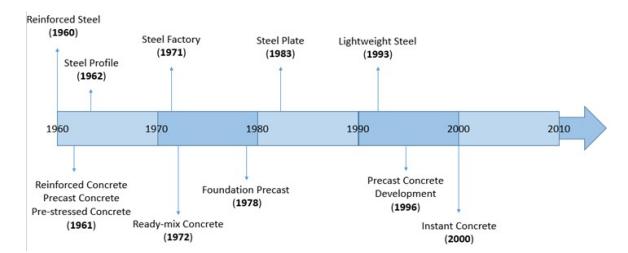
Figure 3. Timeline of construction material technology in Indonesia
4. Result and Discussion
4.1 Positioning of steel and concrete material technology in Indonesia
The results of questionnaires and literature studies were conducted to define the scope of material technology coverage for steel, grouped into Profiled Steel, Reinforced Steel, Lightweight Steel, Plate Steel, and Composite Steel. At the same time, concrete is grouped into Reinforced Normal Concrete, Precast Concrete, Prestressed Concrete, Instant Concrete, and Polymer Concrete. Then obtained the positioning of the concrete and steel material technology as below:
4.2 The utilization and development of construction material technology
The contribution of material technology currently used in construction projects in Indonesia is described by the Material Technology Landscape in terms of the intensity of use, segmentation of the type of project that uses it, and the technology adoption strategy itself.
4.2.1 Usage of material technology
In this study, the use of concrete and steel material technology is seen from the intensity of its use and the majority of the types of projects that use it. The intensity of the use of material technology is defined as how often the technology is used on projects that the respondent has done. Figure 4 shows the questionnaire results regarding the intensity of the use of material technology.
Based on the data obtained, the material technology with the highest average usage intensity is normal concrete for concrete materials and reinforcing steel for steel materials. This can be caused because these
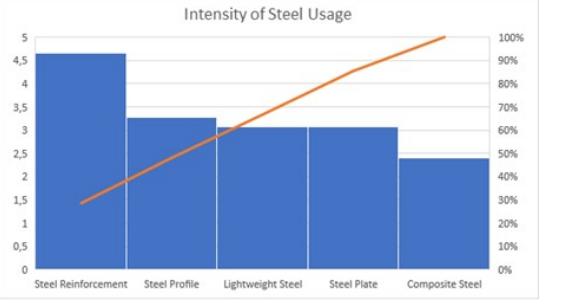
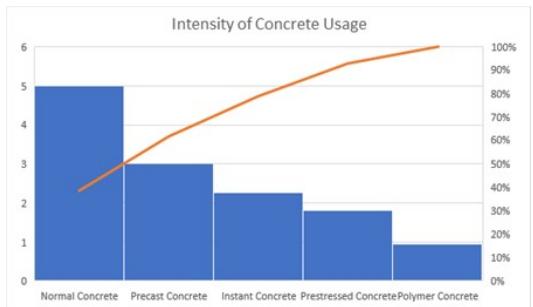
Figure 4. The intensity of steel and concrete usage
two materials are the primary materials used in construction projects. In addition, it is easy to obtain because of the spread of batching plants and workshops to accommodate material needs and the ease of use. It does not require a unique method for its implementation, which also affects the high intensity of using the two technologies. The material technology with the lowest average intensity of use is polymer concrete for concrete materials and composite steel for steel materials. This can be caused by the new development of technology so that the methods that can support its use are not adequate. The Usage of material technology also can be analyzed from most projects that use it. Table 1 shows the questionnaire result of major Usage of concrete material technology.
Based on the questionnaire result, normal concrete is mainly used in building projects. Indonesia's geographical conditions influenced the construction of buildings to use earthquake moment-resisting frame systems using concrete materials, so it is reasonable to have building projects as significant users of normal concrete. Instant concrete is also primarily used in building projects. The Usage of technology can cause this in small-scale architectural work or non-structural items in building projects. Based on the questionnaire, it
Table 1. Major usage of concrete material technology
| 1st Major Usage | 2nd Major Usage | |
|---|---|---|
| Normal Concrete | Building | Housing |
| Instant Concrete | Building | Housing |
| Precast Concrete | Building, Bridge | Roads |
| Prestressed Concrete | Bridge | Building |
| Polymer Concrete | N/A | Building |
Table 2. Major usage of steel material technology
| 1st Major Usage | 2nd Major Usage | |
|---|---|---|
| Reinforcement Steel | Building | Bridge |
| Steel Profiles | Bridge | Building |
| Lightweight Steel | Housing | Building |
| Steel Plate | Bridge | Building |
| Composite Steel | Building | Bridge |
was also obtained that pre-cast and prestress technology are mainly used on bridge projects. This can be caused by the condition of the bridge project, which is usually in environmental conditions that demand rapid development with very minimal disturbance, so the use of pre-cast and prestress technology is the right choice.
Based on questionnaires obtained for steel material technology, profiled and steel plates are mainly used for bridge construction. This can be due to the majority of bridge projects in Indonesia utilizing both types of materials as the main components of the structure. Steel reinforcement technology is mainly used in building and bridge projects. This can be due to projects that usually use normal concrete on a large scale that ultimately requires support from steel reinforcement in its structural components. Lightweight steel is mainly used in housing projects. This can be because housing projects currently use lightweight steel as a roof or canopy component. Composite steel is mainly used in building projects because it is still not commonly used in road, bridge, and housing projects.
4.2.2 Adoption strategy
Adoption strategy is how construction actors get the types of materials used in a construction project. This study is divided into three parts: buying products directly from producers of certain types of materials, developing their types of materials, and no adoption for those who do not use these types of materials.
Based on the table above, it is found that there is dominance for the part to buy products for each type of material indicated because this method of adoption is relatively easy to implement so that it helps the construction project process to be faster. Concrete technology is widely available in the construction industry, so companies prefer to buy concrete technology because it has been well developed by concrete suppliers or specialist companies, especially for normal concrete. Most construction companies have subsidiaries for precast concrete development. In contrast, very few contractors have subsidiaries to develop their steel materials due to the needs of raw materials that are still imported. The activity of
Table 3. Adoption strategy of steel
| No | Type of Material | Buying Products | Developing on Own | Buying License | None/No use |
|---|---|---|---|---|---|
| 1 | Steel Profile | 73.33% | 13.33% | 0% | 13.33% |
| 2 | Steel Reinforcement | 86.67% | 6.67% | 0% | 6.67% |
| 3 | Lightweight Steel | 68.75% | 12.50% | 6.25% | 8.33% |
| 4 | Steel Plate | 91,67% | 0% | 6.25% | 8.33% |
| 5 | Composite Steel | 71.43% | 0% | 0% | 28.57% |
Table 4. Adoption strategy of concrete
| No | Type of Material | Buying Products | Developing Your Own | Buying License | None/No use |
|---|---|---|---|---|---|
| 1 | Normal Concrete | 80% | 13.33% | 0% | 6.67% |
| 2 | Precast Concrete | 41.18% | 35.29% | 0% | 23.53% |
| 3 | Prestressed Concrete | 35.29% | 17.65% | 0% | 47.06% |
| 4 | Instant Concrete | 62.50% | 12.50% | 0% | 25% |
| 5 | Polymer Concrete | 20% | 6.67% | 0% | 73.33% |
Table 5. Strategy for utilization and development of steel technology
| No | Type of Material | Research and Development | Third Parties/Subsidiaries | None/No use |
|---|---|---|---|---|
| 1 | Steel Profiles | 23.53% | 52.94% | 23.53% |
| 2 | Reinforcement Steel | 25% | 43.75% | 31.25% |
| 3 | Lightweight Steel | 23.53% | 58.82% | 17.65% |
| 4 | Steel Plate | 23.53% | 52.94% | 23.53% |
| 5 | Composite Steel | 26.67% | 40% | 33.34% |
Table 6. Strategy for utilization and development of concrete technology
| No | Type of Material | Research and Development | Third Parties/Subsidiaries | None/No use |
|---|---|---|---|---|
| 1 | Normal Concrete | 35.29% | 35.29% | 29.41% |
| 2 | Precast Concrete | 35.29% | 29.41% | 35.29% |
| 3 | Prestressed Concrete | 25% | 31.25% | 43.75% |
| 4 | Instant Concrete | 18.75% | 37.50% | 43.75% |
| 5 | Polymer Concrete | 13.33% | 6.67% | 80% |
Table 7. Critical factors affecting construction technology
| No. | Critical Factors | Definition | Explanation | |
|---|---|---|---|---|
| Component 1: Organizational Resources | ||||
| 1 | Availability of technology | Ability to access technology at reasonable pricing materially. | Technology access determines the speed of adoption rate in the construction industry. New technologies are frequently unavailable and difficult to obtain. | |
| 2 | Readiness of technology | People's willingness to accept and use new technology in their personal and professional lives. | Technology readiness can be thought of as an overall state of mind determined by a gestalt of mental enablers and inhibitors that affect a person's proclivity to use new technology. | |
| 3 | Compatibility of technology | Ability to connect things together and have them work without issues. | The more compatible a technology is with consumers' existing behaviours, the less a behavioural change is necessary, allowing faster adoption. | |
| 4 | Impact on project cost | The possible benefits to be gained and how these benefits are translated into earnings. | The perceived cost of technology adoption is one of the most important factors in deciding whether to adopt technological innovation. The higher the cost of technology adoption, the lower the desire of organizations to adopt technological innovations. | |
| 5 | Impact on project resources | The personnel, capital, material, or products required for successful execution and completion | Technology needs resources to be implemented. Lack of resource could impede progress and lead a project to fall behind schedule. Resource availability affect the decision to adopt new technology. | |
| 6 | Return of Investment (ROI) of technology | Performance metric used to assess an investment's efficiency or profitability. | Technology's return on investment (ROI) critically influences the decision making of construction technology adoption. | |
| Component 2: Organizational Goals | ||||
| 7 | Impact on project quality | The degree to which a set of inherent characteristics fulfils requirements | Technology must be able to produce product with adequate or better quality than the company's quality standard that will boost the technology adoption. | |
| 8 | Impact on worker's competency | The ability to do something successfully or efficiently | Workers need technology mastery to be able implementing it effectively. The more complex the technology in implementation the slower the adoption rate. | |
| Component 3: Organizational Stratergy | ||||
| 9 | Organization's strategic plan | The process of developing specific business plans, putting them into action, and assessing how well they worked for a company's overarching long term goals and objectives. | The perceived of usefulness of technology in the planning process can influence technology adoption | |
| 10 | Management's approach in making decision | Management will choose an approach that is most likely to deliver favourable results and can be implemented cost-effectively with a high probability of success while avoiding unnecessary financial risk | The technology alignment with management's approach affects the technology adoption. If the technology favours the defined management's approach are more likely to be implemented. | |
356 Jurnal Teknik Sipil
importing steel materials can result in cheaper costs than producing steel locally. Regulations governing steel imports have not been able to control import activities properly.
4.3 Material technology utilization and development strategy
Regarding the use of technology, to improve construction productivity, it is considered very important for the industry to implement the right strategy in adopting, utilizing, and developing material technology. This study identified how the contractors utilize and develop technology for construction material, which can be categorized as research and development unit, or by support from third parties or subsidiaries or none/no use. The table above shows third parties or subsidiaries dominate each type of material's maintenance and development strategies that shows companies are more likely to use this approach because it requires building relationship between parties and long-term commitment in developing technology to a certain maturity. Further, as for polymer concrete, R&D and third-party support are also limited since its use is minimal. Since they are not using particular material in the works, a small portion of the respondents stated that they neither have R&D nor got any help from others. To successfully utilize and develop construction material technologies, there are critical factors that need be considered (Khudzari et al, 2021).
Based on the critical factors influencing technology adoption, we can devise strategies to increase the adoption rate of material technology. Construction companies need awareness of the importance of using material technology to gain competitive advantage. While utilizing and developing material technology requires massive investment initially, in the long run, material technology will bring more benefit for companies. Material technology has potential to supress project cost after it reaches certain maturity. Material technology can be developed to use local resources so that it is easy to produce. Consulting to material technology experts or collaborating with experienced foreign companies can accelerate the development process. Pilot projects can help companies in enhancing their product quality using material technology. Companies can hold workforce training to improve capabilities in using material technology. Material technology can also grow rapidly if the government is involved to promoting material technology innovation.
5. Conclusion
1. An important part of efforts to strengthen the capacity of the Indonesian construction industry is to invest in the implementation and development of construction technology. However, the lack of information about the historical development, utilization, and contribution of technology makes it difficult for the industry practitioner to define the strategy for future construction technology implementation. This study has attempted to capture the technology landscape for steel and concrete materials, the two most widely used materials, that provides information on the
- historical development and current status of utilization and technological development strategy for construction material utilization in Indonesia.
- 2. Concrete and steel have remained the popular construction material in Indonesia since 1960. The use of this material will continue to grow along with the industry's effort to adequately respond to the increasing demand, such as the construction of many cement and steel factories, particularly those outside Java Island. However, the availability and increasing utilization of concrete and steel material has yet to be accompanied by the industry's endeavour to advance the adoption and utilization of technology. Responds to the questionnaire in this study may indicate that the contractors are not too keen on changing technology, and the adoption of concrete and steel technology tends to move only slowly. Contractors tend to be less responsive to new technologies. The newer the technology, the more investment is required and the less likely it will be adopted and developed.
- 3. Common construction materials such as normal concrete and reinforcement steel have been used for a long time and will remain with more significant usage and development. In the meantime, other materials such as polymer concrete and composite steel, which were established in the industry, still lack usage and development. Furthermore, in general, building and bridge projects dominate the utilization of concrete and steel technology. From the questionnaire, it can also be concluded that the business process of the parties drives the tendency of the adoption strategy of the technology. Large contractors tend to develop the technology using their subsidiaries, while others buy it from vendors or suppliers.
- 4. Construction companies are more inclined to develop concrete and steel materials technologies through third-party or subsidiaries. Strategies for the adoption of material technology have been developed using critical factors affecting construction technology adoption. In the future, the development of material technology allows concrete and steel products to be easier to use for construction, more substantial, more durable, but still economical and environmentally friendly. This is supported by the development of additional materials and mixtures to produce better properties. One of them is by using the development of nanotechnology on materials that can achieve a denser material arrangement to produce greater compressive strength. In addition, high-strength steel and concrete, self-consolidating concrete (SCC), and pervious concrete are examples of the development of construction material technology that is currently developing.