

Abstract
Kerjasama Pemerintah dan Swasta dengan skema Bangun Guna Serah (PPP/BOT) adalah produk institusi. Proses aransemen institusi yang dihadapkan dengan komplesitas sosio-teknis dalam penyediaan air minum perpipaan. The Institutional Development Framework (IAD) membuka peluang untuk mempelajari bagaimana institusi mampu menjadi prakondisi bagi actor yang berinteraksi pada saat penyiapan PPP/BOT. PPP/BOT di Jakarta berjalan mulai pada Januari 1998 dan berakhir pada Desember 2022. PPP/BOT dimulai dengan cakupan 32,69% dan berakhir setelah 25 tahun dengan hanya mencapai 61%, padahal target awal PPP/Bot pada tahun 1998 adalah mencapai target 95% selama 25 tahun kerjasama. Situasi ini menunjukkan ada disparitas signifikan antara kontrak kerjasama yang disepakati dengan implementasi. Focus penelitian menyoroti bagaimana kualitas persiapan memengaruhi kinerja keuangan dan sistem. Kepatuhan actor yang berinteraksi (pilihan kolektif) terhadap peraturan yang baik dan sesuai dengan best practice internasional, berkorelasi sngat erat dengan peningkatan kinerja PPP/BOT.
Keywords: Kontrak, kinerja keuangan, institusi, PPP/BOT, kinerja sistem.
1. Introduction
The content of this paper stems from a study undertaken from 2015 to 2020 (Plamonia, 2020). It examines the case of Public-Private Partnership (PPP) in the Western Part of Jakarta, initiated in 1998 under the Build Operate and Transfer (BOT) framework. The primary objective of this PPP initiative is to enhance coverage, aiming to increase it from 31.95% in 1997 to 100% by 2022 (Abubakar, 2004; Harsono, 10 February 2003, p. 2; Napitupulu & Watna, 21 December 2013, p. 1). The 2017 Contract stipulated that the coverage target should encompass 95% of the population. However, by the conclusion of 2022, the actual coverage only reached 63%. Subsequently, in 2024, the coverage saw a marginal increase to 64%. Assessments of this performance have been documented across
multiple scientific articles (Surjadi, 2003) (Endo, 2004) (Jensen, 2005) (Hodge & Greve, 2007) (Bakker, 2007), (Iwan, 2008) (Fitriani, 2009) (Hadipuro et al., 2016) (Plamonia, 2020), and audits by both private and government entities (BPKP, 9 July 2004) (BPKP, 11 June 2009) (BPKP, 29 April 2011) (BPS, 1 December 2013) (BPKP, 17 July 2014) (BPKP, 18 July 2014) (BPS, 1 December 2014) (Saputro, 2015) (BPS, 1 November 2015) (BPS, 20 November 2015) (BPKP, 11 February 2016) (JWRB, 31 May 2016) (BPS, 1 December 2016). The contract's performance fell short of expectations without imposing consequences on the party responsible for the shortfall. This shortfall subsequently prompted the initiation of a new PPP.
The PPP/BOT represents an institutional arrangement resulting from a decision-making process encompassing
multiple actors and reflecting the diversity of institutions and actors within society. The inability of the PPP/BOT to enhance coverage reflects the shortcomings of the decision-making processes involved. It's possible that these decision-making processes lead to the creation of inadequate contracts, which in turn fail to effectively regulate operations aimed at developing drinking water infrastructure and services.
Problem Setting: In the event of PPP failure, ideally, the operational actor should rectify the situation by revisiting the decision-making process, ensuring that customers are not burdened with risks such as the inability to access drinking water for extended periods (e.g., 25 years). Alternatively, early termination of the PPP could occur as outlined in the contract mechanism. However, despite the PPP's failure to deliver drinking water from 1998 to 2017, the contract was not terminated and instead continued for the subsequent five years (2018-2022). Furthermore, the PPP was then extended with Moya Indonesia until 2030. This underscores that the success of a PPP extends beyond technical functionality to encompass how the actors, particularly decision-makers, manage the PPP.
The primary research inquiry is formulated as follows: "How do the institutional attributes of the PPP impact the provision of drinking water, particularly concerning the effectiveness of the Contract in attaining the objective of enhancing service coverage?" This inquiry is further dissected into three sub-questions.
The first research question (R.Q.1) is as follows: "What are the primary characteristics of the decision-making process involved in a PPP/BOT contract?"; Given the descriptive and analytical nature of this sub-question, it is divided into two parts: (R.Q.1.a) "Who are the stakeholders engaged in the process?" (R.Q.1.b) "What are the intended outcomes utilizing the Build Operate and Transfer scheme?" The second research question (R.Q.2) is: "How can interactions among actors in an institutional context be modeled, particularly with regard to the influence of external variables?".
The third research question (R.Q.3) is 'How can the preparation of BOT be improved and how does this influence Build Operate and Transfer performance?'. R.Q.3 explores the proper conclusion of PPPs concerning their performance. This evaluative inquiry is pursued through the investigation of two additional questions: (R.Q.3.a) "What are the attributes of PPP performance in real-world Build Operate and Transfer scenarios, and what roles do actors and institutions play in them?" (R.Q.3.b) "To what extent and in what ways does the performance of Build Operate and 1 The contract is titled: "Cooperation Agreement Amended And Restated As Of 22 October 2001 Concerning Clean Water Supply And Service Improvement For The Western Part Of Jakarta Main Contract Perusahaan Daerah Air Minum Daerah Khusus Ibukota Jakarta "PAM JAYA" With PT.PAM Lyonnaise Jaya". [Indonesia: "Perjanjian Kerjasama (Sebagaimana telah diubah dan dinyatakan kembali tertanggal 22 Oktober 2001) Penyediaan dan Peningkatan Pelayanan Air Bersih di Wilayah Barat Jakarta Kontrak Perusahaan Daerah Air Minum Daerah Khusus Ibukota Jakarta dengan PT. Pam Lyonnaise Jaya."] 2 As the PDAMs of DKI Jakarta Province that Established based on the Provincial Regulations of DKI Jakarta No. 3/1977 on the Establishment of PDAM DKI Jakarta "PAM JAYA"
Transfer projects affect the institutional aspects of termination arrangements?". The three sub-questions mentioned earlier serve to elucidate the main research question. To address this research inquiry, we analyze the PPP/BOT contract<sup>1</sup> between 'PAM JAYA<sup>2</sup>' and PAM Lyonnaise Jaya<sup>3</sup>.
Based on the introduction, problem formulation, and research question, the overarching aim of the study is to formulate decision-making support guidelines for institutional actors involved at the contracting stage. This is achieved through an examination of the relationship between the institutional characteristics of the contracting phase in the PPP/BOT process and the resultant outcomes, with a specific emphasis on optimizing coverage areas. The article is structured into four main sections. Part I: Introduction encompasses background information, the formulation of the problem, research inquiries, the research objective, and an outline of the thesis. Part II: Location of the study. Part III: Methods delineates the research methodology, covering data collection, analysis procedures, reporting methods, and case study presentations. Part IV: Results and Discussion. Part V: Conclusion.
2. Location Study
The public water utilities provided by 'PAM JAYA' in Jakarta only served a population of 1,374,777 individuals, representing a mere 32% of the total population of 4,302,846 in 1997 (refer to Figure 1) ((Harsono, 10 February 2003, p. 2; Napitupulu & Watna, 21 December 2013, p. 1)). By the early 1990s, the Ministry of Public Works began embracing the
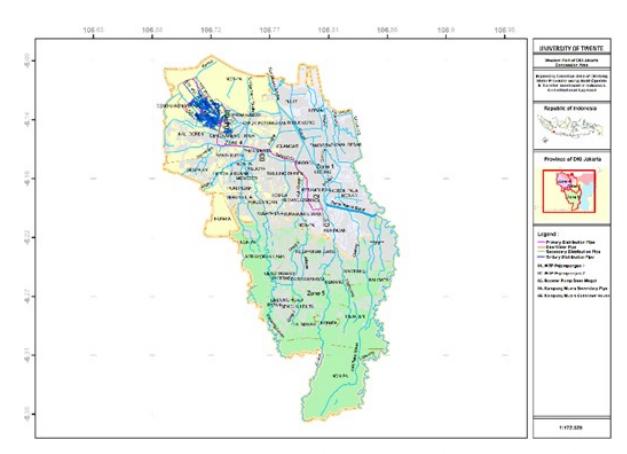
Note: The Special Capital Region of Jakarta Province (hereafter referred to as DKI Jakarta or Jakarta) is situated at a latitude of 6°12' South and a longitude of 106°48' East.
Figure 1. Area of study
3 PT. PAM LYONNAISE JAYA, a limited liability company duly established and existing under the laws of the Republic of Indonesia, having its principal office at Sentral Senayan I Office Tower, 7" Floor, Jl. Asia Afrika No. 8, Jakarta 10270, Indonesia whose Articles of Association have been published in SupplementNo.5769 to the State Gazette of the Republic of Indonesia No.82 of 1998 dated the 13th day of October, 1998. Establish by Suez Lyonnaise Des Eaux SLDE as parent company, currently being taken over by Ondeo. SLIDE / Ondeo is the parent company of 90% shareholder of PALYJA shares.
growing popularity of PPP/BOT approaches. The adoption of the Institutional Analysis and Development (IAD) framework commenced with an examination of background variables including biophysical conditions and community attributes. This evaluation focused on ensuring the alignment of Rules-in-Use with International Best Practices and the Rules-in-Form of 1990 at the collective decision-making level, while also regulating operations at the operational level.
3. Method
The characterization provided by Hodge and Greve (2007, p. 545), stating that "PPPs are broadly described as collaborative institutional agreements involving both public and private entities," validates that PPPs primarily revolve around decision-making and institutional structuring. The Institutional Analysis and Development (IAD) framework serves as the central framework for analyzing PPPs as institutional arrangements, as depicted in Figure 2.
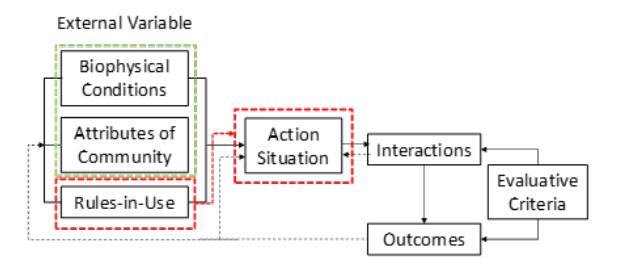
Note: explain that I take the Rules-in-Use as independent variable and Action Situation as Dependent Variable. While the Biophysical Condition and the attributes of the community serves as the background variable
Figure 2. The Institutional Analysis and Development (IAD) framework. Source: Ostrom (2005, p. 15)
Ostrom (2005, p. 59) categorizes the levels of action situations into four distinct stages: (1) metaconstitutional, (2) constitutional, (3) collective choice, and (4) operational. I apply this framework in my dissertation as follow (see Plamonia (2020, p. 67):
Firstly, the International Best Practice (IBP) represents a synthesis of insights gleaned from practical experiences that experts have deemed successful or unsuccessful. This foundation is constructed upon a literature review of international experts' perspectives, drawing upon crossborder experiences. The IBP serves as metaconstitutional guidance, encompassing various best principles, rules, and procedures pertinent to addressing the characteristics, allocation of water rights, and the nature of PPP/BOT arrangements. The IBP for organizing PPP/BOT comprises the following elements: (1) Balanced Relationships; (2) Proportional costs & benefits; (3) Transparency & accountability; (4) Conflict resolution mechanisms; (5) System of fines & sanctions; (6) Renewal procedures; (7) Exit mechanisms.
Secondly, within the institutional framework, the Constitutional rules are delineated by The Ministry of Home Affairs Regulation No. 4/1990, hereafter referred to as RiF 1990. This regulation holds the third position in the hierarchy of regulations, following the Government Regulation (1st) and the Presidential Regulation (2<sup>nd</sup>). Notably, the Constitutional rules align with only two aspects of the International Best Practice (IBP): maintaining a balanced relationship between actors and ensuring proportional costs and benefits. Subsequently, we will explore how the lack of adherence to international standards influences the decision-making institutional arrangement of the PPP/BOT.
Thirdly, the Decision-Making Process represents a Collective Choice Action Situation. It initiated with the issuance of Provincial Regulation No. 13 of 1992 by the Governor of Jakarta on October 15, 1992. At the collective choice level, the quality of the Contract acts as an outcome indicator. This quality hinges on the decision-maker's adherence to the seven principles delineated in the IBP as the metaconstitutional rules.
Finally, the operational level. At this level, The financial and system performances serve as evaluative criteria for the output (outcome indicators). The system performances indicators are as follow (1) Coverage (%); (2) Number of Connection (Unit); (3) Volume Production (m³/year); (4) Volume Delivered (m³/year); (5) Volume Losses (m³/year); (6) Quality (Y/N); (7) Continuity (Y/N). Financial performance is evaluated through indicators including Capital Expenditure: (1) Capital Expenditure (IDR); (2) Operational Expenditure (IDR); (3) Basic Cost (IDR/m³); (4) Imaginary Tariff (IDR/m³); (5) Real Tariff (IDR/m³); (6) Margin (IDR/m³); (7) Water Charge (IDR/m³).
Finally, at the operational level, the financial and system performances serve as crucial benchmarks for assessing outcomes. The system performance indicators encompass metrics such as: (1) Coverage (%); (2) Number of Connection (Unit); (3) Volume Production (m³/year); (4) Volume Delivered (m³/year); (5) Volume Losses (m³/year); (6) Quality (Y/N); (7) Continuity (Y/N). Financial performance is evaluated through indicators including Capital Expenditure: (1) Capital Expenditure (IDR); (2) Operational Expenditure (IDR); (3) Basic Cost (IDR/m³); (4) Imaginary Tariff (IDR/m³); (5) Real Tariff (IDR/m³); (6) Margin (IDR/m³); (7) Water Charge (IDR/m³).
3.1 Rules-in-Use (RiU)
McGinnis (2011, p. 175) defined this as covering "all relevant elements of the institutional context surrounding an action situation" and grouped them into (1) Property rights; (2) Formal rules (or written rules) juxtaposed with (3) Intangible rules commonly applied in practical situations (e.g., religious beliefs).
3.2 Action situation (decision making)
As per Ostrom (2005, p. 33), the action situation is comprised of seven rules (refer to Figure 3): (1) Boundary rules, governing how participants enter or exit
<sup>4</sup> The public water utility operating under the Provincial Government of DKI Jakarta is known as PAM JAYA. PAM JAYA was established in accordance with Provincial Regulation No. 3/1977, which is considered a primary law within the legal hierarchy (Supreme Court of Indonesia Decision No. 31, 10 April 2017, p. 18).
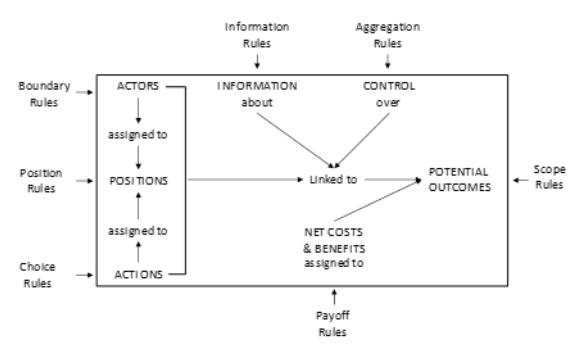
Figure 3. Seven type of rules in the action situation Source: Ostrom (2005, p. 33)
these positions; (2) Position rules, which designate a 'placeholder' for a position that must select from a set of authorized actions during decision-making, including decisions to act or abstain from acting (Ostrom, 2005, p. 45; Smajgl, Leitch, & Lynam, 2009, p. 16); (3) Authority (choice) rules, outlining a set of actions assigned to each position; (4) Information rules, determining the information accessible to each position; (5) Aggregation (control) rules, specifying the function that transforms actions into intermediate or final outcomes; (6) Scope rules (possible outcomes), outlining a range of potential outcomes; (7) Pay-off rules (net costs and benefits), detailing how benefits and costs are distributed, allowed, or prohibited to players.
3.3 Analysis of the decision-making process
In my 2020 dissertation (Plamonia, 2020), I examined the decision-making process by comparing the potential overlaps or intersections of the Rules-in-Use (pertaining to decision-making in Collective Choice Interaction), the Rules-in-Form (in line with Constitutional Rules), and IBP (Meta-Constitutional Rules). The relationships between these rules may manifest in the following ways: (1) None of these three align with each other; (2) only two align; or (3) all three align.
According to Figure 4, there are three distinct situations outlined as follows: (A) denoted as Smart Practice (SP), wherein Rules-in-Use adhere to IBP; (B) referred to as Smart Rules (SR), where Rules-in-Form follow IBP; (C) termed as Lawful Practice (LP), where Rules-in-Use align with Rules-in-Form. As the objective was to comprehend the institutional pattern characteristics observed in real-world practices, a model was devised to illustrate the anticipated patterns reflecting: (1) the presence or absence of smart rules, (2) the presence or absence of smart practice, and (3) the empirical assumptions regarding the sequence of steps taken during the contracting of the PPP and the resulting performances. In my 2020 dissertation (Plamonia, 2020), Table 1 illustrates four interaction models created by integrating Rules-in-Use, Rules-in-Form, and IBP as follows:
1. Dumb Rules and Dumb Practice (DRDP) occurs when Rules-in-Form (RiFs) do not adhere to IBP and Rules-in-Use (RiUs) do not conform to IBP, resulting in a score of 0 (Red).
Figure 4: The correlation among IBP, Rules-in-Form, and Rules-in-Use can be categorized into three conditions: Condition A occurs when Rules-in-Use adhere to the IBP; Condition B arises when Rules-in-Form comply with the IBP; Condition C emerges when Rules-in-Use align with Rules-in-Form.
- 2. Smart Rules, but Dumb Practice (SRDP) is when RiFs follow IBP, but RiUs do not follow IBP (nor, by implication, RiFs) scores as 1 (amber).
- 3. Dumb Rules, but Smart Practice (DRSP) is when RiFs do not follow IBP, but RiUs do follow IBP and score 2 (blue).
- 4. Smart Rules with Smart Practice (SRSP) is when RiF follows IBP and RiU follows RiF. The dark green color indicates the best combination and scores 3 (green).
4. Result and Discussion
4.1 Result
The outcomes at the operational level are divided into two categories of performance: firstly, system performance, and secondly, financial performance.
Firstly, there were three output indicators for system performance, as follows: The primary focus was on whether the planned number of connections was achieved, indicating improvements in coverage area and the balance between subsidized and non-subsidized customers. The observation spanned five periods (1998- 2002; 2003-2007; 2008-2012; 2013-2017; and 2018- 2022). However, the number of connections fell short of the target in all periods (14%, 5%, 6%, 6%, and 6%, respectively) (refer to Figure 5).
Secondly, the examination centers around whether the anticipated volumes of water production and delivery are attained and if water loss remains within anticipated
Table 1. The model of interaction
| Smart Practice (→) | ||||
|---|---|---|---|---|
| Y | N | |||
| Sm art | Y | (3) RIF ≡ IBP | (1) RIF ≡ IBP | |
| R | & RiU ≡ RiF | & RiU ≠ IBP | ||
| ule s ( | N | (2) RIF ≠ IBP | (0) RIF ≠ IBP | |
| →) | & RiU ≡ IBP | & RiU ≠ IBP | ||
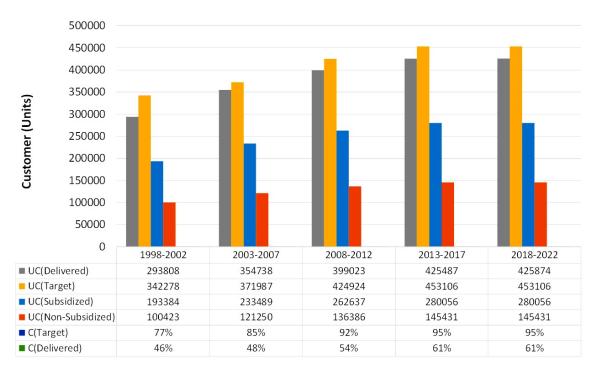
Figure 5: Subsidized and Non-Subsidized Connection Targets and Deliveries: The horizontal axis (X) represents five-year periods, while the vertical axis (Y) indicates the number of connections in units (UC). The coverage (C) is calculated as the projected number of connection units divided by the total population of the concession area, expressed as a percentage (%).
levels. This analysis relies on data regarding water production, volume delivery, and water losses, segmented into five periods: 1998-2002, 2003-2007, 2008-2012, 2013 -2017, and 2018-2022. The volume of water produced demonstrated respective changes of minus 4%, plus 10%, plus 8%, and plus 7% across these periods. Conversely, the volume of water sold experienced variations of minus 18%, minus 7%, plus 14%, and minus 1% in the same periods. However, I encountered three distinct sets of data concerning water losses. From the inception of the partnership, the supposed actual losses were recorded at 28%, 21%, 4%, and 9%, respectively (calculated as the volume produced minus the volume sold). Meanwhile, the volume losses reported by PALYJA to PAM JAYA stood at 55%, 47%, 44%, and 40%, respectively. Concurrently, the targets for losses to be achieved were set at 35%, 25%, 15%, and 5%, respectively (refer to Figure 6).
Secondly, there were three outputs regarding the financial performances, with data spanning five five-year periods from January 1, 1998, to 2022. Firstly, the emphasis is on maintaining a balance between capital and operational expenditures. This balance reflects the allocation of costs and benefits, as illustrated in Figure 7.
Thirdly, the attention is directed towards assessing whether the water quality and continuity met the
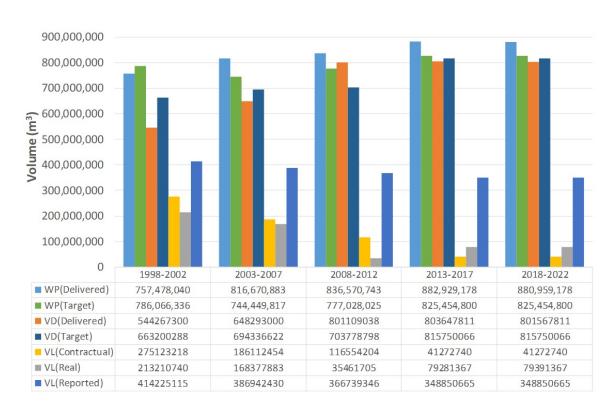
Figure 6: The Production, Delivery (Sold), and Losses: The horizontal axis (X) represents the year, while the vertical axis (Y) denotes the volume in cubic meters (m³). WP indicates Water Production (m³/year), VD signifies Volume Delivered (m³/year), and VL represents Volume Losses (m³/year).
expected standards over five five-year periods. There was inconsistency between the reported volume losses and the actual volume losses, which were recorded at 55%, 47%, 44%, and 40%, respectively. The purported real losses, however, were significantly lower at 28%, 21%, 4%, and 9%, respectively. In both scenarios, the water was deemed unfit for consumption. Importantly, there were no interruptions in water supply during the years under analysis, as indicated in Table 2. The table presents the outcomes derived from laboratory tests.
Firstly, the capital expenditures fell short of the target, recording percentages of 15%, 39%, 41%, and 46%, respectively. Conversely, the operational expenditure exhibited fluctuations. It surpassed the target by 134% during the initial five-year period. In the second period, costs were 40% below the target, followed by 8% below the target in the third period, and 9% below the target in the fourth period.
Secondly, the attention is directed towards the financial performances related to the basic cost (COM), tariff (contractual vs. real tariff), and margin (contractual vs. real margin). Over five five-year periods, the real margin consistently remained positive but was not as substantial as the contractual margin, as depicted in Figure 8.
Table 2 The quality and quantity of the system
| Outcome Indicator | l lait | Five Years Period | ||||
|---|---|---|---|---|---|---|
| Outcome indicator | Unit - | 1 | 2 | 3 | 4 | 5 |
| 1. Quality (Q) | ||||||
| Q (Target) = VL (Real) (25%) | Y/N | Υ | Υ | Υ | Υ | Υ |
| Production | Y/N | Υ | Υ | Υ | Υ | Υ |
| Distribution | ||||||
| Primary | Y/N | Υ | Υ | Υ | Υ | Υ |
| Secondary | Y/N | N | N | N | N | N |
| Tertiary | Y/N | N | N | N | N | N |
| 2. Quantity/Continuity (Q/C) | ||||||
| Q/C(Target) | Y/N | Υ | Υ | Υ | Υ | |
| Q/C(Delivered) | Y/N | N | N | N | N | |
| n.d.a = No Data Available | ||||||
(1)1998-2002; (2) 2003-2007; (3) 2008-2012; (4) 2013-2017; (5) 2018-2022
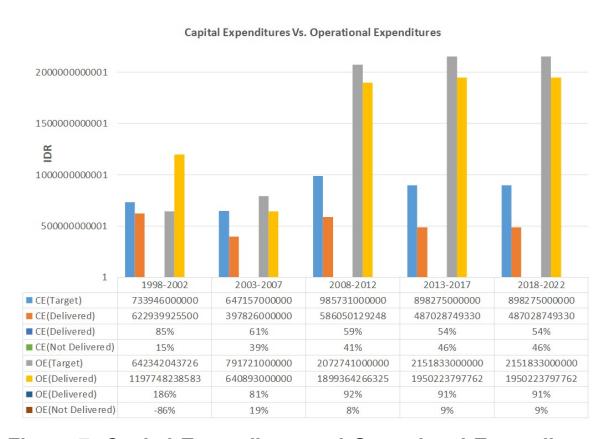
Figure 7: Capital Expenditure and Operational Expenditure: The horizontal axis (X) represents the year, while the vertical axis (Y) indicates the total amount of expenditure in Indonesian Rupiah (IDR). CE stands for Capital Expenditure (IDR/year), and OE represents Operational Expenditure (IDR/year).
Thirdly, attention is directed towards the financial performance of the water charge, with special emphasis on the ability of the contractual margin and real margin to cover the water charge. This aspect is elaborated upon, with a comparison between cases. The mechanism for water charge remained consistent for 20 years but experienced a continual shortfall from 2018 to 2022. While the real margin was consistently positive, it did not match the size of the contractual margin anticipated by PALYJA.
4.1.1 Biophysical condition
The biophysical conditions are elaborated by four aspects.
Multiple Raw Water Resources is there, as the primary source for the western part of Jakarta, the West Tarum Canal is (1) weather fluctuations do not impact heavily, and the canal is capable of supplying 6,458 Lps during the extreme dry season; (2) reliability: the excess water discharged can be stored in the Jatiluhur Dam reservoir.
Upstream Perspectives are there since (1) raw water was taken from four sources in multiple watersheds dating back to before the initiation of the PPP/BOT; (2) the West Tarum Canal already had issues with flow diversion; (3) contamination issues occurred in all areas upstream, midstream and downstream Pratiwi (3 November 2015, p. 14); Saputra and Bramono (2008, p. 13); (GDS, 1 June 1997).
The response of technology is as follows: (1) interventions, such as a large reservoir, were not necessary.; (2) technology processing was conventional for the primary source of the West Tarum Canal (Category A); and (3) significant investment in distribution technology was needed to keep leakages under 5%. (Banerji, 2013, pp. 108-110); GDS (1 June 1997).
The area of water supply was about 388.1 square kilometers and divided into three zones: (1) The northern area, where it was easier to supply by force of gravity by building WTP in the southern area; (2)
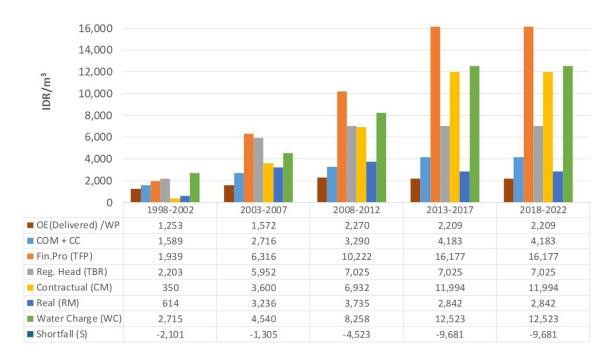
Figure 8: Basic Cost, Tariff and Margin Notes: Operational Expenditures (OE) delivered per Water Production (WP) is the Cost of Operation & Maintenance (COM) (in IDR/m³). CCh is Capital Charge per water production (in IDR/m³). TFP is the Tariff of the Financial Projection (contractual) (in IDR/m³). TBR is the Tariff base on Regional Head Decision (in IDR/m³)
the south was easier to supply through a network of pipes compared to the north; (3) the use of bottled water was concentrated more in the north, while the use of groundwater was evenly distributed. Yunus and Purnamasari (18 October 2016, p. 1) and Kresna (25 October 2016, p. 1) are synthesized
4.1.2 Attributes of the community
The population is divided into five segments based on monthly per capita expenditure.
Firstly, from The Socio-Political and Economic Structure, The per capita expenses led to a division of customers into three segments. The simplest division results in 40% being capable of paying above the basic cost, while the remaining 60% (lower middle class 49.6% and poor class 17.3%) (Kaderi, 2017, p. 1).
The Pattern of Alternatives to Water Consumption, The combined use of the output data, the data on expenses per capita per month, the socio-economic and political structure, and the interview with KRUHA (Sahib, 28 July 2017) led to the representative conclusion that: (1) 40% of consumers combined alternative water sources (bottled water, groundwater, and 162,046 residents were supplied by undrinkable piped water); (2) 60% of consumers are incapable of paying above the basic cost were using groundwater, small pump water and water from itinerant water vendors. The Right to Subsidy the interview with Director PAM JAYA (Kaderi, 2017, p. 1). The results are (1) the high-income customers (40%) are not entitled to subsidies; (2) low-income customers (60%) are entitled to pay below the basic cost (COM).
4.1.3 Operational action level outcome
The decision-making process, constituting a collective choice action situation, led to the formulation of a Contract that outlined both system and financial targets across five periods. However, the operational actor was tasked with fulfilling these targets, yet the system performances fell slightly short of their objectives for connections. Improvement in unit connections progressed at a sluggish pace, and the equilibrium
between subsidized and non-subsidized customers remained largely unchanged. Additionally, the volume of production delivered water and water losses failed to meet the targets in all four periods. The data pertaining to volume losses exhibited inconsistencies, highlighting a lack of alignment between reported figures and actual occurrences. Notably, the quality of the water supplied was deemed undrinkable, and there were disruptions in quantity and continuity. Furthermore, technical leakages compromised the quality of the distributed water, rendering it unfit for consumption. As a result, potable water was unavailable, and there was no consistent 24/7 water supply.
The outcome of system performance exhibited an imbalance across the five periods due to disparities in financial performances, characterized by:
- 1. Imbalance in basic cost (COM), tariff, and margin.
- 2. Lack of balance between capital expenditure and operational expenditure.
- 3. Utilization of water charge to compensate for the lack of capital investment during 1998-2002.
- 4. Limited options to enhance financial and system performances.
- 5. The initial affordability of basic cost (COM) at the onset of the PPP/BOT, which spared it from raw water issues that could have impeded performance.
- 6. Real margin fell short of PALYJA's expectations over the four periods, indicating significant underinvestment and a loss of momentum, leading to substantial shortfalls.
The Contract, or collective choice rules, received negative markings as operational interaction failed to contribute to any improvements in outcomes at the operational level. The break-even point was not achieved within the four to five-year periods, indicating the failure of the PPP/BOT.
The outcome at the operational level underscores the Contract's inability to regulate actors effectively, as both system and financial performances fell below contractual targets.
4.1.4 Outcomes of the Decision Making (Collective Choice action situation)
Under the IAD Framework, the attainment of targets at the operational stage is perceived as the outcome of actor interactions at that level, viewed in light of the Contract's success or failure in governing operational activities. The Contract of the PPP/BOT is established at the decisionmaking level.
The IAD framework operates under the assumption that inputs into operational processes are either permitted or constrained by collective choice rules (the Contract). The Contract serves as the Rules-in-Use (RiU) at the operational level, reflecting the functioning of the institution. When the Contract fails to effectively regulate actors at the operational level, the operational actor should ideally return to the decision-making level to rectify the situation. However, in Jakarta, no action
taken at the decision-making level succeeded in improving operational performance, resulting in the PPP/BOT underperforming for 25 years. This suggests that efforts to revert to collective action were unsuccessful.
4.1.5 Rule-in-use (decision-making process at the collective action situation)
The actors involved during the decision-making process (1990-1997) and the implementation phase (1998-2022) show minimal differences. From 1990 to 1997 and during 2018-2022, each actor entering the decisionmaking process occupies a specific position with defined boundaries. The delineation between the actor and their respective position during 1990-1997 is illustrated in Table 3 (Plamonia, 2020, p. 151).
Moreover, the presence of the Ministry of Public work (the actor at the constitutional level) in decision making proven contraproductive.
Table 3. Position and boundary rules
| Position | Boundary | |||
|---|---|---|---|---|
| Concessionaire/ Financier | Appointed by the Ministry of Public Works | |||
| Ministry of Public Works | National-level Public Trustee | |||
| Governor | Regional Public trustee | |||
| Negotiation Team | Appointed by the Governor | |||
| Director | Operator of Provincial water Utilities | |||
The central focus revolved around how the actor within the action situation manages the information rules. Previously, the equity sponsor and the Concessionaire maintained exclusive control over information, especially in organizing financial projections in 1996. However, their position has become increasingly difficult in the last five years, as the targets were consistently unmet, resulting in them requesting the first party to cover the shortfall or water charge.
The Governor serves as the first party, acting as the regional public trustee, especially in 2022. Notably, the Ministry of Public Works does not partake in the action situation, as observed between 1990 and 1997. It appears that the Ministry of Public Works showed indifference towards the less successful outcome of the PPP/BOT initiative they advocated for during 1990- 1997. In essence, the authority of the position present in Table 4 as follow.
It's crucial to restore balance in the relationship between the involved parties. Both the first and second parties should terminate the contract with clearly defined boundary rules. The second party is requesting payment for the shortfall, which is increasing and could
Table 4. Position and authority rules
| Position | Authority | |||
|---|---|---|---|---|
| Concessionaire/ Financier | Exploiting benefits shift the cost | |||
| Ministry of Public Works | Directing the Regional Government | |||
| Governor | Directing Director | |||
| Negotiation Team | Directing procurement committee | |||
| Director | Negotiating the Contract | |||
potentially lead to disputes. Hence, the presence of a new actor is necessary to address the issue. The new position should be filled by individuals with clear authority. Based on my observations, the required new actors include: (1) an expert in analyzing contractual financial projections; (2) a third-party academic reviewer; (3) a national auditor to audit contractual financial projections; (4) an investment supervisor to analyze capital expenditure needs; and (5) a nationallevel financial supervisor to provide advice on international financial or monetary transactions.
Due to the imbalanced position between 1990 and 1997, the Governor must pay attention to the "imbalance" in information (governed by the information rules), which has impacted the outcome (an imbalanced contract). This can be easily discerned from the financial performance indicators, including: (1) total cash flow, capital expenditure, and operational expenditure (both variable and overhead costs); (2) the balance between basic costs, capital charges, and opportunity costs; and (3) the return on investment, tariffs, and the water charge scheme. Additionally, during 1990-1997, although targets were set, the associated risks were neglected, such as setting the IRR at 22%.
The Concessionaire proposed a mechanism to repay both the capital and operational expenditures through the water charge mechanism exclusively. This mechanism involved automatic increases in the water charge every six months to accommodate fluctuations in the capital charge, such as exchange rates and interest rates. Between 1990 and 1997, it was the Ministry of Public Works that pressured the Governor to guarantee payment of the water charge and lobbied the Ministry of Finance to issue a supporting letter (Supreme Court of Indonesia Decision No. 31, 10 April 2017, pp. 42-43; Romli, 9 November 1995, p. 42).
The commitment was to enhance the volume of drinking water sold while maintaining its quality, with the expectation that subsidized customers (as per the actual tariff structure) would transition to nonsubsidized status. However, the relationship between the actors was not guaranteed, and neither were the associated costs and benefits.
Transparency and accountability pertained to how the Contract oversaw the monitoring and reporting of the Concessionaire's performances to the public trustee. While this aspect was deemed neutral in relation to RiF 1990, it scored low in compliance with IBP.
The conflict resolution mechanisms dealt with how the Contract addressed breaches of the collective choice rules during the operation of the PPP/BOT (e.g., establishment of a regulatory body). These aspects were rated as neutral for RiF 1990 and low for IBP.
The regulatory body was expected to outline the steps and procedures for resolving disputes, but this mechanism was absent. These aspects were rated as neutral for RiF 1990 and low for IBP.
The Contract required an adequate and proportionate system of sanctions and fines to establish balanced power relations during operations. The compliance of the Rules-in-Use (RiU) was rated as neutral concerning RiF 1990 and low regarding IBP.
Adequate renewal procedures would have been needed to amend the Contract. These procedures involve renegotiations to improve any PPP/BOT once implemented. The renewal procedures were not comprehensive and proportional, and thus, the compliance of the RiU was neutral to RiF 1990 and low to IBP.
Exit mechanisms are essential for helping actors resolve ultimate complexity and imbalance in the input -throughput-output that could potentially harm private and/or public interests. However, the exit mechanism aspects in the Contract were found to be lacking in comprehensiveness and proportionality. Specifically, there was no establishment of an arbitration supervisor at the national level to serve as the chamber for terminating the Contract. Additionally, there was no representative of consumer protection supervisor to safeguard the rights of customers.Thus, the compliance of the RiU was neutral to RiF 1990 but low to IBP.
The compliance of RiU to RiF and IBP when considering the internal rules of an action situation as follow (see Table 5) :
- 1. For Rules-in-Form (RiF) 1990, the adherence of Rules-in-Use (RiU) to a balanced relationship and proportional costs and benefits was low. However, for the other five aspects, compliance was deemed neutral.
- 2. For International Best Practices (IBP), the adherence of Rules-in-Use (RiU) was low in all aspects.
The overall score for the entire interaction at the collective choice level (from October 15, 1992, to June 6, 1997) was negative. The action situation demonstrates a mode of governance characterized by Constitutional order (or public hierarchy). In practice, within a public hierarchy, observing the collective choice level in terms of sequence was challenging, particularly since the
Table 5. RiU compliance to RiF 1990
| Outcome Indicator | CR | IBP |
|---|---|---|
| Balanced Relationships | Low | Low |
| Proportional costs and benefits | Low | Low |
| Transparency and accountability | Neutral | Low |
| Conflict resolvent mechanisms | Neutral | Low |
| System of fines and sanctions | Neutral | Low |
| Renewal procedures | Neutral | Low |
| Exit mechanisms | Neutral | Low |
7 Governor Decree No. 5215/1998 on 24 July 1998, a First of Order Tertiary legislation, a Collective Choice Rules
5 Letter No. 3126/072 on December 24, 1997, a First of Order Tertiary legislation, a Collective Choice Rules. 6 Letter No. S-684 /MK.01 / 1997 on 26 December 1997, a Third Order of Secondary Legislation, A Collective Choice Rules.
presence of a specific equity sponsor was detected before the preparation even commenced, lacking clear boundaries.
The actors failed to consider information regarding the biophysical condition and community attributes during the contracting stages, resulting in an imbalance between benefits and costs. The primary reason for this imbalance was the exploitation by SUEZ and Garuda Dipta Semesta, acting as the 2nd party, who dominated the action situation. They took advantage of the position of the Ministry of Public Works and later capitalized on the weak authority of the Governor and the Director, who acted as the 1st party.
The substandard quality of the Contract can be attributed to various factors. Firstly, there was a significant power imbalance between Garuda Dipta Semesta, Salim Group, and Suez on one side, and the Governor and PAM JAYA on the other. This lack of balance resulted in an uneven arrangement of costs and benefits. Additionally, no regulatory body was established, and there were no conflict resolution mechanisms or provisions for applying sanctions. The amendment mechanisms within the Contract were insufficient, and the PPP/BOT contract lacked comprehensive exit procedures beyond force majeure considerations.
Summary: The PPP/BOT process suffered from imbalance and opacity during its preparation and procurement stages, granting undue control to the Concessionaire. The Contract lacked essential components such as a regulatory body, conflict resolution mechanisms, fines and sanctions system, and renewal procedures. Consequently, the unbalanced nature of the contract hindered efforts to rectify flaws at the operational level. The equity sponsor emerged as the dominant actor in decision-making, leading to suboptimal system performances. Financial underperformance was often offset by raising tariffs, indicating a pattern of compensatory measures to address deficiencies.
4.2 Discussion
In this scenario, the actors failed to address crucial information regarding the biophysical condition and community attributes during the collective choice level. This resulted in a negative outcome, characterized by the dominance of SUEZ and Garuda Dipta Semesta as 2nd parties from the outset, even before the preparation stages began. The Ministry of Public Works further exacerbated the situation by leveraging the weak authority of the Governor and Director, the 1st party. Consequently, the Contract was unable to effectively regulate the operational dynamics. Financial and system performances remained unbalanced across all five periods, indicating a systemic failure. This case study exemplifies the limitations of the Constitutional order and mode of governance, where the Collective Choice Rules-in-Form and Rules-in-Use failed to enhance coverage.
In conclusion, the poor performance in, and outcomes of, the decision-making process ultimately led to a negative outcome at the operational level. The Contract is incapable of regulating the operational action situation and predestined operational failure. At this point again, we see the attempt to change the rules of their game by jumping
between levels (from the decision-making process level to the Constitutional Level and back) (i.e., pushing to arrange the Contract by issuing Ministry of Public Works instruction) (see Tabel 6).
Table 6. Internal rules of action situation
| Rules | Contracting | ||||
|---|---|---|---|---|---|
| Position | Limited number of Position : (1) The 1st party; (2) The 2nd party. The Important Actor was not there were: (1) The Arbitration Supervisor (National Level); (2) Regulatory Body; (3) Consumer Protection Supervisor | ||||
| Boundary | The actor taking position in contracting without clear boundary (without tender). | ||||
| Authority | Imbalance collective choice rules, contract cannot guarantee the balance the benefit and cost. | ||||
| Information | Aim for benefit shift the cost to the customer. | ||||
| Aggregation | Clause in the contract was not enough to regulate operational interactions. | ||||
| Scope | Contract was not balanced; five regulating instruments were not accommodated in 1997 contract. | ||||
| Pay-off | Benefits and costs are not balanced. Five instruments are not in the contract. Benefit must ensure profits using IRR 22% | ||||
4.2.1 Interaction patterns: governance and practices result in PPP failure
As mentioned in the methodology section, I would like to compare the final model for the analysis as a typical pattern of interaction or the relation between I.B.P., RiFs, and RiUs institutional patterns and actor interactions are visualized by the triangle in Figure 4 International Best Practice, Rules-in-Form, and Rules-in-Use. Table 7 summarises the cases' compliance with IBP
The decision-making process unfolds as follows: Actors adhering to RiU deviate significantly from IBP and conform to RiF 1990, not establishing prerequisites for actor interactions (refer to Table 7). The interaction among actors exhibiting lower compliance with IBP
Table 7 IBP, RiF, and RiU (Vertical Observation)
| EC | IBPs (Rules of Expert) | A | B | C | D | E |
|---|---|---|---|---|---|---|
| 1. Bal. Relationships | 1 | L | L | √ | 1 | |
| 2. Prop. Costs & Ben. | 1 | L | L | √ | 1 | |
| Co | 3. Transp. & Account. | 0 | N | L | × | 0 |
| ntr | 4. Conf. Resolv. ech. | 0 | N | L | × | 0 |
| ac t | 5. System of F and S | 0 | N | L | × | 0 |
| 6. Ren. Procedures | 0 | N | L | × | 0 | |
| 6. Exit Mechanisms | 0 | N | L | × | 0 | |
| → | Aggregate → | 0 | ||||
| S | Total Aggregate → | 0 | ||||
A = RiF1 to IBP; B = RiU2to RiF1; C = RiU2 to IBP
- D = Model of Interaction; E = Interaction Combination Score
- · Score 0 = Not Compliance to IBP; 1 = Compliance to IBP.
- · L = Low; H = High; N = Neutral; EC = Evaluative Criteria
- (√) = Smart Rules, Smart Practice (SRSP) value is 3
- (√) = Dumb Rules, Smart Practice (DRSP) value is 2
- (√) = Smart Rules, Dumb Practice (SRDP) value is 1
- (×) = Dumb Rules, Dumb Practice (DRDP) value is 0
The positions available under constitutional order during the contracting stages included the equity sponsor, Ministry of Public Works, Governor, Director, and the ad-hoc committee. Across five periods, the interaction pattern resembled DRDP, resulting in underperformance over 25 years. While some attempts were made to address issues from the operational level at the collective choice level, the outcomes (collective choice rules) did not bring about significant changes. In essence, revisions failed to effectively regulate the interaction; for instance, instead of implementing sanctions and fines, the actor occupying the position agreed to lower the targets.
In essence, the conclusions regarding Smart and Dumb RiUs are clear-cut. Decision-making practices characterized as Dumb (exhibiting substantial gaps between RiUs and IBP) showed a strong correlation with negative PPP performances, and vice versa. This deduction finds support in the empirical evidence from the case. Hence, smart RiUs closely aligned with IBP represent both a necessary and sufficient condition for positive PPP performances. These findings are consistent with the central research proposition and my conceptual model, which posits that a successful PPP/ BOT arrangement relies on effective interactions at the Collective Choice (CC) level, based on IBP-compliant RiFs established at the Constitutional level. In this conceptual framework, RiFs that adhere to IBP standards serve as crucial inputs for CC-level interactions, ultimately guiding the establishment of a PPP/BOT arrangement conducive to proper Operational level interactions and the establishment of functional drinking water systems. The empirical evidence strongly suggests that Smart/IBP-proof CClevel practices indeed contribute to improved Operational level interactions and outcomes.
4.2.2 Addressing the primary Research Question (RQ)
The main research question "How do the institutional attributes of the PPP impact the provision of drinking water, particularly concerning the effectiveness of the Contract in attaining the objective of enhancing service coverage?". The answer as follows: The study's analysis of smart and dumb RiU practices revealed a clear correlation between institutionally 'smart' practices and positive PPP outcomes in terms of meeting water supply targets and demonstrating strong financial performance. Conversely, practices categorized as institutionally 'dumber,' characterized by larger discrepancies between RiUs and IBP standards, were associated with negative PPP performance outcomes. Thus, both logical reasoning and empirical evidence support the assertion that smart RiUs closely aligned with IBP standards are essential for positive PPP outcomes. The key takeaway is that smart, IBP-proof CC-level practices significantly enhance operational interactions and outcomes. This finding confirms the central proposition that effective PPP/BOT arrangements depend on properly functioning CC-level interactions based on IBP-proof CC-level RiFs, a proposition that finds empirical support in the study's results.
4.2.3 Relationship between the mode of governance and the decision-making process
The epistemic community for the international P.P.P./ BOT experts was synthesized by this research and led to the IBP criteria used, particularly the key guiding principles and rules for preparing, procuring, and contracting a PPP.
From a governance perspective, rather than applying the whole set of IAD rule types, the context for making and implementing PPP/BOT arrangements can best be understood by looking first and foremost at the relevant (configuration) of position rules, as is more broadly suggested by Van Heffen and Klok (2000, p. 161). The number of positions available was relatively low, with a lack of background variation, since the mode of governance is hierarchical. The numbers of positions and also the variation of their interest backgrounds help to address the complex nature of water supply is handled.
A relatively larger number of positions and the more significant variation of interest backgrounds does, if and when properly configured, seem a better recipe for dealing with the socio-technical complexities in preparing, procuring, and contracting a PPP/BOT. Given this complexity, configuring positions representing a different interest in a 'Regulated market' mode of governance is appealing, as it combines characteristics of public hierarchy and of the market mechanism in serving and balancing both private and public interests. A Regulated market mode comes with a set of positions and befitting actors that is configured to provide a well-balanced process of interaction, with proper 'checks and balances, while securing proper segmentation and coherence of the decision-making process and proper stakeholder input. The challenge is what rules are most appropriate for this type of 'organized engagement'. To answer this is where the best use can be made of the experiences gathered by the international experts on PPP and IBP.
4.2.4 Interal rule of action situation
The key findings on decision support guidelines are (see Figure 10):
- 1. The position rules (Ministry of Public Works) served as the central elements facilitating SRSP, SRDP, and DRDP
- 2. The interrelation between the position rules (whether by the Regent or Ministry of Public Works) and other rule categories determined the fundamental adherence to the IBP by shaping the interaction model, whether as SRSP, DRSP, SRDP, or DRDP
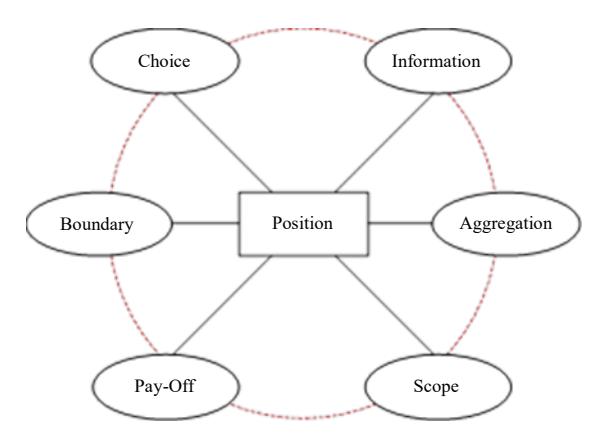
Figure 10: Interconnectedness between rules
3. In action situations, the dynamics between dominant positions and other positions were influenced by the complete set of rules (such as boundary, authority, information, aggregation, scope, and pay-off), with the aim of establishing a functional process for PPP/BOT decision- making, either in accordance with or deviating from IBP compliance.
5. Conclusion
- 1. Enhancing decision-making requires heightened awareness of the potential for actor characteristics, often treated as a 'black box' within institutional settings, to trigger deviations from IBP compliance. Actors occupying specific positions, such as the Regent or Ministry, might have exerted negative influences on proceedings and outcomes due to their inherent characteristics.
- 2. Mitigating the risk of actor characteristics deviating from the intended IBP-proof position rules, such as by introducing counter positions, partly hinges on enhancing institutional settings. This entails refining boundary rules selectively, restricting choice rules, ensuring multi-actor participation through aggregation rules, and securing ex-ante information rules, among others, to maintain a 'balance of power.'
- 3. Decreasing the likelihood of actor characteristics straying from the intended IBP-proof position rules also relies on the readiness to address misconduct by rogue actors, which can be encouraged by regulations regarding appeals and enforcement actions. This, once more, underscores the concept of checks and balances.
Acknowledgments
This article build during doctoral trajectory of Nicco Plamonia, therefore, authors wishes to acknowledge assistance and guidance from doctoral supervisor as follows : Prof. dr. M.A Heldeweg and Dr. K.R.D. Lulofs from University of Twente, Enschede, The Netherland for guidance from 2015 to 2020. Khrisna Suryanto Pribadi provide discussion.