

I Nyoman Teguh Prasidha
Master's Program in Infrastructure and Environmental Engineering, Faculty of Engineering Universitas Pancasila, Email: nyoman.prasidha@univpancasila.ac.id
Yustisia Firdaus
Center for Environment and Clean Technology, National Research and Innovation Agency (BRIN) Email: yust014@brin.go.id
Abstract
Pembangunan sebuah hotel mencakup pembangunan berbagai fasilitas. Salah satu dari fasilitas tersebut bisa berupa jogging track. Kami menggunnakan studi kasus pembanguan jogging track Hotel Aruss di Semarang, Jawa Tengah untuk mempelajari penggunaan material yang berbeda. Hotel tersebut merencanakan penggunaan kayu ulin sebagai bahan untuk jalur jogging karena karakteristiknya yang solid dan tahan lama. Namun, penggunaan kayu secara kolektif menambah tekanan pada hutan hujan. Oleh karena itu, kami mengusulkan untuk menggantikan kayu ulin dengan batu andesit. Bahan andesit juga memiliki karakteristik yang solid dan tahan lama. Kami berpendapat bahwa penggunaan bahan harus mempertimbangkan aspek keberlanjutan dan faktor Nilai untuk Uang (Value for Money/VFM). Tujuan dari artikel ini adalah memberikan perspektif kepada pengambil keputusan yang mencakup perspektif keberlanjutan dan prinsip VFM. Kami melakukan dua aktivitas selama penelitian: (1) membandingkan biaya kedua bahan tersebut dan (2) membandingkan waktu yang diperlukan untuk memasang kedua bahan tersebut. Hasil analisis adalah sebagai berikut: Biaya penggunaan andesit 73% lebih murah dibandingkan kayu ulin. Penggantian kayu ulin dengan andesit terbukti menghemat IDR 307.031.041. Selain itu, penggunaan andesit hanya memerlukan 13 hari kerja, sedangkan kayu ulin membutuhkan 36 hari. Kami menyimpulkan bahwa penggunaan andesit sebagai alternatif kayu ulin memiliki dua keuntungan: (1) mengurangi tekanan pada hutan alam, dan (2) menghemat biaya konstruksi.
Kata Kunci: Aksi berkelanjutan, efisiensi biaya, kayu besi, batu andesit
* Penulis Korespondensi: nicco.plamonia@brin.go.id
1. Introduction
Value for money (henceforth, VFM) may become the sole driving factor for the construction work. To be specific, the construction time and cost efficiency. For a particular facility (i.e., Hotel), aesthetic consideration became vital because it provides a sense of comfort to visitors and a strong image (perhaps a grandeur or environmentally friendly). Building the image of a hotel may lead to neglecting the other important factors. The choice of wood to construct houses, offices, and hotel facilities increases the pressure on the rainforest (Land, 2009). Later, high pressure on the rainforest impacted the environment as well. Especially when there is Andesite Stone as an abiotic material that can be used as a substitute for wood, daily, we will see a lot of facilities using biotic material based on a single-dimension approach.
Asking construction industry players to use sustainable materials is not practical without an alternative solution. At this point, we were pointing to the decision makers (owners of a hotel or planner) who decided to use biotic instead of abiotic. Moreover, is any information available for decision makers related to whether there were substitutes of biotic material using abiotic ones? Therefore, we believe the sustainability approach can be considered by decisionmakers when the information provided is not only a campaign to protect the environment but also concrete solutions. Hopefully, the substitution of materials reduces pressure on the environment and will have a significant impact if the industry does it. Therefore, this journal focuses on "a jogging track" hotel facility.
The objectives of this article are "to provide a consideration for the decision-makers to include the sustainability aspects of construction materials besides construction time and cost efficiency." We divide the research question as follows: (1) What are the differences in the characteristics of iron and andesite materials? (Descriptive); (2) which material is efficient the most in terms of construction time and cost efficiency? (Descriptive question); (3) to what extent does the usage of both materials affect the environment? (Evaluative questions). It is predictive since the answer will provide the possible outcomes, and evaluative since the solution will explain what was happening due to interventions. The Research only examines a limited subject, comparing Ironwood and andesite as decking materials (serves as dependent variable) influencing the construction time and cost efficiency (independent variable).
2. Location Study
The study areas for this research are located within Semarang City (06°59′24″S, 110°25′21″E). Lokasi Hotel Aruss yang menjadi objek penelitian kami terletak di di Jalan dr. Wahidin No. 116 Jatingaleh Candisari, Semarang, Sentral Java, Indonesia.
3. Method
Our research is explanatory research uses a mixture of quantitative and qualitative types (Plamonia, 2020). The research subject is the construction of the Aruss Hotel in Semarang. The research procedure in this Research is as follows: (1) Data Collection, (2) Comparing, and (3) Analysis.
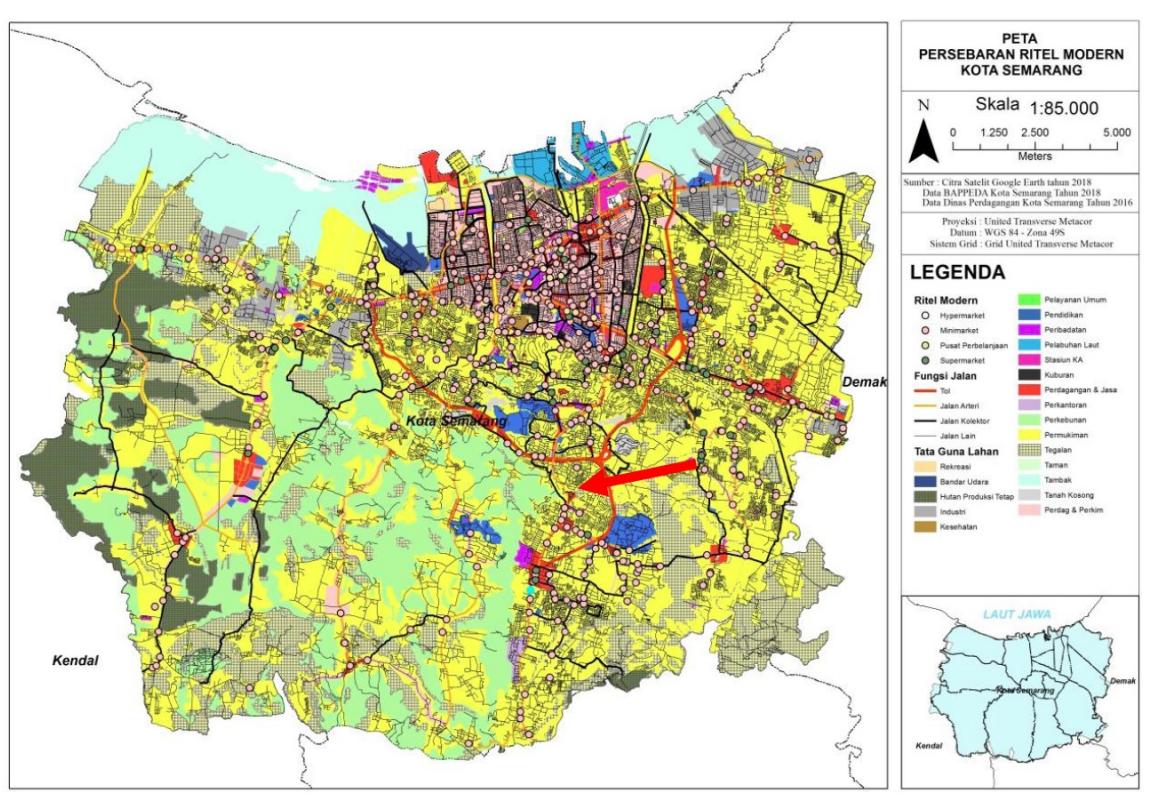
Figure 1. Study area
Data Collection is divided into two: first, the Primary Data Collection is conducted using observation and interview. Interview respondents were selected using a purposive sampling strategy (Miles, 1994). This strategy is appropriate since the population of actors is known and requires the elicitation of views, knowledge, and experience (M.Natsir et al., 2010). Three types of questions were included in the interview guide: (1) Opinions; (2) Knowledge-related questions; and (3) Background questions on age, education, occupation, ethnicity, etc. (Patton, 2002). Second, data collection by observation and written materials. Written material included documents and physical artifacts ((Aprilio & Plamonia, 2024; Gillham et al., 2000; Plamonia & Merapi, 2022; Rahman et al., 2024; Suyitno et al., 2023). Written material consists as follows: (1) Detail Design Plan; (2) Work Unit Price under Ministry of Public Work Regulation No.1/2022; (3) Material Price and Worker Wages of Semarang City for 2021
Analysis divided into two sequences, as follows: First, Identify the direct costs divided into three; (1) Measure the total area of the jogging track; (2) Material Price and Worker Wages of Semarang City for 2021; (3) Work unit price analysis. After the three components above are complete, a calculation is made between the track volumes multiplied by the Work unit price. Second, Analysis of work duration using the worker coefficient analysis. The worker coefficient means the productivity of workers completing the total volume of work. The data required consists of three, as follows: (1) Measuring the total area of the jogging track; (2) Worker coefficient from Unit Price Analysis of Indonesian National Standard 2022 [Indonesia: Analisa Harga Satuan – Standard Nasional Indonesia Tahun 2022 or AHS SNI 2022]; and (3) the cost of 6 Worker.
The result compares (Agustin et al., 2023; Plamonia, Agustin, et al., 2023; Plamonia, Efendi, et al., 2023; Pratama & Plamonia, 2023) the cost of construction (cheaper or expensive) and implementation duration (faster or slower) between Ironwood and Andesite.
The research gap to be addressed in this Research is how to include the sustainability aspect of using natural materials in the construction industry. The important sustainability aspect in the selection of construction materials because it is "directly proportional to service life and performance and inversely proportional to Environmental Impact"(Awaludin et al., 2017; Mueller et al., 2017). However, the sustainability approach is entirely under decision-making results. The novelty of this journal relates to the importance of influencing the information held by decision-makers (actors) to choose (authority) the wood over the andesite.
Important to mention in this section following terminology: (1) construction projects (Section 3.1); (2) Ironwood (Section 3.2); (3) Andesite (Section 3.3); (4) Construction Costs (Section 3.4); (5) Construction Time (Section 3.5).
3.1 Construction project
A construction project is a series of activities that process resources to produce a specific product
according to the plan that involves decision-making. Construction projects have three characteristics: they require resources (human, money, machines, methods, materials), are unique, and require organization (Ervianto, 2023).
3.2 Iron wood
The Ironwood (Eusideroxylon Zwageri) has five characteristics (Wardono & Jepriani, n.d., 2014)as follows: (1) hard; (2) dark in color; (3) length or Height can reach 50 m; (4) the diameter reaches 200 cm; (5) grows in the lowlands to an altitude of 400 m. Ironwood has at least five advantages, as follows: (1) Strong (first class) and durable (first class); (2) Termite resistant (Effendi, 2009); (3) Resistant to changes in humidity and temperature; (4) Seawater resistance; (5) Fire Resistant (high wood grain density); (6) has thick skin with cork in layers. The disadvantages of Ironwood are as follows; (1) the installation process is quite complicated; (2) it requires experts, (3) and relatively expensive.
3.3 Andesite stone
Andesite Stone has four characteristics as follows: (1) extrusive igneous rock with fine-grained crystalline characteristics; (2) Light to dark gray; (3) classified as volcanic rock. Andesite rock has several advantages, including (1) Massive rock; (2) being Resistant to weather changes; (3) a rough surface texture; and (4) Providing a stable, safe, and durable surface.
3.4 Construction cost
Construction Costs can be categorized into two components, namely: (1) Direct Cost (Clark et al., 1994)and Indirect Cost(McGowan, 2010). In a construction project, the costs can be categorized into 2, namely: Direct and Indirect Costs. Direct Cost: This represents the cost of labor, materials, and equipment during the project. In this article, several cost needs to be addressed as follow: (1) cost of material (Iron Wood and or andesite); (2) Workforce cost (Worker,
Figure 2. Iron wood
Figure 3. Andesit stone
Carpenter, Chief Carpenter, Stonemason, Chief Mason, Foreman). At the same time, indirect cost is a variable cost needed to complete the project. These costs include project management fees, tax bills, licensing fees, insurance, administration, stationery, and profits. Profit is where it competes and adjusts at the procurement stages maximum of 15%.
3.5 Construction time
Construction Time is the ability of the workforce to complete the work, which is divided into units of time, hours, or days. Since the workforce's capacity should be considered, the Construction Time is the volume of work divided by the number of workers and the level of worker capacity multiplied by the number of workers.
\[TD = \frac{VW}{WC \times NW}\] (1)
With:
- TD is Total Duration.
- VW is Volume of Work
- WC is Working Capacity
- WW is Number of Worker
4. Result and Discussion
This section is divided into two subsections: the results section and the discussion section. These subsections are presented consecutively because the results are immediately analyzed and discussed in the following section, providing a more comprehensive understanding of the findings.
4.1 Result
We divide this section into five parts, as follows: (1) Quantity Take Off; (2) Material Price and Worker Wages; (3) Unit Price Analysis; (4) Construction Wages; (3) Unit Price Analysis; (4) Construction Cost (Owner's Estimates); (5) Construction Times.
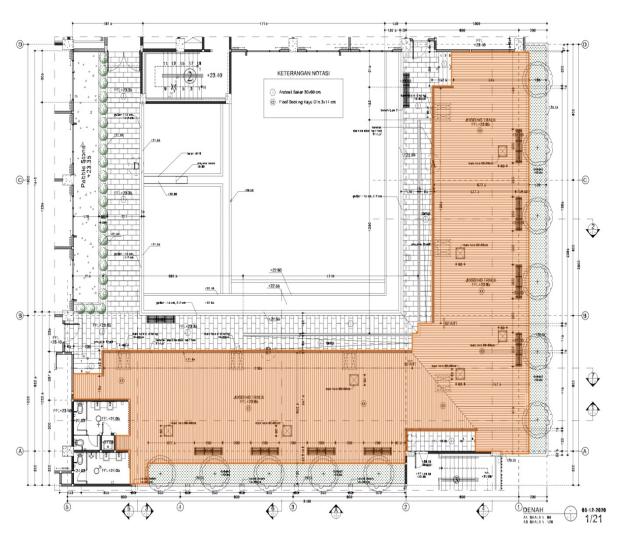
Figure 4. Quantity take off (m2)
4.1.1 Quantity take-off
The width of the track follows the perimeter area track in detail design engineering (DED) for 308 m2 (see Figure 4).
4.1.2 Material price and worker wages
Material Price and Worker Wages of Semarang City in 2021 were obtained based on the interviews with a construction worker on site, and the result is presented in Table 1.
4.1.3 Unit price analysis
Unit Price Analysis [Indonesia: Analisa Harga Satuan Pekerjaan or AHSP] divide in sequences: (1) Ironwood; and (2) Andesite. Each explains as follows:
First, the Unit price for 1 m2 Iron wood base on AHS SNI 2022 point A.4.4.3.45 (Umum, 2022), see Table 2.
Table 1. Material price and worker wages of Semarang City for 2021
| No | Type Of Material | Unit | Price (Idr) | |
|---|---|---|---|---|
| A Ma | aterial | |||
| 1 | Wood 5 cm / 7 cm | m3 | 3.878.437 | |
| 2 | Wood 4 cm / 6 cm | \(m^3\) | 3.878.437 | |
| 3 | Wood 6 cm / 12 cm | \(m^3\) | 5.019.153 | |
| 4 | Iron Wood 25 cm /140 cm | \(m^3\) | 29.761.905 | |
| 5 | Andesite 30 cm x 30 cm | \(m^2\) | 148.293 | |
| B W | ages | |||
| 1 | Worker | man/day | 103.868 | |
| 2 | Stonemason | man/day | 119.223 | |
| 3 | Chief Mason | man/day | 131.547 | |
| 4 | Carpenter | man/day | 122.967 | |
| 5 | Chief Carpenter | man/day | 134.186 | |
| 6 | Foreman | man/day | 130.151 | |
Table 2. Unit price analysis for installing 1m<sup>2</sup> of the ironwood
| No | Description | Unit | Coeffi- cient | Unit Price (IDR) | Total Price (IDR) |
|---|---|---|---|---|---|
| Α | Work Force / Man Pow | /er | |||
| Worker | man/day | 0,700 | 103.868 | 72708 | |
| Carpenter | man/day | 0,350 | 122.967 | 43039 | |
| Chief Carpenter | man/day | 0,035 | 134.186 | 4697 | |
| Foreman | man/day | 0,035 | 130.151 | 4555 | |
| Worker Wages | 124998 | ||||
| В | Material | ||||
| Ironwood 30/140 mm | m3 | 0,0342 | 29.761.905 | 1017857 | |
| Nail 5 cm - 12 cm | kg | 0,4 | 73.576 | 29430 | |
| Joist 50/70 (60cm) | \(m^3\) | 0,01197 | 3.571.429 | 42750 | |
| Total Pric | е | 1090038 | |||
| D | Summary (A+B) | 1215036 | |||
| Е | Profit (11%) | 133654 | |||
| F | Unit Price (D+E) | 1348690 |
Total manpower and material cost is IDR 1090038 per 1 m<sup>2</sup>. Total manpower added with a profit of 11%. Based on Table 2, the total cost of construction, including the profit to accomplish the construction of the ironwood deck, is IDR 1348690.
Second, the Unit price for 1 m<sup>2</sup> andesite based on AHS SNI 2022 point A.4.4.3.10 (Umum, 2022), see Table 3, as follows.
Total manpower and material cost is IDR 45907 per 1 m<sup>2</sup>. Total manpower added with a profit of 11%. Based on Table 3, the total cost of construction, including the profit to accomplish the construction of the andesite deck, is IDR 351 836
4.1.4 Bill of quantity
After the analysis of each unit price, the next step is arranging the Bill of Quantity (BoQ) to conclude the total cost of the project, see Table 4 as follows
Table 3. Unit price analysis for installing 1 m<sup>2</sup> andesite
| No | Description | Unit | Coeffi- cient | Unit Price (IDR) | Total Price (IDR) |
|---|---|---|---|---|---|
| Α | Work Force / Man Pov | wer | |||
| Worker | man/day | 0,260 | 103868 | 27006 | |
| Stonemason | man/day | 0,130 | 119223 | 15499 | |
| Chief Stonemason | man/day | 0,013 | 131547 | 1710 | |
| Foreman | man/day | 0,013 | 130151 | 1692 | |
| Worker Wages | 45907 | ||||
| В | MATERIAL | ||||
| Andesite (30x30 cm) | unit | 11,87 | 13000 | 154310 | |
| AM Coating 153 | ltr | 0,25 | 49051 | 12263 | |
| Portland Cement | kg | 10 | 1141 | 11407 | |
| Color Cement | kg | 1,5 | 52473 | 78709 | |
| Sand | \(m^3\) | 0,045 | 319401 | 14373 | |
| Total Price | 271062 | ||||
| D | Summary (A+B) | 316969 | |||
| Е | Profit (11%) | 34867 | |||
| F | Unit Price (D+E) | 351836 | |||
Table 4 compares the total BoO of both materials. For the ironwood total, BoQ reaches IDR 415396429. While for andesite materials IDR 351836 only cost IDR 108365389.
4.1.5 Construction time
The duration to cover a total 308 m2 area of the track with Ironwood takes 36 days, while the andesite only takes 13 days, see Table 5 below.
4.2 Discussion
Sustainable urban infrastructure development requires a more holistic approach to the selection of materials used. In facing the challenges of climate change, limited natural resources, and increasing environmental impact, the selection of materials for infrastructure should no longer focus solely on technical and economic factors, but also take sustainability into account. The use of environmentally friendly and efficient materials can minimize the ecological footprint and contribute to the development of greener, more sustainable cities.
This section will discuss various sustainability aspects in the selection of materials for urban infrastructure. ranging from environmental impacts, sustainability principles in the life cycle of materials, to the integration of more environmentally friendly construction industry practices. Each subsection will explore in greater detail how material choices can support more efficient development and reduce negative impacts on the environment and human health.
The following subsections will provide an overview of the importance of considering sustainability in material selection and how this can be realized through more innovative practices and environmentally friendly technologies. This section consists of six parts: (1) Sustainability Aspects in Material Selection for Urban Infrastructure: Environmental Impact and Its Connection with Construction Industry Practices; (2) Environmental Impact of Natural Material Selection; (3) Sustainability Principles in the Life Cycle of Materials; (4) Integration of Sustainability Aspects in Construction Industry Practices; (5) Material Selection Based on Energy Performance and Carbon Emissions: (6) Enhancing Innovation and the Use Environmentally Friendly Technologies.
Table 4. Bill of quantity
| (IDR) | (IDR) | |
|---|---|---|
| Ironwood 308 m2 | 1.348.690 | 415396429 |
| Andesite 308 m2 | 351.836 | 108365389 |
Table 5. Construction time of ironwood versus andesite work force / man power
| No. | Material | С | d | е | f | g = c/(exf) |
|---|---|---|---|---|---|---|
| NO. | Materiai | m2 | Unit | m² | man | day |
| а | Ironwood | 308 | 0,70 | 1,4 | 6 | 36 |
| b | Andesite | 308 | 0,26 | 3,8 | 6 | 13 |
| a = Ironwood: b = Andesite: c = volume/quantity: e = worker canacity/ | ||||||
4.2.1 Sustainability aspects in material selection for urban infrastructure: environmental impact and Its connection with construction industry practices
The selection of materials for urban infrastructure development should consider not only technical, cost, and time factors but also sustainability aspects that can reduce long-term environmental impacts. Sustainability, in this context, refers to the use of materials that not only meet technical and economic criteria but also minimize the ecological footprint of construction activities and ensure the efficient use of natural resources. In the modern era, with increasing awareness of climate change and environmental degradation, it is essential to identify and utilize materials that have minimal environmental impact throughout their life cycle, from extraction to recycling (Busch et al., 2017).
4.2.2 Environmental impact of natural material selection
Natural materials are often considered more environmentally friendly compared to synthetic materials because they typically require simpler production processes and result in lower carbon emissions. However, not all natural materials are free from significant environmental impacts. For example, large-scale use of natural stone, sand, and clay for infrastructure projects can cause damage to local ecosystems, degrade soil quality, and potentially lead to biodiversity loss due to poorly managed mining activities(Pacheco-Torgal & Labrincha, 2013). Therefore, it is crucial to conduct a thorough evaluation of the environmental impact of each type of material, including the exploitation and extraction processes of raw materials. Moreover, material selection should also consider the natural resources used, the local availability of raw materials, and the potential for resource regeneration.
4.2.3 Sustainability principles in the life cycle of materials
A sustainability approach to material selection should be viewed through a life cycle assessment (LCA), which takes into account the environmental impact of all stages, from raw material extraction, manufacturing, transportation, use, to disposal or recycling (Junnila, 2006). One increasingly popular concept is the "circular economy," which emphasizes the importance of recycling and reusing materials in a sustainable cycle, thus reducing the need for new materials and minimizing waste. Materials such as recycled concrete, scrap steel, and biomass-based materials show potential in supporting more sustainable development because they reduce dependence on new natural resources and lessen pollution from traditional production processes(Artuch -Garde et al., 2017). Implementing this concept in urban construction can help reduce energy consumption, greenhouse gas emissions, and construction waste.
4.2.4 Material selection based on energy performance and carbon emissions
Sustainability in material selection also involves the significant role of the construction industry in driving more environmentally friendly changes. Sustainable construction practices must include the selection of materials that not only consider the cost of the material itself but also the external costs that may arise from negative environmental and human health impacts (Kibert, 2016). For example, building materials that contain harmful compounds such as formaldehyde or VOCs (Volatile Organic Compounds) can negatively impact indoor air quality and human health. Therefore, it is important to select materials that meet clear environmental and health standards, such as those set by green building certifications like LEED (Leadership in Energy and Environmental Design) or BREEAM (Building Research Establishment Environmental Assessment Method).
Additionally, in the context of urban infrastructure, projects that use locally produced materials can reduce the carbon footprint associated with transporting materials and support the local economy. Using local materials also allows for better adaptation to the local environmental conditions, which enhances the resilience and lifespan of infrastructure. For example, in tropical regions, materials like bamboo or clay, which have natural insulating properties, are recommended over concrete, which requires more energy for processing and maintenance.
4.2.5 Material selection based on energy performance and carbon emissions
Beyond cost and time factors, material selection should also consider energy performance throughout its lifespan. Many building materials have thermal insulating properties that can reduce the energy needed for cooling and heating buildings. Materials such as clay-based bricks or concrete with specially selected aggregates can provide better thermal insulation, thus reducing reliance on artificial cooling and heating systems (Liu et al., 2017). By optimizing the energy performance of building materials, we can reduce the use of fossil fuels, which impacts long-term carbon emissions.
4.2.6 Enhancing innovation and the use of environmentally friendly technologies
New technologies also play a vital role in improving the sustainability of material selection. Innovations such as the use of bio-based materials, such as concrete containing organic waste, or 3D printing technologies that allow for the creation of structures using more efficient and customizable materials, are increasingly applied in the construction industry. These technologies can reduce waste and minimize energy requirements during material production (Maggie et al., 2019). On the other hand, water treatment and material recycling technologies are also becoming a focal point in enhancing the sustainability performance of construction projects, particularly in large cities facing the challenges of increasingly limited resource management.
5. Conclusion
- 1. To this point, I have a present total cost of using Ironwood at IDR 415,396,429, while using the andesite stone costs only IDR 108, 365,389. The deviation of the value of the two materials is IDR 307,031,041 or 73.81%. Andesite material is considered more cost-efficient than Ironwood. Moreover, the total duration of work with Ironwood is 36 working days. While the duration of the work with andesite material takes a shorter time, it only takes 13 days. The difference in implementation time is 23 days. Andesite is also more effective in terms of duration than Ironwood. Moreover, including the sustainability aspect by picking abiotic material instead of biotic material helps to reduce the pressure on the rain forest.
- 2. The integration of sustainability in material selection for urban infrastructure is a crucial step in reducing the environmental impact of the construction sector. Evaluating the life cycle of materials, selecting recycled and locally sourced materials, and innovating in material technology are some of the strategies that can be utilized to achieve sustainable development. Therefore, the construction industry needs to adopt a holistic approach in material selection that not only considers economic and technical aspects but also the long-term impact on the environment and society.
- 3. Sustainability Impact: In addition to being more costand time-efficient, choosing abiotic materials such as andesite over biotic materials like Ironwood helps reduce the pressure on rainforests. Incorporating sustainability in material selection is essential for minimizing the environmental impact of the construction industry.
- 4. The integration of sustainability in material selection for urban infrastructure is a crucial step in reducing the environmental impact of the construction sector. Evaluating the life cycle of materials, selecting recycled and locally sourced materials, and innovating in material technology are some of the strategies that can be utilized to achieve sustainable development. Therefore, the construction industry needs to adopt a holistic approach in material selection that not only considers economic and technical aspects but also the long-term impact on the environment and society.
Acknowledgements
Authors wishes to acknowledge supervision and discussion from Ati Tri Juniati.