

1 Introduction
In this paper, we look at the development of Priangan Batik, expanding not only through growth but also within the dimensions of meaning, principles, and goals. On top of that it has been enriched by the cultural influence of the heterogeneity of Indonesian culture in general. We have investigated the history of Priangan Batik, considering its birth, background, and designs. This investigation was aimed at identifying the characteristics of the aesthetics and identity that are embedded in the originality, values and local content of Sundanese culture.
Many aspects of batik have been the subject of research, but the context of Priangan Batik in the constellation of modern aesthetics, still needs to be studied from the aspect of identity. This sort of study can be a new or fresh start in itself and at the same time it is an attempt to complete previous research findings (from quite a different point of view). Having reviewed the literature
about Sundanese artifacts, we found that there are few artifacts dedicated to ornaments, especially in relation to the aspects of aesthetics and identity. These last two elements are important factors in the endeavor of tracing the Sundanese artifacts.
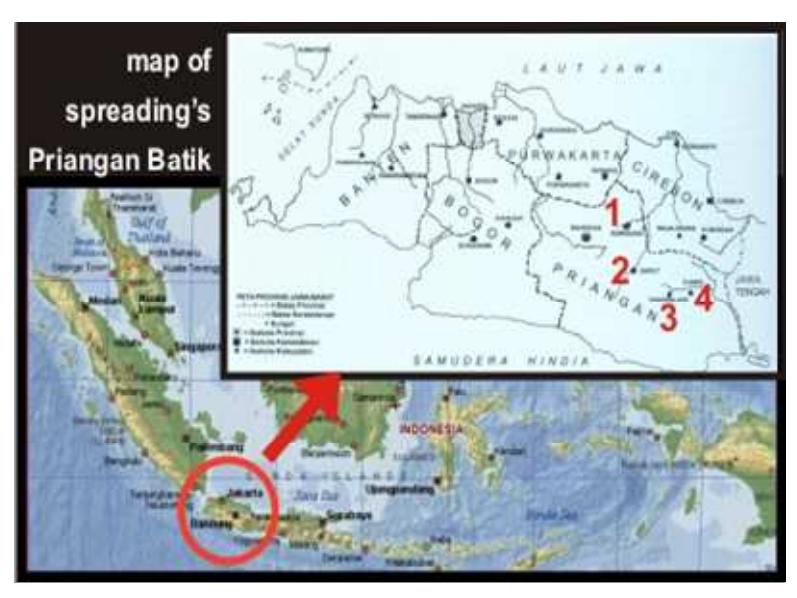
Figure 1 Map of the Priangan area: (1) Sumedang, (2) Garut, (3) Tasik, and (4) Ciamis [1].
Concerning batik artifacts, there is a significant statement in the script of Siksa Kanda ng Karesian from the first half of 16th century that there were a number of "corak lukisan (painting ornament): pupunjengan, hihinggulan, kekembangan, alas-alasan, urang-urangan, memetahan, sisirangan, taruk hata, kembang tarate" and the same source also mentions "sorts of fabrics (boeh): kembang mu(n)cang, gagang senggang, anyam cayut, poleng re(ng)ganis, cecempaan, mangin haris, surat awi, parigi nyengsoh, hujan riris". The above statement clearly implies that at the time the script was written, the Sundanese people were familiar with several kinds of fabrics (samping) and batik as well" [1]. At present, the development of batik – specifically, Priangan Batik: Batik Garut, Batik Tasik, and Batik Ciamis– "has been widely spread into a number of meanings as well as dimensions in its interpretation, principles, goals and even has become an influence towards the cultural variety of Indonesia" [2]. However, the term Priangan Batik itself should be made clear by connecting its characteristics to the traditional meaning of batik related to its aesthetics and identity. The comprehension of the old batik has to be related to the meaning of present-day batik as an expression of modernity.
A number of problems were examined in this research that have to do with the aesthetic development from old or traditional Priangan Batik (in the past) to modern Priangan Batik in the context of the constellation of modern aesthetics, in order to recognize their respective characteristics. These problems were approached by studying the aesthetics of modern Priangan Batik, in order to classify aesthetic elements that can be of advantage, acting as a source of inspiration when designing novel variants –now and in the future– within the constellation of modern aesthetics. The research was conducted in two phases: first, we documented the development of modern Priangan Batik in the aesthetic domain – "aesthetic considered as ornaments" [3] –and secondly, the approach of "typological classification as a sub-part of the taxonomy related to the morphology of form study" [4].
2 Priangan Batik
"In the 20th century the activity of batik making has developed in Cirebon (Trusmi), Indramayu (Paoman), Ciamis (Cikoneng), Tasikmalaya (Sukaraja, Cihideung, Cipedes), and Garut (Tarogong); each city (or area) has specific designs, which produced the terms Dermayon, Trusmian, Garutan, etc." [1]. These batik variants have "been widely spread into a number of meanings as well as dimensions in its interpretation, principles, goals and even has become an influence towards the cultural variety of Indonesia" [2]. Furthermore "batik has been created based on artistic grounds that develop according to the demands of the age" [5]. Batik is "a process of engraving textile using wax as resistant for the colour substance being applied to it. The process applies the cold dying technique and uses the canting technique or copper stamping. In the past, the stamping technique used to be excluded from the traditional dying batik technique. Stamped batik fabric was not considered batik (the original, in its old process of making). But later this view changed, although this inclusive view occurred specially because of commercial considerations" [6]. The term Priangan Batik should be returned to its original meaning in order to be able to identify its characteristics clearly in relation to the aspects of identity and aesthetics. A number of samples of Priangan Batik which have underwent influence from modern batik aesthetics and that were used as research objects are: (a) Batik Garut; (b) Batik Tasik; and (c) Batik Ciamis.
3 Understanding of Modernity
Concerning the meaning of modernity, "in Indonesia, modern aesthetic values came up in the beginning of 20th century and experienced the second textualization process –in its own country– by Western culture. Since undergoing the first textualization process through the adoption of modern aesthetic values and a great effort to 'remove' Eastern culture, the Indonesian
nation has become a transitional nation becoming a modern nation as the Western nations" [7]. In addition to that, the "lifestyle of the urban community during the colonization era has continued to westernize in the era of independence. Along with progress, a lifestyle similar to the modern European lifestyle took root" [8]. This also happened to the residents of Bandung. The modern paradigm contains the concept of "rationalism which is ascertained to support the process of industrial production, and other concepts that relate to objectivity, collectivity, universality and utility as well as commercial culture" [9]. In addition to that, modernity also touched "Sundanese culture which had already experienced huge changes through the influences of Hinduism-Budhism, Islam, Java, the West, and national" [10]. All these influences gave birth to the term 'Modern Sundanese' [11], which is Sundanese culture that has experienced a transformation diachronically as well as synchronically, weaving and overlapping in the process of assimilation, acculturation, enculturation, negation and adoption of various new cultures that are regarded as modern. The actualization of Priangan Batik in the constellation of modern aesthetics happens "when we are able to learn the historical background, philosophy, symbols, techniques, expression and all of the creative aspects in order to achieve a spark of 'wisdom' that benefits the development of human creativity in the present, creating a new form of symbolic articulation in accordance with the given time" [12]. In the modern frame of thought, "whenever discussing textile, the meaning should be related to the function of textile as garment, housing supplement, or commodity. History shows that there is a tension between tradition and modernization. The dynamics of these two poles will produce a synthesis about which (we) must decide ourselves if it is appropriate to the present needs" [13].
4 Priangan Batik in the Constellation of Modern Aesthetics
The fact emerges that there is "an enculturation of aesthetic values between clothes in the modern style with those of traditional clothes. In the beginning of the 20th century, when new coloring substances and textile production techniques were developed, stamped batik grew rapidly. During the postindependence period, batik in the modern style was more in vogue because of the stamped batik, which was produced in great numbers, followed by machineproduced textile with batik motifs" [14]. A number of workshops producing Modern Priangan Batik that have existed since or used to exist in the city of Bandung are: Batik Komar, Batik Hasan, Batik Prie Ernalia, Batik Tetet Cahyati, Batik Jawa Barat, Batik Bandung, etc. "This becomes a new phenomenon in the socialization of modern batik. This phenomenon makes batik culturization more regular and meaningful" [14]. "Batik ornaments have experienced growth, i.e. batik as commodity and design needs in the constellation of modern age" [5]. Therefore if the old batik was "produced
according to custom needs and internal culture, it was later produced for external markets, which turned batik into a commodity" [15]. "Batik must be of commercial dimension and innovative" [16] "Attention must be paid to those who have an innovative perspective, those who are the penetrators of the establishment. They investigate or explore the area of new approaches outside of the context of cultural inheritance" [2]. Modern Priangan Batik can be labeled as batik with a "combination of different ornaments, with a touch of traditional patterns" [17].
4.1 Batik Garut (Garutan)
Generally, this variant of batik is ornamented naturally, showing flora and fauna from the surroundings. The main ornaments are mostly lereng areuy (air root), lereng arben (strawberry), cupat manggu (mangosteen), kurung hayam (chicken cage), tiwu (broken sugarcane), and batu (stone). Sartika [18] states that Batik
Ornament Picture Notes Mojang Priangan Non Geometric Production: 2011 Cotton Batik Tulis 2,5 x 1,25 m Collector: Rajib Nasrudin Designer: Tuti Craftsperson: Nuraida
Table 1 Batik Garut [19].
Garut can be classified into two groups, based on the basic difference of their ornamentation: geometrical and nongeometrical. Geometrical patterns are contained in the following ornaments: lereng calung, lereng areuy, lereng kaktus, lereng cerutu, lereng bohlam, batik kumeli, tiwu, sidomukti kembang, sidomukti payung, lereng arben, and lereng areuy kacang. Nongeometrical patterns are contained in the following ornaments: semen, pinggiran, lunglungan, and peksi.
4.2 Batik Tasik (Tasikan)
Batik Tasik began to develop because of the presence of refugees from Central Java at the time of the Diponegoro War. Batik Tasik has a special background color with a blackish hue that is produced by the decay of tarum indigofera leafs. Other characteristics are classical abstract and realistic ornaments as part of the nongeometrical patterns, winged animals, flora, and tumpal. Stylization is applied to various parts of single objects with the addition of imaginary nuances. Batik Tasik is characterized by simple isen-isen in the form of cecek and sawut application of bright colors such as red, violet, yellow and green with an ornamental style that is similar to the buketan (bouquette-like) of Tasik embroidery in a European style and various colors.
Table 2 Batik Tasik [19].
| Ornament | Picture | Notes |
|---|---|---|
| Production: 1950 | ||
| Parang Kencana | Cotton | |
| Batik tulis | ||
| 2,54 x 1,05 m | ||
| collector: | ||
| Geometric | Museum Tekstil | |
| & | Jakarta | |
| Non | from | |
| Geometric | Roosati Kadarisman | |
| Designer: | ||
| Tan Tjeng Tong |
4.3 Batik Ciamis (Ciamisan)
Batik Ciamis is believed to have been strongly influenced by Batik Banyumas, later called Batik Sarian. This Batik generally uses specific geometrical patterns of lereng / liris / parang in brown-black nuances. Batik Sarian, which used to be in the direction of brown-black later became lustrous with additional bright colors such as red, orange, yellow, and a little bit of green and blue. This Batik Ciamis is influenced by Batik Tasik and Batik Garut and is less refined with regards to the quality of babaran since it is made simply by applying two colors and uses only few isen-isen as ornamental shapes that show details of ornamental objects.
Table 3 Batik Ciamis [19].
| Ornament | Picture | Notes |
|---|---|---|
| Production: 2006 | ||
| Ciung | Cotton | |
| Batik Stamp | ||
| Wanara | 2 m x 1 m | |
| Designer & | ||
| Geometric | collector: | |
| & | H. Komarudin | |
| Non | Kudiya | |
| Geometric | Koperasi Rukun | |
| Batik Ciamis |
5 Conclusions
First of all, the values of Priangan Batik within the constellation of modern aesthetics–as represented in ornaments, themes, patterns, naming, and coloring– can be stipulated as Sundanese identity. Priangan Batik expanded in its development to incorporate various meanings, dimensions, goals and influences of modern culture in the aesthetic domain. Finally, its contribution towards Sundanization, the original values and local know-how of Sundanese culture within Priangan Batik can be acknowledged, especially in the world of academic science, as an contribution to the constellation of modern aesthetics.
Acknowledgements
I would like to express my thanks to Dr. Agus Sachari, M.Sn. and Prof. Dr. Tjetjep Rohendi Rohidi, MA., as academic supervisors for my Ph.D. study.