

1 Introduction
The membership of Bandung as a City of Design in the UNESCO Creative Cities Network (UCCN) has put Bandung on the same level as other member cities such as Helsinki, Shenzen, Montreal, St. Etienne, etc. However, Bandung's angle and viewpoints on 'design' refer not only to a certain level of aesthetic qualities of commodities, objects, or services, but also and more so to initiatives, behavior and a way of thinking: how Bandung citizens solve their own problems by creating prototypes for solutions [1]. The main challenge is to apply and enhance this concept through strengthening of the available data concerning the creative economy potential of Bandung. A previous research conducted by the Economy Department of Bandung Municipality [2] mapped approximately three thousand creative economy actors, distributed into 16 creative industry subsectors in all 30 districts of Bandung (Figure 1).
The result of this mapping was disseminated to all 30 district leaders in Bandung to enable them as local authorities to create programs that are relevant to their district's main potentials. However, in order to identify the actual actors of the industries within the creative economy ecosystem it was necessary to conduct further research and to map the roles of each actor within the supplyand-demand chain of each subsector.
Figure 1 Sixteen creative industry subsectors identified for the 30 districts of Bandung with the subsectors and districts selected for this research [2,3].
2 Research Objectives
This research aimed to further identify the previously mapped actors through their specific roles as entrepreneurs in selected creative industry subsectors within the creative economy ecosystem of Bandung. It is expected that, once their roles have been identified, a strategy for creative economy development can be created based on the particular potentials of the creative industry subsectors at district level.
3 Methodology
The methodology of this research consisted of qualitative research and action research. The first validated the quantitative data from the previous research on the creative economy potentials that are dominant in each district. Meanwhile, the action research classified, detailed and identified the strengths, weaknesses, opportunities and threats (SWOT) of the value chain of the creative economy ecosystem in each district.
In conducting this part of the research, the concept of Penta Helix stakeholders that determine a creative city was used. The Penta Helix [4-6] consists of academia, business sector, community, government, and media (A,B,C,G,M). In a program or activity, these five segments synergize throughout the 3C phases of Connect, Collaborate, and Commerce/Celebrate in order to achieve their common goals (Figure 2).
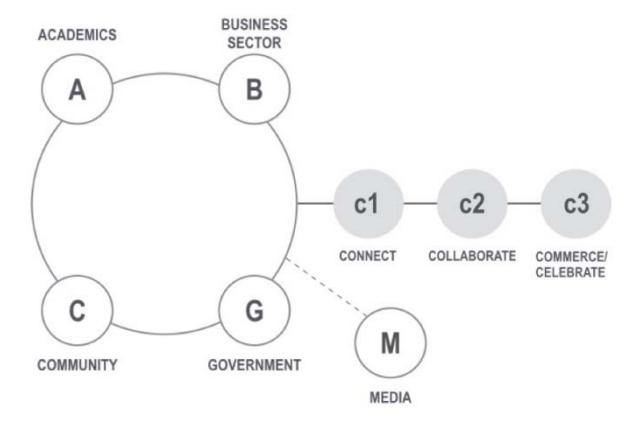
Figure 2 Penta Helix stakeholders academia, business sector, community, government, and media (ABCGM) + 3C phases of Connect, Collaborate, and Commerce/Celebrate.
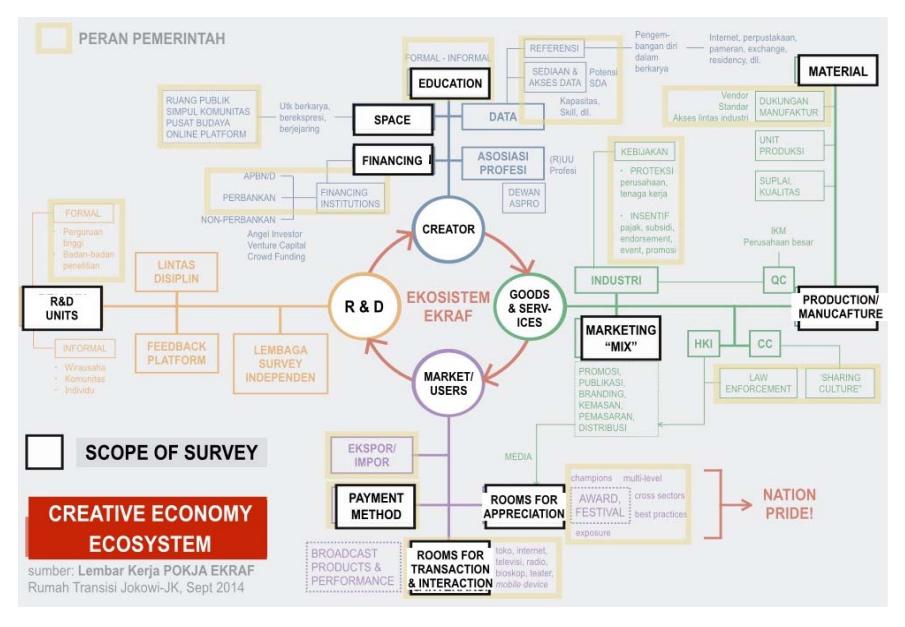
Figure 3 Creative Economy Ecosystem, containing the four main elements of Creator, Goods & Services, Markets/Users and Research & Development [7].
This research also refers to the creative economy ecosystem [7], which contains four elements that were the scope of a field survey in this research, namely: Creators/Human Resources, which refers to the creative actors who use creative potentials to produce their works and commonly need the sub-elements (education, creative spaces, finance, etc.) to conduct their works; Goods, which refers to the production and results of Creators' works (products/services/ systems), and directly relates to the sub-elements (consisting of materials, production/manufacture, marketing mix, etc.); Markets/Users, which refers to the delivery of Goods to their users and commonly involving the sub-elements (spaces for transaction and interaction, spaces for appreciation, payment methods, etc.); and Research & Development, which refers to the sub-elements (feedback, reviews, criticism, etc.) that provide input and references to Creators (Figure 3).
4 Discussion
During the course of this research, a sampling of 10 (ten) districts was selected, containing the following subsectors: Fashion, Craft, Design (visual communication, product, interior), Music, and Culinary.
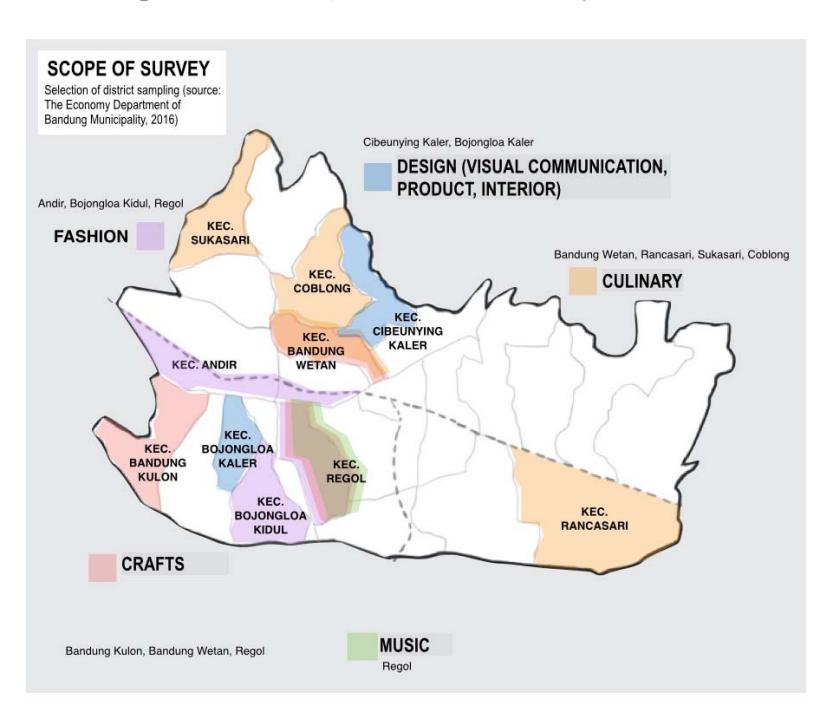
Figure 4 Sampling of ten districts in Bandung and their main creative economy potentials in the five sub-sectors of Fashion, Design (visual communication, product, interior), Culinary, Crafts, and Music.
The Fashion subsector is dominant in the districts of Andir, Bojongloa Kidul, and Regol; Craft in Bandung Kulon, Bandung Wetan, and Regol; Design in Cibeunying Kaler and Bojongloa Kaler; Music in Regol; Culinary in Bandung Wetan, Rancasari, Sukasari, and Coblong. Based on each districts' potentials it is obvious that one district can house more than one creative industry subsector. For instance, Regol has three dominant subsectors i.e. Music, Craft, and Fashion (Figure 4).
| Collaboration Project: Collective Promo + Event | |
|---|---|
| Roles | |
| A — Academia |
|
| B — Business Sector |
|
| \({\bf C}-{\sf Community}\) | Creating more collective events at a national scale for creative subsectors, not only in weekends but also in weekdays |
| G — Government | Providing tax incentive Providing easier access to product certification and legal status for business units Distributing tax to related creative industry subsectors Becoming the market for local creative industry culinary products |
| M — Media | Disseminating, campaigning, and promoting the events that come out as a result of this collaboration project |
Figure 5 Illustration of supply-and-demand chain locations for the Culinary subsector in Bandung with role identification of its Penta Helix stakeholders [3,7].
The survey made it clear that it was necessary to further classify the creative economy actors identified in the previous research into their roles within the creative economy ecosystem and value chain. Not all actors were still active in their fields. The rest were identified according to their roles, i.e. studios, shops, production units and so on, which determine their position in the ecosystem. Furthermore, in a deeper interview, the actors provided more detailed information on the supply chain of their business. This information made it possible to locate all elements of the ecosystem, i.e. market/users of goods, materials for manufacture, production units, etc. The locations for each subsector were marked on a map of Bandung city to illustrate the use of resources (Figure 5).
As an example, Rancasari district is home to a significant number of snack producers who sell their products in the outskirts of Bandung. Meanwhile, a neighboring district houses a busy intercity bus terminal with numerous snack shops, which procure their supplies from snack producers that are located out of town. This condition should be able to trigger strategies that connect local producers to this nearby marketplace and enhance their production by creating services that are relevant to the specific characteristics of the customers, in this case passengers of intercity buses, people who come to the terminal to accompany or pick up others, workers, and onlookers who spend most of their time at the terminal.
Furthermore, during the focus group discussion session of this research, all actors attempted to map their strengths, weaknesses, opportunities and threats in order to identify their actual capacities and challenges in connection to the local ecosystem. A number of discoveries during this session are expected to lead to recommendations for solutions and policies that can improve the current conditions of the industries. As an example, in the Fashion subsector, specifically in the Cibaduyut area, which is famed for its footwear products since the colonial era, the actors identified their SWOT for each element in the creative economy ecosystem. In the Creators/Human Resources element it was found that the workers receive substandard salaries, they lack regeneration since there are hardly any younger people interested in learning the required skills, and they also lack the craftsmanship to fulfil high quality standards. In the Goods element there is hardly any initiative to build local brands that are relevant to current markets or trends; mostly imitations of famous designs and brands are produced by order. In the Markets/Users element, most orders come from a neighbouring country and are for imitation products to be sold at much lower prices compared to the original brands. In the Research & Development element, the actors can hardly find research on footwear products or brands, especially those that reflect the characteristics or uniqueness of Bandung and are applicable to the industries in Cibaduyut. The SWOT data for each element in the ecosystem are expected to lead to recommendations for strategies that provide support for each element according to its particular urgent needs in order to guarantee the continuation of the creative industry itself.
Such solutions can only be achieved by a thorough examination of the superimposed map of Bandung city on which the locations of Creators/Human Resources, Production & Goods, Markets & Users, and R&D are simultaneously mapped against the actual locations for potential marketplaces, production sites, and so on. The dominant creative industry subsectors in each district, especially those run by independent, small- and medium-sized enterprises, should be improved based on the economy opportunities that exist in related areas.
5 Conclusions
The objectives of this research were achieved through the action phase of this research, which resulted in the identification of real actors within the creative industry subsectors in selected districts in Bandung. The previous mapping of the creative economy ecosystem and creative potentials in all 30 districts of Bandung has been a real guidance for the municipal government and other stakeholders to intervene with appropriate support according to the needs of the creative industry entrepreneurs, both in the form of programs and funds. Moreover, these entrepreneurs were given more insight into the business ecosystem in which they operate. Start-ups in creative industry subsectors are better able to succeed within an existing ecosystem that already operates effectively, while the government is able to endorse them or show its support through related programs, policies, or facilities.
In general, the result of this research is expected to contribute to the connectivity between all stakeholders within the creative economy ecosystem of Bandung, especially creative industry actors, entrepreneurs and government. A follow-up research should be conducted after a period of time to obtain more details and to gain updated data that are relevant for further strategy development.
Acknowledgements
The authors would like to express their gratitude to the Padjadjaran University Fundamental Research Grant that made this research possible; to the Bandung Creative Economy Committee and Bandung Creative City Forum (BCCF) for all their support in the form of knowledge and resources; to all the entrepreneurs and creative economy actors who have been involved since the beginning of this research; and the team of surveyors whose hard work played a significant role in this research.