

1 Introduction
To support daily activities humans need light of various qualities. Although artificial lighting is widely used and plays an essential role in supporting multiple productive activities, natural light is a vital resource for humans. One of the main reasons is energy efficiency. In Indonesia, whose geographical location is in the equatorial zone, natural light is an important resource of lighting in support of daily activities. So far no rigid standard guidelines in the application of daylighting have been formulated and therefore the application of natural light needs to be carefully studied, for example to ensure that people can be more productive at work.
One type of public space for leisure activities that may need to use natural light as much as possible are eating places. Their customers usually not only expect to enjoy a meal under natural light but also the view outside [1]. In Bandung, West Java, Indonesia, a city located in a mountainous area with a highland climate and natural resources, there are many cafés where visitors can enjoy food and relax to relieve stress by being close to nature. As a result, there is a significant number of tourists that come to Bandung from neighboring areas with a tropical climate to spend their holidays and enjoy the natural views [2,3].
However, the use of natural lighting may not be secure, because apart from possible exposure to heat from direct sunlight, visual discomfort can also occur. When visiting a café, customers expect to have visual comfort when they have their meal while also being able to view nearby greenery or a more distant natural landscape. As Ciani [3] states, restaurant operators believe that lighting positively influences customers' feelings if the interior elements are appropriately organized to offer a special experience to the guests. Furthermore, as De Castro and Stroebele [4] state, if the ambiance is congruent with the color scheme applied, it can positively stimulate the guests' feelings. A solution for meeting these needs is a challenge that restaurant operators need to face to survive in the highly competitive culinary sector of the present [5].
However, the use of natural lighting can be a significant problem for customers, because the daylight entering into the dining area of a café can be burdening, even though this usually happens in the morning when the temperature is not too high. To optimize the use of natural light, the type of curtains most commonly used are traditional bamboo curtains, because they can withstand heat and rain. Venetian blinds, roller blinds, and vertical blinds are also suitable for outdoor use but are mainly used in indoor environments only. Although bamboo curtains are a practical solution for screening natural light, they do not allow people to see the view behind them through the gaps between the blades.
In this study, unique spatial conditions were developed using a number of glass curtains to test the research hypothesis in trying to solve the problem of customers eating in a café under natural lighting. This research was aimed at testing whether any of a number of curtain types could control natural light in such a way that the customers' visual comfort is satisfied while they would get a comparable level of luminance and illuminance on the one hand and would be able to enjoy natural views. The hypothesis of this research was that by controlling the transmission of natural light and create a particular colored light reflectance resulting from different stained glass curtains and illuminance, the visual comfort and mood of customers can be altered.
2 Visual Performance and Visual Comfort
In running a culinary business such as a café, the operational costs will include the provision of luminaires, functional costs and the profit margin gained [6]. According to the same writer, in a functional space, the application of an appropriate type of luminaires will result in a lighting system that can support the visual task that its users, including customers, need to perform. In other words, the food service operator has to carefully choose a proper lighting system to avoid visual fatigue. Otherwise, more users need more energy to perform visual tasks, which can weaken cognitive performance and motoric performance of the visual tasks, and in the end, cause problems of vision.
Lee, et al. [7]. state that the visual comfort of the users of a room in a café is determined by the level of illuminance over the dining table and the color rendering of the lighting measured over the counter. To make sure that customer's visual performance has the expected level, the illuminance of the working or dining table, the spectral power distribution of the source of lighting and the light distribution from the luminaires can be controlled. This can be done in accordance with the performance of the task of the users of a real location or with a working simulation in a laboratory.
2.1 Lighting Preference and Color Rendering
Previous researches have shown that to support daily activities either at home or work activities in the office people generally prefer daylighting [8,9]. According to Sapia [10], natural light is beneficial for health and fitness from a physiological, psychological and certainly from an economical point of view. Therefore, the use of daylight is expected to boost productivity because of increased worker satisfaction as a result of the improved lighting quality to support work performance [10]. However, daylight cannot always and fully meet the needs of people in supporting visual performance, because natural light changes irregularly in line with time and sky conditions (clouds and precipitation). This results in an uneven quality of light and may have a negative effect on the users' visual performance, especially when they perform delicate and constant visual tasks [11]. For those who conduct low-level and casual visual tasks, such as people who visit a café for leisure, may not need a higher standard of illuminance, because lighting standards regulate the optimum level of illumination for people who need to perform a particular task. However, energetic light that is impressive, dramatic and emotionally stimulating, can evoke the interest of restaurant guests in initiating conversation, as stated by Bhatia [12]. Concerning illuminance, Dahlan [13] notes that window size and curtain design for controlling the penetration of natural light are essential factors that need to be carefully considered (see also [14]).
2.2 Perception of Visual Comfort and Mood
Key findings on the connection between natural light and mood are presented by Gomez & Preto [15], who state that without being exposed to natural light people may suffer psychological problems, such as seasonal affective disorder (SAD). However, more research is necessary if we want to harness the power of sunlight to meet the standards required for work or visual performance. This suggestion is confirmed by Boyce [6], who states that the visual comfort that people experience while executing a particular task can significantly affect their mood. Thus, poor quality of lighting, which includes the level of illumination and the temperature of the color, will have a large impact on the quality of one's mood, which can then affect one's motivation in the workplace. Boyce further explains that visual discomfort hinders achieving an optimum feeling. Some potential factors that affect this could be caused by natural lighting, for example, in the form of glare and flickering; however, this can differ depending on one's situation.
Similar research has been done by Wardono and Soelami [16] to determine how artificial lighting (less than 10 lux) implemented in furniture (luminous furniture) can affect customer mood. Their study showed that luminaires applied below the peripheral vision of a sitting customer can significantly elevate a customer's enjoyment of the dining experience in a static mode of lighting when compared to more dynamic forms of illumination. This finding is in accordance with Boyce's statement on the importance of low levels of light in café settings as this can create an ambiance that is more favorable for customers [17]. This study refers to the circadian rhythm, which determines the production of cortisol to maintain healthy body functions, such as glucose conversion and the creation of melatonin hormones, which regulate sleep. The evidence proves the importance of sunlight for humans [15]. Serotonin, the hormone responsible for mood regulation, appetite, sleep, and muscle contraction, starts to appear when one experiences sunlight of more than 1000 lux [18].
Visual factors can also play a role in achieving moods that promote appetite. The process of exploring, choosing and deciding what kind of food to eat and enjoying a meal always involves the element of sight. Delwiche [19] and Piech, et al. [20] support the notion that people are actively using their visual senses during dining. It comes as no surprise that the senses that involve physiological, psychological and visual attention play a vital role in determining the enjoyment of the dining experience [21,22]. Research has shown that one's appetite can be triggered by perceiving the flavor elements of food [23].
3 Research Method
The café Roemah Kopi in Bandung was selected for conducting a quasiexperimental investigation. It is one of the many restaurants located in the highland environment of Bandung, which complements its business location and is a favorite culinary destination for local customers and visitors from neighboring cities. One dining room was considered appropriate for the experiment as it was directly lighted by daylight. It was also slightly more private, making it suitable as a place for conducting an experiment. The room was equipped with a table of 110 x 150 cm in size, two wooden sofas, and three wooden chairs, as illustrated in Figure 1.
Figure 1 Plan of the café's dining room used for the experiment.
In this dining room, four controlled natural lighting conditions were created by the use of three colored glass curtains and one traditional bamboo roller blind. The goal was to test whether the use of the three different colored glass curtains would have an impact on the subjects' visual comfort and mood. The hypothesis was that a change of the lighting conditions in the room using either cool, warm or combined colored glass curtains would have a significantly different impact on the respondents' visual comfort and mood compared to using the bamboo curtain.
3.1 Glass Curtain as Stimuli
Three sets of glass curtains consisting of ten (10) individual pieces of hanging glass curtain made up from 3 columns of glass pieces (6 x 6 cm) by 12 rows of glass pieces were developed as the experimental stimuli. They were made of bluish colored glass, warm colored glass and cool-warm colored (combined) glass respectively, as shown in Figure 2(a), 1(b) and 1(c). As control condition a bamboo curtain was used, as shown in Figure 2(d).
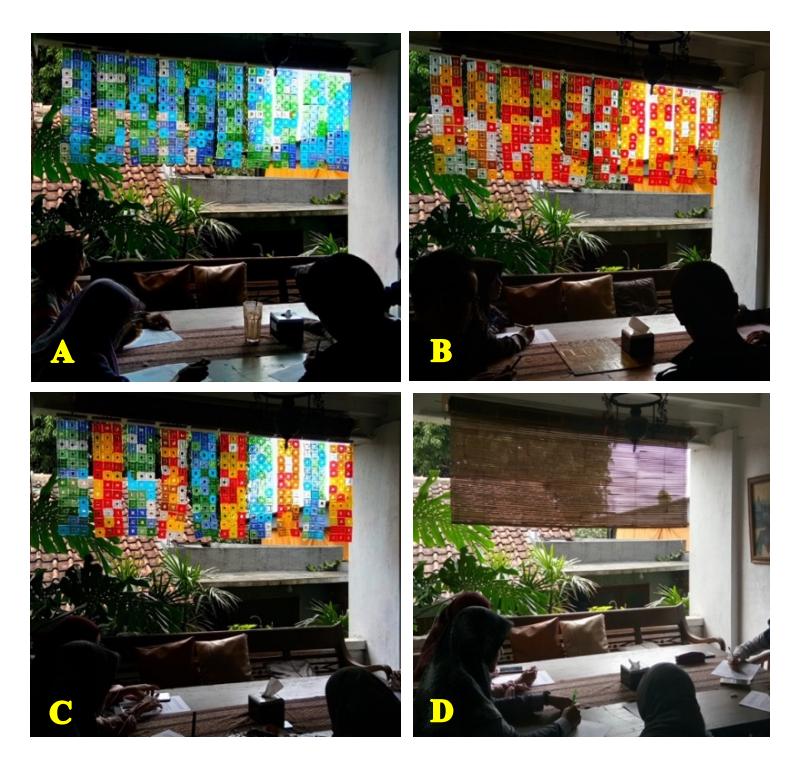
Figure 2 (a) Cool colored glass curtain; (b) warm colored glass curtain; (c) cool-warm colored glass curtain; (d) bamboo curtain (control condition).
3.2 Procedure of Experiment
The experiment involved thirty-eight conveniently sampled students and was conducted for several times starting late morning when the sunlight sufficiently penetrated the dining room to support the dining experience of regular customers. Each iteration of the experiment applied one type of curtain and each group of five respondents sat in the dining room and were instructed by the experimenter on what they should do to carry out the experiment. Before the meal was served, the incident outdoor light as well as that reflected over some areas of the table surface resulted from the daylight was measured using a
Kenko-LX1010B lux meter. The illuminance data were necessary for evaluating the brightness levels perceived by the respondents. The daylight emitting through various colors of the glass curtain was also recorded, using a Konica Minolta LS-110 luminance meter with lens specification, 85 mm, f/2.8, wide angle 9°, ± 2% accuracy, reading capacity of ± 1 digit, as it would influence how the respondents felt during eating.
During the mealtime, the respondents were asked to fill in a 5-point Likert scale based questionnaire, which was prepared and adopted from the visual comfort perception and mood measurement scale previously used by Lee, et al. [7], with a slight adaption related to the objective of this study. All respondents were questioned repeatedly according to four dining room conditions. The respondents' data were then analyzed to conduct comparison tests with regard to the four lighting conditions, i.e. with a warm, cool and combined colored glass curtain and the control condition, to find out which type of curtain performed had the most positive impact on the subjects' visual comfort perception and mood during eating. Besides that we also expected from this analysis to identify which were valued to be the second and and third preferred colored glass curtain.
4 Results of Measurement of Incident Light
The experimenter also measured incident light occurring on a window curtain of the café, which may affect the customers' view and dining experience. This measurement included the measurement of light transmittance over the curtains (bamboo and glass) (see Figure 3). The luminance (cd/m2 ) resulted from the bamboo curtain and the colored glass curtains was measured using a luminance meter (Konica Minolta LS-110, lens: 85mm, F/2, viewing angle: 9°, accuracy: ± 2%, reading ± one digit .8), which was used as supporting data to measure the subjects' visual comfort. To know the transmittance coefficient of a glass surface, we used a comparison by measuring the luminance over the surface of some pieces of glass with white paper as well as without white paper. To acquire the transmittance values, the following formula was used:
\[\frac{L_1}{L_2} = \frac{T_1}{T_2} \tag{1}\]
\[T = e (2)\]
L1 = luminance without white paper;
L2 = luminance with white paper;
T1 = transmittance without white paper;
T2 = transmittance with white paper;
with \(\rho\) of the white paper at 0.9. Thus, the results of the measurement of luminance were as shown in Table 1.
| 700 1 1 4 | D 1. | C 1 | • | 1 1 | C | |||
|---|---|---|---|---|---|---|---|---|
| Table I | Regulfe | ot lum | inance | measurement | On | hamhoo | curtain | surface |
| Points _ | Luminance | e [cd/m2] | Tra | Mean | |||
|---|---|---|---|---|---|---|---|
| Surface | Without paper | With paper | Paper | Measurement Surface | |||
| Bamboo curtain | 1 | 141.5 | 206.6 | 0.278458891 | |||
| 2 | 87.72 | 139.3 | 0.40656 96 | 0.256025058 | 0.258631 | ||
| 3 | 31.53 | 73.38 | 0.174695304 | ||||
| 4 | 25.59 | 63.6 | 0.163586755 | ||||
| 5 | 100.7 | 115.9 | 0.353249049 | ||||
| 6 | 44.39 | 55.4 | 0.325769444 | ||||
Figure 3 The luminance measurement points on the bamboo curtain surface (as represented by schematic brown plane illustrated).
Figure 4 The luminance measurement points over the glass curtain surface.
The result of the measurement of luminance on the colored glass curtain surface are shown in Table 2.
| Luminance [cd/m2] | Transmittance (%) | |||||
|---|---|---|---|---|---|---|
| Surface | Color of glass | Without Paper | With Paper | Paper | Surface Measurement | |
| 1 | Hot Red | 254.6 | 320.1 | 0.323375931 | ||
| 2 | Cool Red | 332.7 | 390.7 | 0.346213785 | ||
| 3 | Hot Yellow | 224.6 | 784.7 | 0.116370008 | ||
| 4 | Cool Yellow | 250.7 | 741.6 | 0.137442036 | ||
| 5 | Hot Brown | 277.81 | 316.4 | 0.356982039 | ||
| 6 | Cool Brown | 334.3 | 511.6 | 0.265668955 | ||
| 7 | Hot White | 398.9 | 2995 | 0.054150463 | ||
| 8 | Cool White | 492.5 | 1304 | 0.153554875 | ||
| 9 | Hot Light Purple | 378.8 | 773.8 | 0.40656966 | 0.199028931 | |
| 10 | Cool Light Purple | 288.2 | 335.2 | 0.349562577 | ||
| 11 | Cool Dark Purple | 387.6 | 470.4 | 0.335005102 | ||
| 12 | Hot Light Green | 425.4 | 437.8 | 0.39505421 | ||
| 13 | Cool Light Green | 267.8 | 499.8 | 0.217845848 | ||
| 14 | Hot Dark Green | 184.9 | 469.5 | 0.160116571 | ||
| 15 | Cool Dark Green | 221.5 | 235.5 | 0.382399914 | ||
| 16 | Hot Blue | 242.3 | 303.4 | 0.324692909 | ||
| 17 | Cool Blue | 148.7 | 635.9 | 0.095072981 | ||
Table 2 Results of luminance measurement on glass curtain surface.
The luminance measurement on the glass curtain surface showed that the luminous intensity over the three experimental conditions ranged from 148.7 cd/m² to 492.5 cd/m². The measurements of the outdoor illuminance during the experiment were done from 09.27 AM to 12.13 PM and ranged from 5800 lux to 35500 lux, whereas the indoor illuminance values ranged from 232 lux to 1412 lux.
4.1 Results of the Respondents' Data Analysis
One way repeated measured ANOVA was used to test the research hypothesis. It showed that there were significant differences in the respondents' visual comfort and mood in response to the different dining room conditions. There is some evidence supporting the research hypothesis. The following results indicate how the respondents' visual comfort and mood in response to the respective room conditions differed significantly: Pillai's trace = .289, F (3, 39) = 5.28, p < .05, \(n^2\) = .29; and Pillai's trace = .149, F (3, 39) = 2.27, p < .05, \(n^2\) = .15.
Pairwise comparison of the respondents' visual comfort levels under the different room conditions following the ANOVA analysis showed that some
pairs differed significantly (p .05), whereas some others did not (see Figure 5). The subjects' response data of visual comfort in the room with the bamboo curtain compared to that with the warm colored glass curtain as well as to that with the combined glass curtain were significantly different (p = .010) and (p = .002), respectively, but not significantly different in comparison to that of the room using the cool colored curtain (p = 1.000). The subjects' perception of visual comfort with the cool colored curtain was not significantly different from that with the warm colored curtain (p = .141). The subjects' visual comfort in the room with the cool colored glass curtain was significantly different from that in the room with the combined colored curtain (p = .038). However, there was no significant difference in the subjects' visual comfort between the room with the warm colored glass curtain and the room with the combined curtain (p = 1.000).
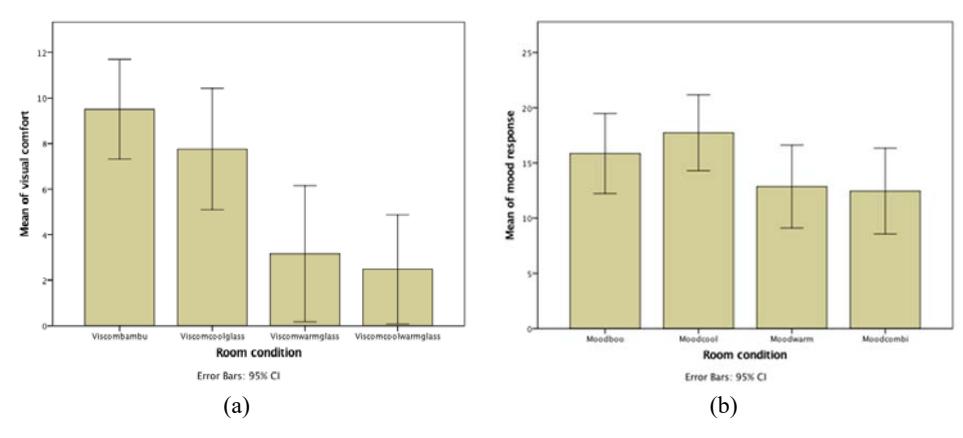
Figure 5 (a) Graph of the mean of visual comfort in four room conditions, (b) graph of the mean of mood response in four room conditions.
In terms of mood response, some groups differed significantly from each other. There was a significant difference in mood response between the room with the cool colored glass curtain and the room with the warm colored glass curtain (p = .030), and also between the mood response in the room with the cool colored glass curtain and the room with the combined glass curtain (p = .022). However, the results showed no significant differences between the subjects' mood response in the room with the bamboo curtain and either the room with the cool colored glass curtain or with the warm colored glass curtain or the combined glass curtain.
5 Discussion
From the overall results it can be seen that the subjects needed improved lighting conditions in the room by having filtering of the natural light. More
specifically, the research findings (see Figure 4) showed that the respondents saw the bamboo curtain and the cool colored glass curtain as the most favorable solutions. This preference indicates that a slight shading and a 'cooler' room for dining are more preferable than a brighter or warmer room, as proved by the fact that the respondents had significantly lower visual comfort and mood response values when using the warm colored glass than the bamboo or cool colored glass curtain. This finding is confirmed by Lee, et al. [7], who state that in performing visual tasks, people rate higher under bluish color lighting conditions. This result could mean that during casual eating events, respondents tend to prefer a lower level of illumination as also confirmed in the previous research by Wardono & Soelami [16] (see also Lee, et al. [7]). The higher illumination level reached at the dining table when using warm or combined colored glass curtains could explain why the respondents scored significantly lower on the visual comfort scale compared to when using the bamboo curtain.
In having lunch while enjoying natural views, this research also found that the respondents preferred a refreshing, natural air-conditioned room supported by the use of the cool colored glass curtain, which is in accordance with the research findings from Gurhananda & Wandebori [1]. The same was also true for the visitors looking for a natural environment in Pratminingsih & Puspitasari [2]. However, this result may also prove that customers expect to gain a particular experience from different daylighting conditions as Ciani believes [3]. This research supports the notion that the respondents' mood score in response to different daylighting factors did not significantly differ from each other. Perhaps, customers like to enjoy a meal in various conditions as reflected in how the subjects' responded to the change from bamboo curtain to the various colored glass curtains. This finding may be coherent with previous studies such as Spence & Piqueras-Fiszman [22], who state that customers prefer to have a surprising new environment for dining.
Furthermore, Ciani also points out that the 'wow factor' is essential for a successful culinary business, which is often overlooked. Therefore, manipulating the spatial conditions by using more various lighting colors may have shown that people were surprised, which supports the enjoyment of their meal. This condition is also relevant to what Bathia has stated, that "nonuniform lighting of varying brightness, including sparkle, glitter, movement, and peripherals of simulating color patterns create this impression and encourage conversation" [12].
However, the constant mood response towards any change of curtain may also have occurred because changing the penetration of daylight as a result of the different colored glass curtains used was not effective in stimulating the subjects' mood. This may have occurred because the open window below the curtain was large, making the dynamic change of daylight not easily felt. Furthermore, the very dynamic change of natural light (see the illuminance measurements) could be the reason that a change of glass curtains may not have been quite sufficient to change the response of the subjects.
Therefore, although Han & Lee [17] have stated that blue and red colored lighting in a room evoke a higher state of a particular mood, i.e. "depressiondejection, anger-hostility, and confusion-bewilderment", in comparison to yellow lighting, these conditions did not seem to apply in the present experiment. The same research also found that samples scored higher on an active state of mood in a blue-lighted room and scored lower in a yellow-lighted room, which was confirmed when applying a yellow-reddish glass curtain in the room.
6 Conclusion
This study tried to test whether a newly developed design solution to control the daylighting in a café dining room by using a colored glass curtain could have a positive impact on the visual comfort perception and mood of guests. Such a study is useful since many food service businesses try to use the surrounding natural environment as an attractive promotion point lack an adequate method of controlling the natural light in meeting their guests' demand for visual comfort and a pleasant dining experience. In this study, three sets of colored glass curtains, i.e. a cool colored glass curtain, a warm colored glass curtain and a cool/warm (combined) colored glass curtain were designed to test the research hypothesis, i.e. that replacing a bamboo curtain as control curtain with each of the colored glass curtains will improve the subjects' visual comfort and mood. Furthermore, this study tried to test which one among the newly developed stained glass curtains and the bamboo curtain would be most effective in improving the subjects' visual comfort and mood.
This study found that the subjects preferred a 'cool' or shady eating environment to support their visual task during eating over a 'warmer' one. Also in terms of mood, 'cool' lighting conditions resulted in a better effect than 'warm' lighting conditions.
In this study, the glass curtains used to control the natural light only covered half of the window opening in order to allow the subjects to have a landscape view. Thus, since natural light changes over time, it was not easy to study how the visual comfort perception correlated with the indoor and outdoor illuminance levels measured. However, the preferred daylighting conditions resulted from this study tended to be a shadier eating environment. A future study may look at ways to control the daylight even further. It is suggested to consider that the illuminance level measured in this study was still very high for carrying out eating activities, which, referring to previous studies, require much lower levels of illumination. Thus, a much more careful study in terms of light distribution is a prime consideration when researching the use of natural light in leisure places, time of day and duration for supporting human psychological responses.
Acknowledgments
Institute Teknologi Bandung (ITB) has funded this research project under the P3MI-2017 program, which was initiated three years ago by the Rector of ITB to improve the lecturers' academic achievements. The authors would like to express their most sincere gratitude for this valuable support. The experiments conducted would not have been possible without support from the ceramic workshop at the Faculty of Art and Design, ITB by providing their firing facility (kiln) and services from their technician; Roemah Kopi by providing one of their dining rooms; and the Engineering Physics laboratory ITB by providing some of the luminance measurement tools. The authors would like to express their most profound appreciation to them.