

1 Introduction
Czech animator and surrealist Jan Švankmajer is one of the most distinctive and influential of contemporary filmmakers. As a leading member of the Prague Surrealist group, his work is linked to a rich avant-garde tradition, and an uncompromising moral stance that brought frequent tensions with the authorities in the years of Normalization following the Soviet invasion of Czechoslovakia in 1968 [1]. In this research, sociopolitical critique strategies in the films of Jan Švankmajer were studied, with the main focus on filming techniques that Švankmajer has used to criticize the sociopolitical conditions of his time. The research question was: What are the sociopolitical critique strategies Jan Švankmajer uses in his films and how do they work, knowing that in literature by various modes of figurative language one can speak in an indirect or fantastic way using words in a sense other than their literal meaning. Thus, a relationship is established between expressions of this type in language and the filmmaking strategies of Švankmajer, which can both be used to indirectly criticize contemporary sociopolitical conditions. Thus, another fundamental question of this research was: As in literature, there are ways in
Received May 21st, 2018, Revised November 21st, 2019, Accepted for publication March 14th, 2020. Copyright © 2020 Published by ITB Institute for Research and Community Services, ISSN: 2337-5795, DOI: 10.5614/j.vad.2020.12.1.4 which the meaning of a single notion can be stated in various and indirect ways in film; are equivalents of such figurative language methods identifiable in the films of Švankmajer? To be able to answer these questions, we first needed to understand the modes of figurative language and then to discover a model for understanding the equivalents of these modes in Švankmajer's works.
According to extracted data by researchers whose essays have been collected in Dark Alchemy: The Films of Jan Švankmajer, Švankmajer is an artist who has a unique style inspired by his country's culture, Surrealism, black humor, the grotesque, dreams and imagination, stop-motion, techniques, and collages and assemblages, Mannerism, remarkable film editing and more. He disrupts accepted filmmaking conventions by using indirect representations to criticize events and sociopolitical issues related to the Soviet communist regime in Czechoslovakia from the mid 1940s to the late 1980s. These methods can be seen as critical instruments to make social comments under censorship [1].
In this research it was also attempted to get acquainted with the artist himself, his concerns and criticism by referring to findings of various scholars who made sociopolitical observations related to Švankmajer's films. Based on this, a model was formed for comparing linguistic expression techniques to Švankmajer's film techniques for the conceptual analysis of other works by Švankmajer, by exploring and discovering their structural similarities. Finally, exploring pictorial equivalents and extract sociopolitical concepts from Švankmajer's other works, it was possible to identify figurative language methods as sociopolitical critique strategies in the work of Švankmajer.
2 Methodology
The research method used in this study was based on finding equivalents between modes of figurative language and Švankmajer's filming techniques. First, figurative language modes were identified base on Sirous Shamisa's book Figurative Language [2]. Furthermore, other researchers' findings in Dark Alchemy, other academic dissertations and essays about the sociopolitical messages in Švankmajer's films were an indispensable source for recognizing his main objectives in the realm of criticism and his procedures to express it. Thus, based on these reviews, the structure of Švankmajer's filmmaking techniques and various figurative language modes were examined and compared to develop a new method of investigating other films of Švankmajer as case studies in this research.
3 Figurative Language
Referring to a variety of insights in humans, Shamisa [2] sees each of them in a particular linguistic form and special way. He calls each of these particular mental and linguistic behaviors 'stylistic' and explains literary style as having an emotional attitude toward the world inside and outside and is associated with visual and emotional language. In literary style, words and sentences are not used in their original sense. In fact, the artist speaks in another way and does not use common language conventions. Shamisa explains that figurative language is "The expression of a single meaning in different ways, provided that difference is just based on imagination. For example, instead of 'Her face is beautiful' one can say, 'Her face is like the moon or a flower'." Shamisa distinguishes the following different figurative language modes:
3.1 Simile
"A simile is the similarity of something to another thing, provided that it is based on a falsehood, not the truth; a claim and not real fact" [2]. The simile in its extended form is a sentence with up to four elements, which are called the 'pillars' of the simile. By referring to the sentence "X is like Y from this point of view", Shamisa defines X as the likened (in the figures: 'similed'), Y as the likened to (in the figures: 'similed to'), the point of view as the similarity that is claimed, and the term like as the simile particle.
3.2 Trope
Shamisa refers to the different uses of vocabulary by poets using common words outside their literal and common meaning. According to Shamisa's explanation, this different word use and meaning displacement should be accompanied by a sign that explains their purpose. These signs are called the index. For example, he points out a couplet of Malek al-Shoara Bahar: "If the Iron Eagle opens up its wings, the city and village are its hunting ground", in which the poet uses the term 'iron' as the index to make the reader understand that this eagle is not a real eagle, but something like an eagle that is made of iron, i.e. an aircraft. Shamisa mentions similes and tropes as a prelude for the discussion of metaphors [2].
3.3 Metaphor
Using a metaphor means to use a word in place of another one. Shamisa states that: "It is possible to extract a metaphor from a simile, which means removing the likened element, the similarity and the simile particle out of a sentence in such a way that only the likened to element remains, which is called a metaphor". After extracting the likened to element from a sentence, it should be included in an expression with the index, so that the reader can find out that it is used in a sense other than its literal meaning [2].
3.4 Personification
A personification is a type of metaphor where the writer leaves out the likened to element and uses the likened element in its own meaning and likens it to something else and then uses one of its adjectives to convey an imaginary picture to the reader. For example, in 'the hands of time', where the likened element is time, which is represented by a human attribute, i.e. the hand. In this kind of metaphor, Shamisa [2] says a human is the omitted likened to element in most cases and therefore he calls it a metaphor of humanity.
3.5 Allegory
Shamisa [2] describes the allegory as the interpretation of an anecdote or a narrative that along with its apparent meaning has a more general meaning, with the speaker referring to the more general meaning. He states that "The allegory is a result of a dual relationship between the likened and the likened to elements". In an allegory, the principle is to only mention the likened to element, which leads us to the likened element. Thus, in the West this is called a 'compound metaphor'.
3.6 Symbol
"A symbol is a secret and an emblem" [2]. Shamisa sees a symbol as a metaphor that has a two-way relationship between the likened and the likened to elements. In fact, in the case of a symbol, the present aspect (the likened to element) causes guidance toward the absent aspect (the likened element). Referring to the difference between a symbol and a metaphor, he states that a symbol is indicative of a number of meanings, the so-called 'aura of meanings', unlike metaphors, which denote only one meaning. For instance, Shamisa refers to 'prison' in mystical poetry, which can be a symbol of the human body as well as the world itself or sensual desires, and so on [2].
3.7 Myth
"A myth is a story which in ancient times had a real meaning for ancient peoples, but today is no longer considered true in its original sense; today people do not believe it. A myth used to be a historical account but today it is understood as a story." From the point of view of figurative language, Shamisa [2] considers a myth as a likened to element, where the omitted likened element must be understood from historical, anthropological, sociological and imaginary points of view.
4 Jan Švankmajer's Work in the Sociopolitical Context of Czechoslovakia
Hames [1] states that Švankmajer "has undergone the unusual experience of six different political regimes and their attendant ideologies. These included prewar democracy, Nazi occupation, postwar democracy, Stalinism, the Prague Spring of 1968, the Normalization that followed the Soviet invasion of the same year, the post-1989 democracy, with the whole process completed by the split between the Czech and Slovak Republics in 1993". It seems that by beginning with this reference, Hames seeks to emphasize the influence of political and historical events in Czechoslovakia on the filmmaking and thinking of Švankmajer.
4.1 Sociopolitical Implications of the Film Food (1992)
In one of her academic sociopolitical analyses of Švankmajer's work, Dowd [3] refers to the first episode of Food (Breakfast) in the light of representing the act of consumption in this film as a comment on the terrible conditions the Czechoslovak people were living in the Soviet Communist era. Food consists of three episodes. In the first episode, which was made using a stop-motion technique (pixilation), there is a cycle of dual confrontations between human beings (workers), where each person receives his food from a machine-like human breast. Dowd [3] describes Food as a demonstration of human actions and behaviors in the act of consuming, where a metonymy is created from a grotesque representation of the human body and its interaction with food. Dowd [3] portrays the breakfast episode in a way that emphasizes the laborious act of consumption between two persons from the working class. Dowd [3] recounts the history of Czechoslovakia from the mid-1960s to the late 1980s, when Czechoslovakia was dominated by the Soviet Communist regime and Alexander Dubček (the first secretary of the Czechoslovak Communist Party) started a move from socialism to democracy, which eventually became known as the Prague Spring. In fact, this gave citizens the hope of a flourishing economy and a return to a rich cultural life, but this hope would be short-lived [3], since Leonid Brezhnev (the general secretary of the Central Committee of the Communist Party of the Soviet Union) was a supporter of Stalinism and opposed such reforms. He eventually ended the movement by ordering Soviet troops to invade Czechoslovakia in August 1968 [3]. Then, he tried to reinstate the order in Czechoslovakia in accordance with communist rule (Normalization), which led to oppressive conditions in the country [3]. Henceforth, Czechoslovakia remained under the control and domination of the Soviet Communist regime until the non-violent people's revolution in 1989, called the Velvet Revolution. Czechoslovakia then found the opportunity of a complete break with communism and to have a democratic state, with Václav
Havel as the first freely elected president [3]. During the years when Czechoslovakia was dominated by the Soviet Communist regime, the general population lived in very difficult circumstances. Marie [3] considers Food to be related to the events of this repressive era in Czechoslovakia and points out that socialism supports an ideology according to which every citizen must have access to the resources provided by the government and each should compensate for this assistence [3]. Unfortunately, this ideology led to lack of essential resources such as food and housing. Also, the available resources were made available only through an unnecessarily bureaucratic and time-consuming process [3]. On this basis, Marie explains the difficult and time-consuming practice of consumption between two human beings as a kind of exaggerated expression of food shortages in the communist state in Food [3].
4.2 Sociopolitical Implications of the Third Episode of Dimensions of Dialogue (Exhausting Dialogue) (1982)
Dowd [3] describes that the idea behind Exhausting Dialogue is related to the tedious nature of the reformation process, both for the leaders and the people of Czechoslovakia. In this episode we witness two human heads bringing objects to each other's mouths. Matching objects do not cause problems, but in a subsequent phase repeated mismatches cause destruction of both heads in the end. As previously mentioned, Dubček started a move from socialism to democracy and sought to fundamentally reform the governing structure of Czechoslovakia. Dowd [3] notes the acceptance of this reform movement by most Czechoslovak leaders and the enthusiasm for it of a large number of citizens (this is shown in Exhausting Dialogue when two heads do not have problems bringing the same objects from their mouth to the other head's mouth), but pressure from Brezhnev in opposition to the reform movement is observed as a reason for division and opposition among members the Czechoslovak Communist Party and decreased public enthusiasm for reform. However, the situation changed to a point where the conversation between the citizens and representatives from the Czechoslovakia Communist Party and Soviet Union leaders did not lead to an agreement and the Soviet Union eventually occupied Czechoslovakia in August 1968 (the unsuccessful conversations and disagreements between citizens, authorities and leaders are shown in the film when the heads face problems and are destroyed as a result of bringing different objects from their mouth to the other head's mouth) [3].
4.3 Sociopolitical Implications of Meat Love (1989)
In Meat Love, which was made using a stop-motion technique (object animation), we witness the resurrection of two pieces of red meat that dance and flirt with each other like a woman and a man, but suddenly a pair of human
hands put forks in them and fry them in a pan. In an interview by Hames [1], Švankmajer says that contemporary and advanced civilization makes the labor force leave the production process and quit the factories as a diversionary tactic. He represents the resulting society as a society that, with the growth of advertising, has grown only from the idea of consumerism among its people. The pursuit of such a system according to Švankmajer constitutes a kind of 'ecological tyranny' in that humans only think of surviving through consumption [1].
Repetition and emphasis on a piece of meat (human food) are highlighted in Meat Love as well. Indeed, Švankmajer portrays his objection to the lifestyle of people who only learn to be consumers in civilized society by displaying a human hand who cruelly destroys the lives of two non-human ones in his struggle for survival.
4.4 Sociopolitical Implications of The Flat (1968)
Joschko and Morgan [4], after pointing out that Czechoslovakia was under control of the Soviet communist regime between 1945 and 1989, refer to the 1950s as a period of Stalinization, which was a prelude to intense political censorship of news media and creative industries. After recalling that period, they refer to a unique feature of 1968, i.e. the short-lived freedom provided by the Prague Spring, and describe the cessation of political censorship as its most distinguishing feature, despite its short life. By outlining the abolition of censorship, they [4] mention the freedom of Czechoslovak artists to express their views and produce a political discourse that was previously curtailed. Joschko and Morgan [4] point out that the artists started to use an allegorical language to express political protest in their works and refer to Švankmajer's film The Flat as an example from this period.
The short film The Flat, "exemplifies the conditions of life offered by socialist society, where rules are not synonymous with fairness and justice" [4]. In this allegorical work, Švankmajer portrays a person trapped inside an impoverished flat, who is exposed to conflict with objects inside it [4]. The Flat clearly represents the conditions of people deprived of liberty and detained in a totalitarian society [4]. In 'Švankmajer's Touch' (2009), Cathryn Vasseleu [5] notes Švankmajer's portraying himself as a poet and not as a film director and mentions the instrument used by him to create his works as poetics. Czech surrealists considered poetry as a counterpart of alchemy. Seeking ways to convert metals into pure gold, alchemy (poetry) means trying to link things together that cannot be linked together [5]. In surrealist poetry, the meaning of words is altered in a powerful and flexible manner, as can be seen from Roger Cardinal's [6] remarks on the Surrealist artist René Magritte changing the meanings of sentences and words. Cardinal [6] mentions The Key To Dreams (1930) by René Magritte in which the artist illustrates six random objects and places a wrong caption below each of them. For instance, placing 'acacia' under the image of an egg, and 'moon' under the image of a shoe, etc. [6]. Cardinal believes that Magritte thus wanted to express the uncertainty and instability of linguistic and intellectual perceptions of civilized human beings related to the world [6].
From the foregoing it can be concluded that in Surrealist poetry the displacement of meaning and the combination of existing reality with nonexisting reality are methods used for expressing specific messages. This is exactly what Švankmajer did in The Flat. For example, as Magritte displays an image of a shoe (an existing reality) along with the wrong name for it (a nonexisting reality), Švankmajer also puts humans (an existing reality) along with animate objects (a non-existing reality) to tell a story using a technique from Surrealist poetry to convey a specific message to the audience. Thus, the structure of Surrealistic poetry can be compared to a compound allegory.
4.5 Sociopolitical Implications of the First Episode of Dimensions of Dialogue (Factual Dialogue)
In Factual Dialogue, we see three heads, one of which is made of vegetables and fruit, one of industrial and kitchen appliances, and one of stationery. These three heads in dual collisions, eat each other, turning the components of their heads into one single substance. A head formed from the single material then comes out of the mouth. This is repeated in a continuing cycle.
In his analysis of Factual Dialogue, Dowd [3] points to the materials that form the heads, because they reveal the symbolic meaning of the heads and the sociopolitical implications for a Czechoslovakian audience in the year the film was made. The head of vegetables and fruits is a reference to food, agriculture and in particular the problem of food shortages for Czechoslovakians due to the Soviet Union's collectivization of agriculture [3]. The second head consists of man-made metal objects such as utensils and kitchen appliances that are directly related to the Soviet Union's pressure to industrialize all its dominated areas [3]. Finally, the head made of stationery represents the bureaucratic state created by the Soviet Union [3]. The second point of this episode is the interaction between the three heads. The heads engage in destructive action by devouring each other. This refers to the separation of communication and cooperation between these three symbols [3]. The inability of these three entities in Czechoslovak society and the lack of effective communication between them played an important role in the events that led to the Prague Spring [3]. Particularly regarding the issue of reform, pro-movement leaders and Czechoslovakians were pushing the government's non-efficient system to fulfill their needs because of the desperate situation they were in [3]. In the end, Brezhnev and other senior Soviet leaders no longer tolerated this pandemic movement and decided to impose Normalization [3]. This bring us to end of the film, where human heads are created by devouring and extrusion [3].
O'Pray [7] in his essay represents Švankmajer as an artist who refers to Czech artistic traditions in his works such as marionette theatre, graphic art and Surrealism. He also mentions the influence on Švankmajer's films from two general aesthetic approaches: Mannerism and Surrealism. He refers to the portraits of Giuseppe Arcimboldo (a 16th-century Italian artist), which are composed of flowers, plants, trees, books, and other objects as a Mannerist expression and asserts that the way Švankmajer uses artifacts is Mannerist similar to Arcimboldo's portraits and is also in accordance with the spiritual aspects of Arcimboldo. O'Pray further notes that the constituting elements of the portraits can be seen as verbal elements of a language on canvas and refers to the predefined meanings of these elements in contrast to the phonemes of discoursal expressive language, since they themselves are known elements, such as fruits, flowers, fish, etc. Hence, O'Pray refers to the original elements, but claims that their combination, which creates the whole of these elements in the form of a human head, creates a second semantic layer with different implications. Simultaneously, with these portraits he also evokes other meanings, e.g. 'summer', 'winter', and so on [7]. O'Pray points out that these three semantic layers can be understood only by referring to the meaning of the original elements [7].
From his description it follows that Arcimboldo's portraits in the first semantic layer represent the words themselves, in the second semantic layer they are an allegory (an example of a human head), and in the third semantic layer they are a symbol (e.g. 'summer'). Since Švankmajer's Mannerist art is derived from Arcimboldo's composite portraits, it also includes these three layers of meaning, where the symbol is located in the third one. Therefore, the structure of these Mannerist portraits can be compared to the structure of a literary symbol.
5 Identification of Mode Equivalents and Techniques for Their Creation in the Work of Jan Švankmajer
5.1 Simile in Food
Regarding the sociopolitical comments of Food, which was made using the pixilation technique, one can conclude that Švankmajer wanted to invoke the manipulation of the population by communism by showing a machine-like
human body. By showing cross-sections of the body of the actors in Food (using pixilation) and body movements accompanied by the sound of machine parts, he depicts the similarity between people and machines. That is, humans are capable of being steered and manipulated as machines. Figure 1 shows the structure of simile formation in Food.
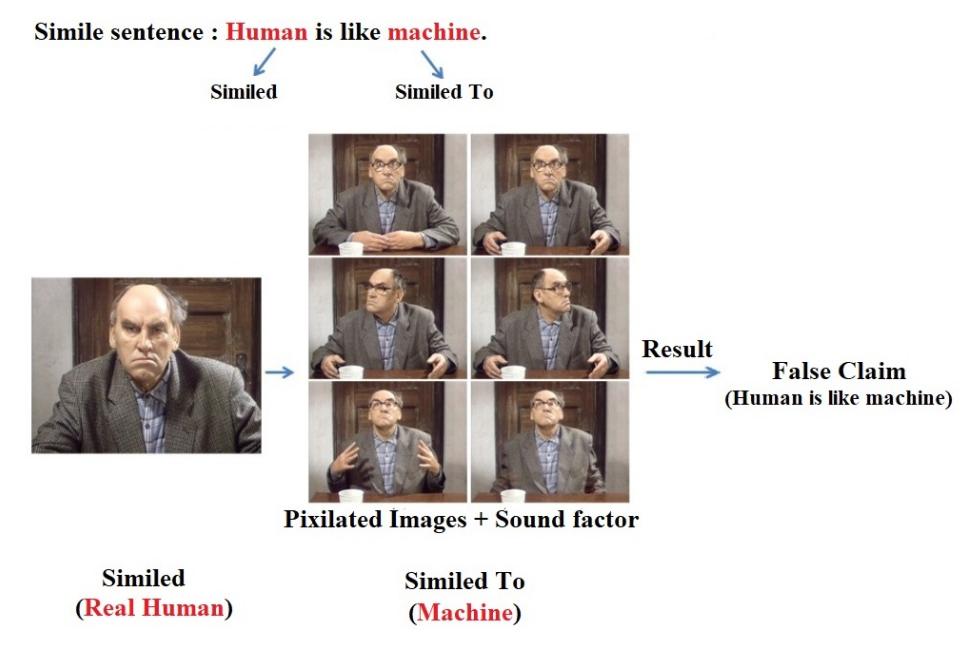
Figure 1 Structure of simile formation in Food.
5.2 Pixilation as Equivalent of Simile
Pixilation plays a major role in comparing humans to machines and one can compare the formation of this technique from simple components. In cinematography, an image (e.g. a human face) expresses the fact or reality of its existence, which is emphasized by adding motion. Thus, a picture frame can be considered as a reality (likened) in pixilation, but gestures shown in this technique do not resemble live action. Because film frames are missing, the degree of truthfulness of the pixilated image is reduced. In this case, we are no longer faced with truth itself but with mechanical movements that we do not expect from human beings. The motion in the image causes the original real image to be separated from reality, i.e. the aspect of motion in pixilation shows us something that contrasts with reality (machine-like motion). Via the pixilation technique, human motion (reality = likened) is compared to machinery motion (unreality = likened to), implying an untrue claim as well as a simile. The conformity between the structures of pixilation and the literary simile is represented in Figure 2.
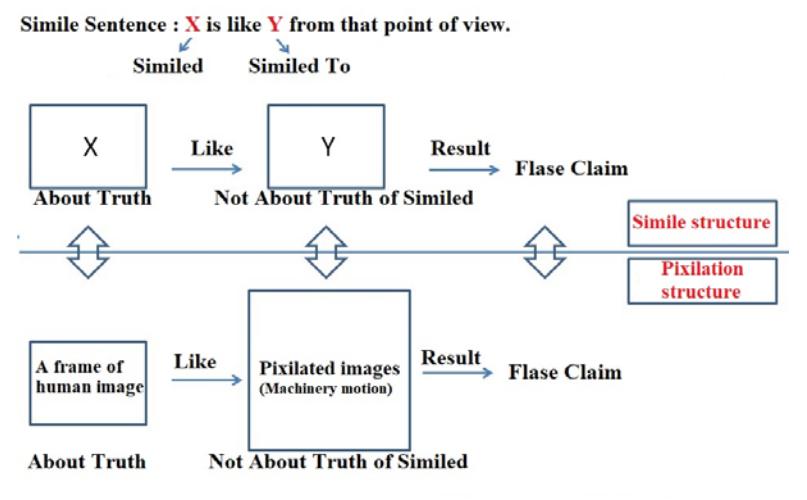
Figure 2 Conformity chart for the structures of literary simile and pixilation.
5.3 Metaphor in the Third Episode of Dimensions of Dialogue (Exhausting Dialogue)
Švankmajer structured his own sociopolitical metaphors by using a unique style of film editing. He created metaphorical meanings by sudden cuts and juxtaposition of different images. In Exhausting Dialogue, the first analogy can be considered as follows: "Human words and narratives are like objects that come from his mouth."
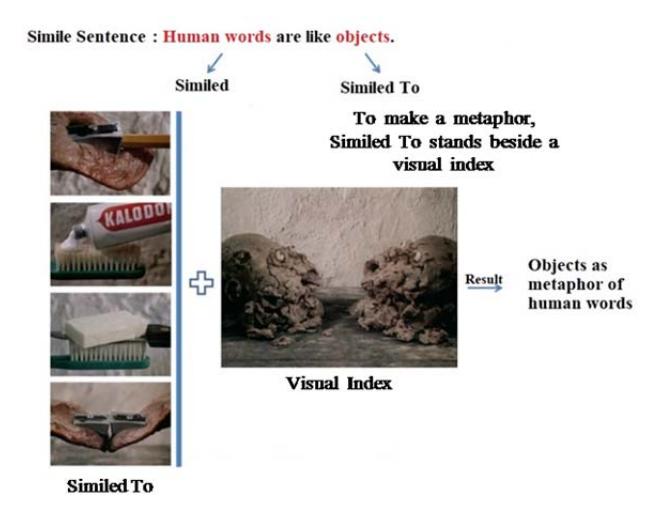
Figure 3 Structure of metaphor formation in Dimensions of Dialogue (Exhausting Dialogue).
The 'objects' that come out of the mouth are taken from the sentence as the likened to element. Now, these objects appear colliding with each other alongside a picture of human faces that are cracked. It is possible to consider the image of the cracked faces as the (visual) index of the displayed objects, which gives them a metaphorical meaning. In Figure 3, the structure of metaphor formation in Exhausting Dialogue is shown.
5.4 Editing as Equivalent of Metaphor
The explanations given in the previous section imply that film editing plays a fundamental role in shaping the equivalent of a metaphor. Thus, its structure can be compared to that of a metaphor.
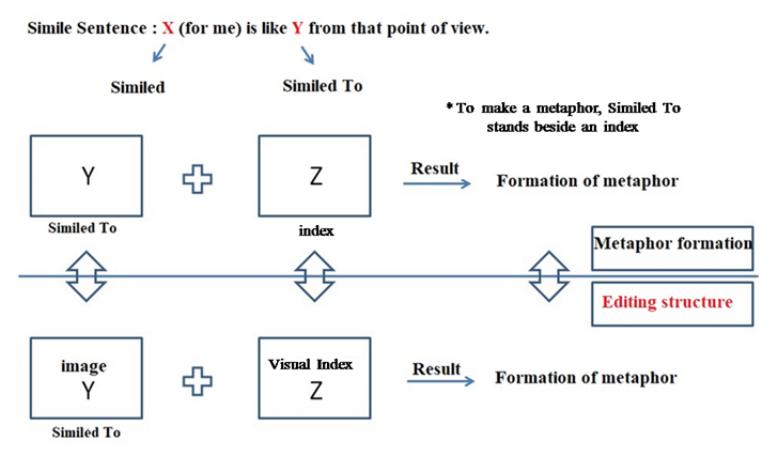
Figure 4 Structural conformity chart for metaphors and film editing.
As in a metaphor, the likened to element is taken from a first-order simile phrase (the artist's mind) and is metaphorically implied by the index. Also, by editing, an image is taken from (likened to) the artist's mind in a similar context, while by placing it next to other images (as (visual index) a metaphorical meaning is formed. The structural correspondence between film editing and literary metaphors is shown in Figure 4.
5.5 Personification in Meat Love
According to the social implications of Meat Love, by personification of a food like meat and then capturing its devouring by human beings, Švankmajer gives a critique of consumerism and the nature-consuming behavior of human beings in today's civilization. But what is important in this regard is his use of the stopmotion technique (object animation) for assigning human features to inanimate
objects and elements. In Meat Love, we can see two pieces of meat behave like humans, which implies personification, as shown in Figure 5.
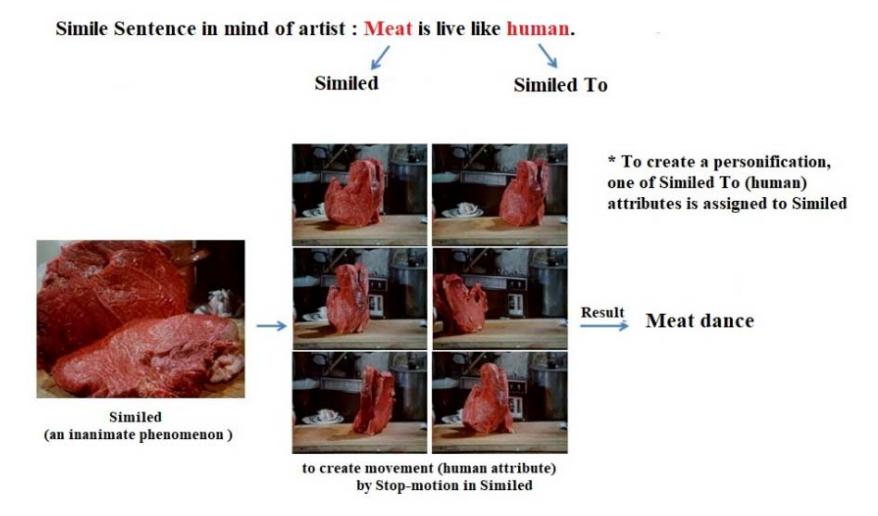
Figure 5 Structure of personification in Meat Love.
5.6 Stop-motion (Object Animation) as Equivalent of Personification
Stop-motion plays a major role in comparing non-human things to humans. Thus, one can compare the way this technique works with personification. In personification, a non-human thing (likened element) has a human feature.
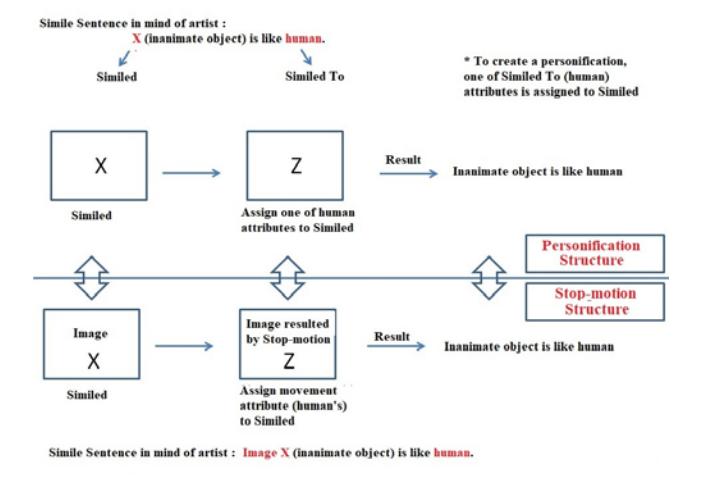
Figure 6 Structural conformity chart of literary personification and stop motion (object animation).
The human feature can involve an action (motion), e.g. when one says that 'clouds cry', attributing the action (a type of human motion) to the non-human thing (cloud). Hence, if an image of an inanimate thing starts to move in front of our eyes, an action has been injected into it. The visual action is one that the stop-motion technique (object animation) can create. In fact, the human-like motion characteristics of non-human things are a common characteristic between stop-motion (object animation) and personification. Figure 6 shows the structural conformity between stop-motion and literary personification.
5.7 Allegory in The Flat
Considering the sociopolitical implications of The Flat, we can realize the allegorical nature of this film, while its general narrative (likened to compound = first semantic layer) refers to political events related to a period from Czechoslovakia history (likened element = second semantic layer). It turns out that Švankmajer replaced a human environment (reality) with living objects (non-reality) as a technique for representing an allegory in his work, as can be seen in The Flat. This composed feature (reality + unreality) is the same combination as can be seen in Surrealist poetry, which Švankmajer was influenced by. The allegory formation in The Flat is summarized in Figure 7.
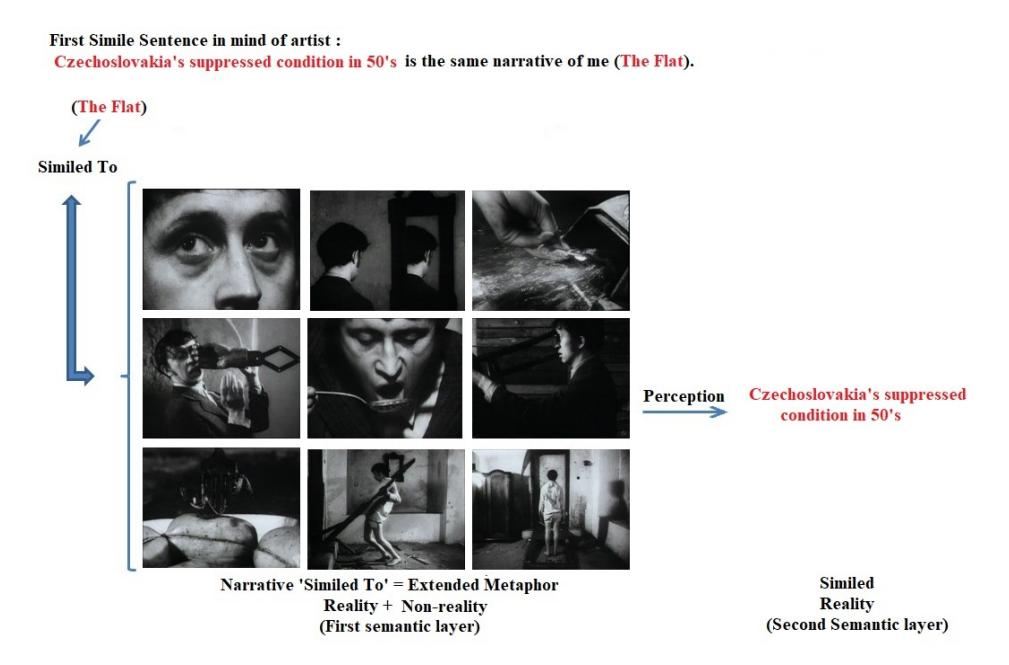
Figure 7 Allegory formation in The Flat.
5.8 Surrealist Poetry as an Equivalent of Allegory
The Surrealist poetry technique uses a combination of reality and non-reality to express the fact that "modern human linguistic and intellectual perceptual force is unstable and uncertain" [6]. Therefore, its structure can be compared with a compound literary allegory. Hence, by changing literal meanings (e.g. choosing the wrong name for objects and plotting this mistake with his/her own desired strategy), the artist creates a general process in Surrealist poetry, representing it as an abstract and complete work with a number of details, similar to a narrative. It is possible to consider this entire narrative from the Surrealist artist's process as a likened to compound, which points to a fact (likened element), i.e. "human perception does not have certainty and stability". Figure 8 displays the conformity chart for Surrealist poetry and literary allegories.
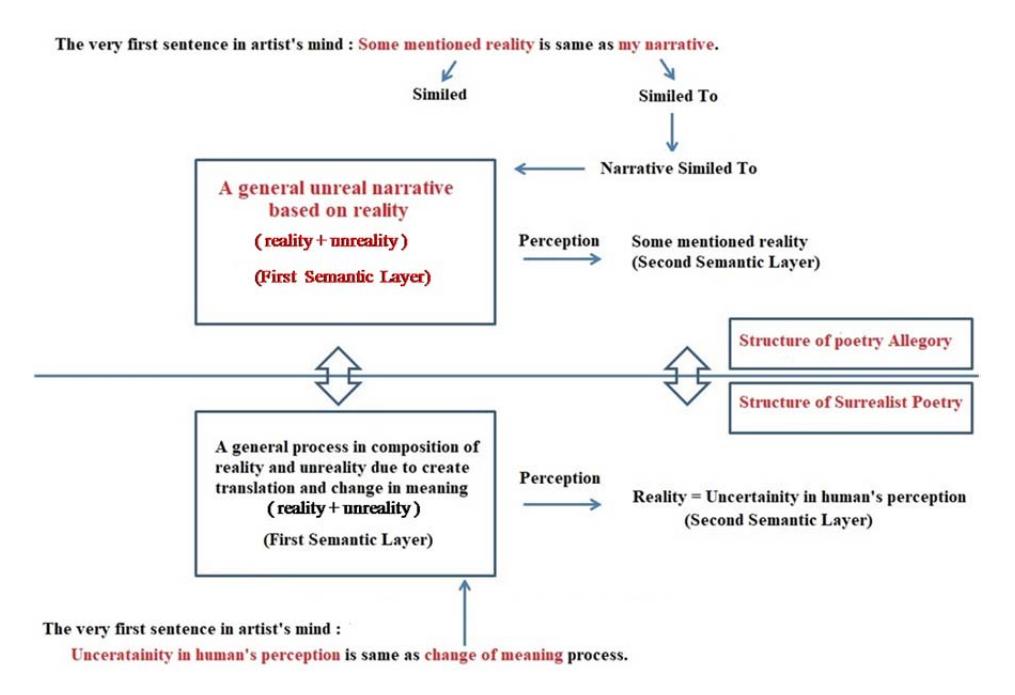
Figure 8 Correspondence chart of literary allegory and Surrealist poetry.
5.9 Symbol in the First Episode of Dimensions of Dialogue (Factual Dialogue)
Given the sociopolitical implications of Factual Dialogue, one can find out the symbolic nature of the vegetative, industrial and administrative heads (objective things = likened to element), while the process of the whole story and the type of heads interacting with each other tells the audience about the political situation in Czechoslovakia in relation to the concept of poor cooperation
between institutions during the communist regime (likened element). In the case of symbols, such as an allegory, it is important to pay attention to the whole narrative, where the fundamental difference between the two is: "The present aspect (likened to) is displayed in the allegory as a general story (narration) but appears in literary symbols as one or more abstract element." Figure 9 shows the formation of symbols in the episode of Factual Dialogue.
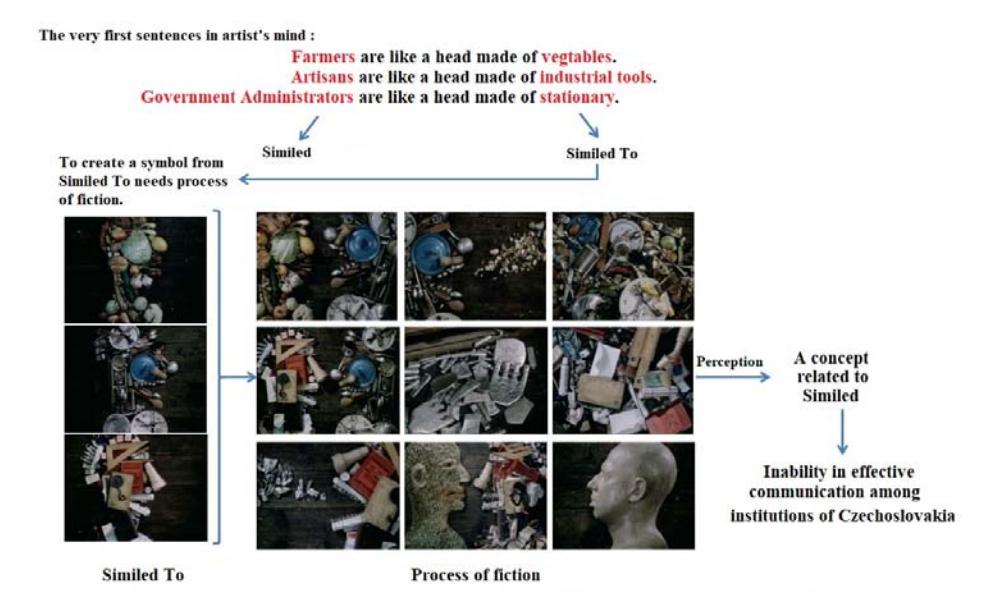
Figure 9 Formation of symbols in Dimensions of Dialogue (Factual Dialogue)
5.10 Mannerism as Equivalent of Symbol
Since Švankmajer's Mannerism is derived from Arcimboldo's composite portraits, it also includes three layers of meanings, where the symbol is located in the third one. Therefore, the structure of these Mannerist portraits can be compared with the structure of a literary symbol. After creating art pieces similar to Arcimboldo's portraits, Švankmajer focuses the perception of their original semantic layers on the overall structure of the narrative to eventually create a symbolic concept. The formation process of literary symbols (personal symbols) is similar to this, while in the construction of literary symbols a phenomenon or an element (likened to element) is selected by the artist, which by his/her personal expression in a narrative or story takes a particular concept (likened element), which then becomes a symbol of that concept. Figure 10 illustrates the structural correspondence chart for personal symbols and Mannerist portraits.
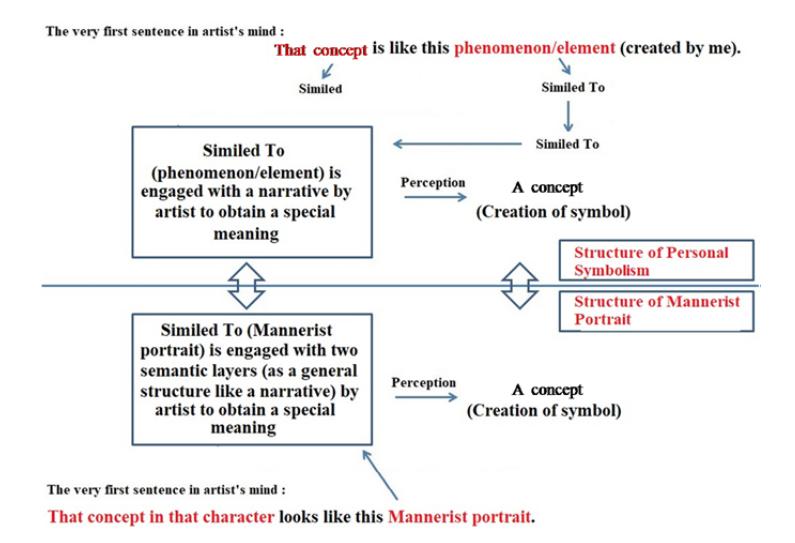
Figure 10 Structural correspondence chart for personal symbols and Mannerist portraits.
6 Case Studies
6.1 The Death of Stalinism in Bohemia (1990)
The Death of Stalinism in Bohemia provides a brief overview from the series of communist leaders of the Soviet Union and Czechoslovakia from 1945 to 1989 (Velvet revolution and the collapse of the communist system).
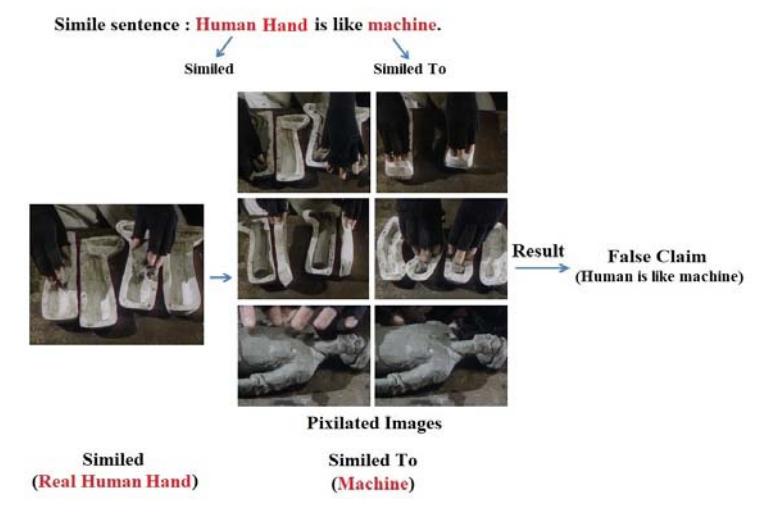
Figure 11 Simile formation in The Death of Stalinism in Bohemia.
In one part of this film we witness the creation of uniform people whose lives and deaths are in the hands of an anonymous hand (communist machine). It would seem that this represents the institutionalization under a communist government and its attempt to subdue its citizens in order to always be in its service and under its control. The pixilated movements of the anonymous hand depict it as a massive machine (simile between humans and machines) that holds the processes of creation and death of humans in its hands. Figure 11 illustrates the way the simile in The Death of Stalinism in Bohemia is created.
Another part of the film shows an anonymous hand pulling rolling pins of different sizes out of a drawer and placing them on the ground. The rolling pins start to roll and crush everything in their way. Then the image of the moving rolling pins suddenly merges into the image of Dubček's face and the sound of shooting is heard, leading us to a picture of Brezhnev on the wall, on which the year Czechoslovakia was occupied (1968) to end the Prague Spring movement is printed. Linking the image of the rollers to Dubček's face is a visual metaphor.
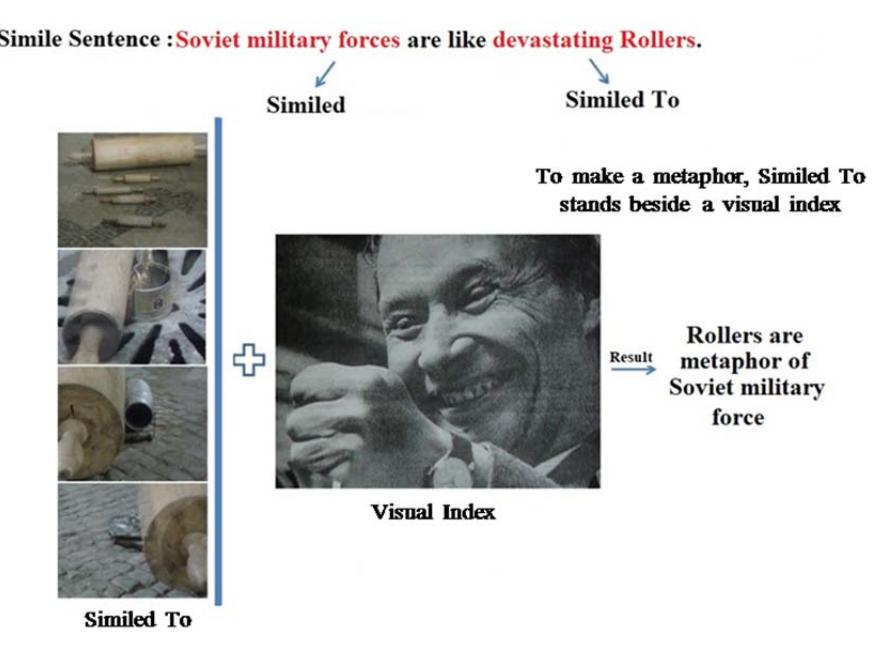
Figure 12 The compound metaphor in The Death of Stalinism in Bohemia.
In order to examine the metaphorical nature of the images, we need to take a simile-founded sentence in mind as the basis for the composition of the metaphor, such as: "The Soviet military forces destroy everything, like devastating rolling pins." To convey a metaphorical meaning to the likened to element (rollers) of this sentence, Švankmajer (by using film editing) links them to Dubček's face (visual index). This can convey the metaphorical sense of the Soviets' destructive force toward Czechoslovakia, Dubček and his reform movement. Figure 12 depicts the structure of the metaphor in the mentioned context.
6.2 A Quiet Week in the House (1969)
In A Quiet Week in the House, we see a spy who enters a house after observing it from outside and sees living objects in each unit. Ultimately, he blows the house up with dynamite and escapes. In this film Švankmajer again combines reality (humans) and non-reality (animated non-human things) (the principle of Surrealist poetry) to express his ideas. The year the film was made, 1969, is about a year after Czechoslovakia was occupied by the Soviet army to end the Prague Spring reform movement. It seems that Švankmajer considered the spy to be a single unit of Soviet military power, who after observation of the house (country) within his territory decides to enter it and intervene in the affairs of the inhabitants (people and leaders). After entering the house (Czechoslovakia), the spy creates a hole in door to peek inside and he sees the silent life of things, which can be seen as observation, investigation, and intervention in the lives of the Czechoslovak people and authorities after the Soviet military invaded the country and initiated the Normalization process (from 1968 onwards).
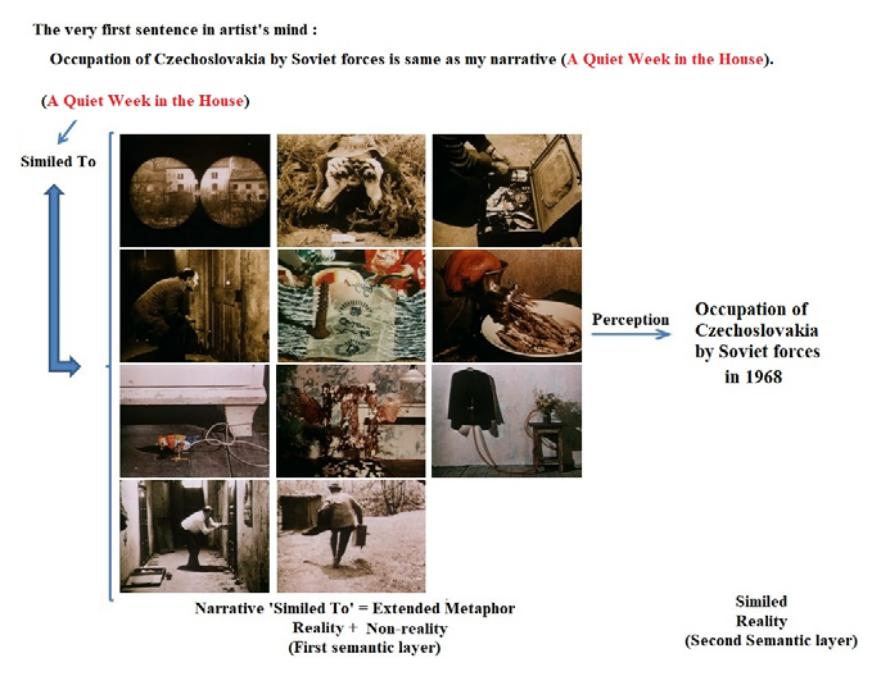
Figure 13 Allegoric structure in A Quiet Week in the House.
The objects in each room are the suspected and almost feared people of Czechoslovakia who were captured and finally executed for trying to free themselves or to act in secret, even to fulfill their most basic needs. It can be assumed that these images represent the effect of Normalization on the lives of the Czechoslovak people. By combing reality and non-reality in his narrative, Švankmajer like he did in The Flat, again leads us to a historic and political event and creates a simulation (allegory) of something that actually occurred in his country. The allegoric structure is shown in Figure 13.
6.3 Flora (1989)
As can be seen from the name of this work, it refers to the myth of Flora (the goddess of spring and flowers in ancient Rome [8]), who is tied to a bed and with popping eyeballs witnesses the decay of its body consisting of flowers, vegetables, and fruits. Besides the bed there is a table with a glass of water on it, but she cannot reach it despite trying hard. It seems Švankmajer has introduced the Flora myth (mixed with Arcimboldo-style portraits) in this short film as a symbol of the short-lived freedom brought by the Prague Spring reform movement. Perhaps the reason for such a choice was to match the meaning of spring and rebirth in the myth of Flora and the Prague Spring, while the explanation for the decay can be the termination of this reform by the Soviet Union in 1968 (occupation of Czechoslovakia). Thus, we witness a myth and a symbol in this short film attempting to convey a sociopolitical conception to its audience. Its formation is shown in Figure 14.
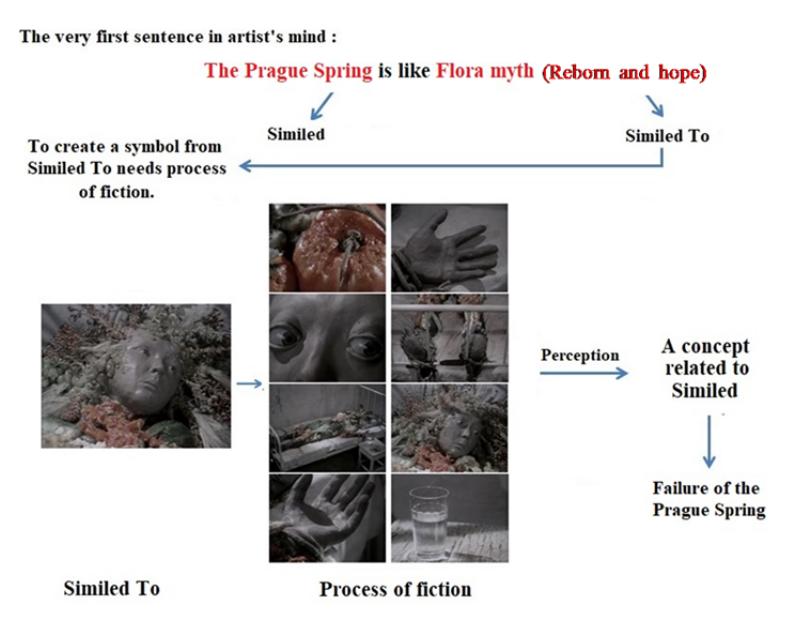
Figure 14 Symbol formation in Flora.
6.4 Little Otik (2000)
In Little Otik there is a young couple who cannot have a child, despite their great desire to have one. The young man gives his wife a tree trunk that looks like a newborn baby to save her from despair. The trunk comes to life and starts to eat up everything. This child only carries out the act of consumption and grows up. In other words, Little Otik is a child of a society that has no other concerns than to consume. Otik appears to be a symbol of consumerist society; a society in which a child grows up only with the idea of consuming and survives only by continuing consumption. Hence, like in Meat Love, there is an emphasis on food and meat in this film. In addition to the unlimited consumption behavior of Otik, there are many close-up shots of peoples' mouths while eating and of different foods. The human-like moves of Little Otik created by stop-motion (object animation) represent the formation of a visual equivalence of personification. This visual technique expresses a manipulated entity by creating clearly disconnected motions in addition to personification, i.e. an entity that reflects the society in which it lives, but also with independence and individuality. Figure 15 depicts the formation of personification in Little Otik.
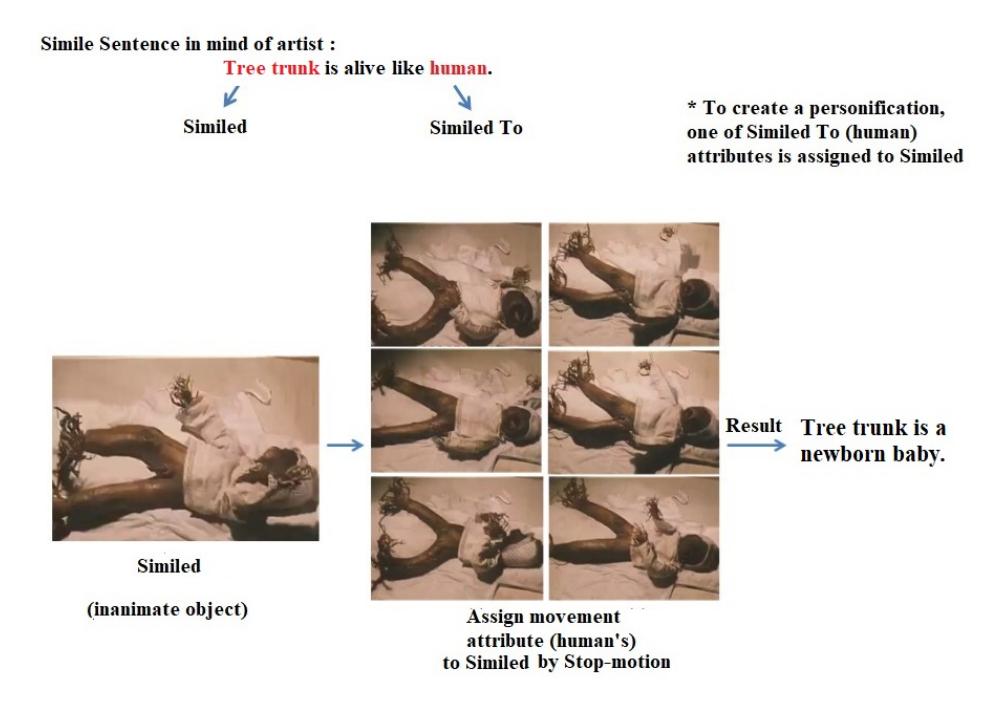
Figure 15 Structure of personification in Little Otik.
7 Conclusion
This research explored sociopolitical criticism strategies in the films of Švankmajer by introducing figurative language and its various indirect and metonymic methods. It was attempted to find structural similarities between different language modes and Švankmajer's filmmaking techniques. Based on this investigation, the possibility was discussed of the existence of equivalents in Švankmajer works by comparing his filmmaking techniques to figurative language modes, as summarized in Table 1. The results of this study led to the formation of a methodology for recognizing visual equivalents of figurative language and for the sociopolitical implications in other works of Švankmajer.
Table 1 Švankmajer's cinematic equivalents with figurative language modes.
| Filmmaking technique | Figurative language method | ||
|---|---|---|---|
| Stop- motion (pixilation) | ↔ | Simile | |
| Editing | ↔ | Metaphor | |
| Stop- motion (object animation) | ↔ | Personification | |
| Surrealist poetry | ↔ | Allegory | |
| Mannerism | ↔ | Symbol | |
By selecting four of Švankmajer works that seem to have figurative and sociopolitical implications relevant to this research, it was attempted to discover their most obvious discoursal equivalents to find their sociopolitical implications, while the structure of each of method's composition was identified. The findings from the case studies are summarized in Table 2.
Table 2 Findings from the case studies.
| Film title | Filmmaking technique | Literary equivalent | Sociopolitical critique | |
|---|---|---|---|---|
| The Death of Stalinism in Bohemia | Pixilation/ editing | ↔ | Simile/Metaphor | The Communist government from beginning to collapse (from 1945 to 1989) |
| A Quiet Week in the House | Surrealist poetry | ↔ | Allegory | The Prague Spring and the occupation of Czechoslovakia in 1968 |
| Flora | Mannerism | ↔ | Symbol / Myth | The Prague Spring and the occupation of Czechoslovakia in 1968 |
| Little Otik | Stop-motion (object animation) | ↔ | Personification | Consumerism |
The results of this research confirm the adoption of figurative language modes as sociopolitical criticism strategies in Jan Švankmajer's films.