

1 Introduction
Visual stylization across different media is a common phenomenon in current society. For example, during Halloween or comic conventions, fans wear the costume of their favorite characters and pose together with other fans in character while taking group photos for remembrance. Live-action versions of characters from comics such as the Avengers (Marvel Studios), X-Men (21th Century Fox), and DC Superheroes (DC/Warner) are used in movies and television shows. Fans of famous cartoon characters create fan art of those characters and share it online. Even the costumes of cartoon characters play a pivotal role in storytelling [1]. In other words, visual stylization is an important cultural phenomenon in our digital society.
Several empirical studies have been conducted to examine, for example, the use of agents in virtual learning, avatar interaction in virtual worlds, the uncanny valley of avatar facial expressions, and gender representations in games. However, the construction of avatars or digital humans in relation to character design has yet to gain momentum in academic research. The pervasiveness of digital humans in digital society has been taken somewhat for granted. This may
Received May 21st, 2018, Revised November 21st, 2019, Accepted for publication March 14th, 2020. Copyright © 2020 Published by ITB Institute for Research and Community Services, ISSN: 2337-5795, DOI: 10.5614/j.vad.2020.12.1.3 be due to the deluge of hyper-realistic visual effects and renders shown in movies that are seamlessly composited with live-action footage. Television viewers and moviegoers expect high-quality production value. Due to the advancement of technology, virtual or digital humans are not uncommon. People present themselves as digital humans in various visual styles in the digital world. The interaction process involves the use of conduits to communicate; these conduits are called avatars. Avatars, from simple cartoons to complex three-dimensional models, have been used as agents to teach the digital generation. Online interaction can be done via the interaction between avatars in computer and video games. Players are often given different ways to create their own custom-made avatars to represent themselves in the virtual world.
Various visual styles are used in animations. Two-dimensional, threedimensional, stop motion, and hybrids of those have been used to explain certain topics for educational purposes [2]. Several studies in the past touched upon the effect of different levels of visual details (realism) on motor learning. The findings from these studies vary but are interesting. In a study observing perceptual and visuomotor brain processes when viewing visuals of digital and real hands, only the actual hand action in a natural environment activated the visuospatial network in the central nervous system [3]. The study concluded that digital visualization such as 2-dimensional or 3-dimensional computer graphics (virtual reality) may not be as effective as watching a realistic visual. In another study, a schematized version of mitosis was found to be superior to the real counterpart; this may be due to the visual complexity of the realistic visual of mitosis [4]. Realistic visuals usually contain more information than schematic visuals. However, low prior knowledge learners may not know what to focus on when viewing realistic visuals. In a study on information salience that compared the learning process of using realistic versus point-light demonstrations of a ballet dance found that the motor learning from a pointlight demonstration was quite sufficient [5]. Besides that, the degree of realism plays no moderating role in the effectiveness of dynamic visualizations [6]. Another study found that a simplified version of a digital character (stick figure) offered more specific object and movement recognition than a more detailed digital character [7]. Another study found that there was interaction between the learners' visuospatial abilities [8]. Interestingly, learners with lower visuospatial abilities performed better with schematic dynamic visualizations, whereas learners with higher visuospatial abilities performed better with realistic dynamic visualizations. In addition, a majority of participants had a preference for higher fidelity visualization after been given a chance to review all available stimuli. They had the initial anticipation that higher fidelity animation would be more helpful in comprehension but later realized this was not the case [9].
The discussion in this article is based on the theory of Moderate Aesthetic Formalism [10] and focuses on the formalistic aspect of visual analysis and interpretation. This is not to argue that its historical and cultural values are not relevant. This article focuses more on the visual stylization aspect. Hopefully, this article will provide a novel perspective on how media and communication technology affects culture and society. Also, it is hoped that this paper will contribute to increasing the awareness and appreciation of diverse visual stylizations of digital humans in various contexts in new media. The core aim of this study was to examine how human-based characters are represented across different media. Textual analysis consisting of interpretive analysis and case studies were employed in this study. The interpretive analysis briefly surveyed historical and current perspectives by examining past artworks and practices as well as current media such as movies, television shows, and video games. Next, the case studies explore how visual stylization is used in selected cases of rhythm-based dancing games and mobile exercise apps.
2 Representational Art
Information can be extrapolated into two representational forms: descriptive (symbol-based such as text) and depictive (illustration-based such as images) [9]. Watson [11] argues that "depictive representations are more 'informationally complete' and the information can be read directly rather than having to make sense of a depiction". However, this may not necessarily be true for artistic, abstract or subjective representations. A graphical representation preserves a "visual record of both object and knowledge" [12]. The visual representation can be projective (i.e. corresponding to reality) or non-projective (i.e. not strictly geometrically involved). Cocchiarella [12] states that both projective and non-projective forms are being used in the arts, sciences and technology. For example, images in science are mainly used for scientific purposes, whereas in art images are used to propose personalized visions.
Representational art is a form of art where the subject matter is portrayed in a composition of visual elements that is suggestive of the real object. Representational art is also known as objective or figurative art [13]. It depicts the appearance of things. The objects that are represented in art are called subjects. Naturalism and realism are two different representational art movements; the artworks are mostly based on visual perception relying on visual experience without exaggeration or interpretation of the depicted subject matter. Optical representation is "the depiction of objects as they are seen from a single vantage point" [14]. On the other hand, non-objective or nonrepresentational art is a kind of art that is imaginative, in which the visual components, their organization, and their treatment are completely personalized, and the visual is not based on the artist's visual perception of objects [13]. The artworks are mostly based on conceptual perception, where creative vision is triggered in the observers' imagination. Conceptual representation is "the use of multiple perspectives to depict objects as they are known to be rather than as they are seen from a single vantage point" [14]. Kress and Van Leeuwen [15] explain that the concept of realism is dependent on the current dominant conventions and visual rendering technologies. As an example, the standard technology of color photography would be regarded as possessing the highest modality (is the most naturalistic); on the other hand, any amplification or reduction of individual elements within the photograph would reduce the modality value. Indeed, Kress and Van Leeuwen [15] also argue that the continuum of highly realistic to abstract corresponds to high and low modality. Nevertheless, the level of modality is also a socially based, subjective judgment based on the social group in which it is meant to be used.
3 The Evolution of Abstraction
The concept of abstraction, or visual reduction, or reductionism, is common in art history. In language, a similar concept of abstraction can be seen in the metaphor: "a creative fusion of similarity and difference that may have its evolutionary origins in symbiogenesis" [16]. Power [16] provides another example: minimalist design, as expressed in the aphorism 'less is more'. Meanwhile, from comic design comes the idea of amplification through simplification, leading to a similar form of abstraction. Art, on the other hand, is used as a medium of visual representation.
As can be seen in Table 1, there has been an evolution of representation of reality by abstraction in art throughout the years. Early artworks were fully representational because they contained specific details. This kind of movement or style is called naturalism. The ensuing evolutionary movement was called realism. The artworks they produced were representational. However, each in a slightly different approach, they emphasized the emotional essence more as compared to specific details. In subsequent years, a new trend in art in the form of semi-abstraction became popular. These types of artworks are partly representational but more simplified and rearranged. Later, the styles in art moved towards full abstraction, where the artworks appear as non-objective and non-representational. Barrett [17] supports the definition of abstract art as art that deviates considerably from natural resemblance. Forms are altered and reworked to various degrees to accentuate particular qualities or content. Thus, it can be surmised that abstract art is purposeful and is able to invoke different perceptions and realizations through symbolism.
| Abstraction Styles | Descriptions | Visual Stylization |
|---|---|---|
| Naturalism | Fully representational with specific details (very objective) | |
| Realism | Representational but with emphasis on the emotional essence, not on specifics (more subjective) | Phot |
| Semi- abstraction | Partly representational but simplified and rearranged | Photo-realistic |
| Full abstraction: Objective abstraction | Based on physical objects but simplified and rearranged so that it appears non-objective | \(\downarrow\) |
| Full abstraction: Non-objective abstraction | Non-representational, starting without any reference to physical objects. Usually based on pure design. Form and content act as subject matter | Abstract |
Table 1 The evolution of abstraction [13].
Different cultures and societies have introduced various ways of representing things and expressing ideas [17]. These various forms of representation are usually approximations of objects or concepts. For example, the concept of abstraction was attempted by Pablo Picasso: the simplification and rearrangement of The Bull, States I-XI (1945) were meant to make the "deeper meaning more accessible, not less profound" [18]. Frank [18] argues that all visual artwork requires some degree of abstraction. For example, a naturalistic rendering of a real flower is an image that has been simplified from its three-dimensional appearance, transferred to a flat surface.
The idea of representation can also be recognized in Henri Matisse's paintings. In 1897, he painted La Desserte in three-dimensional perspective. He used naturalistic colors to portray the subject. Also, he formed his female character and objects by simulating light and shade. This method is similar to the Renaissance style of painting. About twelve years later, he reproduced his painting from a new perspective. He represented the subjects and objects from La Desserte with intense colors and flattened forms. From a reproduction, a more abstract painting called Harmony in Red (1908-1909) was created (see Figure 1). The two-dimensional feel and the abstraction of the artwork was a feature of the Fauvism art movement led by the artist himself.
The Parisian artist Henri de Toulouse-Lautrec used a similar abstraction process in his artworks (see Figure 2). The original artwork was in the form of a photograph, where the female model posed in a somewhat awkward manner. Then he reconstructed the image in an oil study on cardboard. In this study, he
incorporated diagonal lines and curves to bring out the sense of motion that was lacking in the photograph. The subtle use of shadow and shading aided the artist's attempt at portraying a dancing female figure. Finally, the artwork evolved into a lithographic poster with more evidently cut shapes, flat colors and curved lines. This is one of the examples of an abstraction process starting from a live-action model transforming into a three-dimensional figure and then into a simple yet precise two-dimensional design.
Figure 1 An example of abstraction in Henri Matisse's paintings.
Figure 2 An example of abstraction in Henri de Toulouse-Lautrec's paintings.
Animation can be a medium to appreciate various visual stylizations of humanoid characters. The uniqueness of animation is that it is not limited to one style (i.e. realistic) like live-action video. Animation offers "an extraordinary variety of styles, and within each, increasing degrees of realism" [19]. Conversely, live-action video or cinema "cannot record motion independently; it can only provide us with a movement-image, in which movement and image are bound together" [20]. Also, animation can "enhance a cinematic vision through its creation of revealing details and visual discoveries" [21]. Plus, animation is very flexible in terms of representation. Abstraction regarding animation or movement per se can also be seen in Eadweard Muybridge's the Animal Locomotion series (1887). "By extracting a subject, be they a horse or a human, from their normal environment and placing them within a seemingly
neutral place, these studies asserted their status as rational abstractions of things immeasurable to the naked eye" [22]. Jones [22] adds that the use of motion capture is also an act of abstraction, as visual information from the motion capture based on the original data can be rearranged differently. The following section discusses visual representations of several popular movies, television shows, and video games characters.
4 Visual Stylizations of Humanoid Characters across Media
There are various ways to create visual styles. Visual styles or render styles can be created based on the specific medium in which they are supposed to be presented or based on the specific tools or design techniques they were set up with. The most used way of categorizing a visual style is related to the question whether it is a two-dimensional or three-dimensional style. The primary characteristics of a two-dimensional character design are the use of lines, shapes, and a flat color scheme. Two-dimensional characters do not have shading, shadows, or texture gradients. Nevertheless, despite the design being two-dimensional, the overall image is still lucid and cogent in conveying messages and emotion to the viewer. Meanwhile, a three-dimensional design of characters or figures presented in an artwork usually comprises shading, shadows and texture gradients in their composition. These characteristics are central to creating the illusion of mass and depth in the image.
From this first level in distinguishing visual styles, further unique and creative styles can be examined. Examples that show the disparity of render styles are abundant. In the context of this article, several examples were selected from popular television shows such as The Simpsons (21<sup>st</sup> Century Fox), SpongeBob SquarePants (Nickelodeon), Mr. Peabody and Sherman (21<sup>st</sup> Century Fox), and Charlie Brown (Peanuts Worldwide) (see Figure 3).
These television shows were first introduced in two-dimensional cartoon visual styles. It is only recently that these shows have been represented in a three-dimensional form in movies. Unlike original live-action films, animation can be seen as unrestrictive and flexible. "Animation is, of course, a pervasive medium and it can be produced using innumerable production techniques" [20]. With multiple ways to create an animation, there is a multitude of visual styles that can be produced. In McDonnell's [23] study, the researchers categorized nine rendering styles for the digital characters to be used in their experiments, ranging from a highly abstract style, a flat-shaded typical toon style, a two-color shaded toon style to realistic looking characters, shaded using ray-traced lighting techniques.
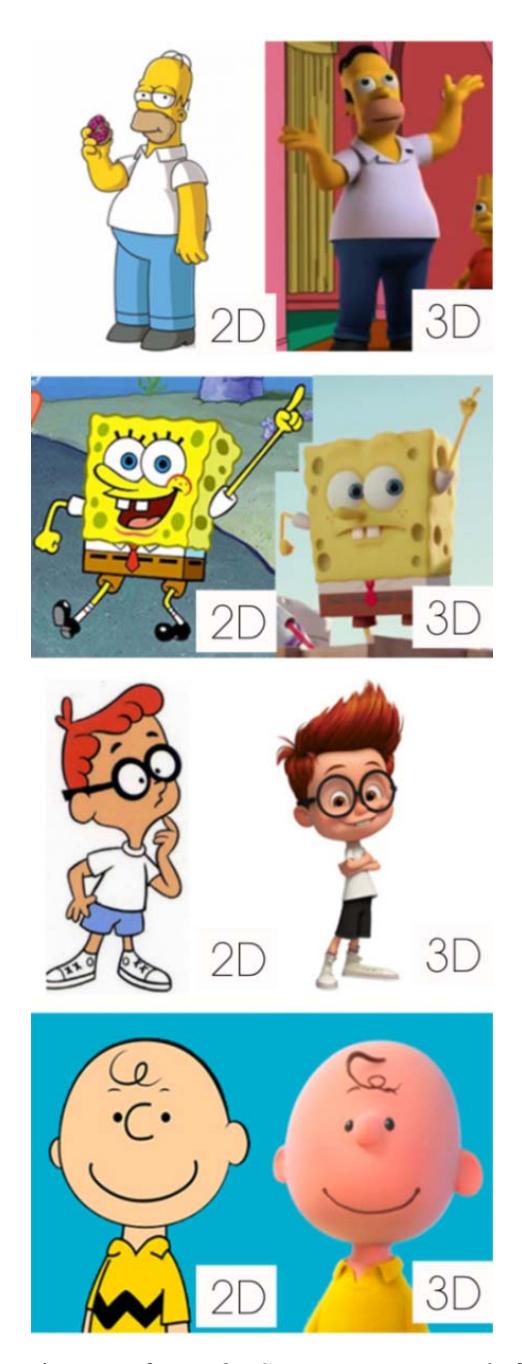
Figure 3 Homer Simpsons from The Simpsons, SpongeBob from SpongeBob SquarePants, Sherman from Mr. Peabody and Sherman, and Charlie Brown from The Peanut Movie animated series in examples of two-dimensional and three-dimensional representation.
Figure 4 Different 2-dimensional, 3-dimensional, and live-action visual representations (arranged from top to bottom) of Lara Croft from Tomb Raider, Link from The Legend of Zelda, Nobita from Doraemon, Raiden from Mortal Kombat, and Kenshin Himura from Samurai X.
Digital characters that are used as interface agents in interface design or games are usually entities within a narrative discourse. Power [24] adds to this that a character is defined as an entity with agency: an intentional agent relevant to the story. Visuals are usually used to represent people, places, and things in various forms of existence [15]. Different versions of character representations can easily be seen in animation and games. Some popular characters are: Lara Croft from the Tomb Raider (Square Enix) game franchise, Link from The Legend of Zelda (Nintendo) game franchise, Nobita from the favorite Japanese animation Doraemon (Fujio F. Fujiko), Raiden from the Mortal Kombat (Midway Games) franchise, and Kenshin Himura from Rurouni Kenshin/Samurai X (Nobuhiro Watsuki) franchise (see Figure 4). These various character representations as two-dimensional, three-dimensional and live-action figures were created for different purposes, such as animations and live-action movies and games.
Lara Croft is well known for being a strong female character in video game story. Throughout the years, her character design has gone through quite some variation. Academy Award-winning actress Angelina Jolie portrayed the liveaction version. Link is the main character and hero in The Legend of Zelda franchise. Link has been visually represented in every series of the video game franchise, ranging from the two-dimensional look to a computer-generated three-dimensional look. Link has been represented in many forms, depending on the overall visual style of the specific Link video game. Many fans of the game love to cosplay as the hero. Doraemon is a well-known Japanese anime about a beloved robot cat that goes back in time to help the younger self of his owner, Nobita, in facing the difficulties of teenage life. Recently, an entirely computer-generated or three-dimensional version of the anime was made into a movie called Stand By Me (2013). Moreover, due to the popularity of the cartoon series, characters from the franchise also appear in a live-action stage musical. Raiden is one of the leading characters in the Mortal Kombat series. The character is often depicted wearing a cone-shaped hat and white-blue monk costume. Christopher Lambert portrayed the mysterious thunder-casting god in the Mortal Kombat live-action film in 1995. Rurouni Kenshin is a widely popular Japanese anime red-haired samurai character. This character, Himura Kenshin, first appeared in a comic in Weekly Shōnen Jump in 1994. Due to the manga's success, the comic was also produced as a long-running anime series. Eventually, the series also spawned off video games, live-action film and stage shows in Japan. The main character has been portrayed with very similar visual representations across media.
As digital characters are appearing in multiple media, they tend to be visually represented in multiple visual styles, ranging from two-dimensional cartoons to realistic three-dimensional models. The advancement of technology in console games allows for digital characters to be presented as three-dimensional computer-generated models. As the success of the franchise increases, other projects such as live-action musicals and movies are planned. The nature of such projects requires these characters to be presented in real human form. Well-known celebrities may usually act as the live-action versions of these animated characters.
No matter how these characters are represented in different media, their visual identities are still retained by preserving their most prominent features. For example, Steve Martino, the director of The Peanuts Movie (2016), wanted to "capture the essence of the original 2D artwork in three dimensions". He and his production crew analyzed the drawings of Charlie Brown (see Figure 3) and found out that Charlie Brown's profile, ear and nose are significant and animated [25]. These unique features provide the identity of the Charlie Brown character and thus needed to be retained when the character was represented in a different medium.
5 Visual Styles of Humanoid Characters in 2-D, 3-D & Live-Action
The application of digital humanoid representations is prevalent nowadays. From cartoons and movies to virtual reality and games, digital characters are used as mediators or assistive agents to aid in guiding user learning. Whether these digital characters are portrayed in a two-dimensional style, a threedimensional style or in live-action, they all serve the same purpose: to teach the user. A couple of these examples can be seen in video games and exercise apps.
The utilization of digital characters in two-dimensional, three-dimensional and live-action form can be observed in video games. For this study, three video games that have a distinct style of visualizing their digital characters were selected: Just Dance (Nintendo/Ubisoft), Dance Central (Microsoft Studios) and Zumba Fitness: World Party (Majesco Entertainment/Hamster). These video games are fitness- and rhythm-themed games. Motion sensor devices like X-Box Kinect, PlayStation Move and Wii Remote are required to play these games. The player executes dancing moves or exercises based on the movement portrayed by the avatar in the games. These games incorporate popular and recent songs for the players to dance to.
First, Just Dance is a rhythm and dancing themed game developed by Ubisoft. Its main character, a dancing avatar, is represented in a two-dimensional style. The flesh or body of the character is represented in white. The outer glow of the character plays a vital role in outlining the shape of the character. There is no apparent shading placed on the exposed parts of the body to suggest a threedimensional form, although the costume and hair do have more of a threedimensional form. The occlusion effects on the dancing character suggest the form and mass of the character. An additional feature displays still graphics, depicting upcoming movements to be performed by the character, guiding the player in executing the avatar's movements correctly.
Second, Dance Central is another dance- and a rhythm-themed game that uses a motion sensor. The game is developed by Harmonix; the video game studio that also produced rhythm-based games like Guitar Hero and Rock Band. The game's dancing avatar is represented in three-dimensional form. Unlike the avatar in Just Dance, Dance Central avatar's body has shading to create a threedimensional effect of the character. Thus, with this feature, the avatar is portrayed to be more robust compared to Just Dance's dancing avatar. Furthermore, when the avatar is showing its moves, a streak of light, streaming out from each of the avatar's hands, acts as a motion path to guide the player to mimicking its movement. Similar to Just Dance, the additional feature of still graphics depicting upcoming movements to be performed by the character also appears on the right side of the screen to assist the player in executing the upcoming movement of the avatar.
The third game that uses an avatar is called Zumba Fitness: World Party. This rhythm- and dance-themed game was developed by Zoë Mode. The avatar is represented in live-action; this fitness game uses real actors and dancers that act as the characters in the game. The actors or actresses in the game dance Zumba perform exercises that players have to mimic. The concept is similar to general exercise videos in which the fitness instructors carry out the exercise in the center with some additional real actors and actresses following her instructions in the background. For this game, a small two-dimensional silhouette appears on the top right a few seconds before the upcoming movement to guide the player in performing the next moves.
All three video game examples present their demonstrators in distinct visual styles. Just Dance presents its digital dancing character in a glowing-like twodimensional visual style, while Dance Central presents its digital dancing character in a three-dimensional visual style. Both games have one thing in common: the demonstrator's facial expressions are not emphasized. Perhaps because facial appearance is not essential for observing psychomotor movement; the game designers may want the player to focus on the body movements of the digital demonstrator.
The following part of this section will cover similar phenomena but for exercise applications. Examples of such exercise applications are easily accessible and available on smartphones. The utilization of digital characters in twodimensional, three-dimensional, and live-action form can also be seen in exercise applications. Examples of these were taken from three exercise apps with distinct visual representations of the digital humanoid character. These exercise apps are Seven, Six Pack, and 7M Workout (see Figure 5). Similar to the video game examples mentioned above, these exercise applications require the player to mimic the movements that are being shown to them. Unlike the video game counterparts, no motion sensor devices are used like the ones available in video game consoles. Therefore, it is optional for users of these exercise apps to follow the displayed exercise movements precisely.
Figure 5 Visual styles of demonstrators in the Seven (top), Six Pack (middle), and 7M Workout (bottom) apps.
Seven is an exercise app (see Figure 5) produced by a company called Perigee. Seven offers a variety of exercise programs ranging from full-body exercises to exercises for specific body parts. Seven incorporates a digital character to demonstrate the exercise moves to the user. Users of this app can opt to pick a male or a female demonstrator to perform the exercise moves. The visual stylization of the digital character is very similar to a two-dimensional style because the digital character is rendered in a flat color with minimal shading. However, black edge lines are used to present the form of the character. This method is commonly used in many of the digital characters discussed previously. The edge line helps the viewer to differentiate the character from the background. The lack of shadow adds to the effect of the digital character looking two-dimensional. One of the unique features that stand out in Seven compared to the other two exercise apps is its capability to rotate the camera
view angle of the character over 360 degrees. This function allows the user of the app to adjust the view angle in order to scrutinize the body positions shown by the digital character. For example, the user can pause halfway during the demonstration and turn the camera view of the character to front, side, or back.
Secondly, the Six Pack exercise app (see Figure 5) is produced by Runtastic, a company that focuses creating health and fitness management and tracking products and services. Like Seven, Six Pack also offers several different exercise programs for its users. Six Pack also provides the user to choose which gender they want their demonstrator to be. Both digital characters are portrayed in a three-dimensional style animation. This is because the use of shading and lighting on the demonstrators is apparent. The male character, called Daniel, is employed as an example in this discussion. Compared to the character presented in Seven, Daniel is rendered with a more three-dimensional effect, suggesting a more solid form. The use of shadow grounds the character and thus the viewer can better estimate the distance between body parts and also the distance between the character and the floor. In the demonstration screen, views can estimate the distance between the character's leg and the mat by looking at the size of the shadow. One unique Six Pack feature is that whenever the digital character performs a move, the section of the muscle that is affected is displayed in red, almost like an X-ray vision into the inner part of the body. This signifies that this part of the body is being affected.
The next exercise app is called the 7M Workout (see Figure 5). The app was developed by Johnson & Johnson and designed by Chris Jordan, Director of Exercise Physiology at the Human Performance Institute Division of Wellness & Prevention. This app follows the conventional method of presenting its demonstrator using a real coach. Interestingly, the way that the demonstrator is being portrayed is in black and white and the clothing worn by the demonstrator is dark in color. Thus, the aspect of color as a visual element is removed. There seem to be two primary light sources illuminating the demonstrator. These light sources are coming from the left and right sides of the demonstrator. The background of the scene is merely white space. The lighting choice and the background are devoid of props, which focuses the attention of the user on the demonstrator performing specific exercise moves. This design choice may have been made to reduce distraction and improve focus on the vital parts of the lesson. The 7M Workout demonstration videos usually show an average of two camera angles when the exercise moves are performed.
To examine the way that each exercise app depicts its digital humanoid character, one can compare the visual styles used by a look at the same exercise move. For instance, all apps have a lesson on performing crunches correctly. Although there is a slight deviation between the three versions, the main move is similar. Visual stylization examples of a two-dimensional render, a threedimensional render, and live-action visual style are shown in Figure 5.
In the screenshots of all three exercise apps it can be seen that all demonstrators are placed in a white space, focusing on the demonstrator only. Unwanted elements such as background props are left out. Only Six Pack app includes an exercise mat underneath the digitally three-dimensional styled character. This is done to remind the user to use an exercise mat as body padding or body support when doing this form of exercise. Besides that, the use of shadow can be seen in both Six Pack and 7M Workout to demonstrate the position of the demonstrator relative to the floor. Seven, on the other hand, lacks this feature, making the demonstrator seem to levitate or float in space; having shadows would make the demonstrator grounded. The absence of a shadow allows the viewer to focus immediately on the digital demonstrator. Nevertheless, the digital demonstrator in Seven has a hint of shading. This shading effect creates the illusion of form on the character so that the demonstrator looks less flat. Nevertheless, the line edges in Seven's digital character play an essential role in defining the form of the character. Regarding the color palette, the Seven app utilizes just a few colors. Meanwhile, Six Pack app utilizes more variation as the threedimensional style design gives more definition to the form of the digital character. Where Seven's and Six Pack's digital characters are displayed in color, the 7M Workout has removed the element of color from the visual presentation. Despite not having color, the form of the demonstrator is still visible. Perhaps the removal of color as part of its visual elements is an aesthetic choice or a technical design choice. Removing the color aspect from an image could facilitate audiences to focus more on the form and movements involved in the demonstration. From a technical point of view, imagery without shading makes the overall exercise app smaller in size. In other words, it would take less storage space in electronic devices such as smartphones and tablet PCs. However, having color adds appeal and retains the interest of the audience. Therefore, finding the right balance between what information is necessary to present and what is appealing to retain interest is crucial.
6 Conclusion
This article examined the application of render styles by surveying several visual artifacts from the past and the present. Many different examples of digital humanoid representations were observed in various forms of new media such as animations, films, and video games. Comparisons of different levels of visual stylization of fictional and non-fictional humanoid characters were made. Lastly, the article explored case studies of rhythm-based dance video games and exercise-themed mobile apps to identify how visual stylizations of avatars or digital humans are appropriated for educational purposes.
It is important to increase the awareness and appreciation of character design of avatars and digital humans, which are becoming ever more relevant in the digital age. Indeed, the idea of visual stylization has come a long way and its influence has been taken for granted. This study hopes to contribute to putting the concepts of character design into a novel perspective as digital humans are being re-appropriated in many ways in digital media. Perhaps, proper awareness of the visual design aspect of digital humans can lead to more productive ways of communicating information and interactions. A recent study [26] has shown that content creators can apply various creative and appropriate visual stylizations of humanoid digital characters to increase the appeal of their overall educational content. For example, in advertising it is also possible to decrease negative perception towards a product by using visual stylizations that are less realistic [27]. New media such as augmented reality and virtual reality may open up more possibilities and opportunities to study the pervasiveness and influence of the visual stylization of digital humans in the information age. It is an ongoing development that is affected by socio-economic factors.
The unique visualization methods used in games raise interesting questions. Do different visual styles have an effect on learning performance when it comes to psychomotor learning with instructional animations? Application-wise, many game designers and app developers do consider incorporating various visual styles in their projects. However, are their design choices merely for aesthetical reasons? Could these design choices have real significance in aiding users of their video games or applications to learn straightforward or complex movements? Many potential applications of these visualization methods could be discovered with a more profound understanding and study of visualization in recognizing objects and movements. As discussed in the case studies section, different visual stylizations can be used in motor skill learning apps, comics, video games, rehabilitation training programs, and interactive multimedia. Future studies can also look at the spectrum of visual stylization as this can be useful in designing user interfaces or user experiences in virtual worlds and simulations. To sum up, different visual stylizations may be suitable for various purposes and this study argues that visual stylizations are an opportunity to find unique and innovative ways of communicating with visual means.