

1 Introduction
The many traditions among the Indonesian people are very diverse. These traditional forms of expression in Indonesia have produced various forms of artifacts, one of which are traditional cloths with distinctive features and uniqueness representing the identity of a region. Handed over by subsequent generations in local communities these traditional ways of making fabrics have been able to survive until today. At present, the environmental conditions, both inside and outside, of local communities in Indonesia have undergone rapid changes due to the impact of modernity. On the other hand, traditional artifacts are still important for local people, because they provide solutions for them to survive or improve the quality of life. Consequently, the development of traditional artifacts by innovation is required in response to the challenges of modern life. It is a natural way of adapting to environmental conditions in order to survive [1].
Every human is a designer by nature. Human beings manipulate their environment and the objects around them. They give their own personal touch to their environment and the objects around them to get self-recognition, feel happy and comfortable, or to fulfil their needs [2]. Even in the context of traditional artifacts it is not enough to do produce them only in a conservative way, to prevent exploitation or to avoid any change of the original forms; it is necessary to develop new techniques [3]. Traditional artifacts in the context of traditions also need to be seen as things that can change at any time. There needs to be an opportunity to analyze the past and involve the whole community in creating new meanings for traditional artifacts [4]. Dealing with the issue of identity representing a group of local people through traditional artifacts can be done diplomatically by opening up opportunities for creative touches that create newness/innovation [5].
To maintain a tradition owned by a group of people can be done among others by maintaining the existence of traditional artifacts both in terms of their manufacturing process and their importance and benefits for the community. This cannot merely be done by means of a conservative approach. In the modern era, different things are actually needed, so a transformative approach by means of innovation is needed. Therefore, an effort should be made to add a degree of innovation to traditional artifacts to preserve their existence in the face of their potential disappearance due to changing needs and conditions in traditional communities who are leaving behind their traditional life style. This can be done by research that tries to analyze the traditional values owned by a community and the strategies that can be used to create novelty and a new identity for traditional artifacts, while still maintaining a connectedness to the original identity. In the present research, a case study was conducted on local community-owned woven fabrics in Tuban, East Java, Indonesia.
2 Methodology
The research was executed by using experiments and a comprehensive approach strategy. To understand the background of traditional woven fabrics made by the local community in Tuban, the following steps were taken:
- a. A literature study by collecting data sourced from scientific journals, articles, and reference books that discuss traditions and traditional woven fabrics (authors: Rens Heringa and Judi Knight Acjhadi), taking personal notes, and making photograps, sketches, and product images.
- b. Direct observation in the field to observe phenomena that occur locally at the production center of gedog weavings, i.e. Kerek district, which is spread over 4 villages: Kedungrejo, Margorejo, Gaji, and Karanglo. Besides that, observation was done towards interaction patterns among traditional makers
- by observing how gedog weavings are produced in order to find their current position within the local community.
- c. Getting spoken testimony by recording statements from traditional makers to retrieve explanations and information based on knowledge from previous generations. Interviews were conducted in the form of long conversations, deep enough to get data and detailed information that are hard to find in textual sources but spontaneously spring up in the middle of the local community.
- d. Experimental research was done by applying different treatments and then measuring the impact of the treatment variables towards impact variables. The method used was causality research with verification by comparing the condition of the objects before and after treatment.
3 Discussion
The Tuban region is located on the border between the province of East Java and the province of Central Java, Indonesia. The total area of Tuban Regency is 183,994,562 Ha. It is administratively divided into 20 districts and 328 villages. Sociologically, the character of the Tuban people is strongly influenced by ethnic Javanese culture. Meanwhile, psychologically there is an environmental influence in Tuban as an agricultural region [6]. Socio-culturally, Tuban as a coastal community has a maritime cultural character that is related to the presence of the sea and trading activities. This traditional character later developed into a more cosmopolitan, inclusive, egalitarian, outward-looking, dynamic, entrepreneurial and pluralistic culture and attitude toward life. A characteristic of coastal areas is their openess, so the people of Tuban are accustomed to trade conditions and competition. In contrast, the agrarian community in Tuban also has the subtle Javanese character of alon-alon waton kelakon (slowly but surely). This latter property dominates over the hard and rough properties influenced by the coastal characteristics [7].
The nature and character of the community also influence the characteristics of traditional artifacts such as woven fabrics. Tuban traditional woven fabrics can be characterized as rustic with a very irregular composition and rough texture. The agrarian environment is an important source of inspiration. In terms of economics, these fabrics have a stable commercial value because they also function as family investments that can be cashed in at any time. The style is almost primitive compared to other woven fabrics made in Indonesia (Figure 1). Traditionally, these fabrics were made when the women were not working in the field or harvesting. To make these cloths, very high persistence and patience are required [5].
Figure 1 Female farmers in Tuban. Photograph by the author, 2018.
The raw material for making woven fabrics is cotton fiber. This fiber comes in two types, namely white cotton, known as lawed, and brown cotton, known as lawa (which means 'bat' – lawa cotton has a brown color that resembles that of bat fur). The availability of cotton fiber is vital for the continuation of the weaving tradition in Tuban [8]. The traditional fabric making technique that is typical for Tuban involves a complicated and lengthy process, which starts with manual spinning using a traditional hand spinning tool (jantra) and ends with weaving using a traditional loom (gedogan). Because they are made using a gedogan, the woven fabrics are called gedog (Figure 2).
Figure 2 The process of yarn spinning and fabric weaving. Photograph by author, 2018.
The gedog loom is a type of backstrap body-tension loom (Figure 3). The structure of gedog weaving is the same as that of weavings in general, namely a plain weave by making a braid pattern between the warp thread (vertical) and the weft thread (horizontal), which intersect with each other [9]. There is a philosophy behind the process of weaving the fabric according to which the direction of the thread from east to west has to do with the movement of the sun, symbolizing the beginning of life. In the Tuban community, the warp is called the 'male path 'and the weft is called the 'female path'. Thus, a piece of woven cloth symbolizes the marriage bond between a man and a woman [8].
Figure 3 Photos of typical gedog woven fabrics from local communities in Tuban. Photograph by author, 2018.
Existing fabrics are produced in two sizes, namely: 1) rectangular cloths with a width between 100 cm and 110 cm and a length of up to 250 cm, which are used to cover the body of a woman from the chest to the ankles by wrapping; 2) square cloths with a width of around 60 cm and a length of up to 300 cm, which serve as a shawl to help carry everyday loads.
These fabrics can also have magical and spiritual functions, for example certain fabrics are believed to be a repellent. Other fabrics are considered important in sacred events such as marriage, birth, death, or other important ceremonies [10,11]. At the level of the social system of the community, fabrics are also used as commercial commodity goods, usually in exchange for daily necessities in a barter system. For Tuban people, gedog woven fabrics have a high and stable selling value. Until today, when the need arises, artisans will come to pawnshops in traditional markets to pawn batik cloths they own. Ancient cloth types or batik fabrics that have good quality are received by pawnshops against a high price. When they are not redeemed, the fabrics can be auctioned [12].
Data were also gained from direct observation at the central area for gedog production. Comparing the conditions around the 1980s with the present condition, the people in Tuban have experienced several changes [5]:
- 1. Around the mid-1980s the community of Tuban still had the characteristics of a rural community, namely: 1) a strong relationship with nature, where many rules of life have the aim of preserving nature; 2) the main sources of income are farming and weaving; 3) a relatively low population density; 4) strong homogeneity within the community in the form of equality of social and psychological characteristics, language, beliefs, customs, and behavior; and 5) social differentiation showing the existence of layers within the community with differences in social status. These characteristics are no longer present in the local community. Nature, as part of the order of the macrocosm and microcosm, is no longer a priority as evidenced by the growth of infrastructure and industrial development, sacrificing natural sustainability. The homogeneity of the community has diminished with the large number of migrants having settled down in Tuban. Social status is no longer existent in the current Tuban community. Based on these circumstances it can be said that the characteristics of the people of Tuban have shifted away from the characteristics of a rural community to the characteristics of a suburban community (i.e. sharing characteristics with rural as well as urban communities).
- 2. Spiritual practices in the form of rituals and traditional ceremonies are no longer routinely carried out by the people of Tuban due to the fading of the community's level of belief in them and appreciation for them. Previously, the role of traditional cloths was considered essential in rituals and traditional ceremonies. When these practices are no longer carried out, the spiritual meaning of the traditional cloths also erodes.
- 3. The environmental conditions in Tuban close to industrial estates have changed because of the growth of the infrastructure, opening up more opportunities to come into contact with technology and be exposed to rapid flows of information. This has affected the mindset, motivation, and ways of making decisions in the Tuban community, which has slowly begun to leave behind things with a traditional (rural) origin, preferring things offered by modernity.
The most appropriate approach to preserve gedog weaving is to develop the traditional method of making fabrics by doing experimental research while maintaining the use of the gedog loom and making modifications to the weaving technique by introducing a variety of woven knots to create a new look, which can become a new identity without discarding the old identity.
3.1 New Identity on Gedog Woven Fabric Owned by Local Communities in Tuban
In developing a new identity for gedog woven fabrics, several innovations were explored by creating variations in the structure of the weavings in the form of various textures on the fabric's surface. This provides a subtle visual change to the fabrics, which previously may have been considered too conventional and plain, as well as changes in their function and meaning.
3.2 'Sodo Sumelap' Gedog Woven Fabric Innovation
Figure 4 Sketches and photos of the development of gedog woven fabric: Sodo Sumelap.
This innovation of gedog woven fabric was developed by making changes in the composition and the amount of the weft thread while still maintaining the use of a gedog loom and handspun cotton. The design of the gedog woven fabric from this development was named 'Sodo Sumelap' (tucked stick) inspired by sticks from coconut trees that are widely grown in the Tuban area and are commonly used by the people of Tuban as raw material for making brooms (Figure 4).
3.3 'Ulu Gibas' Gedog Woven Fabric Innovation
This innovation of gedog woven fabric was developed by using a gedog loom and the traditional weaving principle. To get variation in the texture of the fabric's surface, when weaving the weft thread it is deliberately gouged out of the flat surface of the cloth with the help of a simple hook made of wood. The design of the gedog woven fabric innovation was named 'Ulu Gibas' (wool), inspired by the dense fur of sheep, which are raised and held in a cage in the yard by many Tuban people (Figure 5).
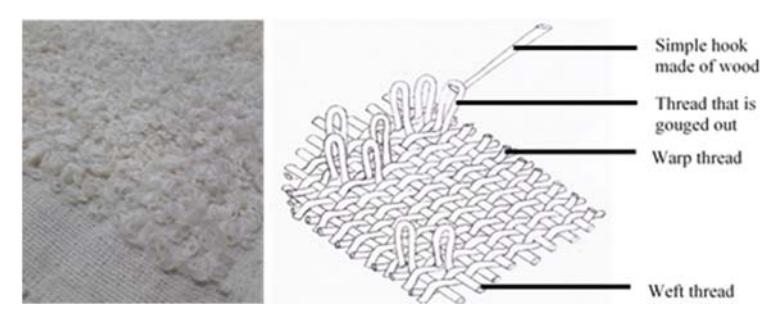
Figure 5 Sketches and photos of the development of gedog woven fabric: Ulu Gibas.
3.4 'Upo Kecer' Gedog Woven Fabric Innovation
This innovation of gedog woven fabric is a continuation of the development of the 'Ulu Gibas' fabric (Figure 6). The threads are shaped like feathers on the surface of the fabric and are cut so that they are only about 0.5 centimeters long. This design was named 'Upo Kecer' (spilled rice), inspired by rice supplies that are brought by farmers to the field wrapped in teak leaves and banana leaves, leaving a small amount of rice scattered on the leaves after eating.
Figure 6 Sketches and photos of the development of gedog woven fabric: Upo Kecer.
3.5 'Cacah Gori' Gedog Woven Fabric Innovation
This innovation with alternate patterns of the outlet and inlet of the weft threads (Figure 7). The weft thread is made to jump over the warp thread at a certain position without making a braid, with the distance set according to the desired design. This design was named 'Cacah Gori' (young jackfruit), inspired by a popular vegetable dish in Tuban with pieces of young jackfruit, usually eaten with rice and side dishes.
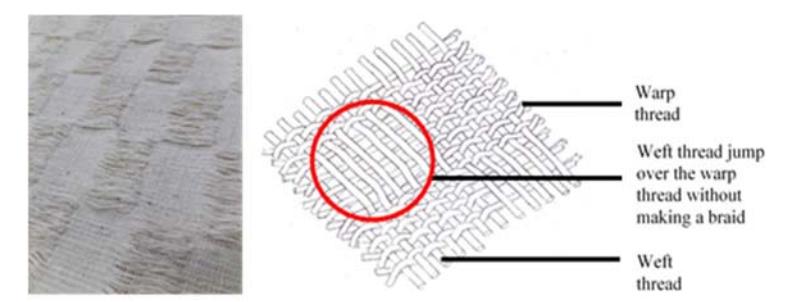
Figure 7 Sketches and photos of the development of gedog woven fabric: Cacah Gori.
3.6 'Tegel Cino' Gedog Woven Fabric Innovation
This innovation of gedog woven fabric was developed by adding embroidery during the weaving process using additional threads that are inserted together with the weft thread, forming a pattern resembling a chessboard (Figure 8). This design was named 'Tegel Cino' (Chinese tiles), inspired by the tiles imported from China around the 1980s and widely used in the homes of weaving masters.
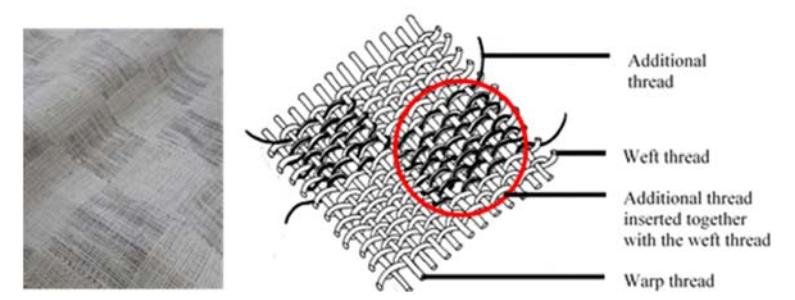
Figure 8 Sketches and photos of the development of gedog woven fabric: Tegel Cino.
The development of the gedog woven fabrics produced 5 variations in the texture of the fabric surface. Several aspects of the original design were maintained in the experimental process because they are considered fundamental to maintaining the characteristics of the gedog woven fabric:
- 1. Choosing inspiration for the fabric titles based on things that are considered valuable by the local community of Tuban.
- 2. Maintaining the use of the gedog loom in realizing the development of the woven fabrics. Tuban is known within Indonesia as a region that still maintains the original tradition of making woven fabrics using gedog looms. In fact, Tuban is the only area that explicitly uses the word gedog to refer to woven fabrics as one of the unique artifacts that represent the region. The
- word gedog in Indonesian is strongly associated with the tradition of cloth making in Tuban. Through gedog weaving, the Tuban region enjoys national recognition, so it is important to continue to support and preserve this traditional technique.
- 3. Maintaining the use of handspun cotton yarn spun using a jantra in order to keep the tactile and visual characteristics of the fabric.
- 4. The experiments were carried out in collaboration with women from the weaving community in Tuban who still use a gedog loom, paying attention to their skills. Traditionally, weavers in Tuban only make fabrics with a flat surface. By developing various textures in gedog woven cloths, the traditional weaving principles that the weavers are accustomed to are still applied so that they are less likely to resist the innovations.
4 Conclusions
From a series of exploration processes that were carried out and a comparison between the traditional gedog woven fabrics and the gedog woven fabrics from the experiments, 7 gedog woven fabrics were developed while making certain that the innovative elements would not overshadow the visual characteristics of the traditional gedog woven fabrics. The weavers in Tuban hold a strongly traditional attitude toward weaving, but innovation can also be achieved by introducing new textures in the fabric. This is still acceptable to the local community of Tuban as part of their identity, also because inspiration was drawn from things they value in their daily life.
Acknowledgements
The author sincerely thanks all those who have helped the completion of this research: Dr. Agus Sachari, Dr. Achmad Haldani, and Dr. Yanyan Sunarya, members of the Faculty of Art and Design, Institut Teknologi Bandung for contributing their thoughts; and Rukayah and Sri Lestari, the master weavers in Tuban who were willing to collaborate to carry out various experiments that were certainly not easy to execute.