

1 Introduction
As an excellent form of folk drama, Huangmeixi opera originated in Huaining County and other areas in Anhui Province in the late Qing Dynasty. It was combined with local folk art and became one of the five major Chinese operas. However, compared with other Chinese operas, Huangmeixi opera's culture and creativity are lagging in the depth of the design and the breadth of implementation. As a result, Huangmeixi opera creative products have no accurate market positioning and can never truly integrate into modern people's lives. Therefore, against the background of the modern era, refining and redesigning the culture of Huangmeixi opera is of great significance for the spread of Huangmeixi opera culture and the industrialization of Huangmeixi opera culture products [1].
In Huangmeixi opera, distorted and exaggerated facial patterns are used to show the personality characteristics of different characters, while different color combinations and element combinations symbolize different categories of characters. Through the expression of color, the facial expressions of the characters appear very elegant; the use of color is the most effective way to present the characters to the audience. The overall effect of facial makeup, costumes (Figure 1), movements, colors, and stage design give Huangmeixi opera a strong aesthetic value.
Received October 27th, 2020, Accepted for publication February 23rd, 2021. Copyright © 2021 Published by ITB Institute for Research and Community Services, ISSN: 2337-5795, DOI: 10.5614/j.vad.2020.12.2.5
Figure 1 Crown from Huangmeixi opera.
To sum up, the colors, costumes, faces and crowns from Huangmei opera provide a broad space for the design and development of creative products from Wenhua. However, compared with other Chinese operas, the creative products of Huangmeixi opera lag behind in both the depth of the design and the breadth of implementation. Due to the lack of publicity channels, promotion efforts and accurate market positioning users do not have a deep understanding of the creative products of Huangmeixi opera, which cannot be truly integrated into modern people's lives. Therefore, against the background of the modern era it is necessary to refine and redesign the cultural elements of Huangmeixi opera, which can play a positive role in promoting the cultural dissemination of Huangmeixi opera and the development of industrial cultural creative products.
2 Design Method of Huangmeixi Opera Cultural Creative Products
Huangmeixi is a form of drama performance in which dance, art, performance, music, literature, and aesthetics are equal. Among them, Huangmeixi opera's repertoire, costumes, and prop features have strong artistic value. These special elements are the primary theme of cultural creative product development. Anqing people regard Huangmeixi opera as a part of their lives [2,3]. Therefore, integrating Huangmeixi opera elements into cultural creative products not only can increase the cultural connotations of the products and enhance the influence of Huangmeixi opera culture but also play a positive role in promoting the local economy. What is important is that it can promote and develop the globalization of Huangmeixi opera culture. In short, the use of Huangmeixi opera as a carrier for cultural and creative product design can have a far-reaching influence in economic, cultural, and commercial aspects [4]. As a derivative of traditional Huangmeixi opera culture, it also brings Huangmeixi opera outside of Anqing to the world.
2.1 Point, Line and Surface Elements of Opera Imagery
In visual communication design, the three basic elements are graphic design, lines and surfaces. Points, lines and colors are important means of visual elements in visual communication. A point is a basic form element that is often used to create a visual symbol. In opera costumes, points are used as basic elements for modeling and decoration. The visual effect and the tension of points are used to induce a vision, attract attention and shape the visual image of the characters. In particular, the point is used as a basic modeling element for creative design. Under the premise of harmonious integrity, the key design of local details will become a bright spot of focus, that is, the most striking element within the overall form. As such, points as opera elements are refined and can very well be applied in visual communication. When creating visual symbols with elements from opera, the basic style also contains a strong drama culture component [5].
Figure 2 Clothing design.
Lines are also among the basic elements of visual art modeling. As long as an object has contours, it can be drawn with lines. In the elements from opera, expression using lines can stimulate the viewer's imagination. Shapes, features and contours quickly capture the viewer's attention. Different ways of using
lines in visual art modeling can achieve different visual effects and communicate to the audience through different visual experiences.
For example, lines can create patterns with dragons, phoenixes, flowers and clouds for use as opera elements. These types of drama elements convey to the audience a noble, attractive and joyous feeling as a visual symbol. In addition to drawing a figurative pattern with lines to convey an intuitive meaning that the designer wants to express, lines can also form an abstract texture that causes the audience to use their imagination in infinite ways. Figure 2 shows a long blue texture, which the viewer may see as waves. A semi-circular line combination is conveyed to the viewer, perhaps associated with mountains. Thus, lines as opera elements are refined and can be used in visual communication to create unique visual symbols (Figure 3).
Figure 3 Fanchang Kiln: four-color jade teacup.
Color is another important element in visual communication design, which can create different tones to reveal a theme. In many visual communication design works, the element of color is a prime visual characteristic that can emotionally convey to the viewer information the designer wants to convey. At the same time, color also has its own independent attributes, such as oranges being orange for and leaves being green. A matching color will become representative of something. The colors in opera are often contrasting and unique in flavor, which can highlight the image of the opera characters. For example, Zhangfei and Caocao (Figure 4) convey a vivid image of the characters through red and black. Therefore, the color elements in opera culture are refined, with distinctive style features, creating a typical visual effect that can give the design a strong visual impact.
2.2 Direct Extraction of Elements
Direct extraction does not mean taking an existing element, such as a pattern or a design, and copying it but to re-define it in a new context and to give it new life. Under the influence of the Ming and Qing Dynasties, Huangmeixi opera has extremely complex and diverse clothing designs and patterns [6,7]. There are many differences between the costumes; the different designs and patterns convey different meanings. This is also one of the characteristics of Huangmeixi opera.
Figure 4 Ceramic cultural creative products: Zhangfei and Caocao.
The traditional ornamentation of Huangmeixi opera can be divided into group patterns and lace patterns. Group patterns are the most common in the costumes of Huangmeixi opera, giving a solemn and solid feeling to the costumes. "The most basic form feature of the group flower is the circle as the most perfect form. It is not only a perfect form in the plane form. Chinese culture as reflected in the circle is irrevocable" [8]. Most patterns depict auspicious symbolic creatures (dragons, phoenixes, rare birds, lions, unicorns, tigers), flower forms (peony, chrysanthemum, plum, magnolia), the Eight Immortals or Eight Treasures, and geometric ornamentation. In terms of designing and developing cultural and creative products, Huangmeixi opera clothing patterns are innovatively designed and applied to objects in form and composition, with high contrast, virtual and real contrast, complex contrast, square contrast, and convergence. Depending on the method used, visual beauty can be formed in the object of creation.
Therefore, applying the principles of design can achieve appropriate innovation when extracting elements, not only preserving the traditional meaning and shape characteristics of a pattern but also paying attention to actively responding to the deformation, abstraction and contrast of the patterns. Design patterns always retain the original artistic taste when using abstraction. Besides, it is essential in what way the cultural elements of Huangmeixi opera are applied in the manufacture of modern products (materials, imagery, craftmanship, connotations, etc.) to promote the combination of opera culture and modern manufacturing.
2.3 Abstract Abstraction of Form and Auspicious Meaning
Abstract forms are a higher form of artistic refinement, breaking up elements and re-establishing a new artistic image. The application of abstract art forms in modern art design is understood by designers, which is not only of great significance to the connection between art and daily life but also conducive to improving people's aesthetic sensibility in relation to high-level artistic creation. As for the design of cultural creative products, the artistic creation of abstract design elements effectively contributes to creating an atmosphere and an artistic conception, which is indispensable to meet the spiritual and cultural needs of modern people [9]. In terms of the process of creation and design, drama culture cannot directly use graphic and symbolic elements from drama culture but should interpret these elements to expand, extend, transform and recombine them in order to showcase the organic combinations of Huangmei opera culture. By collecting costumes, props, tiaras and other elements from Huangmeixi opera, the production process should be taken into account in the production of cultural and creative products.
The shapes and colors of Huangmeixi opera elements should be abstracted to unify the overall shape and vision. For example, in 2007, the QQ game desk calendar designed by Tencent Company based on opera culture (Beijing opera) covers the twelve main role types of Beijing opera, such as sheng (gentleman), dan (lady), jing (criminal) and chou (clown). The design uses the image style of QQ Penguin in a model collection. The classic role types of Beijing opera and the image style of QQ form a QQ Penguin version of Beijing opera imagery. The emergence of this literary product immediately caused a strong chain reaction and a large number of products based on Beijing opera elements entered the market, which greatly promoted the combination of Beijing opera culture and modern industrial manufacturing, and also brought extensive development to enterprises through high economic efficiency.
Cultural and creative products reflect a certain meaning with cultural connotations. Zhuangzi has stated: "The virtual room is white, the auspicious end"; Cheng Xuanying: "Ji, the good things; Xiangzhe, Jiaqing's levy." The elements of Huangmeixi opera can be integrated into the design with the concepts of auspiciousness, happiness, jealousy, and beauty, which makes people feel these cultural connotations when they appreciate the products. While conveying happiness and auspiciousness to people, it also spreads drama culture at a spiritual level. As an opera city, Anqing combines cultural creativity with auspicious meanings to form special cultural connotations and integrate
them into creative products. The designer lets himself be inspired by the elements of Huangmeixi opera. Based on the typical characteristics of the opera elements, general extraction is carried out to obtain a better cultural and creative form, so that the product materiality and spirituality are organically integrated. Designers engaging the cultural creativity of Huangmeixi opera need to find the pain points and key components of the modern lifestyle, so that new products can be better integrated into Huangmeixi opera culture (Figure 5).
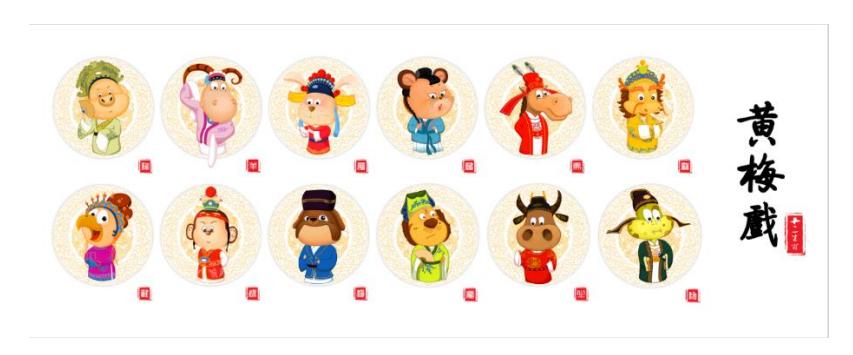
Figure 5 Twelve Zodiacs, Huangmeixi opera play.
2.4 Material and Craftsmanship of Cultural Creative Products
Materials are the basis for the production of design products. Different materials can be used for cultural creative products of different shapes. The selection of materials for Huangmeixi opera cultural products should be based on design considerations. Traditional materials such as wood carving, stone carving, embroidery, or new materials such as nanomaterials and fibers should be selected as material carriers, combined with paper-cuttings, kites, shadow puppets, and other folk art forms. Huangmei opera cultural elements can be applied to these materials to expand the design ideas of Huangmei opera cultural and creative products. As the birthplace of Huangmeixi opera, Anqing offers a large number of opera materials. As the saying goes: "Anqing sees Huangmeixi, Huiban enters Beijing, Shaoxing sees the opera", the traditional Lao Anqing has many craft materials influenced by opera culture, a large number of wall modeling materials, and designs and patterns. Thus, through the reorganization of different materials, Huangmeixi opera cultural creative products can combine visual elements from the opera with these materials to create new visual effects. Therefore, in the design and development of cultural creative products, the designer should pay close attention to materials selection in product development. Materials are not only the carriers of products but also elements from Huangmei opera that can give Huangmeixi opera cultural creative products cultural connotations.
3 Implementation Strategy of Cultural Creative Product Design of Huangmeixi Opera
The cultural and creative industry is a sunrise industry with creativity at its core. "It has grown at a rate 24 times higher than traditional industries and has become a pillar industry in many developed countries or regions" [10]. The development and design of cultural creative products are an important part of the development of the cultural and creative industries. On April 27, 2016, Premier Li Keqiang of the State Council presided over an executive meeting of the State Council, requesting in-depth exploration of the collective resources of cultural and historical heritage and promoting the development of cultural and creative products. This is of great significance for promoting excellent culture, Chinese heritage, and coordinated economic and social development. It is important to promote cross-border integration of outstanding cultural resources with creative design and tourism, and to strengthen policy support and include the development of cultural and creative products within the scope of cultural industry investment and financing service systems. State-owned cultural and historical heritage units must actively explore a reasonable profit distribution mechanism and attract social forces to participate in the development, production, and operation of cultural creative products. These have great influence and social significance for the design and development of cultural creative products.
Against the background of the modern era, the Chinese state attaches great importance to cultural creativity. For the Huangmeixi opera arts creation industry, opportunities and challenges exist, which designers constantly need to think about. Cultural elements from sHuangmeixi opera can be used as a source of creativity to optimize the development of cultural creative products, design ideas and implementation pathways.
3.1 Supplemented with Shape
Shape is the most intuitive semantic component of a product, carrying information such as identification and function. Shape creates types, extracting morphological elements from the unique beauty of Huangmeixi opera, retaining its nationality and regionality, and reconstructing a new style based on the characteristics of opera art. This new style has strongly evokes Huangmeixi opera, retaining the original characteristics of Huangmeixi opera art while at the same time adopting aesthetic characteristics of modern products. The form of reconstruction is based on opera culture, producing a new and unique product art form.
First of all, the design process can directly extract the shapes of characters from Huangmeixi opera, making them more artistic by using abstraction. This new artistic expression must have human characteristics, while also considering practicality. The most typical example is the image of Feng Suzhen (The Female Horse) in Huangmeixi opera, which retains the original flavor of the 'Grass Class'. It takes this aspect, plus the red hat, the red dress, and the red belt of the horse costume, creating an abstract image. Cultural creative elements can be integrated into doll designs, such as anger, sorrow, music, etc., also expressing classic songs from Huangmeixi opera through a series of costume images. In addition to designing doll products, it is also possible to integrate elements from opera into stationery, packaging, daily necessities, ornaments, accompanying gifts, digital product sets, etc., and introduce artistic creations into modern life.
Secondly, opera culture can be applied in packaging design (Figure 6), thinking about characters such as Feng Suzhen, Tian Xian Fu, Yan Fengying, 'Tiger Grass', Tao Jinhua, etc. from Huangmeixi opera as the main images for a series of product packagings of tea products, fan products, drama books, or local folk products. For example, a product packaging design using a yellow plum style can expose people to opera culture when buying goods. These are all unified expressions of shape and type. After the public sees the product, they can more easily accept Huangmeixi opera and through creative design a brand new drama image of culture and creativity can be created, celebrating Huangmeixi opera with a Anqing flavor.
Finally, we must consider turning cultural creative products into cultural brands and creating characteristic commercial spaces through Huangmeixi opera culture, such as opera teahouses, opera restaurants, opera tableware, opera homes, etc., which makes Huangmeixi opera culture into a local economy, thus expanding the brand effect to popularize heritage culture.
Figure 6 Packaging design.
3.2 Creating Shapes with Meaning
In the cultural and creative industries, cultural connotation is 'intention' [11]. It is integrated with product design and is the focus of product differentiation. The focus of product design is the relationship between the user and the physicality of the product, while conveying emotions also plays a role in creating meaning.
Firstly, the designer can start from local proverbs used in Huangmeixi opera, which is a rich collection of Anqing folk wisdom. There are many arias, dialects, folk customs, etc. in Huangmeixi opera, with familiar scenes from daily life of the old Anqing people and a large number of folk culture elements. Famous lines from Huangmeixi opera have ended up in popular sayings from Anqing, such as "An ugly wife always wants to see the in-laws" from The Ring Of The Ring; "The phoenix falls into the pheasant nest" from Tianxian Match, "Nothing is too hard" from Chopper Knife; "Extend your hand, do not laugh at people" from The Ring Of The Ring, and so on.
Secondly, the designer can start from meanings in the texts from Huangmeixi opera (libretto). The prosperity and development of Huangmeixi opera culture are inseparable from the diversity of opera performances, which is not only reflected in the essence of opera but also based on the promotion and dissemination of Huangmeixi opera culture based on cultural creative products. As a culture with the local characteristics of Anqing, Huangmei opera is Anqing's business card. It contains Confucian values such as loyalty and patriotism. It has strong educational significance and guides people's values and social outlook, and thus penetrates all aspects of life. Many historic places in Anqing have been influenced by the connotation of opera and it has also changed the life trajectory of many local historical figures. For example, Zuo Guangdou, Zhang Tingyu, Zhang Ying, the modern Chen Duxiu, Deng Jiaxian, Yang Shixian, and many others from the Ming and Qing dynasties who felt great responsibility towards their home country.
Finally, these unique folk culture elements and products can be combined to create product designs conveying new meanings through their shape. The shape of the product is plastic art with a modern aesthetic value. Its connotations are derived from the essence and spirit of the opera, so that the combination of the external shape and the inner sense can convey meaning. Usable objects such as daily necessities, stickers, T-shirts, and other physical products can be developed as cultural creative products. The design of these elements can also present a series of creative products, such as emoticons, themed UIs, game boards, bookmarks, and so on. Besides, designers can also try to integrate the storyline of Huangmei opera in local tourism, including scenes from classic Huangmei opera's, a DIY production experience hall for cultural and creative
products from Huangmei opera, building an opera set for rural tourism, stage shows, etc. These provide not only experiences to tourists that relate to Huangmei opera but also a better understanding of the diverse expressions of Huangmei opera culture, thus promoting Anqing as a cultural city for opera tourism throughout the country and even the world.
3.3 Fusion of opera and Drama
Looking back on the historical development of film and television in China, the development of drama elements has always been a fertile ground for film and television creation. A large number of popular TV dramas have sprouted from the theatre. In recent years, film and television work with dramatic elements have developed rapidly, such as Journey to the West, Da Tian Temple, Dream of Red Mansions, Mulan Joins the Army, Life and Death, Liang Shanbo and Zhu Yingtai, and The Cowherd and the Weaver Girl. These film and television dramas were adapted from the dramatic repertoire, where traditional plays were artistically processed to provide the content of the story. The prototype characters are based on the basic prototypes from opera, where the adjustment makes the film and television image more in line with the aesthetic taste of the public.
Huangmeixi opera cultural creative products are a kind of national culture in terms of material presentation, which is emphasized through the extraction of opera elements to promote the development of cultural creative products [12]. Thus, the designer can apply cultural elements from Huangmei opera in the design and development of cultural creative products, to conduct a special form of dissemination of traditional opera culture. To a certain extent, Huangmei opera culture can be preserved and promoted through the form of things.
Furthermore, the design and development of cultural creative products based on elements from Huangmeixi opera can create rich visual imagery from opera culture, forming characteristic products with a strong brand presence in the market. Their basic form has commercial value through the combination of brand resources. The combination of Huangmei opera and cultural creative products is an innovative form of cultural integration. Taking cultural creative products as material carriers to express cultural elements from opera, both have the opportunity of cultural industrialization and realize the heritage and development of cross-border types. Through the design of Huangmeixi opera cultural creative products we can directly integrate traditional opera culture into daily life and let more young people understand and accept Huangmeixi opera, rejuvenating drama culture and reconstructing the artistic image and connotations of Huangmei opera, thus ensuring the maximum effective heritage preservation and dissemination of Huangmei opera.
4 Conclusion
The design and development of Huangmeixi opera creative culture products is an activity involving creative and artistic expression. Its purpose is not only to design products that meet people's needs but also an important carrier for the dissemination of opera culture. The rich and diverse cultural elements of Huangmeixi opera are used as the source for the product design. The design expression of opera culture can give new meaning to traditional opera culture, creating new visual imagery and making it conform to current fashion characteristics. The extraction, refinement and reorganization of cultural elements from Huangmeixi opera can give more depth to product design concepts and integrate opera culture with industrial manufacturing. It not only adds new content, new pathways, and new carriers to the heritage of opera culture but also enables creative culture products with rich connotations and visual appeal.
Acknowledgment
This project was supported by the Research on Greenish White Porcelain of Fanchang Kiln program of the Ministry of Education (No. 20YJA760028).