

1 Introduction
Comfort in the workspace is important to note, especially related to indoor workspaces. In many workspaces the aspect of comfort is not prioritized. The level of comfort of a workspace can affect the quality of someone's performance. According to Ayu et al. in 2016, workspace conditions are among the causes of work stress felt by employees [1]. Job stress can have positive and negative effects. If the level of work stress exceeds the limit that can be tolerated by employees, then it can significantly reduce job satisfaction and ultimately employees cannot work optimally in the workspace. This shows that someone's comfort in a workspace is strongly influenced by their surrounding
Received October 24th , 2019, Accepted for publication June 6 th, 2021. Copyright © 2020 Published by ITB Institute for Research and Community Services, ISSN: 2337-5795, DOI: 10.5614/j.vad.2021.13.1.4
environment. Nitisemo in Sukmawati (2008) revealed that the work environment is anything about the workspace that can affect the condition of users while working in the room [2]. With a good work environment, users will be able to work well in the workspace without being disturbed by conditions such as room temperature, noise, lighting intensity, and others.
Sedarmayanti in Budianto & Katini (2015) distinguished two aspects of the work environment, namely the physical work environment and the non-physical work environment [3]. The physical work environment is the environment around the workspace, which can affect someone directly or indirectly. Things in the work environment that affect a person directly are for example the dimensions of the room, the layout of the workspace, the furniture in the workspace, work equipment, and so forth, which can significantly affect the area of someone's movement within the space. The parts of the physical work environment that not directly influence the user, also called the intermediary environment, can affect a person's condition when in the workspace, for example room temperature, air circulation, room lighting (natural or artificial), noise, room smell, wall colors, etc.
This physical work environment, such as lighting, air conditioning, noise, spatial planning, room cleanliness, workspace facilities, and wall coloring, has a significant influence on a person's performance [4]. Research on the relationship between the quality of the indoor environment and someone's productivity at work has been done by several researchers. Six components of the physical work environment can affect satisfaction and productivity in the workspace: indoor air quality, thermal comfort, artificial and natural lighting, room noise and acoustics, room layout, and view [5]. The study conducted by Young (2010) states that the layout of office space can affect privacy, social interaction with coworkers, and acoustic quality [6]. An appropriate space layout can improve someone's satisfaction and performance while working in the workspace.
The non-physical work environment consists of the conditions related to social aspects, that is work relations, both work relationships with superiors, coworkers, and relationships with subordinates [3]. Rus & Tihenea in 2014 state that social relations between colleagues and superiors can have an influence on someone's psychological condition at work [7]. Poor communication between superiors and subordinates can cause discomfort and increase the likelihood of employees quitting their job. Having good communication with subordinates is one of the main factors in improving worker's welfare and productivity [8].
The physical and the non-physical work environment need to be considered in the workspace because a comfortable work environment has a positive influence on the work motivation and performance of a person [9], and vice versa, according to Norianggono (2014), an uncomfortable work environment can have a negative influence on someone's motivation and performance and influence someone's willingness to stay in the workspace [4].
Work environment factors that make a person comfortable and willing to stay in a room are considered as benchmarks in the design of indoor workspaces. Willingness to stay according to Rachman & Kusuma (2014) is a psychological condition where a person feels comfortable so he feels happy to stay for a long time in a place [10]. Satriaji (2017), when studying student willingness to stay on a campus, concluded that students' willingness to stay on the campus can be influenced by three factors, namely social interaction, the environment and physical facilities, and the activities undertaken [11]. The environment and physical facilities are the main factor affecting student welfare. In a study conducted by Sakina & Kusuma (2015) regarding the relationship between the quality of rental housing and the level of student satisfaction revealed that two factors cause imperfection in occupancy, namely poor service quality and poor building quality [12]. Examples of poor quality of services are unreliable telephone and internet signals, disruption of clean water lines. Examples of poor building quality are air circulation and poor residential lighting, narrow space dimensions, and cleanliness of the room.
The present study aimed to look at the influence of work environment factors, both physical and non-physical, on someone's willingness to stay while working in a workspace. This research discusses the work environment factors that make someone feel comfortable working in their workspace and the work environment factors that make a person want to move, based on the answers of respondents who have worked or were working. This results of this research are expected to be the basis for designers or owners of workspaces to consider work environment factors that affect someone's willingness to stay while in a room so that a comfortable working atmosphere is created.
2 Research Method
This study used qualitative-quantitative research methods. Explorative qualitative methods were used to collect data on work environment factors in indoor workspaces. Explanatory quantitative methods were used to see the relationship between these work environment factors and the level of someone's willingness to stay in a workspace. Data collection was done by distributing an online questionnaire. The questionnaire was distributed freely using a nonrandom sampling method with snowball sampling [13] to people who have worked or were working.
2.1 First Phase Qualitative Research
2.1.1 Collecting Data Method
In the first stage, a questionnaire was distributed online containing open-ended questions to dig deeper into which work environment factors affect the sense of comfort and discomfort felt by respondents in a workspace [14], both physical and non-physical factors. Responses were obtained from 105 participants. The respondents' occupations varied, from lecturers, teachers, architects, private employees, graphic designers to accountants, photographers, and so on.
2.1.2 Data Analysis Method
The data collected was analyzed using open coding analysis to identify keywords based on the respondents' answers regarding work environment factors. The first stage of open coding analysis resulted in 21 keywords that represent the participants' responses to the questionnaire. The keywords are: facilities, music, social interaction, work partners, cigarette smoke, privacy, space, room color, furniture comfort, interior appeal, spatial planning, room neatness, room cleanliness, room scents, atmosphere, noise, view, lighting, room humidity, safety, and air. The keywords and sentences from the responses were used to prepare the second online questionnaire.
2.2 Second Stage of Quantitative Research
2.2.1 Collecting Data Method
In the second stage, a questionnaire to collect data was distributed online that contained closed-ended questions. Quantitative questions were directed through questions compiled using various semantic-differential (SD) methods on a scale of 1 to 5. Responses were obtained from 105 participants. Some examples of the closed-ended questions can be seen in Table 1.
Table 1 Questionnaire examples about work environment factors.
| Category | Answer | ||||||
|---|---|---|---|---|---|---|---|
| Room's air temperature | Cool | 1 | 2 | 3 | 4 | 5 | Hot |
| Room's cleanliness | Dirty | 1 | 2 | 3 | 4 | 5 | Clean |
| Noise Level | Silent | 1 | 2 | 3 | 4 | 5 | Noisy |
At the end of the questionnaire, the respondents were asked to indicate their level of willingness to stay based on the conditions in their current work environment, representing both their relationship to physical work environment
factors and non-physical work environment factors in their workspace. To make it easier for respondents to answer this question, the question was presented using a Likert scale of 1 to 5. Some examples of the closed-ended questions relating to the level of willingness to stay can be seen in Table 2.
| Question | Answer | ||||||
|---|---|---|---|---|---|---|---|
| I'm willing to stay in my workspaces for a long time | Strongly Disagree | 1 | 2 | 3 | 4 | 5 | Strongly Agree |
| The work environment makes me more productive | Strongly Disagree | 1 | 2 | 3 | 4 | 5 | Strongly Agree |
| I want to get a more | Strongly | ||||||
Disagree 1 2 3 4 5 Strongly Agree
Table 2 Questionnaire examples about level of willingness to stay.
2.2.2 Data Analysis Method
comfortable workspace
The data collected was then analyzed using principal component analysis and factor analysis, followed by multivariate regression analysis. Principal component analysis and factor analysis were used to find replacement or latent variables that can represent measurable variables.
3 Result and Discussion
3.1 Eleven Factors of Work Environment
From the results of the principal component analysis and factor analysis, 11 principal components were found that had an eigenvalue value of more than 1. The 11 components resulting from the principal component analysis were further analyzed by factor analysis using varimax rotation. The 11 latent variables from the factor analysis results are shown in Table 3. These factors were used as criteria for the evaluation of (indoor) workspaces: social interaction, quality of visual interiors, natural environment, spaciousness, artificial ventilation, glare, crowdedness, natural air, facilities, air temperature, and humidity.
The eleven factors can be categorized into three groups, namely non-physical factors, interior physical factors, and exterior physical factors. Non-physical factors include social interaction and crowdedness. These non-physical factors represent the existence and quality of relationships with colleagues. The interior physical factors represent physical characteristics that are directly present in the workspace, such as the visual quality of the interior, spaciousness, artificial
ventilation, glare, and facilities. Exterior physical factors represent exterior physical characteristics that affect the quality of interior workspaces, such as the natural environment seen from windows, natural ventilation, air temperature, and humidity.
Social interaction is a non-physical factor that represents measurable variables related to social relations in the workspace. This includes the quality of relationships between coworkers, relationships with superiors, conversations in workspaces that are interesting or boring, and also security. Based on these groupings, it can be seen that the security felt by someone in the workspace can be influenced by social relations in their workspace. Crowdedness is another non-physical factor, which represents a measurable variable related to the presence of people such as the number of people and the noise level in the room.
The visual quality of the interior is an interior physical factor related to attractive room decoration, spatial layout, disturbing or unobtrusive wall colors, attractive space colors, furniture comfort, neatness, cleanliness, and a conducive or non-conducive room atmosphere. From this grouping it can be seen that the interior condition of the workspace can affect the atmosphere of a room to make it conducive to work in. Spaciousness is a physical factor of the interior that represents variables related to the extent of someone's workspace and space within a space.
Another interior physical factor is artificial ventilation, which represents the variables artificial ventilation comfort and smell in a room. Someone's sense of comfort in artificial ventilation conditions in their workspace is also influenced by the smell in the room. Then there are the factors glare and facilities. Glare is a factor related to the direction of lighting in the room, while facilities is a factor that represents the music variable in space and the existence of an internet network.
The natural environment is included in the group of exterior factors related to what can be seen from the openings or windows of a room, such as a view of the surrounding environment or a park or trees. This factor is also related to the intensity of natural lighting coming into the room. Then there are the factors natural ventilation, air temperature, and humidity, which are exterior physical factors related to the comfort of natural ventilation, the air circulation, the air temperature, and the air humidity in the workspace.
| Variable | Loading Score | Cronbach α | Mean | Std |
|---|---|---|---|---|
| Social Interaction | 0.83 | 4.15 | 0.70 | |
| Colleague relations | 0.84 | 0.77 | 4.36 | 0.80 |
| Conversation in the room | 0.81 | 0.75 | 3.98 | 0.97 |
| Relationship with superiors | 0.70 | 0.81 | 4.25 | 0.92 |
| Workspace security | 0.70 | 0.81 | 4.11 | 0.97 |
| Co-workers | 0.68 | 0.82 | 4.05 | 0.86 |
| Visual Quality of Interior | 0.86 | 3.30 | 0.76 | |
| Interior decorations | 0.74 | 0.84 | 2.78 | 1.16 |
| Room arrangement | 0.71 | 0.83 | 3.67 | 1.10 |
| Wall color | 0.70 | 0.86 | 2.83 | 1.12 |
| Room color | 0.69 | 0.84 | 2.86 | 1.09 |
| Furniture comfort | 0.63 | 0.85 | 3.53 | 1.07 |
| Room's neatness | 0.48 | 0.84 | 3.42 | 1.07 |
| Room's cleanliness | 0.48 | 0.84 | 3.78 | 1.01 |
| Room's atmosphere | 0.42 | 0.84 | 3.53 | 0.98 |
| Natural Environment | 0.42 | 0.80 | 3.18 | 1.06 |
| View to the park/tree | 0.80 | 0.76 | 2.73 | 1.46 |
| View to the park/nee View to surrounding | ||||
| environment | 0.75 | 0.76 | 2.60 | 1.39 |
| Daylight | 0.58 | 0.75 | 3.66 | 1.23 |
| Daylight conditions | 0.53 | 0.75 | 3.73 | 1.22 |
| Spaciousness | 0.55 | 0.73 | 3.17 | 1.14 |
| 0.84 | 0.82 | 3.17 | 1.14 | |
| Workspace dimension Space to move | 0.79 | 3.20 | 1.23 | |
| Artificial Ventilation | 0.79 | -0.41 | 3.02 | 0.56 |
| Artificial ventilation | -0.41 | 3.02 | 0.30 | |
| conditions | 0.66 | -0.42 | 3.68 | 1.05 |
| Room scents | 0.40 | -0.70 | 3.34 | 0.76 |
| Air Pollution | -0.80 | 0.41 | 2.04 | 1.39 |
| Glare | -0.80 | -0.78 | 2.81 | 0.76 |
| -0.78 | ||||
| Lighting direction | 0.81 | 2.67 | 1.29 | |
| Pantry facilities | -0.48 | 2.95 | 1.24 | |
| Crowdedness | 0.50 | 3.37 | 0.85 | |
| Number of people in the | 0.76 | 0.28 | 3.37 | 1.35 |
| room | ۱ د.د | |||
| Noise level | 0.56 | 0.30 | 2.85 | 1.18 |
| Artificial lighting | 0.48 | 0.55 | 3.90 | 1.03 |
| Natural Air | 0.62 | 3.35 | 0.98 | |
| Natural air condition | 0.80 | 3.20 | 1.20 | |
| Air circulation | 0.63 | 3.50 | 1.09 | |
| Facilities | 0.57 | 3.32 | 1.16 | |
| Music in the room | 0.68 | 3.09 | 1.44 | |
| Internet facilities | 0.68 | 3.55 | 1.35 | |
| Air Temperature | 0.29 | 3.17 | 0.72 | |
| Air temperature | 0.79 | 0.03 | 3.15 | 1.04 |
| Lighting color | 0.56 | 0.23 | 3.07 | 1.09 |
| Privacy | 0.41 | 0.39 | 3.30 | 1.23 |
| Humidity | 3.13 | 0.93 | ||
| Humidity | 0.79 | 3.13 | 0.93 |
3.2 Two Factors of Willingness to Stay in the Workspace
From the principal component analysis and factor analysis, two factors of willingness to stay in the workspace were found, namely willingness to stay and intention to move. These two factors are a person's cognitive response to their workspace. Willingness to stay and intention to move is not called an affective response but a cognitive response, because both of them are accumulated impressions of the workspace that are stored in the memory and affect someone's cognitive processes.
| Variable | Loading Score | Cronbach α | Mean | Std |
|---|---|---|---|---|
| Willingness to Stay | 0,86 | 3,61 | 0,81 | |
| Willingness to Stay Level | 0,87 | 0,78 | 3,53 | 1,02 |
| Get used to Environment | 0,87 | 0,80 | 3,74 | 0,92 |
| Feel Satisfied | 0,85 | 0,80 | 3,45 | 0,93 |
| Feel More Productive | 0,74 | 0,89 | 3,70 | 0,98 |
| Intention to Move | 4,48 | 0,92 | ||
| Intention to Move | 0,97 | 4,48 | 0,92 |
Table 4 Willingness to stay dimensions in work environment.
3.3 Effect of Work Environment Factors on Willingness to Stay
The influence of the work environment factors on willingness to stay can be seen in Table 5. The factors that strongly affect willingness to stay sorted from the highest to the lowest scoring are: social interaction (β 0.576), visual quality of the interior (β 0.288), natural air (β 0.275), natural environment (β 0.275) β 0,261), spaciousness (β 0,179), artificial ventilation (β 0,139), and facilities (β 0,121). The factors that do not significantly affect willingness to stay are: glare (β -0.117), humidity (β -0.107), crowdedness (β 0.091), and air temperature (β -0.081).
Looking at the factors that significantly affect and do not affect willingness to stay, it was found that the factors that affect willingness to stay tend to be preferential characteristics whose existence is not mandatory/must exist. However, if these factors are present in the workspace, then the better their quality, the more happy the occupants feel and want/are able to stay in the workspace. Meanwhile, factors that influence willingness to stay weakly are characteristics that are required. If their quality is good, a person may not necessarily feel happy and want to stay in the workspace, but if the quality is bad someone will not be able to work and may not feel willingness to stay.
Significant factors that affect intention to move (see Table 5), sorted from the highest to the lowest scoring are: the visual quality of the interior (β-0,217), crowdedness (β 0,189), natural ventilation (β -0,188). The visual quality of the interior and natural air have a negative influence, which means that if these two factors improve, the intention to move will decrease. Crowdedness has a positive influence on intention to move. This means that if there are many people in the workspace and they are noisy, then the intention to move will be greater.
From the results of the analysis that was carried on the relationship between work environment factors and willingness to stay and intention to move, three major groups of factors were found, namely factors that strongly affect willingness to stay, factors that weakly affect willingness to stay, and factors that affect willingness to stay and intention to move. Factors that strongly affect willingness to stay are factors that are preferential, while factors that weakly influence on willingness to stay are factors that tend to be requirements. The three groups of factors are shown in the figure below.
Table 5 Regression of work environment factors with the willingness to stay.
| Willingness to Stay | Intention to Move RSq=0,21 PValue=0,0158 | |||||
|---|---|---|---|---|---|---|
| RSq=0,66 PValue<.0001 | ||||||
| β | P | β | P | |||
| Social Interaction | 0,576 | <,0001 | 0,080 | 0,384 | ||
| Quality of Visual Interior | 0,288 | <,0001 | -0,217 | 0,021 | ||
| Natural Environment | 0,261 | <,0001 | -0,149 | 0,108 | ||
| Spaciousness | 0,179 | 0,004 | -0,166 | 0,074 | ||
| Artificial Ventilation | 0,139 | 0,023 | 0,024 | 0,793 | ||
| Glare | -0,117 | 0,054 | 0,092 | 0,319 | ||
| Crowd | 0,091 | 0,135 | 0,189 | 0,043 | ||
| Natural Air | 0,275 | <,0001 | -0,188 | 0,044 | ||
| Facility | 0,121 | 0,048 | -0,159 | 0,087 | ||
| Air Temperature | -0,081 | 0,180 | 0,066 | 0,474 | ||
| Humidity | -0,107 | 0,079 | -0,014 | 0,882 | ||
4 Conclusion
From this study, it was found that there are 11 factors of the work environment that affect willingness to stay and the intention to move. These factors are: social interaction, visual quality of the interior, natural environment, spaciousness, artificial ventilation, glare, crowdedness, natural air, facility, air temperature, and humidity. The results of the analysis revealed that there are factors that strongly influence willingness to stay, factors that weakly affect willingness to stay, and factors that influence intention to move. Factors that strongly affect willingness to stay tend to be preferential characteristics, while factors that weakly affect willingness to stay tend to be requirements.
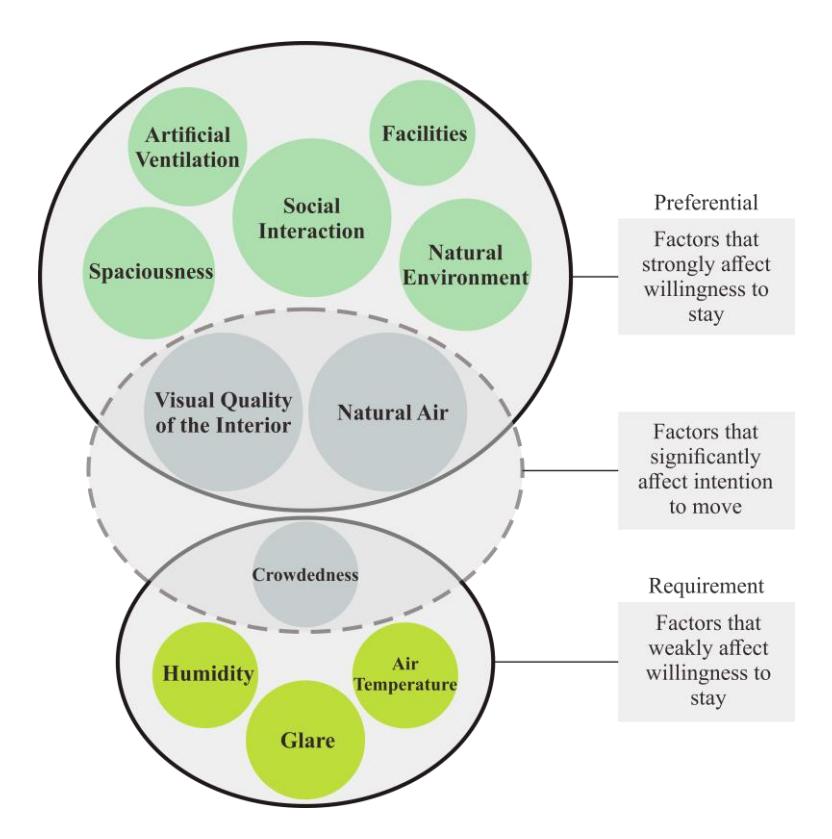
Figure 1 Model analysis result.
The factors that strongly affect willingness to stay are: social interaction, visual quality of the interior, natural air, natural environment, spaciousness, artificial ventilation, and facilities. The factors that weakly influence on willingness to stay are glare, humidity, crowdedness, and air temperature. From the two groups of factors, some factors significantly affect a person's intention to move, namely visual quality of the interior, natural ventilation, and crowdedness.
The study was conducted in two stages, namely one using exploratory methods and one using explanatory methods to ensure that the findings of this study were original. However, data collection done in this research was done using a nonrandom sampling method, the level of generalization of the findings is limited. To increase reliability, it is better if further research uses a random sampling data collection method.