

1 Introduction
Vacant, abandoned buildings are often seen as a negative presence, whereas they can also be seen as opportunities. A building we use today may still exist for at least the next 50 years. Contrary to that fact, challenges and uncertainties in social-economic conditions make the function of buildings often end in shorter periods so that they can threaten the life of the building itself. Adaptation, repurposing, reuse, and various other treatments of existing buildings are effective strategies that provide economically viable alternatives to vacant or under-utilized structures or premature demolition [1]. An unused
Received November 22nd , 2021, Accepted for publication February 2 nd , 2022. Copyright © 2021 Published by ITB Institute for Research and Community Services, ISSN: 2337-5795, DOI: 10.5614/j.vad.2021.13.2.5
building tends to have a negative impact on its surroundings by decreasing the livability and potentially increasing the crime rate [2]. In commercial areas, their negative impact will make the number of customers decrease, affecting other stores and further causing multiple other effects [3].
Permanent or long-term utilization of buildings often leads to conflicts with various stakeholders. For this reason, temporary use (sometimes called interim use, meanwhile use, or transitional use) may become a new component of urban development. In a wider perspective, a temporary transformation model can offer the ability to reconstruct the image of a city, acting as a catalyst for future change. Long-lasting buildings can serve as creative laboratories for the city and as spatial niches for producing innovations in design and planning [4]. In this regard, city policymakers need to look at this phenomenon and consider making it part of their long-term plans.
Learning from several cases in various parts of the world, abandoned spaces are often used to house creative activities and events. In Indonesia, such usage of vacant buildings frequently occurs in several cities. However, not many have been discussed in scientific articles. Research related to the use of abandoned buildings or old buildings focuses more on preserving cultural heritage.
This paper aimed to raise discussion and build knowledge about the above globally developing matters and find its relevance in one case in Bandung, Indonesia. The use of the Dian Lentera Budaya exhibition by the artist Tisna Sanjaya as a case study was considered relevant because it has the same spirit as the discourse under discussion.
2 Literature Review
2.1 Vacant Building
In their book The Temporary City, in page 19, Bishop and Williams show that cities constantly evolve, creating layer upon layer of buildings and spaces [5]. These are not built simultaneously and are always influenced by the spirit of a specific period. Within these dynamics, the fulfillment of residents' needs for physical facilities does not always run smoothly. Mismatches of supply and demand of real estate result in the emergence of buildings with no activities. They wait for a new function to come along and the wait can be short or long, or at worst, it may not happen at all. The longer a building is left empty, the more obsolete it will become.
Sometimes it is not easy to explain what is meant by a 'vacant' building or space. Differences also occur from one research to another [6]. Furthermore, the definition of a vacant space can have various meanings in different regions. Several researchers have discussed the impact of vacant buildings on their surroundings. According to Myers & Wyatt [7] it is associated with the image of unproductiveness of the area or with unemployment. Van Neer [3] raised the issue of the level of livability of an area, while Plerhoples [2] raised its influence on the crime rate.
The vacancy of a building/land can be seen as a potential, such as becoming a green open space, attracting community participation, etc. However, that can only happen if we let go of the economic point of view, which sees it only as an asset to be exploited and make a profit from. Vacant, abandoned buildings can be used for 'spatial experiments' and a source of new ideas for the city [8].
2.2 Temporary Use Defined
Temporary use has occurred in various urban areas; almost any urban location has the potential for temporary use [9]. Still, in this context, a critical thing that needs to be looked at is whether temporary use is a consideration in planning future urban development or not. Blumner [10] highlights temporary use in the context of city policy, where it is about a new perspective on urban growth. It is about how the government activates instead of regulating. It is about optimizing what is available on a site instead of seeing the space as a tabula rasa. Urban development needs to be seen as a process, not as a product.
The term 'temporary' does not imply a specific time limit; it refers to the intention of a use that is not permanent. Some temporary use cases last for only a few weeks, while others can last for years. From the building owner's point of view, the temporary use is permitted until an investor emerges. However, it is not only about the use of vacant spaces or buildings. Temporary use can also be a different use of a space for a limited time, for example, in the case of pop-up events. Temporary use provides opportunities for interaction and participation. It can also be a new component of urban planning and can contribute to the sustainable design of urban change [11].
Temporary urban sites are usually filled with activities that are more risk-taking and experimental than permanent uses, with many considerations, especially budgetary. Due to their unique and sometimes controversial nature, temporary activities are more tolerable when located in places not previously used [5,12].
2.3 Temporary Use Advantages
The benefits of temporary use are varied. REFILL [13] groups them into economic, social, cultural, and environmental values in their documents.
Economic value: the temporary function is beneficial for an asset owner who seeks a temporary use before renovating or leasing on a long-term basis. With small expenditure, the owner can accommodate a short use of the space. In addition, they benefit from facility maintenance by the tenant in exchange for a low rental fee. Another economic potential is to regenerate an abandoned space or building through a temporary function, after which it can return to the market with a higher asset value.
Social value: creating social links and binding communities are essential to many temporary uses. Social bonds can also occur through various new approaches to occupying public spaces.
Cultural value: in many cases, temporary use concerns old buildings that have historical value and strong memories in the community. Using these spaces can activate the creative culture of a region.
Environmental value: extending the life of a building and taking maximum advantage of it are relevant to environmental concerns, including temporary use. This practice also opens up opportunities for the city to optimize its building stock.
2.4 Creative Temporary Use
Currently, there has been a change in urban society, where residents are actively taking part in the city's development. In the last decade in Bandung, citizen initiatives have taken place in various parts of the city, indicating that Bandung is a creative city. Empty spaces can become creative laboratories for a city [10]. This practice goes beyond conventional urban planning. As seen in various cities worldwide, these initiatives are often spearheaded by citizens and creative communities.
Compared to other industrial sectors, the creative sector is usually small-scale, low-capital, and flexible. In other words, investment in this sector is low-risk, relatively inexpensive, and constrained, but can also bring innovation into urban planning. Creative makers have "a feel for unconventional and creative solutions" as well as experimental uses of sites [14].
Creative activity is thought to be stimulated by vacated buildings/land. Things such as their location, architectural character, previous functions, and historical value can inspire both new and experienced artists. It is believed that creative actors such as artists, designers, and architects are particularly well suited to utilizing vacant spaces temporarily [14].
3 Method
This paper reports a short research about an urban architecture phenomenon. It uses a descriptive method through the discussion of a case study. The research began with studying theories on vacant buildings and temporary use phenomena and impacts. It also aimed to learn from cases in various locations globally and their relevance to the context of these phenomena in Indonesia.
Data collection was then conducted in the interview stage. Field observations were carried out to find out the current condition of the case study object and document it. The case study analysis was carried out through the assessment of three factors taken from a part of Blumner [10]. The three factors studied were: user motivations, the actors, and the process.
4 Case Study: Dian Lentera Budaya Exhibition by Tisna Sanjaya
4.1 The Exhibition
Dian Lentera Budaya was a solo exhibition of the artist Tisna Sanjaya's from the end of December 2020 to January 2021. The exhibition was curated by Agung Hujatnikajennong, contained installations, paintings, and performing art. The word 'Dian' in the title refers to the Bioskop Dian building, which was as a medium for creating works of art. Tisna Sanjaya packaged this exhibition comprehensively. In realizing his ideas, he involved various parties, ranging from local communities, historians, architects, cultural heritage experts, and the building's owners, who also represented elements of the local government. In addition to the works of art themselves, Tisna Sanjaya made the series of preparations an integral part of the project.
Figure 1 The preparation (a) and the exhibition (b) of Dian Lentera Budaya (Source: Tisna Sanjaya & Office SA).
As a resident of Bandung who has personal memories of visiting Bioskop Dian, Tisna Sanjaya was constantly disturbed by the condition of the building, which is not being maintained. Departing from this built-up anxiety, he carried out what he called an 'artistic intervention' through the project, hoping to raise public awareness about the existence of an increasingly degraded environment. His consistency in promoting art as a practice with the power to bring about social-cultural change is reiterated in this project.
4.2 The Venue: Bioskop Dian Building
Built in 1930 (another source says 1925), Radio City (currently Bioskop Dian) was only enjoyed by a limited group in the Dutch colony, supported by its strategic location in the city center, which the Dutch then controlled. After the transfer of authority from the Netherlands to Indonesia, the building was renamed Bioskop Dian. In Indonesian, the word dian means 'enlightenment.' Since the name change in 1955, Indonesian people have watched film screenings in this building. Watching movies in theaters had become such a popular form of entertainment that there were many cinemas in Bandung, although currently few are surviving.
Figure 2 Bioskop Dian building façade: (a) 1930s, (b) 1980s, (c) 2012s – now (Source: Tisna Sanjaya & Office SA).
After ending its function as a movie theater in 1994, the building underwent several changes of function, interspersed with periods of vacancy. One significant change of function the building underwent was when in 2005 it became a futsal sports arena. This inappropriate change gradually made the building become neglected. Since 2014, after the futsal activities stopped, the Bioskop Dian building has been sporadically used by mass organizations and street vendors. Several wall partitions were added in the lobby area and used as stall booths with improvised construction. The building is categorized as a cultural heritage building category A, which means that physical changes are not allowed because of its visual architectural character in streamline art deco style. The Bioskop Dian building is classified as one of the crucial landmarks in the center of the city of Bandung. The site area is 1105 m²; the building area is 1230 m²; the building height is 12 m, consisting of 3 floors.
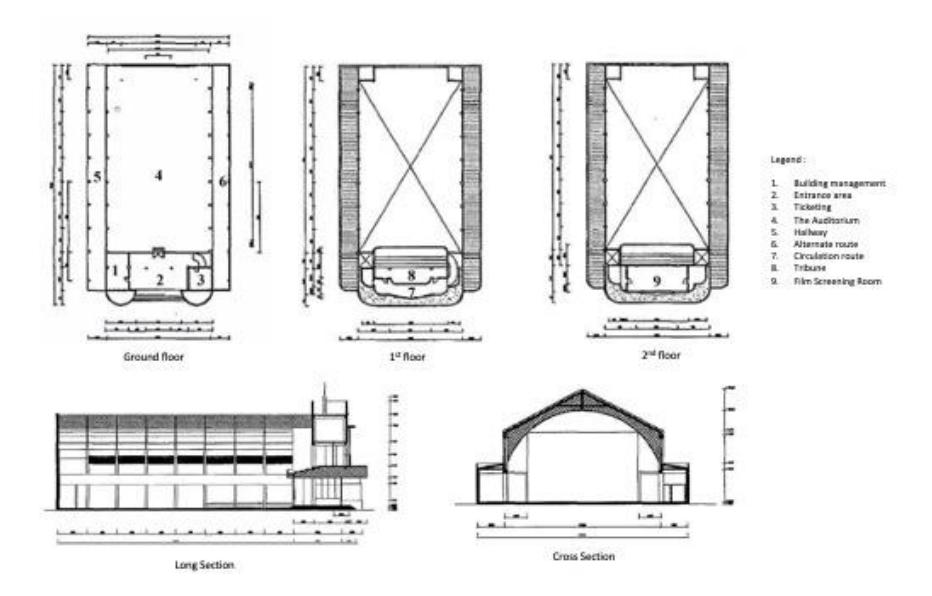
Figure 3 Building schematic layout and section of Bioskop Dian (Source: Tisna Sanjaya & Office SA).
5 Discussion & Recommendations
5.1 User Motivations
The motivation of users for finding and temporarily utilizing vacant buildings varies widely depending on the users. Entrepreneurs usually look for places with low rent for start-up development. For example, non-profit/volunteer groups tend to be motivated to strengthen the image, economy, and community of an urban area. Artists often look for facilities to create works of art or build cultural arts communities. Finally, temporary users may be looking to showcase an alternative lifestyle or wish to make a political or personal statement.
The Dian Lentera Budaya project can be seen as a medium to learn more about similar activities. The artist's motivation, which was inspired by the abandonment of the Dian Cinema building and the global destruction of nature, is an honest expression of an artist as part of the community. Landry [8] states that vacant buildings can be used for spatial experiments and expressing an artistic statement, which is relevant to the project of Tisna Sanjaya in Dian Cinema.
In return for low rental costs, creative workers can give their energy and expertise in modifying vacant spaces and attracting the public to them [5]. This manifests itself in the form of extensive publication about the activities. Local media, both print and online, have quite extensively reported about the project, thus attracting public attention.
5.2 The Actors
Bruijning [15] has revealed that three actors play an important role in the success of temporary use projects, i.e. the initiators, the end users, and the property owners. The initiators, of course, are key actors who determine the project's form, context, and purpose. Furthermore, Oswalt [16] divides initiators into three groups: young entrepreneurs who see this as an opportunity to initiate a business concept (economic context); individual actors who initiate temporary use as an expression of their passion; and small groups of people who aim to 'drop out' of society and build alternative arrangements. Initiators often do not base their intentions on commercial exploitation but have opening future opportunities through public awareness as their goal.
The end users play a role by making it possible to extract value from the temporary project; in other words, regardless of the exceptional quality of the vacant building used, in the end, the end users will determine the worth of the project.
The property owners (private or public) permit the use of their assets. Besides that, they need to consider the social impact or influence of the temporary project. If the temporary project contributes social values, it can also strengthen the economic position of the property owner, as it ensures future lease income.
Referring to the theory above, it is true that these three groups of actors played a role in the case of the Dian Lentera Budaya project. Tisna Sanjaya was the initiator; PT Jasa and Kepariwisataan Jabar (Jaswita Jabar) as municipally owned corporations (locally known as BUMD) were the owner and manager of the property, respectively; and the visitors to the exhibition were the end users.
As the initiator, Tisna Sanjaya tried to carry out the process optimally by involving various relevant elements of the community, along with a positive response from PT Jaswita as the property owner. The actors who can have the most impact are the end users. Maybe there is a difference between the challenge of using spaces in outdoor open areas and those inside a building. The exhibition took place indoors, so it was quite challenging to get the attention of residents who passed by the Bioskop Dian building. Several cases of temporary use that were quite successful and had a long-term impact occur in public
activities, and it is better if a following project similar to Dian Lentera Budaya considers the existence of complementary functions that are purely for public use.
5.3 The Process
There is no standard process for the temporary use of buildings/land, but it usually consists of several steps. First, the facility owner and the potential user need to agree on the use of the space. The owner and user then discuss details such as the use of property, the length of the contract, the rent, maintenance, and utilities. Once any permits have been obtained, the space can be used, and the project begins. In many cases, when the project is less formal or has a minimal budget, permits may not be required, and use agreements can be highly informal [10].
The initiative for temporary use projects can be top-down (from the municipality) or bottom-up (from individuals or community groups). Dian Lentera Budaya can be categorized as an informal bottom-up project. However, Tisna Sanjaya still approached the property owner, who in this case represented the municipal government (in other cases, the property owner is a private party). The preparation process for this project was holistic and gradual. For Tisna Sanjaya it was very important to get the attention of residents around Bioskop Dian. For this reason, he performed performance art by painting Bioskop Dian and painting murals on the non-permanent covering area around the edge of the building. Another representation of the community's involvement was cleaning out the cinema, in which residents also participated (Fig. 1a). Because Bioskop Dian is a historic and protected building, Tisna Sanjaya also consulted with historians and architects in implementing the project. The approaches taken above are part of Tisna Sanjaya's strategy to make the impact of this project broader and more successful.
Bottom-up action demonstrates the possibility of shaping cities through topdown planning and design actions. In addition, Bishop & Williams [5] note that creative use is difficult to make top-down because of its bottom-up nature. The prerequisites are cheap property rentals, a flexible space, and few constraints. Local government can play a role by being open to experiments; establishing clear regulations on the role that creative actors can play; and providing 'creative support' rather than control through new and flexible instruments [14].
So far, traditional urban planning has been conducted, which refers to long-term growth such as zoning and master plans. In Indonesia, instruments for future development such as Rencana Detail Tata Ruang – RDTR (Detailed Spatial Planning); Rencana Tata Ruang dan Wilayah – RTRW (Spatial and Regional
Planning); and Rencana Tata Bangunan dan Lingkungan – RTBL (Building and Environmental Planning) tend to be inflexibly designed. Creating new infrastructure and ecosystems for temporary use is a major challenge. At the same time, it is also an opportunity to develop new governance models for the administration.
Temporary use of vacant buildings or spaces requires a new form of cooperation between the government, property owners, and the community. This cooperation can improve communication between parties, or provide information on existing vacant building resources, which could be very useful for initiators who want to organize activities. Furthermore, they are aware of the need for different (non-government) parties who play a role in representing local needs [17].
6 Limitations & Future Research
Scientific research that discusses the use of temporary buildings as a strategy to activate vacant spaces has not been widely carried out in Indonesia. However, this practice has occurred in many urban areas here. This research only looked at one single case, which is not necessarily the most successful example.
Research development can be done by taking more example cases, studying the process of realization, the actors involved and their motivations, and how the local government responds to them. Other research that can be developed is conducting surveys and data collection on vacant building stock in an area or city. From this data, we can study the typology of the buildings, their distribution patterns, and the pattern of supply and demand for real estate in the area. Both future types of research are essential to get the big picture of the phenomenon of the temporary use of vacant buildings so that appropriate and responsive local government policies are developed for the interest of the community.
Acknowledgements
This paper has been accepted for dissemination at the 2nd International Conference on Art, Craft, Culture and Desain (ICON ARCCADE 2021), and it has been presented on the 29-30 September 2021 under sub-theme "Recontextualizing the Urban Ecosystem". We want to express our gratitude to Tisna Sanjaya as the artist, Agung Hujatnikajennong as exhibition curator, Artiandi Akbar and Office SA as involved architects, and Hanief Muhamad and PT Jaswita Jabar. They have given us the opportunity and their views to complete this paper.