
1 Introduction
1.1 Therapeutic Artmaking in Virtual Space
According to various art therapy professional associations, art therapy, or art psychotherapy, is a form of psychological intervention that requires several conditions, which include that the clinical sessions are administered by a credentialed art therapist. The practice involves a therapeutic alliance between the art therapist, the client, and the artworks, and is grounded in a sound theoretical framework and evidence-based practice [1],[2],[3]. In contrast, therapeutic art-making refers to creative activities that embed therapeutic elements, such as providing access to one's inner world, promoting nonthreatening uses of art media, encouraging one to gain a sense of accomplishment and empowerment, rooted in a stable setup, and allowing personal catharsis in a safe and contained way [4].
The use of technology in the art therapy profession has been slow to progress due to the fear of compromising the clients' safety and violating the professional code of ethics [5]. However, due to the current Covid-19 pandemic it has significantly increased. Zubala & Hackett in 2020 carried out a survey among 96 practicing art therapists in the UK and found that the number has grown from only 6% before March 2020 (beginning of the pandemic) to 86.9% since then. Alternatively, the use of technology in general mental health treatment has seen a steady growth, particularly in the mobile health care (mHealth) industry, driven most significantly by the Covid-19 pandemic [6]. The same report showed that the mental health sector was the fourth biggest investor in the mHealth industry, after telehealth, personal health, and fitness and sport.
During the pandemic, creativity has flourished in different forms and for different reasons, such as comfort and distraction, pleasure, insight or understanding, and to connect with others [7]. Art has also partly provided a psychosocial support in means of allowing both positive and negative emotional expression, providing a sense of control in a safe environment, altering perspectives, and combating disconnection, according to Potash et al. [8]. They further elaborated that in line with the public health psychosocial guidelines to promote expression and inspiration, to develop coping and resilience, and to monitor secondary traumatic stress, some art therapy practices can be used as facilitated self-help activity, a healthy creative routine, and a space to find meaning, respectively. Edwards [7] notes that there has been a significant increase in the UK of art material sales and access to the National Gallery's virtual tour. One notable example found in the art therapy body of literature is To [9], who uses the university platform where she works to facilitate students in making mandala for relaxation and emotional expression.
1.2 A Creative Shift in the Online Classroom
In 2020, Psychology of Art I was taken by 156 students from 14 different undergraduate study programs all over Institut Teknologi Bandung as an elective course provided by the Visual Art Study Program. The course offers insight into psychological (both cognitive and affective) processes during art creation and appreciation as well as an introduction to therapeutic uses of art. Before the Covid-19 pandemic, the end-of-semester exam consisted of a visit to an art gallery or museum to appreciate artworks and writing a report on the experience. In a previous study on cognitive aspects of students' experiences during art appreciation, it was found that using a framework modified from Housen's [10] stages of art appreciation students were able to engage with artworks, experience aesthetic empathy, and construct their narrative in a logical manner.
When the government applied strict lockdown measures at the beginning of the pandemic, the students at ITB had just passed their mid-semester exam. They had met for 7 meetings in the classroom prior to that. The virtual classroom took place on the Google Classroom platform, where pre-recorded lectures and presentation slides were sent weekly and discussions were carried out using chatting. Consequently, the end-of-semester exam had to be altered due to the closure of public places, including art galleries and museums, as well as the restrictions on non-essential travel. It was decided that art appreciation through the screen would not be appropriate, as it requires direct experience with all the artistic elements, such as dimension and texture. Additionally, we considered that an activity based on therapeutic artmaking would be beneficial for the students at that time, considering the psychological impacts the students might be experiencing. Through a survey done by the Association of Indonesian Psychiatric Medicine Specialists (PDSKJI) at the beginning of the pandemic among 1,552 respondents it was found that 63% experienced anxiety, 66% experienced depression, and 80% had post-traumatic psychological stress symptoms from adverse experiences due to the Covid-19 pandemic [11]. Thus, a facilitated therapeutic artmaking activity was designed and delivered twice, the first one as a trial, and the second one during the end-of-semester exam.
2 Methodology
This ongoing study applies a quasi-experimental design (QED) to investigate the causal effect of a therapeutic artmaking intervention facilitated by a video guide. QED in educational settings is preferred over randomized control trials (RCT) due to cost efficiency and ethical concerns [12]. However, for the purpose of the current paper, we focus on the first phase of the intervention design. This phase was done using a pre-experimental design, specifically a case study. Out of the 154 participants, 121 were selected due to their end-ofsemester exam submission in the Psychology of Art I course. Even though the course is organized under the Visual Art Study Program, the ratio between fine art and non-fine art students was 1:2.69. Our data source were the student participants' written reports submitted as the end-of-semester exam, as a substitute for the common post-test in QED research.
The design of the intervention was rooted in the practice of therapeutic artmaking. It used two art therapy techniques, namely response art [13] and aesthetic analysis [14]. We decided that the best method to administer this activity was through a video guide, which the students could access asynchronously at their convenience, mainly in view of poor internet access in different parts of Indonesia where some students may have resided. Participants used the first version of the video guide, which was made in iMovie. Student participants accessed the video guide through Google Drive, since the video had not yet been registered for intellectual property rights. The 40-minute activity was broken down into three parts following the selected techniques and for different purposes (Table 1).
| Title | Technique | Description | |
|---|---|---|---|
| Part 1 | Appreciation | Response art | The participants were asked to provide a material (music, video, photograph, painting or a memory) to appreciate for 5 minutes |
| Part 2 | Creation | Response art | The participants were asked to make art in response to material they explored before for 20 minutes, using an art medium and tools that were available and most comfortable for them, without exceptions |
| Part 3 | Reflection | Aesthetic analysis | The participants were given 9 questions to facilitate their meaning-making process for 15 minutes |
Table 1 Therapeutic Artmaking Video Guide Design.
Data were acquired using Google Classroom as the students' end-of-semester submissions. The written reports were then codified using NVIVO 12 and three were cross-analyzed with the artworks using content analysis with two raters to avoid bias. We looked for verbal indications of a coherent self-concept or selfrepresentation [15]. Diehl & Hay [16] note that an integrated non-polarized selfconcept associates positively with increased resilience and better coping skills. In the following, all names and personal attributes are obscured to protect the privacy of the participants.
3 Findings and Results
3.1 Designing and Improving the Video Guide
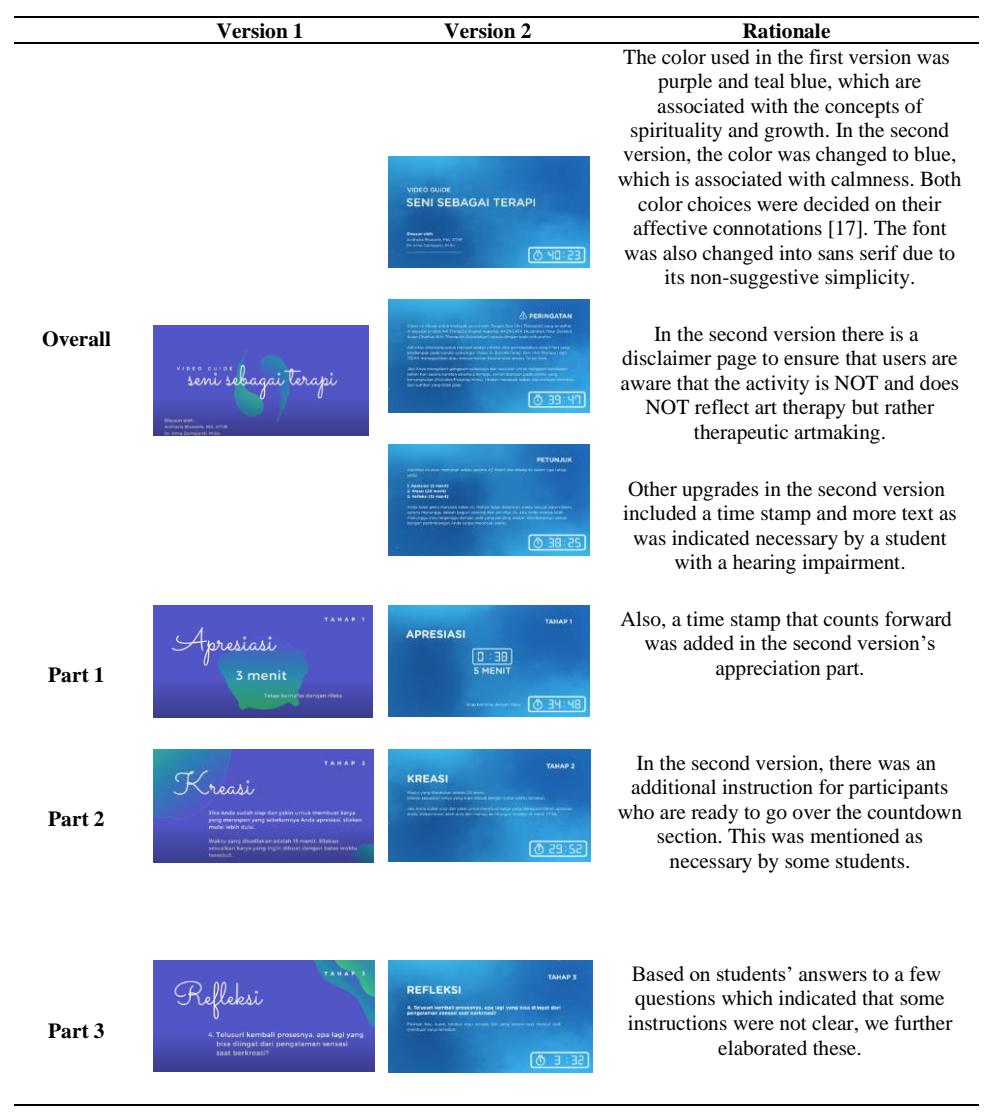
During the initial phase of the video guide design, we recorded the first version using iMovie with background music and sound available on the platform. After the first trial, the students were asked to give feedback on the video guide delivery. There were some important insights, including the use of a timer, eliminating the disturbing background sound during part 2, and some small instructions if this video were to be uploaded to YouTube. Some of this feedback was followed up on in the second version of the video guide (Table 2). Apart from visual changes, we decided to hire a professional animator and voice-over artist to execute the design for the second version. We also followed up on the disturbing background sound and changed it with music.
Table 2 Video Guide Design Improvements.
As of today, the video is not yet available publicly since it is currently being used in the Quasi-Experiment research. A link to the video is available through the corresponding author.
Meanwhile, from the written reports submitted by the students, there were some notable findings. During the art appreciation part, most students chose to respond to music (50%) rather than the other media, either in the form of instrumentals, songs with lyrics, and music videos. The chosen musical piece was generally considered to have made a special impression that evokes certain memories and emotions or was considered to represent their feelings at that time. Another popular choice was photography (45%), including nostalgic photographs, paintings, or public service advertisements. There were also students who chose to only listen to the sounds of nature around them (5%), such as raindrops, birds chirping, and wind blowing through the trees. Those who chose music wrote that music is a familiar art form that they appreciate daily and provides a wide space for the imagination, whereas visual artworks tended to be considered as heavily influential to a degree that they limit the imagination.
Using NVIVO 12 on the written reports, we were able to find verbal indications of positive self-representation, including resilience, coping skills, ideal self, and positive emotions. Figure 1 shows that indicators of resilience were the highest in number. The code uses words such as 'bouncing back' (bangkit) and 'change' (berubah). Coping skills followed in second place, which is attributed to words such as 'tired' (lelah), 'loneliness' (kesepian), 'stress', and 'conflict' (konflik). The third group is ideal self, which is associated with words such as 'able' (mampu) and 'ought to' (seharusnya/sebaiknya). Finally, positive emotions were found indicated by words such as 'happy' (senang) and 'relieved' (lega).
Figure 1 Hierarchy map of positive self-representation indicators NVIVO 12.
During the creation part almost all students with a background in fine arts reported no problem when asked to produce their appreciation piece and were able to promptly express their feelings and thoughts in the form of visual art. They were also more fluent and flexible in choosing a variety of materials and techniques, such as pencils, ballpoints, crayons, and watercolors, despite using them for the first time. One student wrote: "When I create, I really communicate with myself and can re-experience the feelings I imagine. My mind feels focused and seems to move on its own to express feelings through color and brush strokes. The interesting thing that surprised me was that I didn't hesitate to slam the brush, even forcibly removing the watercolor box just to get the desired texture and color. This I have never done before because I always take care of drawing tools carefully. When I look back after the process, I feel like I have conveyed emotions well."
It was however different for students with non-art backgrounds. In their written reports, most stated that at first they hesitated and lacked the confidence to make art because they felt they neither have artistic talent nor skills. They required a relatively longer time to get used to it, until finally they were able put aside their doubts and move on to enjoying the whole process of creating expressively. One student commented: "At first, I was confused about what to create, because I didn't have any ideas and am not a person who makes art often. I can draw but it's so-so. The tools I use are also limited; only what I can find in the room. There were too many things going through my mind, it made me panic and at first forced me to plan an idea. However, when I could relax and looked back at the photo [I was appreciating], the memories of my friend and the incident replayed, and I started to draw abstracts without planning."
Even though they have various backgrounds, during the reflection part all students were able to follow well the aesthetic analysis, some even wrote with detail and sharpness. They were also quite well able to interpret their own process and most even wrote that at the end of the process they felt a sense of pleasure and relief because they could channel bottled up feelings and thoughts – generally negative and stress-inducing ones – into safer and healthier activities.
We were also able to indicate various sources of stress experienced by students, which included the loss of loved ones, poor communication and/or relationships in the family, lack of self-confidence, education, the future, and the general Covid-19 pandemic, which had caused them to feel lonely, alone, and to lose many precious moments. One student wrote, "Because of Covid-19 I have seen all these ordinary things become something special and meaningful. As the saying goes, 'You don't know how much something is worth until you lose it.' Does this floor feel the same as the floor at my boarding house? This wall that
I'm staring at, is it different from the campus wall that I usually stare at? There was no sound around me, unlike the crowd in my friend's boarding house. Why does everything feel so far away? For a moment I felt alone. I used to do all these things every day, and now I can just sit in my room, trying to remember all these things." Another student wrote, "The portrait of my boarding room brings back such a calm time. The room symbolizes happiness. Without realizing it I felt sad because I compared my current condition during the pandemic and before the pandemic in Bandung. Anxiety, panic and fear. I'm afraid of what's to come this year. I am afraid of the outcome of my final project and I feel unprepared to take my life to the next level. So much has changed in 2020 and I'm not sure I'm ready."
Here are some examples of works and reflections that illustrate how at the end of the process students had the ability to acknowledge negative emotions, deal with pressures and difficulties by developing positive emotions towards themselves and build a more integrated self-concept.
About their artwork (Figure 2), the student wrote, "The title I want to give for this work is 'Open Your Eyes, Look Around'. I feel this work sends a message for me to stay calm and that everything will be fine. Even though there is so much pressure I feel, I just have to go through it all and enjoy it. Anxiety and restlessness will always be there, but I just need to accept them because the negative feelings that often haunt me are a part of life that I can't just throw away. If I feel stressed, I can 'open my eyes' and then look around and find peace from the pleasant things that must be around me."
Figure 2 Female – Art/Design Student, Buka Mata, Lihat Sekitar (2020), pencil on paper, 14.8 x 21 cm.
Figure 3 Female – non-Art/Design student, Student's 2020 in a Nutshell (2020), pen and marker on paper, 29.7 x 21 cm.
Another student wrote about their artwork (Figure 3): "This work is trying to tell me that everything will be fine. The year is not over yet and I will be able to deal with it. This work reminds us that the laws of nature are certain. Where there is sadness there must be joy. It's okay to be unproductive for a moment and things should be at my pace. One step at a time. This work says that all feelings of nausea, anxious, and nervousness are a burden given to me by myself. There is no one else who puts pressure on me and everything has to be done."
As the last example, a student wrote the following reflection on their artwork (Figure 4): "Don't think too much about something that can make me more stressed or depressed because everything will be fine. Don't let life make me sad because in the end happiness is always there because I let it. Focus on the little things that can make me smile and laugh so that happiness can always be with me. And believe me, every moment in my life has a meaning and in the end it will become a beautiful memory."
Figure 4 Male – non-Art/Design student, A Soothing Night to Feel Right (2020), watercolor on paper, 20.3 x 12.7 cm.
4 Discussion
The examples above and every reflection piece indicate positive results from the therapeutic artmaking process through the video guide facilitation, especially during the Covid-19 pandemic. Through the process of creating and reflecting, students learn to see themselves as an integrated person, respect themselves, and build hopes to be better. Most of the students admitted that they had positive impacts from these activities: "The making of this work made me feel the benefits of art therapy, especially the regulation of body and mind when listening to songs, and tolerance for emotions during the process of creating"; "From the experience of art as therapy. In this way, I can deal with the event better and stop avoiding it; also tolerate the emotions it causes and accept it. Indeed, these feelings and emotions cannot be eliminated but they can be used as reminders to be better."
There are at least three mechanisms that allow this to happen. Firstly, the materials they choose during the appreciation part were something closely related to them. Secondly, in terms of creating response art, the artwork becomes a container of the artist's expression [13]. Students experience the pandemic in different ways and some quite intensely, hence their choice of material to appreciate gives them a an alternative structure for safe expression to be contained in the artwork. Arguably, this is an important characteristic of distant therapeutic artmaking, where participants are left on their own to express their feelings and thoughts. This is due to the paradox of expression in art
therapy, where the therapist has to find the safest way for people who carry with them bottled up feelings like a ticking time bomb, and the most beneficial way for people to work on their emotions through expression [18].
During the reflection part, some of the questions in the aesthetic analysis [14] facilitated students to think further about their emotions and process them. The set of questions opened with a couple that help them become aware of the process as a mind-body integrated experience. One question directly correlated with the concept of resilience: "Did you have any difficulties during the artmaking process? How did you overcome it?" The last ones acts as a mirror that students can use to gain insight from themselves, for example: "If the artwork could speak, what would be its message for you?" These questions help students to build a more comprehensive self-concept, indicated by nonpolarized integrated self-representation ("These feelings and emotions cannot be eliminated, but they can be used as reminders to be better"), and self-regulatory functions ("The regulation of body and mind when listening to songs, and tolerance for emotions during the process of creating") [16].
5 Conclusions
Elements of art therapy could be used in therapeutic artmaking that is facilitated remotely through a video guide to increase access to self-help during the Covid-19 pandemic. Theoretically grounded steps allowed the participants to express themselves in a safe way and to develop a healthy creative habit. This mechanism was established through a good structure that led to an integrated self-concept as a way to increase resilience and better coping skills. However, rigorous study is needed to comprehend how it worked, why it was effective, and how it could be replicated. We are hopeful to finish the QED study at the end of this year and deliver the results.
Acknowledgements
This paper has been accepted for dissemination at the 2nd International Conference on Art, Craft, Culture and Desain (ICON ARCCADE 2021), and it has been presented on the 29-30 September 2021 under sub-theme "Community for Resilience and Well-Being". This study is fully funded by Penelitian, Pengabdian Masyarakat, Inovasi (PPMI), Faculty of Art and Design, Institut Teknologi Bandung, 2021.