

1 Introduction
Design education teaches students the ability to design and solve problems. Design education is important for the individual to think through, construct, and interpret the design problem from different perspectives. Besides that, they also learn abstract thinking, questioning, wondering and dreaming, and making connections between the dots [1]. In design schools, students are asked to
Received November 22nd , 2021, Accepted for publication May 18th , 2022. Copyright © 2022 Published by ITB Institute for Research and Community Services, ISSN: 2337-5795, DOI: 10.5614/j.vad.2022.14.1.4
consider why and how to solve problems. To help them, they should always be given stimuli through various cases, so that they can see the creative process of other designers or architects. Interior designers will deal with various spatial problems, from simple to complex, regarding the built space and how to find the most appropriate solution for the users. Students should be able to understand the design and actively participate in the organization of the design, which is created based on visual thinking [2]. Students will translate abstract ideas based on their observations into concrete form, such as sketches, mockups, and walkthroughs.
The curriculum in the Undergraduate Program of Interior Design of Institut Teknologi Bandung, Indonesia is arranged to enhance student creativity by gradually introducing problems, from simple ones, such as apartments, to more complex ones such as public spaces; from single rooms to museums, hotels or airports. Interior design studio courses take cases of spatial problems based on the complexity of the user characteristics, needs, functions, and systems that occur in them (Figure 1).
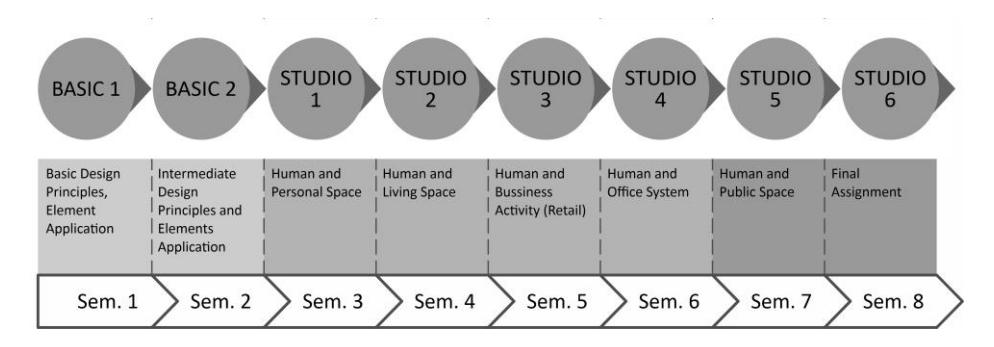
Figure 1 Diagram of the Interior Design Study Program's curriculum.
The first-year studios, introduce newcomers to the fundamentals of art and basic design elements and principles. They experiment with dots, lines, planes, colors, and materials to create dynamic, symmetric, and contrasting compositions. The second-year studios explore spatial compositions and simple problems related to human interactions with space. Individual user preferences within a space become the focus in producing designs. The third-year studio plays a lot with the image and branding of public facilities, such as how to translate corporate identity into a design. Finally, last-year students design an interior for a public facility while considering various aspects, such as environmental, social, cultural, and material aspects, with the aim of increasing regional or traditional values.
The education domain is usually divided into three categories, i.e., knowledge, skills and attitude. According to Bloom, education is tri-polar in nature. There are educational objectives, learning experiences, and changes of behavior [3]. These three are the main objectives to be achieved in the curriculum through courses and learning outcomes. Every student, by completing the courses given, should acquire new technical abilities (skills), understanding of a particular topic (knowledge), and how to be professional (attitudes).
Graduates of the Undergraduate Program of Interior Design, ITB are expected to have the basics design skills to become a professional who has the following competencies: having a specialization in interior design, including spatial principles and elements, knowledge and skills built in the design studio course; being fluent in technology; having synthesis capabilities; and other related competencies based on personal interest. Therefore, the methods and activities of interior design schools must be objective centered, with the students as the main actors while the lecturers act as facilitators. The main purpose of the present research was to improve the teaching method in design courses with multi-disciplinary students in a higher educational institution by taking the case of an exhibition design course.
2 Literature Review
2.1 Exhibition Design Process
To give students a good understanding of the ins and outs of exhibition design, they must first know about the various stages involved in preparing an exhibition design. Exhibition design is about the planning of interpretative spaces because it is a simultaneously networked, dialectical process, one which develops in a dialogue between verbal-conceptual and visual-representational rhetorical techniques [4]. This is different from the scientific method, which involves systematic observation, measurement, and experiment [5]. This process will determine the relationship between the observer and the exhibited objects through the information provided.
Problem Identification → Concept → Design → Planning → Production → Implementation
Figure 2 (Exhibition) design process [4].
Each stage in the exhibition design process requires skills that a designer must possess. It is important to remember that a collection of objects does not make an exhibition. It is only when objects are carefully selected to illustrate a theme and tied together by a narrative or other relational threads that they become an exhibition [6]. The success of an exhibition is not only based on the aesthetical
spatial arrangement of objects, but also on the relationship between these objects and the visitor [4].
2.2 Exhibition Design Course
The Exhibition Design course (DI3005) is a two-credit elective course at the Undergraduate Program of Interior Design, Institut Teknologi Bandung, Indonesia. This course, which is offered every semester, is intended for thirdand fourth-year students from various majors related to design, especially exhibition design. The expected learning outcomes (LO) from this course are that the student knows about the background of exhibition design, can identify exhibition design problems and systems, and can collaborate with people from other disciplines.
As part of the spatial/interior design discipline, exhibition design finds itself on the intersection of art, design, and architecture. Architecture provides the exhibition venue, interior design creates the exhibition atmosphere, and art can provide objects or subjects that provide the final touch. This is the reason this course is open to students with a background in any of these disciplines. This course prioritizes an activity-based method, which requires students to be active in discussions, collaborations, and initiatives in the classroom.
Collaborative processes in the classroom need to be carried out within the context to better understand each other's culture [7]. The lecturer can facilitate collaboration through active and connected learning, interacting with students in the classroom (during the pandemic in online classes). The objectives are to demonstrate that the student's performance improves with attendance, engagement, performance, and learning outcome.
How then, can the lecturer effectively facilitate collaborative learning in the classroom? All activities in the exhibition design class use simulations as if the student enters an exhibition or museum. According to the International Council of Museums (ICOM) [8], "a museum is a non-profit, permanent institution in the service of society and its development, open to the public, which acquires, conserves, research, communicates and exhibits the tangible and intangible heritage of humanity and its environment for the purposes of education, study and enjoyment." The atmosphere in this class is also conditioned so that students can learn in a pleasant way without reducing the quality of learning.
The purpose of designing a museum exhibition is to affect the visitor experience of discovering meaning in the objects on display. Visitor apprehension of the museum exhibits is central to the success of the design. Modes of visitor apprehension in a museum context can be divided into contemplation, comprehension, discovery, and interaction [9]. This division can also be applied in class activities (Table 1).
| Model of Apprehension | Туре | Characteristic | Class Activities | |
|---|---|---|---|---|
| Contemplation | Aesthetic | Individual perception of specific works | Discussion; observation report; sketching, etc. | |
| Comprehension | Contextual or thematic | Relational perception of object in context or in relation to a theme | Material delivery; discussion; Quiz; presentation; sketching; designing, etc. | |
| Discovery | Exploration | Explorations of objects grouped by category | Case study; benchmark; observation, etc. | |
| Interaction | Live demo; multimedia | Kinaesthetic response to stimulus | Virtual tour; video playback & discussion; video making. | |
Table 1 Model of student apprehension.
2.3 Course Assignment Details
Five main assignments are given during one semester. Each task is coded as T (T for task) followed by the assigned task number, for example T1, T2, T3, etc. These assignments are simple simulations of the exhibition design process using a role-playing method. Each student plays a different role, such as exhibition visitor, designer, curator, or museum content maker (expert). The concept of role play helps students in developing a mindset and making good decisions, and, in this context, producing problem solutions according to the assignment. Role-playing is an active teaching method, where a teacher elaborates a fictional situation in which the student takes on a role to decide, create, or solve something [10]. Using this method also teaches students (designers) to become integrators, who in the process develop stories [11]. The objects used in each task are varied, adapted to daily events experienced by the students, to make it easier for them to make decisions and find solutions. In this case the objects are public transportation and traditional food (Table 2). There is no specific connection between the objects in each assignment, which has the aim of enriching the students' understanding of various topics related to exhibition design.
2.3.1 T1 Angkot Experience
In the first assignment, students were asked to recall their impressions and experiences using public transportation. The mode of transportation used in this assignment is public transportation (angkot). An angkot is a mode of public transportation that is found in many cities in Indonesia and has a positive as well as a negative reputation among its users. The question of this task leads to the student's impression about the angkot and things related to it.
2.3.2 T2 Traditional Food Stall Design
The second assignment is divided into two sessions. In the first session students are asked to choose a traditional Indonesian food. Next, they identify the most important elements and characteristics related to the food, in terms of taste, shape, color, aroma, cooking method, the equipment used, etc. Then, in the second session, supposing that the selected food will be included in an international food expo, the students are asked to make a food stall design that has the characteristics of the food.
| Assignment | Roleplay | Brief | Goals | |
|---|---|---|---|---|
| T1 Angkot User (passenger) Experience | Share experience about daily topic | To explore the student's knowledge | ||
| T2a Favorite Traditional Food | User (consumer) | Decide most favorable traditional food | & experience about the topic | |
| T2b Traditional Food Stall Design | Designer | Design traditional food display and exhibition booth | To generate 'out of the box' ideas based on the topic | |
| T3 Object ID | Curator or collector | Object ID: observe and document daily kitchen utensil | To learn how to identify and treat potential objects | |
| T4 Re-design Museum Display | Interior designer | Redesign museum display based on actual case | To enhance the student's design skills and creativity. | |
| T5a 3 New Museums in Indonesia | Government (decision maker) | Decide three out of ten new museums proposals from each | Learn to decide based on the situation | |
| T5b Museum Video Content | Museum expertise | Make museum content related to the topic | To enhance the student's skills and creativity | |
Table 2 Exhibition Design Course Assignment Scenario.
2.3.3 T3 Object ID
In T3, following the pattern found by the J. Paul Getty Trust (ICOM) in identifying objects, the students are asked to look for an everyday object related to kitchen utensils (still related to T2). This task follows the steps taken to identify an object using the Object ID tool [12]. Object ID was created as a practical tool for facilitating the recovery of stolen cultural goods and is now internationally recognized as a necessary and effective tool when inventorying collections. The nine information categories of Object ID are: Type of Object, Materials & Techniques, Measurements, Inscriptions & Markings, Distinguishing Features, Title, Subject, Date or Period, and Maker [13]. The purpose of this assignment is to hone the student's ability to see and observe the value of an object. The stages of work carried out were: documenting the object, identifying the details of the object, and providing a brief description [8].
2.3.4 T4 Re-design Museum Display
In this assignment, the students are asked to increase the value of a museum by redesigning a display. Displays that initially seem static or conservative must be brought to a more interactive direction by involving user-object engagement. The museum that was used as the object of study was the Bandung Geological Museum, which is located close to ITB's campus. Due to the pandemic situation, observations were not carried out directly but only through online surveys and the past experiences of each student.
2.3.5 T5 New Museum in Indonesia
In the final assignment, the students are asked to fill out a questionnaire and choose three out of eleven new museum proposals for different cities. They should act as a decision maker (government), who must consider various aspects before deciding. The results of the decision are then used as material for the next task, namely making video content for use in the museum. The video can be made using various methods, whether in the form of a live report, a demonstration, storytelling, an animation, stop motion, a newscast, and others, according to the abilities and scientific background of each student. The students' logical and technical thinking skills are tested in this assignment.
Besides the use of the role-playing method, the above tasks indirectly aim to increase the student's sensitivity or awareness towards various things and conditions around them. This sensitivity is one of the abilities that must be possessed by a professional designer. By having good sensitivity, designers can easily see small things and use them as the basis for producing a design. Through these assignments, the material presented is not only limited to theoretical comprehension but also aims to increase the student's understanding of the problems surrounding exhibition design [3].
3 Methods
The objective of this study was to describe a reflection on the Exhibition Design course (DI3005). There were 118 students involved in the class activity session in the 2020-2021 academic year (Table 3). As a note, this lecture was held during the Covid-19 pandemic so that the types and forms of assignments were designed considering the limitations that students may have during online classes.
This research used a descriptive-exploratory and documentary-based qualitative research approach [10], using the assignments and student submissions from the Exhibition Design course. The analysis of the data followed the steps of sorting, group classification by category/relevance, and result interpretation. All the students' assignment submissions were sorted and grouped by category and then analyzed based on the trends of the answers.
No Background 1 st Semester 2 nd Semester Total 1 Architecture 55 5 60 2 Art 1 - 1 3 Craft 2 9 11 4 Interior Design 9 27 36 5 Product Design 1 2 3 6 Graphic Design 1 6 7 Total 118
Table 3 Student Demographics.
4 Experimental Results and Discussion
From the results of task T1, the student acted as passengers/users of the angkot, recalling their past experiences. The response was in the form of keywords (Table 4). Angkot is often considered to have a negative reputation, but from this result it turned out that many students had positive experiences using angkot.
| No | Keywords (adjective) | % | Keywords (noun) | % |
|---|---|---|---|---|
| 1 | Cheap | 24.3 | Cars | 33.3 |
| 2 | Narrow | 18.0 | Colors | 29.1 |
| 3 | Speedy | 9.7 | Driver | 25.0 |
| 4 | Reckless | 9.0 | Seat | 6.2 |
| 5 | Friendly | 6.2 | Passenger | 4.1 |
| 6 | Orderly | 4.1 | Stickers | 2.0 |
| 7 | Clean | 2.0 | Other | 0.3 |
| 8 | Wide | 1.3 | ||
| 9 | Quiet | 1.3 |
Table 4 Angkot experience result (T1).
These results indicate that the students had good observation skills related to past experiences so that they could successfully produce keywords. In the design process, these keywords can be used as a guide in drafting the concept. In the future, this task has the potential to be extended by giving a design assignment, for example for a museum exhibition.
From the results of task T2, the students succeeded in making food stall designs using the specific elements from each menu. T2 made the students act in the position of an exhibition booth designer. This task also sharpened the students'
skills in making sketches to transform abstract ideas into something visual. They learned to deliver information to others. Each design was given a brief description, referring to the materials used, how to use it, its shape, etc. (Table 5). In designing an exhibition object, one must consider the five human senses (vision, hearing, touch, smell, and taste) as aspects that can be stimulated.
Table 5 Traditional Food Stall Design (T2).
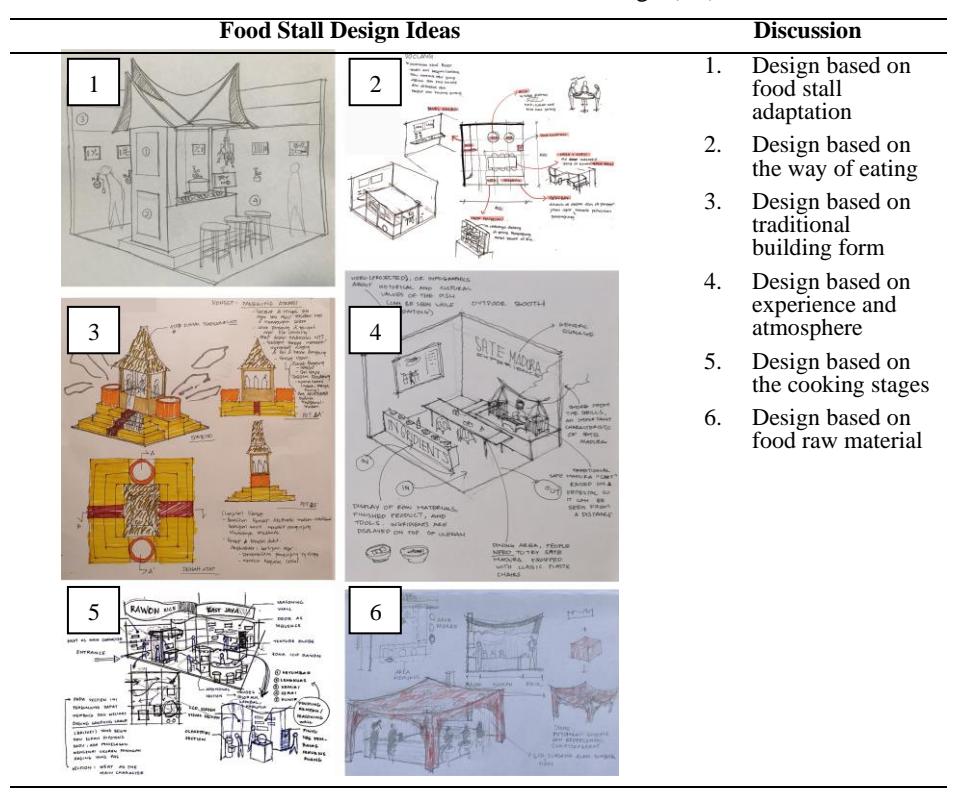
The result of this assignment was that the students took several elements related to menus, cooking utensils, spices, and local culture and made them into design elements. Thus, each traditional food could be identified from the booth design.
The results of task T3 (Object ID), the students managed to observe and identify objects related to food around them. The quality of the documentation produced was mostly very good and provided clear information about the details of the shape and color of the objects. The description of the objects was represented like a museum caption, without any personal information in it (Table 6). Everyday objects that are often found in the kitchen, from saucers to teapots that are not usually seen as special items, must be documented and described in an interesting way.
Table 6 Student's Object ID (T3)
Student Student Picture Picture Description Description A handmade bowl This cube-shaped produced by woven bamboo Leonhart Studio, container is made using the commonly used by throwing method Javanese people to as a unique store kitchen spices creation so that in, such as shallots, garlic, galangal, there are no similar products turmeric, and so on. other than the bowl. Ahmad Tea Mini Cobek refers to a London Bus Tea bowl-like base and pestle refers to an Caddy is a tin can object like a club. for storing black This tool serves to tea leaves mixed pound, grind, with Bergamot, better known as pulverize, grind, Earl Grey, which and mix spices, is a tea that has herbs, and other played an ingredients. important role in the history of tea in England. Saucer with vintage This knife set consisting of five motif printed using knives is made of blue ink. This marble. The saucer is part of a advantage of this tea set series material is that it produced by is light when used Japanese but still sharp and manufacturer does not absorb Noritoki, which odors. This knife was released on the set includes a chef market in 1994, is knife, slicer knife, heat resistant, cold bread knife, resistant, and utility knife and microwave safe. paring knife.
In task T4, the students tried to identify display problems in the Bandung Geology Museum. Then, through reference and benchmark studies related to various museums around the world, they tried to add value to the display by utilizing technology and visitor interaction (Table 7). The experience of space was the main point chosen by most students. How visitors interact with objects and spaces will determine the overall atmosphere of the museum.
Table 7 Re-design Museum Display (T4).
Museum Display Ideas
Finally, task T5 consisted of two related sessions. In the first session, the students chose three (fictional) proposals for museums to be built. The museums selected were: an Indonesian Folklore Museum (20.8%), a Traditional Game Museum (16.7%), and a Traditional Food Museum (11.7%). Factors that were considered in choosing a museum included the potential experience that visitors will get (24.2%), public interest in the theme of the museum (20.8%), and the diversity of content that may be displayed (20.8%). From the results above, the students thought that museums established in Indonesia must promote local values and elements, as can be seen from their choice of folklore, traditional games, and traditional food, because Indonesia has considerable
potential in these three fields. Meanwhile, most students thought that museums should be able to provide experiences to their visitors through the themes and content displayed. In the second session they were asked to make a video that would be used as exhibition material in the museum. The students creatively made videos, from live demos to stop motion animations, by considering that the information presented should be interesting for the visitors.
Through tasks T1-T5, the students carried out a series of processes that are needed in exhibition design. They were trained to have good observation skills in identifying elements (T1, T2), exploring unusual ideas based on topics (T2, T4), describing and documenting objects well (T3), as well as making video content that deserves to be displayed as content in an exhibition (T5).
5 Conclusion
Creativity-based lectures should provide stimulation to students to think and act based on their knowledge and skills. One of the important things for students is the experience gained from the various activities in the classroom, such as presenting material, discussing, collaborating, and solving problems. It is the task of the lecturer as a facilitator to provide stimulation that students can respond to. This is what the Exhibition Design course tries to do by giving various assignments, which involves a variety of exhibition-related roles, so that the students continue to be active and are always curious about the next meeting. Moreover, when this study was conducted, the Covid-19 pandemic situation occurred, so that classes were carried out online. The task of the facilitator thus became more challenging to maintain a good class atmosphere by creating interactive activities to make the class active and successful.
In general, the students responded positively to all the given learning methods. As evidenced by the diversity of the results collected, the online nature of the classes did not prevent the students from generating wild and creative ideas. The results from tasks T1 to T5 in this course indicate that there is always something new that students and lecturers can learn. Each assignment gradually tried to increase the students' sensitivity and awareness of the things around them. Basic design skills such as sensitivity, the ability to observe, and the ability to express ideas in visual form are the goals of learning in the classroom. The discussion process at the end of each assignment session also provided a comparison of a student's position compared to the other students in the class. This role-playing method can be an alternative that can be used by other courses with their own unique characteristics. In the future, this method will continue to be further developed with various cases and different approaches while trying to find the most ideal form in the classroom.
Acknowledgement
This paper has been accepted for dissemination at the 2nd International Conference on Art, Craft, Culture and Desain (ICOM ARCCADE) and has been presented on the 29-30 September 2021 under the theme of Human-Centered & Social Interactions.