

1 Introduction
1.1 Background
Cultural semiotic products undergo discourse, design, production and distribution. These four domains of semiotic practice according to Kress et al. [1] are the framework for the development of 'meaning potential' in a semiotic mode (means of communication) from a semiotic medium (communication channel). These domains pose challenges related to specific articulations and interpretations of a visual language, because the discourse that users may get from a semiotic product will be drawn from their own socio-cultural biases or experiences. Design and production oftentimes affect the product context, while distribution influences the intent awareness of design from local and even global market consumers. This argument is due to the diversity of experiential expressions across culture and the lack or impossibility therein of universal lexical inventory to visual and/or verbal texts, according to Lloren [2]. This is problematic because the establishment of conventional stability of meaningmaking in designs is driven by authoritative and domineering Western concepts in design. Tobin [3] has argued that when 'the West' encourages Western culture, it is an act of officiousness, but when the same inventiveness is applied by 'the East', it is always the subject of ridicule and seen as an act of self-exoticism initiated by a sense of inferiority.
Wang Jie [4] points out notions of hegemony in design when she discusses how Western designers immerse themselves into Asian cultures to come up with products of which the cultural connotations do not come from their own experiential expressions. For example, Hans Weigner, a Danish designer designed the 'China chair' in 1945 using Ming Dynasty Chinese traditional symbols. The chair was a new interpretation of a Chinese traditional decorative design, which deprived local Chinese designers of their own original, authentic design concepts and approach of the design itself. Without a proper understanding of the foreign culture, it is probable that designers who are outsiders will commit cultural appropriation when using indigenous design elements.
This has been a problem for local designers when it comes to incorporating cultural design experiential expressions into a product (idea, product, or service), according to Rose [5]. The modern conceptualization of meaning-making in design using cultural signifiers tends to be more varied, albeit exclusive, according to Barthes [6]. In product design, utilizing cultural elements for commercialization, production, and consumption is no longer just economic behavior but a deconstructed form of code consumption, according to Lu-Jau Hui et al. [7]. Although Filipinos show a colonial mentality in design, there are culturally literate markets that challenge Western concepts through Philippine art and design. Thus, there should be a conscious consideration of culture in the local market and consequently in the global market, where the culturally literate market of the Visayan culture resides in the Philippines or in a Filipino diaspora, who in a sense have lost the sense of rootedness in their own unique culture and traditions because of the extraordinary connection between consumption and culture, in the research conducted by McCracken [8].
1.2 Context
As this research's material of investigation, Pintados tattooing, a cultural practice in the Philippines, particularly in the Visayas region, embodies the discrimination and hegemony imposed by Western people. Pintados is a word coined by the earliest chroniclers as a reference to Filipino people who tattooed themselves. Pintados is a Spanish term, which means, 'painted (tattooed) ones' [9]. Pintados tattooing as part of the 'Filipino Visayan culture' was considered savage, exotic and unholy, a practice instigated by priests, thought by early missionaries to be an aid of the devil. Pintados tattoo designs can challenge the Westernization of art and design if they transcend regional and national borders by re-introducing them as a 'global cultural product' [10]. This can only be done through careful examination of the designs, so the original and core narratives will remain untarnished or only slightly diminished when the designs are transferred to a different medium (e.g. furniture). It is safe to claim that using Pintados tattoo designs is a viable design idea because of the vast literature that supports 'cultural consumption', including the selective borrowing and purchasing of cultural content [11], multi-cultural consumption [12], and cultural globalization [10].
Although the imposition of a hegemonic Western perspective on culture, and particularly design, is eminent in modern times, the idea of the cosmopolitan, or 'citizen of the world' [13], emerged due to globalization, thus creating 'global cosmopolitans' who search for cultural adventures and cultural differences and are attracted by curtailed folk images, expended by locals as well as foreigners [10]. These people consider themselves and their pursuits as something cultural at a trans-societal or trans-national level [14]. Thus, being cosmopolitan is a state of mind or perspective. Global cosmopolitans have the unique characteristic of identifying with other cultures through observation, intuition and reflection. Carrying the culture of the Subaltern ('Other') sometimes makes cosmopolitans become brokers, entrepreneurs or profit makers [10, 15]. Moreover, depicting 'the Other's' culture as 'display' has always happened within the limitations of colonial boundaries or cultural ascendancy (semiotic hegemony), according to Hall [16].
In addition, this study also focused on the attached 'cultural blueprints' [8], or 'cultural codes' [17] of Pintados tattoo designs, at the same time considering the designs as cultural products that not only cross regional/national borders but are in direct relationship with industrial producers and social groups in mass culture [18].
1.3 Purposes
The aims and objectives of this study were the following:
- 1. To investigate, analyze and integrate the cultural codes of Pintados tattoo designs in a cultural product (furniture) to promote their culture and heritage. This is to propose to local designers how they can engage in conversations with local consumers, a culturally literate market, and/or the global cosmopolitans mentioned in Section 1.2 in order to achieve a more culturally adept and ethical consumption of Pintadostattoo designs. The cultural consciousness of the Visayan market must be considered before the Western mindset (which is systemically hegemonic) enters the local Visayan art and design scene and appropriates our own understanding of how we should interpret Pintados tattoo designs.
- 2. To do a market survey using a search engine with a product analysis to point out the product to be created and innovated based on the hypothesis that cultural codes can be obtained from a semiotic analysis.
- 3. To examine consumer culture (e.g. customer feedback) and do a simple semiotic analysis.
- 4. To discuss the results and propose future topics of study.
The research questions were:
- 1. What are the changes concerning visual cues or cultural codes in relation to Pintados tattoo design's meaning-making when they are transferred from the physical body to an external cultural product?
- 2. How do we assess and analyze Pintados tattoo design's cultural codes to translate it into customer requirements in a cultural product (furniture)?
- 3. Is there a significant difference in semiotic meaning potential between semiotic media between the physical body and an external cultural product?
- 4. What recommendations can be made based on the findings of this study?
1.4 Significance and Scope
Integrating the interpretation of Pintados symbolism into the furniture design research was important because: (1) it gives an avenue to introduce this cultural tradition into new art forms that will give nation-wide attention to Visayan artistry, which could enhance export potential; (2) it repurposes the traditional and presumably extinct practice of Pintados tattooing to (re)define Filipino
identity; and (3) it serves as a source of national pride of the Philippine's cultural resources and ostensibly creates a positive image of the Visayas region among foreign nations as these designs circulate within and outside the country.
In addition, exploring other cultural symbols outside the researcher's and research participants' lived experience or cultural consciousness was challenging, because the meaning-making process may not have been appropriate for this study. It is also time to go back to our Filipino sense of rootedness, to eventually provide an opportunity to democratize Visayan designs. A point of correspondence was found between Pintados symbolism and furniture design in a new vision to analyze the paradigm shift of meaning, the content of the subject, and the research methods. The result of this study will be helpful in market research for local artisans and students, especially designers of furniture products, as a reference to carry out relevant exploration of practical designs with a detailed elaboration and demonstration of the role of semiotics in art and design.
This study integrates traditional and modern perspectives through design research on a furniture product design that applied the symbolism and sign system of Pintados tattoo patterns and used the theory of semiotics as well as its tools to explore furniture product design methods. This was done with the purpose of finding new strategies to convey design information that is scientific-based to more accurately introduce the background and cultural connotations of Pintados tattoo patterns to the design arena so as to meet modern consumers' needs related to design products.
2 Review of Related Literature
2.1 Pre-colonial and Contemporary Cultural Connotations of Pintados Tattoo Designs
In the pre-colonial past, the visual cues and cultural codes of the Pintados tattoo patterns related to the relationship of the Bisayans to nature. They believed that all things have a soul. According to Mercado [19], citing Zeus Salazar, ginhawa (breath; goodness) is the life force that gives a good life, while kaluluwa (soul) gives a sense of humanity. To maintain a good soul, the Bisayans protected the passageways of the soul (fingers, etc.) by using gold ornamentations. Warfare happens when Bayani (heroes) go to war to reclaim the dangal (dignity) and ginhawa (goodness) of the community. It is not convenient for a warrior to wear gold ornamentation to the battle field, thus protection was directly imprinted on the body [20]. Thus, the Pintados tattoos served as a "political and spiritual armor." Zeus Salazar also stipulated that Pintados had a direct connection to the Austronesian world.
In the modern era, however, the visual/cultural codes embedded in Pintados tattoos underwent oversimplification according to Garcia-Merritt [21]. In developing countries, the notion of tattooing was associated with deviant lifestyles, criminality, and mental illness [21-23]. We can now say that the cultural connotations of the Pintados tattoos became socio-economic, that is, externally detached from the physical body and soul. Unlike the permanence of the tattoo on the physical body and soul, which makes a Visayan individual a person, in the shift of tattoo designs from the skin to furniture as a medium, through the process of semiotic practice/stratification, the Pintadostattoo patterns become transposable. When the tattoo patterns are transferred to the context of furniture design, they become designs that can be 'owned', which then makes the tattoo patterns become a projection in the construction of a modern Filipino identity.
2.2 Hegemony in Design
Universality, especially in history, has always been approached from a Western perspective – unrightfully so according to Mignolo [24]. Subsequently, the histories of civilizations that encountered the West were always placed in the past and their specific locality. By positioning them as such, they were deprived of their own claims to universality [24]. During the seventeenth and eighteenth century, the world witnessed a departure from the Euro-centric histories of modernity by mobilizing the oriental mindset and resources through trade and slavery [25-26]. Americanization and global consumerism in the twentieth century, on the other hand, were defined by Hollywood and the supermarket [27]. These phenomena created an untenable consumerism based on fossil powered vehicles and a proclivity to spending [28-29]. This also affected the Philippines, having previously been colonized by Spain and the U.S. Colonial teachings oppressed the national identity of Filipino consumers and created a colonial mentality and abhorrence of anything Filipino [30].
2.3 Development and Relevance of Semiotics in Art and Design
Design activities and semiotics are interlocked, because they are both founded on analyzing sign-systems related to human lifestyles. Wang Jie [4] has pointed out that the principles proposed by semiotic theoreticians are important tools in design in the sense that they can guide designers during the design process.
2.4 Novel Application of Semiotics in Product Design
Culture in a sense, is the foundation of design and this needs to be studied. Culture is a set of codes passed on by and learned from sign-systems as a means of understanding explicit/implicit human behavior. These codes are part of different communal practices [31]. This research applied the semiotics of the Product
Design Attributes model from Lu Jau-Hui et al. [7], which discusses the utilization of cultural codes in designing a product. In the communication process of sign-systems, and particularly symbols, the subjectivity of the designer (as the sender) embedded in a particular design product is decoded by the user (receiver). Although this decoding is very important to ensure the design product's success, it is often spontaneous and unconscious. To prevent this, the designer must guide the communication process by encoding the information, function and meaning for the prospective user of the design product, so it can be correctly interpreted. Therefore, no matter how subjective the design may be, there should be an objective qualifier or a universal language that the user can understand in terms of function and aesthetics. The designer should be aware of the selection, combination, transformation and regeneration of the applied design symbols.
Thus, culture being the foundation of design, needs to be studied in design research. Culture reflects intrarelationships (self) and interrelationships (community) as sets of codes passed on by and learned from sign systems (symbols) as a means of understanding explicit and implicit human behavior. These sets of culture codes are part of different communities/groups' systems and practices [31]. Therefore, culture codes express different groups of people's collective narratives over time, defining for ourselves who or what they are. As a designer, it is important to understand the current situation, modern needs and contemporary issues such as social and cultural trends. Studying culture as an essential aspect of the design process, is a strategy of understanding the users' (past and current) opinions and cultural trends, to see what is acceptable by the target audience and others. Only by finding common ground or a universal language for the design there will be no hindrance in the communication of the design information.
In the past, semiotics focused more on composition, usage, and mutual relations of symbols using two components: the signifier, i.e., the materiality of the sign as perceived by our senses, and the signified, the process of associating meaning to signs [32].
2.5 Quality Function Deployment Mechanisms
The Quality Function Deployment method was first introduced by Dehe et al. [33] and later further developed by Evans et al. [34] and Waterworth et al. [35]. To operationalize QFD, the researcher should compose a diagram of matrices in order to present and interchange data or information. QFD uses a matrix (or matrices) called House of Quality (HoQ) because it has the shape of a house [35]. The relevance of the QFD method for this research was that it allowed to set up an effective and efficient design phase related to assessing the most important customer requirements for the product design concept.
2.6 Furniture Products as a Future Philippine Industry
The decision of this research to use Pintados tattoo patterns in furniture as a medium was derived from a report of the Philippine Furniture Industry (PFI) [36], which predicts booming local and global markets, as well as a viable and motivated labor force by 2030. The Philippine furniture industry is one of the most labor-intensive enterprises, nationally and internationally, as a result of which the Philippines were dubbed the 'Milan of Asia' [37]. PFI further boasted that the furniture industry indirectly employs 2.1 million workers across the country and employs 5.4 million people in its supply chain.
A partial PESTEL (Political, Economic, Socio-Cultural, Technological, Ecological, and Legal) analysis was used in this research to understand the threats and opportunities, as well as to justify the research (note: the political and legal analyses were skipped):
The analysis of the economic environment revealed that the Philippine furniture market grew at a compound annual growth rate (CAGR) of 16.7% from 2012 to 2016. The factors that contributed to this growth were: (1) an increase in the number of furniture manufacturers and retail outlets, (2) a rise in urbanization, generating an increased demand for furniture from residential, hotel offices and industrial sectors, and (3) increased awareness about e-commerce compared to the usual 'brick and mortar' setting [38]. The furniture industry was expected to develop further from 2017 to 2021.
The analysis of the socio-cultural environment showed that the Philippines' recognition as among the best furniture manufacturers and designers in the world is based on the excellence of the artistic industry of the country. This is due to the creative and hardworking craftsmen who master their art and craft, as passed on to them by previous generations [37]. These skillful artisans are the reason why the industry can become a sustainable business without compromising aesthetics and functionality as well as towards a culture of adoption and adaptation to the development of the furniture industry in and outside of the Philippines.
Due to the awareness to develop Filipino furniture firms' productivity and competitiveness, the technological environment analysis reported a rise of investments to technologically streamline their production. Machineries and state-of-the-art equipment are used by rattan furniture manufacturers to improve their output. Ancient crafts are given priority in the integration of high technologies in production centers, particularly in Cebu, Manila, and Pampanga.
Lastly, one of the most valuable assets of the Philippines is its abundant reserve of natural resources, as pointed out in the ecological and natural environment
analysis. This is one of the main reasons for the furniture industry's increase in domestic and international sales.
3 Methodology and Research Design
3.1 Methodology
The methodology used in this study was subdivided into three phases: (1) thematic analysis (semiotic theory) to extract the voice of the customer (VoC); (2) technical case study to create a furniture design from the semiotic analysis (the first stage of QFD); and (3) cultural code analysis, to analyze the meaning potential of Pintados tattoo patterns when they are transferred from one medium to another.
3.2 Research Design
The qualitative data collected from the online survey questionnaire were inscribed and coded and then underwent a meticulous semiotic analysis. These data were then used in the first stage of the QFD framework, which was the second phase of this research. The inscribed records of the consumer/user requirements and needs were assigned their related importance. Semiotic analysis is an approach that can be used to determine the VoC and sort out the needs and wants of consumers to the semiotic potential they see fit.
3.3 First Phase: Thematic Analysis (Semiotic Analysis)
For the thematic analysis, the semiotic theoretical frameworks that were used were the conceptual model of Ming Chuan Ho et al. [39] and the hybrid semiotic model of Lu-Jau Hu et al. [7] (see Table 1 and Figure 2). This phase had three stages: (1) the frameworks were used to extract culture codes from respondents; (2) the cultural axes were analyzed; (3) the codes were categorized in the physical (external cultural space), behavioral (middle cultural space), and psychological (internal cultural space) aspects of the design under study. In the technical phase, the codes were translated and assigned to the appropriate VoC/customer requirements.
3.4 Second Phase: Quality Function Deployment (Technical Case Study)
The QFD phase assessed the respondents' requirements from the themes generated using the semiotic analysis. QFD follows a nine-step process derived from Dehe et al. [33]. This second phase of the research facilitated the multidisciplinary group of decision makers to evaluate the VoC extracted in the previous phase to come up with an appropriate design for the product.
3.5 Third Phase: Cultural Code Analysis
To evaluate the semiotics and their use in analyzing the cultural codes, the author triangulated the studies of Leong on a framework of cultural product design [40], Ming Chyuan Ho et al. on a product culture model [39], and Lu Jau-Hui et al. on cultural product attributes [7]. Based on this, a framework for cultural product design was constructed, based on three product attributes as the research framework for this study (see Table 1 below).
| Cultural Spaces | Product Features | Aspects | Codes |
|---|---|---|---|
| Inner (Psycho logical Aspect) | Represents: Social-cultural functions Context of interpretation (trends of the period, group relationships, individual affect, etc. | Meaning Aspect | Affect Codes – These codes can be found in iconic representation codes Transmission Codes – These codes refer to the transmission of messages. Identification Codes – These codes convert perceptional conditions into morphemes. |
| Middle (Behavior al Aspect) | Practical functions Functional – individual structure and context | Functional Aspect | Function Codes – These codes identify object features like size, etc. |
| External (Physical Aspect) | Aesthetic functions Physical – relationship operation context (shape, color, line quality, material usage, etc.) | Technical Aspect | Aesthetic Codes – Stylized systems of meanings Style Codes – These codes are formed through rhetoric devices Hue Codes – Poetic qualities (such as tension) projected by signs that have exceptional tones. |
Table 1 Product attributes [7].
3.6 Participants
The researcher organized and facilitated seven workshops to develop the QFD framework. The selected participants took part in these workshops to ensure that the analysis and the interpretation of the consumer's needs were iterative and organic. The goal was to establish a consensus. Table 2 below shows the specifics.
The participants consisted of two groups: (1) 134 respondents from the culturally literate market, who were identified after the online survey questionnaire, and (2) a team of seven decision-makers from fields related to design, i.e., one local furniture designer, two communication arts experts, two graphic designers, one law student, and one event and theater production organizer/designer. The criteria for the participants were based on market segmentation and the targeted group of potential users (end-users/culturally literate market): (1) growing middle-class population, or middle-income segment; (2) young adults, aged 20 to 34 years; (3) culturally literate market; (4) displaced or migrated and now living or working in the major Visayan cities of Cebu, Samar, and Leyte; and (5) having a positive outlook on cultural globalization, including knowledge of Pintados tattoos.
| No. | Participants | Workshop Type | Outcomes |
|---|---|---|---|
| 1 | Decision-makers (7) | QFD presentation | Trainings and inputs |
| 2 | Decision-makers (7) | QFD deployment | Initial model: QFD Step 1 |
| 3 | Stakeholder/Respondents (134) | QFD iteration | Iteration 1: QFD Step 1-3 |
| 4 | Decision-makers (7) | QFD iteration | Iteration 1: QFD Step 3-9 |
| 5 | Decision-makers (7) | QFD assessment | Model sense making |
| 6 | Decision-makers (7) | QFD assessment | Model interpretation |
| 7 | Decision-makers (7) | QFD assessment | Model feedback |
Table 2 Product attributes [7].
3.7 Research Instruments and Location
The research instrument was an online survey questionnaire based on design language (semiotic models) for the thematic analysis and the design process. After accumulating the relevant data, the researchers attempted a preliminary design in the form of a 2D/3D digital sketch. The locations were the metro cities of Cebu, Leyte, and Samar (Central and Eastern Visayas).
3.8 Research Strengths and Weaknesses
The strengths of this research were the availability of ample resources on product design and experts on the Pintados tattoo tradition. The weaknesses were having only one product iteration and the issue of subjectivity in the usage of the semiotic model. The decision makers, with the assistance and guidance of the researcher, iterated on the subjectivity to make it quantifiable and relevant.
3.9 Design Flow Diagram
Taking all considerations mentioned in the methodology, a diagram of the design flow is presented in Figure 1 below.
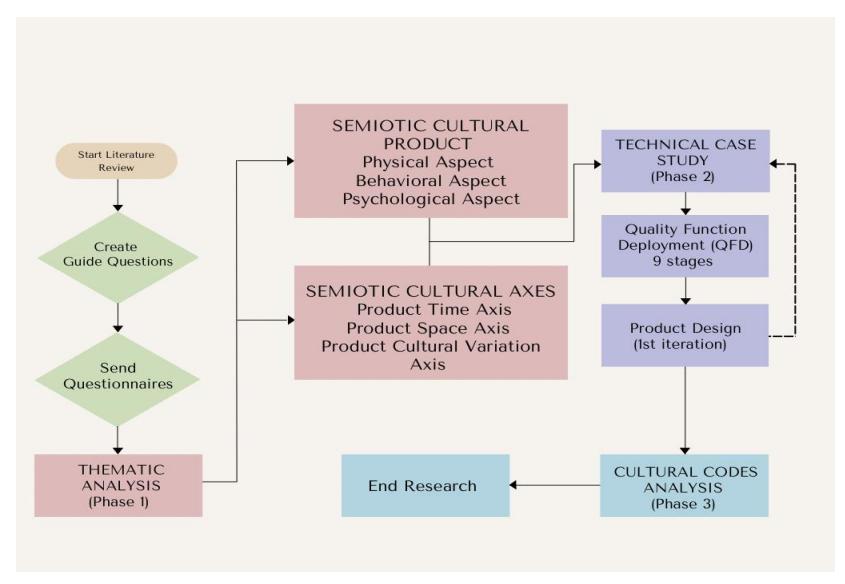
Figure 1 Design flow diagram.
4 Results and Discussion
4.1 Phase 1: Thematic Analysis
In the thematic analysis, out of the 134 respondents, 102 (76.12%) responded 'yes' when asked if Pintados tattoo patterns could be integrated into a furniture product, specifically a coffee table. Furthermore, according to the respondents, Pintados tattoo patterns could best be integrated into costume design (nine respondents – 6.72%), fashion design (ten respondents – 7.46%), and accessories (thirteen respondents – 9.7%). The axes in the model of Ming-Chuan Ho et al. [39] below were used to determine the appropriate market characteristics, establish cultural patterns, and clarify the product meaning.
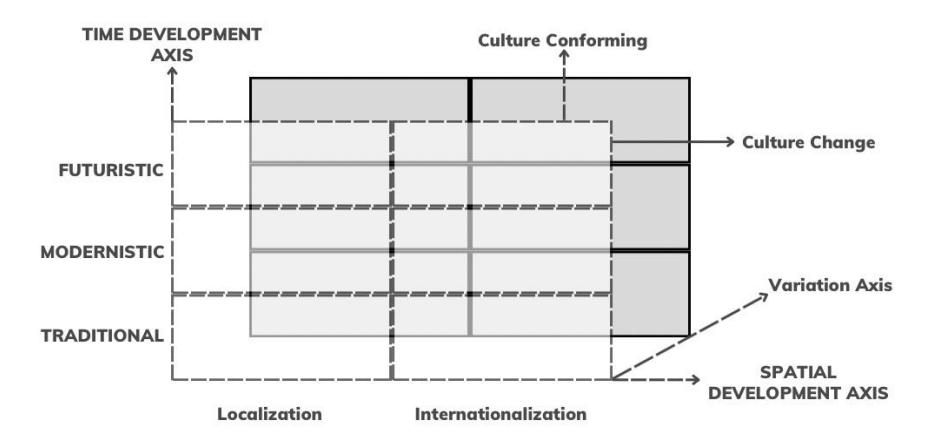
Figure 2 Semiotic model: cultural axes.
- 1. Product Time Axis The data show adherence to 'traditional patterns' with a count of 55 (53.9%). Furthermore, 'modernistic patterns' got 42 counts (41.2%) and 'futuristic patterns' had 5 counts (4.9%) out of 102 respondents.
- 2. Product Space Axis 'Localized space is required' had a count of 82 (80.4%) in the integration of the Pintados tattoo patterns to a furniture medium. Internationalized space got 19.6% or 20 counts. This means that the implementation of the product concept should cater first to local communities.
- 3. Product Cultural Variation/Difference Axis Cultural variation adheres to the 'cultural conforming' aspect had 75 counts (73.5%). While cultural differentiation had 27 counts (26.5%).
4.2 Phase 2: Technical Case Study (QFD)
4.2.1 Stage 1: Defining the Voice of the Customers (VoC)
In defining the VoC, integration of the Pintados tattoo patterns in a furniture medium (coffee table) met the following requirements: Physical Aspect – (i) quality [68, 66.7%], (ii) material [57, 55.9%], (iii) decoration [55, 53.9%], (iv) color [39, 38.2%], (v) texture [36, 35.3%], (vi) measurement [21, 20.6%]; Behavioral Aspect – (vii) durable [60, 58.8%], (viii) functional [56, 54.9%], (ix) cost-efficient [46, 45.1%], (x) environmentally-friendly (waste management) [35, 34.3%], (xi) consideration on structure [26, 25.5%]; Psychological Aspect – (xii) culturally-driven [79, 77.5%], (xiii) aesthetically pleasing [76, 74.5%], (xiv) communicates culture and process [56, 54.9%], (xv) narrative/has embedded story [46, 45.1%] and (xvi) spirit of the era [25, 24.5%].
4.2.2 Stage 2: Voice of Customer (VoC) Weight Importance
Sixteen requirements were selected from their respective modes. This stage permitted the experts to focus on customer priorities. Weight = 5 (extremely important): quality and decoration (Physical); durable, and functional (Behavioral); culturally driven, aesthetically pleasing, and communicates culture and process (Psychological). Weight = 4 (very important): material and measurement (Physical); cost-efficient, environmentally friendly, and consideration on structure (Behavioral). Weight = 3 (quite important): color (Physical). Weight = 2 (important): texture (Physical). Weight = 1 (neutral): narrative/has embedded story, and spirit of the era (Psychological).
4.2.3 Stage 3: Establishment of Technical Characteristics
The sixteen technical characteristic were: (i) quality management, (ii) locally sourced materials, (iii) functionality and decoration, (iv) variety of color, (v) material treatment and process, (vi) length and width (standard measurement), (vii) painting, coating and treating process, (viii) functionality, (ix) manage cost production, (x) usage of traditional and sustainable materials, (xi) ergonomics, (xii) culture conforming, (xiii) aesthetics, (xiv) communication design, (xv) storyline of Pintados tattoo design, and (xvi) simple form for modern times.
4.2.4 Stage 4: Analyzing the Design Parameters
There were seven most important requirements: quality, decoration, durable, functional, culturally driven, aesthetically pleasing, and communicate culture and process. The 'culturally driven' (psychological aspect) quality characteristic stood out as the most important requirement with a count of 79 (of 102 respondents) and a requirement weighting of 5 as 'extremely important.'
4.2.5 Stage 5: Modification of the Requirements
Since this research only had one product iteration, the experts reviewed the outcomes and the feedback and came to a consensus to continue the QFD process.
4.2.6 Stage 6: Analyzing the 'Roof of the House of Quality'
The experts identified the correlations as (+) for a positive correlation; (-) for a negative correlation; and blank ( ) for no correlation. It was analyzed that in terms of direction of improvement (▲ = maximize; ▼ = minimize; and ◊ = target), the researcher targeted 'variety of color,' 'material treatment and process,' 'length and width,' 'managing cost production,' 'ergonomics,' 'communication design,' and 'simple form for modern times.'
4.2.7 Stage 7: Competitive Analysis
The allocated scores ranged from 0 (worst) to 5 (best). The identified benchmarks that cater to mid-segment to premium segment furniture products were the following: (1) Kenneth Cobonpue, (2) Ito Kish, (3) Vito Selma, and (4) Milo Naval, who are mostly furniture designers based in the Visayas region in the Philippines.
1. Customer Competitive Assessment
The decision makers agreed that the Pintados coffee table as a product concept was competitive in terms of quality, material, functionality, and cultural drive with an allocated score of 5 each. Furthermore, the product concept should improve color, measurement, cost-efficiency and aesthetics (score of 3) and develop embedded stories and its connection to and importance for modern needs and trends (spirit of the era) (score of 2).
2. Technical Competitive Assessment
Although the Pintados coffee table product concept scored high on 'storyline of the Pintados tattoo design,' 'procuring locally-sourced' materials, 'ergonomics,' and 'culture conforming' (score of 5), the product concept needed to focus more on 'length and width (standard measurement),' and 'simple form for modern times,' both with a tally of 2.
4.2.8 Stage 8: Target values identified
All sixteen technical features in Table 3 should be linked to the primary target values, according to the decision makers. Although the target values, identified and agreed upon by the decision makers as presented in Figure 3 below, are challenging and may be hard to procure or find because of the limited resources and time available, this study put high emphasis on the design phase in order to evolve the design concept, with a separate study on the manufacture and distribution of the Pintados coffee table product concept to be done later.
4.2.9 Stage 9 – Setting of absolute and relative scores for preliminary design requirements
The experts quantified the design requirements in the QFD process based on the accretion of the numerous forms of information provided by the HoQ table. The quantification of needs is critical because it focuses attention on the characteristics that have the greatest impact and return.
Table 3 Identification of target values.
| Technical Characteristics | Product Narrative/Connotation | ||
|---|---|---|---|
| Quality Management | Rattan, glass and metal materials should be of high quality | ||
| Locally sourced | Rattan/bamboo with and without skin; glass top is straight | ||
| with no bumps | |||
| Functionality & Decoration | Pintados decoration is bonded and weaved on the | ||
| rattan/metal poles | |||
| Variety of Color | No bluish stain on the rattan; variety of brown and white | ||
| colors for variation | |||
| Material Treatment and | No fine hairs on the rattan/bamboo; sanded to smoothen the | ||
| Process | surface | ||
| Length and Width (Standard | 142 cm/56" (length); 35 cm/13/34" (width) | ||
| Measurement) | |||
| Painting, coating and treating | Well painted/dyed rattan/bamboo and metal frame/poles; | ||
| process | rattan strips are powder coated, treated and coated | ||
| Functionality | Indoor usage | ||
| Manage Cost-Production | Mid-segment price | ||
| Usage of Traditional and | No waste; natural materials and processes | ||
| Sustainable Materials | |||
| Ergonomics | Oblong shape with foot gliders | ||
| Culture conforming | In line with Pintados tattoo design tradition | ||
| Aesthetics | Snake/bakunawa patterns; crisscross pattern; and gumamela | ||
| pattern | |||
| Communication Design | Relatable to Visayan people through the design | ||
| Storyline of Pintados Tattoo | Imitation of ferocious animals/mythological creatures | ||
| Design | Geographical location, floral design | ||
| Simple Form for Modern | Simple form, not for accent | ||
| Times | |||
Each of the associations (voice of customers) vs. technical characteristics) has a numerical value (▼ = (1) weak; ○ (3) = moderate; ● (9) = Strong). To compute the absolute and relative scores, the associations (perceived by their numerical value) were multiplied by their relative weight according to the VoC/customer requirement and added up. The VoC's relative weight was computed by multiplying each customer's importance by 100 and dividing by the total of all customers' importance ( = ∗ 100/). It was also important to note that associations without a relationship with each other were not part of the computation process (for example, quality vs variety of color, etc.). The resulting Quality of Function Deployment/House of Quality diagram is shown in Figure 3 below.
4.3 2D/3D Sketch of the Cultural Product (Furniture)
Figure 4 below shows a 2D/3D digital rendition of the Pintados coffee table design with the consideration of the VoC and the corresponding design parameters from the decision makers/local designers supported by the analyzed design specifications from the semiotic analysis. The design shown is reminiscent of a Bakunawa, the mythological moon-eating serpent. This term was mischaracterized by the Spaniards as Pintados, but the locals call them 'taong Bakunawa' or 'ihalas nga tawo' (serpent men).
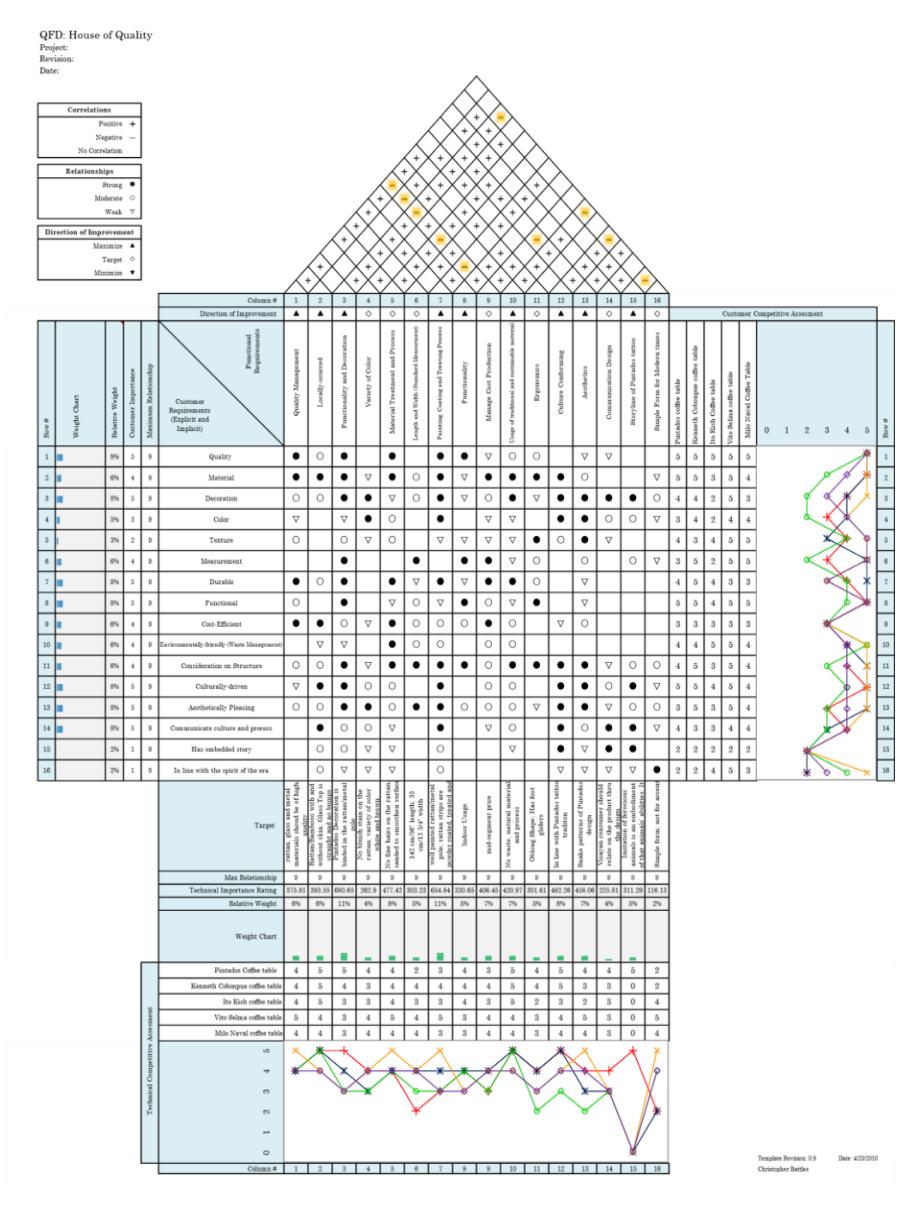
Figure 3 Full Quality Function Deployment/House of Quality (HoQ) diagram (See Supplementary 1 for the higher resolution of Figure 3)
Figure 4 Conceptualized and designed Pintados coffee table.
4.4 Phase Three – Cultural Code Analysis of Pintados Tattoo Design Products
Focusing on Pintados tattoo patterns as the subject of investigation, this research discussed the cultural codes adopted by designers in different products mentioned in the literature and compared each of the cultural codes to the product concept of the Pintados coffee table. This analysis took place after the thematic analysis phase and determined the meaning potential (meaning-making) to assess if the product concept of Pintados furniture (coffee table) is a good medium to hold the meaning of Pintados tattoo patterns for the consolidation of the design under study. The narratives of the product are listed in Table 4 below.
Table 4 Comparative Product Narrative Analysis.
| No | Cultural Products | Medium of Design | Product Narrative/Connotation |
|---|---|---|---|
| 1 | Skin (Original pre colonial practice) | Pintados tattoos served as political and spiritual armor. The paintings were very sophisticated and well-distributed among the members and parts of the body where they are located in Anacion [41]. | |
| 2 | Accessories (Kinamot nga Buhat) | The accessory signified unity and hope in the struggle to endure the aftermath of the strongest typhoon in human history, the Haiyan typhoon in Kinamot nga Buhat [42]. | |
| 3 | National Costume (Miss Universe 2019 Catriona Gray) | The tattoos have become a symbol of beauty, confidence, grace, and prestige in international beauty pageants such as Miss Universe in Tuazon [43]. | |
| 4 | Fashion (Barong Tagalog by Francis Libran | Clients of the Barong Tagalog were mostly influential personalities, etc. which reflects power, influence and the national identity among Filipinos in Salvador Amores [44]. | |
| 5 | Furniture (Coffee table product concept) | With its simple shape and structure, the traditional is united with modernity. The design reflects the cultural background of the designer and the design itself. It also showcases native materials as well as processes from the specific region where the Pintados tattoos originated. Power is invested in the product because only a handful will buy and can afford it. Pintados entered the cultural market with it, a socio-economic connotation. |
With the above-mentioned product narratives, the cultural codes of the product could be assessed as presented in Table 5 below.
Table 5 Cultural Code Analysis.
| Cultural Space | Product Feature | Three Aspects | Codes Used |
|---|---|---|---|
| Inner (psycho- logical aspect) | (1) Original tattoo renditions represent feats of bravery and power (2) Pintados patterns in accessories represent resiliency, strength and endurance. (3) Pintados patterns in national costumes represent beauty and resiliency and the interconnectedness of the islands of Luzon, Visayas and Mindanao. (4) Pintados patterns in fashion (Barong Tagalog) represent national identity, courage and patriotism. (5) Pintados patterns in the furniture design represent the designer's cultural background and showcases Visayan resources and industries (weaving, etc.), which is prestigious work in the Visayas where Pintados originate from. | Meaning Aspect | Affect Codes Transmission Codes Identification Codes |
| Middle (Behavioral Aspect) |
| Functional Aspect | Function Codes Transmission Codes |
| External (physical aspect) | (In terms of design, all products utilized the Pintados tattoo design) (1) Uses the process of tapping, scarring, etc. using soot and ink (2) Uses the process of weaving in metal strips like the process of banig weaving. (3) Uses a body suit designed with Pintados tattoo embellished with Swarovski crystals (4) Uses pinya (pineapple fibers) and designed with Pintados tattoo design (5) Utilizes weaving process of rattan/bamboo materials. The shape is reminiscent of the mythological Bakunawa in Philippine mythology, which is why it is elongated. The color scheme was derived from the tradition of the amakan industry in rural houses. | Technical Aspect | Aesthetic Codes Transmission Codes Style Codes Hue Codes |
5 Conclusion
Studying Pintados tattoo patterns as the subject of design research is a novel way of looking at the Visayan cultural tradition as a potential cultural asset, because few design studies have focused on this tradition. Also, repurposing these traditional tattoo patterns in furniture helps in (re)defining the Filipino national identity through modern interpretations, innovations and promotion of local art and design practices.
This research consciously selected furniture as a potential medium for a Pintados design based on the societal forces investigated in the partial PESTEL analysis (economic environment, socio-cultural environment, technological environment, and ecological and natural environment), which is an important strategy to identify threats and opportunities and to justify the research.
Moreover, this research did not directly criticize Western culture as a whole, but the Western mindset that is a systemic problem in the art and design sector, where products that have gone through the process of semiotic practice (discourse, design, production and distribution) from a Western point of view are seen as more legitimate than local and more authentic interpretations from countries in the East. In contrast, this research determined the market needs/logic of a culturally literate consumers and global cosmopolitans, who are adept, consciously aware, and have lived experiences with the Visayan culture. On the other hand, semiotic analysis investigates sign systems and the production of meaning. It is an assessment of 'meaning potential', which can stand for articulation and interpretation. In product design, the framework of semiotics is important to not only study the materiality of an object but also take into consideration the impact of the object on users and producers – from the psychological to the behavioral and sociological aspects of the product under study.
The result of this study suggests that visual cues and cultural codes only vary in terms of the intended purpose. In the precolonial past, the cultural codes were connected to political and spiritual connotations, but in the modern era they tend more to socio-economic connotations with the medium usually intended to be sold to a culturally literate market. The connotations of Pintados tattoo patterns stay prevalent when transferred to other media, although strategically furniture garners a more cosmopolitan market. The result also emphasizes that the product reflects on a traditional time development axis, a localized spatial development axis, and a cultural conforming cultural difference axis. According to the analysis, the designers must start from their own traditional roots before bringing Pintados designs to a global scale, meaning that the target users (the 'culturally literate market') know or are part of the Visayan community. In addition, there is no
significant difference of meaning potential from the original practice of Pintados tattooing to the cultural furniture product in this research, so it does not affect the Pintados design very much, because the consolidation of the design relies on the culturally-literate market's perception, articulation and interpretation of the design regardless of the medium. Nevertheless, the integration of Pintados tattoo patterns in a commercially viable product design articulates an interpretation of the Filipino Visayan culture.
Lastly, in terms of the cultural code analysis, the inner cultural space (psychological aspect) reflects affect codes, transmission codes, and identification codes, suggesting that the codes in this research are psychologically connected to the social milieu of the Visayan culturally literate market, where the Pintados tattoo patterns originate from. In terms of the middle cultural space (behavioral aspect), the codes generated are function codes and transmission codes, implying that the functionality and practicality of the furniture product should be on an equal footing with its aesthetical appeal when finding new expressions that will eventually keep the tattoo design modern, new and exceptional. Finally, the external cultural space (physical aspect) posits aesthetic codes, transmission codes, style codes, and hue codes, recognizing the importance of relationship operation contexts or elements of design (shape, color, line quality, material usage, etc.), which were equally important in this design research because of the physical appeal they add to the Pintados furniture product, which could help to promote this almost defunct Visayan traditional practice.
Based on the findings of this research, future research should use several design iterations to further develop the furniture product concept (coffee table), because the decision makers' and stakeholder's contributions were limited by the time and resources available. This did not affect the quality or validity of the results, but it did prevent them from being generalizable, so more applications should be investigated. In terms of future studies, the author strongly encourages collaborations between government organizations such as the Department of Trade and Industry (DTI) and the business sector for mass prototyping, manufacturing, and distribution.
Acknowledgements
This paper has been accepted for dissemination at the 2nd International Conference on Art, Craft, Culture and Design (ICON ARCCADE) and has been presented on the 29-30 September 2021 under the sub-theme of "Tradition and History as Cultural Assets". I would also like to thank Professor Yuan-Hua Lu of the Graduate School of Architecture and Interior Design Shu Te University, my thesis adviser, Dr. Tin-Kai (Ken) Chen my co-adviser, and Dr. Mario Maccani
my teacher and proofreader in my Master of Arts in Applied Arts and Design (MAAAD) program for their unwavering support and guidance on the duration of this research.