

1 Introduction
Considering the rapid development of technology these days, we need to start questioning the way art education is implemented in formal institutions. Jiggins [1] raised an issue pertaining to traditional classroom education, where the teacher stands in front of the classroom to teach while the students sit behind their desks to learn, expecting them to take over the workforce eventually. A practice that has remained unchanged for a long time is trying to stay relevant while hanging by a thread with one foot deeply rooted in the industrial revolution that started in the 1800s. Furthermore, despite interdisciplinary methods having been
Received February 9 th, 2020, Revised May 9th, 2023, Accepted for publication July 30th, 2023. Copyright © 2023 Published by ITB Institute for Research and Community Services, ISSN: 2337-5795, DOI: 10.5614/j.vad.2023.15.1.5
discussed for the last twenty years, the curricula in universities today are still structured based on a disciplinary approach [2]. Today's art education increasingly demands the involvement of art in other areas. Art can find a way in and merge with other fields through interdisciplinarity. An interdisciplinary approach in art education is not just a matter of what art can do in other areas but also subject to what kind of art can be produced by using other areas of knowledge. However, in order to propose such a method we first need to investigate the factors and elements that are important in an interdisciplinary approach in art education. It should start early at school or university level. Hence, the art education syllabus needs to be reviewed and to an extent may require a revamp. With the rise of Industrial Revolution 4.0, it is high time for art to integrate with other areas due to the rapid development of technology and the cyber world. The western world has long been discussing interdisciplinarity in art and the importance of art being in line with other critical areas has been recognized.
In 2002, the National Art Education Association strongly suggested interdisciplinary teaching and learning through the arts. According to Lynn [3] art educators agreed that interdisciplinary work lets students solve problems and make meaningful connections, while an interdisciplinary syllabus gives students the chance to establish new perspectives and discover relationships between ideas. In Malaysia, we have yet to find any fine art syllabus that fully applies an interdisciplinary approach; it may have been done but only within some courses rather than the overall curriculum. Interdisciplinarity is not new and has already been explored and adopted by many artists. For example, science and art; Leonardo Da Vinci; the great pyramids, the golden ratio; art, architecture, and math; M.C. Escher and mathematical tessellations (Eisenhower Clearing House, http://www.enc.org, 2006), which beautifully explore the natural connections between works of art, science, and math. Additionally, in 2015, 2016, and 2017, art exhibitions such as NYAWA: Nature's Yield and Wonders of Art, pioneered by the University Putra Malaysia under the Faculty of Design and Architecture, realized a collaboration between art and science that explores therapeutic aspects, forestry, medicine and health sciences, bioscience, etc. While these exhibitions have proven to have great potential for interdisciplinarity in art education, a thorough exploration of this potential is needed so that it can be made into a syllabus for art schools or a proposal to integrate art with other fields. However, to do so, Lynn [3] has stated that academicians need to have a profound knowledge base for teaching the subject and excellent classroom management skills to address the learning needs of the students and critical pedagogy.
2 Arts Education in Malaysia
According to Mat [4], in the visual arts, we are still looking for a suitable system to educate students in line with the rapid development of technology today. He added that the institutions concerned, whether public or private, need to reconsider their curriculum in order to produce graduates who are able to become not only art scholars in the field of visual arts but also great thinkers. Nasruruddin [5] provides further support for this argument by saying that creative arts pedagogy in Malaysia's education system is not up to par, especially when related to the visual and the performing arts. It is merely an afterthought in the educative process. He claims that most scientists do not like the idea of creative arts, science, and mathematics being mentioned in the same breath. We are not here to question the importance ofscience and mathematics, or any other field, compared to the visual arts. Instead, we want to discover the potential of integration between art and other fields. At the same time, the visual arts are also seen as important subjects towards developed nations. Nasuruddin [5] added that the Malaysian education system still very much revolves around the outmoded traditional '3R' concept (reading, (w)riting, and (a)rithmetic) from the British era, which gives priority to science and mathematics. Not to mention the age-old policy of having a ratio of 60:40 between science to non-science students at the higher education level with the aim of producing a nation that is competent in harnessing, utilizing, and advancing science and technology as a developed country [6].
However, the trend of applicants into public universities for science-based programs has shown a decrease to an extent that universities find it difficult to meet the pre-determined ratio set by the government [7]. This creates an issue whereby, given the rigid disciplinary classification in Malaysian universities, students may not have been exposed to an educational ecosystem that nurtures their development in order to meet the sixth challenge of Malaysia's national plan 'Vision 2020', i.e., to establish a scientific and progressive society. Hence, these circumstances call for a pressing need to introduce liberal arts education in the higher education system and more importantly a shift towards STREAM (Science and Technology with Mathematics, Religion, Ethics, Arts and Management) [8]. For Malaysia to become a developed nation, art education at the higher education level must play a crucial role in addressing challenges and issues on a global scale. Therefore, there is a need for art education curricula or syllabi to be revisited and redesigned. There is nothing wrong with adding one or two visual arts programs in Malaysia that focus on an interdisciplinary approach, while the entire program centers on the integration of art with other fields. Integrating art with other disciplines through the art education curriculum is necessary to reduce issues of art being neglected compared to other fields of studies. The integration will also serve as a great potential and may hopefully contribute to a greater impact of art for the betterment of society.
3 The Idea of Interdisciplinarity in Arts Education
A very fundamental definition of interdisciplinarity is that it relates to more than one branch of knowledge. Interdisciplinarity indicates a method or idea that fuses traditional educational concepts in order to reach new approaches or elucidations. Interdisciplinarity is becoming more and more important within both academic research and industry, so that it will benefit students if this approach is implemented in the art education syllabus. More than just sticking together different subjects and methods, interdisciplinary work is the process of an emerging integration of systems that are traditionally thought of as separate fields (such as visual arts, sciences, mathematics, business). An interdisciplinary student will be involved in a level of critical inquiry that is exceptional compared to other degree tracks. The interdisciplinary approach promotes student engagement, encouraging them to develop knowledge, critical thinking, and problem solving, independence, confidence, and passion towards the subject. Repko [9] has stated that interdisciplinary methods cultivate improvements in cognitive ability. Similarly, Kavolski [10] and Field [11] have identified several benefits of interdisciplinary learning, including an increased ability to recognize biases, think critically, tolerate uncertainties, as well as being aware and critical of ethical concerns.
According to Renate [12], interdisciplinarity is a trending topic in the education realm today. Gaining insight in the nature of interdisciplinary education may be of great help in making design decisions on interdisciplinary education. The reason why we need to embrace an interdisciplinary approach is that it will help students to uncover preconceptions and recognize biases. According to the Science Education Resource Center (SERC) [13], an interdisciplinary approach is relevant to recent advances in learning science on how to encourage learning when students carry strong pre-existing ideas with them to the learning process.
On the other hand, learning art will always have to deal with powerful ideas and translate them into tangible form, particularly for fine art students. Pursuant to the idea of Marshall [14] that integrating art with other subjects corresponds with the doctrines of postmodernism, because it connects ideas to form (bentuk), similar to how the focus of art education has shifted away from formalism to meaning-making (makna). It is thus able to cross disciplines, reveal conceptual connections, and place art in the context of other disciplines. He further added that for educators, integrating various themes and ideas in teaching represents a solid and practical approach to teaching art in a postmodern way. Despite the attention to content, context, and boundary-crossing, postmodern art education has not fully delved into the integration of art within the academic curriculum as a practice according to postmodern theory.
Learning visual art is more than just a matter of solving visual problems, it also needs to acknowledge its usefulness in other fields. Students of visual art will benefit from discussions and knowledge from other disciplines. This is supported by Noy, Patrick, Capetola & McBurnie [15], who stated that the exposure of various perspectives on students is a transformative experience that sparks new ways of looking at issues and will lead to a new appreciation of the value of listening to different perspectives.
4 Research Method
The present research was conducted using a seminar, in-depth interviews, and a literature review. The literature review was conducted as the first step to gather information regarding visual art syllabi from selected institutions. In addition, primary data was collected through a seminar that was organized specifically to discuss an interdisciplinary approach of the visual art syllabus in higher education in Malaysia. The details of the seminar were as follows:
Table 1 Seminar (Discussion).
| Title: 'A Discussion on Interdisciplinary Approach of Visual Arts Syllabus in | |||||
|---|---|---|---|---|---|
| Higher Education Malaysia' | |||||
| Date: | th August 2019 5 | ||||
| Time: | 10.00 am – 12.00 pm | ||||
| Venue: | Faculty of Applied & Creative Arts, Universiti Malaysia Sarawak | ||||
| Panels: | 3 + 1 Moderator | ||||
Table 2 In-depth interviews.
| Interview on Interdisciplinary Approach of Visual Arts Syllabus in Higher | ||||||||
|---|---|---|---|---|---|---|---|---|
| Education Malaysia | ||||||||
| Date Time Venue | ||||||||
| Panel 1 | 3 May 2019 | 10.00 – 11.00 am | Kuala Lumpur | |||||
| Panel 2 3 May 2019 | 2.00 - 3.15 pm | Kuala Lumpur | ||||||
| Panel 3 | Kuala Lumpur | |||||||
| Panel 4 | 4 May 2019 | 2.15 - 3.30 pm | Kuala Lumpur | |||||
| Panel 5 | 7 May 2019 10.00 – 11.05 am Sarawak | |||||||
Table 3 Literature review.
| Literature study on Interdisciplinary Approach of Visual Arts Syllabus in Higher | ||||
|---|---|---|---|---|
| Education Malaysia | ||||
| Document 1 | Organic and Fluid Curriculum | |||
| Document 2 | Malaysia Education Blueprint 2015-2025 (Higher Education) | |||
| Document 3 | Selected University Curriculum/Syllabus | |||
The data collected using the seminar, the in-depth interviews and the literature review were analyzed and cross-checked to find similarities.
5 The Visual Art Universities in Malaysia
There are currently several institutions offering an art school or art faculty in Malaysia. The oldest one is University institute Technology Mara (UiTM), formerly known as Institute Technology Mara (ITM), which was established in 1956 (art school in 1967). UiTM has produced many well-known artists, academicians, curators, designers, and many more professions. In addition, UiTM has branches in a few states of Malaysia, such as UiTM Perak, UiTM Kelantan, UiTM Melaka, and many more. Among the other institutions that offer an art school are Universiti Sains Malaysia, Universiti Malaysia Sarawak, Universiti Malaysia Sabah, Universiti Malaysia Kelantan, Universiti Perguruan Sultan Idris as well as private institutions such as Lim Kok Wing University of Creative Technology.
The economy, politics, and culture have been developing rapidly so there are many new institutions offering art schools, with a variety of ideologies, ideas, skills, and other kinds of intellectual values that they attempt to develop. Every institution in the country has its own vision and mission and has a good research center. However, the syllabi of art education in this country have yet to find an interdisciplinary approach that leads to the integration of two bodies of knowledge. With the rapid development of the powerful technological world, the rise of Industrial Revolution 4.0, and Vision 2020, it is high time to revisit our art education syllabi. The universities of the future will no longer rely on the traditional teaching methods because they may be too rigid and no match for state-of-the-art technology and e-learning platforms, as universities mostly still cater to individualistic learning and development. It is therefore necessary to explore what the future of education holds.
6 Current Disciplinary Concept of Art Syllabus Samples
Samples were taken based on the tendency of the programs towards applying an interdisciplinary approach, whether embedded in the course or implemented in teaching and learning activities. Table 4 shows selected examples of existing art syllabi.
Table 4 gives an overview of all program courses and optional courses for the Bachelor of Applied Arts with Honours (Fine Arts) offered by the Faculty of Applied and Creative Arts, Universiti Malaysia Sarawak, Malaysia. The duration of this program is three years (six semesters). The idea of integration is there but is limited to the visual arts courses only. For example, there are ten courses in the integrated arts option, which focuses on painting, installation art, printmaking, new media, and electronic art. The same goes for the optional courses in ceramics and photography, which merely emphasize the skills and content in the respective
fields. The students take an optional course in Semester 1, Year 2. This program was introduced back in 1994.
Table 4 Summary of visual art syllabi for Universiti Malaysia Sarawak (East Malaysia).
| Bachelor of Applied Arts with Honours (Fine Arts) | |||||
|---|---|---|---|---|---|
| Year 1 | Year 2 | Year 3 | |||
| Fundamental Program • Visual Analysis • Analysis of Form • Basic Photography • Digital Arts • Introduction to Ceramics • Modern Arts History • Introduction to Electronic Arts • Video Arts and Technology Option Course 1 • Integrated Media • Integrated Media I • 3-Dimensional Media Option Course 2 • Ceramics Technology | Faculty of Applied & Creative Arts • Advanced Electronic Arts • Research Methodology • Malaysian Visual Arts • Expanded Media Option Course 1 • Integrated Media II • Media and Process • Fine Art Studio • Fine Art Printmaking • Advance Fine Art Studio • Fine Art Photography Option Course 2 • Hybrid Ceramics • Creative Ceramic • Media and Process • Sculptural Ceramic • Individual Ceramic Research Option Course 3 • Colour Technique • Studio & Large Format | • Contemporary Art Theory • Fine Art Seminar • Visual Art Appreciation & Critique • Final Year Project 1 & 2 Option Course 1 • Seminar and Visiting Artist Workshop Option Course 2 • Fine Art Ceramics Option Course 3 • Visual Ethnography | |||
| • 3- Dimensional Media Option Course 3 • Photography Alternative • Digital Imaging | Photography 1 • Studio & Large Format Photography 2 • Fine Art Printmaking • Fine Art Photography • Underwater Photography | ||||
Note: This table was created based on the information from 'Buku Panduan FSGK', https://www.faca.unimas.my/images/2020/download/Final_Buku_Panduan_FSGK_2020_2021_v 2_10092020.pdf. Copyright: Universiti Malaysia Sarawak
Integration with another field by the students is encouraged. The Bachelor of Applied Arts with Honours (Fine Arts), UNIMAS was the first program to emphasize the combination of art and technology in Malaysia. The first electronic art show in Malaysia (1997) was organized by their lecturers and artists in the National Art Gallery. The current program learning objectives (PLO's) are to equip students with fine art knowledge related to both theory and practice. Students must also learn to be able to display technical and practical ability in fine art with the implementation of technology-based management. Students must
demonstrate empathy towards society and the environment through intelligent knowledge-sharing practices in the field of fine arts. Lastly, the students must develop self-esteem with a positive attitude through professionalism in the implementation of fine arts practices.
As for the program PLO's, they are no longer integrated like when the program was initiated. However, elements of integration are still in some way embedded in the teaching and learning process. Several integrated courses in this program discuss the integration of media and materials but not knowledge from other fields.
Table 5 Summary of Visual Art Syllabus of University of Science, Malaysia (West Malaysia).
| Year 2 & 3 | Year 4 |
|---|---|
| Level 200 & 300 | Level 400 |
| • Malaysia Modern Art | • Alternative |
| • | Photomedia |
| • Intermediate | • Digital Sculpture |
| Photomedia | • Alternative Prints |
| • Mould Making and | • Integration and |
| Casting Sculpture | Media Process |
| • Relief and Intaglio | • Visual Art |
| Prints | Management and |
| • Configuration of Form | Entrepreneurship |
| in Painting | (Elective) |
| • Aspects of Traditional | • Final Year Project |
| Arts of Southeast Asia | |
| • Aspects of Traditional | |
| Arts of Southeast | |
| • Asian Modern Art | |
| (Elective) | |
| • Advance Photomedia | |
| • Installation Art | |
| • Serigraphy and | |
| Lithography | |
| • Digital Painting | |
| Experimental Drawings • Industrial Training |
Note: This table was created based on information from https://art.usm.my/programme/undergraduate/. Copyright: Universiti Sains Malaysia
University of Science, Malaysia (USM), under the School of Arts (SoTA), offers a four-year BFA (Hons) Fine Art program. This program gives students the opportunity to discover their niche areas of interest through both traditional and new forms of art such as media and electronic arts. This program aims to shape the students to become drivers of change in the ever-advancing creative world, especially in the context of rapid convergence of technology and time-based media. School of Arts USM was established in 1999 and is considered a pioneer in West Malaysia for the use of technological instruments to create works of art. However, this program also does not fully embrace an interdisciplinary approach in the context of a visual arts curriculum.
Table 6 Summary of Visual Arts Syllabus for Multimedia University (West Malaysia, Private University).
| Bachelor of Multimedia (Hons.) (Media Arts) Faculty of Creative Multimedia (FCM) | |||||
|---|---|---|---|---|---|
| Year 1 | Year 2 | Year 3 | |||
| • Media Arts Design 1 • Media Arts Design 2 • Visual Programming • Digital Imaging Art • Computer Modelling • Internet Applications • Media Culture • Video Production • Multimedia Scripting and Authoring • Media Aesthetics Elective Modules • Contemporary Malaysian Art • Corporate Identity • Diagram Design | • Media Arts Design 3 • Media Arts Design 4 • Interaction Design • New Media Technology • Real-time Expression • Generative Art and Design • Multimodal Interaction Design • Semiotic Studies • Sound Design 1 • Media Anthropology Internship Elective Modules • Project Management • Digital Audio and Video | • Media Arts Design Project 1 • Media Arts Design Project 2 • Media and Networking • Design Research • Art in Electronic Media • Media Law | |||
Note: This table was created based on information from https://www.mmu.edu.my/programmesby-faculty-all/programmes-by-faculty-fcm/media-arts/. Copyright: Multimedia University Malaysia
Meanwhile, Multimedia University (MMU) as a private institution offers a threeyear Bachelor of Multimedia (Hons) in Media Arts program. This course focuses on creating new forms of communication art powered by computing technologies. MMU defines an inter/multidisciplinary approach on a gradual scale by fostering individual exploration, experimentation, and creative technology practices. MMU focuses on the use of advanced technology. The nomenclature of media arts relates to the medium of communication (media), utilizing these media to produce, communicate, and challenge (art). It also centers on the creation of experimental media and outcomes that occur in interactive systems, websites, games, installations, galleries, performances, and public spaces. This program has shown a tendency towards an interdisciplinary approach that is embedded in the courses. Hence, there is no total integration between art and the knowledge of information technology or other fields. However, it has led to an interdisciplinary approach. Table 2 shows that there are only five subjects for elective modules that are still within the context of art.
7 Data Analysis
The data collected at the seminar (voice-recorded and then transcribed) served as primary qualitative and interpretative data. This was supported by in-depth interviews (voice-recorded and then transcribed) and was realized in accordance with the framework for the discussion about an interdisciplinary approach of visual arts syllabi in higher education Malaysia. The transcript and interpretation of the seminar were reviewed and analyzed. The framework, seminar questions, and the interview questions were constructed based on the literature review and on data collected from three major studies (Table 3). The art talk questions focused on: (1) the definition of an interdisciplinary approach in visual art syllabi and the status of art education in Malaysia (2); factors that are important for the integration of art with other fields; (3) how an interdisciplinary approach can be applied in visual arts education especially in Malaysia. The seminar questions and the semi-open interview questions were similar.
8 Findings
The findings of the research can be divided into two categories: (a) seminar and (b) interview data interpretation.
8.1 Seminar Analysis
In this category, the panels' responses to an interdisciplinary approach are presented separately, as shown in Table 7. The panels' responses to the topic are given for comparison purposes. The keywords were chosen based on the core problems faced by the institutions as stated by the panels.
Table 7 Panels' responses and answers towards interdisciplinary approach of visual arts education.
| Panels | Similarities | Dissimilarities |
|---|---|---|
| Panel 1 | Refresh (revamp) the | There is an interdisciplinary approach, but |
| (Institution A) | institution | it is not being pursued |
| Panel 2 | The institutions need to | Lecturers do not follow the philosophy of |
| (Institution B) | change | the faculty |
| Panels | Similarities | Dissimilarities |
|---|---|---|
| Panel 3 (Institution C) | The whole education system needs to be reformed | There was no interdisciplinary approach before, it is only embedded in a few |
| courses |
According to Table 7, Panel 1 stated that there is a need to refresh or revamp the current visual arts syllabus in order to be in line with the pace of technological development and Industrial Revolution 4.0 (IR4.0). However, within higher education, it is necessary to extend the support for developing the students' interdisciplinary skills. This can be started from a cross-faculty interdisciplinary type of approach to sustain the learning process. They added that there used to be an interdisciplinary approach in the past, but it was not continued due to several constraints. This was confirmed by Panel 2. The institutions in this country need to change in the sense that their syllabus should allow integration with other disciplines. Additionally, they gave some examples of IR4.0 being characterized by developments in technological advancement such as artificial intelligence (AI), big data, augmented reality (AR)/virtual reality (VR), and the pace of the internet. Hence, it is necessary to see the fusion of the visual arts and the field of information technology in future art syllabi. On the other hand, as stated by Panel 2, it is compulsory to train academic staff/lecturers to embrace the vision and mission/philosophy of the faculty. It is not about an individual agenda or expertise; they must acquaint themselves with the faculty's vision and mission and then must contribute to the development of interdisciplinary knowledge and collaboration.
Panel 3 shared a similar idea, where the whole education system needs to be reformed. It stated that it is high time to reform the current visual art syllabus. Malaysia Vision 2020 called upon the country to obtain a self-sufficient industrialized nation status by the year 2020, including all aspects, such as worldclass education, social well-being, economic prosperity, political stability, etc. This may start from a high quality standard for education. The panel believes that an interdisciplinary approach can be realized for the whole program, as it is already embedded in some courses in several institutions.
On top of that, Panel 1 stated that it is a good idea to return to a four-year program. It suggested this because the students will need some time to adapt to an organic curriculum with an interdisciplinary approach. Meanwhile, Panel 2 stated that with an interdisciplinary approach and the introduction of an organic curriculum, perhaps certain problems in the visual arts can be solved by using knowledge derived from other fields. Panel 3 mentioned that an education system can never be permanent, it has to be reviewed from time to time. Vision 2020, i.e., the achievement of 21st -century education, can be started from there. They added that it is high time to revamp. We need to change to a new paradigm.
8.2 Interview Data Interpretation
These keywords emerged from five in-depth interviews conducted. The keywords that emerged from discussion of the definition of an interdisciplinary approach were integrated by two respondents, and further fusion, collaboration and cocreate. Based on these data, they understood the interdisciplinary approach to be about integration with other fields, promoting collaboration and co-creation. An analysis was conducted to look for differences between the respondents, but the results indicated similar opinions towards an interdisciplinary approach. The second theme was the status of visual arts education in Malaysia, where three of the interviewees stated that it is necessary to reform or revamp. One respondent comfortably stated that the current visual arts syllabus in Malaysia is fine (maintain it) and one respondent mentioned good direction.
| The Mes | Keyword Semerged |
|---|---|
| Definition on interdisciplinary | integrated (2), fusion (1), |
| approach | collaboration (1), co-create (1), |
| The status of visual art education in | reform (1), revamp (2), maintain (1), |
| Malaysia | good direction (1), |
| Method (how an interdisciplinary | teamwork (1), new syllabus (1), |
| approach can be implemented | integrated (1), new program (2) |
9 Results and Discussion
Overall, this study suggests that it is necessary to have interdisciplinary programs that combine two different bodies of knowledge together. The visual arts syllabus really needs this approach to produce graduates with a strong background in study and competence. It is also meant to equip the students with critical factors and to meet unexpected demands in the global marketplace. We need an immersive learning experience, where the university of the future is expected to be an exciting place. We can learn from wherever and whenever we want with programs and courses that we can choose freely according to our needs and demands, as long it meets the requirements of the accrediting agency. Therefore, an interdisciplinary approach leads to a fluid and organic curriculum, where the students can utilize the flexibility to design and personalize the course of their study. The design of interdisciplinary learning should be based on the vision and mission of the faculty. The vision and mission are central to the learning outcomes, which in turn take care of integration and the constructive alignment of the program.
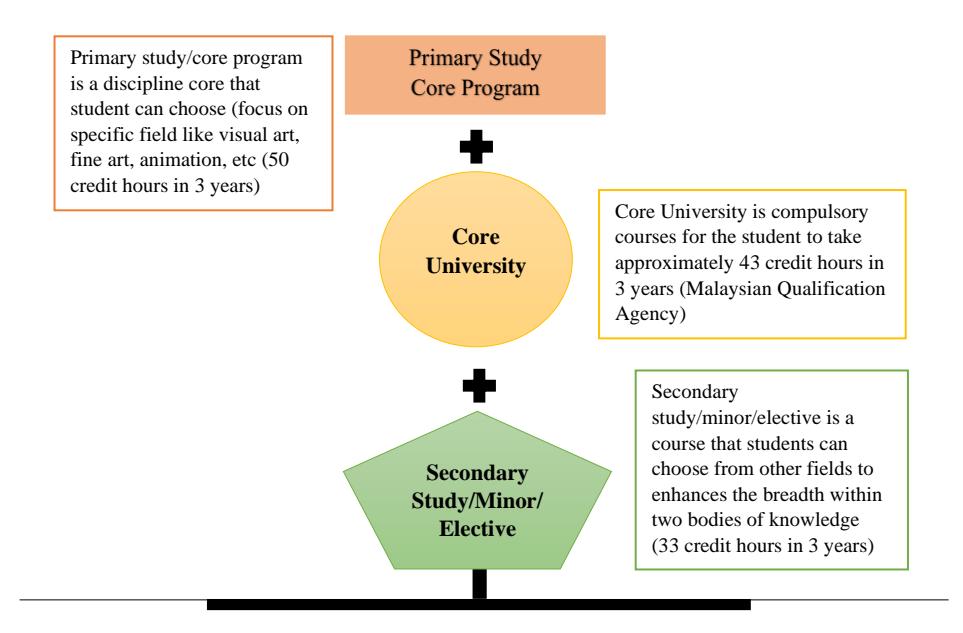
Figure 1 Proposed interdisciplinary curriculum framework for undergraduates (three-year program).
Note: This table was created based on the results of the study to represent an interdisciplinary curriculum framework for an undergraduate (visual arts) program.
Figure 1 depicts the proposed interdisciplinary curriculum framework consisting of primary study/core program, compulsory core university and secondary studies or minor or elective studies that lead to an interdisciplinary approach. The main idea is to offer a fluid/organic/flexible curriculum to the students. Students can choose their primary study/core program within specific disciplines that they are interested in. Meanwhile, the core program is required to be completed within the study period. The proposed credit hours for this core program are around 43 credits out of 120 to 123 credits for the three-year program. Meanwhile, the secondary study (proposed thirty credit hours over three years) consists of more or less free elective modules from clusters that are not related to the primary course (proposed fifty credit hours over three years). For example, a student enrolled in a primary study/core program in the visual arts is then free to choose a module from another discipline as complementary or support, such as an information technologies course, where this program is originally part of computer science. The proposed nomenclature for this program could be a Bachelor of Visual Arts with Honours (Information Technologies). The benefits and the reason for this fluid or integrated syllabus are to strengthen student skills and knowledge with real expertise in that field (information technologies). For example, students who enroll in this program will expand their knowledge on the information technology from a dynamic workplace perspective, emerging technologies that empower society, subjects like web page design and authoring, computational thinking, networking fundamentals, technology planning, etc. It is hoped that this will produce great new media artists or electronic artists in contemporary art.
Table 9 is a sample of a visual art + information technologies syllabus or arrangement for a three-year program. The course arrangement was produced randomly but the calculation of the credit hours follows the criteria set by the Malaysian Qualification Agency (MQA), where a Bachelor Honours Degree takes around 120 to 123 credit hours for the whole three-year study.
Table 9 Proposed or Sample of Interdisciplinary Visual Art Syllabus (Bachelor of Visual Arts with Honours (Internet Technologies).
| Year | Sem | Core University | Core Faculty | Primary Study/Core Program | Secondary Study/Minor/Elective | Total Credits |
|---|---|---|---|---|---|---|
| 1 | I | CU0003 | CF0003 | PC0004 | 22 | |
| University | Faculty | Visual XXX | credits | |||
| Course | Core | PC0004 | ||||
| Visual XXX | ||||||
| PC0004 | ||||||
| Visual XXX | ||||||
| PC0004 | ||||||
| Visual XXX | ||||||
| II | CU0003 | CF0003 Faculty | PC0004 | SS0003 Introduction to | 19 | |
| University | Core | Visual XXX | Educational Technology | credits | ||
| Course | PC0003 | SS0003 Introduction to | ||||
| Visual XXX | Cloud Computing | |||||
| SEMESTER BR | REAK | |||||
| 2 | I | CU0002 | PC0003 | SS0003 Internet of | 18 | |
| University | Visual XXX | Things | credits | |||
| Course | PC0003 | SS0003 Computational | ||||
| CU0002 | Visual XXX | Thinking | ||||
| University | ||||||
| Course | ||||||
| CU0002 | ||||||
| University | ||||||
| Course | ||||||
| II | CU0002 | CF0003 | PC0003 | SS0003 Computer & | 19 | |
| University | Faculty | Visual XXX | Network | credits | ||
| Course | Core | PC0003 | SS0003 Wireless & | |||
| CU0002 | Visual XXX | Security | ||||
| University | ||||||
| Course | ||||||
| S | EMESTER BI | REAK & FO | C0005 INDUSTI | RIAL TRAINING (5 credit l | nours) |
| Year | Sem | Core University | Core Faculty | Primary Study/Core Program | Secondary Study/Minor/Elective | Total Credits |
|---|---|---|---|---|---|---|
| 3 | I | CU0002 | CF0003 | PC0003 | SS0006 Big Data | 20 |
| University | Faculty | Visual XXX | Technologies | credits | ||
| Course | Core | PC0002 | ||||
| CU0002 | Final Year | |||||
| University | Project I | |||||
| Course | ||||||
| CU0002 | ||||||
| University | ||||||
| Course | ||||||
| II | CU0002 | PC0003 | SS0006 Data Centre | 20 | ||
| University | Visual XXX | Virtualisation | credits | |||
| Course | PC0003 | |||||
| CU0002 | Visual XXX | |||||
| University | PC0004 | |||||
| Course | Final Year | |||||
| Project II | ||||||
| 26 credit | 17 | 50 credit | 30 credits hours | 123 | ||
| hours | credit | hours | credit | |||
| hours | hours |
Note: This table was created based on the results of the present study to propose an interdisciplinary visual arts syllabus for an undergraduate study (Bachelor of Visual Arts with Honours (Internet Technologies)
10 Conclusion
The collected data and discussion of this study did not lead to the mechanism of the proposed approach. Further research is required to understand the mechanism of an interdisciplinary approach and how it can be implemented. It is also crucial to study the effectiveness and consequences of the approach. Clearly, visual arts education really needs a new program or to revamp the existing program into a new approach that includes interdisciplinary practices. It is crucial for students to develop a balanced knowledge of art and science, or any other fields (two bodies of knowledge), to become a holistic individual, and to be a crucial enabler for the country to move forward to a post-2020 vision. Therefore, we wish to emphasize that there is much more room for efforts and strategies to address the improvement of the visual arts education system. The concern is for establishing a future-ready curriculum for visual arts education. Perhaps the biggest shift we can expect to witness is more universities exchanging the focus from the lecturer to the student. Each student will be allowed to take control of the course of their own education by selecting their own modules and way of learning, whenever or wherever they want.
Acknowledgments
This research has been supported by the P-Ramlee Research Chair under agreement number F03/PRC/1732/2018, Faculty of Applied & Creative Arts, UNIMAS. Additionally, we would like to acknowledge the Universiti Malaysia Sarawak for their unflagging support of this research.