

1 Introduction
Indonesia has many provinces with various tribes and cultures, including Sumba. The culture that has developed in the Sumba community influences thoughts, human behavior, and works of art [1] . The artwork studied herein is a traditional cloth that the people of Sumba commonly call Sumba ikat. Sumba ikat is a craft, and the weaving process has been traditionally passed down among Sumbanese women from generation to generation [2]. Pieces of cloth not only function as a covering for the body but is also a work of art that apparently grows following the flow of life [3]. The same goes for Sumba woven fabrics. For the people of Sumba, woven cloth is not just a cloth but something culturally essential. Among the Sumbanese woven fabrics are hinggi and lau. Hinggi is a woven cloth that Sumbanese men should wear, while lau, or sarong, is a cloth for Sumbanese women [4]. In Sumbanese woven fabrics, the aesthetic value lies in the motifs' philosophical meaning and their beauty [3]. The process of creating hinggi and lau and selecting the motifs represent the particular culture of the people of Sumba [5]. These two types of cloth are cultural products of the people of East Sumba, which can be read to understand their culture. Hinggi and lau are cultural objects with meanings expressing specific values [6].
Culture consists of patterns, explicit and implicit meanings, and behaviors transmitted by symbols [7]. Discussing a cultural product cannot be separated from studying the cultural elements that compose it. Herbert Read explained three essential aspects of culture: contour, content, and context. Contour relates to the shape or form of the artwork; content relates to the meaning of the message or information; and context relates to the purpose for which the artwork was made. The three cannot be separated because they influence each other.
The most prominent physical form in hinggi and lau are the motifs. The motifs in woven fabrics embody human and natural beauty [8]. Each motif in Sumba cloths has a different background story, describing the flow of their lives [9]. There are motifs in hinggi and lau because there is an idea or meaning that the weaver wants to convey. The motifs contained in hinggi and lau reflect the culture of the Sumba people, which are usually symbols from their belief system and the core of their religion, knowledge, values, rules, as well as expressive symbols [7].
Hinggi and lau have motives that have the potential to be developed in various ways. However, it cannot be denied that hinggi and lau contain forms, meanings, and backgrounds that must be interpreted as a whole to learn their true meaning. Precision in placing an ornamental motif on an object is essential.
An artwork reflects the culture of people from a specific geographical environment where the work is produced [3]. The cultural identity of the people of East Sumba is contained in the hinggi and lau motifs. Therefore, it is necessary to understand the symbolic meanings of the various motifs of hinggi and lau to comprehend that culture.
This phenomenon forms the background of this review. It aims to describe the forms, meanings, and backgrounds of the hinggi and lau motifs more deeply. Hinggi and lau have the potential to serve as cultural artifacts, artistic expressions, and symbols of cultural identity for the people of Sumba. They offer opportunities for the continuation of traditional craftsmanship, artistic exploration, and cultural studies. Studying the values and philosophical meanings of hinggi and lau is crucial because of this potential. In addition to completing
references related to hinggi and lau, the research results may also serve as input for parties in the fashion sector in developing products using hinggi and lau.
2 Methodology
The research method used is systematic literature review by analyzing articles, reports, and books selected according to keywords, drawing conclusions, and providing criticism on the topics. This study used the PRISMA (Preferred Reporting Items for Systematic Reviews and Meta-Analyses) method to conduct a literature review in four stages: identification, screening, eligibility, and inclusion. The literature search flow chart shown in Figure 1 was carried out on the Google Scholar database.
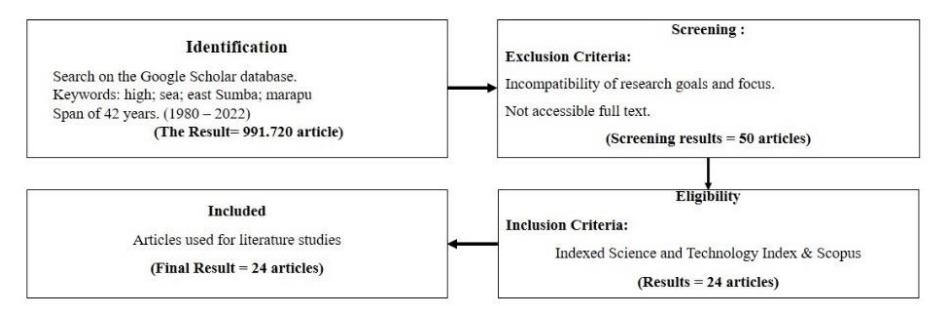
Figure 1 Literature search flowchart.
The identification stage consisted of searching for articles in the Google Scholar database using keywords. The year range of articles was 1980 to 2022. The search for articles in the identification stage yielded 991.720 articles. The screening stage consisted of referring to predetermined exclusion criteria. The exclusion criteria used were incompatibility with the aims and focus of the research and inaccessibility of the complete text. The screening stage yielded 50 articles. The eligibility stage referred to inclusion criteria: articles indexed in the Science and Technology Index & Scopus. Thus, 24 articles were obtained that met the inclusion criteria. The number of publications that was declared relevant to be analyzed was 24 articles.
After going through the identification to inclusion stages, article analysis was carried out by combining data that met the inclusion requirements using qualitative techniques. In this study, the researchers used qualitative data analysis techniques. Analysis activities were carried out by comparing (looking for similarities), contrasting (looking for dissimilarities), criticizing (giving views, synthesizing (comparing), and summarizing (summarizing) to be able to conclude the opinions from the various articles.
3 Results
3.1 The Contour of Hinggi and Lau
The physical form of a cloth cannot be separated from its size, colors, motifs, and overall physical appearance. Hinggi are rectangular, measuring 2 to 2.5 meters, and are used by adult men [9]. On the other hand, a lau is in the form of a 3-meter sarong used by adult women. Even though it is in the form of a sheet of cloth, a hinggi consists of two nai (half cloths) that are each woven separately and then put together to be sewn into a single piece of cloth [6].
Woven fabrics generally consist of blue and red. So it is with hinggi woven fabrics. Hinggi has two color tones, namely red (kombu) and blue (wora) as the primary colors [10]. In comparison, the base color of lau is generally reddish brown or brown. Natural dyes are used, a common characteristic of woven fabrics. The red color in woven fabrics is produced from radish root mixed with leaves [5].
Harmony in hinggi and lau woven fabrics depends on size or color and the motifs. Various research results are related to studying motifs in hinggi and lau. Samuel [9] shows that the hinggi and lau motifs are mainly in the form of animals, such as horses, chickens, and shrimp. However, this differs from Samadara [5], who mentions that motifs in hinggi and lau are often in the form of geometric shapes, such as lines or points. Rada explained in [11] that many different variations of motifs are found in hinggi and lau, such as horses, chickens, humans, and shrimp. Murniasih [6] explained that the common motifs depicted on hinggi and lau are animal, plant, human, and andungu (skull tree) motifs.
The motifs on hinggi and lau are not necessarily described as original. Samuel in [9] their research explained the visualization of motifs on hinggi and lau. Hinggi with horse motifs generally have a blue or red base color. Visually, the horse is depicted with its limbs intact. This animal could be more realistic but has been stylized according to the artist's imagination. The depiction of a horse generally looks straight, especially the head and tail, as shown in Figure 2. On the other hand, the chicken motif is described as a rooster with a certain number of tail feathers, usually with an odd number of 3 or 5 lines, as shown in Figure 2.
Figure 2 Horse motif and chicken motif [12].
The tau (human) motif in hinggi and lau cloths is a human with a simple form, as shown in Figure 3. The tau form is called anatau when a naked human is depicted. In comparison, the shape of the skull motif is characterized by the presence of three holes: two holes for the eyes with another hole as the mouth. The andungu (skull tree) motif is described as skulls stuck onto a wooden stake with a pointed tip, as shown in Figure 3.
Figure 3 Human motif and skull motif [13].
Through this description, the motifs of the hinggi and lau are depicted according to the weavers' imagination. Even so, Yulianti [3] explainsthat at first, the animal motifs on hinggi and lau fabrics were close to realist forms. However, due to the influence of the times, many have been stylized according to the weavers' imagination. This is in line with Ndima [14], who states that weavers express their experiences through woven fabric motifs. Anas [10] divided hinggi motifs into three major groups, namely figurative, schematic, and foreign-influenced motives. The figurative group originates from the environment and local culture (humans, fauna, and flora) [10]. The group of schematic motifs consists of motifs that are thought to originate from both local ideas and foreign influences in an abstract form [10]. The foreign-influenced motifs consist of motifs originating from cultures from abroad, especially from India, China, Portugal, and the Netherlands [10].
Hinggi and lau fabrics have a very distinctive organization of the motifs. Hinggi and lau have a design pattern divided into three parts: the upper, middle, and lower areas [9]. Furthermore, Anas [10] stated that the hinggi motif consists of two groups of pathways separated by an intermediate pathway. Figurative motifs are in the two groups of paths as central motifs along with some filler motifs, while schematic motifs occupy the middle pattern line. The same explanation is given by Yuliati [3]: motifs of animals, humans, and andungu are generally in both the lower hinggi and the lower lau areas. At the same time, the middle parts of the hinggi are usually given a geometric motif. The upper part of the lau is generally without decoration or consists only of stripes, as shown in Figure 4.
Figure 4 The three parts of a hinggi [15].
If we look again at the top and end of the hinggi, they have the same motif but opposite positions, while the central or middle area is a geometric motif. It was also explained by Soeriadiredja [16] that Sumbanese woven fabrics are traditionally well-designed and decorated with ornaments arranged in a harmonious composition. The transverse strip in the center of the cloth is the central plane (padua). The other lanes, positioned side by side, are the end fields (kiku). Ornaments with the same shape on one end are also oppositely depicted on the other. In general, in half of the hinggi cloths, there are parts decorated with various decorations, namely talaba dita (top part), padua (middle part), talaba wawa (bottom part), as shown in Figure 4.
Overall, the physical form of hinggi and lau adheres to several principles, as explained by Soeriadiredja [17]. In both parts of the hinggi, there is a pair of designs that are similar but opposite in direction, and a central part that is 'twofaced' (neutral, ambivalent). This ambivalence shows that the central field has the same relationship with the other fields. Each cloth will have two identical faces on the left and right. The top and bottom sections will form a semicircle or indentation in the center part, while the designs in the lower part face each other.
Thus, the two fabrics, even though they are used differently, have the same characteristics.
3.2 The Contents of the Hinggi and the Lau
The various motifs made on woven fabrics depend on the maker's skills [6]. The community's creativity leads to the development of motifs, which are then incorporated into cloth designs. Samuel explained the same phenomenon in [9]. The decoration of hinggi and lau originally emerged in the Sumba community and was then stylized into motifs. In an example from the study by Eka [4], the motifs of hinggi and lau describe the cycle of death. This shows that in creating hinggi and lau motifs, the people of Sumba, especially the weavers, will observe objects around them, study them, and interpret their roles in daily life.
Through the hinggi and lau motifs, the weavers want to convey stories, ideas, and meanings. Starting with the horse motif, the most common motif found on hinggi and lau, there are various explanations of its the meaning. As in Eka's presentation [4], the horse symbolizes the wearer's wealth and social status. For the Sumbanese, the more horses they own, the higher their social status [18]. The horse is one of the animals they consider sacred and they are the pride of the people of East Sumba. Thus, the horse motif is used to indicate one's social status. This is due to the role of the horse in the life of the East Sumba people as a means of transportation. In addition, the horse motif also symbolizes courage, unity, authority, and chivalry. This is associated with the horse's position in war on Sumba.
Horse-patterned hinggi and lau at a death ceremony in East Sumba have a different meaning, like in the results of Eka [4], which describe the horse as a loyal animal. This can be seen from the horse's position during the death ceremony as a victim or a friend lying beside his owner (corpse) in the grave. Sumijati explained in [19] that the horse is considered a loyal animal because the horse will faithfully accompany his owner until the end of his life, even into the afterlife. In connection with the meaning of the horse in death ceremonies, Yuliati [3] also explained that the horse can symbolize the spirit in the context of ancestor worship.
Samuel [9] explains the meaning of horses in the wedding ceremonies of the Sumba people as belis. Horses portray the valor and might of a leader [19]. Other research discussing the meaning of the horse has been carried out by Wohangara [20], which showed that the horse has a positive image as a mediator between disputing parties.
After these various explanations, it makes sense that horse motifs are often found on hinggi. It is because men are considered leaders and protectors of their families. Making the horse a symbol for men shows the way of life of the Sumba people, adhering to patriarchal principles, where the man is the responsible leader in the household.
3.2.1 Other Animal Motifs besides Horses
Chickens are also sacrificed in East Sumba death ceremonies [4]. Chickens have many meanings, both in traditional ceremonial activities and the daily life of the people of East Sumba. Eka [4] describes the chicken motif on hinggi and lau as a symbol of the creation of a spirit. This is in line with Yuliati [3], who states that the rooster in the death ceremony of the Sumba people is associated with the sound of a rooster awakening the spirit of the deceased to travel to the afterlife. Wohangara explains the meaning of other chicken motifs in [20]. Chickens represent mental skills, namely people who dare to defend those who are persecuted. This is in line with Samuel [9], who states that the chicken represents leadership and unity. Sumijati [19] explains that the rooster is believed to symbolize the sun and fertility. Chicken can also be a symbol of women's awareness, strength, and life [9]. This makes sense, because the hen is followed by its chicks wherever it goes. This indicates that parents will lead, guide, and be role models for their children.
Hinggi and lau have other motifs aside from the chicken and horse motifs, namely skull motifs. The skull motif can be in the form of a skull tree (andungu), symbolizing power and strength. The skull motif provides an overview of the traditional life and history of the Sumba people. This is supported by Yuliati [3], who states that the historical aspect represented by the skull motif is war between tribes. Sumijati [19] explains that the symbolic meaning of this motif is related to the event of victory in inter-tribal warfare. More specifically, the skull tree (andungu) motif symbolizes the beheading of humans in war. The andungu motif is usually used during worship ceremonies at a skull monument before carrying out battles on the battlefield. This motif is interpreted as a symbol of heroism and victory. The tribes of Sumba often had disputes that could lead to war, which would end in victory or defeat. If, in the battle, a member of the opponent was killed, his head was cut off and stuck on a skull tree in front of a traditional house.
Human motifs are also depicted in a straitjacket or naked posture. From a religious perspective, this motif is interpreted as an ancestor [3]. This is in line with the explanation of Sumijati [19] that humans depicted in kangkang style are among the objects of art that are generally believed to be personifications of ancestors. This underlines that there is still a relationship between the ancestral spirits and the living family. Humans depicted in the kangkang style are universal
objects in Sumba art and are generally believed to be personifications of ancestors [21]. Another meaning, explained by Tunggul [22], is that the naked human motive expresses a belief that humans cannot hide from the creator's presence. A different meaning, described by Soejono [23], is that the human motive for wearing a straitjacket is to act as a repellent against enemy forces because it shows his private parts. This explanation makes sense because the anatau motif symbolizes innocence and solitude. Likewise, Eka [4] notes that human motifs in hinggi and lau are meant to repel bad things. In the explanations above, human motifs refer to religious meanings and are believed to contain magical powers. This is reinforced by the custom of the people of East Sumba to visualize human figures on hinggi and lau cloths.
In the previous discussion, the placement of motifs on hinggi and lau has been described, which adheres to the principle of distinguishing three areas: the upper, middle, and lower area. The existence of this principle is not without reason. The composition of hinggi and lau depicts the belief in the three layers of the cosmos, the three orders of residence, and the three social stratifications. This is what the weavers try to convey in making hinggi and lau. Soeriadiredja [16] explains that the people of East Sumba interpret nature as consisting of an upper, a middle, and a lower layer, similar to their interpretation of the order of a residence (house). Even social stratification divides a person into Maramba (upper class), Kabihu (middle class), and Ata (lower class). Therefore, it is clear that there is a connection between the composition of the hinggi and lau with the distribution of the structure of the community in East Sumba.
Motifs in hinggi and lau are arranged following specific numerical patterns, such as 2, 4, 8, and 16 (in a 2 x 8 configuration). Soeriadiredja [14] explains the meaning of each of these numbers. The number 2 means a shadow or mirror, 4 means the arrangement of social life, 8 is considered a perfect number, and 16 signifies everything extraordinary (the supernatural). The Sumba people's conception of the universe shows the relationship between the numbers 2 and 8.
All types of traditional ceremonies require hinggi and lau [2]. Everyone who attends a traditional ceremony wears a hinggi or lau cloth [24]. Traditional processions are marked by giving or receiving woven cloths. Even customary fines can be paid by giving woven cloths. In the death ceremony of the people of Sumba, hundreds of pieces of hinggi or lau cloth are used as coverings for the body to be buried in graves under a large stone [25].
3.3 The Context of Hinggi and Lau
When the motifs on hinggi and lau are based on the weavers' imagination inspired by these images, as explained above, this happens against the background of the belief system of the people of Sumba. Every pattern of motifs resulting from weaving activities is a manifestation of the female weavers' appreciation of their lives, which cannot be separated from each other, the natural world around them, and God the creator [26].
For the people of Sumba, there are three main things related to their culture, namely, an order based on beliefs (Marapu), an order based on residence (Paraingu), and an order based on family ties (Kabihu) [14] . These three kinds of arrangements are guidelines, values, or rules in social life for the people of Sumba [13]. The Marapu religion is the most important identity marker [14]. It is in line with the research by Tunggul [19] that the original Sumba culture in all its forms is a manifestation of the traditional beliefs of the Sumba people, namely the Marapu belief, which is a legacy from their ancestors. Marapu has a role in the culture and customs of the people of Sumba [27].
Marapu means something that is respected, worshiped, or deified [28]. The Marapu belief is a belief that originates from the megalithic era. The core of the belief in megalithic society was that after death, the spirits of the ancestors would not leave but only move from real life to the afterlife [29]. Marapu is an essential part of the Sumba community. The basic premise of every cult is the belief in the existence of a soul, something supernatural, and supernatural powers [4]. In a sense, worship in religion has mechanisms related to daily life and other natural forces [29].
The Marapu belief system evolved in the Sumba community as one of its cultural manifestations. This idea is embodied in the Sumba cloth motifs, which are part of the megalithic culture [5]. In this view, the Marapu belief system can be grouped under natural religions because, in this religion, the power and forces of nature are highly respected and play an essential role in the conceptualization of the belief.
In the previous discussion, the various motifs on hinggi and lau woven fabrics mostly have meanings related to nature. This is supported by Sumijati'sstatement in [19] that the strong Marapu belief in Sumba causes all movements of community members to be associated with these beliefs. This can be seen in the effort to visualize objects with symbolic meanings in woven fabrics. The cloth's physical form aligns with people's mindset toward their religious system (beliefs) [4]. Some of the motifs in Sumba hinggi are those borne from people's beliefs, such as skull trees, others from the natural surroundings, usually in the form of animals, such as sea animals, forest animals, and farm animals [9].
The Marapu belief as a genuine religious system contains elements of animism, dynamism, spiritism, and totemism, with ancestor worship as the core belief. The motifs contained in hinggi and lau are traditional motifs consisting of forms taken from objects considered sacred by the people of Sumba. This is closely related to the beliefs held by the people of Sumba, which contain religious emotions. Animals, plants, and humans are considered sacred because they are related to Marapu. Here it is evident that the function of the symbols is to worship the ancestral spirits or Marapu. These symbols appear as decorations on Sumba cloths [3].
Based on these various explanations, one thing that is principal in the culture of the people of East Sumba is that everything related to life is based on the principle of balance. This means that it not only applies to people's lives but also to Marapu's realm. Thus, the people of East Sumba express their understanding of Marapu through hinggi and lau. Thus, the Marapu belief system affects their weavings.
4 Conclusion
The hinggi and lau from Sumba is the result of a profound expression of the culture and beliefs of the Sumbanese people. These works of textile art are not only artistic products but are also profound manifestations of philosophical beliefs and values in Sumbanese culture. The people of East Sumba use hinggi and lau to express their understanding of Marapu, a belief system that plays an essential role in their culture. Hinggi and lau function as means of conveying the beliefs, values, and traditions of the Sumbanese people. The motifs depicted on hinggi and lau are not just decorations but have deep cultural and religious meanings, reflecting people's respect for nature, spirits, and ancestors. Apart from that, the placement and composition of the motifs on the textiles are in line with the Sumbanese people's belief in three layers of the cosmos, three layers in their living arrangements, and three social strata. Overall, hinggi and lau are concrete expressions of the rich and complex Marapu belief system and its influence on daily life and rituals in East Sumba.
Hinggi and lau, as cultural heritage, can adapt to change. Through this research, the authors recommend relevant parties, such as local artisan communities, educational institutions, cultural institutions, and the government, that the motives and functions of hinggi and lau should not be separated from the philosophical values contained therein, because hinggi and lau embody the cultural identity of the people of East Sumba. Knowledge and understanding of this culture must be accompanied by extensive and comprehensive information about hinggi and lau to avoid conflict between the rules in East Sumba society and the development of a mindset or modern society that causes culture to change too.