

1 Introduction
Adaptive architecture is a concept in which habitable structures are designed and constructed with the capacity to adjust to changes in their environment, including external environmental factors. In contemporary contexts, adaptive architecture is expected to possess flexibility, interactivity, or dynamism, rather than being static artefacts. Their adaptivity is often emphasized through computer-supported technical applications [1]. Holger Schnädelbach has proposed three primary categories for adaptive architecture based on what it adapts to, namely, inhabitants, environment, and objects [1]. Adaptivity has been embedded in the practice of social autonomy throughout the history of architecture. Since the 1960s, adaptive architecture has been transformed into a practical exploration that is closely linked to the digital process of architecture, influenced by complex theory, evolution theory, and cybernetics.
Influenced by the new materialism, the concept of materiality has evolved, emerging as a critical framework in contrast to traditional materiality. This contemporary understanding recognizes that matter possesses inherent tendencies and capacities, engaging in divergent, open-ended evolution driven from within by immanent patterns of existence and transformation. It refutes the Aristotelian notion of 'inner receptacles' for external forms and the law-abiding materiality empowered by transcendent laws [2]. In other words, matter has transcendent essences to a structure of a possibility space where "matter as possessing morphogenetic powers of its own" [2-5]. The emergence of new structuralism "effectively reversed the traditional process to become material, structure, form"; materiality considerations lead the design process [6]. Such an ideological renovation of materiality makes it possible for a material to act as an actuator of the action of architectural adaptations: material systems deforming in response to environmental factors such as temperature and humidity which are driven by the materials' intrinsic properties or capabilities [2,7,8]. Such material responsiveness is measurable. The strength of material actuation and responsiveness of materials are significantly correlated.
2 Material Actuation
The term material actuation is derived from the article A Model for Intelligence of Large-scale Self-assembly by Skylar Tibbits published in 2011 [9]. It refers to the ability of materials to respond to external stimuli such as temperature or light and change their shape or properties as a result. Upon this basis, Kolarevic and Parlac [10] have suggested that material actuation can be harnessed to control the behavior of adaptive systems by selectively activating or deactivating specific components, resulting in the emergence of complex and adaptive structures. This ability is thus considered to be a key trait for active materials. The authors highlight the material-driven potential to enable new forms of architectural expression and create more adaptive and responsive building systems.
However, the material's natural responses to external stimuli are too subtle to be perceived by the naked human eye due to the nature of the materials [7]. The architectural adaptations they form cannot engage in the observer's cognition's development [11] and so become part of the cognitive schema of the environment. Perceivable architectural adaptations promote a sense of harmony and coherence between the human occupants and the natural world. By emphasizing the interaction between the built environment and its surroundings, perceivable adaptivity allows individuals to feel more connected to the space they occupy. This enhances their 'sense of dwelling', which refers to the feeling of being at home or at ease in a particular environment. Perceivable adaptivity also facilitates the Übereinstimmung, or alignment, between humans and nature, creating a more harmonious and sustainable relationship between the two [12].
On the one hand, architects are able to exhibit their aptitude for design innovation by utilizing the materiality and performativity of materials when they make the adaptation process perceivable. However, this process demands further improvements to tackle the physical constraints imposed by nature, such as energy demands and scale, in order to enable material actuation to transcend these constraints for greater material performativity [8]. The enhancement refers to the increase in the material deformation completed within a certain time frame in response to the extrinsic stimuli. The enhanced material actuation is not only magnified physically but also accelerated. During this time period, the deformation process becomes more perceivable to humans [13].
2.1 Methodology
This study, anchored in the principles of new materiality-based adaptive architecture and architectural phenomenology, aimed to explore and generalize the methods used to enhance material actuation in architectural projects since 2010. The research was conducted in four structured phases to ensure a comprehensive and systematic analysis:
- 1. Literature Review and Data Collection. The initial phase involved an extensive literature review. A search was conducted on Google Scholar for conference and journal papers published from 2010 onwards, employing keywords such as 'new materiality', 'architectural design', 'physical computation', and 'material computation'. This timeframe was chosen to capture the most recent advancements and discussions in the field.
- 2. Selection and Labeling. Papers specifically addressing 'material actuation' were selected from the search results. Each article was then carefully read, and the methodologies employed in these studies were manually labeled. This process allowed for the identification of various strategies used in enhancing material actuation within the scope of adaptive architecture.
- 3. Clustering and Categorization. To synthesize the information, a clustering approach was employed on the labeled methodologies. This step was iterative, involving the reduction of clusters to create a manageable and
4. Ordering. The clustering process culminated in the identification of five primary enhancement strategies: 'thinning', 'folding', 'aggregation', 'layering', and 'composite'. These categories were selected based on their prevalence in the literature and their distinctiveness as approaches to material actuation. Each category represents a unique approach with specific features. They were ordered based on the complexity of their material processing implementation, ranging from low to high. Notably, these strategies have not been collectively presented in any existing text.
3 Enhancing Material Actuation: Five Approaches
3.1 Thinning
The most primitive and common approach to enhancing material actuation in practice may be thinning. As can be seen from the studied cases, this method was adopted by most of the projects reviewed for this paper and sometimes functions in conjunction with other strategies as a supplement. In these instances, the materials are processed in strips or tissues rather than chunks or blobs.
Thinning is carried out to reduce the thickness of the materials applied when creating material-based adaptations, as thickness is always considered to compromise adaptive performance [7]. In the case of a wood artefact that is sensitive to air humidity, for instance, the thinning process accelerates the material system's deformation as the thickness at the saturation point, which is required for triggering the material responses, becomes more reachable [14] (Figure 1). The decrease of the self-weight is also beneficial to the enhancement of material actuation, as less energy is required [15,16]. The less energy required, the greater the deformation that can be performed under the same conditions.
Thinning is seldom applied as the only tactical base for developing an enhanced material-based adaptation design. As can be seen from the texts reviewed, thinning usually appears to be a tactical foundation that architects tend to combine with other strategies for complex solutions. Besides such functional validity, thinning also enhances the performativity of visually perceived material systems. From the perspective of cognitive science, the thinning process creates not only a geometrical surface but also a plane of reference for the audience's visual cognition system [13]. The plane, in the sense of mechanics of materials, is responded to by the material's responsive behaviors along the normal vectors on it.
Figure 1 Author's diagram of thinning strategy applied to a humidityresponding material sample. This figure illustrates the saturation level, depicted in blue, of the thinned material sample (right), which is more readily achievable compared to the original sample (left).
Under such a synthetic effect, the adaptive design in thinned material systems is enhanced, becoming extremely legible. Thinning, by gestalt highlighting the norm of material systems, conveys the non-sequential will of architectural spaces. This characteristic sets thinning apart from other amplification strategies, as the legibility of the footprints of the manufacturing process is obscured by the perceived forms. On the other hand, the purity of the interactions between the materials and the environment is maximized.
3.2 Folding
Folding processing is a manufacturing process that involves the deformation of a material along a line, resulting in the formation of folds or creases. The process is commonly used in the fabrication of various products, including paper, textiles, and metal sheets. It is usually applied to planar materials with ductility and is also common in some mixed material sheets. In a homogeneous material sample, the folds along the crease lines (mountains and valleys) embed material pre-stressing to make them extra sensitive to external forces. The physical effect of folding processing on materials has been much explored by architects.
One of the physical effects of folding processing is the deformation of the material along the fold line. This deformation can result in the creation of permanent wrinkles, which can impact the mechanical properties of the material, such as its tensile strength and elasticity. The magnitude of this deformation is dependent on the material properties, such as its thickness, strength, and stiffness [17].
Another physical effect of folding processing is the potential for the formation of micro-cracks along the fold line. These cracks can result from the high-stress concentration that occurs in the material during folding processing, particularly if the material is brittle or has low ductility. The formation of microcracks can also impact the mechanical properties of the material, potentially reducing its strength and lifespan. Furthermore, folding processing can cause changes in the material's microstructure [17-19]. For instance, in metals, the process can lead to the formation of dislocations, grain boundaries, and other microstructural defects. These defects can affect the material's mechanical properties, such as its strength and ductility.
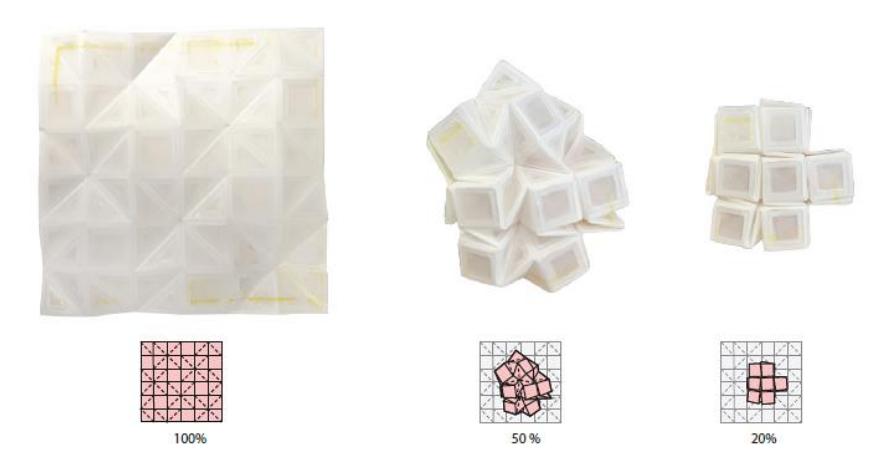
Figure 2 The figure by research team Metaplas showcases how strategic folding along valleys and mountain lines allows materials to transition seamlessly between 2D and 3D forms. This technique facilitates easy assembly and efficient deployment, as demonstrated by the fold lines [18].
By controlling the spatial organization through valleys and mountain lines, materials can be transformed between 2D and 3D forms. During the transition, the fold lines enable easy assembly and efficient deployment (Figure 2) [18]. An added advantage is the integration of embedded material information and assembly instructions. In this sense, the folding effect is not only a means of actuation enhancement for architectural adaptation but also a form-making mechanism for architecture [17,18].
3.3 Aggregation
Aggregation is an additional approach utilized for enhancing material actuation capabilities. Designers employ both layering and aggregation techniques to address one of the common challenges faced by all material-based adaptive designs: scaling [8]. In comparison to thinning, which addresses scale issues by diminishing the volume of material systems or their components, aggregation focuses on using the collective capabilities of single material actuation units in a cellular or aggregative system.
The aggregation strategy depends on the formal influences that arise from material behaviors at the local level units and extend to the global level (i.e., the entire aggregative system). These interrelationships are evident in the design studio project Meta-Patch, conducted by a team at the Rice School of Architecture under the supervision of Michael Hensel and Achim Menges [20]. The project involves connecting numerous square wood sheets side by side to create a three-dimensional aggregative structure. The use of screws between every two wood sheets allows for control over the degree of warping that occurs when the planks are joined. This warping, which is responsive to the force of gravity acting on the material system, represents the effect of the material on the constructed form. The local warping effects are then aggregated to produce a significantly enhanced material response in the overall construction. In sum, the bottom-up effects of warping contribute to the material actuation and embody the interaction between the intrinsic properties of the wood sheets, gravity, and the constructed form.
Regarding the purpose of creating a self-organization system based on transscale material behavioral interactions, Meta-Patch does meet the expectation. The project demonstrates a conceptual shift from unity to aggregation, which releases the project from conventional form-finding techniques. However, the perceivable material actuation performed by Meta-Patch is limited by the time factor, as it is only active during the construction process. As soon as the bolts have been adjusted, Meta-Patch no longer displays a perceivable material actuation but becomes a static structure. Observers would not even be able to tell that the system's form results from an aggregation effect or other causes, such as pre-stressing forces. Such an architectural tectonic leaves a gap between visual cognition and environmental perception for the observer; the representation of the material's engagement in the architectural adaptation process is obscure.
For an intrinsic dynamics system like Meta-Patch, the constraint is inherent. Gravity, for example, is a constant vector expressed by a constant 'g' in physics. A potential solution, loosening, was revealed in a granular fabrication research project: Granular Morphology (Figure 3), implemented by ICD at the University of Stuttgart [21]. Loosening refers to the use of roller-based connection systems when positioning local elements instead of a hinge and fix [22]. As reflected in Granular Morphology, rolling connections allow changes to structural behaviors at the global level since the mutually supporting behaviors between grains are changed. Loosening makes it possible for a material system to be constantly re-formed by playing with the tensions between stability and instability, solidity and looseness. Distinct from other amplification strategies, aggregation could benefit from loosening mechanisms since its unique local-global structural interactions constantly re-construct the whole system; the architectural adaptation is thereby enhanced through the dialogue between the structural behaviors and natural forces.
Figure 3 Author's digital simulation of the Granular Morphology project originally developed by ICD, University of Stuttgart. The project is based on the aggregation of small geometric components dumped by a robotic arm. The components, influenced by gravity and their inherent shapes, collectively give rise to an 'emergent' form through their combined physical effects.
3.4 Layering
Layering processes, such as compositing and additive manufacturing, have been increasingly adopted in material-based designs to achieve improved material actuation. Through the layering process, diverse materials are combined with each other in a layer-by-layer fashion. This was exemplified in the experimental initiative named HydroSkin, carried out by the Institute for Computational Design and Construction at the University of Stuttgart, wherein a composite material system was created to exhibit sensitivity to moisture [7]. HydroSkin involved the attachment of an additively fabricated structure to a wooden skin to enhance the wood's reactivity to changes in air humidity (Figure 4). The outcomes of the experiment showed that HydroSkin had a ten times higher
capacity to respond to air humidity changes in comparison to a standard wooden skin of the same thickness.
Figure 4 Author's diagram of HydroSkin's response to air humidity variations: HydroSkin under lower air humidity (left); activated HydroSkin in higher air humidity, displaying a web-like structure layered with polywood tissue (middle); amplified material actuation in the layered HydroSkin (right).
This demonstrates that the layering strategy results in the deployment of various materials' mechanical properties in a hierarchical arrangement within the composite material. When the system is subjected to environmental forces, each layer responds differently, resulting in a more radical global deformation as the heterogeneous local material reactions work together. This enhances the material's response, ultimately improving the structure and features of the location. As a result, the place of interaction is perceptually vitalized.
Nevertheless, a problem of performativity is reflected in HydroSkin. The material textures in all layers lack coherence and the design appears to be arbitrary, generating little sense of liveliness. In contrast, layers of natural materials are always found to be structurally integrated, both functionally and formally [23]. The layering behaviors in most natural materials follow recognizable patterns, highlighting the inherent capabilities of these materials, such as the coherence of textures between the cuticle and epidermis. In HydroSkin, however, such textual coherences are absent.
As demonstrated in this project, a thinning process is typically necessary when implementing layering and collaboration between the layers ensures material rationality in construction. Additionally, HydroSkin illustrates an ambiguous actuation method. If we view HydroSkin as a composite material system, the architectural adaptation is actuated by two distinct intrinsic property systems
originating from the polywood and the additively fabricated plastic web, respectively. However, if one of these materials is identified as the primary material, the external properties of the other are employed as an integral part of the architectural adaptation actuation. This ambiguity gives rise to the fifth material actuation approach – hybrid actuation – which will be discussed in the following section.
3.5 Composite
In some cases, multiple materials are used to enhance the material actuation, providing some degree of artificial control over the adaptive material system. These materials are integrated into different ways into an integrated material system, which converts the original pure material actuation into the so-called hybrid actuation so that the materials involved respond to the main environmental stimuli while minimizing artificial auxiliary stimuli. As suggested by Branko Kolarevic [8], the actuation capability of the material system can be enhanced and the purpose of architectural adaptation can be achieved through the synergistic drive of multiple materials.
In 2010, ETH Zürich and the Swiss Federal Laboratories for Materials Science and Technology collaborated in prototyping ShapeShift, a kind of electro-active polymer (EAP), with the purpose of investigating the potential of nonmechanical, material-based actuation for creating architecture that is soft and organic, representing "a spatial symbiosis between man, nature and technology", a new kind of architectural experience [24]. In the production of the EAP, the inner surfaces of the flexible and transparent polymer membranes were coated with a layer of a glue-like electro-active substance, which functioned as an actuator to react to external digital signals and a small amount of electricity was used as an energy supply.
As a composite material, the hybrid actuation that ShapeShift performs is contributed to by both the polymer membrane's flexibility and the electro-active layer's electromagnetic capabilities. Though its material behaviors respond to embedded electronic signals, which are artificial and come from external sources, the signals interpret natural impacts from the external environment, such as wind scale and temperature changes. Informed by such interpreted nature input, the material system deforms and performs the hybrid actuation based on its intrinsic properties, the material's nature. Sensing data are usually modified and amplified; hybrid-actuated architectural adaptations are thereby programmable for particular design purposes, including delivering materialengaged genius loci. Consider, for example, a ShapeShift set to respond to wind power: if the input of wind power and the output of electricity are mapped onto a larger numeric interval, the material's responses will be amplified to make the architectural adaptation perceivable. As the architectural adaptation is actuated, the genius locus of the site is reshaped following the change of the aggregated pattern of the EAP units (Figure 5).
Figure 5 Author's diagram of the unit structure of ShapeShift. This diagram explores the manufacturing of an electro-active polymer system for architectural adaptations, employing a composite approach.
In this case, hybrid actuation is applied in combination with layering. Also, a strong attempt to magnify the deformation at the global level is observable. In the case of ShapeShift, the elasticity of the polymer membrane may not be very striking at a perception level since the mode of deformation of the membrane does not differ significantly from the typical impression of material behavior found in this family of polymers. Conversely, as demonstrated in the adaptive architecture project 'Bloom', the performativity of the material actuation system benefits from a paradox between its unconventional material behaviors and people's impressions of metal's materiality [8]. When individuals observe the material behaving differently than anticipated, they actively and consciously explore the environment, reassess the materiality, and try to comprehend the phenomenon that is surprising them.
4 Overall Discussions
4.1 Material-based Actuations
In the above study, the five enhancement strategies, including thinning, folding, aggregation, layering, and composite, were investigated to enhance material actuation for architectural adaptations. The thinning, folding, aggregation, and layering approaches are all pre-actuation strategies, characterized by the deployment and implementation of their enhancement mechanisms occurring prior to the actuation of the primary material system or implementation at the same time. In contrast, the composite strategy is employed as a post-actuation method, implemented subsequent to the actuation process to minimize signal and energy supply while intensifying the material responsive deformation (Table 1). It should be noted that these strategies are not exclusive to each other; in fact, they are always employed to collaborate in material-based adaptive architecture cases.
Table 1 Comparison of enhancement strategies with pre-actuation and postactuation implementation.
| Enhancement Approach | Pre-actuation | Post-actuation | |
|---|---|---|---|
| Thinning | TRUE | FALSE | |
| Folding | TRUE | FALSE | |
| Aggregation | TRUE | FALSE | |
| Layering | TRUE | FALSE | |
| Composite | FALSE | TRUE | |
Thinning enables a material system to perform a material actuation with the intrinsic properties of a single material. However, it requires structural support from other strategies to allow large-scale application. When using a single material, an enhanced material adaption design adopting the aggregation approach can be driven by the intrinsic properties of a single material. Still, usually, some additional subsystem (e.g. joints) is necessary for its structure. The folding method effectively exploits the transition between surfaces and volumes to enable architectural adaptation, fostering unique spatial experiences through the interplay of witnessed events and dimensional changes. The design process of a folding system requires anticipating the form after actuation and considering the structural solution for the adaptation process. Based on its bottom-up constructional logic, aggregation seems to be the optimal material actuation solution for large-scale adaptive architecture. Comparably, layering shows a wealth of potential for large-scale application, yet no example in building scale has been found so far. Layering strategies can demonstrate both the functional and aesthetic versatilities of a single material when a material is used in all layers. Layering-based amplification endows the material system with a linear texture that highlights the orientation of the material behaviors that enhance the legibility of the engagement of materiality within an architectural adaptation. The composite approach would be needed for designs based on composite materials where the intrinsic properties of the material are insufficient to actuate a perceivable material-based adaptation. The adaptation actuated in this way is supplied with a small amount of external energy to overcome the material obstacles in energy demand, enabling the architectural adaptation to perform at a more perceivable scale and pace. Nevertheless, the purity of the performativity of materials is compromised (Table 2).
Table 2 A comparison of the structural and performative attributes demonstrated by five approaches to enhancing material actuations, as well as adaptations based on the material itself (○ = strong; ∆ = modest; − = limited).
| Enhancement | Large-Scale | Energy Independence | Performative | Sense of |
|---|---|---|---|---|
| Strategy | Capability | Purity | Orientation | |
| Thinning | − | ○ | ○ | ○ |
| Folding | ○ | − | − | ○ |
| Aggregation | ○ | ∆ | ∆ | ○ |
| Layering | ∆ | ○ | ∆ | ○ |
| Composite | ○ | − | − | ∆ |
Aggregation and layering share similarities in that both material actuation enhancement processes involve trans-scale form-finding from local to global levels. In contrast, layering and hybrid actuation are exclusively applicable to composite material systems. It is noteworthy that these strategies endow architectural adaptation with a sense of orientation, significantly enhancing not only the legibility of such adaptation but also the genius loci of the respective locations (Table 2).
5 Conclusion
In this study, several common challenges were identified in the implementation of material-based adaptive architecture. As illustrated in the 'composite' example, when a material actuator is designed to respond to continuous environmental impacts, an external energy-supplied subsystem becomes necessary. To maintain the manifestation of material engagement, the subsystem must be actuated by the intrinsic properties or capabilities of the materials involved. As demonstrated by the cases reviewed, multiple
enhancement approaches can complement each other to overcome these challenges. Consequently, this study proposes a potential solution: employing an additional actuator as a subsystem that reacts to extra-environmental impacts to support the primary system. For instance, in Meta-Patch, the mechanical connections (such as screws) could be replaced by joints designed to facilitate thermo-responsive extension. This modification enables the primary system, which is focused on gravity-responsive adaptation, to remain active with the assistance of the thermo-responsive subsystem. In this manner, material and design are intimately integrated and the dialogue between the material system and the environment is further enriched. Such solutions can potentially advance material actuation enhancement methods and warrant exploration in future research.