

1 Introduction
The historical process of European modern design, as a key part of modern design history, has been a main concern of the academic world for many decades. The modern movements that emerged in Europe in the early twentieth century signified the birth of modernism in the field of design. The rise of modern design has consequently voiced the advance of the design culture manifested by the attitude of the modernists towards a new role of design with respect to aesthetics, ethics, and social functions in modern times. These issues have been discussed and argued by many researchers, whose studies have in large part contributed to the understanding of modern design and culture. Accordingly, this article makes a further effort to investigate the potential link between European modern design and the Western cultural tradition. It particularly aims to illustrate the characteristics of Western culture in terms of typology and interpret how modern design as visualization of cultural codes has demonstrated Europe's cultural heritage, in order to clarify the causal links of modern design and cultural
tradition. It will also present the significance of modern design as cultural achievement.
2 Background
Based on the research of Nikolaus Pevsner, who is well known as a classical historian of modern design and in the 1930s wrote the earliest work on modern design history [1], the study of modern design history has experienced stable development. Since the end of the Second World War, the relationship between design and culture gradually caught researchers' attention in the context of the trend towards analysis and interpretation on modern design from sociological and cultural views [2, 3, 4]. In the article 'The State of Design History, Part Ⅰ: Mapping the Field', Clive Dilnot argues that 'the more design and designing are studied, the more important a broad context becomes' and then illustrated that modern design history is becoming a study object from a semiotic perspective, which places 'emphasis on cultural aspects of design meaning' [5]. Similarly, Kjetil Fallan states, in Design History: Understanding Theory and Method, that since design is a cultural phenomenon, design history should be regarded as a kind of cultural history [6]. Researchers with an interest in the study of modern design culture have given great attention to the revolutionary stance of modern design against the cultural background towards modernity. They especially underlined the breakthrough achieved by modern design that showed its innovative quality in the context of industrialized and secularized society. In An Introduction to Design and Culture, for instance, Penny Sparke explainsthe close connection between design activity and 'industrial technology and material, life style, and national identity' under the titles of 'modernity' and 'post-modernity' [3].
Despite the cultural significance of the breakthrough made by modern design, this study investigated 'continuity and long-term effects of culture' embedded in the revolutionary character of modern design from the perspective of a long-range historical process. With respect to the scope of European modern design, this study looked upon Europe as a unity from an outside view in order to distinguish it from other cultural zones, e.g., East Asia (an area which is under the influence of Confucianism), disregarding the geographic and cultural diversities inside Europe. This view will be more helpful to distinguish at a macro level the longterm effect of cultural heritage on modern design activities that emerged across Europe.
3 Methodology
This study mainly relied on qualitative methods. Typology and comparative analysis were employed as the specific approaches to achieve the research
objectives. In general, typology was used as a tool that was used to carry out investigations to disclose the connections between European modern design and cultural types. Comparative analysis was then used to interpret the casual links of modern design and cultural tradition with respect to similarity and difference. The framework used in this study was as follows: in the first place, 'ideal type', which is derived from the sociological theory of Max Weber [7, 8], was applied to explicitly illustrate the qualities of Western culture in terms of typology. According to Weber's theory, ideal type is normally employed to interpret social and economic behaviors. Since a cultural tradition can be considered as an inner behavior with widespread social ramifications, this concept can also be applied to identify cultural traditions (as ideological archetype) and their social impact. Then, based on the defined ideal types, investigations were made to examine how modern design unfolded Europe's cultural heritage, where the diversified connections between modern design and cultural types are discussed in this paper and finally the causal links between modern design and cultural tradition are interpreted by means of comparative analysis. The goal of this study was to clarify that the European cultural tradition, as regards modern design, is still present even in modern times and continuity persists in spite of the revolutionary character of modernism.
4 Rationalism and Idealism: Ideal Types
4.1 Rationalism
The attempt to identify ideal types in the tradition of Western culture first offers a glimpse of ancient Greece, where rationalism and idealism originate. As Immanuel Kant described, it was the Greeks who introduced reason into their way of thinking for the first time in history [9]. The philosophy of ancient Greece bears the quality of rationality that has dominated mathematics, logic, history, politics, and arts in Greece. The knowledge of mathematics and deduction are ascribed to the Greeks, as syllogism was one of the common uses of deduction. Bertrand Russell has even argued that the emergence of modern science would have been impossible if the Greeks had not invented geometry [10]. In the study of history, Herodotus applied a 'scientific method', which had the senses and reflection claim a place in historical research [11]. Greek politics made its way towards rationalism as well. Plato saw reason as a precondition of the ruling class and Aristotle held that a healthy government should be based upon the rule of law, which results from reasoning and can avert violent passion [12].
Additionally, Greek art expressed reasonableness. Alfred Weber has concluded that the Greeks knew how to convey imagination through objectivity and rationality [13]. The properties of reasoning then had Greek art dye a scientific color. According to Xenocrates' opinion, for instance, the works of a Greek
painter was an achievement in terms of science [14]. It hence has been embodied in Greek architecture and sculpture, which proved to be the origin and the norm of classical art [15] and left an imprint on ancient Rome (e.g., Vitruvius looked upon reason as the only standard of art criticism) [14] and Renaissance (e.g., Leonardo Da Vinci). Once rationalism took root in Western culture, it certainly did not only influence ancient Rome or the Italian Renaissance. As a cultural element, rationalism supported the rise of the modern western world, and a distinct connection can be found between the rationalization trend and, e.g., the scientific revolution, the industrial revolution, as well as modern capitalism and organizational management [8].
4.2 Idealism
The exploration of European idealism or utopian vision normally attributes this to the cultural influence of Jewish civilization from which Christianity originated. Nevertheless, the ideological foundation of idealism was already laid in ancient Greece. Christianity then had it develop into a rigorous spiritual discipline. Therefore, an explanation of this ideal type will first pay attention to the ideas of the Greeks and then to the culture and religion (as an enhancer) of the Middle Ages.
The capability of thinking in abstract terms encouraged the Greeks to create a perfect world in their mind, from which the absolute truth comes and under which the real world exists as an imperfect one. This became the origin of dualism in ancient Greece, based upon which, e.g., Parmenides, Plato, and Aristotle developed their philosophies [10] and which consequently turned into the spiritual connection to rising Christianity in Europe. In fact, the successful implantation of Christianity as an alien culture was largely due to dualism, which was in step with ancient Greek philosophy. From Russell's opinion, the latter's dominance was influential and the former merely provided a concrete form, e.g., heaven [10], whose manifestation referred to a confrontation with worldliness, e.g., wealth [16]. As a result, the Christian world view broadened the vision of the Europeans, who, once they started cultivating this belief, realized that there is eternity beyond the real world and asserted that the next world is superior to this world. It is not very difficult to see that their creativity and imagination were going to be stimulated by this vision. Though dualism was an issue contemplated only by the philosophers in ancient Greece, the tension between the idealized world and the real world has been popularized throughout evangelized Europe, which led to the endeavors to push Europe into an ideally conceived world in modern times, e.g., St. Thomas More, Robert Owen, Comte de Saint-Simon, Charles Fourier, and Karl Marx, as Russell has displayed a consistent match between the theory of Saint Augustine and the socialism of Karl Marx [10].
For culture, the course of European modern history was to a great extent the historical process of the representation of rationalism and idealism. As has been remarked, the rise of modern science and technologies, as well as modern capitalism, was largely due to the rationalization trend within Europe, while the ideas of utopia were mainly in service of attempts at social reform in Europe in modern times. The significance of European modern design therefore, as regards cultural tradition, should be accessed and evaluated from the same view.
5 European Modern Design: An Inheritor of Rationalism
Rationalism has presented itself through a series of social actions, e.g., philosophic thought, classical art, laws and morals, the spirit of capitalism, science and technology, and the industrial revolution, whose force was directly exerted on design activity in modern times. If European modern design was investigated in the same way, it would be seen as a manifestation of the same idea, which has emerged repeatedly in European history. The task of this section, therefore, is to interpret the links between them. Regarding the ideal type of rationalism, 'substantive rationalization' will be employed as a term to differentiate itself from another term, 'symbolic rationalization', in order to put a richer interpretation on the issue discussed in this section. The former is equal to the logically rationalized methods based upon function, effect, or objective, e.g., the Greeks tried to elaborate the world by mathematics or an inventor managed to provide power by a mechanical device during the industrial revolution in Britain, while the latter means the symbols whose visual form has been created to represent reason, e.g., the prescribed proportions of classical architecture or sculpture.
European modern design has embodied the tradition of rationalism by following these two patterns. In terms of substantive rationalization of European modern design, it prominently reflected upon the reaction to industrial technology and mass production (as the key factors of social change in modern times). Specifically, it reflected upon how to establish a relationship with industrialization by means of rationalized methods, through which the form of modern design emerged as a result of this process. Particularly, there was no confirmed connection between industrialization and design activity in modern times, as there was no design without 'decorations' yet. For instance, when compared with the Victorian or the Rococo style, the design patterns of the Arts and Crafts Movement or of Art Nouveau were very 'modern' at the time.
As is known from the perspective of cultural sociology, the process of industrialization itself was a clear manifestation of rationalism in production techniques, whose beginning was connected to the rise of modern science and modern capitalism in Europe. Taking this view as a reference, observers will find that the rationalized idea of design based on industrialization did not first arise from the group now called 'designers', who lost an opportunity to digest it appropriately, but from engineers, who were undertaking tasks such as the construction of public buildings and civil engineering. The engineers had a positive attitude towards industrialized production techniques before the ideologists of the Arts and Crafts movement felt a revulsion at them. They vigorously applied industrial technologies to engineering projects from the nineteenth century to the early twentieth century, e.g., bridges, stations, and exhibition halls, disregarding the disturbing issues of ethics or aesthetics aroused by the humanists [1]. Then, a few architects or designers in England, France, and Belgium, e.g., William Richard Lethaby, John Dando Sedding, Tony Garnier, Auguste Perret, and Henry van de Velde, accepted the effect of industrialization on design practice. To some extent they considered design activity as a scientific process [17], which revealstheir rationalized standpoint towards design, although some of them were involved in the Arts and Crafts movement and Art Nouveau. Therefore, as regards the contribution to modern design, their roles were characterized equally as engineer.
After that, this trend was disclosed in the modern movements from the 1900s to the 1930s. The development of German modern design bore the quality of rationalization from the beginning due in part to the cultural tradition of rationalism. Having an explicit understanding of the beneficial connection between modern industry and design activity, German ideologists and designers succeeded in making design form in accordance with industrial technology and production. This form later became a guide for design practice. Otherwise, European modern design could possibly have wandered around the Middle Ages, organic and exotic styles. When a comparison of Deutscher Werkbund and Bauhaus is made, a clue is revealed of the rationalized ideas emerging in succession. The Deutscher Werkbund is seen as one of the first organizations in Europe that made a concerted endeavor to combine industrialization and design. Since this organization had the support of the German government, its action and contribution were far beyond what the aforesaid far-sighted individuals had achieved. It established a brand-new norm for European modern design and successfully introduced industrialized production techniques into design practice by cultivating a rationalized attitude towards industrialization. As a government official, Herman Muthesius once learned the significance of the Arts and Crafts movement in England, but he recognized a disadvantage of this movement, whose ideologists and designers determinedly refused to accept the effect of industrialization and modern technology. He proposed the idea of standardized design based on industrialization in 1914 and advocated that mass production should rely upon efficient manufacturing enterprises rather than the individual artists [18]. Several German designers who stayed in step with Muthesius then tried to realize the idea of objectivity, science, and functionalism through their
practice. For instance, Peter Behrens put forward 'economical building' by which modern technology and industrial production should be fully taken into consideration in order to reduce costs [19]. Walter Gropius carried out this type of work as well, e.g., Fagus Werk. He, as one of the followers of Behrens, also looked at the issue of economic costs of architecture and even took notice of the action of national administrations [18]. Consequently, the idea of rationalization appeared in Bauhaus (Figure 1). The spirit of rationality and objectivity was conspicuous particularly after the mid-term reform in the history of Bauhaus. Moholy-Nagy and Hannes Meyer both were functionalist who approved of the use of modern industry and science. The former insisted on objective and standardized model of design, e.g., creating graphics through telephone, and the latter radically promoted rationality and social responsibility of design education after he became director of Bauhaus [18].
Figure 1 Bauhaus, Dessau.
As the name 'De Stijl' implied, the modern movement in the Netherlands had a tendency towards formalism. Nevertheless, Dutch modern design was a source of objectivity. The rationalist spirit of Hendrik Berlage's architecture influenced the modernization of Dutch design and an attitude towards rationalization which was equal to that of the Deutscher Werkbund can be seen. That is, design should first take technology and function instead of visual appearance into account. The works of Jacobus Johannes Pieter Oud, for instance, were about the properties of functionalism. Oud strongly disagreed with the opinion that design can achieve a target of aesthetics at the expense of practicality. He laid great stress on the qualifications of function, objective aim, and economic factors, and argued that the form of design should be created according to such requirements. Like Adolf Loos, Oud opposed any decorative scheme in design and considered that decorations merely pay compensation for innate defects. He also discovered the possibility of technological progress and the hindrance of aesthetics to progress and looked forward to the standardization model of design [20]. Similarly, the achievements of Constructivism in large part relied on the course of industrialization in Russia in the early twentieth century. This process cultivated the rationalized idea of Russian modern design, namely, to accelerate the pace of utilization of industrial technology and to realize the ambitions of creating the 'new society' through objective and functional design practice. This was expressed by many Russian designers and architects at the time, e.g., El Lissitzky or Nikolay Alexandrovich Milyutin [17, 21], although Constructivism was dyed the color of formalism as well. It is remarkable that practical works, e.g., residential buildings, rather than those typical designs of Constructivism, e.g., Monument to the Third International, were characterized by objectivity and rationality in Russia at the time.
Now, this paper will focus on the issue of symbolic rationalization. The modern movements not only promoted an integration of industrial technology and design practice in Europe but also confirmed a kind of form that symbolically represented rationalism. Loos was almost certainly the first to look upon the appearance of design as a symbol of rationalism in the history of modern design. He had demonstrated the quality of symbolic rationalization of modern design well in advance but foretold it in a different way. The main idea of Loos was against meaningless decorative schemes. He devalued the decorations of traditional design and held that decoration is the expression of morbidity or backwardness and signifies an inferior cultural life. In short, decoration is crime in spirit [19]. Nonetheless, there were a few tributaries of symbolic rationalization in Art Nouveau at the same time, although the style of Art Nouveau was far from rationalism and objectivity in general. This direction became observable particularly in German-speaking countries, e.g., Otto Wagner and Joseph Hoffman, as well as in Scotland, e.g., Charles Rennie Mackintosh, whose designs subtly indicated the rational tendency through the abstract and simplified forms.
As Banham mentioned, decoration might be well have been preserved in modern design had not Loos attacked it without mercy. The criticism of Loos has had implications for providing the psychological openness to concepts that pursue an abstract and objective aim. What had been implied by Loos was voiced and made by the artists of De Stijl instead. They strongly proposed that the practice of art and design should be aiming at universality, objectivity, and abstraction. These ideas were remarkably presented in the manifesto of this movement and in the writings of Piet Mondrian [20, 21]. Besides, in terms of the trend of design form in modern times, Loos pointed out what rationalized modern design should exclude, while the artists in the Netherlands showed what rationalized modern design should include. Obviously, as a symbol of rationalism, the whole meaning of modern design was given by both of them. Once this issue had been identified, the significance of symbolic rationalization emerged: the unadorned and abstract form of modern design matched the rationalism spirit of European modern civilization, just as the sculptures in ancient Greece or the churches in the Middle Ages represented spiritually.
Similarly, many works of Constructivism were symbolic. De Stijl resulted from the philosophy of the artists, whereas the unadorned and abstract form exhibited by the Constructivists came from their connection with the modernization of Russia. This movement carried a burden of responsibility for announcing the prospect of industrialized society entitled 'communism'. Hence a large number of symbolic elements was woven into their designs so as to demonstrate ambition and power. For example, the aforesaid Monument to the Third International, not to mention the horizontal skyscraper designed by Lissitzky or the Soviet Pavilion designed by Konstantin Melnikov, all played a semiotic role in constructing an industrialized modern society in Eastern Europe.
Figure 2 Neue Nationalgalerie, Berlin.
Again, in Western Europe, although Ludwig Mies van der Rohe based his designs on economic and technological factors, he tested the boundary of functionalism and disclosed the quality of symbolic rationalization (Figure 2), e.g., through his
well-known maxim 'less is more'. Le Corbusier went even further than Mies. The idea of Le Corbusier had the characteristic of symbolic rationalization as well, which is revealed directly in his writings, e.g., Vers une architecture. An analogy was made between the symbol of rationalism and geometry in his mind. He thus endowed the straight line with a feature of rationality and viewed geometry as an expression of spirituality [20].
6 European Modern Design: An Industrial Utopia
In the tradition of idealism, the modern movement was dyed the color of utopia in England since the nineteenth century. Therefore, attention should first be paid to the Arts and Crafts Movement in order to fully interpret the meaning of idealism of European modern design. As mentioned above, this tradition is in fact a composite product of ancient Greece and the Middle Ages. The thought of conceiving an ideal world based on religious or political beliefs repeatedly emerged in European history and it then became a background against which the tradition of idealism of European modern design can be illustrated. As for the utopian trend, it also developed into two types in the course of European modern design history. European ideologists and designers either imagined a substitute for growing discontent with the modern world or started preparation for the future due to their strong desire to assume a perfect modern community.
The idealistic concept of the Arts and Crafts Movement was mainly held by the ideologists who were feeling dissatisfied with the harsh realities then. John Ruskin deplored crushing work caused by the division of labor in modern times and complained that there is no real happiness in a capitalist society whose end is merely the pursuit of wealth. William Morris expressed his disgust at the laissez-faire economy of capitalism as well. From his point of view, there is only exploitation, poverty, and ugliness. Therefore, they looked for a better alternative and deemed it necessary to reform society through architecture [18]. While recognizing architecture's interaction with social circumstances, their attention was diverted finally from the social responsibility of design to political activities.
Nevertheless, Morris as well as Ruskin persistently advocated the value of handicraft and objected to the effect of modern industry, which destroyed their hopes for industrial society. Consequently, those groups who had been the main beneficiaries of the social change they opposed benefited again from the fine workmanship they demanded. Comparatively speaking, the endeavor of Ebenezer Howard avoided this kind of confusion, because he adopted a practical approach to the same problem. He also recognized the importance of architecture and urban planning for the improvement of social circumstances, which is beneficial for the public, and tried to achieve this goal by design itself instead of politics. The concept of the garden city was a confrontation with modern industry and capitalism, revealing his idealism. Nevertheless, he always hoped to practically start his project in the real world and considered urban planning as the best method of social reform and of meeting the needs of the people, which then received a good review from the critics, e.g., Lewis Mumford [22]. Consequently, he realized his ambition at the beginning of the twentieth century.
Unlike the ideologists and the designers in England, Tony Garnier put more effort into preparations for the coming of the industrial age in France, although he only did this in his drawings [18]. Garnier was by no means hostile to the realities of industrialization, even though he showed the same imagination that had been displayed by the Arts and Crafts Movement, both of which represented a version of communism and were against private ownership [23]. In Italy, the Futurists visualized an industrial utopia in a similar way. They enriched the picture of industrial society described already by Garnier and radically praised modern life through poetic expression. Garnier and the Futurists both had a similar position with respect to urban planning. They wanted to present what a perfect city, with the coming of the industrial age, would be. It was still an idea of utopia, into which modern technology had been inserted. However, it developed in the opposite direction when compared with designs from England such as garden cities. While British ideologists and designers envisaged stepping back in time, their French and Italian counterparts longed for the future of industrial society.
The ideal society visualized by Garnier and the Futurists inspired Russian designers. The ambitious urban planning of Garnier coincided with the Soviet government's aspiration to create a new society and the legacy of the Futurists was preserved in the East [18]. The October Revolution was essentially a consequence of Marx's communist utopia. After seizing power, to weave a better future became one of the pressing political tasks of the Soviet government. In order to meet this target, modern movementslike Suprematism or Constructivism shouldered the burden of producing a new vision of Russia, which represented the 'millennium' in this country [18]. As an analogue of the Futuriststyle, modern architecture and urban planning in the Soviet Union thus expressed an unrealistic desire to become a powerful industrial nation. Observers found that their designs were to some extent a bluff, particularly considering the economic and technological conditions of Russia then. The close relationship between the modern movement and national politics of Russia is an issue repeatedly stressed in this paper. Russian modern designers were deeply involved in the 'social engineering' of communist utopia carried out by the communists and were severely dependent on their only employer, namely the communist government. They could not manage anything without this employer. As a result, the modernists of Russia bore the quality of idealism due to their involvement in a larger movement of utopia, the Communist Movement.
Bauhaus obeyed the spirit of utopia in the early days as well. Its nature was not akin to Constructivism but to the Arts and Crafts Movement, however. Both of them expected to return to the Middle Ages. Walter Gropius, the founder of this well-known school, raised the hopes of dealing with the deep crisis caused by industrialization, e.g., the First World War [24]. The war badly injured the mental world of the Europeans and cast a shadow on industrial society: the machine suddenly became a tool of destruction and slaughter. This dreadful use of mechanization could hardly have been imagined in the past and hence shocked Gropius, who had been a modernist nurtured by the functionalists of Deutscher Werkbund, e.g., Behrens. He had set the tone of utopia for the educational idea of this organization in the early stages. Weimar Bauhaus is consequently viewed as a social experiment at the micro level, which was made to resolve the social crisis in modern times. Following Ruskin and Morris, the keynote of this experiment was still an attempt to take the organizational base from the Middle Ages, e.g., the guilds, for the school so as to develop an idealized community [17, 18, 24].
Le Corbusier can be revisited from an idealistic point of view. His concept of utopia originated from Garnier and the Futurists as well, e.g., Antonio Sant'Elia [17]. Nevertheless, his idea of symbolic rationalization itself was characterized by a trend of idealization. According to this idea, the rule of reason can create a kingdom of perfection [17], which led to the application of a classical process in his designs [20]. Therefore, the works of Le Corbusier (urban planning in particular) were characterized by abstract forms, e.g., Ville Contemporaine. On the one hand, Le Corbusier had utopia expectations of the future [25]. On the other hand, he, like the ideologists in England, sensitively perceived the crisis in the modern world and even hoped to save it by architecture, e.g., Vers une architecture. He was counting on the architect to achieve this task and named him 'the king' [26], thus giving his ideas a touch of delusion.
7 Comparative Analysis
So far as rationalism of European modern design is concerned, the relationship of the two types, namely substantive rationalization and symbolic rationalization, is delicately symbiotic rather than antagonistic. As we all know, the form of European modern design was indeed an outcome of the industrial revolution, since this kind of form was determined by industrialized methods, e.g., standardization and mass production. However, this kind of form is completely in accordance with the rationalism originating from ancient Greece. The geometric form could easily be seen as a model of perfection by classically cultivated Europeans. It hence symbolically represents rationality: not only does European modern design appear rational for the effect of industrialization, but also the visual form itself represents the idea of rationality.
While congruence is confirmed between substantive rationalization and symbolic rationalization, contradiction is disclosed in the utopian trend of the modern movements. As discussed, the idea of idealism developed into two types in the course of European modern design history as well. Accordingly, idealization did not only imply that European modern designers or ideologists were looking forward to a better prospect against the background of industrial civilization. Rather, some of them were willing to look backward in order to deliver the people from the mental injury of the modern world. Regardless of whether they were retrospective or prospective in nature, their expectations were raised based on the tradition of idealism. Rationalism and idealism in European modern design can be compared as follows (Table 1).
Table 1 Comparisons between rationalism and idealism.
| Types | Characteristics |
|---|---|
| substantive rationalism | rationalized methods based on function, effect, or objective |
| symbolic rationalism | visual symbols created to represent reason |
| backward idealism | a substitute for the modern world |
| forward idealism | preparation for a perfect modern community |
The relationship between rationalism and idealism in European modern design is by no means a dichotomy. Rather, these two types are interrelated. In other words, as these ideas, which both originated from ancient Greece and took effect in European culture over a long period of time, rationalism and idealism together have sometimes exerted an influence on the same design activity. As mentioned above, many works and ideas of European modern design characterized by rationalism bore the quality of idealism at the same time, e.g., Constructivism, Bauhaus, and Le Corbusier, and vice versa. Therefore, the mixed manifestation of rationalism and idealism demonstrates that the two ideas are not mutually exclusive in the practice of European modern design. The appearance of one does not suggest the disappearance of the other. The relationship between rationalism and idealism in European modern design can be represented as follows (Figure 3).
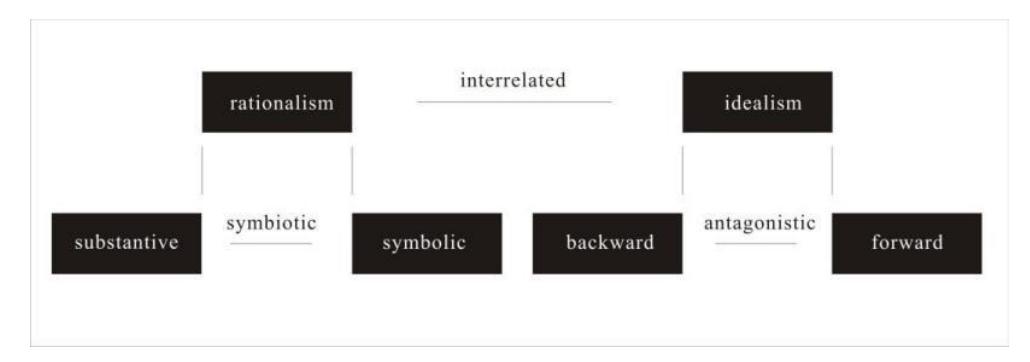
Figure 3 The relationship between rationalism and idealism.
8 Conclusion
According to this investigation, which was conducted to clarify the potential link between European modern design and the tradition of Western culture, this article has come to the conclusion that European modern design, as visualization of cultural codes, is essentially a manifestation of Europe's cultural heritage, even though it reflects a revolutionary stance against the cultural background of modernization and achieved a breakthrough that showed the innovative quality of modern culture. The study unfolded the long-term effect of culture on the rise of modern design in Europe, which strongly indicate culture's continuity in the long-range historical process. European modern design has always been viewed as a culture phenomenon in modern times, yet this phenomenon has its roots in ancient Greece and the Middle Ages.
Based on the definition of rationalism and idealism, as ideal types of the tradition of Western culture, the investigation revealed that European modern design presented these ideal types through diversified design activities in the modern movements. Specifically, European modern design represents rationalism with respect to substantive rationalization and symbolic rationalization. The former is equal to the logically rationalized methods based upon function, effect, or objective, while the latter refers to the symbols whose visual form has been created to represent reason. In terms of substantive rationalization, it prominently reflected upon the reaction of the modern movements to industrial technology and mass production. Specifically, it reflected upon how to establish a relationship with industrialization by means of rationalized methods, through which the form of modern design emerged as a result of this process. In terms of symbolic rationalization, it was reflected remarkably in the opinion about how to look upon the appearance of design as a symbol of rationalism in the history of modern design. As for the idea of idealism and utopia, it also developed two trends in the course of European modern design history. European ideologists and designers either imagined a substitute for growing discontent with the modern world or started preparation for the future due to their strong desire to assume a perfect modern community. The former expected to look backward in order to deliver the people from the mental injury of the modern world, while the latter were looking forward to a better prospect against the background of industrial civilization. Additionally, congruence was confirmed between substantive rationalization and symbolic rationalization of European modern design, whereas contradiction is disclosed in the utopian trend of the modern movements. Nevertheless, the relationship between rationalism and idealism is not mutually exclusive but interrelated in the practice of European modern design. In general, the significance of European modern design is embodied not only in the revolution or innovation of modern culture but also in cultural inheritance and continuity in history.
In addition, since Europe was the origin of modern design in terms of culture, the emergence of modern design in any other cultural zone is supposed to inevitably encounter the impact of cultural tradition innate in European modern design. That is, localization of modern design anywhere will meet the challenge of transplanting, modifying, or resisting European culture that is coded into the logical process and visual form of modern design. Therefore, localization of modern design does not simply mean a full-scale stylistic revolution but also a cultural shift or a cultural exchange that may last for a long period of time.
Acknowledgement
I am grateful to Yang Li and Li Chen for their help in providing the photos. Figure 1 was taken by Yang Li, and Figure 2 was taken by Li Chen.