

1 Introduction
As a dominant worldview, anthropocentrism has been affecting the ecosystem through patterns of decision and action that prioritize the advantage of humankind while ignoring the presence of non-human entities. Thus, the ecosystem has been shaped by the growth and future development mentality of human-centered ethics [1]. Through perceivable outcomes of radical changes in socio-ecological processes, cultural mechanisms, and social orders, humans recognized the necessity for confronting anthropocentric problems and solving them. For that, the sustainability movement has emerged to balance human-ecosystem relations. However, even if there are positive insights and signs of improvement, the limitations and deficient interventions impair the reliability of the concept of sustainability as a holistic strategy. Both the concept of sustainability itself and sub-concepts such as ecosystem regeneration and circular economy are not capable of transcending the visionary boundaries of anthropocentrism [2]. To obtain absolute ecological regeneration and integrity, there is a need to define a new ecocentric vision [3]. To this end, responses to the question: "How would circularity be conceptualized and utilized in consideration of the commons of all living and non-living stakeholders in the ecosystem?" will be sought throughout the present research.
This article presents an alternative pathway that enables a holistic ecocentric perspective by integrating all living and non-living entities in the ecosystem to regenerate it. For this purpose, a design model is proposed based on the circularity concept in an interobjective structure of active participation [4]. The paper is composed of two main sections: 1) Theoretical Framework, consisting of the problem definition and conceptual framework, and 2) Data & Discussion, consisting of the model proposal and explanation, which construct the model step by step (see Figure 1).
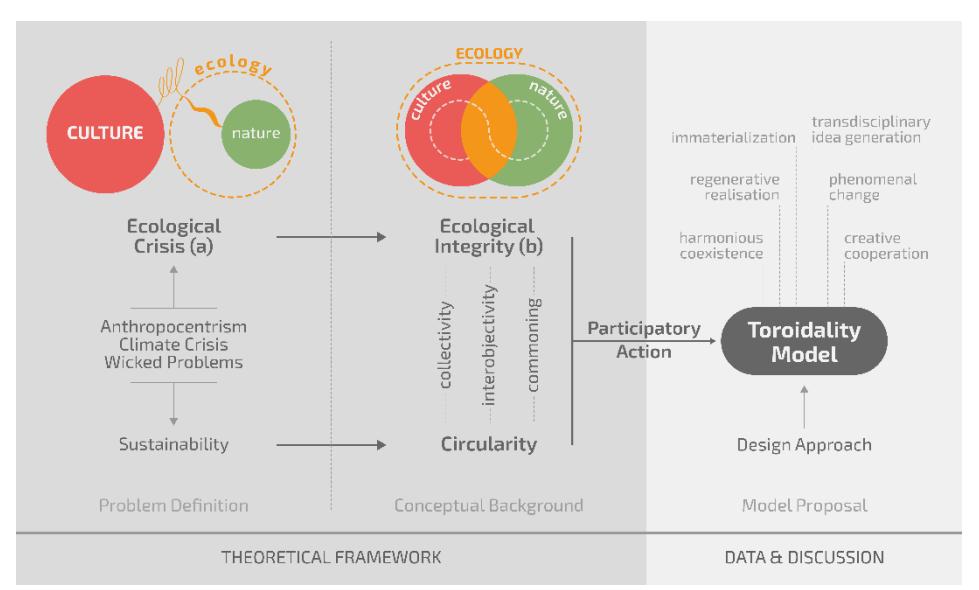
Figure 1 The structure of the research.
In the Theoretical Framework section, some critical analyses are done to define problems about anthropocentrism, climate crisis, wicked problems, sustainability, and circularity. Through these definitions, the ecological crisis is described. Then, in order to define a conceptual framework, the detected problems are linked with the related concepts to create an alternative connection within the circularity concept from a broader perspective to obtain ecological integrity. Following the connection between ecological integrity and circularity, the Toroidality model is presented and explained in the Data & Discussion section. The model's components and steps are detailed by referring to the problems described. In the conclusion of this paper, plans for further steps to test the model and the intended outcomes of the research are explained.
2 Theoretical Framework
2.1 Problem Definition
From the beginning of the Anthropocene epoch, dating back to 1610 according to the Orbis hypothesis [5], humankind has constantly dissociated itself from the natural aspects of the ecosystem and performed antithetical practices that harm it. Non-human entities in the ecosystem have been devastated in the interest of uncontrolled production and consumption patterns, and the natural balance has been destroyed drastically. Nature has been exhausted as a raw material by prioritizing notions such as efficiency, competition, and corporate supremacy [6]. As a result, the usage of the ecosystem has exceeded planetary boundaries [7]. Loss of biodiversity, greenhouse impact by fossil fuel exhaustion, multidimensional pollution, destruction of the ozone layer, depletion of natural resources, and damaged natural cycles are some of the catastrophic outcomes of the Anthropocene [8].
However, more than the environmental crisis and climate change, anthropocentrism has caused a disorientation of ecological flows and multifaceted wicked problems for the world [9]. These have grown out of the malfunctioning processes both in cultural and natural phenomena [10]. The multidimensional global crisis has become ineluctable due to the deterioration of cultural and natural patterns. This crisis can be recognized as an ecological crisis that is caused by the corrupted relations among culture, nature, and ecology concepts [11] (see Figure 1, 'Ecological Crisis(a)'). Humans have separated culture from the essence of ecology and the intersecting notions of nature through time [12]. They have magnified the boundaries of culture by breaking the hierarchical allegiance with ecology. By weakening the connection of culture with ecology and nature, humans have made transgenerational interpretations through cultural production without considering the negative impacts on nonhuman entities in the ecosystem. For instance, from the beginning of the agricultural revolution, humans have constantly disrupted forests, lands, and water resources to manipulate them for the development of humankind, without considering other species or the sustainability of natural resources [13]. Being
estranged from nature has made humankind irresponsible in cultural actions, with catastrophic outcomes for the ecosystem.
As a response to these anthropocentric manipulations and wicked problems, the concept of sustainability has emerged. Some interventions have been planned and started to be implemented to obtain a sustainable future in conditions of a healthy environment, economic prosperity, and social justice while ensuring the wellbeing and quality of life of current and future generations [14]. Through these interventions, some practical methodologies have been applied to regenerate the negative impacts of human actions. However, because of the polarization of nature and culture and the misleading dynamics among them, the present sustainability concept cannot cover the requirements of ecological regeneration. For instance, in the commonly accepted sustainability assessment model – the triple bottom line – there are three pillars of sustainability: environmental, economic, and social [15]. Thus, ecology has been degraded to and equated with the concept of nature [12]. Also, the economy and society, which are cultural productions, have been separated from each other and the sub-concepts under culture have been discarded. With this kind of problematic identification, sustainability has ended up with dysfunctional and ambiguous cases in action [16].
Considering the capabilities of various sustainability concepts, the circular economy – or from a more general point of view – the concept of circularity has some unique aspects that can answer the negativities of the ecological crisis and procure the needs of future generations [17]. Fundamentally, circularity directly links to ecological phenomena by being developed through biomimetic inspirations from nature and lessons from the natural cycles in the ecosystem [18]. It provides tools and methods that offer some resource-intensive and regenerative solutions in a closed loop to transform linear design processes into long-term holistic, sustainable strategies [19]. Circularity is based on the cycles of organic and technical nutrients [18], with some methods like reuse, reduce, recycle, refurbish, reclaim, and repair to prevent excessive material and energy use by repeatedly integrating discarded products, residues, by-products, and production wastes into production processes [20]. Regenerative and distributive dynamics of circularity can provide a democratic and sustainable base to create a balance between people and planet [21].
However, some visionary and technical limitations obstruct the functioning of circularity [22]. From a visionary perspective, dominating neo-capitalist and colonialist motivations contradict the dynamics of circularity, such as using fewer resources, producing less, minimizing consumption [23], activating reuse, repair, and sharing economy models [24], collaborative consumption [25], and commonbased peer production [26]. Also, the competitive inter-organizational and global
market conditions and aggressive profit-margin strife force organizations to disrupt the equity of share rather than collaborating through structures like industrial symbiosis [27] in the production phase or consumer cooperatives in the use phase. On the other hand, technical boundaries affect the material-dominant production patterns [28] and the transformation of physical matters and energy [29], which are the essential drivers of modern culture that are mainly based on tangible assets. For instance, petroleum-based materials, some metals and alloys, and other particular raw materials, which are the dominant ingredients in this production culture [30], are not suitable for recycling more than 4-5 times because of the natural law of entropy [31]. Thus, there is a constant primary raw material need even in circular design and production processes [32].
Adding to these technical challenges, there are socio-cultural and socio-economic misconceptions on a global scale [33]. The strategic positioning of integrating consumers into circular systems as active participants is too ambiguous. The perception of consumers about circularity is almost fully limited to the recycling of wastes, rather than reducing consumption, extending lifespan, or sharing services and products. With this kind of limited perspective, the dependency on natural resources and further needs for virgin materials inevitably remain substantial [34]. Parallel to that, the transition from consumer to user is not sufficient for integrating consumers as stakeholders in circular design processes. It results in a lack of data to improve the circular system related to user insight, confusion, and constraints based on the current experiences [35].
As a result of the above, circularity in practice has some contradicting qualities compared to the idealized circularity concept. Briefly, circular processes consist of linear mechanisms that function ostensibly in a circular outlook, and currently, circularity is far from living up to its promises [36]. Without a new holistic vision, the direct integration of the current rapid production/instant consumption vision to circularity will not be sustainable in the long run. There is an urgent need to reduce the role and part of tangible assets and natural resources in production processes. Rather, it is necessary to activate a knowledge-based approach in circular processes [37], through the integration of intangible assets such as traditions, morals, and phenomenal data; intellectual capital such as expertise, tacit knowledge, and scientific knowledge; and multidisciplinary knowledge such as sociology, ecology, phenomenology, ontology. For this new holistic vision, new conceptual links must be defined between some interrelated notions by applying complementary methods. The problems described above, under the concepts of anthropocentrism, wicked problems, ecological crisis, sustainability, and circularity, will be discussed below through a critical lens and developed through alternative approaches to creating a conceptual background.
2.2 Conceptual Background
The structure of the conceptual background consists of three sub-sections (see Figure 1). The first sub-section describes ecological integrity, which is targeted at reversing the negative outcomes of the ecological crisis. The second subsection signifies a contextual reference for the catalyst concepts: interobjectivity, collectivity, and commoning. Throughout the second sub-section, the interaction between the ecological integrity and desired circularity concepts will be addressed. In the third sub-section, a methodological framework will be defined to transform the conceptual background into the model proposal.
2.2.1 Ecological Integrity
As defined in the problem definition, the outcomes and side effects of the ecological crisis obstruct conceptualizing and executing a proper functioning sustainability strategy that stands for all entities in the ecosystem without prioritizing any of them. So, it is primarily necessary to define a fundamental vision that considers ecology as a unity, following the notion of ecocentrism [38]. The connection between culture, nature, and ecology must be restored to regenerate ecological mechanisms.
The boundaries of ecology must be expanded to comprise culture to be compatible with the terms of the ecosystem, the notion of nature must be made stronger to ensure the continuum of biomes, and the space of intersection between nature and culture must be enlarged to obtain harmonious coexistence. By assuring these regenerative steps, it is possible to maintain ecological integrity (see Figure 1, 'Ecological Integrity (b)') as the fundamental vision. Circularity can function as a realization tool for the desired model of ecological integrity by providing continuous phases of experimentation and experience generation. Within ecological integrity, circularity is not just a production mentality but also a bridge for interacting humans and the wisdom of natural cycles. However, the tracking and evaluation of the regenerative outcomes of circularity within ecological integrity requires the embodiment of some catalysts. Therefore, some substantial contextual references are useful to develop a circularity concept that is compatible with the principles of the ecological integrity vision.
2.2.2 Interobjectivity, Collectivity, and Commoning
Constructing this ecocentric vision and positioning the interaction among the cultural and natural assets are critical issues that will determine the circularity of this integration. The interrelational and interdependent qualities of reciprocal relationships among cultural and natural assets depend on non-hierarchical and democratic symbiosis. The concept of interobjectivity provides a potential framework to conceptualize this symbiosis. As far as it is a vision to define an object by other objects that form its surroundings and the dynamics among them, interobjectivity provides an alternative perspective to perceive this symbiotic context based on the relational process of events or actions [39]. Humans and non-humans co-exist through their collaboratively constructed objectifications [40]. That is why interobjectivity is crucial in determining how to structure the network among all living and non-living entities in the ecosystem [4]. Interobjectivity will provide a doctrine to humankind that will help them develop more-than-human empathy and a sense of harmonious coexistence with nonhuman entities in the ecosystem. Retreating from self-superior positioning is inevitable for humankind to integrate themselves into the interobjective ecosystem of entities [41]. Ecological integrity is to be reached by turning anthropocentric, biocentric, or nature centric visions into interobjectivity.
Following the terms of interobjectivity, collective knowledge of all presences is a crucial factor for activating intangible asset-based circularity. Breaking away from the limitations of monocentric knowledge clusters is essential for obtaining the interobjective structure of ecological wisdom. Each entity in the ecosystem – human or non-human – is an actual co-producer of knowledge by contributing to the transformation of data into knowledge [42]. The constant production of collective knowledge is crucial, by providing alternative resources for circular processes.
Practicing phenomenal aspects of collective knowledge within a circular design format requires bio-inclusive collaboration and participation [43] that depends on the 'commoning' of human and non-human stakeholders. Commoning is an experimental action of re/producing the relationships between culture and nature. It is about offering generative possibilities with the participation of human and non-human entities, through socio-ecological motivations to target multifaceted problems [44]. Therefore, co-creating a common ground for collaboration and participation is the primary driver of cross-disciplinary practices by stimulating stakeholders to challenge and recreate existing disciplinary boundaries [45]. By following the vision of interobjectivity, matching circularity strategies with the human and non-human entities will enable commoning. Commoning on an ecological scale can be obtained by taking care of and caring for ecological matters that depend on the shared values and common future of the stakeholders [46]. Envisioning and co-creating a common future depends on the collaborative experimentation stimulated by collective wondering [47]. Interobjectivity in collaborative experiments enables mutual learning experiences that will ensure the circularity of collective knowledge and ecological integrity.
With the catalysis of interobjectivity, collective knowledge, and commons, the desired exemplification of ecological integrity can be grounded and interrelated with the circularity mindset, in theory. However, the application of this framework requires a methodological structure that depends on participatory dynamics and constant action for change. Considering this, participatory action research (hereafter, PAR) provides an appropriate methodological structure for designing an alternative circular design model.
2.2.3 Participatory Action Research (PAR)
PAR is action research processed through collective participation based on iterative and circular phases of planning, action, observation, and results with collective movement [48]. It depends on collective reasoning, and evidencebased learning focused on social action that promotes cross-fertilization, value creation in exploration, and the transformation of common phenomena. It is a transformative action conducted 'with' people instead of making decisions and applying strategies 'for' or 'about' people [49].
Figure 2 Cycles of action research (developed upon [51]).
As a reference methodology, action research is based on the cyclical processes of research and implementation (see Figure 2) to produce action and knowledge to tackle real-life problems. Through action research, not just the produced knowledge is to be used for change [50], but also the change itself will lead to generating knowledge. These continuous cycles of action research are aimed at constant improvement through converging towards better situation understanding and improved action. Thus, it enables experiential knowledge gained through the unique patterns of action research cycles [51].
Participatory action depends on the combination of the expert knowledge of researchers and the experiential knowledge of practitioners as the main driver of new knowledge generation [42]. Through dialogues and phenomena-based interpretations, people with various knowledge sets and multidisciplinary
backgrounds become actual co-creators of knowledge [52]. By integrating morethan-human entities both as the direct resources of knowledge, co-producers of new knowledge, and actors of phenomenal transformations, an interobjective ecocentric vision will be achieved [53]. For that, an alternative PAR approach must be developed to cover the notions of circularity for and through ecological integrity.
Following the specifications and dynamics defined above about PAR, the methodological approach of the research was determined. Participation of humans and non-humans in an interobjective structure with the action and change intent covers the research's fundamental aims and practical preferences. That is why the PAR methodology functions both as a reference for model development as well as a potential guideline to design a case study for the application phase of the model.
3 Data & Discussion
3.1 Toroidality Model Proposal
Following the conceptual background defined above, an alternative model for circular design, the Toroidality Model, was created (see Figure 3). Through the methodological approach of PAR, Toroidality was formed to reach ecological integrity by following its notions. Along with the commoning, toroidal designs center the circularity of collective knowledge through an immaterialization point of view.
The Toroidality Model was conceptualized through toroidal and poloidal axes on a 'torus' shape (see Figure 3(a)). The dynamics of Toroidality are based on the continuous poloidal cycles that are intertwined with the toroidal cycle of collective knowledge. Poloidal cycles are based on the following four fundamental phases:
- 1- Phase 1: Explore
- 2- Phase 2: Relate
- 3- Phase 3: Co-design
- 4- Phase 4: Regenerate
Also, there are four nods between these phases:
- a- Map
- b- Focus
- c- Reaction
- d- Resource
To conceptualize the interaction between the poloidal and toroidal cycles, the operational aspects of Toroidality are illustrated in Figure 3(b).
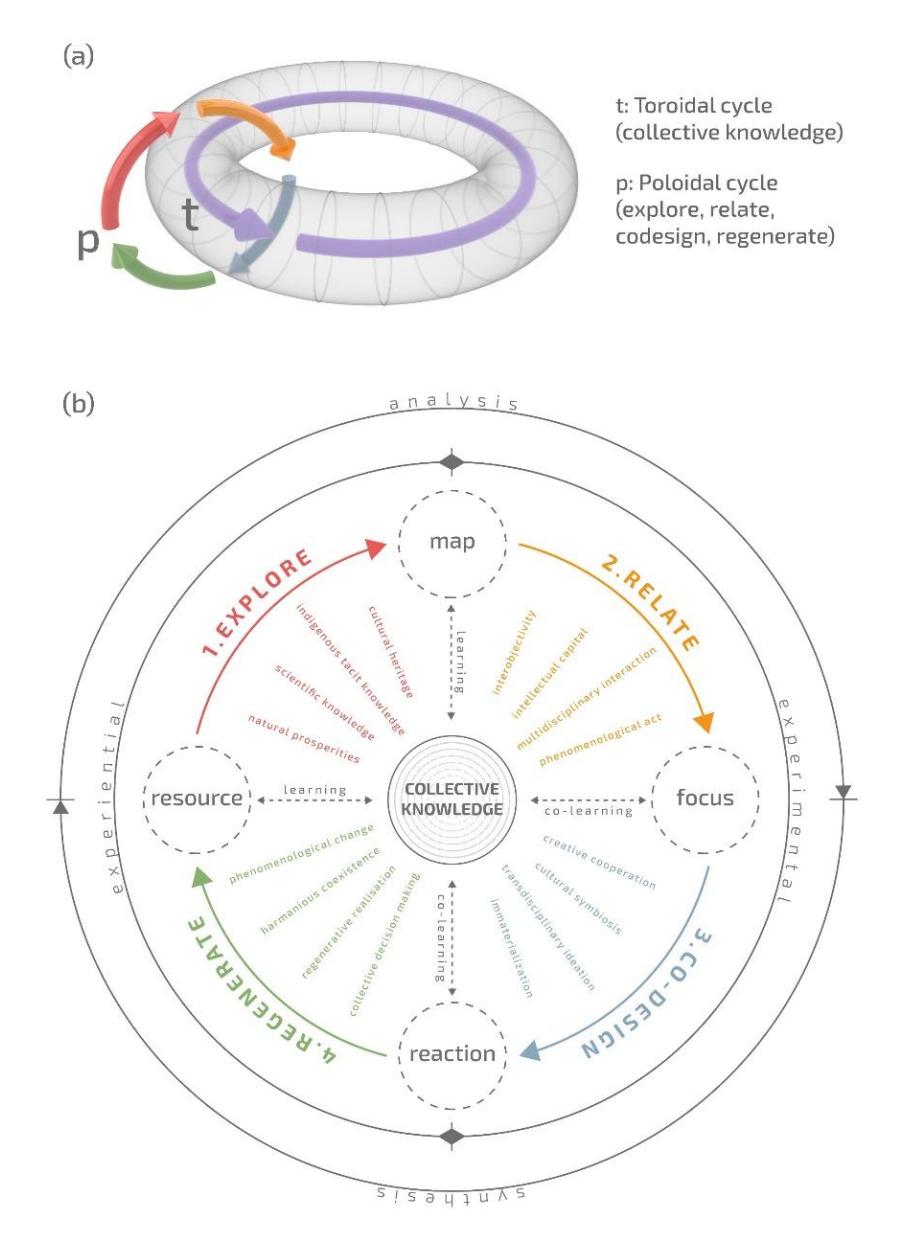
Figure 3 Toroidality as a circular design model. (a) Three-dimensional representation of the poloidal cycle and toroidal cycle. (b) Phases of the poloidal cycle around the toroidal cycle.
By following the notions of Participatory Action Research, this model prioritizes integrating as many stakeholders as possible in certain cases for activating a democratic, transdisciplinary, and collective design mentality. One of this model's main considerations is maximizing the participants' diversity to enhance the richness of the knowledge and solutions co-designed. With this model, it is possible to work on the same cases while ending up with different solutions according to the alterations in participant groups and approaches due to its dynamic methodological structure. Along with the circulation, the analysissynthesis cycle leads to divergent-convergent design thinking processes [54] that maximize the creative value of the outcomes.
Also, the experience-based and experiment-based approaches to the hemispheres of the cycle create a multi-methodological structure. Through the 'Relate' and 'Co-design' phases, all assets from a phenomenological perspective will have been processed to experiment with the transformation of phenomena to new values. In contrast, these value propositions must be transformed into new phenomena through the 'Regenerate' phase. The process of action in a collaborative structure leads to the generation of experiential knowledge. These new phenomena will be experienced to be reinterpreted as a resource in the 'Explore' phase to start a new circulation. Through the experience-experiment cycle, each circulation will ensure to offer not just co-designed outcomes but also new phenomenological resources. This model will provide constant possibilities for further applications, even for the same cases. The model's functioning will be explained through its four phases to understand the operational aspects and dynamics of the design flow.
3.1.1 Phase 1: Explore
Depending on the asset-based design practices, the identification and classification of the entities of the networks is the fundamental step for making a start. That is why exploring tangible and intangible assets will be the first requirement to detect, prioritize and analyze the actions to circulate. Through the exploration process, natural prosperities and cultural heritage will be integrated by the phenomenological representations of scientific and indigenous tacit knowledge. To reach the blend of living knowledge consisting of practical wisdom and positivist sciences, a variety of assets and the diversity of the experiences about these assets are crucial to getting integrated. Natural prosperities, ancient knowledge, tangible and intangible cultural heritage, morals, customs and values, intellectual capital, and creative potential are possible phenomenological resources depending on the individual or communal experiences that create the whole asset pool. The exploration of these assets is too complex to handle through the efforts of individuals. Also, the richness and diversity of the collective knowledge is the key factor for generating holistic and representative datasets. With the insights of each member of the stakeholder group, a map will be generated collectively to visualize and conceptualize the complex data of the asset pool. Knowledge about current challenges or opportunities from the collective intelligence of the focus group will provide a wide range of data for the asset mapping phase.
3.1.2 Phase 2: Relate
After the map has been generated by structuring the gathered collective data, it has to be processed through the discussions of the relations among them. Without justifying the functions and defining the interactions among the phenomena, the co-created mindmap will be ineffective. Each linkage between each phenomenon has to be defined as relations through context mapping [55]. For relating the entities along with the mindmap, the interobjective linkages among them must be the main consideration for reaching the network structure. In this phase, the integration of intellectual capital is crucial to determine and prepare the conceptual approach for the next phase, which is 'Co-design'. By using the creative capabilities of intellectual participation, the linkages among the phenomena in the pool can be grounded by future possibilities. By combining the impact of the multidisciplinary interaction, each asset will be scrutinized in order for it to be redefined through the common cultural symbiosis. Through this commoning process based on phenomenological actions, the symbiotic relations will be considered for further circulations in a participatory and democratic way. At the end of this relating phase, the creative representatives can monitor the possible stakeholders participating in certain co-design cases to interact within. After defining the interrelational structure through context mapping, the cases can be defined, prioritized, and prepared as focused themes for the Co-design phase with the help of creative interaction.
3.1.3 Phase 3: Co-design
Throughout the Co-design phase, the active participation of the stakeholders is the key factor that affects the outcomes and the experiences of the process. Along with the Co-design, some predefined specifications and some characteristic qualities depend on the selected cases and the expertise of the stakeholder groups. From both perspectives, depending on the variations in the unique context mapping, each co-design experience will present distinctive experiences. Because of aiming to create values regarding common goals, the participatory action must depend on the dynamics of the explorative steps: co-discovering, co-designing, and co-developing [56]. To reach common goals, each stakeholder will contribute to the co-design process within a focus group structure by composing creative properties and the network structure in the context map. Through design participation in the realm of collaboration, the focus group will perform actions about the desired future. The co-design method offers "knowledge about the plausibility and meaning of future realities" [57]. Also, the peculiar patterns of each focus group – as actor networks – will create a harmonious co-design experience between both resource-dependent and resource-based design approaches [58].
Along the co-design processes, the mindset of PAR engages participants on various scales to work on real-life situations and act for change [49]. As a result of the combination of various disciplines' processing, the Co-design phase depends on the transdisciplinary idea generation mindset. Intellectually dense outcomes will be reached through collective intelligence in the creative cooperation of the stakeholders. Depending on the variety and density of scientific and practical expertise of the stakeholders, the medium of the outputs will vary. All the outputs of the Co-design phase offer creative outputs as the new members of the interobjetive network. The crucial point that will lead to regeneration depends on how these creative outputs react with each other.
3.1.4 Phase 4: Regenerate
After generating offers throughout the Co-design phase, it is time to make the solutions react and realize them for change. From the second phase of the experimental part to the first experiential part, the changes will be presented for the semi-active 'Regeneration' phase. However, the reaction among the codesigned values is crucial before leading to regeneration. Like in the prior phases, the collective decision-making process will enable the optimum commoning practice for regeneration through the creative outputs in reaction. Throughout this regeneration, both the short- and long-term impacts of the proposed changes on the various levels and scales of the ecosystem and the responses of the ecosystem to these changes will be monitored and rationalized. Each regeneration proposes new cultural productions by interacting with agents in the ecosystem. These cultural productions can be considered as the reacted realizations of the codesigned output and the new value chains defined through the interactions. Also, because it is a result of the natural asset-supported network map, the outputs are expected to make changes in habitat. These changes can contribute to ecological symbiosis, strengthening the bonds between natural and cultural elements and creating new relationships among all stakeholders that restore and regenerate ecological togetherness. Both with the changes in the cultural and natural aspects, ecosystem restoration will be achieved, relying on the symbiosis among the interdependent objects in the ecosystem.
Also, one of this model's most beneficial and flexible aspects is being duplicable and adaptable to other circular processes. Because of depending on intellectual capital and intangible assets, following community-driven steps and aiming to perform for the commons, there are no organizational pressures or requirements in front of evolving or splitting the research and creating another circular process, even in the middle of the process. By that, the model's efficiency and productivity is enhanced.
Moreover, creating a constant contribution to the collective knowledge with learning outcomes forces this model to be active and dynamic. Each phase provides learning outcomes regarding the dynamics of Participatory Action Research as a theoretical reference concept. Because the Relate and Co-design phases are based on participatory experimentation, they even provide co-learning outputs at the end. Collective knowledge is the central resource fed by the outcomes, providing intangible assets for circular design. Functioning as a central energy resource that depends on the iterative energy flow back and forth, collective knowledge flows through the toroidal axe at the center of numerous poloidal circular flows. Thus, Toroidality can be seen as a magnetic flux model [59], which generates fusion energy from the complementary flux transmission between the poloidal axes and the central toroidal axe (see Figure 3(a)).
In addition to explaining the phases, their characteristics, and the fundamental aspects of the model, it is beneficial to define the complementary notions that are crucial for the model. By referring to these complementary notions, the theoretical framework of Toroidality will be identified in detail.
3.2 The Characteristics of Toroidality
3.2.1 Creative Cooperation
Collective actions through the social creativity and commoning processes are the determinants of production and the ingredients of the toroidal design experience. A common motivation for practical collaboration and intellectual exchange is the trigger of knowledge production. The transfusion of experiential knowledge is valid through collective actions and practical reflections from all presences in ecological integrity. All the active and passive integrations in creative cooperation lead to the collective interpretation of certain phenomena. As a result, they can participate in co-creating meanings.
Through the co-creation of meanings, the Toroidality model follows the patterns of divergent-convergent phases of the design process (see Figure 4). Along the cycle, the phases determine the dynamics of creative integration and steer the idea-generation process. Throughout the Explore phase, singular resources are gathered in a framework and intensified as a cluster of data in map format. In this phase, the possibilities of mapping data are even multiplied regarding the directions of primary resources. In the Relate phase, the complex structure of the mapped data is simplified by linking some related topics and creating some
focused themes to work on. Through the Co-design phase, these focused themes are transformed into ideas with multiple contributions and numerous proposals. Some of these selected co-created data will be reacted into real-life solutions and integrated into the ecosystem along the Regenerate phase. In the end, the reflections of regeneration and co-created phenomena become new resources for the following cycle. These divergent-convergent phases of creative cooperation ensure the sustainability of the model's circular design capacity.
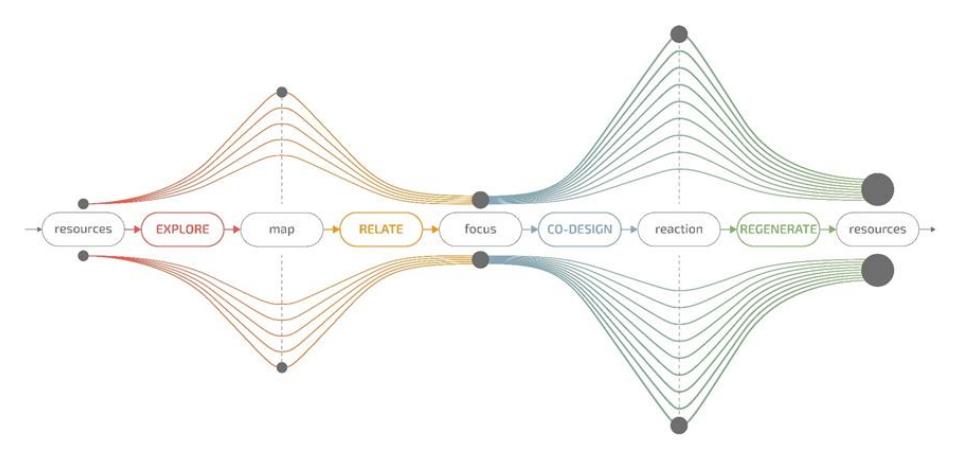
Figure 4 Divergent and convergent phases of design practices.
3.2.2 Transdisciplinary Idea Generation
More-than-one discipline perspective responds to complex, wicked problems with active participation on a focused theme. Not just for the case of natural and applied sciences but also for the social sciences, it is necessary to build a reciprocal, reflective, and context-sensitive scientific understanding for the closer interaction of science and society and the production of both soft and hard knowledge [60]. Integrating multiple perspectives and meta-positions can lead to a grounded change that will not be built upon one discipline's predefined research boundaries and pre-accepted knowledge typologies. Once the cross-disciplinary structure of the participant group is achieved, there is a chance to reach the main considerations of absolute common values.
Beyond multi-disciplinary and inter-disciplinary approaches, transdisciplinary idea generation practices obtain balanced, creative, and participatory atmospheres through non-ad hoc aims and unpremeditated disciplinary motivations. Through the circulations in Toroidality, each stakeholder participates in the phases without knowing the exact outputs of the study, even the outlines of the following discussions. Every single transdisciplinary group combination and the level of participation of the stakeholders in those groups define the unique characteristics of each study and affect the way of interacting with the collective knowledge. Also, creating constantly reproducing patterns for new areas of knowledge takes place at the in-between space of various disciplines and the combination of scientific and practical knowledge. The constant cycle of feeding and being fed from collective knowledge blurs the borders of disciplines by creating constantly changing shared value clusters depending on commons. Crossing disciplines provides certain interfaces to propose innovative and creative ideas.
At this point, the action-based design perspective [61] can provide critical contributions to operating transdisciplinary practices through the creative leading capacity and transcended disciplinary norms. The transdisciplinary idea generation processes can be operated through designing, facilitating, coordinating, and aiming to focus on ecological integrity benefiting from collective knowledge.
3.2.3 Regenerative Realization
Co-designed solutions are the direct outputs of the Toroidality model, composed of knowledge generated by transdisciplinary participation. They are the new items of collective knowledge. However, more than these direct outputs, one crucial transformation and related new phenomenological data generation would occur throughout the phases of the application. Through the Regenerate phase, the interaction of co-created values with the stakeholders in the ecosystem will lead to some phenomenal transformations and unique patterns of experience. By regenerative action, new reactions and networks among the newly defined agents will offer particular data for circulating the newer cases. Exploring and experiencing the reactions among these new assets will provide unique phenomenal outputs. The reactions among the cultural and natural assets will define the dynamics of knowledge prosumption. With the regenerative realization, each circulation creates added value and leads to positive changes in the ecological integrity rather than exhausting the intellectual capital and tangible and intangible properties of the ecosystem.
3.2.4 Immaterialization
The most distinctive realization of this circular model from the former ones comes out by manipulating the process of creation by prioritizing the intangible design outcomes with chained steps and collective interdependency. As far as constructing the exploring, mapping, and relating process mostly on intangible phenomena, the co-designed solutions will be directed to immaterialization. Knowledge-based circularity [37] can be sustained by interobjective participation structured upon commons. Without aiming for a predefined and conventional output referring to exact typologies, material dependency could be diminished to the minimum levels considering ecological ethics. Circulation by circulation, the accumulated rations of intangible outputs will enhance the capacity of immaterialization and keep material exhaustion under control.
3.2.5 Phenomenal Change
The interventions' impacts and influences will create phenomenal changes in the common asset pool. These phenomenal changes will positively affect our circularity perception and ecological cognition by depending on experiences and leading to behavioral change in the stakeholders. Following an intangible assetbased design approach, this model enables the circulation of collective knowledge around the phenomenal changes from one to another. Phenomenabased learning will be activated and spread naturally, with the collaboration of stakeholders, by following the natural cycles of giving and receiving [62]. This experience of social learning/co-learning will cause phenomenal reflections on all disciplines [63]. By that, the co-created phenomenal changes will cause approximations among the disciplines and enhance the possibilities of disciplinary associations based on phenomena.
3.2.6 Harmonious Coexistence
As a result of these collective practices, the shared values of a certain community will be enriched, evaluated, and improved with the common sense of ecological togetherness. By following common sense, cultural integration into the circular design process can be guaranteed, considering the shared values and benefits of all presences and relationships within the network. The interconnectedness between human and nonhuman entities will be reinforced along with the phenomenal experimentations based on ontological design and decolonizing design approaches [64]. This way of unification and circulation becomes promising by assuring the sustainability of the desired outcomes and reaching harmonious coexistence through ecological symbiosis. By that, 'ecosophic awareness' [65] can be maintained resiliently, with the assurance of the decentralization of humankind and practiced patterns of ecological integrity.
4 Conclusion
This article engaged with the concern about how circularity can be conceptualized and utilized considering the harmonious coexistence of all living and non-living stakeholders in the ecosystem. Considering the problems caused by anthropocentrism, the complexities of wicked problems, and the deficiencies of existing circularity visions, an alternative circular design approach has to be developed. To this end, Toroidality is proposed as a circular design model.
Toroidality follows intertwined cycles of design and accumulation of collective knowledge. Through this constant self-feeding mechanism, natural and cultural
phenomena stimulate co-designing practices, without the boundaries of specific scientific disciplines, even with the integration of non-human entities. Following the continuous actions within four phases, Toroidality guides stakeholders to integrate collective knowledge into circular design practices. By that, stakeholders collaborate in each phase to ensure circular solutions based on intangible assets and collective decision-making. As a result, considering the notions of ecological integrity, Toroidality utilizes circular participatory action to obtain harmonious coexistence.
Adding to the explanation of the model's theoretical framework, there is still a need for a complementary clarification of the operational characteristics and further implications of Toroidality. Following this introductory article, a complementary study based on a particular concept would be beneficial to illustrate the dynamics and practical notions. To this end, in a participatory structure, a case study will be carried out as further research to test, evaluate, and discuss the model. Eventually, Toroidality is aimed to be revised and improved to maximize the capacity for circular participatory action for and through ecological integrity.