

1 Introduction
Beauty has always been the spirit that gives life to works of art, both as a subject and as an object to be enjoyed. From this concept of beauty, artists get enthusiasm for creating their work, such as Michelangelo who had a passion to free figures from boulders through his sculptures [1]. Also, beauty serves as a guide for art observers who capture and translate it in their lives. Since the birth of humanity, there has been interest and attention towards philosophical thought patterns concerning beauty. Although taking gradual steps, beauty has increasingly obtained a solid theoretical foundation. For example, in Plato's aesthetic theory of mimicry, where beauty is the worldly human effort of trying to achieve the perfection of the ideal or eternal world. His student Aristotle's definition of aesthetics included tragedy, because human beauty only focuses on matter and form but still needs a purpose. The tragedy related to beauty comes from the human effort trying to reach perfection and inevitably failing [2].
Because of this failure, philosophers began to think about the need for a third element in the formation of beauty. A monk who was also a great philosopher, Thomas Aquinas, developed a theory about the role of theology in beauty, where every art creation aspiring to beauty cannot become perfect without having a purpose. The true source of ultimate beauty is eternal salvation, which is contained in Christ himself, because he was a person who rose from the dead, giving evidence of human success in defeating death and living perfectly before God [3]. The objective of this beauty was re-developed by the Swiss theologian Hans Urs von Balthasar in his theory that there is an order in beauty, especially in the purpose of spreading the good news of Christ, or evangelization. This evangelization must begin with beauty first, from beauty humans will know salvation, which is the ultimate goal of beauty. Christ as the transfiguration of the beauty of God himself in human form, who loves humans so much as to sacrifice himself for the salvation of all humans, which becomes the basis of all concepts and views about beauty in the world [4].
The same insight can be found in Bishop Robert Barron's theory on beauty, who stated that the purposeful reflection of Thomas Aquinas [5] was transfigured into beauty according to Balthasar. When lived daily it becomes a good and useful thing, which means that the beauty of Christ is reflected in the usefulness, goodness and beauty that is reflected in various aspects of human life and activities. Turning his lens to Indonesian artisans, the researcher found an artist from Yogyakarta, Sigit Sukasman, who practiced strengthening beauty in creating wayang puppets called Wayang Ukur [6]. Sukasman found that a wayang figure or character (in this case Sukasman refers to the figure of wayang kulit purwa) that has a lot of beautiful details can actually have weaknesses when viewed from a distance. For this reason, the beauty of the details needs to be strengthened in a figurative way so that each figure's character is easily recognized even from a great distance.
This spirit was adopted by the researcher in trying to create the figures of Jesus and Mary using the beauty of the visual culture of Balinese wayang in a context across time, so as to create new evangelization media to introduce the good news of Christ, for the world and especially for the Indonesian nation. The researcher has previously attempted to rejuvenate wayang imagery by creating chat sticker media [7]. In the present research, the researcher carried out the same effort once more in a different context, namely the process of making the figures of Jesus and
Mary into Balinese wayang forms. For this reason, the researcher realized the need for a process of discovering the essence of the aesthetic experience aligned with the neurological method from Ramachandran [8], which was applied in the search for a wayang visual approach to be the basis for the visual style of the imagery.
2 Proposed Method/Algorithm
The beauty in the journey of this research was getting unexpected results at the end of it; the beauty in the process was perhaps even more important than the beauty of the end results. Design is a process [9] – this not just a statement but a real experience as well. This was the basis of the present research; the researcher used qualitative methods by conducting several experiments in the process of creating images of Jesus and Mary, primarily based on Robert Barron's theory of beauty. In Barron's definition of beauty, evangelization is reflected through the principle of persuasive beauty [10], with which the researcher took an approach based on the acculturation of beauty.
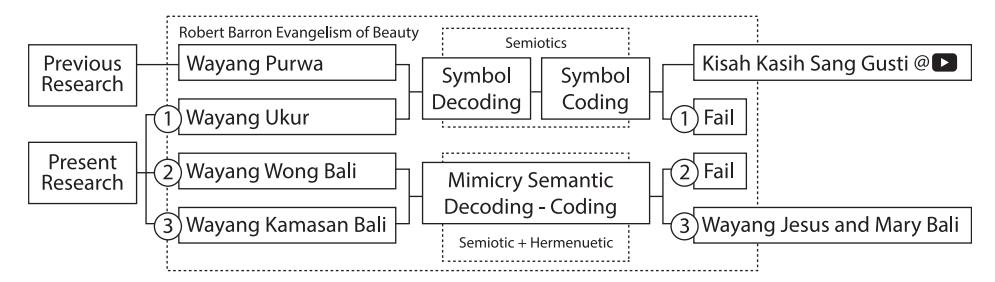
Figure 1 Research method mapping.
Figure 1 illustrates the research framework for visual acculturation by mapping the progression from previous studies to the present research. It shows how earlier references to Wayang Purwa and Wayang Ukur were extended through several experimental stages involving Wayang Wong Bali and Wayang Kamasan Bali, guided by Robert Barron's evangelization through beauty and semiotic theory. Based on this research, the researcher applied methods to achieve beauty by using the characteristics of Wayang Ukur. Thus, the researcher applied the three bases of Barron's method by: (1) combining it with Wayang Ukur Yogyakarta to obtain research results, (2) combining it with Balinese Wayang Wong (person) to obtain a new correlation of integration in the research results, and finally, (3) the researcher combined it with Balinese wayang from Kamasan village. All of these three are proposed based on the experience of the beauty achieved in different experiments.
To support the experimental visual approach, the researcher conducted in-depth interviews with 12 carefully selected participants: 4 Balinese dalang (puppet masters) from Gianyar and Klungkung known for their mastery of narrative gestures and character symbolism; 2 Kamasan-style painters specialized in traditional religious iconography; 3 Catholic priests from parishes in Bali and Yogyakarta with experience in contextual theology; and 3 Christian authors or cultural theologians who focus on visual evangelism and inculturation. The interviews explored three main questions: (1) How do you define beauty within your tradition or faith context? (2) What visual elements are considered sacred or non-negotiable in depicting holy figures? (3) How can local culture such as wayang support or challenge the portrayal of Jesus and Mary? The responses revealed a shared emphasis on harmony, gesture, eye contact, and proportion as carriers of spiritual meaning. The dalang stressed the importance of gestures (mudra) and expressive movements, while the priests and Christian authors highlighted theological accuracy and emotional resonance. The painters contributed views on color, ornamentation, and facial serenity. These insights shaped the formulation of visual metaphors used in the final artwork, bridging Christian sacred themes with Balinese visual culture.
3 Experimental Designs
In the first research stage, the researcher conducted a visual experiment by breaking the patterns of each large ornament on a wayang figure and recombining them. For this purpose, the researcher largely used Barron's semiotic beauty embodied on the basis of Charles William Morris' semiotic theory, which divides the visual semantics of beauty into three main segments: semantics, syntax, and pragmatics [11]. At the end of the experiment, the researcher ended up with a stagnant and rigid result. They realized that this was because of their attachment to one of the segments, namely uniformity or syntax.
From this experience, the researcher learned that he needed to break away from the attachment to syntactic beauty. For this reason, the researcher incorporated another concept of beauty, from Balinese Wayang Wong. Although more successful than the first attempt, the researcher found that this beauty was not able to produce images of Jesus and Mary ideally. This was because the combination of the images of Jesus and Mary produced results that prioritize natural elements compared to the supernatural elements of the figures of Jesus and Mary [12]. This happened because researcher did not apply Hans-Georg Gadamer's iconoclastic foundation.
On the basis of his iconoclasm, the researcher changed the reference for visualization to Balinese wayang from the Kamasan area. The basis for choosing this type of wayang was to find an iconography more based on a dichotomy
between the visual semiotics of beauty and the hermeneutics of Balinese Kamasan Wayang itself, which has a ritualistic element or purpose for offerings that is supernatural [13]. In Balinese society, this is done by taksu, where work that is alive and worthy of being a ritualistic offering to God has two basic energies: energy in tangible form, called sekala, and energy in intangible form, called niskala [14].
4 Results and Discussion
With the background of the researcher's love for the beauty of acculturation, an unforgettable experience was visiting the Catholic church of Denpasar, Bali, Indonesia. In the church, the researcher realized how great the blend of Christian culture and local Balinese Indonesian culture can be [15]. All the decorations, interiors, and architecture of this church display a deep blend of both with the aim of uniting, staying close to everyday life, and forming a deep sense of belonging to the audience. Based on this experience, the researcher carried out the process of acculturation of Wayang Purya from Yogyakarta Indonesia into an animated story of the crucifixion of Jesus. The results of this creative process have been captured in the video Kisah Kasih Sang Gusti (The Love Story of God), which was published on YouTube, and it became the subject of the thesis of the first author of this article [16].
Figure 2 Previous research Kisah Kasih Sang Gusti.
Figure 2 depicts a stylized reinterpretation of the Last Supper using the visual language of Balinese wayang (where Jesus and the apostles are portrayed with elongated forms, rhythmic gestures, and decorative patterns typical of Balinese aesthetics). The researcher received unexpected feedback in an interview with Prof. Dr. Ir. Sulistyawati, M.S., M.M., M.Mis., D.Th., Ph.D., D.Ag, the architect of the Denpasar Cathedral [17]. The researcher was introduced to the concept of acculturation, starting from the interior and decoration (Figure 3), and they also discussed the cross of Jesus on the church altar, colors, and elements in the Denpasar Cathedral [18]. Based on this particular experience of beauty, the researcher learned that the creative process had been successful but had
drawbacks in terms of Christian wayang's stature. In this case, the researcher received the suggestion to study Wayang Ukur from Yogyakarta [19]. For this reason, the researcher tried to combine the Balinese wayang style with that of Wayang Ukur [20]. However, the result was too stiff; all characters were too similar to each other. The researcher needed to adopt a new approach to get the expected beautiful shapes for the images of Jesus and Mary. The first author of this article was very grateful to be able to continue his research as a dissertation student living in Bali close to his subject, which is in line with the practice of ethnological researchers [21].
Figure 3 Acculturated angel statues in the Denpasar Cathedral.
Figure 4 First experimental sketches based on Wayang Ukur.
The preliminary thesis results confirmed these shortcomings, so the researcher tried to apply the Balinese wayang style [22]. However, the results obtained were considered less beautiful, i.e., the figures of Jesus and Mary became very stiff and did not reflect a personality of love and kindness. The researcher believed that this result failed because the research base was too tied to Morris' semiotics, consisting of semantics, syntactics, and pragmatics. In terms of semantics, the researcher found this difficult because it requires a deep exploration of visual beauty, but, in addition, the failure of this result was more due to the researcher's attachment to the syntactic system. The syntax of beauty has rigid elements, so the beauty of the Balinese wayang was very difficult to apply in the figuration of Jesus and Mary.
Figure 5 Sketches of Jesus and Mary (top left), tracing (top right), coloring (bottom left), and rendering (bottom right).
This failure changed the researcher's paradigm and inspired the search for a more appropriate research base. In the next experiment, the researcher approached beauty with semiotics and hermeneutics that are more fundamental, as can be seen in Figure 5. For semiotic beauty, the author approached the creation method based on Wayang Wong, which includes a more complete set of ornaments and attributes. For hermeneutic beauty, the researcher started with sketching, which was the basis for the formation of visual beauty creation as part of the research
process. This approach produced good results, so the researcher continued the research with a digital cleaning process of the sketches. After this digital cleaning, the researcher found a clearer beauty in the results, where the shape and volume of the Wong Wayang-based images of Jesus and Mary were more clearly visible. The researcher also improved the lines and proportions.
However, while exploring beauty, the researcher still enjoyed the process of creating beauty until the process was complete. For this reason, after the tracing process, the researcher continued with the process of coloring and giving threedimensional effects, as can be seen in Figure 6. The researcher also evaluated the results of the creation and found that some elements needed to be revised, such as the shape of the face of Mary, the thickness of the mustache on Jesus, the hands of the Balinese wayang Jesus, which followed the hand gestures in Javanese wayang, and the addition of dimensions to the fabric motif to make it look more voluminous. From all these results, the researcher ensured that it was a valuable learning outcome without considering the time and the final goal only. Through this process, the researcher learned that for Barron hermeneutic deepening is the main focus, starting from beauty, then making it goodness, and revealing the truth through the creation process. For this reason, the researcher continued to the next stage of creation using the classic Balinese wayang from Kamasan as a reference.
Figure 6 Sketches of Jesus and Mary (top left), tracing (top right), coloring (bottom left), and rendering (bottom right).
For this reason, the researcher returned to the initial process, now sketching with reference to classical Balinese wayang from Kamasan. From the repetition of this sketching process, as shown in Figure 7, the researcher came back with a more fundamental mindset. The researcher sketched a more detailed rendering process with greater passion; this passion was a combination of hermeneutics and semiotics. In terms of hermeneutics, the researcher got a lot of input during the sketching process, where Barron's hermeneutics was the priority when making it. There is a diversity that fits with the Balinese tradition in making a wayang painting, especially in Kamasan village. Beauty encapsulated in details, postures, and facial expressions was the priority in this creation. In addition, when the researcher proceeded to the tracing process, he applied bilateral semiotics. In this process, the researcher made many adjustments to make the images more familiar to the target Christian audience by choosing several ornaments, facial expressions, and types of fabric motifs.
Figure 7 Sketches of Jesus and Mary (top left), tracing (top right), coloring (bottom left), and rendering (bottom right) in classic Balinese Kamasan Wayang style.
The researcher continued to the outline and coloring process. In the outline process, he went back to detailing to get content in each column that was still empty in the tracing stage. From this process, the researcher enjoyed the beauty of the added details and appreciated the beauty of these details with gratitude. With this outline process, the researcher gained a lot of novelty in the semiotic process. Many of the detail-filling processes contained highly decorative visual symbols, especially those that use lines as decorative ornaments, as well as volumizing elements. After the outlining process, the researcher proceeded to the coloring process, as shown in Figure 8. Unlike the previous coloring process, which was based on blocking and then shading, in line with the classic Balinese Kamasan Wayang style, the researcher more directly performed gradation coloring.
Figure 8 Sketches of Jesus and Mary (top left), tracing (top right), coloring (bottom left), and rendering (bottom right) in classic Kamasan Wayang style.
The researcher then moved on to the evaluation process and received feedback that the faces and expressions of Jesus and Mary needed to be improved. Going back to Barron's hermeneutic process, the researcher realized the need for expressions that communicate with the viewer. Thus, for both Jesus and Mary, he revised the direction of the eyes, making them look more towards the viewer. Along with the beauty that the researcher wanted to achieve, the revision of the eye direction was followed by a revision of the shape of the mouths, so they look more smiling with an open mouth shape. The researcher also made improvements to Jesus' mustache so that it became clearer and had a curve that matched the overall volume of his face. As for Maria, the researcher also revised the shape of the eyebrows, so that they looked full of tenderness but still did not reflect a sad expression. With this, the researcher continued this revision with the finalization
stage of the image of Jesus and Mary in the Kamasan Wayang style, as can be seen in Figure 9.
Figure 9 Jesus and Mary in classic Kamasan Wayang style – revision.
After going through all these creation processes, the researcher enhanced the image of Jesus and Mary in the classic Kamasan Wayang style by providing a background with typography. This was done to add a ritualistic feel, where the researcher added the Our Father and Hail Mary prayers; all written repetitively in four languages: Indonesian, English, Balinese, and Latin. In addition, the researcher also made a halo as a symbol of the sanctity of Jesus and Mary, using Balinese ornaments to form the halo circle. With the same ornamentation, the researcher also created a frame for the image of Jesus and Mary in the classic Kamasan Wayang style. Throughout the whole process, the researcher gained a lot of experience in terms of hermeneutic deepening related to beauty. Also with the semiotic process, the researcher found many symbol-making processes that flowed, intertwined, and came into being to complement each other that can be found throughout the Balinese Kamasan Wayang style in the figures of Jesus and Mary.
Table 1 Evaluation of Visual Semiotic Acculturation Success.
| No | Visual Semiotic Parameters | Balinese Wayang Elements | Christian Elements | Acculturation Success Indicators | Validation Source |
|---|---|---|---|---|---|
| 1 | Gestures/mudra | Hand mudras for begging and blessing | Blessing gesture and prayer of Jesus/Mary | Spiritual gesture synchronization achieved | The puppeteer and imam stated that "this gesture is spiritually unified." |
| 2 | Body proportions and poses | Supple and elegant bodies typical of wayang wong | Mary's loving pose; Jesus's authority | Proportions are considered 'soft yet majestic' | The Kamasan painter stated that "the composition is very symbolically appropriate." |
| 3 | Visual ornamentation | Gold carvings, prada, and flower crowns | Halo, robe, and symbol of the cross | Decorative elements blend without obscuring sacredness | The Christian author stated that "the ornaments do not obscure the Christian meaning." |
| 4 | Color | Red, gold, and blue, typical Balinese honors | Liturgical colors: white (Mary), red (Jesus' sacrifice) | Color harmony conveys spiritual depth | The imam stated that "the colors add to the solemnity of the prayer." |
| 5 | Facial expressions | Downward eyes, a slight smile of respect | Expression of compassion and forgiveness | Expressions convey purity and tenderness | 83% of respondents stated that "the face is spiritually touching." |
| 6 | Background context | Gunungan, Balinese cloud motifs, natural reliefs | Background: wooden cross, Star of Bethlehem | The background blends without losing the Gospel narrative | Agreed by all sources without exception. |
The result provides a logical progression of the research process, beginning with initial conceptual sketches and continuing through iterative visual experiments to the final design. The interpretation of the results was grounded in established theories of beauty, particularly those proposed by Robert Barron, and supported by semiotic analysis relevant to both Christian symbolism and Balinese visual traditions. However, the study did not include quantitative or comparative data that could measure the effectiveness or reception of the visual acculturation outcomes. The evaluation of the final artworks remained largely subjective, relying on the researcher's personal interpretation, insight from interviews, and visual coherence with cultural and theological references. While this approach allowed for creative freedom and contextual sensitivity, it also limited the empirical validity of the findings. Future research could benefit from incorporating audience feedback, expert panel assessments, or visual impact testing to strengthen the conclusions and broaden the scope of validation.
Based on Table 1, the visual semiotic acculturation of Jesus and Mary into the Balinese wayang style was considered successful across multiple parameters. Key elements such as gestures, body proportions, ornamentation, color, facial expressions, and background settings were harmoniously blended with Christian symbolism. For instance, traditional mudra hand gestures were aligned with the blessings and prayer poses of Jesus and Mary, while Balinese decorative elements like prada and gold leaf were integrated without diminishing the sacredness of Christian imagery. The use of liturgical colors to enhance the spiritual atmosphere was appreciated and the facial expressions were described as emotionally moving by 83% of the participants. The background elements, including gunungan and natural motifs, were also found to support rather than overshadow the Gospel narrative. These findings were validated by 12 participants: dalang, Kamasan painters, Catholic priests, and Christian authors; who confirmed that the final visuals respected both theological integrity and local aesthetic values.
5 Conclusion
While the discussion successfully connected the findings of this research to Barron's concept of beauty and semiotic theory, further reflection on the broader and local implications would enrich the analysis. The integration of Christian sacred figures into Balinese visual traditions opens opportunities for intercultural dialogue within the global Christian community, offering a contextualized approach to evangelization that respects local aesthetics. In the field of the visual arts, this study contributes to expanding the vocabulary of sacred imagery through culturally embedded design. However, the subjective nature of beauty remains a limitation, as interpretations may vary based on personal, cultural, or denominational perspectives. Additionally, the creative process involves navigating complex cultural sensitivities, particularly the risk of misrepresentation or perceived syncretism when merging sacred Christian iconography with traditional Balinese forms. These limitations highlight the need for ongoing dialogue with both religious authorities and local artists to ensure theological accuracy and cultural respect in future explorations.
The researcher tried out various processes of achieving beauty with the determination to make Balinese wayang images of Jesus and Mary as a new evangelization tool for Christians. Although, these were initially not satisfying, the researcher continued to make revisions, unafraid if he had to start over from scratch. The spirit of creating the best for Jesus and Mary became an effort that was not easily broken and even became kind of a ritual journey for the researcher to find a tool for developing evangelization with local Balinese wisdom.
The expected impact of the research is to have a medium and/or props for telling Bible stories, especially to children. With this, the local wisdom approach is the main thing in providing new visuals for the church. Thus, the Jesus and Mary figures in Balinese Kamasan Wayang style themselves can become part of the daily life of Christian children, so it is hoped that it can also give birth to a sense of love and pride in having a form of beauty that is enculturated with classic Kamasan Wayang.
The references used in this study demonstrate a thoughtful integration of classical theological frameworks, such as those by Aquinas and Balthasar, with contemporary discourse on wayang art and visual communication. The inclusion of local Indonesian sources, including insight from Balinese artists and cultural practitioners, enriched the research with authentic cultural depth and context. However, certain references related to experimental design and optimization appeared tangential and less aligned with the primary focus on visual acculturation and sacred aesthetics. To strengthen academic grounding, this would benefit from a more focused literature review, particularly by incorporating relevant studies in the fields of religious art, intercultural design, and visual theology. This would not only enhance the scholarly coherence but also situate the work more firmly within current debates on contextual theology and indigenous visual expression.
Acknowledgements
The researcher would like to present their highest thankful and gratitude to Lord Jesus Christ, and present high gratitude to Prof. I Made Gede Arimbawa for all guidance, Prof. Martinus Dwi Marianto for sharing their knowledge on beauty theory, and Prof. Dr. I Ketut Suteja for sharing his knowledge especially on research methods, to Prof. Dr. Ir. Sulistyawati as the architect of the Denpasar Cathedral church, and to all doctoral program students in Institut Seni Indonesia Bali for their support and the concluding forum group discussion during processing the research outcomes and writing this article.