
ABSTRAK
PEMBENAHAN KUALITAS AIR MASAM TAMBANG DENGAN ZEOLIT ALAM DENGAN KASUS STUDI DI SUMATERA SELATAN. Beberapa jenis zeolit alam telah dimanfaatkan cukup lama untuk membenahi kualitas air limbah tambang. Penelitian ini ditujukan untuk mempelajari kegunaan bahan zeolit alam dari Lampung (Indonesia) untuk memperbaiki kualitas air masam asal tambang emas di Sumatera Selatan. Zeolit yang digunakan berukuran 0,045-0,090 mm dan terdiri atas jenis klinoptilolit. Selanjutnya dibuat menjadi kolom zeolit ke dalam pipa PVC panjang 20 cm dan diameter 10,2 cm. Kolom zeolit dilindih dalam keadaan jenuh selama 12 minggu yang terbagi menjadi empat kali pengambilan contoh lindihan. Air limbah tambang diambil dari lokasi tambang Barisan Tropical Mining (Rawas gold project, Indonesia) pada tanggal 21 dan 23 Juli 1998. Contoh air dari pit Berenai mengandung besi relatif banyak (28 mg/l) dan mangan 9 mg/l, sedangkan seng kurang dari 2 mg/l. Air tersebut umumnya sangat masam (pH 2,9) dan mengandung sulfat hingga 250 mg/l serta salinitas 28 mS/cm. Contoh air dari kolam sedimen dan sungai tambang umumnya mengandung besi, mangan dan seng lebih rendah dibanding pit Berenai. Lindihan melalui kolom zeolit pada akhir percobaan mengandung besi kurang dari 1 mg/l, sedangkan mangan hanya berubah sedikit. Untuk contoh air dari pit Berenai, kolom zeolit juga menurunkan kadar sulfat menjadi 66 mg/l, mengurangi kelarutan garam (salinitas) kurang dari 18 mS/cm, sebaliknya menaikkan pH menjadi 6,5 atau lebih. Hasil tersebut menunjukkan bahwa zeolit alam dari Lampung dapat digunakan untuk memperbaiki kualitas air masam tambang. Namun demikian, penggunaan zeolit tersebut untuk skala yang lebih besar masih memerlukan kajian yang lebih detail.
Key words: Air masam tambang, kualitas air, tambang emas, zeolit alam.
INTRODUCTION
Open pit mining is a common practice in gold exploration. Waste rocks and tailings produced by gold mining operation may expose a large amount of pyrite and other types of sulphide to water and oxygen that subsequently generate acid mine drainage (AMD). The oxidation of sulphidic rocks occurs slowly in a natural system, mainly through diffusion, erosion of topsoil and underlying exposure of bedrocks. However, the pyrite oxidation accelerates when mining starts (Harries, 1997) [1]. This oxidation process results in releasing of iron (Fe) cation and production of sulphate as described in the following reaction:
\[FeS_2 + 15/4 O_2 + 7/2 H_2O ---> Fe(OH)_3 + 2 SO_4^{2-} + 4 H^+\] (1).
Normally microbial activity accelerates the oxidation of sulphide minerals in mine wastes (Janssen et al., 1995) [2]. Acid production brings detrimental impact on the mine site environment. Furthermore, soils may be enriched in heavy metals including iron, zinc, cadmium and manganese. As a result, those soils may not be suitable for plant growth. Those metals may become a potential source of pollution in water bodies or streams if liberated by acidic weathering (Currey et al., 1998 [3]; Eaglen et al., 1998 [4]).
In areas with heavy rainfall, like South Sumatra, the release of iron and other heavy metals together with sulphate during the mining operation into local drainage system may cause an adverse impact on the aquatic environment. Soil erosion in sloping areas due to high rainfall may also transport iron and other metals downstream through run-off or seepage water. This may cause very acid, metal-contaminated wastewater running into streams. Therefore, every effort should be made to reduce this potential risk through implementation of mine planning and appropriate handling of waste materials.
The use of various waste water treatments is also beneficial to improve water quality. Utilization of natural zeolite is an example for AMD treatment. Zeolite is a unique crystalline, hydrated alumino-silicate mineral that contains alkali and alkaline earth with a three-dimensional crystal structure. It has channels, void, a honey comb structure which serves as a sieve for cations, water adsorption and gas adsorption (Ames, 1960 [5]; Ming and Mumpton, 1989 [6]). general zeolite has a relatively high value of cation exchange capacity (CEC > 50 cmol/kg), thus has potential for improving soil fertility and reducing ammonium and nitrate leaching (Weber et al., 1983 [7]; MacKown and Tucker, 1985 [8]: Warsito and Setyawan, 1990 [9]; Estiaty et al., 2004 [10]), and being effective as an exchange material for management of radioactive nuclear waste especially strontium and cesium (Susilowati and Las. 1997 [11]: Widiatmo and Las, 1997 [12]). Leaching experiment using various columns is quite common to simulate real condition in the field (Hood and Oertel, 1984 [13]).
Research on the use of natural zeolite for improving the quality of AMD water is still challenging (Ouki and Kavannagh, 1997 [14]). This work is in particular aimed to compare the effectiveness of natural zeolite from Lampung for improving AMD water quality from an open pit gold mining.
EXPERIMENTAL PROCEDURE
This work used AMD water collected from the Barisan Tropical Mining site, Rawas Gold Project in South Sumatra. Waste water was collected on 21 and 23 July 1998. The experiment was started in August 1998 and completed in January 1999. Water sample was analyzed at the Soil Chemical Laboratory Faculty of Agriculture UNSRI; except for zinc conducted at the Inorganic Chemistry Laboratory, Faculty of Mathematics and Science UNSRI.
Natural zeolite for this experiment was obtained from PT. Minatama Mineral Perdana in Lampung. Fine size particle (0.045-0.090 mm) of zeolite was used for the leaching experiment. Zeolite is not purified or pre-treated for use in this research for the reason of practical use in the field. The first group received waste water from the Berenai pit (BP). The second batch was percolated with water sample from the sediment pond (SP). The third group was leached with drainage water from Tembang River (TR). Leaching columns were prepared by hand-packing zeolite (ca. 2.0 kg) into PVC pipe of 10.2 cm diameter and 20-cm height. The bottom of each column was covered with cotton cloth to retain solid materials while allow leachate percolation. Subsequently all zeolite columns were saturated with distilled water through a capillary process in a sink. Distilled water was added occasionally to maintain the saturation of zeolite. The leaching process occurs by keeping a constant head (about 1 cm) above the zeolite. The water volume for percolation was 1000 ml (approx. 25 cm). A plastic funnel was attached to the bottom of column for conveying effluent from the column. An Erlenmeyer flask was placed to collect the effluent. Leaching began on 28 August 1998 for a total period nearly 4 months which was maintained in room temperature (28-32 °C). The saturated columns were leached with an interval of 14 to 20 days.
Mineralogical composition of zeolite samples was determined using the X-ray diffractometer (XRD) at the Centre for Soil and Agroclimate Research in Bogor. The samples for XRD analysis were prepared as random powder, and for clay mineral as oriented clay samples after saturation with MgCl2 and Mg+glycerol.
Effluent water was analyzed for its pH using pH meter. Electrical conductivity was measured using EC meter. Iron (Fe) was measured using a spectrophotometer at 510 nm, with addition of phenantroline for coloring. Manganese (Mn) was read at 518 nm with potassium iodidate as indicator. Zinc (Zn) was determined using atomic absorption spectrometer (AAS) at 213.9 nm. Sulphate was measured with a spectrophotometer at 432 nm, after reaction with barium chloride and Tween®80 (sorbitan mono-oleate).
RESULTS AND DISCUSSION
Properties of natural zeolite from Lampung Natural zeolite from Lampung contains very high exchangeable calcium (27.6 cmol+/kg) and potassium (36.1 cmol+/kg) with CEC of 56.7 cmol+/kg. The relatively low CEC value may indicate some impurities, possibly of clay mineral (smectite). Elemental composition of this rock sample consists of largely SiO2 (72.6 %) and secondly Al2O3 (12.4 %) as described in Table 1.
Table 1. Elemental composition of natural zeolite from Lampung, Sumatra
| Constituent | Conten | Consti | Content | |
|---|---|---|---|---|
| t (%) | -tuent | (%) | ||
| SiO2 | 72.60 | CaO | 2.56 | |
| Al2O3 | 12.40 | MgO | 1.15 | |
| Fe2O3 | 1.19 | K2O | 2.17 | |
| TiO2 | 0.16 | Na2O | 0.45 | |
Source: PT. Minatama Mineral Perdana Lampung
The Si/Al ratio of 5.17 is typical range for clinoptilolite type of zeolite. Low value of Si/Al ratio reflects low CEC of Lampung deposit, in contrast to a ratio of 6.74 (CEC > 135 cmol/kg) for a deposit from Cikancra Tasikmalaya (Estiaty et al., 2004). The Xray analysis has confirmed that clinoptilolite is the major constituent of zeolite along with some clay mineral (smectite), feldspar and cristobalite (Figure 1).
Chemical propertes of effluent water
The quality of waste water from the mine site varied greatly between location. Iron was much higher (up to 28 mg/l) for samples of the Berenai pit compared with those from the sediment pond and Tembang River (Table 2). Released iron from pyritic materials in the pit wall may contribute to high concentration of iron and acid pH of water samples. It is also observed from the reddish color. The iron concentration in the sediment pond was lower than the upper limit to comply with the requirement being suitable for raw drinking water stock as set out by the Government Regulation No. 20 (1990). Manganese concentration was higher than the limit for all categories in the Regulation. Increased levels of some metals are common as also found in tailing samples from Tanzania (Bowell et al., 1995 [15]).
Reduction in concentrations of some metals (Fe, Mn, Zn) was evident in effluent from a waste material (overburden) amended with natural zeolite (Setyawan, 2003 [16]). Zinc concentration in water is the particular concern if we consider its potential use for fishery and livestock. Toxic level of Zn should be minimized before releasing into water systems. In general the Zn level in these waste water is higher than the limit for fishery and livestock utilization but it is acceptable for agricultural irrigation purpose.
Sulfate concentration was considerably higher for water from the Berenai pit; it decreased by almost half in the sediment pond and much lower in water of Tembang River (Table 2). The exposed rock in the pit may contain oxidized sulphidic mineral from which sulphate dissolves in rain water together with iron, manganese, zinc and other soluble salts.
This leads to high EC value and low pH of the Berenai pit waste water. Waste rock with EC 2 mS/cm or higher may reflect a high level of soluble constituents (Miller, 1998 [17]). The high EC value of the studied wastewater is possibly related to high content of soluble sulfate salt. The lower concentrations of sulphate and iron in the four successive leaching followed by a lower EC and a higher pH may be related to precipitation of iron and sulfate (it may include manganese and zinc).
These variations in chemical properties may be partly due to mineral constituent of natural zeolite. The fine zeolite contains more smectite (a type of clay mineral) while the coarse particle fraction contains some primary minerals with acid neutralising capacity (Figure 1). A longer contact time occurred between the fine particle fraction and the waste water. Low hydraulic conductivity of the fine size may decrease the lifetime of leaching column. Slow water movement may also induce the formation of iron sulfate precipitation that further inhibits subsequent leaching. A sealing blanket was observed on the surface resulting from precipitation of iron and other metal salts on the column, as it is commonly found in acid mine drainage in the field.
Practical aspect of this work
For practical use, natural zeolite should be packed into a column that still allows sufficient flow of AMD water by maintaining a suitable hydraulic conductivity. In the real field situation, discharge volume should be monitored for an annual budget calculation of dissolved substances. In the field, AMD quality may vary seasonally signifying a dilution effect of rainfall and discharge rate.
Result from a column study is limited to the setting of experiment. However, from a column study we would have a sufficient background information to understand and estimate possible changes as we can mimic what happens in the mining environment. Hood and Oertel (1984) in a column study estimated that each 1-week leaching cycle in study equal to approximately 3 years of natural weathering, based on scaling factors in comparison with the quality of leachate produced to those at several mines studied.
Appropriate treatment for reducing AMD may vary between mine sites. Active treatments are preferred during the active operation of mining since it is adjustable and a large volume of water in open cut mining may be available. Passive treatment is more popular because it requires a little or no maintenance and is inexpensive (Tarutis, 1998 [18]). It usually involves the passing of AMD water through a bed of limestone, compost material, or other media to remove iron oxy-hydroxides by sorption and/or precipitation. In this case, zeolite mineral may be used as an alternative.
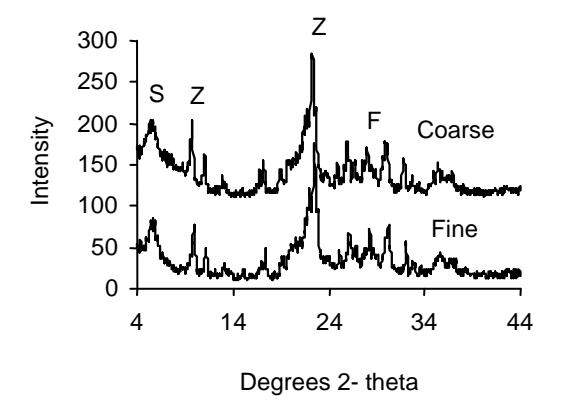
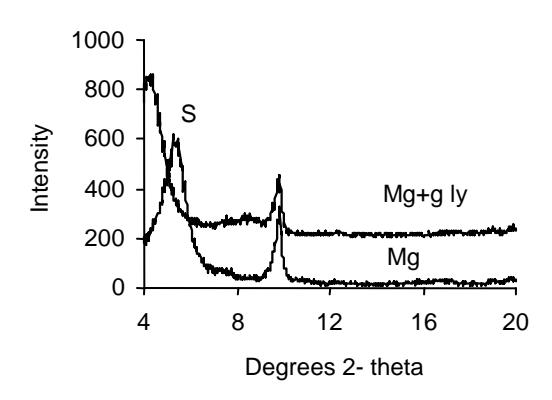
Figure 1. Diffractograms of natural zeolite prepared as random powder (left) and the patterns from oriented clay sample preparation (right). The symbols represent smectite (S), zeolite (Z), feldspars (F).
Table 2. Changes in parameter of AMD water after four leaching cycles through fine-zeolite column. BP, Berenai pit; SP, sediment pond; TR, Tembang River.
| AMD | |||||||
|---|---|---|---|---|---|---|---|
| source | Leaching | Metal (mg/l) | Sulfate | EC | pH | ||
| Fe | Mn | Zn | (mg/l) | (dS/cm) | |||
| Berenai Pit | 0 | 28.5 | 9.04 | 1.36 | 252 | 28.4 | 2.9 |
| 1 | 9.75 | 11.9 | 0.31 | 250 | 22.6 | 3.3 | |
| 2 | 0.03 | 4.84 | 2.64 | 46.8 | 4.43 | 4.3 | |
| 3 | 0.08 | 8.13 | 0.09 | 61.2 | 14.4 | 6.6 | |
| 4 | 0.27 | 8.93 | 0.81 | 78.7 | 12.2 | 4.3 | |
| Sediment Pond | 0 | 0.53 | 13.3 | 0.30 | 122 | 6.43 | 3.5 |
| 1 | 0.56 | 13.6 | 0.46 | 121 | 6.12 | 3.5 | |
| 2 | 0.07 | 4.19 | 1.90 | 38.7 | 3.84 | 7.0 | |
| 3 | 0.15 | 2.34 | 0 | 26.5 | 5.75 | 7.9 | |
| 4 | 0.38 | 4.23 | 0.12 | 49.5 | 7.55 | 7.6 | |
| Tembang River | 0 | 0.06 | 2.11 | 0.07 | 26.6 | 2.05 | 3.7 |
| 1 | 0.11 | 1.59 | 0.28 | 24.1 | 1.54 | 4.3 | |
| 2 | 0.12 | 0 | 2.46 | 20.8 | 1.65 | 7.7 | |
| 3 | 0.11 | 1.09 | 0 | 18.9 | 3.70 | 7.8 | |
| 4 | 0.23 | 2.99 | 0.26 | 21.6 | 4.15 | 7.7 | |
CONCLUSION
Journal of Indonesian Zeolites
Natural zeolite from Lampung has potential to be used as amendment of acid mine drainage in this study trough zeolite column. For practical use in the field, the optimum size of zeolite column should be determined. Zeolite activation may be required to enhance its cation exchange capacity.
REFERENCES
- 1. Harries, J. 1997. Acid mine drainage in Australia: Its extent and potential future liability. Supervising Scientist Report 125. Supervising Scientist, Canberra.
- 2. Janssen, J.A.M., W. Andriesse, H. Prasetyo, and A.K. Bregt. 1995. Guidelines for Soil Surveys in Acid Sulphate Soils in the Humid Tropics. AARD/LAWOO Agency for Agricultural Research and Development Indonesia, Bogor.
- 3. Currey, N.A., P.J. Ritchie, and G.S.C. Murray. 1998. Management strategies for acid rock drainage at Kidston Gold Mine, North Queensland. In R.W. McLean and L.C. Bell (eds). Proceedings of the Third Australian Acid Mine Drainage Workshop. Darwin 15-18 July 1997. p 93-102. Australian Centre for Minesite Rehabilitation Research, Brisbane.
- 4. Eaglen, P.L., I.C. Firth, and J. van der Linden. 1998. Acid rock drainage control at P.T. Kelian Equatorial Mining. In R.W. McLean and L.C. Bell (eds). Proceedings of the Third Australian Acid Mine Drainage Workshop. Darwin 15-18 July 1997. p 83-92. Australian Centre for Minesite Rehabilitation Research, Brisbane.
- 5. Ames, L.L., Jr. 1960. Cation sieve properties of clinoptilolite. The American Mineralogist. 45:689-700.
- 6. Ming, D.W. and F.A. Mumpton. 1989. Zeolites in soils. p 873-911. In J.B. Dixon and S.B. Weed (eds). Minerals in
- Soil Environments. Second Ed. Soil Science Society of America, Madison, Wisconsin.
- 7. Weber, M.A., K.A. Barbarick, and D.G. Westfall. 1983. Ammonium adsorption by a zeolite in a static and a dynamic system. Journal of Environmental Quality 12(4): 549-552.
- 8. MacKown, C.T. and T.C. Tucker. 1985. Ammonium nitrogen movement in a coarse-textured soil amended with zeolite. Soil Science Society of America Journal 49:235-235.
- 9. Warsito dan D. Setyawan. 1990. Pemanfaatan zeolit untuk meningkatkan efisiensi pemupukan N. Laporan penelitian (tidak dipublikasikan). Pusat Penelitian Universitas Sriwijaya, Palembang.
- 10. Estiaty, L.M., D. Fatimah, dan I. Yunaeni. 2004. Zeolit alam Cikancra Tasikmalaya: Media penyimpan ion amonium dari pupuk amonium sulfat. Jurnal Zeolit Indonesia 3(2): 55-61.
- 11. Susilowati, D. dan Thamzil Las. 1997. Pertukaran ion strontium dengan zeolit menggunakan teknik kolom. Prosiding Pertemuan Ilmiah Teknologi Pengolahan Limbah I. p14-20.
- 12. Widiatmo dan Thamzil Las. 1997. Unjuk kerja kolom zeolit untuk pengolahan limbah cesium. Prosiding Pertemuan Ilmiah Teknologi Pengolahan Limbah I. p34-38.
- 13. Hood, W.C. and A.O. Oertel. 1984. A leaching column method for predicting effluent quality from surface mines. p 271-277. National Symposium on Surface Mining, Hydrology, Sedimentology, and Reclamation, Lexington 2-7 Dec 1984. Office of Engineering Services, Univ. of Kentucky, Lexington.
- 14. Ouki, S.K. and M. Kavannagh. 1997. Performance of natural zeolites for the treatment of mixed metal-contaminated effluents. Waste Water Management and Research 15(4): 383-394.
- 15. Bowell, R.J., A. Warren, H.A. Minjera, and N. Kimaro. (1995). Environmental impact of former gold mining on the Orangi River, Serengeti N.P., Tanzania. Biogeochemistry (Dordrecht) 28(3): 131- 160.
- 16. Setyawan, D. 2003. Mineral zeolit untuk ameliorasi tanah bekas tambang emas dalam percobaan kolom ditinjau dari
- sifat kimia tanah. Jurnal Tanah Tropika 17: 29-36.
- 17. Miller, S. 1998. Predicting acid drainage. Groundwork 2(1): 8-9.
- 18. Tarutis, W.J. Jr. 1998. Removal of iron from synthetic coal mine drainage using rubber. Journal of the Pennsylvania Academy of Science 71(3): 109-112.